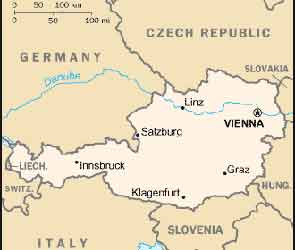

| AUSTRIA Republic of Austria Republik Oesterreich Joined United Nations: 14 December 1955 Human Rights as assured by their constitution Click here Updated 09 December 2012 |

| CAPITAL |
| POPULATION |
| CHIEF OF STATE |
| SELECTION PROCESS |
Vienna
8,219,743 (July 2012 est.)
Michael Spindelegger
Vice Chancellor since 21 April 2011
Vice Chancellor since 21 April 2011
President elected by direct popular vote for a six-year term (eligible
for a second term); presidential election last held 25 April 2010
Next scheduled election: 25 April 2016
for a second term); presidential election last held 25 April 2010
Next scheduled election: 25 April 2016
HEAD OF GOVERNMENT
SELECTION PROCESS
Chancellor formally chosen by the president but determined by
the coalition parties forming a parliamentary majority; Vice
Chancellor chosen by the President on the advice of the
Chancellor; Election last held last held 28 September 2008
Next scheduled election: September 2013
the coalition parties forming a parliamentary majority; Vice
Chancellor chosen by the President on the advice of the
Chancellor; Election last held last held 28 September 2008
Next scheduled election: September 2013
| DECLARATION OF HUMAN RIGHTS |
| ETHNIC GROUPS |
Austrians 91.1%, former Yugoslavs 4% (includes Croatians, Slovenes, Serbs, and Bosniaks), Turks 1.6%, German 0.9%, other
or unspecified 2.4% (2001 census)
or unspecified 2.4% (2001 census)
| RELIGIONS |
Roman Catholic 73.6%, Protestant 4.7%, Muslim 4.2%, other 3.5%, unspecified 2%, none 12% (2001 census)
| GOVERNMENT STRUCTURE |
Federal republic 9 states (Bundeslaender, singular - Bundesland); Legal system is a civil law system with Roman law origin; judicial
review of legislative acts by the Constitutional Court; separate administrative and civil/penal supreme courts; accepts compulsory
ICJ jurisdiction
Executive: President elected by direct popular vote for a six-year term (eligible for a second term); presidential election last held
25 April 2010 (next to be held in 25 April 2016); chancellor formally chosen by the president but determined by the coalition
parties forming a parliamentary majority; vice chancellor chosen by the president on the advice of the chancellor
Legislative: Bicameral Federal Assembly or Bundesversammlung consists of Federal Council or Bundesrat (62 seats; members
chosen by state parliaments with each state receiving 3 to 12 members according to its population; to serve a five- or six-year term)
and the National Council or Nationalrat (183 seats; members elected by direct popular vote to serve four-year terms)
elections: National Council - last held 28 September 2008 (next to be held by September 2013)
Judicial: Supreme Judicial Court or Oberster Gerichtshof; Administrative Court or Verwaltungsgerichtshof; Constitutional Court or
Verfassungsgerichtshof
review of legislative acts by the Constitutional Court; separate administrative and civil/penal supreme courts; accepts compulsory
ICJ jurisdiction
Executive: President elected by direct popular vote for a six-year term (eligible for a second term); presidential election last held
25 April 2010 (next to be held in 25 April 2016); chancellor formally chosen by the president but determined by the coalition
parties forming a parliamentary majority; vice chancellor chosen by the president on the advice of the chancellor
Legislative: Bicameral Federal Assembly or Bundesversammlung consists of Federal Council or Bundesrat (62 seats; members
chosen by state parliaments with each state receiving 3 to 12 members according to its population; to serve a five- or six-year term)
and the National Council or Nationalrat (183 seats; members elected by direct popular vote to serve four-year terms)
elections: National Council - last held 28 September 2008 (next to be held by September 2013)
Judicial: Supreme Judicial Court or Oberster Gerichtshof; Administrative Court or Verwaltungsgerichtshof; Constitutional Court or
Verfassungsgerichtshof
| LANGUAGES |
German (official nationwide) 88.6%, Turkish 2.3%, Serbian 2.2%, Croatian (official in Burgenland) 1.6%, other (includes
Slovene,official in Carinthia, and Hungarian, official in Burgenland) 5.3% (2001 census)
Slovene,official in Carinthia, and Hungarian, official in Burgenland) 5.3% (2001 census)
| BRIEF HISTORY |
During the Migration Period, the Slavs migrated into the Alps in the wake of the expansion of their Avar overlords during the 7th
century, mixed with the Celto-Romanic population, and established the realm of Karantania, which covered much of eastern and
central Austrian territory. In the meantime, the Germanic tribe of the Bavarians had developed in the 5th and 6th century in the west
of the country and in Bavaria, while what is today Vorarlberg had been settled by the Alemans. Those groups mixed with the
Rhaeto-Romanic population and pushed it up into the mountains. Karantania, under pressure of the Avars, lost its independence to
Bavaria in 745 and became a margraviate. During the following centuries, Bavarian settlers went down the Danube and up the Alps,
a process through which Austria was to become the mostly German-speaking country it is today. The Bavarians themselves came
under the overlordship of the Carolingian Franks and subsequently a Duchy of the Holy Roman Empire. Duke Tassilo III, who
wanted to maintain Bavarian independence, was defeated and displaced by Charlemagne in 788. An Eastern March (marchia
orientalis) was established in Charlemagne's time, but it was overrun by the Magyars in 909. After the defeat of the Magyars by
Emperor Otto the Great in the Battle of Lechfeld (955), new Marches were established in what is today Austria. The first record
showing the name Austria is 996 were it is written as Ostarrîchi, referring to the territory of the Babenberg March. The term
Ostmark is not historically ascertained and appears to be a translation of marchia orientalis that came up only much later. The
following centuries were characterized first by the settlement of the country, when forests were cleared and towns and monasteries
were founded. In 1156 the Privilegium Minus elevated Austria to the status of a duchy. Following the extinction of the Babenbergs
in the 13th century, Austria came briefly under the rule of the Czech King Otakar II. Contesting the election of Rudolf I of Habsburg
as Emperor, Otakar was defeated and killed by the German King, who took Austria and gave it to his sons in 1278. Austria was
ruled by the Habsburgs for the next 640 years. In the 14th and 15th centuries, the Habsburgs began to accumulate other provinces
in the vicinity of the Duchy of Austria, which remained a small Duchy along the Danube, and Styria, which they had acquired from
Ottokar alongside with Austria. Habsburg expansion into Hungary, however, led to frequent conflicts with the Turks, particularly
the so-called Long War of 1593 to 1606. The long reign of Leopold I (1657-1705) saw the culmination of the Austrian conflict
with the Turks. Following the successful defense of Vienna in 1683, a series of campaigns resulted in the return of all of Hungary to
Austrian control by the Treaty of Carlowitz in 1699. At the same time, Austria was becoming more involved in competition with
France in Western Europe, with Austria fighting the French in the Third Dutch War (1672-1679), the War of the League of
Augsburg (1688-1697) and finally the War of the Spanish Succession (1701-1714), in which the French and Austrians (along with
their British and Dutch allies) fought over the inheritance of the vast territories of the Spanish Habsburgs. Although the French
secured control of Spain and its colonies for a grandson of Louis XIV, the Austrians also ended up making significant gains in
Western Europe, including the former Spanish Netherlands (now called the Austrian Netherlands, including most of modern
Belgium), the Duchy of Milan in Northern Italy, and Naples and Sardinia in Southern Italy. (The latter was traded for Sicily in
1720). The latter part of the reign of Emperor Charles VI (1711-1740) saw Austria relinquish many of these fairly impressive gains,
largely due to Charles's apprehensions at the imminent extinction of the House of Habsburg. And, as many had anticipated, when
Charles died in 1740, all those assurances from the other powers proved of little worth to Maria Theresa. The peace was initially
broken by King Frederick II of Prussia, who invaded Silesia. On Maria Theresa's death in 1780, she was succeeded by her son
Joseph II, already Holy Roman Emperor since Francis I's death in 1765. By the time of Joseph's death in 1790, all his plans
seemed ruined, with both Hungary and the Netherlands in open revolt and the war in the Balkans dragging on and seeming
impossible to finish, given Russia's commitment to continuing the war. The war with France, which lasted until 1797, proved
unsuccessful for Austria. Although Austrian forces under Archduke Charles, the Emperor's brother, were successful in driving the
French back in Germany, the French Army of Italy, under the command of the young Corsican General Napoleon Bonaparte, was
brilliantly successful. With Bonaparte's assumption of the title of Emperor of the French in 1804, Francis, seeing the writing on the
wall for the old Empire, took the new title of Emperor of Austria as Francis I, in addition to his title of Holy Roman Emperor.
Napoleon was defeated at Leipzig in October, and forced to withdraw into France itself. As 1814 began, the Allied forces invaded
France. Initially, Metternich remained unsure as to whether he wanted Napoleon to remain on the throne, a Marie Louise regency
for Napoleon's young son, or a Bourbon restoration, but he was eventually brought around by British Foreign Secretary Lord
Castlereagh to the last position. Napoleon abdicated on April 3, 1814, and Louis XVIII was restored, soon negotiating a peace
treaty with the victorious allies at Paris in June. Liberalism and nationalism were on the rise, which resulted in the Revolutions of
1848. A constitution was enacted in March 1848, but it had little practical impact. However, one of the concessions to
revolutionaries with a lasting impact was freeing of peasants in Austria. The defeat at Königgrätz in the Austro-Prussian War of
1866 resulted in Austria's exclusion from Germany; the German Confederation was dissolved. The monarchy's weak external
position forced Franz Joseph to concede also internal reforms. To appease Hungarian nationalism, Franz Joseph made a deal with
Hungarian nobles, which led to the creation of Austria-Hungary through the Austro-Hungarian Compromise of 1867. The Austrian
half of the dual monarchy began to move towards constitutionalism. A constitutional system with a parliament, the Reichsrat was
created, and a bill of rights was enacted also in 1867. Nationalist strife increased during the decades until 1914. The assassination of
Archduke Franz Ferdinand, who was the presumed heir of Franz Joseph as Emperor, in Sarajevo by a Serb nationalist group
triggered World War I. The defeat of the Central Powers in 1918 resulted in the disintegration of Austria-Hungary. Emperor Karl
of Austria, who had ruled since 1916, went into exile. Following the defeat of Austria-Hungary in World War I, in the Aftermath of
World War I the Empire was broken up based loosely on national grounds. Austria, with its modern borders, was created out of
the main German speaking areas. On November 12, 1918, Austria became a republic called German Austria. Under the Christian
Social Party, the Austrian government was moving towards centralization of power in the Fascist model. On February 12, 1934 the
new Austrofascist regime provoked the Austrian Civil War by ordering search warrants for the headquarters of the socialist party.
On March 11, 1938 following a demand by Hitler for power-sharing with pro-German circles, German troops occupied Austria
with no resistance. On April 1945, the very astute Karl Renner an Austrian elder statesman, declared Austria separate from
Germany and set up a government. The country was occupied by the Allies from May 9, 1945. The two major parties strove
towards ending allied occupation and restoring a fully independent Austria. The Austrian State Treaty was signed on May 15, 1955.
Upon the termination of allied occupation, Austria was proclaimed a neutral country, and "everlasting" neutrality was incorporated
into the Constitution on October 26, 1955. Austria joined the European Union in 1995 and Austria was set on the track towards
joining the Eurozone, when it was established in 1999. On 1st October 2006 the SPÖ. (Social Democratic Party) won a head on
head elections and negotiated a grand coalition with the ÖVP, the Christian-conservative Austrian People's Party. This coalition
start it’s term on January 11, 2007 with Alfred Gusenbauer as Chancellor of Austria. Notable in this election, for the first time
Green Party of Austria became the 3rd largest party in a nation wide election, overtaking the FPÖ by a thin margin of only a few
hundred votes. The grand coalition headed by Alfred Gusenbauer collapsed in the early summer of 2008 over disagreements about
the country's EU policy. The early elections held on September 28 resulted in extensive losses for the two ruling parties and
corresponding gains for Heinz-Christian Strache's FPÖ and Jörg Haider's BZÖ (the Green Party was relegated to the 5th position).
Nevertheless, SPÖ and ÖVP renewed their coalition under the leadership of the new SPÖ party chairman Werner Faymann. In
2008 Jörg Haider died in a car accident and was succeeded as BZÖ party chairman by Herbert Scheibner and as governor of
Carinthia by Gerhard Dörfler.
Source: Wikipedia: History of Austria
century, mixed with the Celto-Romanic population, and established the realm of Karantania, which covered much of eastern and
central Austrian territory. In the meantime, the Germanic tribe of the Bavarians had developed in the 5th and 6th century in the west
of the country and in Bavaria, while what is today Vorarlberg had been settled by the Alemans. Those groups mixed with the
Rhaeto-Romanic population and pushed it up into the mountains. Karantania, under pressure of the Avars, lost its independence to
Bavaria in 745 and became a margraviate. During the following centuries, Bavarian settlers went down the Danube and up the Alps,
a process through which Austria was to become the mostly German-speaking country it is today. The Bavarians themselves came
under the overlordship of the Carolingian Franks and subsequently a Duchy of the Holy Roman Empire. Duke Tassilo III, who
wanted to maintain Bavarian independence, was defeated and displaced by Charlemagne in 788. An Eastern March (marchia
orientalis) was established in Charlemagne's time, but it was overrun by the Magyars in 909. After the defeat of the Magyars by
Emperor Otto the Great in the Battle of Lechfeld (955), new Marches were established in what is today Austria. The first record
showing the name Austria is 996 were it is written as Ostarrîchi, referring to the territory of the Babenberg March. The term
Ostmark is not historically ascertained and appears to be a translation of marchia orientalis that came up only much later. The
following centuries were characterized first by the settlement of the country, when forests were cleared and towns and monasteries
were founded. In 1156 the Privilegium Minus elevated Austria to the status of a duchy. Following the extinction of the Babenbergs
in the 13th century, Austria came briefly under the rule of the Czech King Otakar II. Contesting the election of Rudolf I of Habsburg
as Emperor, Otakar was defeated and killed by the German King, who took Austria and gave it to his sons in 1278. Austria was
ruled by the Habsburgs for the next 640 years. In the 14th and 15th centuries, the Habsburgs began to accumulate other provinces
in the vicinity of the Duchy of Austria, which remained a small Duchy along the Danube, and Styria, which they had acquired from
Ottokar alongside with Austria. Habsburg expansion into Hungary, however, led to frequent conflicts with the Turks, particularly
the so-called Long War of 1593 to 1606. The long reign of Leopold I (1657-1705) saw the culmination of the Austrian conflict
with the Turks. Following the successful defense of Vienna in 1683, a series of campaigns resulted in the return of all of Hungary to
Austrian control by the Treaty of Carlowitz in 1699. At the same time, Austria was becoming more involved in competition with
France in Western Europe, with Austria fighting the French in the Third Dutch War (1672-1679), the War of the League of
Augsburg (1688-1697) and finally the War of the Spanish Succession (1701-1714), in which the French and Austrians (along with
their British and Dutch allies) fought over the inheritance of the vast territories of the Spanish Habsburgs. Although the French
secured control of Spain and its colonies for a grandson of Louis XIV, the Austrians also ended up making significant gains in
Western Europe, including the former Spanish Netherlands (now called the Austrian Netherlands, including most of modern
Belgium), the Duchy of Milan in Northern Italy, and Naples and Sardinia in Southern Italy. (The latter was traded for Sicily in
1720). The latter part of the reign of Emperor Charles VI (1711-1740) saw Austria relinquish many of these fairly impressive gains,
largely due to Charles's apprehensions at the imminent extinction of the House of Habsburg. And, as many had anticipated, when
Charles died in 1740, all those assurances from the other powers proved of little worth to Maria Theresa. The peace was initially
broken by King Frederick II of Prussia, who invaded Silesia. On Maria Theresa's death in 1780, she was succeeded by her son
Joseph II, already Holy Roman Emperor since Francis I's death in 1765. By the time of Joseph's death in 1790, all his plans
seemed ruined, with both Hungary and the Netherlands in open revolt and the war in the Balkans dragging on and seeming
impossible to finish, given Russia's commitment to continuing the war. The war with France, which lasted until 1797, proved
unsuccessful for Austria. Although Austrian forces under Archduke Charles, the Emperor's brother, were successful in driving the
French back in Germany, the French Army of Italy, under the command of the young Corsican General Napoleon Bonaparte, was
brilliantly successful. With Bonaparte's assumption of the title of Emperor of the French in 1804, Francis, seeing the writing on the
wall for the old Empire, took the new title of Emperor of Austria as Francis I, in addition to his title of Holy Roman Emperor.
Napoleon was defeated at Leipzig in October, and forced to withdraw into France itself. As 1814 began, the Allied forces invaded
France. Initially, Metternich remained unsure as to whether he wanted Napoleon to remain on the throne, a Marie Louise regency
for Napoleon's young son, or a Bourbon restoration, but he was eventually brought around by British Foreign Secretary Lord
Castlereagh to the last position. Napoleon abdicated on April 3, 1814, and Louis XVIII was restored, soon negotiating a peace
treaty with the victorious allies at Paris in June. Liberalism and nationalism were on the rise, which resulted in the Revolutions of
1848. A constitution was enacted in March 1848, but it had little practical impact. However, one of the concessions to
revolutionaries with a lasting impact was freeing of peasants in Austria. The defeat at Königgrätz in the Austro-Prussian War of
1866 resulted in Austria's exclusion from Germany; the German Confederation was dissolved. The monarchy's weak external
position forced Franz Joseph to concede also internal reforms. To appease Hungarian nationalism, Franz Joseph made a deal with
Hungarian nobles, which led to the creation of Austria-Hungary through the Austro-Hungarian Compromise of 1867. The Austrian
half of the dual monarchy began to move towards constitutionalism. A constitutional system with a parliament, the Reichsrat was
created, and a bill of rights was enacted also in 1867. Nationalist strife increased during the decades until 1914. The assassination of
Archduke Franz Ferdinand, who was the presumed heir of Franz Joseph as Emperor, in Sarajevo by a Serb nationalist group
triggered World War I. The defeat of the Central Powers in 1918 resulted in the disintegration of Austria-Hungary. Emperor Karl
of Austria, who had ruled since 1916, went into exile. Following the defeat of Austria-Hungary in World War I, in the Aftermath of
World War I the Empire was broken up based loosely on national grounds. Austria, with its modern borders, was created out of
the main German speaking areas. On November 12, 1918, Austria became a republic called German Austria. Under the Christian
Social Party, the Austrian government was moving towards centralization of power in the Fascist model. On February 12, 1934 the
new Austrofascist regime provoked the Austrian Civil War by ordering search warrants for the headquarters of the socialist party.
On March 11, 1938 following a demand by Hitler for power-sharing with pro-German circles, German troops occupied Austria
with no resistance. On April 1945, the very astute Karl Renner an Austrian elder statesman, declared Austria separate from
Germany and set up a government. The country was occupied by the Allies from May 9, 1945. The two major parties strove
towards ending allied occupation and restoring a fully independent Austria. The Austrian State Treaty was signed on May 15, 1955.
Upon the termination of allied occupation, Austria was proclaimed a neutral country, and "everlasting" neutrality was incorporated
into the Constitution on October 26, 1955. Austria joined the European Union in 1995 and Austria was set on the track towards
joining the Eurozone, when it was established in 1999. On 1st October 2006 the SPÖ. (Social Democratic Party) won a head on
head elections and negotiated a grand coalition with the ÖVP, the Christian-conservative Austrian People's Party. This coalition
start it’s term on January 11, 2007 with Alfred Gusenbauer as Chancellor of Austria. Notable in this election, for the first time
Green Party of Austria became the 3rd largest party in a nation wide election, overtaking the FPÖ by a thin margin of only a few
hundred votes. The grand coalition headed by Alfred Gusenbauer collapsed in the early summer of 2008 over disagreements about
the country's EU policy. The early elections held on September 28 resulted in extensive losses for the two ruling parties and
corresponding gains for Heinz-Christian Strache's FPÖ and Jörg Haider's BZÖ (the Green Party was relegated to the 5th position).
Nevertheless, SPÖ and ÖVP renewed their coalition under the leadership of the new SPÖ party chairman Werner Faymann. In
2008 Jörg Haider died in a car accident and was succeeded as BZÖ party chairman by Herbert Scheibner and as governor of
Carinthia by Gerhard Dörfler.
Source: Wikipedia: History of Austria
| ECONOMIC OVERVIEW |
Austria, with its well-developed market economy, skilled labor force, and high standard of living, is closely tied to other EU
economies, especially Germany's. Its economy features a large service sector, a sound industrial sector, and a small, but highly
developed agricultural sector. Following several years of solid foreign demand for Austrian exports and record employment growth,
the international financial crisis of 2008 and subsequent global economic downturn led to a sharp but brief recession. Austrian GDP
contracted 3.9% in 2009 but saw positive growth of about 2% in 2010 and 3% in 2011. Unemployment did not rise as steeply in
Austria as elsewhere in Europe, partly because the government subsidized reduced working hour schemes to allow companies to
retain employees. Stabilization measures, stimulus spending, and an income tax reform pushed the budget deficit to 4.7% in 2010
and 3.6% in 2011, from only about 1.3% in 2008. The international financial crisis of 2008 caused difficulties for Austria's largest
banks whose extensive operations in central, eastern, and southeastern Europe faced large losses. The government provided bank
support - including in some instances, nationalization - to support aggregate demand and stabilize the banking system. Austria's fiscal
position compares favorably with other euro-zone countries, but it faces considerable external risks, such as Austrian banks'
continued high exposure to central and eastern Europe as well as political and economic uncertainties caused by the European
sovereign debt crisis. In 2011 the government attempted to pass a constitutional amendment limiting public debt to 60% of GDP by
2020, but it was unable to obtain sufficient support in parliament and instead passed the measure as a simple law. In March 2012,
the Austrian parliament approved an austerity budget that will bring public finances into balance by 2016.
Source: CIA World Factbook (select Austria)
economies, especially Germany's. Its economy features a large service sector, a sound industrial sector, and a small, but highly
developed agricultural sector. Following several years of solid foreign demand for Austrian exports and record employment growth,
the international financial crisis of 2008 and subsequent global economic downturn led to a sharp but brief recession. Austrian GDP
contracted 3.9% in 2009 but saw positive growth of about 2% in 2010 and 3% in 2011. Unemployment did not rise as steeply in
Austria as elsewhere in Europe, partly because the government subsidized reduced working hour schemes to allow companies to
retain employees. Stabilization measures, stimulus spending, and an income tax reform pushed the budget deficit to 4.7% in 2010
and 3.6% in 2011, from only about 1.3% in 2008. The international financial crisis of 2008 caused difficulties for Austria's largest
banks whose extensive operations in central, eastern, and southeastern Europe faced large losses. The government provided bank
support - including in some instances, nationalization - to support aggregate demand and stabilize the banking system. Austria's fiscal
position compares favorably with other euro-zone countries, but it faces considerable external risks, such as Austrian banks'
continued high exposure to central and eastern Europe as well as political and economic uncertainties caused by the European
sovereign debt crisis. In 2011 the government attempted to pass a constitutional amendment limiting public debt to 60% of GDP by
2020, but it was unable to obtain sufficient support in parliament and instead passed the measure as a simple law. In March 2012,
the Austrian parliament approved an austerity budget that will bring public finances into balance by 2016.
Source: CIA World Factbook (select Austria)
| POLITICAL CLIMATE |
The power of the Federal Council is very limited because its veto has only deferring effect. A convention, called the Österreich–
Konvent was convened in June 30, 2003 to decide upon suggestions to reform the constitution, but has failed to produce a
proposal that would receive the two thirds of votes in the Nationalrat necessary for constitutional amendments and/or reform.
However, some important parts of the final report were generally agreed upon and are still expected to be implemented.
The Social-democrats under Alfred Gusenbauer emerged as the winner of Austria's general election in October 2006. After
negotiations with the ÖVP were successfully concluded Alfred Gusenbauer and his SPÖ-ÖVP coalition government were sworn in
on January 11, 2007 by President Heinz Fischer.
This coalition broke-up again in June 2008. Elections in September 2008 further weakened both major parties, Social Democrats
and People's Party, but together they still hold more than 50% of the votes with the Social Democrats holding the majority. The
Freedom Party and the recently deceased Jörg Haider's new party Alliance for the Future of Austria, both right-wing parties, were
strengthened. Due to the surge of the right at the last elections, many speculated that any government coalition would include at least
one of the two "far-right" parties. This idea was put to rest when both the Social Democrats and the People's Party stated that
neither of them would work with the Freedom Party or the Alliance for the Future of Austria. Lengthy negotiations led to a renewed
"grand coalition" consisting of the Social Democrats and the People's Party. As of 2010 32 initiatives have taken place since their
introduction in 1963. National opinion polls or consultative referenda are held, unlike referenda, before the National Council passes
a law. Its results are not legally binding and as of the date of writing, no national opinion poll has occurred
Source: Wikipedia: Politics of Austria
Konvent was convened in June 30, 2003 to decide upon suggestions to reform the constitution, but has failed to produce a
proposal that would receive the two thirds of votes in the Nationalrat necessary for constitutional amendments and/or reform.
However, some important parts of the final report were generally agreed upon and are still expected to be implemented.
The Social-democrats under Alfred Gusenbauer emerged as the winner of Austria's general election in October 2006. After
negotiations with the ÖVP were successfully concluded Alfred Gusenbauer and his SPÖ-ÖVP coalition government were sworn in
on January 11, 2007 by President Heinz Fischer.
This coalition broke-up again in June 2008. Elections in September 2008 further weakened both major parties, Social Democrats
and People's Party, but together they still hold more than 50% of the votes with the Social Democrats holding the majority. The
Freedom Party and the recently deceased Jörg Haider's new party Alliance for the Future of Austria, both right-wing parties, were
strengthened. Due to the surge of the right at the last elections, many speculated that any government coalition would include at least
one of the two "far-right" parties. This idea was put to rest when both the Social Democrats and the People's Party stated that
neither of them would work with the Freedom Party or the Alliance for the Future of Austria. Lengthy negotiations led to a renewed
"grand coalition" consisting of the Social Democrats and the People's Party. As of 2010 32 initiatives have taken place since their
introduction in 1963. National opinion polls or consultative referenda are held, unlike referenda, before the National Council passes
a law. Its results are not legally binding and as of the date of writing, no national opinion poll has occurred
Source: Wikipedia: Politics of Austria
| INTERNATIONAL DISPUTES |
While threats of international legal action never materialized in 2007, 915,220 Austrians, with the support of the newly elected
Freedom Party, signed a petition in January 2008, demanding that Austria block the Czech Republic's accession to the EU unless
Prague closes its nuclear power plant in Temelin, bordering Austria
Freedom Party, signed a petition in January 2008, demanding that Austria block the Czech Republic's accession to the EU unless
Prague closes its nuclear power plant in Temelin, bordering Austria


| REFUGEES AND INTERNALLY DISPLACED PERSONS (IDPS) |
None reported.
| ILLICIT DRUGS |
Transshipment point for Southwest Asian heroin and South American cocaine destined for Western Europe; increasing
consumption of European-produced synthetic drugs.
consumption of European-produced synthetic drugs.
| HUMAN RIGHTS STATEMENTS, ANALYSIS AND CRITIQUES |
2011 Human Rights Report: Austria
Bureau of Democracy, Human Rights, and Labor
2011 Country Reports on Human Rights Practices
May 25, 2012
The Republic of Austria is a parliamentary democracy with constitutional power shared between a popularly elected president and a
bicameral parliament (Federal Assembly), in which the members of one house are directly elected and the other named by the constituent
states. In practice the multiparty parliament and the coalition government it elects exercise most day-to-day governmental powers.
National parliamentary elections in 2008 and presidential elections in 2009 were free and fair.
There were no widespread and systemic human rights abuses during the year. There continued to be reports that police at times used
excessive force, particularly against members of minority groups. Societal discrimination persisted against ethnic minorities, including
Muslims of immigrant origin, Roma, Jews, and foreigners of African origin.
Other reported abuses included shortcomings in detention centers, particularly those holding persons awaiting deportation. Freedom of
speech was restricted by laws that criminalize the public denial, belittlement, approval, or justification of Nazi genocide, and by laws
forbidding incitement, insult, or expressions of contempt toward a group because of its members’ race, nationality, or ethnicity. Public
corruption remained a problem, as did violence against women and children. There were unconfirmed reports that female genital
mutilation (FGM) was practiced among some immigrant groups. There were some anti-Semitic incidents, including physical attacks,
taunting, property damage, and vilifying and threatening letters and telephone calls. Laws mandating access for persons with disabilities
were not adequately enforced.
Click here to read more »
Bureau of Democracy, Human Rights, and Labor
2011 Country Reports on Human Rights Practices
May 25, 2012
The Republic of Austria is a parliamentary democracy with constitutional power shared between a popularly elected president and a
bicameral parliament (Federal Assembly), in which the members of one house are directly elected and the other named by the constituent
states. In practice the multiparty parliament and the coalition government it elects exercise most day-to-day governmental powers.
National parliamentary elections in 2008 and presidential elections in 2009 were free and fair.
There were no widespread and systemic human rights abuses during the year. There continued to be reports that police at times used
excessive force, particularly against members of minority groups. Societal discrimination persisted against ethnic minorities, including
Muslims of immigrant origin, Roma, Jews, and foreigners of African origin.
Other reported abuses included shortcomings in detention centers, particularly those holding persons awaiting deportation. Freedom of
speech was restricted by laws that criminalize the public denial, belittlement, approval, or justification of Nazi genocide, and by laws
forbidding incitement, insult, or expressions of contempt toward a group because of its members’ race, nationality, or ethnicity. Public
corruption remained a problem, as did violence against women and children. There were unconfirmed reports that female genital
mutilation (FGM) was practiced among some immigrant groups. There were some anti-Semitic incidents, including physical attacks,
taunting, property damage, and vilifying and threatening letters and telephone calls. Laws mandating access for persons with disabilities
were not adequately enforced.
Click here to read more »
5 October 2012
Committee on the Rights of the Child
Sixty - first session
17 September – 5 October 2012
Consideration of reports submitted by States parties under article 44 of the Convention
Concluding observations: Austria
I. Introduction
2. The Committee welcomes the submission of the consolidated third and fourth periodic report of the State party (CRC/C/AUT/3-4) and
the written reply to its list of issues (CRC/C/AUT/Q/3-4/Add.1), which allowed for a better understanding of the situation in the State
party. The Committee expresses appreciation for the constructive dialogue held with the high-level and multi-sectoral delegation of the
State party.
II. Follow-up measures undertaken and progress achieved by the State party
3. The Committee welcomes the adoption of the following legislative, measures:
a) The Federal Constitutional Law on the Rights of Children, on 20 January 2011, which is directly applicable in the courts of the State
party and protects the best interests of the child, the views of the child and several other rights enshrined in the Convention;
b) The amendment to the Criminal Code, on 27 December 2011, strengthening the protection of children from sexual exploitation and
sexual abuse;
III. Main areas of concerns and recommendations
A. General measures of implementation (arts. 4, 42 and 44, para. 6 of the Convention)
The Committee’s previous recommendations
6. The Committee, while welcoming the State party’s efforts to implement the Committee’s previous concluding observations of 2005
(CRC/C/15/Add.251) on the State party’s second periodic report (CRC/C/83/Add.8), notes with regret that some of the
recommendations contained therein have not been fully addressed.
7. The Committee urges the State party to take all necessary measures to address those recommendations from the concluding
observations on the second periodic report under the Convention that have not been implemented or sufficiently implemented,
particularly those related to the withdrawal of reservations, coordination, non-discrimination and juvenile justice.
Click here to read more »
Committee on the Rights of the Child
Sixty - first session
17 September – 5 October 2012
Consideration of reports submitted by States parties under article 44 of the Convention
Concluding observations: Austria
I. Introduction
2. The Committee welcomes the submission of the consolidated third and fourth periodic report of the State party (CRC/C/AUT/3-4) and
the written reply to its list of issues (CRC/C/AUT/Q/3-4/Add.1), which allowed for a better understanding of the situation in the State
party. The Committee expresses appreciation for the constructive dialogue held with the high-level and multi-sectoral delegation of the
State party.
II. Follow-up measures undertaken and progress achieved by the State party
3. The Committee welcomes the adoption of the following legislative, measures:
a) The Federal Constitutional Law on the Rights of Children, on 20 January 2011, which is directly applicable in the courts of the State
party and protects the best interests of the child, the views of the child and several other rights enshrined in the Convention;
b) The amendment to the Criminal Code, on 27 December 2011, strengthening the protection of children from sexual exploitation and
sexual abuse;
III. Main areas of concerns and recommendations
A. General measures of implementation (arts. 4, 42 and 44, para. 6 of the Convention)
The Committee’s previous recommendations
6. The Committee, while welcoming the State party’s efforts to implement the Committee’s previous concluding observations of 2005
(CRC/C/15/Add.251) on the State party’s second periodic report (CRC/C/83/Add.8), notes with regret that some of the
recommendations contained therein have not been fully addressed.
7. The Committee urges the State party to take all necessary measures to address those recommendations from the concluding
observations on the second periodic report under the Convention that have not been implemented or sufficiently implemented,
particularly those related to the withdrawal of reservations, coordination, non-discrimination and juvenile justice.
Click here to read more »
Freedom In The World 2012 Report
Political Rights Score: 1
Civil Liberties Score: 1
Status: Free
Overview
In 2011, Austria saw a number of high-profile court cases centering on the balance between freedom of speech and hate speech,
including one case involving a person convicted of denigration of religious teachings for statements made during a seminar on Islam. In
June, the parliament repealed a constitutional provision that had denied the right of members of the Habsburg family to run for Austria’s
presidency. Meanwhile, Austria was elected to the UN Human Rights Council in May.
Incumbent Heinz Fischer of the SPÖ won a second term as president in an April 2010 election. He took around 80 percent of the vote,
defeating FPÖ candidate Barbara Rosenkranz and Christian Party of Austria (CPÖ) candidate Rudolf Gehring, with some 16 percent and
5.5 percent, respectively.
In October 2010 state elections in Vienna, the SPÖ lost its absolute majority in the legislature for only the second time since World War
II, though it still led with 44.2 percent of the vote. The FPÖ placed second with 27 percent, while the ÖVP faced its worst-ever result in
Vienna with only 13.2 percent. However, the FPÖ did not achieve equal gains in the Burgenland and Styria state elections, which have
small foreign-born and ethnic minority populations.
In 2009, Ulrich Habsburg-Lothringen, whose family ruled the Austro-Hungarian Empire until 1918, lobbied the Austrian Constitutional
Court to end a ban prohibiting members of his family from running for Austria’s presidency. After both his request and his presidential
candidacy were denied, the Habsburg family filed a complaint with the European Court of Human Rights in October 2010 claiming that
the ban violated their right to participate in democratic elections. In June 2011, the Austrian parliament formally repealed the
constitutional provision.
In May 2011, Austria was elected as a new member of the UN Human Rights Council. As part of its candidature, the government made
a series of pledges and commitments to promote and protect the rule of law and human rights, including increasing protections for
religious minorities and members of the press, and advancing children’s rights.
Click here to read more »
Political Rights Score: 1
Civil Liberties Score: 1
Status: Free
Overview
In 2011, Austria saw a number of high-profile court cases centering on the balance between freedom of speech and hate speech,
including one case involving a person convicted of denigration of religious teachings for statements made during a seminar on Islam. In
June, the parliament repealed a constitutional provision that had denied the right of members of the Habsburg family to run for Austria’s
presidency. Meanwhile, Austria was elected to the UN Human Rights Council in May.
Incumbent Heinz Fischer of the SPÖ won a second term as president in an April 2010 election. He took around 80 percent of the vote,
defeating FPÖ candidate Barbara Rosenkranz and Christian Party of Austria (CPÖ) candidate Rudolf Gehring, with some 16 percent and
5.5 percent, respectively.
In October 2010 state elections in Vienna, the SPÖ lost its absolute majority in the legislature for only the second time since World War
II, though it still led with 44.2 percent of the vote. The FPÖ placed second with 27 percent, while the ÖVP faced its worst-ever result in
Vienna with only 13.2 percent. However, the FPÖ did not achieve equal gains in the Burgenland and Styria state elections, which have
small foreign-born and ethnic minority populations.
In 2009, Ulrich Habsburg-Lothringen, whose family ruled the Austro-Hungarian Empire until 1918, lobbied the Austrian Constitutional
Court to end a ban prohibiting members of his family from running for Austria’s presidency. After both his request and his presidential
candidacy were denied, the Habsburg family filed a complaint with the European Court of Human Rights in October 2010 claiming that
the ban violated their right to participate in democratic elections. In June 2011, the Austrian parliament formally repealed the
constitutional provision.
In May 2011, Austria was elected as a new member of the UN Human Rights Council. As part of its candidature, the government made
a series of pledges and commitments to promote and protect the rule of law and human rights, including increasing protections for
religious minorities and members of the press, and advancing children’s rights.
Click here to read more »
4 September 2012
European countries urged to hold former Guatemalan officials to account
Guatemalan ex-officials who fled to Europe to escape allegations of involvement in extrajudicial executions must face justice, Amnesty
International said today.
On Monday night a court in Geneva ordered that Erwin Sperisen – Guatemala’s former National Director of Police – remain for at least
three months in administrative detention as he faces trial for murder charges stemming from his time in that role from 2004 to 2007.
Swiss authorities had arrested Sperisen – who cannot be extradited to Guatemala because he also holds Swiss nationality – on Friday, 31
August. He faces charges linked to a number of alleged extrajudicial executions carried out by members of the Guatemalan police force
under his command.
Other Guatemalan former officials believed to be in Europe – including in Austria and Spain – have yet to be held to account for alleged
crimes committed in the Central American country.
“Erwin Sperisen’s arrest in Switzerland should give pause for thought to all those who think that rank and status – or indeed holding a
different passport – will allow them to evade justice,” said Sebastian Elgueta, Amnesty International's Researcher on Guatemala.
Sperisen is suspected of criminal responsibility for the extrajudicial executions of four escaped prisoners from Guatemala’s El Infiernito
prison in 2005 and seven inmates at El Pavón prison in 2006.
In 2007, Sperisen resigned as police chief and fled to Europe along with several of his co-accused in an apparent attempt to escape
justice. The former police chief took up residence in Switzerland, while former Interior Minister Carlos Vielman fled to Spain, and the
former deputy director of police investigations Javier Figueroa to Austria, where he was granted refugee status.
While the case against those who remained in Guatemala has advanced slowly through the national courts – where seven are awaiting
trial and five have arrest warrants pending – it has been more difficult to bring Sperisen, Vielman and Figueroa to justice abroad.
Spanish authorities arrested Vielman in October 2010, and he is currently being investigated in Spain for his role in the alleged
extrajudicial executions.
Austrian authorities arrested Javier Figueroa in May 2011, after an extradition request to Guatemala was turned down. He is currently in
custody while the investigation continues.
Click here to read more »
European countries urged to hold former Guatemalan officials to account
Guatemalan ex-officials who fled to Europe to escape allegations of involvement in extrajudicial executions must face justice, Amnesty
International said today.
On Monday night a court in Geneva ordered that Erwin Sperisen – Guatemala’s former National Director of Police – remain for at least
three months in administrative detention as he faces trial for murder charges stemming from his time in that role from 2004 to 2007.
Swiss authorities had arrested Sperisen – who cannot be extradited to Guatemala because he also holds Swiss nationality – on Friday, 31
August. He faces charges linked to a number of alleged extrajudicial executions carried out by members of the Guatemalan police force
under his command.
Other Guatemalan former officials believed to be in Europe – including in Austria and Spain – have yet to be held to account for alleged
crimes committed in the Central American country.
“Erwin Sperisen’s arrest in Switzerland should give pause for thought to all those who think that rank and status – or indeed holding a
different passport – will allow them to evade justice,” said Sebastian Elgueta, Amnesty International's Researcher on Guatemala.
Sperisen is suspected of criminal responsibility for the extrajudicial executions of four escaped prisoners from Guatemala’s El Infiernito
prison in 2005 and seven inmates at El Pavón prison in 2006.
In 2007, Sperisen resigned as police chief and fled to Europe along with several of his co-accused in an apparent attempt to escape
justice. The former police chief took up residence in Switzerland, while former Interior Minister Carlos Vielman fled to Spain, and the
former deputy director of police investigations Javier Figueroa to Austria, where he was granted refugee status.
While the case against those who remained in Guatemala has advanced slowly through the national courts – where seven are awaiting
trial and five have arrest warrants pending – it has been more difficult to bring Sperisen, Vielman and Figueroa to justice abroad.
Spanish authorities arrested Vielman in October 2010, and he is currently being investigated in Spain for his role in the alleged
extrajudicial executions.
Austrian authorities arrested Javier Figueroa in May 2011, after an extradition request to Guatemala was turned down. He is currently in
custody while the investigation continues.
Click here to read more »
Austria: Press Russia on Chechen Murder Link
Guilty Verdict on Vienna Killing a Good Start
June 2, 2011
(Vienna) - The conviction of three men on June 1, 2011, in the fatal kidnapping attempt of a Chechen refugee in Vienna is a good
beginning in the effort to uncover all those responsible in this case, Human Rights Watch said today. Police evidence gathered during the
Austrian investigation indicated a link between the killing and the Chechen leadership, but the Russian authorities have failed to respond to
judicial requests to question key witnesses who are based in Russia.
The refugee, Umar Israilov, died as a result of gunshot wounds inflicted by his assailants during the bungled kidnapping attempt in
Vienna on January 13, 2009.
"We are obviously pleased that this verdict provides some justice for Israilov and his family, but this is not the end of this case," said
Hugh Williamson, Europe and Central Asia director at Human Rights Watch. "Real justice means tracing the links between Israilov's
murder and Chechnya."
The Viennese Criminal Court handed down sentences ranging from 16 years to life for murder, attempted abduction to a foreign power,
and creation of a criminal organization.
Israilov had been detained in 2003 in Chechnya as a rebel fighter, was freed under an amnesty, and then briefly served in security
services headed by Ramzan Kadyrov, who is now the Moscow-backed Chechen leader.
In a New York Times interview with Israilov, published just after his murder, Israilov was quoted as saying that during his detention
Kadyrov had tortured him, including using electric shocks. Israilov was also quoted as saying that he had witnessed beating, kicking, and
other torture of detainees by Kadyrov and his subordinates.
The indictment in the Vienna case points to the Chechnya link, saying that the goal of the crime was "to attack Umar ISRAILOV, thereby
threatening his life and freedom. He was to be kidnapped and taken out of Austria, where he was to be handed over to the authorities of
the Russian republic of Chechnya. If the plan could not be carried out, murder was seen as an alternative."
In his closing statement in Vienna, the prosecutor called the case a "political murder." The indictment also says that in the summer of
2008, Israilov was approached by a man who said he was sent by Kadyrov and who threatened harm to Israilov and his family if he did
not withdraw the case about his torture that he had submitted to the European Court of Human Rights and return to Chechnya. Shortly
thereafter the man, Artur Kurmakaev, told Viennese police that Kadyrov had "ordered him to find Israilov and to return him." Kurmakaev
was eventually detained in Austria and deported - allegedly voluntarily - to Russia in June 2008.
Click here to read more »
Guilty Verdict on Vienna Killing a Good Start
June 2, 2011
(Vienna) - The conviction of three men on June 1, 2011, in the fatal kidnapping attempt of a Chechen refugee in Vienna is a good
beginning in the effort to uncover all those responsible in this case, Human Rights Watch said today. Police evidence gathered during the
Austrian investigation indicated a link between the killing and the Chechen leadership, but the Russian authorities have failed to respond to
judicial requests to question key witnesses who are based in Russia.
The refugee, Umar Israilov, died as a result of gunshot wounds inflicted by his assailants during the bungled kidnapping attempt in
Vienna on January 13, 2009.
"We are obviously pleased that this verdict provides some justice for Israilov and his family, but this is not the end of this case," said
Hugh Williamson, Europe and Central Asia director at Human Rights Watch. "Real justice means tracing the links between Israilov's
murder and Chechnya."
The Viennese Criminal Court handed down sentences ranging from 16 years to life for murder, attempted abduction to a foreign power,
and creation of a criminal organization.
Israilov had been detained in 2003 in Chechnya as a rebel fighter, was freed under an amnesty, and then briefly served in security
services headed by Ramzan Kadyrov, who is now the Moscow-backed Chechen leader.
In a New York Times interview with Israilov, published just after his murder, Israilov was quoted as saying that during his detention
Kadyrov had tortured him, including using electric shocks. Israilov was also quoted as saying that he had witnessed beating, kicking, and
other torture of detainees by Kadyrov and his subordinates.
The indictment in the Vienna case points to the Chechnya link, saying that the goal of the crime was "to attack Umar ISRAILOV, thereby
threatening his life and freedom. He was to be kidnapped and taken out of Austria, where he was to be handed over to the authorities of
the Russian republic of Chechnya. If the plan could not be carried out, murder was seen as an alternative."
In his closing statement in Vienna, the prosecutor called the case a "political murder." The indictment also says that in the summer of
2008, Israilov was approached by a man who said he was sent by Kadyrov and who threatened harm to Israilov and his family if he did
not withdraw the case about his torture that he had submitted to the European Court of Human Rights and return to Chechnya. Shortly
thereafter the man, Artur Kurmakaev, told Viennese police that Kadyrov had "ordered him to find Israilov and to return him." Kurmakaev
was eventually detained in Austria and deported - allegedly voluntarily - to Russia in June 2008.
Click here to read more »
11.07.2012
Gabriele Heinisch-Hosek: "In its ruling the Constitutional Court follows the judgement of the European Court of Human
Rights"
The Court ruling does not imply any automatic mechanism for child custody after divorce disputes
"In its ruling the Constitutional Court of Austria follows the judgement of the European Court of Human Rights. The federal government
is called upon to define more clearly under which circumstances custody of common children should be granted to which parent", stated
Minister for Women’s Affairs Gabriele Heinisch-Hosek in a first response to today’s press conference of the Constitutional Court.
"The Constitutional Court stated very clearly that this ruling was by no means a mandate to the legislator to enforce shared parenting
even in conflict cases. Essentially, it gives unmarried fathers the right to seek custody of the child – even against the will of the mother.
We have been aware of the need to adopt rules for these cases for quite some time", said Heinisch-Hosek.
"We are pushing ahead with new legislation which will promote the welfare of children and support parents to avoid fighting and hurting
one another, while putting the interests of their children first. Today’s ruling fits very well into the bigger picture of our task ahead",
concluded the Minister for Women’s Affairs.
Click here to read more »
Gabriele Heinisch-Hosek: "In its ruling the Constitutional Court follows the judgement of the European Court of Human
Rights"
The Court ruling does not imply any automatic mechanism for child custody after divorce disputes
"In its ruling the Constitutional Court of Austria follows the judgement of the European Court of Human Rights. The federal government
is called upon to define more clearly under which circumstances custody of common children should be granted to which parent", stated
Minister for Women’s Affairs Gabriele Heinisch-Hosek in a first response to today’s press conference of the Constitutional Court.
"The Constitutional Court stated very clearly that this ruling was by no means a mandate to the legislator to enforce shared parenting
even in conflict cases. Essentially, it gives unmarried fathers the right to seek custody of the child – even against the will of the mother.
We have been aware of the need to adopt rules for these cases for quite some time", said Heinisch-Hosek.
"We are pushing ahead with new legislation which will promote the welfare of children and support parents to avoid fighting and hurting
one another, while putting the interests of their children first. Today’s ruling fits very well into the bigger picture of our task ahead",
concluded the Minister for Women’s Affairs.
Click here to read more »
Prohibition of discrimination under administrative penal law: AOB recommendations implemented
16 August 2012
For a long time, the Austrian Ombudsman Board (AOB) has been pointing out the inefficient implementation of the prohibition of
discrimination based on ethnic origin with regard to access to public places and public services under administrative penal law.
In 2007 and 2011 AOB members jointly determined cases of maladministration as the inconsistent and inefficient application of the
prohibition of discrimination as stipulated in art III para 1 clause 3 of the Introductory Act to the Administrative Procedure Acts 1991
(Einführungsgesetz zu den Verwaltungsverfahrensgesetzen 1991, EGVG) did not fulfill Austria’s national commitments and international
commitments under Community law regarding the combating of discrimination. In this context the AOB also criticized the restrictive
interpretation of the prohibition of discrimination which cannot fulfill the international requirements and the requirements under
Community law with respect to the protection against discrimination.
Despite the legally binding prohibition of discrimination denials of access for Turkish men to night clubs or advertisements offering
housing or jobs exclusively to Austrians are not being pursued and punished adequately. According to both the AOB and many NGOs
this is one of the reasons why - despite the high number of incidents of discrimination - the persons affected very seldom contact the
authorities and why the few proceedings are often dismissed without any penalties.
Already twice, the AOB submitted a recommendation to the Federal Government requesting it to ensure an effective and uniform
enforcement of the prohibition of discrimination based on ethnic origin.
An amendment of art III para 1 clause 3 of the Introductory Act to the Administrative Procedure Acts 1991will enter into force on 1
September 2012 taking into consideration the AOB recommendations. This should result into a more efficient prosecution and
punishment of discriminatory treatment (Federal Law Gazette I [BGBl] No. 50/2012). In future, the persons affected do not have to
prove that the unequal treatment occurred solely due to his/her ethnic origin.
The AOB hopes that this amendment in connection with other measures such as training for staff involved in administrative penal
proceedings and information campaigns will contribute essentially to the improvement of the protection against discrimination with
regard to access to public places and public services.
Click here to read more »
16 August 2012
For a long time, the Austrian Ombudsman Board (AOB) has been pointing out the inefficient implementation of the prohibition of
discrimination based on ethnic origin with regard to access to public places and public services under administrative penal law.
In 2007 and 2011 AOB members jointly determined cases of maladministration as the inconsistent and inefficient application of the
prohibition of discrimination as stipulated in art III para 1 clause 3 of the Introductory Act to the Administrative Procedure Acts 1991
(Einführungsgesetz zu den Verwaltungsverfahrensgesetzen 1991, EGVG) did not fulfill Austria’s national commitments and international
commitments under Community law regarding the combating of discrimination. In this context the AOB also criticized the restrictive
interpretation of the prohibition of discrimination which cannot fulfill the international requirements and the requirements under
Community law with respect to the protection against discrimination.
Despite the legally binding prohibition of discrimination denials of access for Turkish men to night clubs or advertisements offering
housing or jobs exclusively to Austrians are not being pursued and punished adequately. According to both the AOB and many NGOs
this is one of the reasons why - despite the high number of incidents of discrimination - the persons affected very seldom contact the
authorities and why the few proceedings are often dismissed without any penalties.
Already twice, the AOB submitted a recommendation to the Federal Government requesting it to ensure an effective and uniform
enforcement of the prohibition of discrimination based on ethnic origin.
An amendment of art III para 1 clause 3 of the Introductory Act to the Administrative Procedure Acts 1991will enter into force on 1
September 2012 taking into consideration the AOB recommendations. This should result into a more efficient prosecution and
punishment of discriminatory treatment (Federal Law Gazette I [BGBl] No. 50/2012). In future, the persons affected do not have to
prove that the unequal treatment occurred solely due to his/her ethnic origin.
The AOB hopes that this amendment in connection with other measures such as training for staff involved in administrative penal
proceedings and information campaigns will contribute essentially to the improvement of the protection against discrimination with
regard to access to public places and public services.
Click here to read more »
AUSTRIA: AOB Human Rights Advisory Board convenes for the first time
13.04.2012
The Austrian Ombudsman Board (AOB) will take up its new function as National Preventive Mechanism within the OPCAT regime as of
1 July 2012 and is currently taking the necessary preparatory steps. In addition to filling staff vacancies the AOB’s new Human Rights
Advisory Board recently convened for the first time.
OPCAT obliges participating states to introduce an inspection system for all places of detention. As of 1 July 2012 the new Human
Rights Advisory Board will advise AOB members on different matters regarding the inspection system such as eventual priorities,
potential recommendations following such visits as well as establishing common standards for these visits.
According to the new legal foundations of the AOB the Human Rights Advisory Board is not part of the NPM structure as such but acts
as an advisory body. The AOB appoints the Human Rights Advisory Board Chair as well as its members and their substitutes. Once that
they are appointed members act independently. All members are requested to possess a specific expertise in the field of human rights.
Prior to the first session of this new advisory body AOB members have appointed Mrs. Renate Kicker as Chairwoman. Mrs. Gabriele
Kucsko-Stadlmayer will take on the function as Deputy Chairwoman. Renate Kicker is Deputy Head of the Institute of International Law
and International Relations at the University of Graz and has longstanding experience as member of the European Committee for the
Prevention of Torture (CPT). Gabriele Kucsko-Stadlmayer is Deputy Head of the Department of Constitutional and Administrative Law
at the University of Vienna and substitute member of the Council of Europe’s Venice Commission. Since 2008 she has acted as Deputy
Chairwoman of the previous Human Rights Advisory Board that was not affiliated with the AOB.
NGOs as well as Federal Ministries and representatives from the Laender are represented in the Human Rights Advisory Board. Members
and substitute members are appointed by the AOB following a nomination process by NGOs and ministries. At the end of February 2012
AOB members informed representatives of human rights NGOs about the opportunity for civil society to participate in the future Human
Rights Advisory Board. More than 30 NGOs actively participated in the following decision-making process. A joint proposal concerning
the collaboration of civil society was submitted to the AOB and AOB members followed this recommendation. Likewise the competent
Federal ministries and Federal states nominated their candidates.
Click here to read more>>
13.04.2012
The Austrian Ombudsman Board (AOB) will take up its new function as National Preventive Mechanism within the OPCAT regime as of
1 July 2012 and is currently taking the necessary preparatory steps. In addition to filling staff vacancies the AOB’s new Human Rights
Advisory Board recently convened for the first time.
OPCAT obliges participating states to introduce an inspection system for all places of detention. As of 1 July 2012 the new Human
Rights Advisory Board will advise AOB members on different matters regarding the inspection system such as eventual priorities,
potential recommendations following such visits as well as establishing common standards for these visits.
According to the new legal foundations of the AOB the Human Rights Advisory Board is not part of the NPM structure as such but acts
as an advisory body. The AOB appoints the Human Rights Advisory Board Chair as well as its members and their substitutes. Once that
they are appointed members act independently. All members are requested to possess a specific expertise in the field of human rights.
Prior to the first session of this new advisory body AOB members have appointed Mrs. Renate Kicker as Chairwoman. Mrs. Gabriele
Kucsko-Stadlmayer will take on the function as Deputy Chairwoman. Renate Kicker is Deputy Head of the Institute of International Law
and International Relations at the University of Graz and has longstanding experience as member of the European Committee for the
Prevention of Torture (CPT). Gabriele Kucsko-Stadlmayer is Deputy Head of the Department of Constitutional and Administrative Law
at the University of Vienna and substitute member of the Council of Europe’s Venice Commission. Since 2008 she has acted as Deputy
Chairwoman of the previous Human Rights Advisory Board that was not affiliated with the AOB.
NGOs as well as Federal Ministries and representatives from the Laender are represented in the Human Rights Advisory Board. Members
and substitute members are appointed by the AOB following a nomination process by NGOs and ministries. At the end of February 2012
AOB members informed representatives of human rights NGOs about the opportunity for civil society to participate in the future Human
Rights Advisory Board. More than 30 NGOs actively participated in the following decision-making process. A joint proposal concerning
the collaboration of civil society was submitted to the AOB and AOB members followed this recommendation. Likewise the competent
Federal ministries and Federal states nominated their candidates.
Click here to read more>>
| Click map for larger view |
| Click flag for Country Report |



Heinz Fischer
President since 8 July 2004
President since 8 July 2004
Werner Faymann
Chancellor since 2 December 2008
Chancellor since 2 December 2008
| TRAFFICKING IN PERSONS |
None reported.