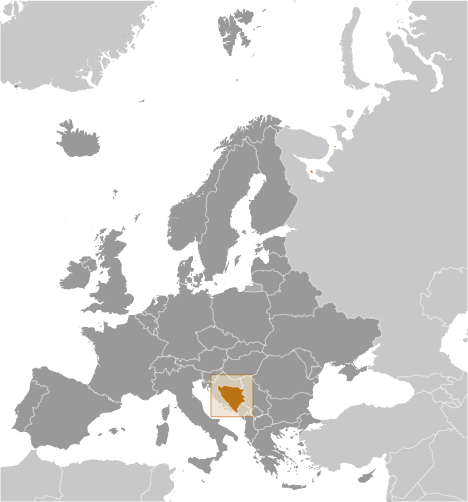

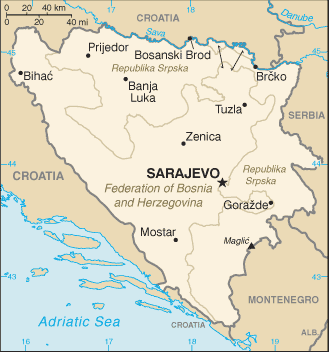
| BOSNIA AND HERZEGOVINA Bosnia and Herzegovina Bosna i Hercegovina Joined United Nations: 22 May 1992 Human Rights as assured by their constitution Click here Updated 22 February 2013 |

| CAPITAL |
| POPULATION |
| CHIEF OF STATE |
| SELECTION PROCESS |
Sarajevo
3,879,296 (July 2012 est.)
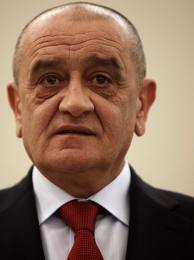
Vjekoslav Bevanda
Chairman of the Council of Ministers since
12 January 2012
Chairman of the Council of Ministers since
12 January 2012
The three members of the presidency (one Bosniak, one Croat, one
Serb) are elected by popular vote for a four-year term (eligible for a
second term, but then ineligible for four years); the chairmanship
rotates every eight months and resumes where it left off following
each national election; election last held 1 October 2010
Next scheduled election: October 2014
Serb) are elected by popular vote for a four-year term (eligible for a
second term, but then ineligible for four years); the chairmanship
rotates every eight months and resumes where it left off following
each national election; election last held 1 October 2010
Next scheduled election: October 2014
HEAD OF GOVERNMENT
SELECTION PROCESS
The Chairman of the Council of Ministers is appointed by the
presidency and confirmed by the National House of
Representatives;
Next scheduled election: 2014
presidency and confirmed by the National House of
Representatives;
Next scheduled election: 2014
| DECLARATION OF HUMAN RIGHTS |
| ETHNIC GROUPS |
Bosniak 48%, Serb 37.1%, Croat 14.3%, other 0.6% (2000)
note: Bosniak has replaced Muslim as an ethnic term in part to avoid confusion with the religious term Muslim - an adherent of Islam
note: Bosniak has replaced Muslim as an ethnic term in part to avoid confusion with the religious term Muslim - an adherent of Islam
| RELIGIONS |
Muslim 40%, Orthodox 31%, Roman Catholic 15%, other 14%
| GOVERNMENT STRUCTURE |
Emerging federal democratic republic with 2 first-order administrative divisions and 1 internationally supervised district; Legal
system is based on civil law system; has not accepted compulsory ICJ jurisdiction
Executive: The three members of the presidency (one Bosniak, one Croat, one Serb) are elected by popular vote for a four-year
term (eligible for a second term, but then ineligible for four years); the chairmanship rotates every eight months and resumes where it
left off following each national election; election last held 1 October 2010 (next to be held in October 2014); the chairman of the
Council of Ministers is appointed by the presidency and confirmed by the National House of Representatives
Legislative: Bicameral Parliamentary Assembly or Skupstina consists of the national House of Representatives or Predstavnicki
Dom (42 seats, 28 seats allocated for the Federation of Bosnia and Herzegovina and 14 seats for the Republika Srpska; members
elected by popular vote on the basis of proportional representation, to serve four-year terms); and the House of Peoples or Dom
Naroda (15 seats, 5 Bosniak, 5 Croat, 5 Serb; members elected by the Bosniak/Croat Federation's House of Representatives and
the Republika Srpska's National Assembly to serve four-year terms); note - Bosnia's election law specifies four-year terms for the
state and first-order administrative division entity legislatures
elections: House of Peoples - last constituted in 9 June 2011 (next to be constituted in 2015); state-level House of Representatives
- elections last held on 3 October 2010 (next to be held in October 2014)
Judicial: BH Constitutional Court (consists of nine members: four members are selected by the Bosniak/Croat Federation's House
of Representatives, two members by the Republika Srpska's National Assembly, and three non-Bosnian members by the president
of the European Court of Human Rights); BH State Court (consists of nine judges and three divisions - Administrative, Appellate
and Criminal - having jurisdiction over cases related to state-level law and appellate jurisdiction over cases initiated in the entities); a
War Crimes Chamber opened in March 2005
note: the entities each have a Constitutional Court; each entity also has a number of lower courts; there are 10 cantonal courts in the
Federation, plus a number of municipal courts; the Republika Srpska has five district courts and a number of municipal courts
system is based on civil law system; has not accepted compulsory ICJ jurisdiction
Executive: The three members of the presidency (one Bosniak, one Croat, one Serb) are elected by popular vote for a four-year
term (eligible for a second term, but then ineligible for four years); the chairmanship rotates every eight months and resumes where it
left off following each national election; election last held 1 October 2010 (next to be held in October 2014); the chairman of the
Council of Ministers is appointed by the presidency and confirmed by the National House of Representatives
Legislative: Bicameral Parliamentary Assembly or Skupstina consists of the national House of Representatives or Predstavnicki
Dom (42 seats, 28 seats allocated for the Federation of Bosnia and Herzegovina and 14 seats for the Republika Srpska; members
elected by popular vote on the basis of proportional representation, to serve four-year terms); and the House of Peoples or Dom
Naroda (15 seats, 5 Bosniak, 5 Croat, 5 Serb; members elected by the Bosniak/Croat Federation's House of Representatives and
the Republika Srpska's National Assembly to serve four-year terms); note - Bosnia's election law specifies four-year terms for the
state and first-order administrative division entity legislatures
elections: House of Peoples - last constituted in 9 June 2011 (next to be constituted in 2015); state-level House of Representatives
- elections last held on 3 October 2010 (next to be held in October 2014)
Judicial: BH Constitutional Court (consists of nine members: four members are selected by the Bosniak/Croat Federation's House
of Representatives, two members by the Republika Srpska's National Assembly, and three non-Bosnian members by the president
of the European Court of Human Rights); BH State Court (consists of nine judges and three divisions - Administrative, Appellate
and Criminal - having jurisdiction over cases related to state-level law and appellate jurisdiction over cases initiated in the entities); a
War Crimes Chamber opened in March 2005
note: the entities each have a Constitutional Court; each entity also has a number of lower courts; there are 10 cantonal courts in the
Federation, plus a number of municipal courts; the Republika Srpska has five district courts and a number of municipal courts
| LANGUAGES |
Bosnian, Croatian, Serbian
| BRIEF HISTORY |
Bosnia has been inhabited at least since Neolithic times. In the late Bronze Age, the Neolithic population was replaced by more
warlike Indo-European tribes known as the Illyres or Illyrians. Celtic migrations in the 4th and 3rd century BCE displaced many
Illyrian tribes from their former lands, but some Celtic and Illyrian tribes mixed. Conflict between the Illyrians and Romans started in
229 BCE, but Rome wouldn't complete its annexation of the region until 9 CE. In the Roman period, Latin-speaking settlers from all
over the Roman empire settled among the Illyrians and Roman soldiers were encouraged to retire in the region. Christianity had
already arrived in the region by the end of the 1st century, and numerous artifacts and objects from the time testify to this. Following
events from the years 337 and 395 when the Empire split, Dalmatia and Pannonia were included in the Western Roman Empire.
The region was conquered by the Ostrogoths in 455, and further exchanged hands between the Alans and Huns in the years to
follow. By the 6th century, Emperor Justinian had re-conquered the area for the Byzantine Empire. The Slavs, a migratory people
from northeastern Europe, were subjugated by the Eurasian Avars in the 6th century, and together they invaded the Eastern Roman
Empire in the 6th and 7th centuries, settling in what is now Bosnia and Herzegovina and the surrounding lands. Upon their arrival,
the Slavs brought with them a tribal social structure, which probably fell apart and gave way to feudalism only with Frankish
penetration into the region in the late 9th century (Bosnia probably originated as one such pre-feudal Slavic entity). The region of
Bosnia had been part of the kingdoms of Serbia and Croatia, whose borders were often fluctuant. However, by the high middle
ages the Bosnian nobles began to become increasingly independent, ruling over an area of which gradually increased in size. The
first notable Bosnian ruler, Ban Kulin, presided over nearly three decades of peace and stability during which he strengthened the
country's economy through treaties with Dubrovnik and Venice. His rule also marked the start of a controversy with the Bosnian
Church, an indigenous Christian sect considered heretical by both the Roman Catholic and Eastern Orthodox churches. The
Ottoman Empire had already started its conquest of Europe and posed a major threat to the Balkans throughout the first half of the
15th century. Finally, after decades of political and social instability, Bosnia officially fell in 1463. Herzegovina would follow in
1482, with a Hungarian-backed reinstated "Bosnian Kingdom" being the last to succumb in 1527. A native Slavic-speaking Muslim
community emerged and eventually became the largest of the ethno-religious groups (mainly as a result of a gradually rising number
of conversions to Islam), while a significant number of Sephardi Jews arrived following their expulsion from Spain in the late 15th
century. As the Ottoman Empire thrived and expanded into Central Europe, Bosnia was relieved of the pressures of being a frontier
province and experienced a prolonged period of general welfare and prosperity. However, by the late 17th century the Empire's
military misfortunes caught up with the country, and the conclusion of the Great Turkish War with the treaty of Karlowitz in 1699
once again made Bosnia the Empire's westernmost province. The following hundred years were marked by further military failures,
numerous revolts within Bosnia, and several outbursts of plague. Related rebellions would be extinguished by 1850, but the situation
continued to deteriorate. Later agrarian unrest eventually sparked the Herzegovinian rebellion, a widespread peasant uprising, in
1875. The conflict rapidly spread and came to involve several Balkan states and Great Powers, which eventually forced the
Ottomans to cede administration of the country to Austria-Hungary through the treaty of Berlin in 1878. The Austro-Hungarian
government's decision to formally annex Bosnia-Herzegovina in 1908 (i.e. Bosnian Crisis) added to a sense of urgency among these
nationalists. The political tensions caused by all this culminated on June 28, 1914, when Serb nationalist youth Gavrilo Princip
assassinated the heir to the Austro-Hungarian throne, Archduke Franz Ferdinand, in Sarajevo; an event that proved to be the spark
that set off World War I. Following World War I, Bosnia was incorporated into the South Slav kingdom of Serbs, Croats and
Slovenes (soon renamed Yugoslavia). The establishment of the Kingdom of Yugoslavia in 1929, however, brought the redrawing of
administrative regions into banates that purposely avoided all historical and ethnic lines, removing any trace of a Bosnian entity. The
famous Cvetković-Maček agreement that created the Croatian banate in 1939 encouraged what was essentially a partition of
Bosnia between Croatia and Serbia. However, outside political circumstances forced Yugoslav politicians to shift their attention to
the rising threat posed by Adolf Hitler's Nazi Germany. Following a period that saw attempts at appeasement, the signing of the
Tripartite Treaty, and a coup d'état, Yugoslavia was finally invaded by Germany on April 6, 1941. Once the kingdom of Yugoslavia
was conquered by Nazi forces in World War II, all of Bosnia was ceded to the Nazi-puppet state of Croatia. The Nazi rule over
Bosnia led to widespread persecution. The Jewish population was nearly exterminated. Military success eventually prompted the
Allies to support the Partisans, and the end of the war resulted in the establishment of the Socialist Federal Republic of Yugoslavia,
with the constitution of 1946 officially making Bosnia and Herzegovina one of six constituent republics in the new state. Though
considered a political backwater of the federation for much of the 50s and 60s, the 70s saw the ascension of a strong Bosnian
political elite. While working within the communist system, politicians such as Džemal Bijedić, Branko Mikulić and Hamdija
Pozderac reinforced and protected the sovereignty of Bosnia and Herzegovina. Their efforts proved key during the turbulent period
following Tito's death in 1980, and are today considered some of the early steps towards Bosnian independence. The 1990
parliamentary elections led to a national assembly dominated by three ethnically-based parties, which had formed a loose coalition
to oust the communists from power. A declaration of sovereignty in October of 1991 was followed by a referendum for
independence from Yugoslavia in February and March 1992 boycotted by the great majority of Bosnian Serbs. Following a tense
period of escalating tensions and sporadic military incidents, open warfare began in Sarajevo on April 6. By 1993, when an armed
conflict erupted between the Sarajevo government and the Croat statelet of Herzeg-Bosnia, about 70% of the country was
controlled by the Serbs. In March 1994, the signing of the Washington accords between the leaders of the republican government
and Herzeg-Bosnia led to the creation of a joint Bosniak-Croat Federation of Bosnia and Herzegovina. This, along with
international outrage at Serb war crimes and atrocities (most notably the genocidal killing of 8,000 Bosniak males in Srebrenica in
July, 1995), eventually turned the tide of war. The signing of the Dayton Agreement in Paris by the presidents of Bosnia and
Herzegovina (Alija Izetbegović), Croatia (Franjo Tuđman), and Yugoslavia (Slobodan Milošević) brought a halt to the fighting,
roughly establishing the basic structure of the present-day state. The three years of war and bloodshed had left between 100,000
and 250 000 people killed and more than 2 million displaced. Bosnia and Herzegovina is a potential candidate country for accession
into the EU; an EU-BiH Stabilization and Association Agreement has been signed in 2008. Its accession to NATO is in the phase
of negotiation, and a Membership Action Plan has been signed in April 2010.
Source: Wikipedia: History of Bosnia and Herzegovina
warlike Indo-European tribes known as the Illyres or Illyrians. Celtic migrations in the 4th and 3rd century BCE displaced many
Illyrian tribes from their former lands, but some Celtic and Illyrian tribes mixed. Conflict between the Illyrians and Romans started in
229 BCE, but Rome wouldn't complete its annexation of the region until 9 CE. In the Roman period, Latin-speaking settlers from all
over the Roman empire settled among the Illyrians and Roman soldiers were encouraged to retire in the region. Christianity had
already arrived in the region by the end of the 1st century, and numerous artifacts and objects from the time testify to this. Following
events from the years 337 and 395 when the Empire split, Dalmatia and Pannonia were included in the Western Roman Empire.
The region was conquered by the Ostrogoths in 455, and further exchanged hands between the Alans and Huns in the years to
follow. By the 6th century, Emperor Justinian had re-conquered the area for the Byzantine Empire. The Slavs, a migratory people
from northeastern Europe, were subjugated by the Eurasian Avars in the 6th century, and together they invaded the Eastern Roman
Empire in the 6th and 7th centuries, settling in what is now Bosnia and Herzegovina and the surrounding lands. Upon their arrival,
the Slavs brought with them a tribal social structure, which probably fell apart and gave way to feudalism only with Frankish
penetration into the region in the late 9th century (Bosnia probably originated as one such pre-feudal Slavic entity). The region of
Bosnia had been part of the kingdoms of Serbia and Croatia, whose borders were often fluctuant. However, by the high middle
ages the Bosnian nobles began to become increasingly independent, ruling over an area of which gradually increased in size. The
first notable Bosnian ruler, Ban Kulin, presided over nearly three decades of peace and stability during which he strengthened the
country's economy through treaties with Dubrovnik and Venice. His rule also marked the start of a controversy with the Bosnian
Church, an indigenous Christian sect considered heretical by both the Roman Catholic and Eastern Orthodox churches. The
Ottoman Empire had already started its conquest of Europe and posed a major threat to the Balkans throughout the first half of the
15th century. Finally, after decades of political and social instability, Bosnia officially fell in 1463. Herzegovina would follow in
1482, with a Hungarian-backed reinstated "Bosnian Kingdom" being the last to succumb in 1527. A native Slavic-speaking Muslim
community emerged and eventually became the largest of the ethno-religious groups (mainly as a result of a gradually rising number
of conversions to Islam), while a significant number of Sephardi Jews arrived following their expulsion from Spain in the late 15th
century. As the Ottoman Empire thrived and expanded into Central Europe, Bosnia was relieved of the pressures of being a frontier
province and experienced a prolonged period of general welfare and prosperity. However, by the late 17th century the Empire's
military misfortunes caught up with the country, and the conclusion of the Great Turkish War with the treaty of Karlowitz in 1699
once again made Bosnia the Empire's westernmost province. The following hundred years were marked by further military failures,
numerous revolts within Bosnia, and several outbursts of plague. Related rebellions would be extinguished by 1850, but the situation
continued to deteriorate. Later agrarian unrest eventually sparked the Herzegovinian rebellion, a widespread peasant uprising, in
1875. The conflict rapidly spread and came to involve several Balkan states and Great Powers, which eventually forced the
Ottomans to cede administration of the country to Austria-Hungary through the treaty of Berlin in 1878. The Austro-Hungarian
government's decision to formally annex Bosnia-Herzegovina in 1908 (i.e. Bosnian Crisis) added to a sense of urgency among these
nationalists. The political tensions caused by all this culminated on June 28, 1914, when Serb nationalist youth Gavrilo Princip
assassinated the heir to the Austro-Hungarian throne, Archduke Franz Ferdinand, in Sarajevo; an event that proved to be the spark
that set off World War I. Following World War I, Bosnia was incorporated into the South Slav kingdom of Serbs, Croats and
Slovenes (soon renamed Yugoslavia). The establishment of the Kingdom of Yugoslavia in 1929, however, brought the redrawing of
administrative regions into banates that purposely avoided all historical and ethnic lines, removing any trace of a Bosnian entity. The
famous Cvetković-Maček agreement that created the Croatian banate in 1939 encouraged what was essentially a partition of
Bosnia between Croatia and Serbia. However, outside political circumstances forced Yugoslav politicians to shift their attention to
the rising threat posed by Adolf Hitler's Nazi Germany. Following a period that saw attempts at appeasement, the signing of the
Tripartite Treaty, and a coup d'état, Yugoslavia was finally invaded by Germany on April 6, 1941. Once the kingdom of Yugoslavia
was conquered by Nazi forces in World War II, all of Bosnia was ceded to the Nazi-puppet state of Croatia. The Nazi rule over
Bosnia led to widespread persecution. The Jewish population was nearly exterminated. Military success eventually prompted the
Allies to support the Partisans, and the end of the war resulted in the establishment of the Socialist Federal Republic of Yugoslavia,
with the constitution of 1946 officially making Bosnia and Herzegovina one of six constituent republics in the new state. Though
considered a political backwater of the federation for much of the 50s and 60s, the 70s saw the ascension of a strong Bosnian
political elite. While working within the communist system, politicians such as Džemal Bijedić, Branko Mikulić and Hamdija
Pozderac reinforced and protected the sovereignty of Bosnia and Herzegovina. Their efforts proved key during the turbulent period
following Tito's death in 1980, and are today considered some of the early steps towards Bosnian independence. The 1990
parliamentary elections led to a national assembly dominated by three ethnically-based parties, which had formed a loose coalition
to oust the communists from power. A declaration of sovereignty in October of 1991 was followed by a referendum for
independence from Yugoslavia in February and March 1992 boycotted by the great majority of Bosnian Serbs. Following a tense
period of escalating tensions and sporadic military incidents, open warfare began in Sarajevo on April 6. By 1993, when an armed
conflict erupted between the Sarajevo government and the Croat statelet of Herzeg-Bosnia, about 70% of the country was
controlled by the Serbs. In March 1994, the signing of the Washington accords between the leaders of the republican government
and Herzeg-Bosnia led to the creation of a joint Bosniak-Croat Federation of Bosnia and Herzegovina. This, along with
international outrage at Serb war crimes and atrocities (most notably the genocidal killing of 8,000 Bosniak males in Srebrenica in
July, 1995), eventually turned the tide of war. The signing of the Dayton Agreement in Paris by the presidents of Bosnia and
Herzegovina (Alija Izetbegović), Croatia (Franjo Tuđman), and Yugoslavia (Slobodan Milošević) brought a halt to the fighting,
roughly establishing the basic structure of the present-day state. The three years of war and bloodshed had left between 100,000
and 250 000 people killed and more than 2 million displaced. Bosnia and Herzegovina is a potential candidate country for accession
into the EU; an EU-BiH Stabilization and Association Agreement has been signed in 2008. Its accession to NATO is in the phase
of negotiation, and a Membership Action Plan has been signed in April 2010.
Source: Wikipedia: History of Bosnia and Herzegovina
| ECONOMIC OVERVIEW |
Bosnia has a transitional economy with limited market reforms. The economy relies heavily on the export of metals as well as on
remittances and foreign aid. A highly decentralized government hampers economic policy coordination and reform, while excessive
bureaucracy and a segmented market discourage foreign investment. The interethnic warfare in Bosnia and Herzegovina caused
production to plummet by 80% from 1992 to 1995 and unemployment to soar. With an uneasy peace in place, output recovered in
1996-99 but slowed in 2000-02 and picked up again during 2003-08, when GDP growth exceeded 5% per year. However, the
country experienced a decline in GDP of nearly 3% in 2009 reflecting local effects of the global economic crisis. GDP has stagnated
since then. Foreign banks, primarily from Austria and Italy, now control most of the banking sector. The konvertibilna marka
(convertible mark or BAM) - the national currency introduced in 1998 - is pegged to the euro, and confidence in the currency and
the banking sector has increased. Bosnia's private sector is growing, but foreign investment has dropped off sharply since 2007.
Government spending, at roughly 50% of GDP, remains high because of redundant government offices at the state, entity and
municipal level. Privatization of state enterprises has been slow, particularly in the Federation, where political division between
ethnically-based political parties makes agreement on economic policy more difficult. High unemployment remains the most serious
macroeconomic problem. Successful implementation of a value-added tax in 2006 provided a predictable source of revenue for the
government and helped rein in gray-market activity. National-level statistics have also improved over time but a large share of
economic activity remains unofficial and unrecorded. Bosnia and Herzegovina became a full member of the Central European Free
Trade Agreement in September 2007. Bosnia and Herzegovina's top economic priorities are: acceleration of integration into the EU;
strengthening the fiscal system; public administration reform; World Trade Organization (WTO) membership; and securing
economic growth by fostering a dynamic, competitive private sector. In 2009, Bosnia and Herzegovina was granted an International
Monetary Fund (IMF) stand-by arrangement, necessitated by sharply increased social spending and a fiscal crisis exacerbated by
the global economic downturn. Disbursement of IMF aid was suspended in 2011 after a parliamentary deadlock left Bosnia without
a state-level government for over a year. The IMF concluded a new stand-by arrangement with Bosnia in October 2012, with the
first tranches paid in November and December 2012.
Source: CIA World Factbook (select Bosnia and Herzegovina)
remittances and foreign aid. A highly decentralized government hampers economic policy coordination and reform, while excessive
bureaucracy and a segmented market discourage foreign investment. The interethnic warfare in Bosnia and Herzegovina caused
production to plummet by 80% from 1992 to 1995 and unemployment to soar. With an uneasy peace in place, output recovered in
1996-99 but slowed in 2000-02 and picked up again during 2003-08, when GDP growth exceeded 5% per year. However, the
country experienced a decline in GDP of nearly 3% in 2009 reflecting local effects of the global economic crisis. GDP has stagnated
since then. Foreign banks, primarily from Austria and Italy, now control most of the banking sector. The konvertibilna marka
(convertible mark or BAM) - the national currency introduced in 1998 - is pegged to the euro, and confidence in the currency and
the banking sector has increased. Bosnia's private sector is growing, but foreign investment has dropped off sharply since 2007.
Government spending, at roughly 50% of GDP, remains high because of redundant government offices at the state, entity and
municipal level. Privatization of state enterprises has been slow, particularly in the Federation, where political division between
ethnically-based political parties makes agreement on economic policy more difficult. High unemployment remains the most serious
macroeconomic problem. Successful implementation of a value-added tax in 2006 provided a predictable source of revenue for the
government and helped rein in gray-market activity. National-level statistics have also improved over time but a large share of
economic activity remains unofficial and unrecorded. Bosnia and Herzegovina became a full member of the Central European Free
Trade Agreement in September 2007. Bosnia and Herzegovina's top economic priorities are: acceleration of integration into the EU;
strengthening the fiscal system; public administration reform; World Trade Organization (WTO) membership; and securing
economic growth by fostering a dynamic, competitive private sector. In 2009, Bosnia and Herzegovina was granted an International
Monetary Fund (IMF) stand-by arrangement, necessitated by sharply increased social spending and a fiscal crisis exacerbated by
the global economic downturn. Disbursement of IMF aid was suspended in 2011 after a parliamentary deadlock left Bosnia without
a state-level government for over a year. The IMF concluded a new stand-by arrangement with Bosnia in October 2012, with the
first tranches paid in November and December 2012.
Source: CIA World Factbook (select Bosnia and Herzegovina)
| POLITICAL CLIMATE |
The highest political authority in the country is the High Representative in Bosnia and Herzegovina, the chief executive officer for the
international civilian presence in the country. Since 1995, the High Representative was able to bypass the elected parliamentary
assembly or to remove elected officials. The methods selected by the High Representative are often seen as dictatorship. Even the
symbols of Bosnian statehood (flag, coat of arms) have been chosen by the Highest Representative rather than by Bosnian people.
The source of the authority of the High Representative is essentially contractual. His mandate derives from the Dayton Agreement,
as confirmed by the Peace Implementation Council, an ad hoc body with a Steering Board composed of representatives of Canada,
France, Germany, Italy, Japan, Russia, the UK, the US, the presidency of the European Union, the European Commission, and the
Organization of the Islamic Conference.
The Chair of the Presidency of Bosnia and Herzegovina rotates among three members (Bosniak, Serb, Croat), each elected as the
Chair for an 8-month term within their 4-year term as a member. The three members of the Presidency are elected directly by the
people (Federation votes for the Bosniak/Croat, Republika Srpska for the Serb). The Presidency is the head of state institution and
it is mainly responsible for the foreign policy and proposing the budget.
The Parliamentary Assembly or Parlamentarna skupština is the main legislative body in Bosnia and Herzegovina. It consists of two
chambers:
* the House of Peoples or Dom naroda
* the National House of Representatives or Predstavnički dom/Zastupnički dom
Source: Wikipedia: Politics of Bosnia and Herzegovina
international civilian presence in the country. Since 1995, the High Representative was able to bypass the elected parliamentary
assembly or to remove elected officials. The methods selected by the High Representative are often seen as dictatorship. Even the
symbols of Bosnian statehood (flag, coat of arms) have been chosen by the Highest Representative rather than by Bosnian people.
The source of the authority of the High Representative is essentially contractual. His mandate derives from the Dayton Agreement,
as confirmed by the Peace Implementation Council, an ad hoc body with a Steering Board composed of representatives of Canada,
France, Germany, Italy, Japan, Russia, the UK, the US, the presidency of the European Union, the European Commission, and the
Organization of the Islamic Conference.
The Chair of the Presidency of Bosnia and Herzegovina rotates among three members (Bosniak, Serb, Croat), each elected as the
Chair for an 8-month term within their 4-year term as a member. The three members of the Presidency are elected directly by the
people (Federation votes for the Bosniak/Croat, Republika Srpska for the Serb). The Presidency is the head of state institution and
it is mainly responsible for the foreign policy and proposing the budget.
The Parliamentary Assembly or Parlamentarna skupština is the main legislative body in Bosnia and Herzegovina. It consists of two
chambers:
* the House of Peoples or Dom naroda
* the National House of Representatives or Predstavnički dom/Zastupnički dom
Source: Wikipedia: Politics of Bosnia and Herzegovina
| INTERNATIONAL DISPUTES |
Serbia delimited about half of the boundary with Bosnia and Herzegovina, but sections along the Drina River remain in dispute


| REFUGEES AND INTERNALLY DISPLACED PERSONS (IDPS) |
Refugees (country of origin): 6,769 (Croatia) (2011)
IDPs: 113,000 (Bosnian Croats, Serbs, and Bosniaks displaced in 1992-95 war) (2011)
IDPs: 113,000 (Bosnian Croats, Serbs, and Bosniaks displaced in 1992-95 war) (2011)
| ILLICIT DRUGS |
Increasingly a transit point for heroin being trafficked to Western Europe; minor transit point for marijuana; remains highly
vulnerable to money-laundering activity given a primarily cash-based and unregulated economy, weak law enforcement, and
instances of corruption
vulnerable to money-laundering activity given a primarily cash-based and unregulated economy, weak law enforcement, and
instances of corruption
| HUMAN RIGHTS STATEMENTS, ANALYSIS AND CRITIQUES |
2011 Human Rights Report: Bosnia and Herzegovina
Bureau of Democracy, Human Rights, and Labor
2011 Country Reports on Human Rights Practices
May 25, 2012
Bosnia and Herzegovina consists of two entities within the state, the Federation of Bosnia and Herzegovina (the Federation) and the
Republika Srpska (RS). The 1995 General Framework Agreement for Peace (the Dayton Accords) provides for a democratic republic
with a bicameral parliament but assigns many governmental functions to the two entities. The Dayton Accords also provide for a high
representative who has the authority to impose legislation and remove officials. In October 2010 the country held general elections that
international observers deemed free and fair. As of year’s end the country had not formed a government, although leaders reached an
agreement to do so early in 2012. Security forces reported to civilian authorities.
Deep-seated ethnic divisions continued to foster widespread discrimination in most aspects of daily life, undermined the rule of law,
distorted public discourse in the media, and obstructed the return of persons who were displaced during the 1992-95 conflict. Other
significant problems affecting the country included poor conditions and overcrowding in prisons, and harassment and intimidation of
journalists and civil society.
Other human rights problems in the country included deaths from landmines; mistreatment of prisoners; police failure to inform
detainees of their rights or allow effective access to legal counsel prior to questioning; government corruption; discrimination and
violence against women and sexual and religious minorities; discrimination against persons with disabilities; trafficking in persons; and
limits on employment rights.
Both entities and the Brcko District maintained units that investigated allegations of police abuses, meted out administrative penalties, and
referred cases of criminal misconduct to prosecutors. These units generally operated effectively and there were no reports of impunity
during the year.
Click here to read more »
Bureau of Democracy, Human Rights, and Labor
2011 Country Reports on Human Rights Practices
May 25, 2012
Bosnia and Herzegovina consists of two entities within the state, the Federation of Bosnia and Herzegovina (the Federation) and the
Republika Srpska (RS). The 1995 General Framework Agreement for Peace (the Dayton Accords) provides for a democratic republic
with a bicameral parliament but assigns many governmental functions to the two entities. The Dayton Accords also provide for a high
representative who has the authority to impose legislation and remove officials. In October 2010 the country held general elections that
international observers deemed free and fair. As of year’s end the country had not formed a government, although leaders reached an
agreement to do so early in 2012. Security forces reported to civilian authorities.
Deep-seated ethnic divisions continued to foster widespread discrimination in most aspects of daily life, undermined the rule of law,
distorted public discourse in the media, and obstructed the return of persons who were displaced during the 1992-95 conflict. Other
significant problems affecting the country included poor conditions and overcrowding in prisons, and harassment and intimidation of
journalists and civil society.
Other human rights problems in the country included deaths from landmines; mistreatment of prisoners; police failure to inform
detainees of their rights or allow effective access to legal counsel prior to questioning; government corruption; discrimination and
violence against women and sexual and religious minorities; discrimination against persons with disabilities; trafficking in persons; and
limits on employment rights.
Both entities and the Brcko District maintained units that investigated allegations of police abuses, meted out administrative penalties, and
referred cases of criminal misconduct to prosecutors. These units generally operated effectively and there were no reports of impunity
during the year.
Click here to read more »
2 November 2012
Concluding observations on the second periodic report of Bosnia and Herzegovina, adopted by the Committee at its 106th
session, 15 October to 2 November
A. Introduction
2. The Committee welcomes the submission of the second periodic report of Bosnia and Herzegovina and the information presented
therein. It expresses appreciation for the opportunity to renew its constructive dialogue with the State party’s high level delegation on the
measures that the State party has taken during the reporting period to implement the provisions of the Covenant. The Committee is
grateful to the State party for its written replies to the list of issues (CCPR/BIH/Q/2/Add.1) which were supplemented by the oral
responses provided by the delegation.
B. Positive aspects
3. The Committee welcomes the following legislative and other steps taken by the State party:
(a) The enactment of the Law on Prohibition of Discrimination in 2009;
(b) The adoption by the Parliamentary Assembly of a Resolution on the fight against Domestic Violence (Official Gazette of
BIH, No. 15/08) in 2008;
(c) The adoption of the National War Crimes Prosecution Strategy in 2008;
(d) The Adoption of a Revised Strategy for the implementation of Annex 7 (the Framework Programme for the Return of
Refugees and Internally Displaced Persons) in 2010.
C. Principal matters of concern and recommendations
5. While noting that the Office of the Ombudsperson has been accredited with “A” status by the International Coordinating Council
of National Human Rights Institutions and that the State party intends to designate it as a National Preventive Mechanism against torture
under the Optional Protocol to the Convention against Torture, the Committee is concerned at the Office’s lack of financial autonomy
and the recent budget cuts that threaten the full implementation of its mandate in the promotion and protection of human rights in the
State party (art. 2).
The State party should strengthen its efforts to ensure that the Office of the Ombudsperson enjoys financial autonomy and that it is
provided with adequate financial and human resources commensurate with the additional activities conferred upon it.
6. The Committee recalls its previous recommendation (CCPR/C/BIH/CO/1, para. 8) and expresses its regret that the Constitution
and Election Law of the State party continues to exclude persons who do not belong to one of the State party’s “constituent peoples”,
namely Bosniaks, Croats and Serbs, from being elected to the House of Peoples and to the tripartite Presidency of Bosnia and
Herzegovina. The Committee particularly regrets that notwithstanding its previous recommendations and the judgment of the European
Court of Human Rights in the case of Dervo Sejdic and Jakob Finci, Case No. 27996/06, handed down on 22 December 2009, efforts to
amend the Constitution have stalled such that the law continues to exclude citizens from certain groups from participating in elections
that were held in October 2010 (arts. 2, 25 and 26).
The Committee reiterates its previous concluding observations (CCPR/C/BIH/CO/1, para. 8) to adopt an electoral system that guarantees
equal enjoyment of the rights of all citizens under article 25 of the Covenant irrespective of ethnicity. In this regard, the Committee
recommends that the State party should, as a matter of urgency, amend its Constitution and Election Law to remove provisions that
discriminate against citizens from certain ethnic groups from participating in elections.
Click here to read more »
Concluding observations on the second periodic report of Bosnia and Herzegovina, adopted by the Committee at its 106th
session, 15 October to 2 November
A. Introduction
2. The Committee welcomes the submission of the second periodic report of Bosnia and Herzegovina and the information presented
therein. It expresses appreciation for the opportunity to renew its constructive dialogue with the State party’s high level delegation on the
measures that the State party has taken during the reporting period to implement the provisions of the Covenant. The Committee is
grateful to the State party for its written replies to the list of issues (CCPR/BIH/Q/2/Add.1) which were supplemented by the oral
responses provided by the delegation.
B. Positive aspects
3. The Committee welcomes the following legislative and other steps taken by the State party:
(a) The enactment of the Law on Prohibition of Discrimination in 2009;
(b) The adoption by the Parliamentary Assembly of a Resolution on the fight against Domestic Violence (Official Gazette of
BIH, No. 15/08) in 2008;
(c) The adoption of the National War Crimes Prosecution Strategy in 2008;
(d) The Adoption of a Revised Strategy for the implementation of Annex 7 (the Framework Programme for the Return of
Refugees and Internally Displaced Persons) in 2010.
C. Principal matters of concern and recommendations
5. While noting that the Office of the Ombudsperson has been accredited with “A” status by the International Coordinating Council
of National Human Rights Institutions and that the State party intends to designate it as a National Preventive Mechanism against torture
under the Optional Protocol to the Convention against Torture, the Committee is concerned at the Office’s lack of financial autonomy
and the recent budget cuts that threaten the full implementation of its mandate in the promotion and protection of human rights in the
State party (art. 2).
The State party should strengthen its efforts to ensure that the Office of the Ombudsperson enjoys financial autonomy and that it is
provided with adequate financial and human resources commensurate with the additional activities conferred upon it.
6. The Committee recalls its previous recommendation (CCPR/C/BIH/CO/1, para. 8) and expresses its regret that the Constitution
and Election Law of the State party continues to exclude persons who do not belong to one of the State party’s “constituent peoples”,
namely Bosniaks, Croats and Serbs, from being elected to the House of Peoples and to the tripartite Presidency of Bosnia and
Herzegovina. The Committee particularly regrets that notwithstanding its previous recommendations and the judgment of the European
Court of Human Rights in the case of Dervo Sejdic and Jakob Finci, Case No. 27996/06, handed down on 22 December 2009, efforts to
amend the Constitution have stalled such that the law continues to exclude citizens from certain groups from participating in elections
that were held in October 2010 (arts. 2, 25 and 26).
The Committee reiterates its previous concluding observations (CCPR/C/BIH/CO/1, para. 8) to adopt an electoral system that guarantees
equal enjoyment of the rights of all citizens under article 25 of the Covenant irrespective of ethnicity. In this regard, the Committee
recommends that the State party should, as a matter of urgency, amend its Constitution and Election Law to remove provisions that
discriminate against citizens from certain ethnic groups from participating in elections.
Click here to read more »
Freedom In The World 2012 Report
Political Rights Score: 4
Civil Liberties Score: 3
Status: Partly Free
Overview
In the tripartite presidential election, incumbent Željko Komšić of the SDP was reelected as the Croat member of presidency. In a
surprise victory, Bakir Izetbegović of the SDA, the son of the late president Alija Izetbegović, defeated the incumbent Silajdžić in the race
for the Bosniak seat. SNSD incumbent Nebojša Radmanović narrowly defeated Mladen Ivanić of the Party of Democratic Progress
(PDP) to become the Serb member of presidency.
In months following the elections, prolonged political wrangling over the formation of ruling coalitions paralyzed the country, stifling the
already slow reform process. In Republika Srpska, a new government was formed in December 2010. In the Federation, however, a
new government was not formed until March 2011, and it almost immediately faced a legal challenge by the HDZ BiH and its ally, HDZ
1990,, which argued that the entity’s legislature did not have a quorum when it voted to approve the new cabinet. Although the Central
Electoral Commission (CEC) ruled in favor of the claim, Inzko in late March declared that the government would remain in place until
the Federation’s Constitutional Court provided a final ruling, and in April the two Croat parties decided to withdraw their legal challenge.
After a 15-month deadlock following the October 2010 elections, Bosnia and Herzegovina’s political parties formed a government in
December 2011. In the meantime, the country experienced political stagnation, with the parliament failing to pass any significant reforms
deemed necessary by the international Peace Implementation Council.
An agreement on a new central government was not reached until late December 2011, in large part due to disagreement over which
party should receive the premiership and other key cabinet positions. The SDP argued that it should name the prime minister, as it won a
plurality of the votes in the elections, but the HDZ BiH and HDZ 1990 claimed the right to choose the key officeholders, citing the
informal system of rotating core posts among the three main ethnic groups. The December compromise agreement permitted the HDZ
BiH to nominate candidates for only three out of four key ministry positions allocated to Croats, though HDZ BiH’s Vjekoslav Bevanda
was set to be confirmed as prime minister in January 2012.
Several rallies were held in Republika Srpska to support former Bosnian Serb military commander Ratko Mladić, who was arrested in
Serbia in May after over 16 years in hiding. In June, the Republika Srpska government created a new fund to help with the legal costs of
Mladić and other accused Bosnian Serb war criminals on trial before the International Criminal Tribunal for the former Yugoslavia
(ICTY), which many Serbs perceive as biased against them, provoking strong criticism from other ethnic groups.
In September, in a move designed to dilute the powers of the OHR, the head of the EU mission in BiH assumed the position of EU special
representative to Bosnia, a role that was previously combined with the OHR. Although some European countries see the OHR as having
outlived its usefulness, the PIC has refused to set a timeline for its closure due to the lack of progress on key reforms and consistent
challenges by the government of Republika Srpska to central state institutions.
Click here to read more »
Political Rights Score: 4
Civil Liberties Score: 3
Status: Partly Free
Overview
In the tripartite presidential election, incumbent Željko Komšić of the SDP was reelected as the Croat member of presidency. In a
surprise victory, Bakir Izetbegović of the SDA, the son of the late president Alija Izetbegović, defeated the incumbent Silajdžić in the race
for the Bosniak seat. SNSD incumbent Nebojša Radmanović narrowly defeated Mladen Ivanić of the Party of Democratic Progress
(PDP) to become the Serb member of presidency.
In months following the elections, prolonged political wrangling over the formation of ruling coalitions paralyzed the country, stifling the
already slow reform process. In Republika Srpska, a new government was formed in December 2010. In the Federation, however, a
new government was not formed until March 2011, and it almost immediately faced a legal challenge by the HDZ BiH and its ally, HDZ
1990,, which argued that the entity’s legislature did not have a quorum when it voted to approve the new cabinet. Although the Central
Electoral Commission (CEC) ruled in favor of the claim, Inzko in late March declared that the government would remain in place until
the Federation’s Constitutional Court provided a final ruling, and in April the two Croat parties decided to withdraw their legal challenge.
After a 15-month deadlock following the October 2010 elections, Bosnia and Herzegovina’s political parties formed a government in
December 2011. In the meantime, the country experienced political stagnation, with the parliament failing to pass any significant reforms
deemed necessary by the international Peace Implementation Council.
An agreement on a new central government was not reached until late December 2011, in large part due to disagreement over which
party should receive the premiership and other key cabinet positions. The SDP argued that it should name the prime minister, as it won a
plurality of the votes in the elections, but the HDZ BiH and HDZ 1990 claimed the right to choose the key officeholders, citing the
informal system of rotating core posts among the three main ethnic groups. The December compromise agreement permitted the HDZ
BiH to nominate candidates for only three out of four key ministry positions allocated to Croats, though HDZ BiH’s Vjekoslav Bevanda
was set to be confirmed as prime minister in January 2012.
Several rallies were held in Republika Srpska to support former Bosnian Serb military commander Ratko Mladić, who was arrested in
Serbia in May after over 16 years in hiding. In June, the Republika Srpska government created a new fund to help with the legal costs of
Mladić and other accused Bosnian Serb war criminals on trial before the International Criminal Tribunal for the former Yugoslavia
(ICTY), which many Serbs perceive as biased against them, provoking strong criticism from other ethnic groups.
In September, in a move designed to dilute the powers of the OHR, the head of the EU mission in BiH assumed the position of EU special
representative to Bosnia, a role that was previously combined with the OHR. Although some European countries see the OHR as having
outlived its usefulness, the PIC has refused to set a timeline for its closure due to the lack of progress on key reforms and consistent
challenges by the government of Republika Srpska to central state institutions.
Click here to read more »
10 December 2012
Banning of human rights march in Republika Srpska 'unacceptable'
A march to commemorate International Human Rights Day in Republika Srpska has been banned by police, prompting Amnesty
International to urge the authorities to uphold the right to freedom of expression and assembly.
The event in the city of Prijedor was forbidden without any legal reason being given. Republika Srpska is one of the two entities that
make up Bosnia and Herzegovina.
"The unacceptable decision to ban this peaceful march is the latest worrying example of the authorities' attempts to silence dissenting
voices in Republika Srpska," said Lejla Hadzimesic, Amnesty International's Balkans researcher.
"The fact the police have not even given a valid reason for forbidding the peaceful march makes this appear even more sinister."
The march was supposed to bring attention to discrimination and numerous violations of human rights in Prijedor.
It was organised by a local Commemoration Committee, which is calling on authorities to investigate abuses of power and human rights
violations committed in the area of and around Prijedor.
"Rather than trying to clamp down on activist groups in Prijedor, the authorities should be heeding their calls for justice," said Lejla
Hadzimesic.
Last month, the UN Human Rights Committee criticized restrictions on freedom of expression and assembly in Prijedor.
In May, the town's mayor prohibited planned commemorations marking the 20th anniversary of mass atrocities that followed the conflict
in Bosnia and Herzegovina.
Prijedor residents were reportedly warned they would face prosecution if they used the term "genocide" to refer to the crimes committed
during the war.
Two infamous concentration camps in the Prijedor region, Omarska and Keraterm, functioned throughout the conflict in Bosnia and
Herzegovina.
Many people were killed, tortured and sexually abused there, but most of those crimes have never been investigated and prosecuted by
the local authorities.
Click here to read more »
Banning of human rights march in Republika Srpska 'unacceptable'
A march to commemorate International Human Rights Day in Republika Srpska has been banned by police, prompting Amnesty
International to urge the authorities to uphold the right to freedom of expression and assembly.
The event in the city of Prijedor was forbidden without any legal reason being given. Republika Srpska is one of the two entities that
make up Bosnia and Herzegovina.
"The unacceptable decision to ban this peaceful march is the latest worrying example of the authorities' attempts to silence dissenting
voices in Republika Srpska," said Lejla Hadzimesic, Amnesty International's Balkans researcher.
"The fact the police have not even given a valid reason for forbidding the peaceful march makes this appear even more sinister."
The march was supposed to bring attention to discrimination and numerous violations of human rights in Prijedor.
It was organised by a local Commemoration Committee, which is calling on authorities to investigate abuses of power and human rights
violations committed in the area of and around Prijedor.
"Rather than trying to clamp down on activist groups in Prijedor, the authorities should be heeding their calls for justice," said Lejla
Hadzimesic.
Last month, the UN Human Rights Committee criticized restrictions on freedom of expression and assembly in Prijedor.
In May, the town's mayor prohibited planned commemorations marking the 20th anniversary of mass atrocities that followed the conflict
in Bosnia and Herzegovina.
Prijedor residents were reportedly warned they would face prosecution if they used the term "genocide" to refer to the crimes committed
during the war.
Two infamous concentration camps in the Prijedor region, Omarska and Keraterm, functioned throughout the conflict in Bosnia and
Herzegovina.
Many people were killed, tortured and sexually abused there, but most of those crimes have never been investigated and prosecuted by
the local authorities.
Click here to read more »
World Report 2013: Bosnia and Herzegovina
Jan 10 2013
There was little improvement in human rights in 2012 in Bosnia and Herzegovina (BiH) despite the formation of a national government in
February after a delay of 14 months.
The government missed several deadlines to make changes to the constitution that were needed to end discriminatory restrictions on
Jews and Roma holding political office. Roma remain subject to widespread discrimination. Some refugees and internally displaced
persons (IDPs) wishing to return to their pre-war homes faced an obstacle in the courts, and there was no progress on implementing a
return strategy. Journalists remained vulnerable to threats and attack.
Ethnic and Religious Discrimination
The new Bosnian government failed to implement a 2009 European Court of Human Rights (ECtHR) ruling ordering the country to
amend its constitution to eliminate ethnic discrimination in the national tri-partite presidency and House of Peoples, both currently
restricted to the three main ethnic groups (Bosniaks, Serbs, and Croats).
This was despite the government agreeing in June to present reform proposals by August 31, and a binding September 3 deadline set by
the ECtHR itself. A joint working group established to propose changes has not met since March, and there are sharp disagreements
among the main parties on the way forward. Local elections scheduled for October 2012 were held under the existing constitution.
A questionnaire for BiH’s first national census since 1991, made public in April 2012 and scheduled for 2013, drew criticism from the
International Monitoring Operation (IMO) and the Conference of European Statisticians. The IMO was established by the European
Union and Council of Europe (CoE) to monitor the census. Criticism was based on questions requiring respondents to identify their
ethnicity, religion, and mother tongue in the form of a closed question and limiting them to a single response. Amendments to the
questionnaire largely failed to address the IMO’s criticisms, and continued to require respondents to identify their mother tongue, which
may have a discriminatory effect on national minority groups and those who want to declare themselves as multilingual and multi-ethnic.
Roma remain the most vulnerable minority group, subject to widespread discrimination. Many Roma are still not on the national public
registry that records births, deaths, and marriage, impeding their access to public services. Roma continue to face problems accessing
health care due to registration restrictions, lower educational enrollment than other groups, and employment discrimination. Many Roma,
particularly refugees and IDPs, including from Kosovo, remain in informal settlements. The practice of placing Roma in special schools
in Mostar, a city in the Federation, instead of mainstream schools, continued during the year.
Most of the 100 Roma evicted from their homes in Mostar in October 2011 to make room for a housing project for other Roma families
simply relocated to other informal settlements in the city and remain vulnerable to further evictions.
Click here to read more »
Jan 10 2013
There was little improvement in human rights in 2012 in Bosnia and Herzegovina (BiH) despite the formation of a national government in
February after a delay of 14 months.
The government missed several deadlines to make changes to the constitution that were needed to end discriminatory restrictions on
Jews and Roma holding political office. Roma remain subject to widespread discrimination. Some refugees and internally displaced
persons (IDPs) wishing to return to their pre-war homes faced an obstacle in the courts, and there was no progress on implementing a
return strategy. Journalists remained vulnerable to threats and attack.
Ethnic and Religious Discrimination
The new Bosnian government failed to implement a 2009 European Court of Human Rights (ECtHR) ruling ordering the country to
amend its constitution to eliminate ethnic discrimination in the national tri-partite presidency and House of Peoples, both currently
restricted to the three main ethnic groups (Bosniaks, Serbs, and Croats).
This was despite the government agreeing in June to present reform proposals by August 31, and a binding September 3 deadline set by
the ECtHR itself. A joint working group established to propose changes has not met since March, and there are sharp disagreements
among the main parties on the way forward. Local elections scheduled for October 2012 were held under the existing constitution.
A questionnaire for BiH’s first national census since 1991, made public in April 2012 and scheduled for 2013, drew criticism from the
International Monitoring Operation (IMO) and the Conference of European Statisticians. The IMO was established by the European
Union and Council of Europe (CoE) to monitor the census. Criticism was based on questions requiring respondents to identify their
ethnicity, religion, and mother tongue in the form of a closed question and limiting them to a single response. Amendments to the
questionnaire largely failed to address the IMO’s criticisms, and continued to require respondents to identify their mother tongue, which
may have a discriminatory effect on national minority groups and those who want to declare themselves as multilingual and multi-ethnic.
Roma remain the most vulnerable minority group, subject to widespread discrimination. Many Roma are still not on the national public
registry that records births, deaths, and marriage, impeding their access to public services. Roma continue to face problems accessing
health care due to registration restrictions, lower educational enrollment than other groups, and employment discrimination. Many Roma,
particularly refugees and IDPs, including from Kosovo, remain in informal settlements. The practice of placing Roma in special schools
in Mostar, a city in the Federation, instead of mainstream schools, continued during the year.
Most of the 100 Roma evicted from their homes in Mostar in October 2011 to make room for a housing project for other Roma families
simply relocated to other informal settlements in the city and remain vulnerable to further evictions.
Click here to read more »
New York, 14 Dec 2012
Statement by H.E. Ms Mirsada Čolaković, Ambassador of Bosnia and Herzegovina to the United Nations at the Closing of the
Stakeholders’ Forum on preventing and eliminating violence against women
First of all I would like to thank UN Women for organizing this Forum. I believe that discussions in the last two days will bring concrete
activities and contributions with regard to preventing and eliminating violence against women, particularly in the light of the priority
theme of the forthcoming Session of the Commission of the Status of Women.
I would like to emphasize the importance of strengthening normative framework related to violence against women. It is of vital
importance that countries develop adequate national instruments and combine them with international instruments in order to implement
the norms in this area. In Bosnia and Herzegovina we work on improving the legal framework with regard to the status of persons who
were victims of rape and other forms of sexual violence.
Survivors can often be the driving force seeking for the truth and justice. Furthermore, the victims can transform their experience into
activism. This is an invaluable asset in the post-conflict reconciliation process.
Elimination and prevention of all forms of violence against women and girls requires not only political commitment but the willingness to
implement it. Leadership, partnerships and appropriate resources are necessary.
The UNFPA and the Government of Bosnia and Herzegovina implemented a two-year project in period 2010-2012, supported by the UN
Action Against Violence, on comprehensive addressing this issue. Currently the Ministry of Human Rights and Refugees and UNFPA are
developing a Programme for improving the status of women victims of rape, sexual abuse and other forms of torture for period 2012-
2016.
It is extremely important to adopt national strategies or develop programmes to deal with the issue of sexual and gender-based violence in
a post-conflict country. Addressing these issues in a comprehensive manner as well as having effective implementation of policy are
essential in the context of transitional justice and protection for the survivors.
Sexual violence and rape are considered as the most degrading weapons of armed conflict, generating shame and trauma. The crime of
rape is not exclusively linked to a specific time, region or continent. Nevertheless, effective legal prohibition against it emerged only
recently.
Our country has significant experience in dealing with the issue of sexual violence in conflict. Much has been done by the associations of
survivors, local governments and international organizations in tackling this difficult and sensitive issue. Much more needs to be done in
order to remove the stigma associated with it.
Click here to read more »
Statement by H.E. Ms Mirsada Čolaković, Ambassador of Bosnia and Herzegovina to the United Nations at the Closing of the
Stakeholders’ Forum on preventing and eliminating violence against women
First of all I would like to thank UN Women for organizing this Forum. I believe that discussions in the last two days will bring concrete
activities and contributions with regard to preventing and eliminating violence against women, particularly in the light of the priority
theme of the forthcoming Session of the Commission of the Status of Women.
I would like to emphasize the importance of strengthening normative framework related to violence against women. It is of vital
importance that countries develop adequate national instruments and combine them with international instruments in order to implement
the norms in this area. In Bosnia and Herzegovina we work on improving the legal framework with regard to the status of persons who
were victims of rape and other forms of sexual violence.
Survivors can often be the driving force seeking for the truth and justice. Furthermore, the victims can transform their experience into
activism. This is an invaluable asset in the post-conflict reconciliation process.
Elimination and prevention of all forms of violence against women and girls requires not only political commitment but the willingness to
implement it. Leadership, partnerships and appropriate resources are necessary.
The UNFPA and the Government of Bosnia and Herzegovina implemented a two-year project in period 2010-2012, supported by the UN
Action Against Violence, on comprehensive addressing this issue. Currently the Ministry of Human Rights and Refugees and UNFPA are
developing a Programme for improving the status of women victims of rape, sexual abuse and other forms of torture for period 2012-
2016.
It is extremely important to adopt national strategies or develop programmes to deal with the issue of sexual and gender-based violence in
a post-conflict country. Addressing these issues in a comprehensive manner as well as having effective implementation of policy are
essential in the context of transitional justice and protection for the survivors.
Sexual violence and rape are considered as the most degrading weapons of armed conflict, generating shame and trauma. The crime of
rape is not exclusively linked to a specific time, region or continent. Nevertheless, effective legal prohibition against it emerged only
recently.
Our country has significant experience in dealing with the issue of sexual violence in conflict. Much has been done by the associations of
survivors, local governments and international organizations in tackling this difficult and sensitive issue. Much more needs to be done in
order to remove the stigma associated with it.
Click here to read more »
14.02.2013, Public announcement
Civil and political rights volitions are most frequent cause of citizens’ addressing to BiH Ombudsman Institution
In 2012 Department for Following of Civil and Political Rights of BiH Human Rights Ombudsman Institution received 1.737 complaints,
which is 55,60% of complete number of complaints registered in BiH Ombudsman institution in 2012.
With regard to structure of rights violated falling under competency of the Department (courts, administration, property and legal
relations, access to information, governmental and ministerial appointments, police, public documents, etc.), still the greatest number of
registered complaints are those related to work of courts (637). The citizens mainly address the Institution due to too lengthy court
procedures and non-effective execution of court decisions.
Although there are a number of objective and subjective factors impacting duration of court procedures, the ombudsmen note that
certain number of received complaints reveals that despite of the fact that law prescribes urgent procedures, decision-taking procedures
on existential citizens' issues took too long time, such as rights related to legal and labor status, payment of residual claims arising from
employment, and compensation for various forms of damage. It especially applies to segment of execution of court decisions which
significantly reveals that very frequently court decisions are not respected and it takes a long period of time for execution of mentioned
decisions.
The main number of complaints registered in 2012 against administrative procedures (381) was related to lengthiness of administrative
procedures, silence of administration, non-effective respond by inspections and non-handling of cases within legally prescribed deadlines
for taking decisions on complainants' claims by administrative organs. Based on number of registered complaints, the ombudsmen
conclude that they are due to stress existence of poor functioning of administration, which is impacted by a number of circumstances,
including inter alia differently defined levels of competence, lack of legal remedy on some first instance administrative acts,
unprofessional staff, etc.
In 2012 the citizens also complained to Ombudsman Institution due to impossibility of peaceful enjoyment in some of their property
rights (150), and structure of complaints filed is the best confirmation that in this area BiH citizens' rights are still significantly violated.
Knowledge they obtained through handling of citizens’ complaints and initiation of ex officio investigations in mentioned and other areas
from competence of this Department shall be presented
Click here to read more »
Civil and political rights volitions are most frequent cause of citizens’ addressing to BiH Ombudsman Institution
In 2012 Department for Following of Civil and Political Rights of BiH Human Rights Ombudsman Institution received 1.737 complaints,
which is 55,60% of complete number of complaints registered in BiH Ombudsman institution in 2012.
With regard to structure of rights violated falling under competency of the Department (courts, administration, property and legal
relations, access to information, governmental and ministerial appointments, police, public documents, etc.), still the greatest number of
registered complaints are those related to work of courts (637). The citizens mainly address the Institution due to too lengthy court
procedures and non-effective execution of court decisions.
Although there are a number of objective and subjective factors impacting duration of court procedures, the ombudsmen note that
certain number of received complaints reveals that despite of the fact that law prescribes urgent procedures, decision-taking procedures
on existential citizens' issues took too long time, such as rights related to legal and labor status, payment of residual claims arising from
employment, and compensation for various forms of damage. It especially applies to segment of execution of court decisions which
significantly reveals that very frequently court decisions are not respected and it takes a long period of time for execution of mentioned
decisions.
The main number of complaints registered in 2012 against administrative procedures (381) was related to lengthiness of administrative
procedures, silence of administration, non-effective respond by inspections and non-handling of cases within legally prescribed deadlines
for taking decisions on complainants' claims by administrative organs. Based on number of registered complaints, the ombudsmen
conclude that they are due to stress existence of poor functioning of administration, which is impacted by a number of circumstances,
including inter alia differently defined levels of competence, lack of legal remedy on some first instance administrative acts,
unprofessional staff, etc.
In 2012 the citizens also complained to Ombudsman Institution due to impossibility of peaceful enjoyment in some of their property
rights (150), and structure of complaints filed is the best confirmation that in this area BiH citizens' rights are still significantly violated.
Knowledge they obtained through handling of citizens’ complaints and initiation of ex officio investigations in mentioned and other areas
from competence of this Department shall be presented
Click here to read more »
10 February 2012 | News | Bosnia and Herzegovina
We condemn the attacks against the Helsinki Committee
Civil Rights Defenders is concerned about the recent threats and attacks against members of our partner organisation, the Helsinki
Committee in Bosnia-Herzegovina. We call upon the authorities of Bosnia-Herzegovina to condemn the attacks and take all necessary
measures to ensure the protection of human rights defenders.
“It is crucial that the authorities in Bosnia-Herzegovina condemn the attacks against the members of the Helsinki Committee and other
human rights defenders. It is their responsibility to bring about an environment where human rights defenders can operate freely without
fear of reprisals”, said Goran Miletic, Programme Director at Civil Rights Defenders.
In mid January, the newspaper Oslobodenje published two defamatory articles about Vera Jovanovic, President of the Helsinki
Committee in Bosnia-Herzegovina, and other members of the organisation. The articles contained statements that could incite to hostile
opinions against the members of the Helsinki Committee. This was not the first time. In October 2011, a group named Herzeg-Bosnia
Republican Alternative directed serious threats against the former President of the Helsinki Committee, Srdjan Dizdarevic, and the current
President, Vera Jovanovic, on the website www.poskok.info.
In a letter sent to the Council of Ministers in Bosnia-Herzegovina, the Minister of Human Rights and Refugees, the Minister of Security
and the Presidency of Bosnia-Herzegovina, we call upon the authorities to condemn the attacks and take all necessary measures to
ensure the protection of human rights defenders.
Click here to read more>>
We condemn the attacks against the Helsinki Committee
Civil Rights Defenders is concerned about the recent threats and attacks against members of our partner organisation, the Helsinki
Committee in Bosnia-Herzegovina. We call upon the authorities of Bosnia-Herzegovina to condemn the attacks and take all necessary
measures to ensure the protection of human rights defenders.
“It is crucial that the authorities in Bosnia-Herzegovina condemn the attacks against the members of the Helsinki Committee and other
human rights defenders. It is their responsibility to bring about an environment where human rights defenders can operate freely without
fear of reprisals”, said Goran Miletic, Programme Director at Civil Rights Defenders.
In mid January, the newspaper Oslobodenje published two defamatory articles about Vera Jovanovic, President of the Helsinki
Committee in Bosnia-Herzegovina, and other members of the organisation. The articles contained statements that could incite to hostile
opinions against the members of the Helsinki Committee. This was not the first time. In October 2011, a group named Herzeg-Bosnia
Republican Alternative directed serious threats against the former President of the Helsinki Committee, Srdjan Dizdarevic, and the current
President, Vera Jovanovic, on the website www.poskok.info.
In a letter sent to the Council of Ministers in Bosnia-Herzegovina, the Minister of Human Rights and Refugees, the Minister of Security
and the Presidency of Bosnia-Herzegovina, we call upon the authorities to condemn the attacks and take all necessary measures to
ensure the protection of human rights defenders.
Click here to read more>>
| Click map for larger view |
| Click flag for Country Report |



Zeljko Komsic (Croat)
Co-President since 01 October 2006
Co-President since 01 October 2006
Bakir Izetbegovia (Bosniak)
Co-President since 3 October 2010
Co-President since 3 October 2010
| TRAFFICKING IN PERSONS |
None reported.


Nebojsa Radmanovic (Serb)
Chairman of the Presidency
since 10 November 2010
Chairman of the Presidency
since 10 November 2010