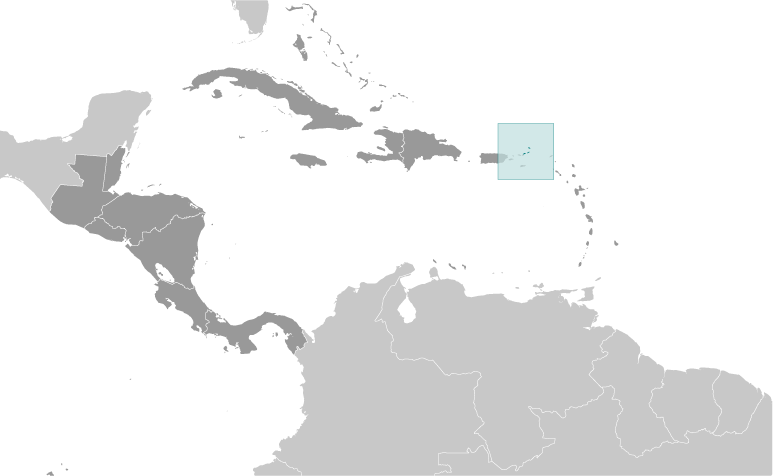
| BRITISH VIRGIN ISLANDS British Virgin Islands British Virgin Islands (Self governing overseas territory of the United Kingdom) Joined United Nations: 24 October 1945 Human Rights as assured by their constitution Click here Updated 26 December 2012 |

| CAPITAL |
| POPULATION |
| CHIEF OF STATE |
| SELECTION PROCESS |
Road Town
31,148 (July 2012 est.)
Orlando Smith
Premier since 9 November 2011
Premier since 9 November 2011
The monarch is hereditary; the Governor appointed by the monarch;
Next scheduled election: None
Next scheduled election: None
HEAD OF GOVERNMENT
SELECTION PROCESS
Following legislative elections, the leader of the majority party or
the leader of the majority coalition is usually appointed Premier
by the governor; elections: last held on 7 November 2011
Next scheduled election: 2015
the leader of the majority coalition is usually appointed Premier
by the governor; elections: last held on 7 November 2011
Next scheduled election: 2015
| DECLARATION OF HUMAN RIGHTS |
| ETHNIC GROUPS |
Black 82%, white 6.8%, other 11.2% (includes Indian and mixed) (2008)
| RELIGIONS |
Protestant 84% (Methodist 33%, Anglican 17%, Church of God 9%, Seventh-Day Adventist 6%, Baptist 4%, other 15%),
Roman Catholic 10%, Jehovah's Witnesses 2%, other 2%, none 2% (1991)
Roman Catholic 10%, Jehovah's Witnesses 2%, other 2%, none 2% (1991)
| GOVERNMENT STRUCTURE |
Overseas territory of the United Kingdom; internal self-governing with 0 administrative divisions; Legal system is English law
Executive: The monarch is hereditary; governor appointed by the monarch; following legislative elections, the leader of the majority
party or the leader of the majority coalition is usually appointed premier by the governor
Legislative: Unicameral House of Assembly (13 elected seats and 1 non-voting ex officio member in the attorney general;
members are elected by direct popular vote, 1 member from each of nine electoral districts, 4 at-large members; to serve four-year
terms)
elections: last held 7 November 2011 (next to be held in 2015)
Judicial: Eastern Caribbean Supreme Court, consisting of the High Court of Justice and the Court of Appeal (one judge of the
Supreme Court is a resident of the islands and presides over the High Court); Magistrate's Court; Juvenile Court; Court of
Summary Jurisdiction
Executive: The monarch is hereditary; governor appointed by the monarch; following legislative elections, the leader of the majority
party or the leader of the majority coalition is usually appointed premier by the governor
Legislative: Unicameral House of Assembly (13 elected seats and 1 non-voting ex officio member in the attorney general;
members are elected by direct popular vote, 1 member from each of nine electoral districts, 4 at-large members; to serve four-year
terms)
elections: last held 7 November 2011 (next to be held in 2015)
Judicial: Eastern Caribbean Supreme Court, consisting of the High Court of Justice and the Court of Appeal (one judge of the
Supreme Court is a resident of the islands and presides over the High Court); Magistrate's Court; Juvenile Court; Court of
Summary Jurisdiction
| LANGUAGES |
English (official)
| BRIEF HISTORY |
The first recorded settlement of the Territory was by Arawak Indians from South America, in around 100 BC. However, there is
some dispute about the dates. Some historians place it later, at around 200 AD, but they suggest that the Arawaks may have been
preceded by the Ciboney Indians, who are thought to have settled in nearby St. Thomas as early as 300 BC. There is some
evidence of Amerindian presence on the islands as far back as 1500 BC, although there is little academic support for the idea of a
permanent settlement on any of the current British Virgin Islands at that time. The Arawaks inhabited the islands until the 1400s
when they were displaced by the more aggressive Caribs, a tribe from the Lesser Antilles islands, after whom the Caribbean Sea is
named. Some historians, however, believe that this popular account of warlike Caribs chasing peaceful Arawaks out of the
Caribbean islands is rooted in simplistic European stereotypes, and that the true story is more complex. None of the later European
visitors to the Virgin Islands ever reported encountering Amerindians in what would later be the British Virgin Islands, although
Columbus would have a hostile encounter with the Carib natives of St. Croix. The first European sighting of the Virgin Islands was
by Christopher Columbus in 1493 on his second voyage to the Americas. Columbus gave them the fanciful name Santa Ursula y las
Once Mil Vírgenes (Saint Ursula and her 11,000 Virgins), shortened to Las Vírgenes (The Virgins), after the legend of Saint Ursula.
He is also reported to have personally named Virgin Gorda (the Fat Virgin), which he thought to be the largest island in the group.
The Spanish claimed the islands by original discovery, but did nothing to enforce their claims, and never settled the Territory. In
1508 Juan Ponce de León settled Puerto Rico, and reports in Spanish journals suggested that the settlement used the Virgin Islands
for fishing, but nothing else. It is unclear whether they sailed as far the modern British Virgin Islands to fish, and the references may
be to the present U.S. Virgin Islands. In 1517 Sir Sebastian Cabot and Sir Thomas Pert visited the islands on their way back from
their exploration of Brazilian waters. Sir John Hawkins visited the island three times, firstly in 1542 and then again in 1563 with a
cargo of slaves bound for Hispaniola. On his third visit, he was accompanied by a young Captain by the name of Francis Drake in
the Judith, for whom the central channel in the British Virgin Islands would later be named. The English monarch, King James I,
granted a patent to the Earl of Carlisle for Tortola, as well as "Angilla, Semrera (Sombrero island) & Enegada". He also received
letters of patent for Barbados, St. Kitts and "all the Caribees" in 1628. Carlisle died shortly after, but his son, the 2nd Earl of
Carlisle, leased the patents to Lord Willoughby for 21 years in 1647. Neither ever attempted to settle the northern islands. It was a
Dutch privateer named Joost van Dyk who organised the first permanent settlements in the Territory in Soper's Hole, on the West
end of Tortola. It is not know precisely when he first came to the Territory, but by 1615 van Dyk's settlement was recorded in
Spanish contemporary records, noting its recent expansion. He traded with the Spaniards in Puerto Rico and farmed cotton and
tobacco. Some sources suggest that the first settlements in the Virgin Islands were by the Spanish, who mined copper at the copper
mine on Virgin Gorda, but there is no archaeological evidence to support the existence of any settlement by the Spanish in the
islands at any time, or any mining of copper on Virgin Gorda prior to the 1800s. By 1625 van Dyk was recognised by the Dutch
West India Company as the private "Patron" of Tortola, and had moved his operations to Road Town. The settlements were not
ultimately an economic success, and the evidence suggests that the Dutch spent most of their time more profitably engaged in
privateering (or piracy, depending upon one's perspective) than trading. The lack of prosperity of the territory mirrored the lack of
commercial success of the Dutch West India Company as a whole. In 1665 the Dutch settlers on Tortola were attacked by a British
privateer, John Wentworth, who is recorded as capturing 67 slaves which were removed to Bermuda. This is the first official record
of slaves being held in the Territory. Subsequently in 1666 there were reports that a number of the Dutch settlers were driven out by
an influx of British "brigands and pirates", although clearly a number of the Dutch remained. The British Virgin Islands came under
British control in 1672, at the outbreak of the Third Anglo-Dutch War, and have remained so ever since. The circumstances of the
British taking control however are somewhat uncertain. The Dutch averred that in 1672 Willem Hunthum put Tortola under the
protection of Colonel Sir William Stapleton, the English Governor-General of the Leeward Islands. Stapleton himself reported that
he had captured the Territory shortly after the outbreak of war. By the Treaty of Westminster of 1674, the war was ended, and
provision was made for mutual restoration of all territorial conquests during the war. The British initially claimed St. Thomas (and St.
John as well), but in 1717 the Danish disputed their claim to those islands. In contrast to the long dispute over ownership of Tortola,
the dispute over St. Thomas was settled readily with a year. The Danish claim was strong; they had the benefit of the Treaty of
Alliance and Commerce of 1670 between Britain and Denmark, which led to the founding of the Danish West India Company in
1671 which its charter permitted it to take possession of and occupy the two islands. On 25 May 1672 the Danes took possession
of St. Thomas, and discovered it to have been abandoned by the British settlers some weeks earlier. The British could scarcely
object to the Danes retaining the island. Even after British control of the Territory became complete, population infiltration was slow.
The Territory was granted a Legislative Assembly on 27 January 1774, however, it took a full further decade for a constitutional
framework to be settled. Between 1760 and 1800 the British significantly upgraded the defences of the Territory. Uprisings in the
Territory were common, as they were elsewhere in the Caribbean. The first notable uprising in the British Virgin islands occurred in
1790. Subsequent rebellions also occurred in 1823, 1827 and 1830, although in each case they were quickly put down. The
abolition of slavery occurred on 1 August 1834, and to this day it is celebrated by a three day public holiday on the first Monday,
Tuesday and Wednesday in August in the British Virgin Islands. The original emancipation proclamation hangs in the High Court. In
1834 the Territory was an agricultural economy with two main crops: sugar and cotton. Of the two, sugar was the considerably
more lucrative export. Shortly after the abolition of slavery the Territory was rocked by a series of hurricanes. At the time, there
was no accurate method of forecasting hurricanes, and their effect was devastating. A particularly devastating hurricane struck in
1837, which was reported to have completed destroyed 17 of the Territory's sugar works. Further hurricanes hit in 1842 and 1852.
Two more struck in 1867 and 1871. To compound these miseries, in 1846 the United Kingdom passed the Sugar Duties Act 1846
to equalise duties on sugar grown in the colonies. In 1887 a plot for an armed rebellion was uncovered. In 1890 a dispute over
smuggling led to further violence, and a Long Look resident, Christopher Flemming, emerged as a local hero simply for standing up
to authority. In 1901 the Legislative Council was finally formally dissolved, and the islands were then officially administered through
the Governor of the Leeward Islands, who appointed a commissioner and an executive council. As a result of the demonstrations
the previous year, the Legislative Council was reinstituted in 1950 under a new constitution. The reformation of the Legislative
Council is often left as a footnote in the Territory's history - a mere part of the process that led to the more fundamental
constitutional government in 1966. Elections followed in 1967, and a comparatively young Lavity Stoutt was elected as the first
Chief Minister of the Territory. The fortunes of the Territory dramatically improved in the late twentieth century with the advent of
the offshore financial services industry. Former president of the BVI's Financial Services Commission, Michael Riegels, recites the
anecdote that the industry commenced on an unknown date in the 1970s when a lawyer from a firm in New York telephoned him
with a proposal to incorporate a company in the British Virgin Islands to take advantage of a double taxation relief treaty with the
United States. In 2000, KPMG were commissioned by the British Government to produce a report on the offshore financial
industry generally, and the report indicated that nearly 41% of the offshore companies in the world were formed in the British Virgin
Islands. Within the space of a few years, hundreds of such companies had been incorporated. The British Virgin Islands is now one
of the world's leading offshore financial centres, and boasts one of the highest incomes per capita in the Caribbean. he British Virgin
Islands general election, 2011 was held in the British Virgin Islands on 7 November 2011. The result was a decisive victory for the
opposition National Democratic Party (NDP) led by Orlando Smith over the incumbent Virgin Islands Party (VIP), led by Premier
Ralph T. O'Neal. No minor parties or independent candidates won any seats.
Source: Wikipedia: History of British Virgin Islands
some dispute about the dates. Some historians place it later, at around 200 AD, but they suggest that the Arawaks may have been
preceded by the Ciboney Indians, who are thought to have settled in nearby St. Thomas as early as 300 BC. There is some
evidence of Amerindian presence on the islands as far back as 1500 BC, although there is little academic support for the idea of a
permanent settlement on any of the current British Virgin Islands at that time. The Arawaks inhabited the islands until the 1400s
when they were displaced by the more aggressive Caribs, a tribe from the Lesser Antilles islands, after whom the Caribbean Sea is
named. Some historians, however, believe that this popular account of warlike Caribs chasing peaceful Arawaks out of the
Caribbean islands is rooted in simplistic European stereotypes, and that the true story is more complex. None of the later European
visitors to the Virgin Islands ever reported encountering Amerindians in what would later be the British Virgin Islands, although
Columbus would have a hostile encounter with the Carib natives of St. Croix. The first European sighting of the Virgin Islands was
by Christopher Columbus in 1493 on his second voyage to the Americas. Columbus gave them the fanciful name Santa Ursula y las
Once Mil Vírgenes (Saint Ursula and her 11,000 Virgins), shortened to Las Vírgenes (The Virgins), after the legend of Saint Ursula.
He is also reported to have personally named Virgin Gorda (the Fat Virgin), which he thought to be the largest island in the group.
The Spanish claimed the islands by original discovery, but did nothing to enforce their claims, and never settled the Territory. In
1508 Juan Ponce de León settled Puerto Rico, and reports in Spanish journals suggested that the settlement used the Virgin Islands
for fishing, but nothing else. It is unclear whether they sailed as far the modern British Virgin Islands to fish, and the references may
be to the present U.S. Virgin Islands. In 1517 Sir Sebastian Cabot and Sir Thomas Pert visited the islands on their way back from
their exploration of Brazilian waters. Sir John Hawkins visited the island three times, firstly in 1542 and then again in 1563 with a
cargo of slaves bound for Hispaniola. On his third visit, he was accompanied by a young Captain by the name of Francis Drake in
the Judith, for whom the central channel in the British Virgin Islands would later be named. The English monarch, King James I,
granted a patent to the Earl of Carlisle for Tortola, as well as "Angilla, Semrera (Sombrero island) & Enegada". He also received
letters of patent for Barbados, St. Kitts and "all the Caribees" in 1628. Carlisle died shortly after, but his son, the 2nd Earl of
Carlisle, leased the patents to Lord Willoughby for 21 years in 1647. Neither ever attempted to settle the northern islands. It was a
Dutch privateer named Joost van Dyk who organised the first permanent settlements in the Territory in Soper's Hole, on the West
end of Tortola. It is not know precisely when he first came to the Territory, but by 1615 van Dyk's settlement was recorded in
Spanish contemporary records, noting its recent expansion. He traded with the Spaniards in Puerto Rico and farmed cotton and
tobacco. Some sources suggest that the first settlements in the Virgin Islands were by the Spanish, who mined copper at the copper
mine on Virgin Gorda, but there is no archaeological evidence to support the existence of any settlement by the Spanish in the
islands at any time, or any mining of copper on Virgin Gorda prior to the 1800s. By 1625 van Dyk was recognised by the Dutch
West India Company as the private "Patron" of Tortola, and had moved his operations to Road Town. The settlements were not
ultimately an economic success, and the evidence suggests that the Dutch spent most of their time more profitably engaged in
privateering (or piracy, depending upon one's perspective) than trading. The lack of prosperity of the territory mirrored the lack of
commercial success of the Dutch West India Company as a whole. In 1665 the Dutch settlers on Tortola were attacked by a British
privateer, John Wentworth, who is recorded as capturing 67 slaves which were removed to Bermuda. This is the first official record
of slaves being held in the Territory. Subsequently in 1666 there were reports that a number of the Dutch settlers were driven out by
an influx of British "brigands and pirates", although clearly a number of the Dutch remained. The British Virgin Islands came under
British control in 1672, at the outbreak of the Third Anglo-Dutch War, and have remained so ever since. The circumstances of the
British taking control however are somewhat uncertain. The Dutch averred that in 1672 Willem Hunthum put Tortola under the
protection of Colonel Sir William Stapleton, the English Governor-General of the Leeward Islands. Stapleton himself reported that
he had captured the Territory shortly after the outbreak of war. By the Treaty of Westminster of 1674, the war was ended, and
provision was made for mutual restoration of all territorial conquests during the war. The British initially claimed St. Thomas (and St.
John as well), but in 1717 the Danish disputed their claim to those islands. In contrast to the long dispute over ownership of Tortola,
the dispute over St. Thomas was settled readily with a year. The Danish claim was strong; they had the benefit of the Treaty of
Alliance and Commerce of 1670 between Britain and Denmark, which led to the founding of the Danish West India Company in
1671 which its charter permitted it to take possession of and occupy the two islands. On 25 May 1672 the Danes took possession
of St. Thomas, and discovered it to have been abandoned by the British settlers some weeks earlier. The British could scarcely
object to the Danes retaining the island. Even after British control of the Territory became complete, population infiltration was slow.
The Territory was granted a Legislative Assembly on 27 January 1774, however, it took a full further decade for a constitutional
framework to be settled. Between 1760 and 1800 the British significantly upgraded the defences of the Territory. Uprisings in the
Territory were common, as they were elsewhere in the Caribbean. The first notable uprising in the British Virgin islands occurred in
1790. Subsequent rebellions also occurred in 1823, 1827 and 1830, although in each case they were quickly put down. The
abolition of slavery occurred on 1 August 1834, and to this day it is celebrated by a three day public holiday on the first Monday,
Tuesday and Wednesday in August in the British Virgin Islands. The original emancipation proclamation hangs in the High Court. In
1834 the Territory was an agricultural economy with two main crops: sugar and cotton. Of the two, sugar was the considerably
more lucrative export. Shortly after the abolition of slavery the Territory was rocked by a series of hurricanes. At the time, there
was no accurate method of forecasting hurricanes, and their effect was devastating. A particularly devastating hurricane struck in
1837, which was reported to have completed destroyed 17 of the Territory's sugar works. Further hurricanes hit in 1842 and 1852.
Two more struck in 1867 and 1871. To compound these miseries, in 1846 the United Kingdom passed the Sugar Duties Act 1846
to equalise duties on sugar grown in the colonies. In 1887 a plot for an armed rebellion was uncovered. In 1890 a dispute over
smuggling led to further violence, and a Long Look resident, Christopher Flemming, emerged as a local hero simply for standing up
to authority. In 1901 the Legislative Council was finally formally dissolved, and the islands were then officially administered through
the Governor of the Leeward Islands, who appointed a commissioner and an executive council. As a result of the demonstrations
the previous year, the Legislative Council was reinstituted in 1950 under a new constitution. The reformation of the Legislative
Council is often left as a footnote in the Territory's history - a mere part of the process that led to the more fundamental
constitutional government in 1966. Elections followed in 1967, and a comparatively young Lavity Stoutt was elected as the first
Chief Minister of the Territory. The fortunes of the Territory dramatically improved in the late twentieth century with the advent of
the offshore financial services industry. Former president of the BVI's Financial Services Commission, Michael Riegels, recites the
anecdote that the industry commenced on an unknown date in the 1970s when a lawyer from a firm in New York telephoned him
with a proposal to incorporate a company in the British Virgin Islands to take advantage of a double taxation relief treaty with the
United States. In 2000, KPMG were commissioned by the British Government to produce a report on the offshore financial
industry generally, and the report indicated that nearly 41% of the offshore companies in the world were formed in the British Virgin
Islands. Within the space of a few years, hundreds of such companies had been incorporated. The British Virgin Islands is now one
of the world's leading offshore financial centres, and boasts one of the highest incomes per capita in the Caribbean. he British Virgin
Islands general election, 2011 was held in the British Virgin Islands on 7 November 2011. The result was a decisive victory for the
opposition National Democratic Party (NDP) led by Orlando Smith over the incumbent Virgin Islands Party (VIP), led by Premier
Ralph T. O'Neal. No minor parties or independent candidates won any seats.
Source: Wikipedia: History of British Virgin Islands
| ECONOMIC OVERVIEW |
The economy, one of the most stable and prosperous in the Caribbean, is highly dependent on tourism generating an estimated 45%
of the national income. More than 934,000 tourists, mainly from the US, visited the islands in 2008. In the mid-1980s, the
government began offering offshore registration to companies wishing to incorporate in the islands, and incorporation fees now
generate substantial revenues. Roughly 400,000 companies were on the offshore registry by yearend 2000. The adoption of a
comprehensive insurance law in late 1994, which provides a blanket of confidentiality with regulated statutory gateways for
investigation of criminal offenses, made the British Virgin Islands even more attractive to international business. Livestock raising is
the most important agricultural activity; poor soils limit the islands' ability to meet domestic food requirements. Because of
traditionally close links with the US Virgin Islands, the British Virgin Islands has used the US dollar as its currency since 1959.
Source: CIA World Factbook (select British Virgin Islands)
of the national income. More than 934,000 tourists, mainly from the US, visited the islands in 2008. In the mid-1980s, the
government began offering offshore registration to companies wishing to incorporate in the islands, and incorporation fees now
generate substantial revenues. Roughly 400,000 companies were on the offshore registry by yearend 2000. The adoption of a
comprehensive insurance law in late 1994, which provides a blanket of confidentiality with regulated statutory gateways for
investigation of criminal offenses, made the British Virgin Islands even more attractive to international business. Livestock raising is
the most important agricultural activity; poor soils limit the islands' ability to meet domestic food requirements. Because of
traditionally close links with the US Virgin Islands, the British Virgin Islands has used the US dollar as its currency since 1959.
Source: CIA World Factbook (select British Virgin Islands)
| POLITICAL CLIMATE |
The Governor is appointed by the Monarch. The Premier (formerly Chief Minister) is appointed by the Governor from among the
members of the Legislative Council, and is by parliamentary convention the leader of the party holding the largest number of seats.
The cabinet, the Executive Council, is appointed by the Governor from among the elected members of the Legislative Council.
The British Virgin Islands elects on territorial level a legislature. The House of Assembly (formerly Legislative Council) has 15
members, 13 members elected for a four year term, 9 of them in single-seat constituencies and 4 at large, one ex officio member
and one speaker chosen from outside the council.
The House of Assembly was dissolved on 13 September 2011, by the Governor, Mr William Boyd McCleary, on advice from the
Premier. However, the date of the election was not announced until 23 September 2011. Premier Ralph O'Neal confirmed that he
would lead his party at the 2011 general election, even though he would turn 78 shortly after the election, and would be 82 at the
end of the term of office (if re-elected). Second district representative, Alvin Christopher (who received the highest percentage of
votes for a territorial candidate (75.9%) in the 2007 election) announced that he will run for the Virgin Islands Party. Mr
Christopher has formerly run for the VIP, the NDP and as an independent candidate. Although the ruling Virgin Islands Party had a
huge majority following the 2007 election the intervening years had been characterised by difficult economic times, and a series of
natural disasters had hit the Territory damaging its infrastructure. Both of these events led to criticism being directed towards the
ruling Government
Source: Wikipedia: Politics of British Virgin Islands
members of the Legislative Council, and is by parliamentary convention the leader of the party holding the largest number of seats.
The cabinet, the Executive Council, is appointed by the Governor from among the elected members of the Legislative Council.
The British Virgin Islands elects on territorial level a legislature. The House of Assembly (formerly Legislative Council) has 15
members, 13 members elected for a four year term, 9 of them in single-seat constituencies and 4 at large, one ex officio member
and one speaker chosen from outside the council.
The House of Assembly was dissolved on 13 September 2011, by the Governor, Mr William Boyd McCleary, on advice from the
Premier. However, the date of the election was not announced until 23 September 2011. Premier Ralph O'Neal confirmed that he
would lead his party at the 2011 general election, even though he would turn 78 shortly after the election, and would be 82 at the
end of the term of office (if re-elected). Second district representative, Alvin Christopher (who received the highest percentage of
votes for a territorial candidate (75.9%) in the 2007 election) announced that he will run for the Virgin Islands Party. Mr
Christopher has formerly run for the VIP, the NDP and as an independent candidate. Although the ruling Virgin Islands Party had a
huge majority following the 2007 election the intervening years had been characterised by difficult economic times, and a series of
natural disasters had hit the Territory damaging its infrastructure. Both of these events led to criticism being directed towards the
ruling Government
Source: Wikipedia: Politics of British Virgin Islands
| INTERNATIONAL DISPUTES |
None reported.


| REFUGEES AND INTERNALLY DISPLACED PERSONS (IDPS) |
None reported.
| ILLICIT DRUGS |
Transshipment point for South American narcotics destined for the US and Europe; large offshore financial center makes it
vulnerable to money laundering
vulnerable to money laundering
| HUMAN RIGHTS STATEMENTS, ANALYSIS AND CRITIQUES |
British Virgin Islands
February 23, 2011
COUNTRY DESCRIPTION: The British Virgin Islands (BVI) are a British overseas territory, part of the British West Indies, lying about
60 miles east of Puerto Rico. There are about 50 islands in the BVI, many of them uninhabited. Tortola is the main island; other islands
include Virgin Gorda, Jost Van Dyke, and Anegada. Tourist facilities are widely available.
CRIME: Theft, armed robbery and other violent crimes do occur in the BVI. Take common-sense precautions to guard against petty
crime. Avoid carrying large amounts of cash and use hotel safety deposit facilities to safeguard valuables and travel documents. Do not
leave valuables unattended on the beach or in cars, and do not leave them in plain view inside rental properties or hotel rooms. Always
lock up boats when going ashore.
Don’t buy counterfeit and pirated goods, even if they are widely available. Not only are the bootlegs illegal in the United States,you may
be breaking local law too.
Click here to read more »
February 23, 2011
COUNTRY DESCRIPTION: The British Virgin Islands (BVI) are a British overseas territory, part of the British West Indies, lying about
60 miles east of Puerto Rico. There are about 50 islands in the BVI, many of them uninhabited. Tortola is the main island; other islands
include Virgin Gorda, Jost Van Dyke, and Anegada. Tourist facilities are widely available.
CRIME: Theft, armed robbery and other violent crimes do occur in the BVI. Take common-sense precautions to guard against petty
crime. Avoid carrying large amounts of cash and use hotel safety deposit facilities to safeguard valuables and travel documents. Do not
leave valuables unattended on the beach or in cars, and do not leave them in plain view inside rental properties or hotel rooms. Always
lock up boats when going ashore.
Don’t buy counterfeit and pirated goods, even if they are widely available. Not only are the bootlegs illegal in the United States,you may
be breaking local law too.
Click here to read more »
15 June 2011
Committee on the Elimination of Discrimination against Women
Consideration of reports submitted by States parties under article 18 of the Convention on the Elimination of All Forms of
Discrimination against Women
Seventh periodic report of States parties
United Kingdom of Great Britain and Northern Ireland
Overseas Territories of the United Kingdom
THE VIRGIN ISLANDS PERIODIC REPORT ON THE CONVENTION OF ALL FORMS OF DISCRIMINATION AGAINST
WOMEN (CEDAW) 2007 - 2010
Introduction
The Government of the Virgin Islands is committed to implementing and complying with UN CEDAW in achieving gender equality,
equity and empowerment of women by 2013. One of the Government’s strategic objectives is to support and promote the fundamental
rights of women, men and children to live productive lives free of violence and other forms of discrimination. The Virgin Islands
Government is also committed to establishing and enhancing the socio-economic services provided to women, men and children,
especially the girl child. The Government will also seek to fulfill its mandate to ensure the health, safety and wellbeing of all, especially
women and children with special needs. Government’s motto is to also move the education system, including adult literacy and
vocational programmes from good to great.
Challenges
Following the submission of the last report, the CEDAW Committee directed no specific questions and recommendations to the Virgin
Islands. It would have been very useful to receive concluding comments observations and recommendations from the Committee on
how the Virgin Islands is complying with the CEDAW and what areas required special focus. Unfortunately, there would be no
submission of a shadow report from the NGO’s, there has never been any such reports. The Office of Gender Affairs will endeavour to
include all the NGO’s in its public education and awareness activities on the Convention, which is expected to commence during the
third quarter of 2011.
Another challenge faced in preparing this report was the absence of statistics by sex to demonstrate how many men and women access
the health clinics for family planning services. The Virgin Islands Government will ensure that all the gaps related to sex disaggregated
data will be made available for the next reporting period.
Article 1: Definition of Discrimination
The Government of the Virgin Islands shall continue to ensure no person particularly women is excluded or restricted and discriminated
against based on sex, marital status and nationality.
In accordance with the Virgin Islands Constitution Order of 2007, chapter 2, page 8, ”Fundamental Rights and Freedoms of the
Individual” ”Those fundamental rights and freedoms are enjoyed without distinction of any kind such as sex, age, race, colour, language,
religion, political or other opinion, national, ethnic or social origin association with a national minority, property, family relations,
economic status, disability, age, birth, sexual orientation, marital status or other status” These fundamental rights are upheld in the new
Labour Code of 2010, and in the other services provided in the Virgin Islands.
Click here to read more »
Committee on the Elimination of Discrimination against Women
Consideration of reports submitted by States parties under article 18 of the Convention on the Elimination of All Forms of
Discrimination against Women
Seventh periodic report of States parties
United Kingdom of Great Britain and Northern Ireland
Overseas Territories of the United Kingdom
THE VIRGIN ISLANDS PERIODIC REPORT ON THE CONVENTION OF ALL FORMS OF DISCRIMINATION AGAINST
WOMEN (CEDAW) 2007 - 2010
Introduction
The Government of the Virgin Islands is committed to implementing and complying with UN CEDAW in achieving gender equality,
equity and empowerment of women by 2013. One of the Government’s strategic objectives is to support and promote the fundamental
rights of women, men and children to live productive lives free of violence and other forms of discrimination. The Virgin Islands
Government is also committed to establishing and enhancing the socio-economic services provided to women, men and children,
especially the girl child. The Government will also seek to fulfill its mandate to ensure the health, safety and wellbeing of all, especially
women and children with special needs. Government’s motto is to also move the education system, including adult literacy and
vocational programmes from good to great.
Challenges
Following the submission of the last report, the CEDAW Committee directed no specific questions and recommendations to the Virgin
Islands. It would have been very useful to receive concluding comments observations and recommendations from the Committee on
how the Virgin Islands is complying with the CEDAW and what areas required special focus. Unfortunately, there would be no
submission of a shadow report from the NGO’s, there has never been any such reports. The Office of Gender Affairs will endeavour to
include all the NGO’s in its public education and awareness activities on the Convention, which is expected to commence during the
third quarter of 2011.
Another challenge faced in preparing this report was the absence of statistics by sex to demonstrate how many men and women access
the health clinics for family planning services. The Virgin Islands Government will ensure that all the gaps related to sex disaggregated
data will be made available for the next reporting period.
Article 1: Definition of Discrimination
The Government of the Virgin Islands shall continue to ensure no person particularly women is excluded or restricted and discriminated
against based on sex, marital status and nationality.
In accordance with the Virgin Islands Constitution Order of 2007, chapter 2, page 8, ”Fundamental Rights and Freedoms of the
Individual” ”Those fundamental rights and freedoms are enjoyed without distinction of any kind such as sex, age, race, colour, language,
religion, political or other opinion, national, ethnic or social origin association with a national minority, property, family relations,
economic status, disability, age, birth, sexual orientation, marital status or other status” These fundamental rights are upheld in the new
Labour Code of 2010, and in the other services provided in the Virgin Islands.
Click here to read more »
No Reports from Freedom House mentioning British Virgin Islands after exhaustive search of their database. Please forward
any information you may have regarding Freedom House efforts on behalf of British Virgin Islands to the Pax Gaea World
Report editor at the link below
Contact the editor »
any information you may have regarding Freedom House efforts on behalf of British Virgin Islands to the Pax Gaea World
Report editor at the link below
Contact the editor »
No Reports from Amnesty International mentioning British Virgin Islands after exhaustive search of their database. Please
forward any information you may have regarding Amnesty International efforts on behalf of British Virgin Islands to the Pax
Gaea World Report editor at the link below
Contact the editor »
forward any information you may have regarding Amnesty International efforts on behalf of British Virgin Islands to the Pax
Gaea World Report editor at the link below
Contact the editor »
Letter to the Governor of the Cayman Islands
March 11, 2009
His Excellency Mr Stuart Jack CVO
Governor
Cayman Islands
Dear Governor Jack:
On behalf of Human Rights Watch, I write to urge your government's support for full protections against discrimination in the new
constitution of the Cayman Islands, a British Overseas Territory. The present draft of the proposed constitution contains severely
restricted protections against discrimination, at the apparent urging of civil-society groups anxious that it not prevent discrimination
based on sexual orientation and gender identity in many crucial walks of life. It is unacceptable that discrimination against a specific
group or identity be allowed to persist and given constitutional permission. It is equally unacceptable that animus against that group lead
to a rollback of rights protections for all.
As you know, The Cayman Islands' existing constitution dates from 1972 and has been the subject of a debate over revision for eight
years. A referendum on the third draft of a new constitution will take place on May 20, 2009. It is critical that language restoring full
protections for equality and against discrimination be submitted to the voters, rather than the present restrictive text.
The present draft of section 16 of the Bill of Rights does not recognize any free-standing right of equal treatment. As a result, it offers
no protection against discrimination by the government in relation to rights not set out in the Bill of Rights. Discrimination in social and
economic areas such as health care, provision of services, housing, employment and many others will be left out.
The new proposal also limits the scope of protection to discrimination by the government. Horizontal discrimination by non-state actors
is not barred.
Human Rights Watch is aware of the fact that the original section 16 of the draft Bill of Rights stated that the Cayman Islands'
Government could not discriminate against anyone at any time and that the right to equality applied in all areas of daily life. This already
limited approach (no protection against horizontal discrimination between people or groups of people) was abandoned in its final draft.
Unfortunately, the revised and even more limited version of the draft constitution was approved by the Foreign and Commonwealth
Office on behalf of the British government. Reports in the press indicate that officials in the FCO have described the proposed
constitution as ‘less than ideal.'
Human Rights Watch is deeply concerned by this proposal and its limited approach.
Human Rights Watch brings to your attention that the 2007 constitution of another British Overseas Territory, the British Virgin Islands-
approved by the FCO--contains a free-standing protection against discrimination in all areas of life. . There can be no rationale for
offering different treatment and lesser protection to the population of the Cayman Islands.
Click here to read more »
March 11, 2009
His Excellency Mr Stuart Jack CVO
Governor
Cayman Islands
Dear Governor Jack:
On behalf of Human Rights Watch, I write to urge your government's support for full protections against discrimination in the new
constitution of the Cayman Islands, a British Overseas Territory. The present draft of the proposed constitution contains severely
restricted protections against discrimination, at the apparent urging of civil-society groups anxious that it not prevent discrimination
based on sexual orientation and gender identity in many crucial walks of life. It is unacceptable that discrimination against a specific
group or identity be allowed to persist and given constitutional permission. It is equally unacceptable that animus against that group lead
to a rollback of rights protections for all.
As you know, The Cayman Islands' existing constitution dates from 1972 and has been the subject of a debate over revision for eight
years. A referendum on the third draft of a new constitution will take place on May 20, 2009. It is critical that language restoring full
protections for equality and against discrimination be submitted to the voters, rather than the present restrictive text.
The present draft of section 16 of the Bill of Rights does not recognize any free-standing right of equal treatment. As a result, it offers
no protection against discrimination by the government in relation to rights not set out in the Bill of Rights. Discrimination in social and
economic areas such as health care, provision of services, housing, employment and many others will be left out.
The new proposal also limits the scope of protection to discrimination by the government. Horizontal discrimination by non-state actors
is not barred.
Human Rights Watch is aware of the fact that the original section 16 of the draft Bill of Rights stated that the Cayman Islands'
Government could not discriminate against anyone at any time and that the right to equality applied in all areas of daily life. This already
limited approach (no protection against horizontal discrimination between people or groups of people) was abandoned in its final draft.
Unfortunately, the revised and even more limited version of the draft constitution was approved by the Foreign and Commonwealth
Office on behalf of the British government. Reports in the press indicate that officials in the FCO have described the proposed
constitution as ‘less than ideal.'
Human Rights Watch is deeply concerned by this proposal and its limited approach.
Human Rights Watch brings to your attention that the 2007 constitution of another British Overseas Territory, the British Virgin Islands-
approved by the FCO--contains a free-standing protection against discrimination in all areas of life. . There can be no rationale for
offering different treatment and lesser protection to the population of the Cayman Islands.
Click here to read more »
Territory Observes 16 Days Of Activism Against Violence
28 November 2012
Following on the heels of the Domestic Violence Awareness month in October, the Office of Gender Affairs continues its public
awareness campaign against violence in the Territory with 16 Days of Activism Against Violence.
The 16 Days of Activism Against Violence started with the International Day to Eliminate Violence Against Women on November 25
under this year’s theme, ‘From Peace in the Home to Peace in the World’. The activities will follow through to December 10,
International Human Rights Day, highlighting the link between human rights and living life violence free. The 16 Days of Activism
Against Violence campaign offers to bring awareness to the public on the effects of violence.
This evening, the Office of Gender Affairs is spearheading the first event with a Moon Light Poetry Night, which will allow persons who
have gone through violence to speak publicly about their experience or to speak about situations they have known someone else has gone
through. This event will be held at the Mill Mall at 7:00p.m.
Gender Affairs Coordinator, Ms. Lorolie Connor said to the Department of Information and Public Relations, “We want to focus these
16 days of activities on bringing public awareness to violence and not just against women but violence on a whole.”
Ms. Connor continued, “We have violence now popping up amongst our youths, we have violence within our homes, violence is just
something that we have grown so accustomed to, but we need to start remembering the effects of violence.”
Other activities include a Fashion Show hosted by UMI, on Friday, November 30 outside of UMI Fashions at 5:00pm; World AIDS Day
Adult Sexual Seminar hosted by the National AIDS Programme at the H. Lavity Stoutt Community College Auditorium on Saturday,
December 1 starting at 9a.m.
The observance will continue on Friday, December 7 with a Candle Light Vigil, walking from the Governors House at 5:30 pm. directly
followed by a Celebration of Life Concert at the to the Noel Lloyd Positive Action Movement Park.
Ms. Connor explained that violence is a real situation in the Territory and it is not fabricated. She said that these activities are geared
towards educating the public on violence and the impact that it has on the Territory.
“Violence of women, violence of men, violence of our children, violence is violence and we need to start within our homes to rectify
violence so that we can have a peaceful and productive society,” Ms. Connor concluded.
This 16-day period is an international campaign initiated by United Nations Children's Fund (UNCEF), which also highlights other
significant dates including November 29, International Women Human Rights Defenders Day, December 1, World AIDS Day, and
December 3, International Disability Day.
The Ministry of Health and Social Development aspires to provide leadership that promotes health, social wellbeing, and a safe
environment as positive resources for living and sustainable development of the Territory.
Click here to read more »
28 November 2012
Following on the heels of the Domestic Violence Awareness month in October, the Office of Gender Affairs continues its public
awareness campaign against violence in the Territory with 16 Days of Activism Against Violence.
The 16 Days of Activism Against Violence started with the International Day to Eliminate Violence Against Women on November 25
under this year’s theme, ‘From Peace in the Home to Peace in the World’. The activities will follow through to December 10,
International Human Rights Day, highlighting the link between human rights and living life violence free. The 16 Days of Activism
Against Violence campaign offers to bring awareness to the public on the effects of violence.
This evening, the Office of Gender Affairs is spearheading the first event with a Moon Light Poetry Night, which will allow persons who
have gone through violence to speak publicly about their experience or to speak about situations they have known someone else has gone
through. This event will be held at the Mill Mall at 7:00p.m.
Gender Affairs Coordinator, Ms. Lorolie Connor said to the Department of Information and Public Relations, “We want to focus these
16 days of activities on bringing public awareness to violence and not just against women but violence on a whole.”
Ms. Connor continued, “We have violence now popping up amongst our youths, we have violence within our homes, violence is just
something that we have grown so accustomed to, but we need to start remembering the effects of violence.”
Other activities include a Fashion Show hosted by UMI, on Friday, November 30 outside of UMI Fashions at 5:00pm; World AIDS Day
Adult Sexual Seminar hosted by the National AIDS Programme at the H. Lavity Stoutt Community College Auditorium on Saturday,
December 1 starting at 9a.m.
The observance will continue on Friday, December 7 with a Candle Light Vigil, walking from the Governors House at 5:30 pm. directly
followed by a Celebration of Life Concert at the to the Noel Lloyd Positive Action Movement Park.
Ms. Connor explained that violence is a real situation in the Territory and it is not fabricated. She said that these activities are geared
towards educating the public on violence and the impact that it has on the Territory.
“Violence of women, violence of men, violence of our children, violence is violence and we need to start within our homes to rectify
violence so that we can have a peaceful and productive society,” Ms. Connor concluded.
This 16-day period is an international campaign initiated by United Nations Children's Fund (UNCEF), which also highlights other
significant dates including November 29, International Women Human Rights Defenders Day, December 1, World AIDS Day, and
December 3, International Disability Day.
The Ministry of Health and Social Development aspires to provide leadership that promotes health, social wellbeing, and a safe
environment as positive resources for living and sustainable development of the Territory.
Click here to read more »
2011 Human Rights Day observance in the BVI to be celebrated with Multicultural Youth Outreach Summit
Related by Humanity - Friday, November 4th, 2011
Road Town, Tortola, British Virgin Islands -The newly restructured Human Rights awareness organization, Related by Humanity will be
observing Human Rights Day on Saturday, December 10, 2011 with an unprecedented Multicultural All-inclusive Youth Summit to be
held at the Noel Lloyd Positive Action Park.
The theme for this year’s activity is “Moving Carefully on the Treacherous Journey from Boys to Men”, and it aims to sensitize the
youth population about how to avoid the many pitfalls of life in today’s society, as it pertains to the concerns about the various social ills
that are confronting our young men, in particular.
This is a non-government, non-religious organization and hopes to attract all who are in support of civil society and building social
consciousness to promote respect, social justice and dignity for peace and harmony, through human rights awareness.
Among activities being planned is a series of interactive motivational discussions with topics such as “Surviving Rejection by Society”,
“The Only Growth Hormone needed is Love”, “Say NO to the Balsum Ghut Degree”, and “You are not a Loser, Don’t Give Up on
Yourself”.
There will also be a Scooter Show where prizes will be awarded in various categories, and there will be a Safety and Accident
Prevention Presentation aimed at all who use bicycles and scooters as a means of transportation. Various information stalls where young
people can access information on joining recreational clubs, get employment tips, and other useful information to empower them and
help them on the road to success, will be available.
Entertainment will be provided by various performing artists, and dancers. Vendors are welcome to apply for a concession to sell Food
and Drinks as a fund-raising activity.
We are celebrating this day because Human Rights awareness is an aspect of social education that should not be underestimated, as it
empowers young people to become socially competent citizens. Human rights education not only helps people to know their rights, but
also to respect the rights of others, thus promoting peace through conflict reduction and social justice.
For further information regarding participation or support for this event, please email us at rbyhumanity@hotmail.com.
Click here to read more »
Related by Humanity - Friday, November 4th, 2011
Road Town, Tortola, British Virgin Islands -The newly restructured Human Rights awareness organization, Related by Humanity will be
observing Human Rights Day on Saturday, December 10, 2011 with an unprecedented Multicultural All-inclusive Youth Summit to be
held at the Noel Lloyd Positive Action Park.
The theme for this year’s activity is “Moving Carefully on the Treacherous Journey from Boys to Men”, and it aims to sensitize the
youth population about how to avoid the many pitfalls of life in today’s society, as it pertains to the concerns about the various social ills
that are confronting our young men, in particular.
This is a non-government, non-religious organization and hopes to attract all who are in support of civil society and building social
consciousness to promote respect, social justice and dignity for peace and harmony, through human rights awareness.
Among activities being planned is a series of interactive motivational discussions with topics such as “Surviving Rejection by Society”,
“The Only Growth Hormone needed is Love”, “Say NO to the Balsum Ghut Degree”, and “You are not a Loser, Don’t Give Up on
Yourself”.
There will also be a Scooter Show where prizes will be awarded in various categories, and there will be a Safety and Accident
Prevention Presentation aimed at all who use bicycles and scooters as a means of transportation. Various information stalls where young
people can access information on joining recreational clubs, get employment tips, and other useful information to empower them and
help them on the road to success, will be available.
Entertainment will be provided by various performing artists, and dancers. Vendors are welcome to apply for a concession to sell Food
and Drinks as a fund-raising activity.
We are celebrating this day because Human Rights awareness is an aspect of social education that should not be underestimated, as it
empowers young people to become socially competent citizens. Human rights education not only helps people to know their rights, but
also to respect the rights of others, thus promoting peace through conflict reduction and social justice.
For further information regarding participation or support for this event, please email us at rbyhumanity@hotmail.com.
Click here to read more »
Georges Stands Firm...
Thursday, 20th December 2012 by BVI Platinum News
Update Georges Stands Firm Says Failure To Appoint Labour Tribunal Has Caused Injustices
According to Georges the Labour Code was in preparation and discussion for many years prior to its passage in July, 2010 and there
was more than ample time for the Government to have laid the groundwork for the essential infrastructure to be put in place.
"The failure over this prolonged period to appoint the Tribunal is a breach of the law and has caused injustice to a number of employees
who cannot feel that their grievances have been fairly addressed and determined," Georges pointed out in a statement.
He added, "The Government, in my view, should make a public statement on the position and the House of Assembly needs to look at
this matter urgently to see how the continuing breach and injustices can be brought to an end as soon as possible. The needs of the
several working people affected by this matter require this kind of attention."
Georges pointed out that in late October he wrote to Minister Pickering to express regret that he had to consider the submission of a
special report to the House in a case that 'a poor woman' had failed to get anywhere with an approach to the Labour Department about
the failure of her employers to pay her regular wages for months and to pay overtime or vacation pay for years.
Mr. Georges pointed out that the original complaint to Labour was made in September, 2010 and an investigation report to the
Department and Ministry in February, 2012.
"The point of main concern for this statement is that successive administrations have failed in 24 months to appoint the key body of the
Labour Code, 2010 for final dispute resolution: the Arbitral Tribunal," Mr. Georges stated.
He alluded that the Labour Code stipulates that if the Labour Commissioner fails to bring about a settlement between employee and
employer within 30 days she must refer the complaint to the Minister with her report.
Mr. Georges stated that the Minister then attempts to get the parties to agree, but if he fails to do so within 21 days then he must refer
the dispute to a Board of Inquiry set up by the Minister for the particular case or to the Arbitral Tribunal that the Code says must be in
place.
He noted that the referral to a Board would be indicated for the sort of individual complaint where the employment is not an essential
service and no danger to the health or safety of employees or the public is involved.
Click here to read more>>
Thursday, 20th December 2012 by BVI Platinum News
Update Georges Stands Firm Says Failure To Appoint Labour Tribunal Has Caused Injustices
According to Georges the Labour Code was in preparation and discussion for many years prior to its passage in July, 2010 and there
was more than ample time for the Government to have laid the groundwork for the essential infrastructure to be put in place.
"The failure over this prolonged period to appoint the Tribunal is a breach of the law and has caused injustice to a number of employees
who cannot feel that their grievances have been fairly addressed and determined," Georges pointed out in a statement.
He added, "The Government, in my view, should make a public statement on the position and the House of Assembly needs to look at
this matter urgently to see how the continuing breach and injustices can be brought to an end as soon as possible. The needs of the
several working people affected by this matter require this kind of attention."
Georges pointed out that in late October he wrote to Minister Pickering to express regret that he had to consider the submission of a
special report to the House in a case that 'a poor woman' had failed to get anywhere with an approach to the Labour Department about
the failure of her employers to pay her regular wages for months and to pay overtime or vacation pay for years.
Mr. Georges pointed out that the original complaint to Labour was made in September, 2010 and an investigation report to the
Department and Ministry in February, 2012.
"The point of main concern for this statement is that successive administrations have failed in 24 months to appoint the key body of the
Labour Code, 2010 for final dispute resolution: the Arbitral Tribunal," Mr. Georges stated.
He alluded that the Labour Code stipulates that if the Labour Commissioner fails to bring about a settlement between employee and
employer within 30 days she must refer the complaint to the Minister with her report.
Mr. Georges stated that the Minister then attempts to get the parties to agree, but if he fails to do so within 21 days then he must refer
the dispute to a Board of Inquiry set up by the Minister for the particular case or to the Arbitral Tribunal that the Code says must be in
place.
He noted that the referral to a Board would be indicated for the sort of individual complaint where the employment is not an essential
service and no danger to the health or safety of employees or the public is involved.
Click here to read more>>
| Click map for larger view |
| Click flag for Country Report |



Elizabeth II of the United Kingdom
Queen since 6 February 1952
Queen since 6 February 1952
Represented by
Boyd McCleary
Governor since 20 August 2010
Boyd McCleary
Governor since 20 August 2010
| TRAFFICKING IN PERSONS |
None reported.