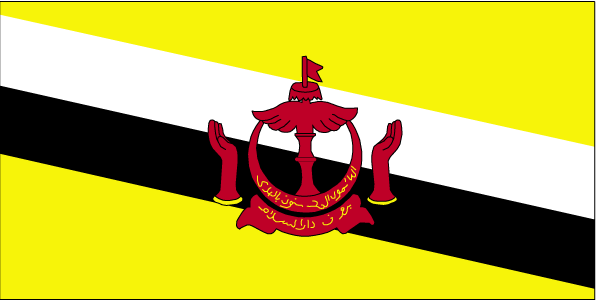
| BRUNEI Brunei Darussalam Negara Brunei Darussalam Joined United Nations: 21 September 1984 Human Rights as assured by their constitution Click here Updated 21 September 2012 |
| CAPITAL |
| POPULATION |
| CHIEF OF STATE |
| SELECTION PROCESS |
Bandar Seri Begawan
408,786 (July 2012 est.)
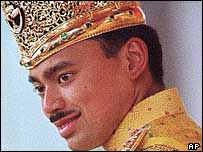
Sir Hassanal Bolkiah
Sultan and Prime Minister
since 5 October 1967
Sultan and Prime Minister
since 5 October 1967
Ascended to the throne upon the abdication of his father Omar
Ali Saifuddin III after 17 year rule
Next scheduled election: None, the monarchy is
hereditary; heir apparent is Crown Prince Al-Muhtadee
Billah
Ali Saifuddin III after 17 year rule
Next scheduled election: None, the monarchy is
hereditary; heir apparent is Crown Prince Al-Muhtadee
Billah
HEAD OF GOVERNMENT
Al-Muhtadee Billah
Crown Prince and Heir Apparent
since 10 August 1988
Crown Prince and Heir Apparent
since 10 August 1988
The president is both chief of state and head of government
| DECLARATION OF HUMAN RIGHTS |
| ETHNIC GROUPS |
Malay 66.3%, Chinese 11.2%, indigenous 3.4%, other 19.1% (2004 est.)
| RELIGIONS |
Muslim (official) 67%, Buddhist 13%, Christian 10%, indigenous beliefs and other 10%
| GOVERNMENT STRUCTURE |
Constitutional sultanate comprised of 4 districts (daerah-daerah, singular - daerah); Legal system is based on
English common law; for Muslims, Islamic Shari'a law supersedes civil law in a number of areas; does not accept
compulsory ICJ jurisdiction
Executive: The monarchy is hereditary
Legislative: The Sultan appointed a Legislative Council with 29 members in September 2005; he increased the size
of the council to 33 members in June 2011; the council meets annually in March
elections: last held in March 1962 (date of next election NA)
note: The Legislative Council met on 25 September 2004 for first time in 20 years with 21 members appointed by
the Sultan; it passed constitutional amendments calling for a 45-seat council with 15 elected members
Judicial: Supreme Court - chief justice and judges are sworn in by monarch for three-year terms; Judicial
Committee of Privy Council in London is final court of appeal for civil cases; Shariah courts deal with Islamic laws
(2006)
English common law; for Muslims, Islamic Shari'a law supersedes civil law in a number of areas; does not accept
compulsory ICJ jurisdiction
Executive: The monarchy is hereditary
Legislative: The Sultan appointed a Legislative Council with 29 members in September 2005; he increased the size
of the council to 33 members in June 2011; the council meets annually in March
elections: last held in March 1962 (date of next election NA)
note: The Legislative Council met on 25 September 2004 for first time in 20 years with 21 members appointed by
the Sultan; it passed constitutional amendments calling for a 45-seat council with 15 elected members
Judicial: Supreme Court - chief justice and judges are sworn in by monarch for three-year terms; Judicial
Committee of Privy Council in London is final court of appeal for civil cases; Shariah courts deal with Islamic laws
(2006)
| LANGUAGES |
Malay (official), English, Chinese
| BRIEF HISTORY |
| ECONOMIC OVERVIEW |
Brunei has a small well-to-do economy that encompasses a mixture of foreign and domestic entrepreneurship,
government regulation, welfare measures, and village tradition. Crude oil and natural gas production account for just
over half of GDP and more than 90% of exports. Per capita GDP is among the highest in Asia, and substantial
income from overseas investment supplements income from domestic production. The government provides for all
medical services and free education through the university level and subsidizes rice and housing. A new monetary
authority was established in January 2011 with responsibilities that include monetary policy, monitoring of financial
institutions, and currency trading activities. Source: CIA World Factbook (select Brunei)
government regulation, welfare measures, and village tradition. Crude oil and natural gas production account for just
over half of GDP and more than 90% of exports. Per capita GDP is among the highest in Asia, and substantial
income from overseas investment supplements income from domestic production. The government provides for all
medical services and free education through the university level and subsidizes rice and housing. A new monetary
authority was established in January 2011 with responsibilities that include monetary policy, monitoring of financial
institutions, and currency trading activities. Source: CIA World Factbook (select Brunei)
| POLITICAL CLIMATE |
The politics of Brunei take place in a framework of an absolute monarchy, whereby the Sultan of Brunei is both head
of state and head of government. Executive power is exercised by the government. Brunei has a Legislative Council
with 20 appointed members, that only has consultative tasks. Under Brunei's 1959 constitution, His Majesty Paduka
Seri Baginda Sultan Haji Hassanal Bolkiah Mu'izzaddin Waddaulah, is the head of state with full executive authority,
including emergency powers since 1962. The Sultan's role is enshrined in the national philosophy known as Melayu
Islam Beraja (MIB), or Malay Islamic Monarchy. The country has been under hypothetical martial law since a
rebellion occurred in the early 1960s and was put down by British troops from Singapore.
Under the 1959 constitution there was an elected Legislative Council, or Majlis Masyuarat Negeri, but only one
election has ever been held, in 1962. Soon after that election, the assembly was dissolved following the declaration
of a state of emergency, which saw the banning of the Brunei People's Party. In 1970 the Council was changed to an
appointed body by decree of the Sultan. In 2004 the Sultan announced that for the next parliament, fifteen of the 20
seats would be elected. However, no date for the election has been set.
All magistrates and judges both in the Common Law Courts and the Shariah Courts are appointed by the
Government. All local magistrates and judges were appointed from the civil service with none thus far being
appointed from the private practice.
Sources: Wikipedia: Politics of Brunei
of state and head of government. Executive power is exercised by the government. Brunei has a Legislative Council
with 20 appointed members, that only has consultative tasks. Under Brunei's 1959 constitution, His Majesty Paduka
Seri Baginda Sultan Haji Hassanal Bolkiah Mu'izzaddin Waddaulah, is the head of state with full executive authority,
including emergency powers since 1962. The Sultan's role is enshrined in the national philosophy known as Melayu
Islam Beraja (MIB), or Malay Islamic Monarchy. The country has been under hypothetical martial law since a
rebellion occurred in the early 1960s and was put down by British troops from Singapore.
Under the 1959 constitution there was an elected Legislative Council, or Majlis Masyuarat Negeri, but only one
election has ever been held, in 1962. Soon after that election, the assembly was dissolved following the declaration
of a state of emergency, which saw the banning of the Brunei People's Party. In 1970 the Council was changed to an
appointed body by decree of the Sultan. In 2004 the Sultan announced that for the next parliament, fifteen of the 20
seats would be elected. However, no date for the election has been set.
All magistrates and judges both in the Common Law Courts and the Shariah Courts are appointed by the
Government. All local magistrates and judges were appointed from the civil service with none thus far being
appointed from the private practice.
Sources: Wikipedia: Politics of Brunei
| INTERNATIONAL DISPUTES |
Per Letters of Exchange signed in 2009, Malaysia in 2010 ceded two hydrocarbon concession blocks to Brunei in
exchange for Brunei's sultan dropping claims to the Limbang corridor, which divides Brunei; nonetheless, Brunei
claims a maritime boundary extending as far as a median with Vietnam, thus asserting an implicit claim to Louisa Reef.
exchange for Brunei's sultan dropping claims to the Limbang corridor, which divides Brunei; nonetheless, Brunei
claims a maritime boundary extending as far as a median with Vietnam, thus asserting an implicit claim to Louisa Reef.


| TRAFFICKING IN PERSONS |
None reported.
| ILLICIT DRUGS |
Drug trafficking and illegally importing controlled substances are serious offenses in Brunei and carry a mandatory
death penalty
death penalty
| HUMAN RIGHTS STATEMENTS, ANALYSIS AND CRITIQUES |
2011 Human Rights Report: Brunei Darussalam
Bureau of Democracy, Human Rights, and Labor
2011 Country Reports on Human Rights Practices
May 24, 2012
Brunei Darussalam is a sultanate that has been ruled by the same family for more than 600 years. Sultan Haji Hassanal Bolkiah
governed under longstanding emergency powers that placed few limits on his power. The Legislative Council, made up of
appointed, indirectly elected, and ex officio members, met during the year and exercised a limited role in recommending and
approving legislation. Security forces reported to the sultan.
Restrictions on religious freedom; exploitation of foreign workers; and limitations on freedom of speech, press, assembly, and
association were the most prevalent human rights problems.
The following human rights problems were also reported: inability of citizens to change their government, trafficking in persons,
and discrimination against women.
There were no reported cases of government officials committing human rights abuses.
Click here to read more »
Bureau of Democracy, Human Rights, and Labor
2011 Country Reports on Human Rights Practices
May 24, 2012
Brunei Darussalam is a sultanate that has been ruled by the same family for more than 600 years. Sultan Haji Hassanal Bolkiah
governed under longstanding emergency powers that placed few limits on his power. The Legislative Council, made up of
appointed, indirectly elected, and ex officio members, met during the year and exercised a limited role in recommending and
approving legislation. Security forces reported to the sultan.
Restrictions on religious freedom; exploitation of foreign workers; and limitations on freedom of speech, press, assembly, and
association were the most prevalent human rights problems.
The following human rights problems were also reported: inability of citizens to change their government, trafficking in persons,
and discrimination against women.
There were no reported cases of government officials committing human rights abuses.
Click here to read more »
27 October 2003
COMMITTEE ON THE RIGHTS OF THE CHILD
Thirty-fourth session
CONSIDERATION OF REPORTS SUBMITTED BY STATES PARTIES UNDER ARTICLE 44 OF THE CONVENTION
Concluding observations: Brunei Darussalam
A. Introduction
2. The Committee welcomes the submission of the State party’s initial report, which followed the established guidelines, and the
written replies to its list of issues (CRC/C/Q/BRN/1) which provided the Committee with the necessary information. The
Committee acknowledges that the presence of a highly qualified delegation directly involved with the implementation of the
Convention allowed for a better understanding of the rights of the child in the State party.
B. Positive aspects
3. The Committee welcomes, inter alia:
(a) The enactment of the Children’s Order 2000;
(b) The establishment of the National Children’s Council in 2001;
(c) The excellent health-care system reflected in very good indicators;
(d) The very high school enrolment rates.
C. Principal subjects of concern and recommendations
1. General measures of implementation
Reservations
4. The Committee is deeply concerned that the broad and imprecise nature of the State party’s general reservation potentially
negates many of the provisions and principles of the Convention as to its compatibility with the object and purpose of the
Convention, as well as the overall implementation of the Convention.
5. The Committee strongly recommends that the State party expeditiously undertake the re-examination of its reservations with a
view to reconsidering and ultimately withdrawing them, in accordance with the Vienna Declaration and Plan of Action of the
World Conference on Human Rights (1993). In this regard, the Committee considers that the State party should benefit from the
recent withdrawal of a similar reservation by another State party. In addition, the Committee recommends that the State party study
its reservations to articles 14, 20 and 21 of the Convention with a view to withdrawing them.
Legislation
6. The Committee notes the adoption of various legislative measures with respect to children’s rights (e.g. the 2000 Children’s
Order, the Emergency Islamic Family Order, the Islamic Adoption of Children Order and the 2001 Adoption of Children Order), but
remains concerned that they do not sufficiently reflect a comprehensive rights-based approach to the implementation of the
Convention.
Click here to read more »
COMMITTEE ON THE RIGHTS OF THE CHILD
Thirty-fourth session
CONSIDERATION OF REPORTS SUBMITTED BY STATES PARTIES UNDER ARTICLE 44 OF THE CONVENTION
Concluding observations: Brunei Darussalam
A. Introduction
2. The Committee welcomes the submission of the State party’s initial report, which followed the established guidelines, and the
written replies to its list of issues (CRC/C/Q/BRN/1) which provided the Committee with the necessary information. The
Committee acknowledges that the presence of a highly qualified delegation directly involved with the implementation of the
Convention allowed for a better understanding of the rights of the child in the State party.
B. Positive aspects
3. The Committee welcomes, inter alia:
(a) The enactment of the Children’s Order 2000;
(b) The establishment of the National Children’s Council in 2001;
(c) The excellent health-care system reflected in very good indicators;
(d) The very high school enrolment rates.
C. Principal subjects of concern and recommendations
1. General measures of implementation
Reservations
4. The Committee is deeply concerned that the broad and imprecise nature of the State party’s general reservation potentially
negates many of the provisions and principles of the Convention as to its compatibility with the object and purpose of the
Convention, as well as the overall implementation of the Convention.
5. The Committee strongly recommends that the State party expeditiously undertake the re-examination of its reservations with a
view to reconsidering and ultimately withdrawing them, in accordance with the Vienna Declaration and Plan of Action of the
World Conference on Human Rights (1993). In this regard, the Committee considers that the State party should benefit from the
recent withdrawal of a similar reservation by another State party. In addition, the Committee recommends that the State party study
its reservations to articles 14, 20 and 21 of the Convention with a view to withdrawing them.
Legislation
6. The Committee notes the adoption of various legislative measures with respect to children’s rights (e.g. the 2000 Children’s
Order, the Emergency Islamic Family Order, the Islamic Adoption of Children Order and the 2001 Adoption of Children Order), but
remains concerned that they do not sufficiently reflect a comprehensive rights-based approach to the implementation of the
Convention.
Click here to read more »
FREEDOM IN THE WORLD REPORT- 2012
Political Rights Score: 6
Civil Liberties Score: 5
Status: Not Free
Overview
Brunei, which has been ruled continuously by Sultan Hassanal Bolkiah Mu’izzaddin Waddaulah since 1967, experienced little
political change in 2011. The essentially rubberstamp Legislative Council was disbanded in March after completing its five-year
term, and a new, expanded council was appointed in June.
In 2004, Hassanal reconvened the Legislative Council, which had been suspended since 1984. The Council passed a constitutional
amendment to expand its size to 45 seats, 15 of which would be elected. However, in 2005 Hassanal appointed a new, 29-member
Legislative Council, including five indirectly elected members representing village councils; most of the members of this body were
either relatives or loyalists. Following the completion of its five-year term, the Legislative Council was disbanded in March 2011
and replaced with a newly appointed and expanded 33-member council in June.
Hassanal instituted a significant reshuffle of the Cabinet of Ministers in May 2010. While many ministers retained their positions,
and the sultan continued to hold the posts of prime minister, minister of defense, and minister of finance, the changes there were
instituted signified a small step toward improving governance. The new cabinet included the country’s first woman cabinet member
as deputy minister for culture, youth, and sports.
Energy wealth has long allowed the government to stave off demands for political reform by employing much of the population,
providing citizens with extensive benefits and sparing them an income tax. Despite a declining GDP growth rate, Brunei remains the
fourth-largest oil producer in Southeast Asia and the ninth-largest exporter of liquefied natural gas in the world. In December 2010,
Brunei and Malaysia moved forward with a “milestone” offshore oil exploration deal in which both countries have agreed to a 50-50
sharing partnership for a period of 40 years.
Brunei is not an electoral democracy. The sultan continues to wield broad powers under a long-standing state of emergency, and no
direct legislative elections have been held since 1962. Citizens convey concerns to their leaders through government-vetted councils
of elected village chiefs.
Click here to read more »
Political Rights Score: 6
Civil Liberties Score: 5
Status: Not Free
Overview
Brunei, which has been ruled continuously by Sultan Hassanal Bolkiah Mu’izzaddin Waddaulah since 1967, experienced little
political change in 2011. The essentially rubberstamp Legislative Council was disbanded in March after completing its five-year
term, and a new, expanded council was appointed in June.
In 2004, Hassanal reconvened the Legislative Council, which had been suspended since 1984. The Council passed a constitutional
amendment to expand its size to 45 seats, 15 of which would be elected. However, in 2005 Hassanal appointed a new, 29-member
Legislative Council, including five indirectly elected members representing village councils; most of the members of this body were
either relatives or loyalists. Following the completion of its five-year term, the Legislative Council was disbanded in March 2011
and replaced with a newly appointed and expanded 33-member council in June.
Hassanal instituted a significant reshuffle of the Cabinet of Ministers in May 2010. While many ministers retained their positions,
and the sultan continued to hold the posts of prime minister, minister of defense, and minister of finance, the changes there were
instituted signified a small step toward improving governance. The new cabinet included the country’s first woman cabinet member
as deputy minister for culture, youth, and sports.
Energy wealth has long allowed the government to stave off demands for political reform by employing much of the population,
providing citizens with extensive benefits and sparing them an income tax. Despite a declining GDP growth rate, Brunei remains the
fourth-largest oil producer in Southeast Asia and the ninth-largest exporter of liquefied natural gas in the world. In December 2010,
Brunei and Malaysia moved forward with a “milestone” offshore oil exploration deal in which both countries have agreed to a 50-50
sharing partnership for a period of 40 years.
Brunei is not an electoral democracy. The sultan continues to wield broad powers under a long-standing state of emergency, and no
direct legislative elections have been held since 1962. Citizens convey concerns to their leaders through government-vetted councils
of elected village chiefs.
Click here to read more »
Document - Brunei Darussalam: Submission to the UN Universal Periodic Review: Sixth session of the UPR Working
Group of the Human Rights Council, November - December 2009
13 April 2009 Public
Executive summary
In this submission, Amnesty International provides information under sections B, C and D as stipulated in the General Guidelines
for the Preparation of Information under the Universal Periodic Review:1
*Under section B, Amnesty International raises concerns, inter alia, about administrative detention laws and other restrictive
legislation that denies individuals freedom from arbitrary detention; restrictions on press freedom; the status of ratification and
implementation of international human rights treaties; and legislation discriminating against lesbians, gay, bisexual and transgender
people.
*In section C, Amnesty International describes concerns over violations of human rights by the state through the prosecution of
individuals under the Sedition Act.
*In section D, Amnesty International makes a number of recommendations for action by the government in the areas of concerns
listed.
B. Normative and institutional framework of the State
Infringements on human rights in national legislation
Restrictive legislation may be used by the State to detain individuals arbitrarily, and to deny them the right to a fair trial and other
human rights. Although during the reporting period, there were no known instances of such legislation being invoked, the perceived
threat of detention has the effect of limiting such freedoms in the country. The Internal Security Act allows an individual to be held
without charge or trial for a period of up to two years; this is renewable indefinitely. The law effectively allows the government to
detain individuals indefinitely on the basis of the Home Minister’s directive alone.
Imprisonment and cruel punishment for immigration offences
Migrant workers who overstay beyond the expiry of their visa are regularly imprisoned and caned or whipped under Sections 6 or
15 of the Immigration Act of 1956. Caning and whipping constitute cruel, inhuman or degrading punishment and may amount to
torture. Amendments to the Immigration Act in 2005 made caning mandatory for certain immigration offences such as illegal entry,
overstaying after the expiry of travel documents or being undocumented.
During the period of review, there were numerous arrests of undocumented migrant workers. Those overstaying their visas were
jailed and/or whipped. Numerous press reports in 2009 indicated that the Immigration Department had said that approximately 396
migrants had been whipped since 2004.
Click here to read more »
Group of the Human Rights Council, November - December 2009
13 April 2009 Public
Executive summary
In this submission, Amnesty International provides information under sections B, C and D as stipulated in the General Guidelines
for the Preparation of Information under the Universal Periodic Review:1
*Under section B, Amnesty International raises concerns, inter alia, about administrative detention laws and other restrictive
legislation that denies individuals freedom from arbitrary detention; restrictions on press freedom; the status of ratification and
implementation of international human rights treaties; and legislation discriminating against lesbians, gay, bisexual and transgender
people.
*In section C, Amnesty International describes concerns over violations of human rights by the state through the prosecution of
individuals under the Sedition Act.
*In section D, Amnesty International makes a number of recommendations for action by the government in the areas of concerns
listed.
B. Normative and institutional framework of the State
Infringements on human rights in national legislation
Restrictive legislation may be used by the State to detain individuals arbitrarily, and to deny them the right to a fair trial and other
human rights. Although during the reporting period, there were no known instances of such legislation being invoked, the perceived
threat of detention has the effect of limiting such freedoms in the country. The Internal Security Act allows an individual to be held
without charge or trial for a period of up to two years; this is renewable indefinitely. The law effectively allows the government to
detain individuals indefinitely on the basis of the Home Minister’s directive alone.
Imprisonment and cruel punishment for immigration offences
Migrant workers who overstay beyond the expiry of their visa are regularly imprisoned and caned or whipped under Sections 6 or
15 of the Immigration Act of 1956. Caning and whipping constitute cruel, inhuman or degrading punishment and may amount to
torture. Amendments to the Immigration Act in 2005 made caning mandatory for certain immigration offences such as illegal entry,
overstaying after the expiry of travel documents or being undocumented.
During the period of review, there were numerous arrests of undocumented migrant workers. Those overstaying their visas were
jailed and/or whipped. Numerous press reports in 2009 indicated that the Immigration Department had said that approximately 396
migrants had been whipped since 2004.
Click here to read more »
IOC: Olympic Hurdles for Saudi Women Persist
London Games Should Advance Rights for Women, Girls in Kingdom
May 23, 2012
(London) – As the clock ticks down to the July opening ceremony, all nations except Saudi Arabia have confirmed that women
athletes will participate in the London 2012 Olympics, Human Rights Watch said today. The International Olympic Committee’s
executive board is meeting in Quebec City from May 23 through May 25 to hear reports on the upcoming Games.
The International Olympic Committee (IOC) meeting comes as Saudi Arabia’s National Olympic Committee has failed to confirm
the participation of women on its national team for the London Games. At the 2008 Beijing Olympics, only Qatar, Brunei, and Saudi
Arabia fielded all-male teams. This year, Qatar and Brunei have confirmed they will send female athletes as part of their teams for
the first time.
Human Rights Watch has reported extensively on the effective ban on women and girls taking part in sports inside the kingdom,
including in state schools.
Click here to read more »
London Games Should Advance Rights for Women, Girls in Kingdom
May 23, 2012
(London) – As the clock ticks down to the July opening ceremony, all nations except Saudi Arabia have confirmed that women
athletes will participate in the London 2012 Olympics, Human Rights Watch said today. The International Olympic Committee’s
executive board is meeting in Quebec City from May 23 through May 25 to hear reports on the upcoming Games.
The International Olympic Committee (IOC) meeting comes as Saudi Arabia’s National Olympic Committee has failed to confirm
the participation of women on its national team for the London Games. At the 2008 Beijing Olympics, only Qatar, Brunei, and Saudi
Arabia fielded all-male teams. This year, Qatar and Brunei have confirmed they will send female athletes as part of their teams for
the first time.
Human Rights Watch has reported extensively on the effective ban on women and girls taking part in sports inside the kingdom,
including in state schools.
Click here to read more »
Move forward toward exploring better opportunities
Tuesday, 28 August 2012 00:00
His Majesty Sultan Haji Hassanal Bolkiah Mu'izzaddin Waddaulah ibni Al-Marhum Sultan Haji Omar 'Ali Saifuddien Sa'adul Khairi
Waddien, the Sultan and Yang Di-Pertuan of Brunei Darussalam, in a titah, has called on Government-Linked Companies, GLCs,
and the private sector to together study the strategies of the 10th National Development Plan toward further building and advancing
the development of entrepreneurships and local businesses. His Majesty believes with their experience, the GLCs and the private
sector are capable to move forward toward exploring better opportunities, including opportunities outside the country. His Majesty
was speaking at a Hari Raya Celebration for the year 1433 Hijrah / 2012, organised by Yayasan Sultan Haji Hassanal Bolkiah,
yesterday morning. His Majesty expressed hope that the Hari Raya celebrations are made into pious deeds that are endorsed by
Allah the Al-Mighty, and also made as an opportunity to further strengthen the family institution. Islam, His Majesty pointed, is the
perfect religion for organising life, and its every move is designed for goodness and to eliminate evil. In the economic field, His
Majesty further pointed, Islam functions to bring mankind to progress.
Titah 1
" I understand that the 'Idil Fitri celebration organised by the Yayasan this year brings forth professionals, officials as well as local
employees serving with GLCs and some of the private sector who represent several business and service categories in the country.
I most welcome their participation. The private sector and GLCs play a vital role in assisting the progress of the national economy.
In the 10th National Development Plan, NDP, 2012-2017 wherein through the economic strategy, we are always making effort to
build a competitive economy, which can bring about quality employment opportunities both in the public and private sectors for the
rakyat and residents. Thus, to this end, GLCs and the private sector are hoped to together study the strategies of the NDP,
especially the Economic Strategy and the Entrepreneurship and Local Business Development Strategy for the development and
progress of those areas. I believe, based on their experience, GLCs and the private sector can move forward toward exploring
better opportunities, including opportunities outside the country. In this regard, my government through several related agencies is
providing and has provided various strategies, services and facilities toward further assisting and developing the private sector,
from the national to regional and international levels".
Click here to read more »
Tuesday, 28 August 2012 00:00
His Majesty Sultan Haji Hassanal Bolkiah Mu'izzaddin Waddaulah ibni Al-Marhum Sultan Haji Omar 'Ali Saifuddien Sa'adul Khairi
Waddien, the Sultan and Yang Di-Pertuan of Brunei Darussalam, in a titah, has called on Government-Linked Companies, GLCs,
and the private sector to together study the strategies of the 10th National Development Plan toward further building and advancing
the development of entrepreneurships and local businesses. His Majesty believes with their experience, the GLCs and the private
sector are capable to move forward toward exploring better opportunities, including opportunities outside the country. His Majesty
was speaking at a Hari Raya Celebration for the year 1433 Hijrah / 2012, organised by Yayasan Sultan Haji Hassanal Bolkiah,
yesterday morning. His Majesty expressed hope that the Hari Raya celebrations are made into pious deeds that are endorsed by
Allah the Al-Mighty, and also made as an opportunity to further strengthen the family institution. Islam, His Majesty pointed, is the
perfect religion for organising life, and its every move is designed for goodness and to eliminate evil. In the economic field, His
Majesty further pointed, Islam functions to bring mankind to progress.
Titah 1
" I understand that the 'Idil Fitri celebration organised by the Yayasan this year brings forth professionals, officials as well as local
employees serving with GLCs and some of the private sector who represent several business and service categories in the country.
I most welcome their participation. The private sector and GLCs play a vital role in assisting the progress of the national economy.
In the 10th National Development Plan, NDP, 2012-2017 wherein through the economic strategy, we are always making effort to
build a competitive economy, which can bring about quality employment opportunities both in the public and private sectors for the
rakyat and residents. Thus, to this end, GLCs and the private sector are hoped to together study the strategies of the NDP,
especially the Economic Strategy and the Entrepreneurship and Local Business Development Strategy for the development and
progress of those areas. I believe, based on their experience, GLCs and the private sector can move forward toward exploring
better opportunities, including opportunities outside the country. In this regard, my government through several related agencies is
providing and has provided various strategies, services and facilities toward further assisting and developing the private sector,
from the national to regional and international levels".
Click here to read more »
'Use MSD to build ombudsman character'
Rachel Thien
BANDAR SERI BEGAWAN
Friday, July 8, 2011
THE Management Services Department (MSD) at the Prime Minister's Office can be an institution that produces ombudsmen who
investigate public complaints of the government, the State Legislative Council (LegCo) Speaker said.
MSD "may be the beginning of an institution of ombudsman character in Brunei", Pehin Orang Kaya Laila Setia Bakti Dato Laila
Utama Hj Isa Pehin Datu Perdana Manteri Dato Laila Utama Hj Ibrahim told The Brunei Times yesterday.
The LegCo yesterday hosted visiting officials of Australia's Commonwealth Ombudsman Office, which has statutory roles to
investigate complaints from individuals, groups or organisations on Australian government officials and agencies' administrative
actions.
Second Clerk of LegCo Dato Paduka Sa Bali Abas said the public can file their complaints on services provided by government
agencies to ensure accountability through MSD.
"Though Brunei has no particular agency which has extensive roles and power as ombudsman like yours, but since 1998, MSD
was given the responsibility as (the) focal point for people to lodge their complaints with respect to services rendered by
government agencies and to have those complaints resolved on their merits," Dato Sa Bali said.
"I believe this arrangement helps ensure that government agencies are accountable while at the same time, assist agencies to
improve their administration and be more customer-focused," he added.
Alisan Larkins of Australia's Commonwealth Ombudsman's Office briefed the LegCo on the agency's roles and functions.
She explained a fundamental feature of Australian democracy is that people have a right to complain about government agencies to
an independent organisation without hindrance or reprisal, and have their complaints resolved.
This helps to ensure that government agencies are accountable and assists agencies to improve their administration, she added.
Larkin said the ombudsman is impartial and independent and is not an advocate for complaints or for agencies.
She said the emphasis of ombudsman work is on achieving remedies for complaints and improving public administration.
The ombudsman has "no power" to force an agency to change a decision or provide a service, but relies on agencies to cooperate
in resolving problems, she added.
The Commonwealth Ombudsman Office currently has about 150 staff.
Asked what Brunei could learn from the Ombudsman Office, Pehin Dato Hj Isa said there are many things the LegCo can learn
from time to time, but one at a time.
Click here to read more »
Rachel Thien
BANDAR SERI BEGAWAN
Friday, July 8, 2011
THE Management Services Department (MSD) at the Prime Minister's Office can be an institution that produces ombudsmen who
investigate public complaints of the government, the State Legislative Council (LegCo) Speaker said.
MSD "may be the beginning of an institution of ombudsman character in Brunei", Pehin Orang Kaya Laila Setia Bakti Dato Laila
Utama Hj Isa Pehin Datu Perdana Manteri Dato Laila Utama Hj Ibrahim told The Brunei Times yesterday.
The LegCo yesterday hosted visiting officials of Australia's Commonwealth Ombudsman Office, which has statutory roles to
investigate complaints from individuals, groups or organisations on Australian government officials and agencies' administrative
actions.
Second Clerk of LegCo Dato Paduka Sa Bali Abas said the public can file their complaints on services provided by government
agencies to ensure accountability through MSD.
"Though Brunei has no particular agency which has extensive roles and power as ombudsman like yours, but since 1998, MSD
was given the responsibility as (the) focal point for people to lodge their complaints with respect to services rendered by
government agencies and to have those complaints resolved on their merits," Dato Sa Bali said.
"I believe this arrangement helps ensure that government agencies are accountable while at the same time, assist agencies to
improve their administration and be more customer-focused," he added.
Alisan Larkins of Australia's Commonwealth Ombudsman's Office briefed the LegCo on the agency's roles and functions.
She explained a fundamental feature of Australian democracy is that people have a right to complain about government agencies to
an independent organisation without hindrance or reprisal, and have their complaints resolved.
This helps to ensure that government agencies are accountable and assists agencies to improve their administration, she added.
Larkin said the ombudsman is impartial and independent and is not an advocate for complaints or for agencies.
She said the emphasis of ombudsman work is on achieving remedies for complaints and improving public administration.
The ombudsman has "no power" to force an agency to change a decision or provide a service, but relies on agencies to cooperate
in resolving problems, she added.
The Commonwealth Ombudsman Office currently has about 150 staff.
Asked what Brunei could learn from the Ombudsman Office, Pehin Dato Hj Isa said there are many things the LegCo can learn
from time to time, but one at a time.
Click here to read more »
Lobbying pays off for Consumer group
Ying Chia
BANDAR SERI BEGAWAN
Thursday, March 17, 2011
THE Consumer Association of Brunei Darussalam's (CAB) nine years of lobbying for a Consumer Protection Act (CPA) has paid
off, with this year's LegCo proceedings raising the issue of a need for a national CPA.
Welcoming the decision, the association's executive secretary Ariffin Hj Hassan told The Brunei Times that they "hope it will
safeguard the concerns of the consumers".
The NGO association, which celebrated its 10th anniversary last month, is also celebrating the news of a proposed CPA which
would handle consumer complaints on issues such as pricing, products and service.
For example, he said, if a tourist comes to Brunei and they discover they are paying more than they should be paying for a service
or product then "they don't have to wait years for the court (solution), they can just go to CPA to have their concerns addressed".
The Department of Economic and Planning (JPKE) would be the most appropriate agency to handle the day-to-day regulation of
the CPA, he added, but noted that the association does hope to have a physical presence in the future where consumers and
volunteers can go to.
"The mapping for the CPA has been sent already, including all the reports from the stakeholders," Ariffin noted.
"We don't have a proper body to handle these concerns, and secondly it's the pricing, it's too highly priced, and then the
advertisement of these products (and) how the products are being marketed," he said.
Ariffin admits that consumers in the Sultanate are not very aware of their rights and how a consumer can play an important role in
the way products are sold in Brunei.
"But the question now is what options are there available to them, the consumer? Do they have options? The truth is they don't," he
said, adding he hopes the CAB's role is to one day be able to advise and educate consumers on what their options are via
workshops and forums.
Second Minister of Finance, Pehin Orang Kaya Laila Setia Dato Seri Setia Hj Abdul Rahman Hj Ibrahim, had recommended that a
Consumer Protection Act be put in place to protect consumers in the Sultanate during a Legislative Council meeting last weekend.
According to previous reports, this recommendation was raised in regards to Legislative Council member, Belait District
representative Hj Mohd Shafiee Ahmad inquiring about public response to the prices of commonly used commodities in the market
posted online by the Department of Economic and Planning (JPKE).
"I have previously enquired about the response from the Consumer Price Watch Column (CPWC), regarding the prices of goods in
Brunei and have not yet received any feedback," he was quoted as saying.
The CPWC only covers supermarkets but not small sundry stores and Hj Mohd Shafiee had queried why the price watch was not
more comprehensive further asking, "Thirdly, why are there only 13 commodities that are being monitored by the Department of
Economic and Planning (JPKE) when there are a lot more daily commodities that are being purchased by people throughout Brunei?"
The minister had responded that monitoring all items would require a substantial increase in manpower. The Brunei Times
Click here to read more »
Ying Chia
BANDAR SERI BEGAWAN
Thursday, March 17, 2011
THE Consumer Association of Brunei Darussalam's (CAB) nine years of lobbying for a Consumer Protection Act (CPA) has paid
off, with this year's LegCo proceedings raising the issue of a need for a national CPA.
Welcoming the decision, the association's executive secretary Ariffin Hj Hassan told The Brunei Times that they "hope it will
safeguard the concerns of the consumers".
The NGO association, which celebrated its 10th anniversary last month, is also celebrating the news of a proposed CPA which
would handle consumer complaints on issues such as pricing, products and service.
For example, he said, if a tourist comes to Brunei and they discover they are paying more than they should be paying for a service
or product then "they don't have to wait years for the court (solution), they can just go to CPA to have their concerns addressed".
The Department of Economic and Planning (JPKE) would be the most appropriate agency to handle the day-to-day regulation of
the CPA, he added, but noted that the association does hope to have a physical presence in the future where consumers and
volunteers can go to.
"The mapping for the CPA has been sent already, including all the reports from the stakeholders," Ariffin noted.
"We don't have a proper body to handle these concerns, and secondly it's the pricing, it's too highly priced, and then the
advertisement of these products (and) how the products are being marketed," he said.
Ariffin admits that consumers in the Sultanate are not very aware of their rights and how a consumer can play an important role in
the way products are sold in Brunei.
"But the question now is what options are there available to them, the consumer? Do they have options? The truth is they don't," he
said, adding he hopes the CAB's role is to one day be able to advise and educate consumers on what their options are via
workshops and forums.
Second Minister of Finance, Pehin Orang Kaya Laila Setia Dato Seri Setia Hj Abdul Rahman Hj Ibrahim, had recommended that a
Consumer Protection Act be put in place to protect consumers in the Sultanate during a Legislative Council meeting last weekend.
According to previous reports, this recommendation was raised in regards to Legislative Council member, Belait District
representative Hj Mohd Shafiee Ahmad inquiring about public response to the prices of commonly used commodities in the market
posted online by the Department of Economic and Planning (JPKE).
"I have previously enquired about the response from the Consumer Price Watch Column (CPWC), regarding the prices of goods in
Brunei and have not yet received any feedback," he was quoted as saying.
The CPWC only covers supermarkets but not small sundry stores and Hj Mohd Shafiee had queried why the price watch was not
more comprehensive further asking, "Thirdly, why are there only 13 commodities that are being monitored by the Department of
Economic and Planning (JPKE) when there are a lot more daily commodities that are being purchased by people throughout Brunei?"
The minister had responded that monitoring all items would require a substantial increase in manpower. The Brunei Times
Click here to read more »
Historians believe there was a forerunner to the present Brunei Sultanate, which the Chinese called Po-ni. Chinese
and Arabic records indicate that this ancient trading kingdom existed at the mouth of the Brunei River as early as the
seventh or eighth century A.D. This early kingdom was apparently conquered by the Sumatran empire of Srivijaya in
the early ninth century and later controlled northern Borneo and the Philippines. It was subjugated briefly by the
Java-based Majapahit Empire but soon regained its independence and once again rose to prominence. The Brunei
Empire had its golden age from the 15th to the 17th centuries, when its control extended over the entire island of
Borneo and north into the Philippines. Brunei was particularly powerful under the fifth sultan, Bolkiah (1473-1521),
who was famed for his sea exploits and even briefly captured Manila; and under the ninth sultan, Hassan
(1605-1619), who fully developed an elaborate Royal Court structure, elements of which remain today. After Sultan
Hassan , Brunei entered a period of decline, due to internal battles over royal succession as well as the rising
influences of European colonial powers in the region, that, among other things, disrupted traditional trading patterns,
destroying the economic base of Brunei and many other Southeast Asian sultanates. In 1839, the English adventurer
James Brooke arrived in Borneo and helped the Sultan put down a rebellion. As a reward, he became governor and
later "White Rajah" of Sarawak in northwest Borneo and gradually expanded the territory under his control. Brooke
never gained control of Brunei; though he did attempt to. He asked the British to check whether or not it would be
acceptable for him to claim Brunei as his own, however, they came back with bad news; although Brunei was poorly
run, it had a definite sense of national identity and could therefore not be absorbed by Brooke. Meanwhile, the
British North Borneo Company was expanding its control over territory in northeast Borneo. In 1888, Brunei
became a protectorate of the British Government, retaining internal independence but with British control over
external affairs. In 1906, Brunei accepted a further measure of British control when executive power was transferred
to a British Resident, who advised the ruler on all matters except those concerning local custom and religion. In
1959, a new constitution was written declaring Brunei a self-governing state, while its foreign affairs, security, and
defence remained the responsibility of the United Kingdom, now represented by a High Commissioner. An attempt
in 1962 to introduce a partially elected legislative body with limited powers was abandoned after the opposition
political party, Parti Rakyat Brunei, launched an armed uprising, which the government put down with the help of
British forces. The Constitution has been effectively suspended since then as Brunei declared a State of Emergency
and has renewed that status, ironically, as the constitution requires as a means of suspending it. In the late 1950s and
early 1960s, the government also resisted pressures to join neighbouring Sabah and Sarawak in the newly formed
Malaysia. The Sultan eventually decided that Brunei would remain a separate state. In 1967, Omar Ali Saifuddin
abdicated in favour of his eldest son, Hassanal Bolkiah, who became the 29th ruler. The former Sultan remained as
Defence Minister and assumed the royal title Seri Begawan. In 1970, the national capital, Brunei Town, was
renamed Bandar Seri Begawan in his honour. The Seri Begawan died in 1986. On January 4, 1979, Brunei and the
United Kingdom signed a new treaty of friendship and cooperation. On January 1, 1984, Brunei Darussalam became
a fully independent state. As its first initiatives toward improved regional relations, Brunei joined ASEAN on 7
January 1984, becoming the sixth member.[58] It later joined the United Nations at the 39th Session of the United
Nations General Assembly and became a full member on 21 September 1984 as a means to achieve recognition of
its sovereignty and full independence from the world community. After its accession to the Asia Pacific Economic
Cooperation forum (APEC) in 1989, Brunei hosted the APEC Economic Leaders' Meeting in November 2000 and
the ASEAN Regional Forum (ARF) in July 2002. Brunei is recognized by every nation in the world. It shares a close
relationship particularly with the Philippines and other nations such as Singapore. In April 2009, Brunei and the
Philippines signed a Memorandum of Understanding (MOU) that seeks to strengthen the bilateral cooperation of the
two countries in the fields of agriculture and farm-related trade and investments.
Sources: Wikipedia: History of Brunei
and Arabic records indicate that this ancient trading kingdom existed at the mouth of the Brunei River as early as the
seventh or eighth century A.D. This early kingdom was apparently conquered by the Sumatran empire of Srivijaya in
the early ninth century and later controlled northern Borneo and the Philippines. It was subjugated briefly by the
Java-based Majapahit Empire but soon regained its independence and once again rose to prominence. The Brunei
Empire had its golden age from the 15th to the 17th centuries, when its control extended over the entire island of
Borneo and north into the Philippines. Brunei was particularly powerful under the fifth sultan, Bolkiah (1473-1521),
who was famed for his sea exploits and even briefly captured Manila; and under the ninth sultan, Hassan
(1605-1619), who fully developed an elaborate Royal Court structure, elements of which remain today. After Sultan
Hassan , Brunei entered a period of decline, due to internal battles over royal succession as well as the rising
influences of European colonial powers in the region, that, among other things, disrupted traditional trading patterns,
destroying the economic base of Brunei and many other Southeast Asian sultanates. In 1839, the English adventurer
James Brooke arrived in Borneo and helped the Sultan put down a rebellion. As a reward, he became governor and
later "White Rajah" of Sarawak in northwest Borneo and gradually expanded the territory under his control. Brooke
never gained control of Brunei; though he did attempt to. He asked the British to check whether or not it would be
acceptable for him to claim Brunei as his own, however, they came back with bad news; although Brunei was poorly
run, it had a definite sense of national identity and could therefore not be absorbed by Brooke. Meanwhile, the
British North Borneo Company was expanding its control over territory in northeast Borneo. In 1888, Brunei
became a protectorate of the British Government, retaining internal independence but with British control over
external affairs. In 1906, Brunei accepted a further measure of British control when executive power was transferred
to a British Resident, who advised the ruler on all matters except those concerning local custom and religion. In
1959, a new constitution was written declaring Brunei a self-governing state, while its foreign affairs, security, and
defence remained the responsibility of the United Kingdom, now represented by a High Commissioner. An attempt
in 1962 to introduce a partially elected legislative body with limited powers was abandoned after the opposition
political party, Parti Rakyat Brunei, launched an armed uprising, which the government put down with the help of
British forces. The Constitution has been effectively suspended since then as Brunei declared a State of Emergency
and has renewed that status, ironically, as the constitution requires as a means of suspending it. In the late 1950s and
early 1960s, the government also resisted pressures to join neighbouring Sabah and Sarawak in the newly formed
Malaysia. The Sultan eventually decided that Brunei would remain a separate state. In 1967, Omar Ali Saifuddin
abdicated in favour of his eldest son, Hassanal Bolkiah, who became the 29th ruler. The former Sultan remained as
Defence Minister and assumed the royal title Seri Begawan. In 1970, the national capital, Brunei Town, was
renamed Bandar Seri Begawan in his honour. The Seri Begawan died in 1986. On January 4, 1979, Brunei and the
United Kingdom signed a new treaty of friendship and cooperation. On January 1, 1984, Brunei Darussalam became
a fully independent state. As its first initiatives toward improved regional relations, Brunei joined ASEAN on 7
January 1984, becoming the sixth member.[58] It later joined the United Nations at the 39th Session of the United
Nations General Assembly and became a full member on 21 September 1984 as a means to achieve recognition of
its sovereignty and full independence from the world community. After its accession to the Asia Pacific Economic
Cooperation forum (APEC) in 1989, Brunei hosted the APEC Economic Leaders' Meeting in November 2000 and
the ASEAN Regional Forum (ARF) in July 2002. Brunei is recognized by every nation in the world. It shares a close
relationship particularly with the Philippines and other nations such as Singapore. In April 2009, Brunei and the
Philippines signed a Memorandum of Understanding (MOU) that seeks to strengthen the bilateral cooperation of the
two countries in the fields of agriculture and farm-related trade and investments.
Sources: Wikipedia: History of Brunei


Click on map for larger view
Click on flag for Country Report



| INTERNALLY DISPLACED PERSONS (IDPs) |
None reported.