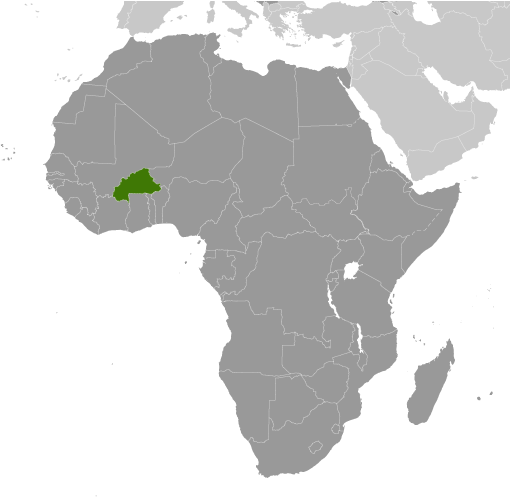
| BURKINA FASO Burkina Faso Burkina Faso Joined United Nations: 20 September 1960 Human Rights as assured by their constitution Click here Updated 07 August 2012 |
| CAPITAL |
| POPULATION |
| CHIEF OF STATE |
| SELECTION PROCESS |
Ouagadougou
17,275,115
NOTE: estimates for this country explicitly take into account the effects of
excess mortality due to AIDS; this can result in lower life expectancy, higher
infant mortality and death rates, lower population and growth rates, and changes
in the distribution of population by age and sex than would otherwise be
expected (July 2012 est.)
NOTE: estimates for this country explicitly take into account the effects of
excess mortality due to AIDS; this can result in lower life expectancy, higher
infant mortality and death rates, lower population and growth rates, and changes
in the distribution of population by age and sex than would otherwise be
expected (July 2012 est.)
Blaise Compaore
President since 15 October 1987
President since 15 October 1987
President elected by popular vote for a five-year term (eligible for
a second term); election last held 13 November 2005 ( in April
2000, the constitution was amended reducing the presidential term
from seven to five years, enforceable as of 2005
Next scheduled election: 2010
a second term); election last held 13 November 2005 ( in April
2000, the constitution was amended reducing the presidential term
from seven to five years, enforceable as of 2005
Next scheduled election: 2010
HEAD OF GOVERNMENT
SELECTION PROCESS
Luc-Adolphe Tiao
Prime Minister since 18 April 2011
Prime Minister since 18 April 2011
Prime Minister appointed by the president with the consent of
the legislature
the legislature
| DECLARATION OF HUMAN RIGHTS |
| ETHNIC GROUPS |
Mossi over 40%, Gurunsi, Senufo, Lobi, Bobo, Mande, Fulani
| RELIGIONS |
Muslim 60.5%, Catholic 19%, animist 15.3%, Protestant 4.2%, other 0.6%, none 0.4%
| GOVERNMENT STRUCTURE |
Parliamentary republic comprised of 45 provinces; Legal system is based on French civil law system and customary
law ; has not accepted compulsory ICJ jurisdiction
Executive: President elected by popular vote for a five-year term (eligible for a second term); election last held on 21
November 2010 (next to be held in 2015); prime minister appointed by the president with the consent of the legislature
Legislative: Unicameral National Assembly or Assemblee Nationale (111 seats; members are elected by popular vote
to serve five-year terms)
elections: National Assembly election last held on 6 May 2007 (next to be held in 2 December 2012)
Judicial: Supreme Court of Appeals or Cour de Cassation; Council of State or Conseil d'Etat; Court of Accounts or la
Cour des Comptes; Constitutional Council or Conseil Constitutionnel
law ; has not accepted compulsory ICJ jurisdiction
Executive: President elected by popular vote for a five-year term (eligible for a second term); election last held on 21
November 2010 (next to be held in 2015); prime minister appointed by the president with the consent of the legislature
Legislative: Unicameral National Assembly or Assemblee Nationale (111 seats; members are elected by popular vote
to serve five-year terms)
elections: National Assembly election last held on 6 May 2007 (next to be held in 2 December 2012)
Judicial: Supreme Court of Appeals or Cour de Cassation; Council of State or Conseil d'Etat; Court of Accounts or la
Cour des Comptes; Constitutional Council or Conseil Constitutionnel
| LANGUAGES |
French (official), native African languages belonging to Sudanic family spoken by 90% of the population
| BRIEF HISTORY |
| ECONOMIC OVERVIEW |
Burkina Faso is a poor, landlocked country that relies heavily on cotton and gold exports for revenue. The country has
few natural resources and a weak industrial base. About 90% of the population is engaged in subsistence agriculture,
which is vulnerable to periodic drought. Cotton is the main cash crop. Since 1998, Burkina Faso has embarked upon a
gradual privatization of state-owned enterprises and in 2004 revised its investment code to attract foreign investment.
As a result of this new code and other legislation favoring the mining sector, the country has seen an upswing in gold
exploration and production. By 2010, gold had become the main source of export revenue. Gold mining production
doubled between 2009 and 2010. Two new mining projects were launched the third quarter of 2011. Local community
conflict persists in the mining and cotton sectors, but the Prime Minister has made efforts to defuse some of the
economic cause of public discontent, including announcing income tax reductions, reparations for looting victims, and
subsidies for basic food items and fertilizer. An IMF mission to Burkina Faso in October 2011 expressed general
satisfaction with the measures. The risk of a mass exodus of the 3 to 4 million Burinabe who live and work in Cote
D'Ivoire has dissipated and trade, power, and transport links are being restored.
few natural resources and a weak industrial base. About 90% of the population is engaged in subsistence agriculture,
which is vulnerable to periodic drought. Cotton is the main cash crop. Since 1998, Burkina Faso has embarked upon a
gradual privatization of state-owned enterprises and in 2004 revised its investment code to attract foreign investment.
As a result of this new code and other legislation favoring the mining sector, the country has seen an upswing in gold
exploration and production. By 2010, gold had become the main source of export revenue. Gold mining production
doubled between 2009 and 2010. Two new mining projects were launched the third quarter of 2011. Local community
conflict persists in the mining and cotton sectors, but the Prime Minister has made efforts to defuse some of the
economic cause of public discontent, including announcing income tax reductions, reparations for looting victims, and
subsidies for basic food items and fertilizer. An IMF mission to Burkina Faso in October 2011 expressed general
satisfaction with the measures. The risk of a mass exodus of the 3 to 4 million Burinabe who live and work in Cote
D'Ivoire has dissipated and trade, power, and transport links are being restored.
| POLITICAL CLIMATE |
In 1995, Burkina held its first multiparty municipal elections since independence. With minor exceptions, balloting was
considered free and fair by the local human rights organizations which monitored the contest. The president's ODP/MT
won over 1,100 of some 1,700 councillor seats being contested.
In February 1996, the ruling ODP/MT merged with several small opposition parties to form the Congress for
Democracy and Progress (CDP). This effectively co-opted much of what little viable opposition to Compaoré existed.
The remaining opposition parties regrouped in preparation for 1997 legislative elections and the 1998 presidential
election. The 1997 legislative elections, which international observers pronounced to be substantially free, fair, and
transparent, resulted in a large CDP majority--101 to 111 seats.
The president is elected by popular vote for a seven-year term and may serve unlimited terms. The prime minister is
appointed by the president with the consent of the legislature. The constitution of June 2, 1991, established a
semi-presidential government with a parliament (Assemblée) which can be dissolved by the President of the Republic,
who is elected for a term of 5 years. The year 2000 saw a constitutional amendment reducing the presidential term from
7 to 5 years, which was enforced during the 2005 elections. Another change according to the amendment would have
prevented sitting president Blaise Compaoré from being re-elected. However, notwithstanding a challenge by other
presidential candidates, in October 2005, the constitutional council ruled that because Compaoré was already a sitting
president in 2000, the amendment would not apply to him until the end of his second term in office, thereby clearing the
way for his candidacy in the 2005 election. On November 13 Compaoré was reelected in a landslide due to a divided
political opposition.
Source: Wikipedia: Politics of Burkina Faso
considered free and fair by the local human rights organizations which monitored the contest. The president's ODP/MT
won over 1,100 of some 1,700 councillor seats being contested.
In February 1996, the ruling ODP/MT merged with several small opposition parties to form the Congress for
Democracy and Progress (CDP). This effectively co-opted much of what little viable opposition to Compaoré existed.
The remaining opposition parties regrouped in preparation for 1997 legislative elections and the 1998 presidential
election. The 1997 legislative elections, which international observers pronounced to be substantially free, fair, and
transparent, resulted in a large CDP majority--101 to 111 seats.
The president is elected by popular vote for a seven-year term and may serve unlimited terms. The prime minister is
appointed by the president with the consent of the legislature. The constitution of June 2, 1991, established a
semi-presidential government with a parliament (Assemblée) which can be dissolved by the President of the Republic,
who is elected for a term of 5 years. The year 2000 saw a constitutional amendment reducing the presidential term from
7 to 5 years, which was enforced during the 2005 elections. Another change according to the amendment would have
prevented sitting president Blaise Compaoré from being re-elected. However, notwithstanding a challenge by other
presidential candidates, in October 2005, the constitutional council ruled that because Compaoré was already a sitting
president in 2000, the amendment would not apply to him until the end of his second term in office, thereby clearing the
way for his candidacy in the 2005 election. On November 13 Compaoré was reelected in a landslide due to a divided
political opposition.
Source: Wikipedia: Politics of Burkina Faso
| INTERNATIONAL DISPUTES |
Adding to illicit cross-border activities, Burkina Faso has issues concerning unresolved boundary alignments with its
neighbors; demarcation is currently underway with Mali, the dispute with Niger was referred to the ICJ in 2010, and a
dispute over several villages with Benin persists; Benin retains a border dispute with Burkina Faso around the town of
Koualou
neighbors; demarcation is currently underway with Mali, the dispute with Niger was referred to the ICJ in 2010, and a
dispute over several villages with Benin persists; Benin retains a border dispute with Burkina Faso around the town of
Koualou


| REFUGEES AND INTERNALLY DISPLACED PERSONS (IDP) |
Refugees (country of origin): 32,000 (Mali) (2012)
| ILLICIT DRUGS |
None reported.
| HUMAN RIGHTS STATEMENTS, ANALYSIS AND CRITIQUES |
2011 Human Rights Report: Burkina Faso
Bureau of Democracy, Human Rights, and Labor
2011 Country Reports on Human Rights Practices
May 24, 2012
Burkina Faso is a presidential republic. In November 2010 President Blaise Compaore was reelected to a fourth term with more
than 80 percent of the vote. Despite some irregularities and the resource advantage held by the president, international observers
considered the election to have been free and transparent. The president, assisted by members of his party, the Congress for
Democracy and Progress (CDP), continued to dominate the government. The CDP won a majority in the 2007 legislative elections,
which observers declared generally free and orderly despite irregularities, including fraud involving voter identification cards. There
were instances in which elements of the security forces acted independently of civilian control.
Major human rights problems included security force use of excessive force against civilians, criminal suspects, and detainees;
abuse of prisoners and harsh prison conditions; and societal violence and discrimination against women and children, including
female genital mutilation.
Other major abuses included arbitrary arrest and detention, judicial inefficiency and lack of independence, official corruption,
trafficking in persons, discrimination against persons with disabilities, and child labor.
The government took steps to prosecute individuals in the police and military accused of human rights abuse. However, impunity
remained a problem in the country
Click here to read more »
Bureau of Democracy, Human Rights, and Labor
2011 Country Reports on Human Rights Practices
May 24, 2012
Burkina Faso is a presidential republic. In November 2010 President Blaise Compaore was reelected to a fourth term with more
than 80 percent of the vote. Despite some irregularities and the resource advantage held by the president, international observers
considered the election to have been free and transparent. The president, assisted by members of his party, the Congress for
Democracy and Progress (CDP), continued to dominate the government. The CDP won a majority in the 2007 legislative elections,
which observers declared generally free and orderly despite irregularities, including fraud involving voter identification cards. There
were instances in which elements of the security forces acted independently of civilian control.
Major human rights problems included security force use of excessive force against civilians, criminal suspects, and detainees;
abuse of prisoners and harsh prison conditions; and societal violence and discrimination against women and children, including
female genital mutilation.
Other major abuses included arbitrary arrest and detention, judicial inefficiency and lack of independence, official corruption,
trafficking in persons, discrimination against persons with disabilities, and child labor.
The government took steps to prosecute individuals in the police and military accused of human rights abuse. However, impunity
remained a problem in the country
Click here to read more »
29 January 2010
Committee on the Rights of the Child
Fifty-third session
11-29 January 2010
Consideration of reports submitted by States parties under article 44 of the Convention Concluding Observations of the
Committee on the Rights of the Child: BURKINA FASO
A. Introduction
2. The Committee welcomes the submission of combined third and fourth report periodic report as well as the written replies to its
list of issues (CRC/C/BFA/Q/3-4) which gave a better understanding of the situation of children in the State Party. It also
appreciates the presence of a high-level delegation and the frank and open dialogue with the delegation.
B. Follow-up measures and progress achieved by the State party
3. The Committee notes with appreciation the adoption of:
- Act No. 029-2008 on Combating Trafficking in Persons and Related Practices of 15 May 2008;
- Act No. 028-2008/AN of 14 May 2008 issuing the Labour Code;
- Act No. 049-2005/AN of 22 December 2005 on Reproductive Health; and
- Act N° 28-2004/AN of 8 September 2004 on Judiciary Organization.
C. Main areas of concern and recommendations
1. General measures of implementation
(arts. 4, 42 and 44, paragraph 6 of the Convention)
The Committee’s Previous Recommendations
6. The Committee welcomes efforts by the State party to implement the Committee’s 2002 concluding observations on the State
party’s second periodic report (CRC/C/15/Add.193). Nevertheless, the Committee regrets that some of its concerns and
recommendations have been insufficiently or only partly addressed.
7. The Committee urges the State party to take all necessary measures to address those recommendations from the concluding
observations of the second report that have not yet been implemented or sufficiently implemented, including those related notably to
the definition of the child, the allocation of resources for children, early and forced marriages, ill treatment of children in police
stations, child abuse and neglect and child labour. The Committee also recommends that the State party provide adequate follow-up
to the recommendations contained in the present concluding observations on the combined third and fourth periodic report.
Click here to read more »
Committee on the Rights of the Child
Fifty-third session
11-29 January 2010
Consideration of reports submitted by States parties under article 44 of the Convention Concluding Observations of the
Committee on the Rights of the Child: BURKINA FASO
A. Introduction
2. The Committee welcomes the submission of combined third and fourth report periodic report as well as the written replies to its
list of issues (CRC/C/BFA/Q/3-4) which gave a better understanding of the situation of children in the State Party. It also
appreciates the presence of a high-level delegation and the frank and open dialogue with the delegation.
B. Follow-up measures and progress achieved by the State party
3. The Committee notes with appreciation the adoption of:
- Act No. 029-2008 on Combating Trafficking in Persons and Related Practices of 15 May 2008;
- Act No. 028-2008/AN of 14 May 2008 issuing the Labour Code;
- Act No. 049-2005/AN of 22 December 2005 on Reproductive Health; and
- Act N° 28-2004/AN of 8 September 2004 on Judiciary Organization.
C. Main areas of concern and recommendations
1. General measures of implementation
(arts. 4, 42 and 44, paragraph 6 of the Convention)
The Committee’s Previous Recommendations
6. The Committee welcomes efforts by the State party to implement the Committee’s 2002 concluding observations on the State
party’s second periodic report (CRC/C/15/Add.193). Nevertheless, the Committee regrets that some of its concerns and
recommendations have been insufficiently or only partly addressed.
7. The Committee urges the State party to take all necessary measures to address those recommendations from the concluding
observations of the second report that have not yet been implemented or sufficiently implemented, including those related notably to
the definition of the child, the allocation of resources for children, early and forced marriages, ill treatment of children in police
stations, child abuse and neglect and child labour. The Committee also recommends that the State party provide adequate follow-up
to the recommendations contained in the present concluding observations on the combined third and fourth periodic report.
Click here to read more »
FREEDOM IN THE WORLD REPORT- 2012
Political Rights Score: 5
Civil Liberties Score: 3
Status: Partly Free
Overview
In the first half of 2011, Burkina Faso was rocked by antigovernment protests and army mutinies, followed by an increased level of
violence and instability. In response, President Blaise Compaoré replaced the prime minister and declared himself minister of
defense. In July, the leaders of the army mutiny were arrested and several hundred soldiers were dismissed, while three policemen
responsible for the death of a student in their custody were convicted in August.
In the November 2010 presidential election, six opposition candidates ran against Compaoré, who won with just over 80 percent of
the vote. His closest challenger, Hama Arba Diallo, captured less than 10 percent. Only 55 percent of registered voters came out to
the polls; the Burkina-based think tank, Center for Democratic Governance, estimated that over 3.5 million eligible voters remain
unregistered. Although four opposition candidates challenged Compaoré’s victory and called for a new election, the Constitutional
Council upheld the results. The 2010 election was the last in which Compaoré was eligible to run under the current constitution.
However, the CDP has stated its intention to revise Article 37 of the charter, which would allow him to run again in 2015.
In February 2011, student riots broke out in many major cities in reaction to the death of a student, Justin Zongo, while in police
custody. The government ordered universities to close and cut off funding for student services. Meanwhile, army soldiers mutinied
over unpaid wages from March to May, a period of looting and general violence nationwide. In April, policemen and teachers joined
the protests, demanding better pay and working conditions. Compaoré responded in mid-April by replacing the prime minister and
the security chiefs, and naming himself minister of defense. However, soldiers rampaged in Bobo-Dioulasso, the second-largest
city, for several days in early June until elite troops arrived to quell the unrest. Later in June, Compaoré replaced all 13 of the
country’s regional governors. In July, 217 leaders of the army mutiny were arrested and 566 soldiers who took part were
dismissed. In August, three policemen were sentenced for Zongo’s death.
The crisis in neighboring Côte d’Ivoire in early 2011 caused significant disruptions in the volume of trade to and from Burkina
Faso, as well as a sharp decrease in remittances from the large Burkinabè emigrant community in Côte d’Ivoire.
Burkina Faso is not an electoral democracy. International monitors have judged recent elections to be generally free but not entirely
fair, due to the ruling CDP’s privileged access to state resources and the media. Some reported problems with the 2010 presidential
election include traditional leaders mobilizing voters for the incumbent, inadequate numbers of voting cards and ballots at the polls,
incorrect electoral lists, and the use of state resources for President Blaise Compaoré’s campaign. The 111-seat National Assembly
is unicameral, and members serve five-year terms. The legislature is independent, but subject to executive influence. In July 2011,
the National Assembly dissolved the National Electoral Commission at the request of the opposition, and a new commission will be
formed before the May 2012 legislative and municipal elections.
Click here to read more »
Political Rights Score: 5
Civil Liberties Score: 3
Status: Partly Free
Overview
In the first half of 2011, Burkina Faso was rocked by antigovernment protests and army mutinies, followed by an increased level of
violence and instability. In response, President Blaise Compaoré replaced the prime minister and declared himself minister of
defense. In July, the leaders of the army mutiny were arrested and several hundred soldiers were dismissed, while three policemen
responsible for the death of a student in their custody were convicted in August.
In the November 2010 presidential election, six opposition candidates ran against Compaoré, who won with just over 80 percent of
the vote. His closest challenger, Hama Arba Diallo, captured less than 10 percent. Only 55 percent of registered voters came out to
the polls; the Burkina-based think tank, Center for Democratic Governance, estimated that over 3.5 million eligible voters remain
unregistered. Although four opposition candidates challenged Compaoré’s victory and called for a new election, the Constitutional
Council upheld the results. The 2010 election was the last in which Compaoré was eligible to run under the current constitution.
However, the CDP has stated its intention to revise Article 37 of the charter, which would allow him to run again in 2015.
In February 2011, student riots broke out in many major cities in reaction to the death of a student, Justin Zongo, while in police
custody. The government ordered universities to close and cut off funding for student services. Meanwhile, army soldiers mutinied
over unpaid wages from March to May, a period of looting and general violence nationwide. In April, policemen and teachers joined
the protests, demanding better pay and working conditions. Compaoré responded in mid-April by replacing the prime minister and
the security chiefs, and naming himself minister of defense. However, soldiers rampaged in Bobo-Dioulasso, the second-largest
city, for several days in early June until elite troops arrived to quell the unrest. Later in June, Compaoré replaced all 13 of the
country’s regional governors. In July, 217 leaders of the army mutiny were arrested and 566 soldiers who took part were
dismissed. In August, three policemen were sentenced for Zongo’s death.
The crisis in neighboring Côte d’Ivoire in early 2011 caused significant disruptions in the volume of trade to and from Burkina
Faso, as well as a sharp decrease in remittances from the large Burkinabè emigrant community in Côte d’Ivoire.
Burkina Faso is not an electoral democracy. International monitors have judged recent elections to be generally free but not entirely
fair, due to the ruling CDP’s privileged access to state resources and the media. Some reported problems with the 2010 presidential
election include traditional leaders mobilizing voters for the incumbent, inadequate numbers of voting cards and ballots at the polls,
incorrect electoral lists, and the use of state resources for President Blaise Compaoré’s campaign. The 111-seat National Assembly
is unicameral, and members serve five-year terms. The legislature is independent, but subject to executive influence. In July 2011,
the National Assembly dissolved the National Electoral Commission at the request of the opposition, and a new commission will be
formed before the May 2012 legislative and municipal elections.
Click here to read more »
11 October 2011
STATEMENT BY AMNESTY INTERNATIONAL
Item 6: Human Rights Situation in Africa
Amnesty International welcomes this opportunity to address the African Commission on Human and Peoples’ Rights (African
Commission) on the state of the situation of human rights in Africa. In this statement, Amnesty International would like to focus on
the status of the death penalty in Africa and progress towards its abolition.
Among the 53 State Parties to the African Charter on Human and Peoples’ Rights (African Charter), 37 states retain the death
penalty in their national laws. But only six African states executed convicted persons in 2010. Furthermore, 38 African Charter
Member States are abolitionist in law (16) or practice (22). This means that both on the global and on the regional level in Africa,
more than two thirds of the respective countries have abolished the death penalty in law or practice. Presently 96 countries
worldwide have abolished the death penalty completely, nine only retain them for extra-ordinary crimes, and 34 countries have not
carried out executions for at least ten years. Of the 58 fully retentionist countries, only 23 were known to have carried out
executions in 2010, or only 12 per cent of the world’s states, exemplifying their isolated stance. States actively using death
sentences or even carrying out executions find themselves part of an ever-decreasing minority. This is true for Africa as it is in the
rest of the world. Amnesty International firmly believes that Africa has the potential to become a region that is free of executions.
Over the last years, the government of Burkina Faso has made several statements in favor of abolition. Most recently, during a
meeting with a delegation from Amnesty International in March 2011, the then- Minister of Human Rights informed the delegation
of her intention to request the ratification of the Second Optional Protocol to the ICCPR. To this day, no measures are known to
have been taken to start the ratification process.
Amnesty International therefore urges the African Commission to call:
· upon Mali to adopt the draft bill for abolition of the death penalty;
· upon Burkina Faso to ratify the Second Optional Protocol;
· upon the authorities in Ghana and Zimbabwe to include provisions abolishing the death penalty in their revised new constitutions.
Issues of concerns
Amnesty International would also like to respectfully bring a number of negative developments to your attention. Amnesty
International is particularly concerned about executions carried out in Egypt and Somalia in 2011. The organization also received
information on death sentences imposed in the Democratic Republic of Congo, Egypt, The Gambia, Ghana, Guinea, Kenya, Mali,
Mauritania, Nigeria, Sierra Leone, Sudan, Swaziland and Uganda in the course of the year. In at least one country, Mauritania,
juveniles were among those sentenced to death.
Click here to read more »
STATEMENT BY AMNESTY INTERNATIONAL
Item 6: Human Rights Situation in Africa
Amnesty International welcomes this opportunity to address the African Commission on Human and Peoples’ Rights (African
Commission) on the state of the situation of human rights in Africa. In this statement, Amnesty International would like to focus on
the status of the death penalty in Africa and progress towards its abolition.
Among the 53 State Parties to the African Charter on Human and Peoples’ Rights (African Charter), 37 states retain the death
penalty in their national laws. But only six African states executed convicted persons in 2010. Furthermore, 38 African Charter
Member States are abolitionist in law (16) or practice (22). This means that both on the global and on the regional level in Africa,
more than two thirds of the respective countries have abolished the death penalty in law or practice. Presently 96 countries
worldwide have abolished the death penalty completely, nine only retain them for extra-ordinary crimes, and 34 countries have not
carried out executions for at least ten years. Of the 58 fully retentionist countries, only 23 were known to have carried out
executions in 2010, or only 12 per cent of the world’s states, exemplifying their isolated stance. States actively using death
sentences or even carrying out executions find themselves part of an ever-decreasing minority. This is true for Africa as it is in the
rest of the world. Amnesty International firmly believes that Africa has the potential to become a region that is free of executions.
Over the last years, the government of Burkina Faso has made several statements in favor of abolition. Most recently, during a
meeting with a delegation from Amnesty International in March 2011, the then- Minister of Human Rights informed the delegation
of her intention to request the ratification of the Second Optional Protocol to the ICCPR. To this day, no measures are known to
have been taken to start the ratification process.
Amnesty International therefore urges the African Commission to call:
· upon Mali to adopt the draft bill for abolition of the death penalty;
· upon Burkina Faso to ratify the Second Optional Protocol;
· upon the authorities in Ghana and Zimbabwe to include provisions abolishing the death penalty in their revised new constitutions.
Issues of concerns
Amnesty International would also like to respectfully bring a number of negative developments to your attention. Amnesty
International is particularly concerned about executions carried out in Egypt and Somalia in 2011. The organization also received
information on death sentences imposed in the Democratic Republic of Congo, Egypt, The Gambia, Ghana, Guinea, Kenya, Mali,
Mauritania, Nigeria, Sierra Leone, Sudan, Swaziland and Uganda in the course of the year. In at least one country, Mauritania,
juveniles were among those sentenced to death.
Click here to read more »
Letter to Foreign Ministers in advance of the 19th African Union Summit
Letter from African Civil Society and International Organizations on the Relationship between the ICC and the AU
July 10, 2012
Dear Foreign Minister,
On the occasion of the 19th summit of the African Union, which will be held in Addis Ababa from July 9-16, 2012, African civil
society organizations and international organizations with a presence in Africa write to address Your Excellencies on events that
surround the relationship between the International Criminal Court (ICC) and the African Union (AU).
Efforts by the AU and African states to fight impunity
The African Union has made a commitment to ending impunity, as enshrined in its Constitutive Act (Article 4(h)(o)), and has
illustrated this commitment on different occasions. Notably, in 2006 and 2007, at an AU meeting of heads of state in Addis Ababa,
Sudanese President Omar al-Bashir’s bid to become the AU chairperson was rejected due to the atrocities that were occurring in
Darfur, Sudan. More recently, the AU deployed 5,000 troops to pursue Joseph Kony of the Lord’s Resistance Army, who is
wanted by the ICC for crimes committed in northern Uganda.The AU has also played a key role in pressing Senegal to investigate
and prosecute Hissène Habré, the former president of Chad, for serious crimes.
Beyond the AU forum, individual African states have independently reaffirmed their commitments to ending impunity. This includes
the requests by the governments of Uganda, the Democratic Republic of Congo, the Central African Republic, and Côte d’Ivoire to
the International Criminal Court to investigate crimes committed in their countries.
A number of African states have incorporated genocide, war crimes, crimes against humanity, and cooperation with the ICC into
their domestic law. Mauritius adopted such legislation in 2012, and other countries—including Burkina Faso, the Central African
Republic, Kenya, Senegal, and South Africa—previously enacted such laws.
Click here to read more »
Letter from African Civil Society and International Organizations on the Relationship between the ICC and the AU
July 10, 2012
Dear Foreign Minister,
On the occasion of the 19th summit of the African Union, which will be held in Addis Ababa from July 9-16, 2012, African civil
society organizations and international organizations with a presence in Africa write to address Your Excellencies on events that
surround the relationship between the International Criminal Court (ICC) and the African Union (AU).
Efforts by the AU and African states to fight impunity
The African Union has made a commitment to ending impunity, as enshrined in its Constitutive Act (Article 4(h)(o)), and has
illustrated this commitment on different occasions. Notably, in 2006 and 2007, at an AU meeting of heads of state in Addis Ababa,
Sudanese President Omar al-Bashir’s bid to become the AU chairperson was rejected due to the atrocities that were occurring in
Darfur, Sudan. More recently, the AU deployed 5,000 troops to pursue Joseph Kony of the Lord’s Resistance Army, who is
wanted by the ICC for crimes committed in northern Uganda.The AU has also played a key role in pressing Senegal to investigate
and prosecute Hissène Habré, the former president of Chad, for serious crimes.
Beyond the AU forum, individual African states have independently reaffirmed their commitments to ending impunity. This includes
the requests by the governments of Uganda, the Democratic Republic of Congo, the Central African Republic, and Côte d’Ivoire to
the International Criminal Court to investigate crimes committed in their countries.
A number of African states have incorporated genocide, war crimes, crimes against humanity, and cooperation with the ICC into
their domestic law. Mauritius adopted such legislation in 2012, and other countries—including Burkina Faso, the Central African
Republic, Kenya, Senegal, and South Africa—previously enacted such laws.
Click here to read more »
TRANSLATED FROM FRENCH BY GOOGLE TRANSLATE
Policy statement of the Prime Minister Luc Adolphe Tiao: the entire document
Thursday, November 10, 2011
Exactly one week ago, I presented before this august Assembly, the state of the nation. Significant advances were recorded during the
past four years. I congratulate my predecessor, His Excellency Mr. Tertius Zongo, and the government team he led, for the work
done. But major challenges still remain and have been further highlighted by the crisis that has shaken the foundations of the recently
Burkinabe society. I mainly remember:
- The challenge of governance still hampered by legal and administrative failures;
- The challenge of the fight against corruption, fraud, incivility and insecurity due to the persistence of poverty, cultural extraversion
and the loss of core values in our societies;
- The challenge of strengthening human and institutional capacity causing low labor productivity and administrative burdens out of
step with the need for speed and competitiveness that characterize today's business governance;
- The challenge of a youth who legitimately claim their right to contribute to national development;
- The challenge of women, proud to exercise their reproductive claimed their place in national political life and see their various
contributions taken into account explicitly in the accounts of national wealth;
- The real challenge of the leader of the demographic transition due to the still high level of fertility and mortality in continuous decline;
- Finally, the challenge to break even operate to transform our business model to boost growth in a healthy, pro-poor and sustainable.
Prospects to meet all these challenges, are all drawn into the social project of President Blaise Compaore: "Building together a Burkina
emerge." Explicitly, it is for him, I quote: "... to build a society confident and determined, driven by its endogenous energy, fortified by
the opportunities open to the world. Freedom, dynamism, the continuing quest for excellence, sharing, solidarity and consensus are
key elements to converge towards this vision. "End quote. Four imperatives are highlighted. These are:
- Confidence in the capacity as endogenous factors of progress and emancipation;
- The culture of excellence and competition to take better advantage of opportunities offered by globalization and regionalization;
- The inculcation of values of sharing, solidarity and consensus as a factor of social cohesion;
- The continued strengthening of democracy through the promotion of collective and individual freedoms.
Click here to read more »
Policy statement of the Prime Minister Luc Adolphe Tiao: the entire document
Thursday, November 10, 2011
Exactly one week ago, I presented before this august Assembly, the state of the nation. Significant advances were recorded during the
past four years. I congratulate my predecessor, His Excellency Mr. Tertius Zongo, and the government team he led, for the work
done. But major challenges still remain and have been further highlighted by the crisis that has shaken the foundations of the recently
Burkinabe society. I mainly remember:
- The challenge of governance still hampered by legal and administrative failures;
- The challenge of the fight against corruption, fraud, incivility and insecurity due to the persistence of poverty, cultural extraversion
and the loss of core values in our societies;
- The challenge of strengthening human and institutional capacity causing low labor productivity and administrative burdens out of
step with the need for speed and competitiveness that characterize today's business governance;
- The challenge of a youth who legitimately claim their right to contribute to national development;
- The challenge of women, proud to exercise their reproductive claimed their place in national political life and see their various
contributions taken into account explicitly in the accounts of national wealth;
- The real challenge of the leader of the demographic transition due to the still high level of fertility and mortality in continuous decline;
- Finally, the challenge to break even operate to transform our business model to boost growth in a healthy, pro-poor and sustainable.
Prospects to meet all these challenges, are all drawn into the social project of President Blaise Compaore: "Building together a Burkina
emerge." Explicitly, it is for him, I quote: "... to build a society confident and determined, driven by its endogenous energy, fortified by
the opportunities open to the world. Freedom, dynamism, the continuing quest for excellence, sharing, solidarity and consensus are
key elements to converge towards this vision. "End quote. Four imperatives are highlighted. These are:
- Confidence in the capacity as endogenous factors of progress and emancipation;
- The culture of excellence and competition to take better advantage of opportunities offered by globalization and regionalization;
- The inculcation of values of sharing, solidarity and consensus as a factor of social cohesion;
- The continued strengthening of democracy through the promotion of collective and individual freedoms.
Click here to read more »
TRANSLATED FROM FRENCH BY GOOGLE TRANSLATE
This visit marks the "normalization" of relations
MINISTRY IN CHARGE OF HUMAN RIGHTS-MBDHP
- The Country - Archives - The Land of No. 5073 Monday, March 19, 2012 -
Date online: Sunday, March 18, 2012
Publishing The Country
Professor Albert Ouedraogo, Minister of Human Rights and Civic Promotion (MDHPC) accompanied by his closest aides, paid a
courtesy visit to Burkinabe Movement for Human Rights and Peoples (MBDHP), Friday, March 16 2012 at its headquarters in
Ouagadougou. Objective of the politician: a tribute to pioneer organization in the defense and promotion of human rights in Burkina
Faso by the duty of remembrance and gratitude for all the action of struggle of "the brothers, human rights activists "that are
activists of the movement. What, the same time, mark the "normalization" of relations between the two organizations, once
perceived as reports of "tension".
The date of March 16, 2012 will forever be engraved in the history of MBDHP. The reason is simple: the movement has received in
that day, his first official visit by a member of the government, memory activist and head of its president, Chrysogonus Zougmoré.
A visit not least because it is the one the first Head of Human Rights and promoting civic, ministry of MBDHP. Indeed, the
MDHPC, Albert Ouedraogo, accompanied by his closest colleagues, conducted a courtesy visit to the headquarters for MBDHP, he
said, paying tribute to the "pioneer of organization defense and promotion of human rights "in Burkina Faso. This visit is for him "a
duty to remember and gratitude for all the action of struggle of the brothers that human rights activists are activists MBDHP
because of, get in the fight for human rights was a real vocation. " Once perceived as an "enemy to crush" in the words of
Chrysogonus Zougmoré, the MBDHP is perceived as an ally to Professor Albert Ouedraogo despite the differential response
because the bottom is the same: the defense and promotion of human rights. Thus the minister suggested that "we are committed to
working together with all organizations of the defense and promotion of human rights, in the MBDHP first as an organization
pioneer, and soon transform this trial into actions convergence field by educating people on issues of tolerance, civility and respect
of human life. " For this visit marks the beginning of a "normalization" of relations between the department and the movement, the
latter by its President, Chrysogonus Zougmoré, said he was honored and comforted. That is, he says, a evidence that the MBDHP
contributes to the consolidation of democracy and human rights in Burkina. The opportunity was also seized by the movement to
raise points of concern which have also been recorded in its official documents, for example, the various reports. "The drifts in the
first known half of 2011 and even in early 2012, the question of abolishing the death penalty is not still effective as the first human
right is the right to life and cases pending in court which deserve careful handling "are some of these points of concern.
Chrysogonus Zougmoré has also entrusted that the movement will always stand by the Ministry for a synergy of actions to achieve
the goal while keeping, as the most jealous possible independence. He, therefore, officially handed over to Minister all documents of
the movement. Visiting the local administration through "Radio Liberty", has ended the courtesy which took place in a climate of
good will.
Click here to read more »
This visit marks the "normalization" of relations
MINISTRY IN CHARGE OF HUMAN RIGHTS-MBDHP
- The Country - Archives - The Land of No. 5073 Monday, March 19, 2012 -
Date online: Sunday, March 18, 2012
Publishing The Country
Professor Albert Ouedraogo, Minister of Human Rights and Civic Promotion (MDHPC) accompanied by his closest aides, paid a
courtesy visit to Burkinabe Movement for Human Rights and Peoples (MBDHP), Friday, March 16 2012 at its headquarters in
Ouagadougou. Objective of the politician: a tribute to pioneer organization in the defense and promotion of human rights in Burkina
Faso by the duty of remembrance and gratitude for all the action of struggle of "the brothers, human rights activists "that are
activists of the movement. What, the same time, mark the "normalization" of relations between the two organizations, once
perceived as reports of "tension".
The date of March 16, 2012 will forever be engraved in the history of MBDHP. The reason is simple: the movement has received in
that day, his first official visit by a member of the government, memory activist and head of its president, Chrysogonus Zougmoré.
A visit not least because it is the one the first Head of Human Rights and promoting civic, ministry of MBDHP. Indeed, the
MDHPC, Albert Ouedraogo, accompanied by his closest colleagues, conducted a courtesy visit to the headquarters for MBDHP, he
said, paying tribute to the "pioneer of organization defense and promotion of human rights "in Burkina Faso. This visit is for him "a
duty to remember and gratitude for all the action of struggle of the brothers that human rights activists are activists MBDHP
because of, get in the fight for human rights was a real vocation. " Once perceived as an "enemy to crush" in the words of
Chrysogonus Zougmoré, the MBDHP is perceived as an ally to Professor Albert Ouedraogo despite the differential response
because the bottom is the same: the defense and promotion of human rights. Thus the minister suggested that "we are committed to
working together with all organizations of the defense and promotion of human rights, in the MBDHP first as an organization
pioneer, and soon transform this trial into actions convergence field by educating people on issues of tolerance, civility and respect
of human life. " For this visit marks the beginning of a "normalization" of relations between the department and the movement, the
latter by its President, Chrysogonus Zougmoré, said he was honored and comforted. That is, he says, a evidence that the MBDHP
contributes to the consolidation of democracy and human rights in Burkina. The opportunity was also seized by the movement to
raise points of concern which have also been recorded in its official documents, for example, the various reports. "The drifts in the
first known half of 2011 and even in early 2012, the question of abolishing the death penalty is not still effective as the first human
right is the right to life and cases pending in court which deserve careful handling "are some of these points of concern.
Chrysogonus Zougmoré has also entrusted that the movement will always stand by the Ministry for a synergy of actions to achieve
the goal while keeping, as the most jealous possible independence. He, therefore, officially handed over to Minister all documents of
the movement. Visiting the local administration through "Radio Liberty", has ended the courtesy which took place in a climate of
good will.
Click here to read more »
TRANSLATED FROM FRENCH BY GOOGLE TRANSLATE
The Ombudsman of Burkina Faso, an institution that needs to be strengthened and known
By Justin on June 19, 2012 Yarga
The Prime Minister Luc Adolphe Tiao was Monday morning visiting the Ombudsman of Burkina Faso. Hosted by Alima Traore,
Mediator of Faso, surrounded by his staff, they are mostly complaints awaiting the head of government. Despite his 16 years of
existence, it still suffers from a lack of visibility, a consequence of the weakness of his means.
The morning of Monday, June 18 was special for the institution of Ombudsman of Burkina Faso. For 87 officers of the institution,
it is a great honor to receive the Prime Minister who came for the first time since his appointment in April 2011. As head of the
Government of Burkina Faso visit to the mediator, responsible for reconciling administered and administration is a great opportunity
for him to tap away the reality of this work, suggested Alima Traore. The opportunity was also seized for submission to the Prime
Minister needs human, logistical and financial, especially in order to strengthen the Ombudsman's delegations in regions of Burkina
Faso.
In 16 years, the Ombudsman of Burkina Faso has treated over 4800 cases, despite the limited visibility and difficulties in relations
with government. "Often we write to government and we do not get answers," said Ms. Sylvie Ouedraogo, head of the department
of economic affairs, social and cultural. For her, with more resources, the institution can do better. Because they are not lacking
ambition. Marcel Ouedraogo, head of IT division, cites as an illustration of the proposed establishment of a computer system that
will facilitate the processing of claims, allowing citizens to stay informed at all times of their claims via the Internet or the phone
mobile.
For his part, Prime Minister paid tribute to "the extraordinary work shot by the Ombudsman of Burkina Faso in 16 years." "More
than ever, the role of this institution should be strengthened and expanded its role in our country changing sociological," wrote the
Prime Minister in the guestbook of the institution. Specifically, he wants the institution to engage in its own way to contribute to
social peace in Burkina Faso.
Click here to read more »
The Ombudsman of Burkina Faso, an institution that needs to be strengthened and known
By Justin on June 19, 2012 Yarga
The Prime Minister Luc Adolphe Tiao was Monday morning visiting the Ombudsman of Burkina Faso. Hosted by Alima Traore,
Mediator of Faso, surrounded by his staff, they are mostly complaints awaiting the head of government. Despite his 16 years of
existence, it still suffers from a lack of visibility, a consequence of the weakness of his means.
The morning of Monday, June 18 was special for the institution of Ombudsman of Burkina Faso. For 87 officers of the institution,
it is a great honor to receive the Prime Minister who came for the first time since his appointment in April 2011. As head of the
Government of Burkina Faso visit to the mediator, responsible for reconciling administered and administration is a great opportunity
for him to tap away the reality of this work, suggested Alima Traore. The opportunity was also seized for submission to the Prime
Minister needs human, logistical and financial, especially in order to strengthen the Ombudsman's delegations in regions of Burkina
Faso.
In 16 years, the Ombudsman of Burkina Faso has treated over 4800 cases, despite the limited visibility and difficulties in relations
with government. "Often we write to government and we do not get answers," said Ms. Sylvie Ouedraogo, head of the department
of economic affairs, social and cultural. For her, with more resources, the institution can do better. Because they are not lacking
ambition. Marcel Ouedraogo, head of IT division, cites as an illustration of the proposed establishment of a computer system that
will facilitate the processing of claims, allowing citizens to stay informed at all times of their claims via the Internet or the phone
mobile.
For his part, Prime Minister paid tribute to "the extraordinary work shot by the Ombudsman of Burkina Faso in 16 years." "More
than ever, the role of this institution should be strengthened and expanded its role in our country changing sociological," wrote the
Prime Minister in the guestbook of the institution. Specifically, he wants the institution to engage in its own way to contribute to
social peace in Burkina Faso.
Click here to read more »
Mossi (sing. Moaaga) are a people in central Burkina Faso, living mostly in the villages of the Volta River Basin. The
Mossi are the largest ethnic group in Burkina Faso, constituting 40% of the population, or about 6.2 million people. The
other 60% of Burkina Faso's population is composed of more than 60 ethnic groups, mainly the Gurunsi, Senufo, Lobi,
Bobo, and Fulani. The Mossi speak the More language. According to tradition, the Mossi derive from the marriage of
a Dagomba princess and Mandé hunter. Yennenga was a warrior princess, daughter of a Dagomba king in upper east
Ghana. While exploring her kingdom on horseback, she lost her way and was rescued by Rialé, a solitary Mandé
hunter. They got married and gave birth to the first authentic Mossi: Ouedraogo who is recognised as the father of
Mossi people. Despite its status as a legend, it contains factual information: the Mossi originate from the Ashanti group,
a Ghanaian entity composed of many subgroups. The Mossi also are also directly descended from the Dagomba
people and similarly live in Upper East Ghana with a capital of Tamale. As the Mossi people's history has been kept by
oral tradition, it is impossible to assign precise dates for the period before colonization. Nevertheless historians assign
the beginning of their existence as a state to the 15th century. The Mossi were able to conquer a vast amounts of
territory thanks to their mastering of the horse, and created a prosperous empire and kept peace in the region until the
beginning of colonialism. The expansion of the Mossi empire was stopped in the 19th century with the initiation of
intensive colonisation by the French. For centuries, the Mossi peasant was both farmer and soldier, and the Mossi
people were able to defend their religious beliefs and social structure against forcible attempts to convert them to Islam
by Muslims from the northwest. When the French arrived and claimed the area in 1896, Mossi resistance ended with
the capture of their capital at Ouagadougou. In 1919, certain provinces from Côte d'Ivoire were united into a separate
colony called the Upper Volta in the French West Africa federation. In 1932, the new colony was dismembered in a
move to economize; it was reconstituted in 1937 as an administrative division called the Upper Coast. After World
War II, the Mossi renewed their pressure for separate territorial status and on September 4, 1947, Upper Volta
became a French West African territory again in its own right. A revision in the organization of French Overseas
Territories began with the passage of the Basic Law (Loi Cadre) of July 23, 1956. This act was followed by
reorganizational measures approved by the French parliament early in 1957 that ensured a large degree of self-
government for individual territories. Upper Volta became an autonomous republic in the French community on
December 11, 1958. Upper Volta achieved independence on August 5, 1960. The first president, Maurice Yaméogo,
was the leader of the Voltaic Democratic Union (UDV). The 1960 constitution provided for election by universal
suffrage of a president and a national assembly for 5-year terms. Soon after coming to power, Yaméogo banned all
political parties other than the UDV. The government lasted until 1966 when after much unrest-mass demonstrations
and strikes by students, labor unions, and civil servants-the military intervened. The military coup deposed Yaméogo,
suspended the constitution, dissolved the National Assembly, and placed Lt. Col. Sangoulé Lamizana at the head of a
government of senior army officers. The army remained in power for 4 years, and on June 14, 1970, the Voltans
ratified a new constitution that established a 4-year transition period toward complete civilian rule. Lamizana remained
in power throughout the 1970s as president of military or mixed civil-military governments. After conflict over the 1970
constitution, a new constitution was written and approved in 1977, and Lamizana was reelected by open elections in
1978. Lamizana's government faced problems with the country's traditionally powerful trade unions, and on November
25, 1980, Col. Saye Zerbo overthrew President Lamizana in a bloodless coup. Colonel Zerbo established the Military
Committee of Recovery for National Progress as the supreme governmental authority, thus eradicating the 1977
constitution. Colonel Zerbo also encountered resistance from trade unions and was overthrown two years later, on
November 7, 1982, by Maj. Dr. Jean-Baptiste Ouédraogo and the Council of Popular Salvation (CSP). The CSP
continued to ban political parties and organizations, yet promised a transition to civilian rule and a new constitution.
Factional infighting developed between moderates in the CSP and the radicals, led by Capt. Thomas Sankara, who
was appointed prime minister in January 1983. The internal political struggle and Sankara's leftist rhetoric led to his
arrest and subsequent efforts to bring about his release, directed by Capt. Blaise Compaoré. This release effort resulted
in yet another military coup d'état on August 4, 1983. After the coup, Sankara formed the National Council for the
Revolution (CNR), with himself as president. Sankara also established Committees for the Defense of the Revolution
(CDRs) to "mobilize the masses" and implement the CNR's revolutionary programs. The CNR, whose exact
membership remained secret until the end, contained two small intellectual Marxist-Leninist groups. Sankara,
Compaore, Capt. Henri Zongo, and Maj. Jean-Baptiste Lingani-all leftist military officers-dominated the regime. On
August 4, 1984, Upper Volta changed its name to Burkina Faso, meaning "the country of honorable people." Sankara,
a charismatic leader, sought by word, deed, and example to mobilize the masses and launch a massive bootstrap
development movement. On Christmas Day 1985, tensions with Mali over the mineral-rich Agacher Strip erupted in a
war that lasted five days and killed about 100 people. The conflict ended after mediation by President Félix Houphouët-
Boigny of Ivory Coast. The conflict is known as the "Christmas war" in Burkina Faso. Repeated military coups during
the 1970s and 1980s were followed by multiparty elections in the early 1990s. Burkina Faso's high population density
and limited natural resources result in poor economic prospects for the majority of its citizens. Recent unrest in Cote
d'Ivoire and northern Ghana has hindered the ability of several hundred thousand seasonal Burkinabe farm workers to
find employment in neighboring countries.In April 2005, President Compaoré was re–elected for a third straight term.
He won 80.3% of the vote, while Benewende Stanislas Sankara came a distant second with a mere 4.9%. In
November 2010, President Compaoré was re–elected for a fourth straight term. He won 80.2% of the vote, while
Hama Arba Diallo came a distant second with a mere 8.2%. In February 2011, the death of a schoolboy provoked an
uprising in the entire country, lasting through April 2011, which was coupled with a military mutiny and with a strike of
the magistrates.
Sources: Wikipedia History of Burkina Faso; CIA World Factbook (select Burkina Faso)
Mossi are the largest ethnic group in Burkina Faso, constituting 40% of the population, or about 6.2 million people. The
other 60% of Burkina Faso's population is composed of more than 60 ethnic groups, mainly the Gurunsi, Senufo, Lobi,
Bobo, and Fulani. The Mossi speak the More language. According to tradition, the Mossi derive from the marriage of
a Dagomba princess and Mandé hunter. Yennenga was a warrior princess, daughter of a Dagomba king in upper east
Ghana. While exploring her kingdom on horseback, she lost her way and was rescued by Rialé, a solitary Mandé
hunter. They got married and gave birth to the first authentic Mossi: Ouedraogo who is recognised as the father of
Mossi people. Despite its status as a legend, it contains factual information: the Mossi originate from the Ashanti group,
a Ghanaian entity composed of many subgroups. The Mossi also are also directly descended from the Dagomba
people and similarly live in Upper East Ghana with a capital of Tamale. As the Mossi people's history has been kept by
oral tradition, it is impossible to assign precise dates for the period before colonization. Nevertheless historians assign
the beginning of their existence as a state to the 15th century. The Mossi were able to conquer a vast amounts of
territory thanks to their mastering of the horse, and created a prosperous empire and kept peace in the region until the
beginning of colonialism. The expansion of the Mossi empire was stopped in the 19th century with the initiation of
intensive colonisation by the French. For centuries, the Mossi peasant was both farmer and soldier, and the Mossi
people were able to defend their religious beliefs and social structure against forcible attempts to convert them to Islam
by Muslims from the northwest. When the French arrived and claimed the area in 1896, Mossi resistance ended with
the capture of their capital at Ouagadougou. In 1919, certain provinces from Côte d'Ivoire were united into a separate
colony called the Upper Volta in the French West Africa federation. In 1932, the new colony was dismembered in a
move to economize; it was reconstituted in 1937 as an administrative division called the Upper Coast. After World
War II, the Mossi renewed their pressure for separate territorial status and on September 4, 1947, Upper Volta
became a French West African territory again in its own right. A revision in the organization of French Overseas
Territories began with the passage of the Basic Law (Loi Cadre) of July 23, 1956. This act was followed by
reorganizational measures approved by the French parliament early in 1957 that ensured a large degree of self-
government for individual territories. Upper Volta became an autonomous republic in the French community on
December 11, 1958. Upper Volta achieved independence on August 5, 1960. The first president, Maurice Yaméogo,
was the leader of the Voltaic Democratic Union (UDV). The 1960 constitution provided for election by universal
suffrage of a president and a national assembly for 5-year terms. Soon after coming to power, Yaméogo banned all
political parties other than the UDV. The government lasted until 1966 when after much unrest-mass demonstrations
and strikes by students, labor unions, and civil servants-the military intervened. The military coup deposed Yaméogo,
suspended the constitution, dissolved the National Assembly, and placed Lt. Col. Sangoulé Lamizana at the head of a
government of senior army officers. The army remained in power for 4 years, and on June 14, 1970, the Voltans
ratified a new constitution that established a 4-year transition period toward complete civilian rule. Lamizana remained
in power throughout the 1970s as president of military or mixed civil-military governments. After conflict over the 1970
constitution, a new constitution was written and approved in 1977, and Lamizana was reelected by open elections in
1978. Lamizana's government faced problems with the country's traditionally powerful trade unions, and on November
25, 1980, Col. Saye Zerbo overthrew President Lamizana in a bloodless coup. Colonel Zerbo established the Military
Committee of Recovery for National Progress as the supreme governmental authority, thus eradicating the 1977
constitution. Colonel Zerbo also encountered resistance from trade unions and was overthrown two years later, on
November 7, 1982, by Maj. Dr. Jean-Baptiste Ouédraogo and the Council of Popular Salvation (CSP). The CSP
continued to ban political parties and organizations, yet promised a transition to civilian rule and a new constitution.
Factional infighting developed between moderates in the CSP and the radicals, led by Capt. Thomas Sankara, who
was appointed prime minister in January 1983. The internal political struggle and Sankara's leftist rhetoric led to his
arrest and subsequent efforts to bring about his release, directed by Capt. Blaise Compaoré. This release effort resulted
in yet another military coup d'état on August 4, 1983. After the coup, Sankara formed the National Council for the
Revolution (CNR), with himself as president. Sankara also established Committees for the Defense of the Revolution
(CDRs) to "mobilize the masses" and implement the CNR's revolutionary programs. The CNR, whose exact
membership remained secret until the end, contained two small intellectual Marxist-Leninist groups. Sankara,
Compaore, Capt. Henri Zongo, and Maj. Jean-Baptiste Lingani-all leftist military officers-dominated the regime. On
August 4, 1984, Upper Volta changed its name to Burkina Faso, meaning "the country of honorable people." Sankara,
a charismatic leader, sought by word, deed, and example to mobilize the masses and launch a massive bootstrap
development movement. On Christmas Day 1985, tensions with Mali over the mineral-rich Agacher Strip erupted in a
war that lasted five days and killed about 100 people. The conflict ended after mediation by President Félix Houphouët-
Boigny of Ivory Coast. The conflict is known as the "Christmas war" in Burkina Faso. Repeated military coups during
the 1970s and 1980s were followed by multiparty elections in the early 1990s. Burkina Faso's high population density
and limited natural resources result in poor economic prospects for the majority of its citizens. Recent unrest in Cote
d'Ivoire and northern Ghana has hindered the ability of several hundred thousand seasonal Burkinabe farm workers to
find employment in neighboring countries.In April 2005, President Compaoré was re–elected for a third straight term.
He won 80.3% of the vote, while Benewende Stanislas Sankara came a distant second with a mere 4.9%. In
November 2010, President Compaoré was re–elected for a fourth straight term. He won 80.2% of the vote, while
Hama Arba Diallo came a distant second with a mere 8.2%. In February 2011, the death of a schoolboy provoked an
uprising in the entire country, lasting through April 2011, which was coupled with a military mutiny and with a strike of
the magistrates.
Sources: Wikipedia History of Burkina Faso; CIA World Factbook (select Burkina Faso)


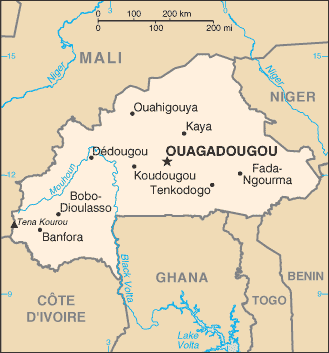
| Click on map for larger view |
Click on flag for Country Report





| TRAFFICKING IN PERSONS |
None reported.