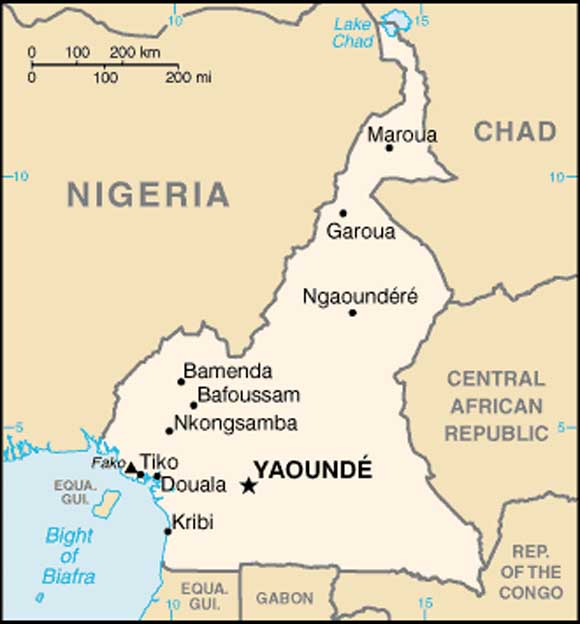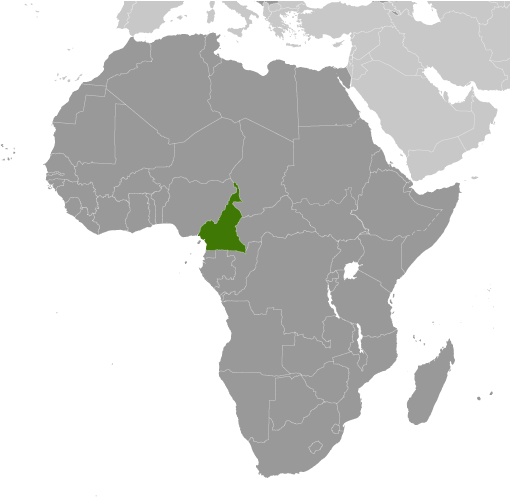

| CAMEROON Republic of Cameroon Republique du Cameroun Joined United Nations: 20 September 1960 Human Rights as assured by their constitution Click here Updated 27 December 2012 |

| CAPITAL |
| POPULATION |
| CHIEF OF STATE |
| SELECTION PROCESS |
Yaounde
20,129,878
note: estimates for this country explicitly take into account the effects of excess mortality
due to AIDS; this can result in lower life expectancy, higher infant mortality and death
rates, lower population and growth rates, and changes in the distribution of population by
age and sex than would otherwise be expected (July 2012 est.)
note: estimates for this country explicitly take into account the effects of excess mortality
due to AIDS; this can result in lower life expectancy, higher infant mortality and death
rates, lower population and growth rates, and changes in the distribution of population by
age and sex than would otherwise be expected (July 2012 est.)
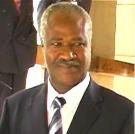
Philemon Yang
Prime Minister since 30 June 2009
Prime Minister since 30 June 2009
President elected by popular vote for a seven-year term (eligible for
a second term); election last held 9 October 2011
Next scheduled election: October 2018
a second term); election last held 9 October 2011
Next scheduled election: October 2018
HEAD OF GOVERNMENT
SELECTION PROCESS
Prime Minister appointed by the president
| DECLARATION OF HUMAN RIGHTS |
| ETHNIC GROUPS |
Cameroon Highlanders 31%, Equatorial Bantu 19%, Kirdi 11%, Fulani 10%, Northwestern Bantu 8%, Eastern Nigritic 7%, other
African 13%, non-African less than 1%
African 13%, non-African less than 1%
| RELIGIONS |
Indigenous beliefs 40%, Christian 40%, Muslim 20%
| GOVERNMENT STRUCTURE |
Republic; multiparty presidential regime with 10 provinces; Legal system is based on French civil law system, with common law
influence; accepts compulsory ICJ jurisdiction
Executive: President elected by popular vote for a seven-year term (eligible for a second term); election last held 9 October 2011
(next to be held in October 2018); prime minister appointed by the president
Legislative: Unicameral National Assembly or Assemblee Nationale (180 seats; members are elected by direct popular vote to
serve five-year terms); note - the president can either lengthen or shorten the term of the legislature
elections: last held 22 July 2007 (next to be held in February 2013)
Judicial: Supreme Court (judges are appointed by the president); High Court of Justice (consists of nine judges and six substitute
judges, elected by the National Assembly)
influence; accepts compulsory ICJ jurisdiction
Executive: President elected by popular vote for a seven-year term (eligible for a second term); election last held 9 October 2011
(next to be held in October 2018); prime minister appointed by the president
Legislative: Unicameral National Assembly or Assemblee Nationale (180 seats; members are elected by direct popular vote to
serve five-year terms); note - the president can either lengthen or shorten the term of the legislature
elections: last held 22 July 2007 (next to be held in February 2013)
Judicial: Supreme Court (judges are appointed by the president); High Court of Justice (consists of nine judges and six substitute
judges, elected by the National Assembly)
| LANGUAGES |
24 major African language groups, English (official), French (official)
| BRIEF HISTORY |
The earliest inhabitants of Cameroon were probably the Baka (Pygmies). They still inhabit the forests of the south and east
provinces. Bantu speakers originating in the Cameroonian highlands were among the first groups to move out before other invaders.
The Mandara kingdom in the Mandara Mountains was founded around 1500 and erected magnificent fortified structures, the
purpose and exact history of which is still unresolved. The Aro Confederacy of Nigeria, may have had presence in Western (likely
British) Cameroon due to migration in the 18th and 19th centuries. During the late 1770s and early 1800s, the Fulani, a pastoral
Islamic people of the western Sahel, conquered most of what is now northern Cameroon, subjugating or displacing its largely non-
Muslim inhabitants. Although the Portuguese arrived on Cameroon's coast in the 1500s, malaria prevented significant European
settlement and conquest of the interior until the late 1870s, when large supplies of the malaria suppressant, quinine, became
available. The early European presence in Cameroon was primarily devoted to coastal trade and the acquisition of slaves. The
northern part of Cameroon was an important part of the Muslim slave trade network. The slave trade was largely suppressed by the
mid-19th century. Christian missions established a presence in the late 19th century and continue to play a role in Cameroonian life.
Beginning on July 5, 1884, all of present-day Cameroon and parts of several of its neighbours became a German colony, Kamerun,
with a capital first at Buea and later at Yaoundé. The Imperial German government made substantial investments in the infrastructure
of Cameroon, including the extensive railways, such as the 160-metre single-span railway bridge on the Sanaga South branch.
Hospitals were opened all over the colony, including two major hospitals at Douala, one of which specialised in tropical diseases
(the Germans had discovered the Cholera Bacillus). Karl Ebermeir, who became governor in 1912, wrote in an official report in
1919 that the population of Kamerun had increased significantly. However, the indigenous peoples proved reluctant to work on
these projects, so the Germans instigated a harsh and unpopular system of forced labour. In fact, Jesko von Puttkamer was relieved
of duty as governor of the colony due to his untoward actions toward the native Cameroonians. In 1911 at the Treaty of Fez after
the Agadir Crisis, France ceded a nearly 300,000 km² portion of the territory of French Equatorial Africa to Kamerun which
became Neukamerun, while Germany ceded a smaller area in the north in present day Chad to France. In World War I the British
invaded Cameroon from Nigeria in 1914 in the West Africa campaign, with the last German fort in the country surrendering in
February 1916. After the war this colony was partitioned between the United Kingdom and France under a June 28, 1919 League
of Nations mandates (Class B). France gained the larger geographical share, transferred Neukamerun back to neighboring French
colonies, and ruled the rest from Yaoundé as Cameroun (French Cameroons). Britain's territory, a strip bordering Nigeria from the
sea to Lake Chad, with an equal population was ruled from Lagos as Cameroons (British Cameroons). German administrators
were allowed to once again run the plantations of the southwestern coastal area. A British Parliamentary Publication, Report on the
British Sphere of the Cameroons (May 1922, p.62-8), reports that the German plantations there were "as a whole . . . wonderful
examples of industry, based on solid scientific knowledge. The natives have been taught discipline and have come to realise what
can be achieved by industry. Large numbers who return to their villages take up cocoa or other cultivation on their own account,
thus increasing the general prosperity of the country." In 1955, the outlawed Union of the Peoples of Cameroon (UPC), based
largely among the Bamileke and Bassa ethnic groups, began an armed struggle for independence in French Cameroon. This
rebellion continued, with diminishing intensity, even after independence. Estimates of death from this conflict vary from thousands to
hundreds of thousands. French Cameroons achieved independence in 1960 as the Republic of Cameroon. The following year, on
October 1, 1961, the largely Muslim northern two-thirds of British Cameroons voted to join Nigeria; the largely Christian southern
third, Southern Cameroons, voted to join with the Republic of Cameroon to form the Federal Republic of Cameroon. The formerly
French and British regions each maintained substantial autonomy. Ahmadou Ahidjo, a French-educated Fulani, was chosen
president of the federation in 1961. Ahidjo, relying on a pervasive internal security apparatus, outlawed all political parties but his
own in 1966. He successfully suppressed the continuing UPC rebellion, capturing the last important rebel leader in 1970. In 1972, a
new constitution replaced the federation with a unitary state called the United Republic of Cameroon. Although Ahidjo's rule was
characterised as authoritarian, he was seen as noticeably lacking in charisma in comparison to many post-colonial African leaders.
He didn't follow the anti-western policies pursued by many of these leaders, which helped Cameroon achieve a degree of
comparative political stability and economic growth. Ahidjo resigned as president in 1982 and was constitutionally succeeded by his
Prime Minister, Paul Biya, a career official from the Beti-Pahuin ethnic group. Ahidjo later regretted his choice of successors, but his
supporters failed to overthrow Biya in a 1984 coup. Biya won single-candidate elections in 1983 and 1984 when the country was
again named the Republic of Cameroon. Biya has remained in power, winning flawed multiparty elections in 1992, 1997, and 2004.
His Cameroon People's Democratic Movement (CPDM) party holds a sizeable majority in the legislature. On August 15, 1984,
Lake Monoun exploded in a limnic eruption that released carbon dioxide, suffocating 37 people to death. On August 21, 1986,
another limnic eruption at Lake Nyos killed as many as 1,800 people and 3,500 livestock. The two disasters are the only recorded
instances of limnic eruptions. Cameroon has received some international attention following the relative success of its football team.
It has qualified for the FIFA World Cup on a number of occasions. Its most notable performance was at Italia 90, when the team
beat Argentina, the then reigning Champions in the opening game; Cameroon eventually lost in extra time in the Quarter Finals to
England. On June 30, 2002 the country held legislative and municipal elections that again were denounced by the opposition as
fraudulent. The victory for the ruling party was cemented with the reelection of the 72-year old president Paul Biya in October
2004, thus enhancing the chances of continued domination by the ruling party until the end of his term in 2011. By 2006, appeals
were being heard in Biya's home province in favour of a constitutional amendment that would allow him to run for another term
when his current term expires. However, against the backdrop of worsening social conditions and high poverty, students protested
and conducted strikes for several weeks in April 2005, and clashes with police led to two student deaths. Opposition parties
registered their intention to block any attempt to amend the constitution that would allow Biya to run for a third term. In early 2006
a final resolution to the dispute between Cameroon and Nigeria over the oil-rich Bakassi peninsula was expected. In October 2002,
the International Court of Justice had ruled in favour of Cameroon. Nonetheless, a lasting solution would require agreement by both
countries’ presidents, parliaments, and by the United Nations. The peninsula was the site of fighting between the two countries in
1994 and again in June 2005, which led to the death of a Cameroonian soldier.
Source: Wikipedia: History of Cameroon
provinces. Bantu speakers originating in the Cameroonian highlands were among the first groups to move out before other invaders.
The Mandara kingdom in the Mandara Mountains was founded around 1500 and erected magnificent fortified structures, the
purpose and exact history of which is still unresolved. The Aro Confederacy of Nigeria, may have had presence in Western (likely
British) Cameroon due to migration in the 18th and 19th centuries. During the late 1770s and early 1800s, the Fulani, a pastoral
Islamic people of the western Sahel, conquered most of what is now northern Cameroon, subjugating or displacing its largely non-
Muslim inhabitants. Although the Portuguese arrived on Cameroon's coast in the 1500s, malaria prevented significant European
settlement and conquest of the interior until the late 1870s, when large supplies of the malaria suppressant, quinine, became
available. The early European presence in Cameroon was primarily devoted to coastal trade and the acquisition of slaves. The
northern part of Cameroon was an important part of the Muslim slave trade network. The slave trade was largely suppressed by the
mid-19th century. Christian missions established a presence in the late 19th century and continue to play a role in Cameroonian life.
Beginning on July 5, 1884, all of present-day Cameroon and parts of several of its neighbours became a German colony, Kamerun,
with a capital first at Buea and later at Yaoundé. The Imperial German government made substantial investments in the infrastructure
of Cameroon, including the extensive railways, such as the 160-metre single-span railway bridge on the Sanaga South branch.
Hospitals were opened all over the colony, including two major hospitals at Douala, one of which specialised in tropical diseases
(the Germans had discovered the Cholera Bacillus). Karl Ebermeir, who became governor in 1912, wrote in an official report in
1919 that the population of Kamerun had increased significantly. However, the indigenous peoples proved reluctant to work on
these projects, so the Germans instigated a harsh and unpopular system of forced labour. In fact, Jesko von Puttkamer was relieved
of duty as governor of the colony due to his untoward actions toward the native Cameroonians. In 1911 at the Treaty of Fez after
the Agadir Crisis, France ceded a nearly 300,000 km² portion of the territory of French Equatorial Africa to Kamerun which
became Neukamerun, while Germany ceded a smaller area in the north in present day Chad to France. In World War I the British
invaded Cameroon from Nigeria in 1914 in the West Africa campaign, with the last German fort in the country surrendering in
February 1916. After the war this colony was partitioned between the United Kingdom and France under a June 28, 1919 League
of Nations mandates (Class B). France gained the larger geographical share, transferred Neukamerun back to neighboring French
colonies, and ruled the rest from Yaoundé as Cameroun (French Cameroons). Britain's territory, a strip bordering Nigeria from the
sea to Lake Chad, with an equal population was ruled from Lagos as Cameroons (British Cameroons). German administrators
were allowed to once again run the plantations of the southwestern coastal area. A British Parliamentary Publication, Report on the
British Sphere of the Cameroons (May 1922, p.62-8), reports that the German plantations there were "as a whole . . . wonderful
examples of industry, based on solid scientific knowledge. The natives have been taught discipline and have come to realise what
can be achieved by industry. Large numbers who return to their villages take up cocoa or other cultivation on their own account,
thus increasing the general prosperity of the country." In 1955, the outlawed Union of the Peoples of Cameroon (UPC), based
largely among the Bamileke and Bassa ethnic groups, began an armed struggle for independence in French Cameroon. This
rebellion continued, with diminishing intensity, even after independence. Estimates of death from this conflict vary from thousands to
hundreds of thousands. French Cameroons achieved independence in 1960 as the Republic of Cameroon. The following year, on
October 1, 1961, the largely Muslim northern two-thirds of British Cameroons voted to join Nigeria; the largely Christian southern
third, Southern Cameroons, voted to join with the Republic of Cameroon to form the Federal Republic of Cameroon. The formerly
French and British regions each maintained substantial autonomy. Ahmadou Ahidjo, a French-educated Fulani, was chosen
president of the federation in 1961. Ahidjo, relying on a pervasive internal security apparatus, outlawed all political parties but his
own in 1966. He successfully suppressed the continuing UPC rebellion, capturing the last important rebel leader in 1970. In 1972, a
new constitution replaced the federation with a unitary state called the United Republic of Cameroon. Although Ahidjo's rule was
characterised as authoritarian, he was seen as noticeably lacking in charisma in comparison to many post-colonial African leaders.
He didn't follow the anti-western policies pursued by many of these leaders, which helped Cameroon achieve a degree of
comparative political stability and economic growth. Ahidjo resigned as president in 1982 and was constitutionally succeeded by his
Prime Minister, Paul Biya, a career official from the Beti-Pahuin ethnic group. Ahidjo later regretted his choice of successors, but his
supporters failed to overthrow Biya in a 1984 coup. Biya won single-candidate elections in 1983 and 1984 when the country was
again named the Republic of Cameroon. Biya has remained in power, winning flawed multiparty elections in 1992, 1997, and 2004.
His Cameroon People's Democratic Movement (CPDM) party holds a sizeable majority in the legislature. On August 15, 1984,
Lake Monoun exploded in a limnic eruption that released carbon dioxide, suffocating 37 people to death. On August 21, 1986,
another limnic eruption at Lake Nyos killed as many as 1,800 people and 3,500 livestock. The two disasters are the only recorded
instances of limnic eruptions. Cameroon has received some international attention following the relative success of its football team.
It has qualified for the FIFA World Cup on a number of occasions. Its most notable performance was at Italia 90, when the team
beat Argentina, the then reigning Champions in the opening game; Cameroon eventually lost in extra time in the Quarter Finals to
England. On June 30, 2002 the country held legislative and municipal elections that again were denounced by the opposition as
fraudulent. The victory for the ruling party was cemented with the reelection of the 72-year old president Paul Biya in October
2004, thus enhancing the chances of continued domination by the ruling party until the end of his term in 2011. By 2006, appeals
were being heard in Biya's home province in favour of a constitutional amendment that would allow him to run for another term
when his current term expires. However, against the backdrop of worsening social conditions and high poverty, students protested
and conducted strikes for several weeks in April 2005, and clashes with police led to two student deaths. Opposition parties
registered their intention to block any attempt to amend the constitution that would allow Biya to run for a third term. In early 2006
a final resolution to the dispute between Cameroon and Nigeria over the oil-rich Bakassi peninsula was expected. In October 2002,
the International Court of Justice had ruled in favour of Cameroon. Nonetheless, a lasting solution would require agreement by both
countries’ presidents, parliaments, and by the United Nations. The peninsula was the site of fighting between the two countries in
1994 and again in June 2005, which led to the death of a Cameroonian soldier.
Source: Wikipedia: History of Cameroon
| ECONOMIC OVERVIEW |
Because of its modest oil resources and favorable agricultural conditions, Cameroon has one of the best-endowed primary
commodity economies in sub-Saharan Africa. Still, it faces many of the serious problems confronting other underdeveloped
countries, such as stagnant per capita income, a relatively inequitable distribution of income, a top-heavy civil service, endemic
corruption, and a generally unfavorable climate for business enterprise. Since 1990, the government has embarked on various IMF
and World Bank programs designed to spur business investment, increase efficiency in agriculture, improve trade, and recapitalize
the nation's banks. The IMF is pressing for more reforms, including increased budget transparency, privatization, and poverty
reduction programs. Subsidies for electricity, food, and fuel have strained the budget. New mining projects - in diamonds, for
example - have attracted foreign investment, but large ventures will take time to develop. Cameroon's business environment - one of
the world's worst - is a deterrent to foreign investment.
Source: CIA World Factbook (select Cameroon)
commodity economies in sub-Saharan Africa. Still, it faces many of the serious problems confronting other underdeveloped
countries, such as stagnant per capita income, a relatively inequitable distribution of income, a top-heavy civil service, endemic
corruption, and a generally unfavorable climate for business enterprise. Since 1990, the government has embarked on various IMF
and World Bank programs designed to spur business investment, increase efficiency in agriculture, improve trade, and recapitalize
the nation's banks. The IMF is pressing for more reforms, including increased budget transparency, privatization, and poverty
reduction programs. Subsidies for electricity, food, and fuel have strained the budget. New mining projects - in diamonds, for
example - have attracted foreign investment, but large ventures will take time to develop. Cameroon's business environment - one of
the world's worst - is a deterrent to foreign investment.
Source: CIA World Factbook (select Cameroon)
| POLITICAL CLIMATE |
The government adopted legislation in 1990 to authorize the formation of multiple political parties and ease restrictions on forming
civil associations and private newspapers. Cameroon' s first multiparty legislative and presidential elections were held in 1992
followed by municipal elections in 1996 and another round of legislative and presidential elections in 1997. Because the government
refused to consider opposition demands for an independent election commission, the three major opposition parties boycotted the
October 1997 presidential election, which Biya easily won. The leader of one of the opposition parties, Bello Bouba Maigari of the
NUDP, subsequently joined the government.
The Cameroonian Government's human rights record has been improving over the years but remains flawed. There continue to be
reported abuses, including beatings of detainees, arbitrary arrests, and illegal searches. The judiciary is frequently corrupt, inefficient,
and subject to political influence.
Worthy of note is the fact that Cameroon is the only country in which two Constitutions are applicable side-by-side. For example,
the 1972 Constitution designates the Prime Minister as constitutional successor of the Head of State in case of incapacity, death,
resignation or unaccountable absence of the incumbent. Contrarily, the 1996 Constitutional Reform designates the President of the
Senate as constitutional successor; but the Senate (provided for by 1996 Reform) does not exist. Apart from increasing the
presidential mandate from 5 years to 7 years, very few amendments of the 1996 Constitutional Reform have been applied. The
president is not required to consult the National Assembly. In 2008, a constitutional amendment was passed that eliminated term
limits for president.
The judiciary is subordinate to the executive branch's Ministry of Justice. The Supreme Court may review the constitutionality of a
law only at the president's request.
Source: Wikipedia: Politics of Cameroon
civil associations and private newspapers. Cameroon' s first multiparty legislative and presidential elections were held in 1992
followed by municipal elections in 1996 and another round of legislative and presidential elections in 1997. Because the government
refused to consider opposition demands for an independent election commission, the three major opposition parties boycotted the
October 1997 presidential election, which Biya easily won. The leader of one of the opposition parties, Bello Bouba Maigari of the
NUDP, subsequently joined the government.
The Cameroonian Government's human rights record has been improving over the years but remains flawed. There continue to be
reported abuses, including beatings of detainees, arbitrary arrests, and illegal searches. The judiciary is frequently corrupt, inefficient,
and subject to political influence.
Worthy of note is the fact that Cameroon is the only country in which two Constitutions are applicable side-by-side. For example,
the 1972 Constitution designates the Prime Minister as constitutional successor of the Head of State in case of incapacity, death,
resignation or unaccountable absence of the incumbent. Contrarily, the 1996 Constitutional Reform designates the President of the
Senate as constitutional successor; but the Senate (provided for by 1996 Reform) does not exist. Apart from increasing the
presidential mandate from 5 years to 7 years, very few amendments of the 1996 Constitutional Reform have been applied. The
president is not required to consult the National Assembly. In 2008, a constitutional amendment was passed that eliminated term
limits for president.
The judiciary is subordinate to the executive branch's Ministry of Justice. The Supreme Court may review the constitutionality of a
law only at the president's request.
Source: Wikipedia: Politics of Cameroon
| INTERNATIONAL DISPUTES |
Joint Border Commission with Nigeria reviewed 2002 ICJ ruling on the entire boundary and bilaterally resolved differences,
including June 2006 Greentree Agreement that immediately ceded sovereignty of the Bakassi Peninsula to Cameroon with a full
phase-out of Nigerian control and patriation of residents in 2008; Cameroon and Nigeria agree on maritime delimitation in March
2008; sovereignty dispute between Equatorial Guinea and Cameroon over an island at the mouth of the Ntem River; only Nigeria
and Cameroon have heeded the Lake Chad Commission's admonition to ratify the delimitation treaty, which also includes the
Chad-Niger and Niger-Nigeria boundaries
including June 2006 Greentree Agreement that immediately ceded sovereignty of the Bakassi Peninsula to Cameroon with a full
phase-out of Nigerian control and patriation of residents in 2008; Cameroon and Nigeria agree on maritime delimitation in March
2008; sovereignty dispute between Equatorial Guinea and Cameroon over an island at the mouth of the Ntem River; only Nigeria
and Cameroon have heeded the Lake Chad Commission's admonition to ratify the delimitation treaty, which also includes the
Chad-Niger and Niger-Nigeria boundaries


| REFUGEES AND INTERNALLY DISPLACED PERSONS (IDPS) |
Refugees (country of origin): 90,176 (Central African Republic); 5,251 (Chad) (2011)
| ILLICIT DRUGS |
Not reported.
| HUMAN RIGHTS STATEMENTS, ANALYSIS AND CRITIQUES |
2011 Human Rights Report: Cameroon
Bureau of Democracy, Human Rights, and Labor
2011 Country Reports on Human Rights Practices
May 25, 2012
Cameroon is a republic dominated by a strong presidency. The country has a multiparty system of government, but the Cameroon
People’s Democratic Movement (CPDM) has remained in power since it was created in 1985. It has unfettered control of all
government branches. The president retains the power to control legislation and rule by decree. On October 9, CPDM leader Paul Biya
won reelection as president, a position he has held since 1982. The election was flawed by irregularities, including the failure to properly
distribute all voter cards, late opening of polling stations, multiple voting, ballot-box stuffing, the absence of indelible ink, and intimidation
of voters. There were instances in which elements of the security forces acted independently of civilian control.
The most important human rights problems in the country were security force abuses--particularly of detainees and prisoners; denial of
fair and speedy public trial; and restrictions on freedom of assembly.
Other major human rights abuses included arbitrary arrest and detention, prolonged and sometimes incommunicado pretrial detention, life-
threatening prison conditions, and infringement on privacy rights. The government harassed and imprisoned journalists, restricted
freedoms of speech, press, and association, and impeded freedom of movement. Corruption was pervasive at all levels of government.
Societal violence and discrimination against women and girls, including female genital mutilation (FGM), was a problem. Trafficking in
persons, particularly children, and discrimination against pygmies, gays, and lesbians occurred. There was occasional discrimination
against persons with albinism, although such incidents continued to decrease. The government restricted worker rights and the activities
of independent labor organizations. Hereditary servitude, forced labor, including by children, and child labor were problems.
Although the government took some steps to punish and prosecute officials who committed abuses in the security forces and in the
public service, impunity remained a problem.
Click here to read more »
Bureau of Democracy, Human Rights, and Labor
2011 Country Reports on Human Rights Practices
May 25, 2012
Cameroon is a republic dominated by a strong presidency. The country has a multiparty system of government, but the Cameroon
People’s Democratic Movement (CPDM) has remained in power since it was created in 1985. It has unfettered control of all
government branches. The president retains the power to control legislation and rule by decree. On October 9, CPDM leader Paul Biya
won reelection as president, a position he has held since 1982. The election was flawed by irregularities, including the failure to properly
distribute all voter cards, late opening of polling stations, multiple voting, ballot-box stuffing, the absence of indelible ink, and intimidation
of voters. There were instances in which elements of the security forces acted independently of civilian control.
The most important human rights problems in the country were security force abuses--particularly of detainees and prisoners; denial of
fair and speedy public trial; and restrictions on freedom of assembly.
Other major human rights abuses included arbitrary arrest and detention, prolonged and sometimes incommunicado pretrial detention, life-
threatening prison conditions, and infringement on privacy rights. The government harassed and imprisoned journalists, restricted
freedoms of speech, press, and association, and impeded freedom of movement. Corruption was pervasive at all levels of government.
Societal violence and discrimination against women and girls, including female genital mutilation (FGM), was a problem. Trafficking in
persons, particularly children, and discrimination against pygmies, gays, and lesbians occurred. There was occasional discrimination
against persons with albinism, although such incidents continued to decrease. The government restricted worker rights and the activities
of independent labor organizations. Hereditary servitude, forced labor, including by children, and child labor were problems.
Although the government took some steps to punish and prosecute officials who committed abuses in the security forces and in the
public service, impunity remained a problem.
Click here to read more »
TRANSLATED FROM FRENCH BY GOOGLE TRANSLATE
December 2, 2011
Committee on Economic, Social and Cultural
Forty-seventh session
Geneva, 14 November-2 December 2011
Consideration of reports submitted by States parties under articles 16 and 17 of the Covenant
Concluding Observations of the Committee on Economic, Social and Cultural
Cameroon
A. Introduction
2. The Committee welcomes the presentation of the second and third periodic reports of Cameroon, which are in general conformity
with the Committee's guidelines and report on measures taken to implement the recommendations made by the Committee in its previous
concluding observations. The Committee notes that the report was submitted seven years late.
3. The Committee also welcomes the written replies were given to the list of issues (E/C.12/CMR/Q/2-3/Add.1) and responses to
questions during the dialogue. He notes, however, that some of the responses have often been too general.
B. Positive aspects
4. The Committee welcomes the ratification of the Optional Protocol to the Convention on the Elimination of All Forms of Discrimination
against Women.
5. The Committee notes with appreciation the efforts made by the State party to promote the implementation of economic, social and
cultural rights, including:
(A) The efforts undertaken by the State party to reach the completion point under the Initiative for Heavily Indebted Poor Countries
which have yielded additional resources from debt relief for sectors priority in the field of health;
(B) The introduction of free primary education by the Finance Act No. 2000/08 of 30 June 2000;
C. Principal subjects of concern and recommendations
7. The Committee is concerned that despite the primacy of the Covenant over national law, the Covenant has so far never been invoked
by national courts in their decisions.
The Committee recommends that the State party take appropriate measures to give effect to the Covenant in the domestic legal order,
and adopt, if necessary, a text application. The Committee recommends that the State party take steps to educate members of the
judiciary and the people of the Covenant and the justiciability of economic, social and cultural rights. The Committee requests the State
party to include in its next periodic report, information on decisions of national courts and administrative authorities to give effect to the
rights recognized in the Covenant. The Committee draws the attention of the State party to its general comment No. 9 (1998) on the
implementation of the Covenant at the national level.
8. The Committee notes with concern that corruption continues to be widespread in the State party, despite awareness campaigns about
its effects and prosecutions against perpetrators of certain acts of corruption.
The Committee recommends that the State party take all effective measures to fight against corruption.
Click here to read more »
December 2, 2011
Committee on Economic, Social and Cultural
Forty-seventh session
Geneva, 14 November-2 December 2011
Consideration of reports submitted by States parties under articles 16 and 17 of the Covenant
Concluding Observations of the Committee on Economic, Social and Cultural
Cameroon
A. Introduction
2. The Committee welcomes the presentation of the second and third periodic reports of Cameroon, which are in general conformity
with the Committee's guidelines and report on measures taken to implement the recommendations made by the Committee in its previous
concluding observations. The Committee notes that the report was submitted seven years late.
3. The Committee also welcomes the written replies were given to the list of issues (E/C.12/CMR/Q/2-3/Add.1) and responses to
questions during the dialogue. He notes, however, that some of the responses have often been too general.
B. Positive aspects
4. The Committee welcomes the ratification of the Optional Protocol to the Convention on the Elimination of All Forms of Discrimination
against Women.
5. The Committee notes with appreciation the efforts made by the State party to promote the implementation of economic, social and
cultural rights, including:
(A) The efforts undertaken by the State party to reach the completion point under the Initiative for Heavily Indebted Poor Countries
which have yielded additional resources from debt relief for sectors priority in the field of health;
(B) The introduction of free primary education by the Finance Act No. 2000/08 of 30 June 2000;
C. Principal subjects of concern and recommendations
7. The Committee is concerned that despite the primacy of the Covenant over national law, the Covenant has so far never been invoked
by national courts in their decisions.
The Committee recommends that the State party take appropriate measures to give effect to the Covenant in the domestic legal order,
and adopt, if necessary, a text application. The Committee recommends that the State party take steps to educate members of the
judiciary and the people of the Covenant and the justiciability of economic, social and cultural rights. The Committee requests the State
party to include in its next periodic report, information on decisions of national courts and administrative authorities to give effect to the
rights recognized in the Covenant. The Committee draws the attention of the State party to its general comment No. 9 (1998) on the
implementation of the Covenant at the national level.
8. The Committee notes with concern that corruption continues to be widespread in the State party, despite awareness campaigns about
its effects and prosecutions against perpetrators of certain acts of corruption.
The Committee recommends that the State party take all effective measures to fight against corruption.
Click here to read more »
Freedom House Questions Due Process in Case of Political Prisoner in Cameroon
Apr 17 2012 - 4:34pm
The case of political prisoner Michel Thierry Atangana in Cameroon will reach a critical juncture tomorrow as the prosecution plans to
rest its case with regards to new embezzlement charges against him. The hearing is an opportunity to withdraw the charges as opposed
to handing the case over to the judges. Freedom House remains concerned that these new charges are being levied in violation of
Cameroonian law; we urge for a critical review of the case and the withdrawal of the charges if they are impermissible under the
procedural or legal codes.
According to reports, Atangana's original embezzlement trial was conducted in an overnight session without the assistance of counsel
and without the chance to respond to the charges. He has served almost his entire 15-year sentence as a result of a procedure that
deviates from that proscribed under Cameroon law. Freedom House is also concerned that the latest charges of misappropriation of
government funds against Mr. Atangana may be a continued reflection of political animosity toward his co-defendant, Titus Edzoa,
former Secretary General of the Presidency. Moreover, since the case being pursued against Mr. Atangana appears to arise from the
same operative facts as his previous conviction, there is a stronger likelihood that the act of filing new charges in Mr. Atangana’s case
violates both Cameroonian law and international standards of jurisprudence regarding the double-jeopardy principle.
Cameroon is rated Not Free in Freedom in the World 2012. Cameroon’s courts have a long-standing reputation of being used as a tool of
political retribution and score settling. The government of Cameroon must work to ensure that the rule of law is upheld and that it is the
sole basis for engagement with and decisions made under the justice system.
Click here to read more »
Apr 17 2012 - 4:34pm
The case of political prisoner Michel Thierry Atangana in Cameroon will reach a critical juncture tomorrow as the prosecution plans to
rest its case with regards to new embezzlement charges against him. The hearing is an opportunity to withdraw the charges as opposed
to handing the case over to the judges. Freedom House remains concerned that these new charges are being levied in violation of
Cameroonian law; we urge for a critical review of the case and the withdrawal of the charges if they are impermissible under the
procedural or legal codes.
According to reports, Atangana's original embezzlement trial was conducted in an overnight session without the assistance of counsel
and without the chance to respond to the charges. He has served almost his entire 15-year sentence as a result of a procedure that
deviates from that proscribed under Cameroon law. Freedom House is also concerned that the latest charges of misappropriation of
government funds against Mr. Atangana may be a continued reflection of political animosity toward his co-defendant, Titus Edzoa,
former Secretary General of the Presidency. Moreover, since the case being pursued against Mr. Atangana appears to arise from the
same operative facts as his previous conviction, there is a stronger likelihood that the act of filing new charges in Mr. Atangana’s case
violates both Cameroonian law and international standards of jurisprudence regarding the double-jeopardy principle.
Cameroon is rated Not Free in Freedom in the World 2012. Cameroon’s courts have a long-standing reputation of being used as a tool of
political retribution and score settling. The government of Cameroon must work to ensure that the rule of law is upheld and that it is the
sole basis for engagement with and decisions made under the justice system.
Click here to read more »
Report 2012: No longer business as usual for tyranny and injustice ...
24 May 2012
Cameroon
The government continued to restrict the activities of political opponents and journalists. People suspected of same-sex relations were
detained and some sentenced to lengthy prison terms. The government reduced some prison sentences and commuted death sentences,
but did not reveal how many.
Background
President Biya was re-elected with 75 per cent of the vote following presidential elections on 9 October. Of the 22 opposition presidential
candidates, his closest rival, John Fru Ndi of the Social Democratic Front, won just over 10 per cent. Opposition political parties claimed
that the election was unfair. Election observers from the AU, International Organization of La Francophonie and the Commonwealth
stated that the election was generally fair, while the US Ambassador to Cameroon said that US government observers noted widespread
irregularities at every level.
Before starting a new term in November, President Biya issued a decree commuting sentences imposed by the courts. According to the
decree, people serving prison sentences of one year or less were to be released and those serving life imprisonment would have their
sentences reduced to 20 years. Death sentences were commuted to life imprisonment. Prisoners convicted of economic crimes,
aggravated robbery or murder were excluded from the presidential pardon.
There were several attacks by armed groups on the Bakassi Peninsula, which reverted to Cameroon from Nigeria following a 2002
International Court of Justice decision. In one such attack in February, two Cameroonian soldiers were killed and at least 13 civilians
abducted.
Corruption charges
Several dozen former government officials accused of corruption remained in custody, many awaiting trial or serving prison sentences.
The trial of Titus Edzoa and Thierry Atangana on new corruption charges had not concluded by the end of the year, although they were
close to completing their 15-year prison term imposed in 1997 following an unfair trial.
Impunity
Members of the security forces who committed or ordered serious human rights violations, including unlawful killings, during
demonstrations and riots in February 2008 continued to enjoy impunity. The judiciary failed to investigate the violations and bring the
perpetrators to justice.
Freedom of expression
Several journalists and government critics were detained and some released during the year.
Bertrand Zepherin Teyou, a writer arrested in November 2010 while trying to launch his book about the wife of the President, was
released on 29 April. He had been found guilty of “contempt of a personality” by the High Court in Douala and sentenced to a fine of
2,030,150 CFA francs (approximately US$4,425) or two years’ imprisonment.
Human rights defenders and lawyers continued to call for the release of former mayor Paul Eric Kingué, serving a prison sentence in
connection with the February 2008 riots, on the grounds that he was victimized for criticizing abuses by government forces. He was
also on trial for alleged corruption.
Click here to read more »
24 May 2012
Cameroon
The government continued to restrict the activities of political opponents and journalists. People suspected of same-sex relations were
detained and some sentenced to lengthy prison terms. The government reduced some prison sentences and commuted death sentences,
but did not reveal how many.
Background
President Biya was re-elected with 75 per cent of the vote following presidential elections on 9 October. Of the 22 opposition presidential
candidates, his closest rival, John Fru Ndi of the Social Democratic Front, won just over 10 per cent. Opposition political parties claimed
that the election was unfair. Election observers from the AU, International Organization of La Francophonie and the Commonwealth
stated that the election was generally fair, while the US Ambassador to Cameroon said that US government observers noted widespread
irregularities at every level.
Before starting a new term in November, President Biya issued a decree commuting sentences imposed by the courts. According to the
decree, people serving prison sentences of one year or less were to be released and those serving life imprisonment would have their
sentences reduced to 20 years. Death sentences were commuted to life imprisonment. Prisoners convicted of economic crimes,
aggravated robbery or murder were excluded from the presidential pardon.
There were several attacks by armed groups on the Bakassi Peninsula, which reverted to Cameroon from Nigeria following a 2002
International Court of Justice decision. In one such attack in February, two Cameroonian soldiers were killed and at least 13 civilians
abducted.
Corruption charges
Several dozen former government officials accused of corruption remained in custody, many awaiting trial or serving prison sentences.
The trial of Titus Edzoa and Thierry Atangana on new corruption charges had not concluded by the end of the year, although they were
close to completing their 15-year prison term imposed in 1997 following an unfair trial.
Impunity
Members of the security forces who committed or ordered serious human rights violations, including unlawful killings, during
demonstrations and riots in February 2008 continued to enjoy impunity. The judiciary failed to investigate the violations and bring the
perpetrators to justice.
Freedom of expression
Several journalists and government critics were detained and some released during the year.
Bertrand Zepherin Teyou, a writer arrested in November 2010 while trying to launch his book about the wife of the President, was
released on 29 April. He had been found guilty of “contempt of a personality” by the High Court in Douala and sentenced to a fine of
2,030,150 CFA francs (approximately US$4,425) or two years’ imprisonment.
Human rights defenders and lawyers continued to call for the release of former mayor Paul Eric Kingué, serving a prison sentence in
connection with the February 2008 riots, on the grounds that he was victimized for criticizing abuses by government forces. He was
also on trial for alleged corruption.
Click here to read more »
Cameroon: Investigate Threats Against Rights Lawyers
Condemn Attack on Right to Counsel in Homosexuality Cases
October 24, 2012
(Nairobi) – Authorities in Cameroon should promptly investigate threats against two prominent lawyers who are representing clients
accused of homosexuality, Human Rights Watch said. The government should publicly denounce the threats against the defense lawyers
and ensure that they receive necessary protection.
Since October 18, 2012, Alice Nkom, a lawyer based in Douala, and Michel Togue, a Yaoundé-based lawyer, have received a series of
anonymous threats by cell phone and email related to their work on several high-profile homosexuality cases. One text message to
Togue threatened his school-age children and warned him to stop defending people accused of homosexuality. A subsequent email
message to Togue warned, “In this country there is no place for faggots and their defenders.” The sender attached photos of Togue’s
children leaving their school building. An email message to Nkom stated, “If you don’t stop [‘renoncer’], you’ll see.” The email
reiterated the threats to Togue’s children, warning Nkom, “This will be bloody.” It also threatened Nkom’s children.
“Cameroonian authorities should immediately investigate to find out who is threatening these courageous human rights defenders,” said
Neela Ghoshal, researcher in the Lesbian, Gay, Bisexual, and Transgender (LGBT) Rights Program at Human Rights Watch. “The
government should make clear to the public that everyone has a right to defense, and that threats against defense attorneys will not be
tolerated.”
Cameroon is one of a handful of countries that aggressively prosecutes consensual same-sex intimacy. Article 347 bis of Cameroon’s
penal code criminalizes homosexuality, punishing “sexual relations with a person of the same sex” with sentences ranging from six
months to five years. At least four Cameroonians are serving prison sentences on homosexuality charges. Nkom and Togue are
representing them in appeals of their convictions. At least one other Cameroonian is in pretrial detention on the basis of the same article.
Justice Ministry records show that in 2011, 12 of 14 people prosecuted for homosexuality were convicted.
Human Rights Watch research conducted in Cameroon in October found that many homosexuality cases are marked by compounded
violations of due process rights, including denying suspects the right to legal counsel during the investigation phase. Prosecutors and
courts have relied on flimsy evidence, such as the possession of condoms and lubricant in one case, or the type of alcoholic beverage
preferred by a suspect in another, as “proof” of homosexuality.
The homophobic climate in Cameroon, reinforced by government policy, contributes to a hostile environment for lawyers and other
human rights defenders protecting the rights of LGBT people and of people suspected of homosexuality. Lawyers representing clients in
homosexuality cases are regularly denounced in the media, with the lawyers’ own sexual orientation called into question. Nkom has
previously been warned by fellow lawyers, as well as by the former minister of justice, to stop her activities.
Click here to read more »
Condemn Attack on Right to Counsel in Homosexuality Cases
October 24, 2012
(Nairobi) – Authorities in Cameroon should promptly investigate threats against two prominent lawyers who are representing clients
accused of homosexuality, Human Rights Watch said. The government should publicly denounce the threats against the defense lawyers
and ensure that they receive necessary protection.
Since October 18, 2012, Alice Nkom, a lawyer based in Douala, and Michel Togue, a Yaoundé-based lawyer, have received a series of
anonymous threats by cell phone and email related to their work on several high-profile homosexuality cases. One text message to
Togue threatened his school-age children and warned him to stop defending people accused of homosexuality. A subsequent email
message to Togue warned, “In this country there is no place for faggots and their defenders.” The sender attached photos of Togue’s
children leaving their school building. An email message to Nkom stated, “If you don’t stop [‘renoncer’], you’ll see.” The email
reiterated the threats to Togue’s children, warning Nkom, “This will be bloody.” It also threatened Nkom’s children.
“Cameroonian authorities should immediately investigate to find out who is threatening these courageous human rights defenders,” said
Neela Ghoshal, researcher in the Lesbian, Gay, Bisexual, and Transgender (LGBT) Rights Program at Human Rights Watch. “The
government should make clear to the public that everyone has a right to defense, and that threats against defense attorneys will not be
tolerated.”
Cameroon is one of a handful of countries that aggressively prosecutes consensual same-sex intimacy. Article 347 bis of Cameroon’s
penal code criminalizes homosexuality, punishing “sexual relations with a person of the same sex” with sentences ranging from six
months to five years. At least four Cameroonians are serving prison sentences on homosexuality charges. Nkom and Togue are
representing them in appeals of their convictions. At least one other Cameroonian is in pretrial detention on the basis of the same article.
Justice Ministry records show that in 2011, 12 of 14 people prosecuted for homosexuality were convicted.
Human Rights Watch research conducted in Cameroon in October found that many homosexuality cases are marked by compounded
violations of due process rights, including denying suspects the right to legal counsel during the investigation phase. Prosecutors and
courts have relied on flimsy evidence, such as the possession of condoms and lubricant in one case, or the type of alcoholic beverage
preferred by a suspect in another, as “proof” of homosexuality.
The homophobic climate in Cameroon, reinforced by government policy, contributes to a hostile environment for lawyers and other
human rights defenders protecting the rights of LGBT people and of people suspected of homosexuality. Lawyers representing clients in
homosexuality cases are regularly denounced in the media, with the lawyers’ own sexual orientation called into question. Nkom has
previously been warned by fellow lawyers, as well as by the former minister of justice, to stop her activities.
Click here to read more »
26.09.2012
Prime Minister receives African Commissioners for Human and People's rights authorities
By: Mary Ngu Ekukole
The Prime Minister, Head of Government, His Excellency Philemon Yang, granted audience to two members of the African Commission
for Human and People's Rights who were on mission to Cameroon since the 4th of september 2012. They had come to evaluate the state
of human rights in Cameroon, specifically on those of women and people living with HIV/AIDS, whose prevalence rate dropped from
5.1% to 4% in the year 2011.
Speaking to the press after the audience, the Senegalese citizen Mrs. Soyata was delighted to note that Cameroon has demonstrated
through concrete action the importance that she attaches to the woman. For example, the treatment of patients in this category is free of
charge throughout the national territory. She appreciated the care that the medical professionals are taking in reducing the transmission
from mother to child at birth. A special mention was also made of the Ministry of Basic Education in efforts to cater to the school needs
of orphans from parents with HIV/AIDS.
Besides, she noted cases like the education of the girl-child; the special charge taken by the Government in favor of women's
reproductive health; sensitisation that has led to the considerable reduction of some health-threatening practices like female genital
mutilation.
However, she noted that there were still areas in which the Government needs to work to reverse cultural practices, namely, succession
rights which in most cases exclude the widow; marriage rites which ignore or undermine the stance or opinion of the woman; and early
pregnancy which some customs still encourage.
Beyond the customary practices that still disfavor women, Mrs. Soyata brought to the fore the 30% representation which should be
accorded to women, to which Cameroon Government is signatory, at the level of the administration.
On the overrall, she recommended special training courses and the assigning of resources to cater to the special needs of women. Within
that package, she advised that a special committee should be put in place to fight against all forms of discrimination and stigmatisation
against those living with HIV/AIDS.
Having realized that women suffering from HIV/AIDS are still the most challenged due to poverty, the Cameroonian-born Mrs. Asuagbor
urged Government to take special measures to help the women concerned to impove on their economic status.
Talking about the response of the Prime Minister, Mrs. Soyata said that the Government reassured them that more will be done to cater
to women's needs at various levels of vulnerability to the extent that Cameroon's record will be enhanced in the future.
Click here to read more »
Prime Minister receives African Commissioners for Human and People's rights authorities
By: Mary Ngu Ekukole
The Prime Minister, Head of Government, His Excellency Philemon Yang, granted audience to two members of the African Commission
for Human and People's Rights who were on mission to Cameroon since the 4th of september 2012. They had come to evaluate the state
of human rights in Cameroon, specifically on those of women and people living with HIV/AIDS, whose prevalence rate dropped from
5.1% to 4% in the year 2011.
Speaking to the press after the audience, the Senegalese citizen Mrs. Soyata was delighted to note that Cameroon has demonstrated
through concrete action the importance that she attaches to the woman. For example, the treatment of patients in this category is free of
charge throughout the national territory. She appreciated the care that the medical professionals are taking in reducing the transmission
from mother to child at birth. A special mention was also made of the Ministry of Basic Education in efforts to cater to the school needs
of orphans from parents with HIV/AIDS.
Besides, she noted cases like the education of the girl-child; the special charge taken by the Government in favor of women's
reproductive health; sensitisation that has led to the considerable reduction of some health-threatening practices like female genital
mutilation.
However, she noted that there were still areas in which the Government needs to work to reverse cultural practices, namely, succession
rights which in most cases exclude the widow; marriage rites which ignore or undermine the stance or opinion of the woman; and early
pregnancy which some customs still encourage.
Beyond the customary practices that still disfavor women, Mrs. Soyata brought to the fore the 30% representation which should be
accorded to women, to which Cameroon Government is signatory, at the level of the administration.
On the overrall, she recommended special training courses and the assigning of resources to cater to the special needs of women. Within
that package, she advised that a special committee should be put in place to fight against all forms of discrimination and stigmatisation
against those living with HIV/AIDS.
Having realized that women suffering from HIV/AIDS are still the most challenged due to poverty, the Cameroonian-born Mrs. Asuagbor
urged Government to take special measures to help the women concerned to impove on their economic status.
Talking about the response of the Prime Minister, Mrs. Soyata said that the Government reassured them that more will be done to cater
to women's needs at various levels of vulnerability to the extent that Cameroon's record will be enhanced in the future.
Click here to read more »
| LA COMMISSION NATIONALE DES DROITS DE L'HOMME ET DES LIBERTES/ NATIONAL COMMISSION ON HUMAN RIGHTS AND FREEDOMS (CNDHL) |
TRANSLATED FROM FRENCH BY GOOGLE TRANSLATE
THE NATIONAL COMMISSION FOR HUMAN RIGHTS AND FREEDOMS UNVEILS ITS MAJOR PROJECTS:
News from the 12th Session
Palace of Congress
Yaounde
27 June 2012
The National Commission of Human Rights and Fundamental Freedoms held its twelfth regular session on 27 June 2012 at the Yaounde
Conference Centre under the chairmanship of Dr Chemuta Divine BANDA, President of this institution.
In his opening speech, and acting activities undertaken since the last session, the President noted:
- networking between the Commission and various national, regional and international promotion and protection of human rights;
- increasing the number of hits recorded on violations of human rights, a sign of the dynamism of the Commission;
- visits to places of detention, including in the regions of Eastern, Central and Littoral.
About the implementation of the Commission, the President highlighted the construction of the headquarters building and the next
opening of regional offices in the Far North, South, budgeted investment in 2012.
During the work, various resolutions and recommendations were adopted, including:
- improving the quality of outreach tools of human rights;
- activity report and the report on the state of human rights in Cameroon in 2011 whose publication is planned in the third quarter
of this year;
- exploring ways to give more impact to the action of the institution vis-à-vis individuals who do not deferential to its summons
and governments that do not respond to his correspondence;
- the current legal and social challenge for some media on respect for ethics and professional ethics.
In closing the proceedings, the President invited members to actively contribute to the objectives for the emergence of Cameroon in
2035 in terms of human rights.
The Secretary General of the NCHRF
Bartholomew OBONGONO EYE'E
Click here to read more »
THE NATIONAL COMMISSION FOR HUMAN RIGHTS AND FREEDOMS UNVEILS ITS MAJOR PROJECTS:
News from the 12th Session
Palace of Congress
Yaounde
27 June 2012
The National Commission of Human Rights and Fundamental Freedoms held its twelfth regular session on 27 June 2012 at the Yaounde
Conference Centre under the chairmanship of Dr Chemuta Divine BANDA, President of this institution.
In his opening speech, and acting activities undertaken since the last session, the President noted:
- networking between the Commission and various national, regional and international promotion and protection of human rights;
- increasing the number of hits recorded on violations of human rights, a sign of the dynamism of the Commission;
- visits to places of detention, including in the regions of Eastern, Central and Littoral.
About the implementation of the Commission, the President highlighted the construction of the headquarters building and the next
opening of regional offices in the Far North, South, budgeted investment in 2012.
During the work, various resolutions and recommendations were adopted, including:
- improving the quality of outreach tools of human rights;
- activity report and the report on the state of human rights in Cameroon in 2011 whose publication is planned in the third quarter
of this year;
- exploring ways to give more impact to the action of the institution vis-à-vis individuals who do not deferential to its summons
and governments that do not respond to his correspondence;
- the current legal and social challenge for some media on respect for ethics and professional ethics.
In closing the proceedings, the President invited members to actively contribute to the objectives for the emergence of Cameroon in
2035 in terms of human rights.
The Secretary General of the NCHRF
Bartholomew OBONGONO EYE'E
Click here to read more »
Position Statement: (March 5, 2012)
CCDHR SUPPORTS THE EFFORT BY SYNES FOR THE ELECTION OF
UNIVERSITY OF BUEA ADMINISTRATIVE OFFICIALS
1. Introduction
CCDHR is concerned at the state of affairs and the situation of the academic faculty and students at the University of Buea (UB). For the
past decade, the University has experienced various tribulations, while its academic faculty and students have suffered some of the
worse forms of machinations an institution of higher learning ever wishes itself. CCDHR recognizes that at the core of the difficulties the
University of Buea is navigating are three main factions – the University Administration, the Academic Faculty represented by the
Syndicate of Lecturers of Higher Education (SYNES), and the Students represented by the University of Buea Students Union (UBSU).
While the position of each of these factions has been different depending on the specific issue at hand, it is appropriate to state that the
majority of issues confronting the university have been an assertion of the rights or entitlements of the students led by UBSU or the
academic faculty led by SYNES against the university administration.
2. Background
Established by Decree No. 93/034 of 19th January 1993, the University of Buea was in Article 1(a) “conceived in the Anglo-Saxon
tradition” as a beckon of hope for Cameroons’ Anglophone population. It was a model Anglo-Saxon system of higher education,
specifically tailored to carter for the growing number of Cameroons’ Anglophone students who were for decades prior compelled to
study in French, a language which for most of them, was never a medium of communication, let alone one of study. The establishment
of the University of Buea was also viewed as a belated victory for the many Anglophone activists, who since the independence of
Cameroon have been calling for a fair system of higher learning, one that allowed students to study exclusively in either English or
French, and also permitted students and faculty to participate in its governance.
Less that two decades after the University of Buea was established, the institution has been crippled by issues raging from politics, fraud,
corruption, abuse of authority, and violations of the rights of students and the academic faculty. This intend has led to an endless routine
of strike actions by the academic faculty and students alike, as strikes have become the only means to get the attention of the university
administration to any issue facing the students or academic faculty. The effects of the complexity of issues confronting the University of
Buea has been compounded by the fact that little difference exist between the university administration and the Ministry of Higher
Education, an organ of the Government of Cameroon, whose record on the rule of law, respect for human rights, corruption, and fraud
leaves much to be desired.
3. SYNES Call for the Election of University of Buea Administrative Officials
In an effort to put the University of Buea on the right track, maintain its integrity, provide its students with the highest quality of
education, effectively fight corruption, fraud, and political machinations, SYNES has made a resolute request that the Vice-Chancellor,
Deans of Faculties, and Heads of Departments of the University of Buea be selected through an electoral process as specifically
prescribed by Articles 26, 54, and 74 of Decree No. 93/034 of 1993 establishing the university. CCDHR commends this specific effort
by SYNES because the current system of appointment of University of Buea administrative officials by Yaounde is the root cause of the
instability that has plagued the university since its inception.
CCDHR holds that the violation of the university law which envisioned and stated clearly that the university administrators were to be
selected through elections is truly unfortunate. The declaration by the Vice-Chancellor (who retired in February 2012 but still maintains
his position of Vice-Chancellor) on March 1, 2012, that the university law has been amended with the university ‘francophonised’ by the
removal of the provisions prescribing elections of officials is sad and disturbing. This statement is a confirmation of Government’s
active policy of marginalizing the Anglophone population by ignoring the election clause in the document establishing the University of
Buea. Making the provisions on elections good only on paper demonstrates a lack of will by the Government of Cameroon to accept core
values of the Anglo-Saxon system of education. The undemocratic tradition of appointments by decree without inputs from academic
faculty which has continued at the University of Buea unchecked until now must give way. CCDHR therefore unreservedly support all
legal actions by SYNES as it launches a full scale drive and final push to have the selection of University of Buea administrative officials
through an electoral process.
Click here to read more>>
CCDHR SUPPORTS THE EFFORT BY SYNES FOR THE ELECTION OF
UNIVERSITY OF BUEA ADMINISTRATIVE OFFICIALS
1. Introduction
CCDHR is concerned at the state of affairs and the situation of the academic faculty and students at the University of Buea (UB). For the
past decade, the University has experienced various tribulations, while its academic faculty and students have suffered some of the
worse forms of machinations an institution of higher learning ever wishes itself. CCDHR recognizes that at the core of the difficulties the
University of Buea is navigating are three main factions – the University Administration, the Academic Faculty represented by the
Syndicate of Lecturers of Higher Education (SYNES), and the Students represented by the University of Buea Students Union (UBSU).
While the position of each of these factions has been different depending on the specific issue at hand, it is appropriate to state that the
majority of issues confronting the university have been an assertion of the rights or entitlements of the students led by UBSU or the
academic faculty led by SYNES against the university administration.
2. Background
Established by Decree No. 93/034 of 19th January 1993, the University of Buea was in Article 1(a) “conceived in the Anglo-Saxon
tradition” as a beckon of hope for Cameroons’ Anglophone population. It was a model Anglo-Saxon system of higher education,
specifically tailored to carter for the growing number of Cameroons’ Anglophone students who were for decades prior compelled to
study in French, a language which for most of them, was never a medium of communication, let alone one of study. The establishment
of the University of Buea was also viewed as a belated victory for the many Anglophone activists, who since the independence of
Cameroon have been calling for a fair system of higher learning, one that allowed students to study exclusively in either English or
French, and also permitted students and faculty to participate in its governance.
Less that two decades after the University of Buea was established, the institution has been crippled by issues raging from politics, fraud,
corruption, abuse of authority, and violations of the rights of students and the academic faculty. This intend has led to an endless routine
of strike actions by the academic faculty and students alike, as strikes have become the only means to get the attention of the university
administration to any issue facing the students or academic faculty. The effects of the complexity of issues confronting the University of
Buea has been compounded by the fact that little difference exist between the university administration and the Ministry of Higher
Education, an organ of the Government of Cameroon, whose record on the rule of law, respect for human rights, corruption, and fraud
leaves much to be desired.
3. SYNES Call for the Election of University of Buea Administrative Officials
In an effort to put the University of Buea on the right track, maintain its integrity, provide its students with the highest quality of
education, effectively fight corruption, fraud, and political machinations, SYNES has made a resolute request that the Vice-Chancellor,
Deans of Faculties, and Heads of Departments of the University of Buea be selected through an electoral process as specifically
prescribed by Articles 26, 54, and 74 of Decree No. 93/034 of 1993 establishing the university. CCDHR commends this specific effort
by SYNES because the current system of appointment of University of Buea administrative officials by Yaounde is the root cause of the
instability that has plagued the university since its inception.
CCDHR holds that the violation of the university law which envisioned and stated clearly that the university administrators were to be
selected through elections is truly unfortunate. The declaration by the Vice-Chancellor (who retired in February 2012 but still maintains
his position of Vice-Chancellor) on March 1, 2012, that the university law has been amended with the university ‘francophonised’ by the
removal of the provisions prescribing elections of officials is sad and disturbing. This statement is a confirmation of Government’s
active policy of marginalizing the Anglophone population by ignoring the election clause in the document establishing the University of
Buea. Making the provisions on elections good only on paper demonstrates a lack of will by the Government of Cameroon to accept core
values of the Anglo-Saxon system of education. The undemocratic tradition of appointments by decree without inputs from academic
faculty which has continued at the University of Buea unchecked until now must give way. CCDHR therefore unreservedly support all
legal actions by SYNES as it launches a full scale drive and final push to have the selection of University of Buea administrative officials
through an electoral process.
Click here to read more>>
| Click map for larger view |
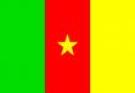
| Click flag for Country Report |



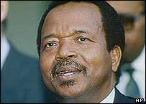
Paul Biya
President since 6 November 1982
President since 6 November 1982
| TRAFFICKING IN PERSONS |
None reported.