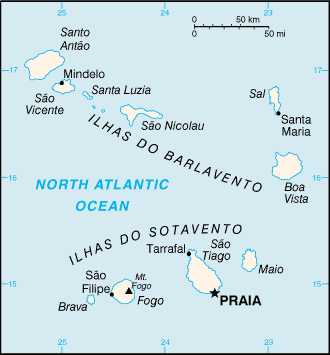
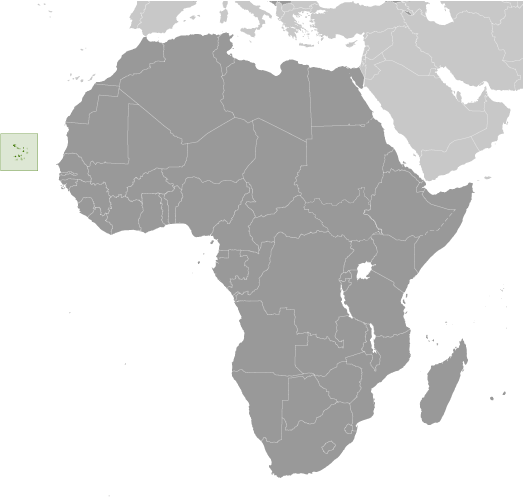
| CAPE VERDE Republic of Cape Verde Republica de Cabo Verde Joined United Nations: 16 September 1975 Human Rights as assured by their constitution Click here Updated 25 March 2013 |

| CAPITAL |
| POPULATION |
| CHIEF OF STATE |
| SELECTION PROCESS |
Praia
531,046 (July 2013 est.)
Jose Maria Pereira Neves
Prime Minister since 1 February 2001
Prime Minister since 1 February 2001
President elected by popular vote for a five-year term (eligible for a
second term); election last held 7 August 2011 with a second round
runoff on 21 August 2011
Next scheduled election: August 2016
second term); election last held 7 August 2011 with a second round
runoff on 21 August 2011
Next scheduled election: August 2016
HEAD OF GOVERNMENT
SELECTION PROCESS
Prime minister nominated by the National Assembly and
appointed by the president; elections: last held 6 February 2011
Next scheduled election: 2016
appointed by the president; elections: last held 6 February 2011
Next scheduled election: 2016
| DECLARATION OF HUMAN RIGHTS |
| ETHNIC GROUPS |
Creole (mulatto) 71%, African 28%, European 1%
| RELIGIONS |
Roman Catholic (infused with indigenous beliefs), Protestant (mostly Church of the Nazarene)
| GOVERNMENT STRUCTURE |
Republic with 17 municipalities (concelhos, singular - concelho); Legal system is based on the legal system of Portugal; has not
accepted compulsory ICJ jurisdiction
Executive: President elected by popular vote for a five-year term (eligible for a second term); election last held 7 August 2011 with
a second round runoff on 21 August 2011 (next to be held in 2016); prime minister nominated by the National Assembly and
appointed by the president
Legislative: Unicameral National Assembly or Assembleia Nacional (72 seats; members are elected by popular vote to serve
five-year terms)
elections: last held 26 February 2011 (next to be held by 2016)
Judicial: Supreme Tribunal of Justice or Supremo Tribunal de Justia
accepted compulsory ICJ jurisdiction
Executive: President elected by popular vote for a five-year term (eligible for a second term); election last held 7 August 2011 with
a second round runoff on 21 August 2011 (next to be held in 2016); prime minister nominated by the National Assembly and
appointed by the president
Legislative: Unicameral National Assembly or Assembleia Nacional (72 seats; members are elected by popular vote to serve
five-year terms)
elections: last held 26 February 2011 (next to be held by 2016)
Judicial: Supreme Tribunal of Justice or Supremo Tribunal de Justia
| LANGUAGES |
Portuguese, Crioulo (a blend of Portuguese and West African words)
| BRIEF HISTORY |
The first written record of Cape Verde can be found in the works "De choreographia" by Pomponius Mela and "Historia naturalis"
by Pliny the Elder. They called the islands "Gorgades" in remembering the home of the mythical Gorgons killed by Perseus and
afterwards - in typically ancient euhemerism - interpreted (against the written original statement) as the site where the Carthaginian
Hanno slew two female "Gorillai" and brought their skins into the temple of the female deity Tanit (the Carthaginian Juno) in
Carthage. According to Pliny the Elder, the Greek Xenophon Lampsacenus states that the Gorgades (Cape Verde) are situated
two days from "Hesperu Ceras" - today called Cap-Vert, the westernmost part of the African continent. According to Pliny the
Elder and his citation by Solinus, the sea voyage time from Atlantis (Madeira) crossing the Gorgades to the islands of the Ladies of
the West (Hesperides) is around 40 days. The Isles of the Blessed written of by Marinos of Tyre and referenced by Ptolemy in his
Geographia may have been the Cape Verde islands. The Portuguese explorers rediscovered the islands in 1456 or 1460 and
described the islands as "uninhabited". However, given the prevailing winds and ocean currents in the region, the islands may well
have been visited by Moors or Wolof, Serer, or perhaps Lebu fishermen from the Guinea Coast. Folklore suggests that the islands
may have been visited by Arabs, centuries before the arrival of the Europeans. The Portuguese explorer Jaime Cortesão reported a
story that Arabs were known to have visited an island which they referred to as "Aulil" or "Ulil" where they took salt from naturally
occurring salinas. Some believe they may have been referring to Sal Island. A recent hypothesis (1421 hypothesis by Gavin
Menzies) suggests the Chinese explorer Zheng He had reached the islands in 1420. However, this hypothesis has received no
support from mainstream historians. Whatever the case may have been, the population (if there was any) at the time of arrival of the
Portuguese, was not sufficiently well established to resist their complete penetration. In 1456, Alvise Cadamosto discovered some
of the islands. In the next decade, Diogo Dias and António Noli, captains in the service of prince Henry the Navigator, discovered
the remaining islands of the archipelago. When these mariners first landed in Cape Verde, the islands were barren of people but not
of vegetation. Seeing the islands today, you find it hard to imagine that they were once sufficiently verde (green) to entice the
Portuguese to return six years later to the island of São Tiago to found Ribeira Grande (now Cidade Velha), in 1462 -- the first
permanent European settlement city in the tropics. In Iberia the Reconquista movement was growing in its mission to recover
Catholic lands from the Muslim Moors who had first arrived in the 8th century. It was however in 1492 that the Spanish Inquisition
emerged in its fullest expression of anti-Semitism. This social pathology quickly spread to neighboring Portugal where King João II
and especially Manuel I in 1496, decided to exile thousands of Jews to São Tomé, Príncipe, and Cape Verde. The Portuguese
soon brought slaves from the West African coast to perform the hard labor. Positioned on the great trade routes between Africa,
Europe, and the New World, the archipelago prospered from the transatlantic slave trade, in the 16th century. The islands'
prosperity brought them unwanted attention in the form of a sacking at the hands of many pirates including England's Sir Francis
Drake, who in 1582 and 1585 sacked Ribeira Grande. After a French attack in 1712, the city declined in importance relative to
Praia, which became the capital in 1770. In 1747 the islands were hit with the first of the many droughts that have plagued them
ever since, with an average interval of five years. The situation was made worse by deforestation and overgrazing, which destroyed
the ground vegetation that provided moisture. Three major droughts in the 18th and 19th centuries resulted in well over 100,000
people starving to death. The Portuguese government sent almost no relief during any of the droughts. The 19th-century decline of
the lucrative slave trade was another blow to the country's economy. The fragile prosperity slowly vanished. Cape Verde's colonial
heyday was over. It was around this time that Cape Verdeans started emigrating to New England. This was a popular destination
because of the whales that abounded in the waters around Cape Verde, and as early as 1810 whaling ships from Massachusetts
and Rhode Island in the United States (U.S.) recruited crews from the islands of Brava and Fogo. At the end of the 19th century,
with the advent of the ocean liner, the island's position astride Atlantic shipping lanes made Cape Verde an ideal location for
resupplying ships with fuel (imported coal), water and livestock. Because of its excellent harbor, Mindelo (on the island of São
Vicente) became an important commercial centre during the 19th century, mainly because the British used Cape Verde as a storage
depot for coal which was bound for the Americas. The harbour area at Mindelo was developed by the British for this purpose. The
island was made a coaling and submarine cable station, and there was plenty of work for local labourers. This was the golden
period of the city, where it gained the cultural characteristics that made it the current cultural capital of the country. Although the
Cape Verdeans were treated badly by their colonial masters, they fared slightly better than Africans in other Portuguese colonies
because of their lighter skin. A small minority received an education and Cape Verde was the first Portuguese colony to have a
school for higher education. By the time of independence, a quarter of the population could read, compared to 5% in Portuguese
Guinea (now Guinea-Bissau). This largesse ultimately backfired on the Portuguese, however, as literate Cape Verdeans became
aware of the pressures for independence building on the mainland, while the islands continued suffering from frequent drought and
famine, at times from epidemic diseases and volcanic eruptions, and the Portuguese government did nothing. Thousands of people
died of starvation during the first half of the 20th century. But in 1926, Portugal had become a rightist dictatorship which regarded
the colonies an economic frontier, to be developed in the interest of Portugal and the Portuguese. Frequent famine, unemployment,
poverty and the failure of the Portuguese government to address these issues caused resentment. And the Portuguese dictator
António de Oliveira Salazar wasn't about to give up his colonies as easily as the British and French had given up theirs. After World
War II, Portugal was intent to hold on to its former colonies, since 1951 called overseas territories. When most former African
colonies gained independence in 1957/1964, the Portuguese still held on. Consequently, following the Pijiguiti Massacre, the people
of Cape Verde and Guinea-Bissau fought one of the longest African liberation wars. After the fall (April 1974) of the fascist regime
in Portugal, widespread unrest forced the government to negotiate with the PAIGC, and on July 5, 1975, Cape Verde finally gained
independence from Portugal. Immediately following a November 1980 coup in Guinea-Bissau (Portuguese Guinea declared
independence in 1973 and was granted de jure independence in 1974), relations between the two countries became strained. Cape
Verde abandoned its hope for unity with Guinea-Bissau and formed the African Party for the Independence of Cape Verde
(PAICV). Problems have since been resolved, and relations between the countries are good. The PAICV and its predecessor
established a one-party system and ruled Cape Verde from independence until 1990. Responding to growing pressure for a political
opening, the PAICV called an emergency congress in February 1990 to discuss proposed constitutional changes to end one-party
rule. Opposition groups came together to form the Movement for Democracy (MpD) in Praia in April 1990. Together, they
campaigned for the right to contest the presidential election scheduled for December 1990. The one-party state was abolished
September 28, 1990, and the first multi-party elections were held in January 1991. The MpD won a majority of the seats in the
National Assembly, and the MpD presidential candidate António Mascarenhas Monteiro defeated the PAICV's candidate by
73.5% of the votes cast to 26.5%. He succeeded the country's first President, Aristides Pereira, who had served since 1975.
Legislative elections in December 1995 increased the MpD majority in the National Assembly. The party held 50 of the National
Assembly's 72 seats. A February 1996 presidential election returned President António Mascarenhas Monteiro to office. The
December 1995 and February 1996 elections were judged free and fair by domestic and international observers. In the presidential
election campaign of 2000 and 2001, two former prime ministers, Pedro Pires and Carlos Veiga were the main candidates. Pires
was the Prime Minister during the PAICV regime, while Veiga served as prime minister during most of Monteiro's presidency,
stepping aside only when it came time for campaigning. In what might have been one of the closest races in electoral history, Pires
won by 12 votes, he and Veiga each receiving nearly half the votes. A presidential election took place in Cape Verde on 12
February 2006. This was the country's fourth presidential election since the introduction of multiparty politics in 1990. In a repeat of
the 2001 election, two candidates representing Cape Verde's main political parties contested the election. Incumbent President
Pedro Pires of the ruling African Party for the Independence of Cape Verde (PAICV) was challenged by former Prime Minister
Carlos Veiga of the Movement for Democracy (MpD). In the 2001 presidential run-off, Pires defeated Veiga by a margin of only
12 votes. In 2006, Pires won another narrow victory, prevailing by about 3,000 votes and slightly surpassing the 50% majority
necessary to avoid a run-off. A presidential election was held in Cape Verde on 7 August 2011, with a second round run-off on 21
August. The result was a victory for Jorge Carlos Fonseca of the Movement for Democracy, who received 54% of the vote in the
second round. A parliamentary election was held Cape Verde on 6 February 2011. The African Party for the Independence of
Cape Verde (PAICV), led by Prime Minister Jose Maria Neves, had been the governing party since 2001; it faced the main
opposition Movement for Democracy (MpD), led by Carlos Veiga. Although technical problems prevented a prompt
announcement of official results, it quickly became clear that PAICV had won a parliamentary majority, and Veiga conceded defeat
on 7 February 2011. The opposition's immediate acceptance of defeat, prior to an official announcement, was viewed as a sign of
the strength of democracy in Cape Verde.
Source: Wikipedia: History of Cape Verde
by Pliny the Elder. They called the islands "Gorgades" in remembering the home of the mythical Gorgons killed by Perseus and
afterwards - in typically ancient euhemerism - interpreted (against the written original statement) as the site where the Carthaginian
Hanno slew two female "Gorillai" and brought their skins into the temple of the female deity Tanit (the Carthaginian Juno) in
Carthage. According to Pliny the Elder, the Greek Xenophon Lampsacenus states that the Gorgades (Cape Verde) are situated
two days from "Hesperu Ceras" - today called Cap-Vert, the westernmost part of the African continent. According to Pliny the
Elder and his citation by Solinus, the sea voyage time from Atlantis (Madeira) crossing the Gorgades to the islands of the Ladies of
the West (Hesperides) is around 40 days. The Isles of the Blessed written of by Marinos of Tyre and referenced by Ptolemy in his
Geographia may have been the Cape Verde islands. The Portuguese explorers rediscovered the islands in 1456 or 1460 and
described the islands as "uninhabited". However, given the prevailing winds and ocean currents in the region, the islands may well
have been visited by Moors or Wolof, Serer, or perhaps Lebu fishermen from the Guinea Coast. Folklore suggests that the islands
may have been visited by Arabs, centuries before the arrival of the Europeans. The Portuguese explorer Jaime Cortesão reported a
story that Arabs were known to have visited an island which they referred to as "Aulil" or "Ulil" where they took salt from naturally
occurring salinas. Some believe they may have been referring to Sal Island. A recent hypothesis (1421 hypothesis by Gavin
Menzies) suggests the Chinese explorer Zheng He had reached the islands in 1420. However, this hypothesis has received no
support from mainstream historians. Whatever the case may have been, the population (if there was any) at the time of arrival of the
Portuguese, was not sufficiently well established to resist their complete penetration. In 1456, Alvise Cadamosto discovered some
of the islands. In the next decade, Diogo Dias and António Noli, captains in the service of prince Henry the Navigator, discovered
the remaining islands of the archipelago. When these mariners first landed in Cape Verde, the islands were barren of people but not
of vegetation. Seeing the islands today, you find it hard to imagine that they were once sufficiently verde (green) to entice the
Portuguese to return six years later to the island of São Tiago to found Ribeira Grande (now Cidade Velha), in 1462 -- the first
permanent European settlement city in the tropics. In Iberia the Reconquista movement was growing in its mission to recover
Catholic lands from the Muslim Moors who had first arrived in the 8th century. It was however in 1492 that the Spanish Inquisition
emerged in its fullest expression of anti-Semitism. This social pathology quickly spread to neighboring Portugal where King João II
and especially Manuel I in 1496, decided to exile thousands of Jews to São Tomé, Príncipe, and Cape Verde. The Portuguese
soon brought slaves from the West African coast to perform the hard labor. Positioned on the great trade routes between Africa,
Europe, and the New World, the archipelago prospered from the transatlantic slave trade, in the 16th century. The islands'
prosperity brought them unwanted attention in the form of a sacking at the hands of many pirates including England's Sir Francis
Drake, who in 1582 and 1585 sacked Ribeira Grande. After a French attack in 1712, the city declined in importance relative to
Praia, which became the capital in 1770. In 1747 the islands were hit with the first of the many droughts that have plagued them
ever since, with an average interval of five years. The situation was made worse by deforestation and overgrazing, which destroyed
the ground vegetation that provided moisture. Three major droughts in the 18th and 19th centuries resulted in well over 100,000
people starving to death. The Portuguese government sent almost no relief during any of the droughts. The 19th-century decline of
the lucrative slave trade was another blow to the country's economy. The fragile prosperity slowly vanished. Cape Verde's colonial
heyday was over. It was around this time that Cape Verdeans started emigrating to New England. This was a popular destination
because of the whales that abounded in the waters around Cape Verde, and as early as 1810 whaling ships from Massachusetts
and Rhode Island in the United States (U.S.) recruited crews from the islands of Brava and Fogo. At the end of the 19th century,
with the advent of the ocean liner, the island's position astride Atlantic shipping lanes made Cape Verde an ideal location for
resupplying ships with fuel (imported coal), water and livestock. Because of its excellent harbor, Mindelo (on the island of São
Vicente) became an important commercial centre during the 19th century, mainly because the British used Cape Verde as a storage
depot for coal which was bound for the Americas. The harbour area at Mindelo was developed by the British for this purpose. The
island was made a coaling and submarine cable station, and there was plenty of work for local labourers. This was the golden
period of the city, where it gained the cultural characteristics that made it the current cultural capital of the country. Although the
Cape Verdeans were treated badly by their colonial masters, they fared slightly better than Africans in other Portuguese colonies
because of their lighter skin. A small minority received an education and Cape Verde was the first Portuguese colony to have a
school for higher education. By the time of independence, a quarter of the population could read, compared to 5% in Portuguese
Guinea (now Guinea-Bissau). This largesse ultimately backfired on the Portuguese, however, as literate Cape Verdeans became
aware of the pressures for independence building on the mainland, while the islands continued suffering from frequent drought and
famine, at times from epidemic diseases and volcanic eruptions, and the Portuguese government did nothing. Thousands of people
died of starvation during the first half of the 20th century. But in 1926, Portugal had become a rightist dictatorship which regarded
the colonies an economic frontier, to be developed in the interest of Portugal and the Portuguese. Frequent famine, unemployment,
poverty and the failure of the Portuguese government to address these issues caused resentment. And the Portuguese dictator
António de Oliveira Salazar wasn't about to give up his colonies as easily as the British and French had given up theirs. After World
War II, Portugal was intent to hold on to its former colonies, since 1951 called overseas territories. When most former African
colonies gained independence in 1957/1964, the Portuguese still held on. Consequently, following the Pijiguiti Massacre, the people
of Cape Verde and Guinea-Bissau fought one of the longest African liberation wars. After the fall (April 1974) of the fascist regime
in Portugal, widespread unrest forced the government to negotiate with the PAIGC, and on July 5, 1975, Cape Verde finally gained
independence from Portugal. Immediately following a November 1980 coup in Guinea-Bissau (Portuguese Guinea declared
independence in 1973 and was granted de jure independence in 1974), relations between the two countries became strained. Cape
Verde abandoned its hope for unity with Guinea-Bissau and formed the African Party for the Independence of Cape Verde
(PAICV). Problems have since been resolved, and relations between the countries are good. The PAICV and its predecessor
established a one-party system and ruled Cape Verde from independence until 1990. Responding to growing pressure for a political
opening, the PAICV called an emergency congress in February 1990 to discuss proposed constitutional changes to end one-party
rule. Opposition groups came together to form the Movement for Democracy (MpD) in Praia in April 1990. Together, they
campaigned for the right to contest the presidential election scheduled for December 1990. The one-party state was abolished
September 28, 1990, and the first multi-party elections were held in January 1991. The MpD won a majority of the seats in the
National Assembly, and the MpD presidential candidate António Mascarenhas Monteiro defeated the PAICV's candidate by
73.5% of the votes cast to 26.5%. He succeeded the country's first President, Aristides Pereira, who had served since 1975.
Legislative elections in December 1995 increased the MpD majority in the National Assembly. The party held 50 of the National
Assembly's 72 seats. A February 1996 presidential election returned President António Mascarenhas Monteiro to office. The
December 1995 and February 1996 elections were judged free and fair by domestic and international observers. In the presidential
election campaign of 2000 and 2001, two former prime ministers, Pedro Pires and Carlos Veiga were the main candidates. Pires
was the Prime Minister during the PAICV regime, while Veiga served as prime minister during most of Monteiro's presidency,
stepping aside only when it came time for campaigning. In what might have been one of the closest races in electoral history, Pires
won by 12 votes, he and Veiga each receiving nearly half the votes. A presidential election took place in Cape Verde on 12
February 2006. This was the country's fourth presidential election since the introduction of multiparty politics in 1990. In a repeat of
the 2001 election, two candidates representing Cape Verde's main political parties contested the election. Incumbent President
Pedro Pires of the ruling African Party for the Independence of Cape Verde (PAICV) was challenged by former Prime Minister
Carlos Veiga of the Movement for Democracy (MpD). In the 2001 presidential run-off, Pires defeated Veiga by a margin of only
12 votes. In 2006, Pires won another narrow victory, prevailing by about 3,000 votes and slightly surpassing the 50% majority
necessary to avoid a run-off. A presidential election was held in Cape Verde on 7 August 2011, with a second round run-off on 21
August. The result was a victory for Jorge Carlos Fonseca of the Movement for Democracy, who received 54% of the vote in the
second round. A parliamentary election was held Cape Verde on 6 February 2011. The African Party for the Independence of
Cape Verde (PAICV), led by Prime Minister Jose Maria Neves, had been the governing party since 2001; it faced the main
opposition Movement for Democracy (MpD), led by Carlos Veiga. Although technical problems prevented a prompt
announcement of official results, it quickly became clear that PAICV had won a parliamentary majority, and Veiga conceded defeat
on 7 February 2011. The opposition's immediate acceptance of defeat, prior to an official announcement, was viewed as a sign of
the strength of democracy in Cape Verde.
Source: Wikipedia: History of Cape Verde
| ECONOMIC OVERVIEW |
The economy is service oriented with commerce, transport, tourism, and public services accounting for about three-fourths of GDP.
This island economy suffers from a poor natural resource base, including serious water shortages exacerbated by cycles of
long-term drought and poor soil for agriculture on several of the islands. Although about 40% of the population lives in rural areas,
the share of food production in GDP is low. About 82% of food must be imported. The fishing potential, mostly lobster and tuna, is
not fully exploited. Cape Verde annually runs a high trade deficit financed by foreign aid and remittances from its large pool of
emigrants; remittances supplement GDP by more than 20%. Despite the lack of resources, sound economic management has
produced steadily improving incomes. Continued economic reforms are aimed at developing the private sector and attracting foreign
investment to diversify the economy and mitigate high unemployment. Future prospects depend heavily on the maintenance of aid
flows, the encouragement of tourism, remittances, and the momentum of the government's development program. Cape Verde
became a member of the WTO in July 2008.
Source: CIA World Factbook (select Cape Verde)
This island economy suffers from a poor natural resource base, including serious water shortages exacerbated by cycles of
long-term drought and poor soil for agriculture on several of the islands. Although about 40% of the population lives in rural areas,
the share of food production in GDP is low. About 82% of food must be imported. The fishing potential, mostly lobster and tuna, is
not fully exploited. Cape Verde annually runs a high trade deficit financed by foreign aid and remittances from its large pool of
emigrants; remittances supplement GDP by more than 20%. Despite the lack of resources, sound economic management has
produced steadily improving incomes. Continued economic reforms are aimed at developing the private sector and attracting foreign
investment to diversify the economy and mitigate high unemployment. Future prospects depend heavily on the maintenance of aid
flows, the encouragement of tourism, remittances, and the momentum of the government's development program. Cape Verde
became a member of the WTO in July 2008.
Source: CIA World Factbook (select Cape Verde)
| POLITICAL CLIMATE |
Following independence in 1975, the African Party for the Independence of Guinea and Cape Verde (PAIGC) established a one
party political system. This became the African Party for the Independence of Cape Verde (PAICV) in 1980, as Cape Verde
sought to distance itself from Guinea-Bissau, following unrest in that country.
In 1991, following growing pressure for a more pluralistic society, multi-party elections were held for the first time. The opposition
party, the Movement for Democracy (MpD), won the legislative elections, and formed the government. The MpD candidate also
defeated the PAICV candidate in the presidential elections. In the 1996 elections, the MpD increased their majority, but in the 2001
the PAICV returned to power, winning both the Legislative and the Presidential elections.
Generally, Cape Verde enjoys a stable democratic system. The elections have been considered free and fair, there is a free press,
and the rule of law is respected by the State. In acknowledgment of this, Freedom House granted Cape Verde two 1s in its annual
Freedom in the World report, a perfect score. It is the only African country to receive this score.
A presidential election was held in Cape Verde on 7 August 2011, with a second round run-off on 21 August. The result was a
victory for Jorge Carlos Fonseca of the Movement for Democracy, who received 54% of the vote in the second round. A
parliamentary election was held Cape Verde on 6 February 2011. The African Party for the Independence of Cape Verde
(PAICV), led by Prime Minister Jose Maria Neves, had been the governing party since 2001; it faced the main opposition
Movement for Democracy (MpD), led by Carlos Veiga. Although technical problems prevented a prompt announcement of official
results, it quickly became clear that PAICV had won a parliamentary majority, and Veiga conceded defeat on 7 February 2011.
The opposition's immediate acceptance of defeat, prior to an official announcement, was viewed as a sign of the strength of
democracy in Cape Verde.
Source: Wikipedia: Politics of Cape Verde
party political system. This became the African Party for the Independence of Cape Verde (PAICV) in 1980, as Cape Verde
sought to distance itself from Guinea-Bissau, following unrest in that country.
In 1991, following growing pressure for a more pluralistic society, multi-party elections were held for the first time. The opposition
party, the Movement for Democracy (MpD), won the legislative elections, and formed the government. The MpD candidate also
defeated the PAICV candidate in the presidential elections. In the 1996 elections, the MpD increased their majority, but in the 2001
the PAICV returned to power, winning both the Legislative and the Presidential elections.
Generally, Cape Verde enjoys a stable democratic system. The elections have been considered free and fair, there is a free press,
and the rule of law is respected by the State. In acknowledgment of this, Freedom House granted Cape Verde two 1s in its annual
Freedom in the World report, a perfect score. It is the only African country to receive this score.
A presidential election was held in Cape Verde on 7 August 2011, with a second round run-off on 21 August. The result was a
victory for Jorge Carlos Fonseca of the Movement for Democracy, who received 54% of the vote in the second round. A
parliamentary election was held Cape Verde on 6 February 2011. The African Party for the Independence of Cape Verde
(PAICV), led by Prime Minister Jose Maria Neves, had been the governing party since 2001; it faced the main opposition
Movement for Democracy (MpD), led by Carlos Veiga. Although technical problems prevented a prompt announcement of official
results, it quickly became clear that PAICV had won a parliamentary majority, and Veiga conceded defeat on 7 February 2011.
The opposition's immediate acceptance of defeat, prior to an official announcement, was viewed as a sign of the strength of
democracy in Cape Verde.
Source: Wikipedia: Politics of Cape Verde
| INTERNATIONAL DISPUTES |
None reported.


| REFUGEES AND INTERNALLY DISPLACED PERSONS (IDPS) |
None reported.
| ILLICIT DRUGS |
Used as a transshipment point for Latin American cocaine destined for Western Europe, particularly because of Lusophone links
to Brazil, Portugal, and Guinea-Bissau; has taken steps to deter drug money laundering, including a 2002 anti-money laundering
reform that criminalizes laundering the proceeds of narcotics trafficking and other crimes and the establishment in 2008 of a
Financial Intelligence Unit (2008)
to Brazil, Portugal, and Guinea-Bissau; has taken steps to deter drug money laundering, including a 2002 anti-money laundering
reform that criminalizes laundering the proceeds of narcotics trafficking and other crimes and the establishment in 2008 of a
Financial Intelligence Unit (2008)
| HUMAN RIGHTS STATEMENTS, ANALYSIS AND CRITIQUES |
2011 Human Rights Report: Cape Verde
Bureau of Democracy, Human Rights, and Labor
2011 Country Reports on Human Rights Practices
May 25, 2012
Cape Verde is a multiparty parliamentary democracy in which constitutional powers are shared between the newly elected (in August)
head of state, President Jorge Carlos Fonseca, and Prime Minister Jose Maria Neves, who is serving a third term after his party won the
parliamentary elections in February. President Fonseca was elected to a five-year term in generally free and fair elections. The Supreme
Court and the National Electoral Commission also declared the 2011 nationwide legislative elections generally free and fair. There
continue to be isolated instances in which elements of the security forces acted independently of civilian control.
There were reports of human rights problems in the following areas: allegations of police violence towards prisoners and detainees,
lengthy pretrial detention, and violence and discrimination against women.
Other human rights issues concerned child abuse and some instances of child labor.
The government took steps to prosecute and punish officials who committed abuses. A tendency to downplay or disregard police abuses
sometimes characterized the attitude of local governments.
Click here to read more »
Bureau of Democracy, Human Rights, and Labor
2011 Country Reports on Human Rights Practices
May 25, 2012
Cape Verde is a multiparty parliamentary democracy in which constitutional powers are shared between the newly elected (in August)
head of state, President Jorge Carlos Fonseca, and Prime Minister Jose Maria Neves, who is serving a third term after his party won the
parliamentary elections in February. President Fonseca was elected to a five-year term in generally free and fair elections. The Supreme
Court and the National Electoral Commission also declared the 2011 nationwide legislative elections generally free and fair. There
continue to be isolated instances in which elements of the security forces acted independently of civilian control.
There were reports of human rights problems in the following areas: allegations of police violence towards prisoners and detainees,
lengthy pretrial detention, and violence and discrimination against women.
Other human rights issues concerned child abuse and some instances of child labor.
The government took steps to prosecute and punish officials who committed abuses. A tendency to downplay or disregard police abuses
sometimes characterized the attitude of local governments.
Click here to read more »
23 April 2012
Human Rights Committee
104th session
New York, 12-30 March 2012
Consideration of reports submitted by States parties under article 40 of the Covenant
Concluding observations of the Human Rights Committee
Cape Verde
A. Introduction
3. The Covenant came into force for Cape Verde on 6 November 1993. The State party was under the obligation to submit its initial
report under article 40, paragraph 1 (a), of the Covenant by 5 November 1994. The Committee regrets that the State party has failed to
honour its reporting obligations under article 40 of the Covenant and that, despite numerous reminders, the State party has not submitted
the initial report. This amounts to a serious breach by the State party o f its obligations under article 40 of the Covenant. However, the
Committee appreciates that the State party’s permanent representative to the United Nations attended the session and provided
clarification on a number of issues.
B. Positive aspects
4. The Committee welcomes the accession by the State party to the following treaties:
(a) The Optional Protocol to the International Covenant on Civil and Political Rights and its Second Optional Protocol aiming at the
abolition of the death penalty, on 19May 2000;
(b) The Convention on the Rights of Persons with Disabilities, on 10 October 2011;
(c) The Optional Protocol to the Convention on the Rights of the Child on the involvement of children in armed conflict, on 10 May 2002;
C. Principal matters of concern and recommendations
5. While welcoming the establishment of the National Commission for Human Rights and Citizenship (NCHRC), the Committee
expresses concern at the lack of information on its operations and its independence. The Committee shares the concerns expressed by
the Human Rights Council during the review of the State party under the universal periodic review (UPR) mechanism on the need to
strengthen the NCHRC so that it complies with the Paris Principles (General Assembly resolution 48/134, annex) (art. 2of the Covenant).
The State party should provide information in its initial report on the mandate,independence, funding and activities of the NCHRC.
Furthermore, the State party should report on the measures taken, since its review by the Human Rights Council under the UPR
mechanism, to strengthen the NCHRC so that it operates in accordance with the Paris Principles (General Assembly resolution 48/134,
annex).
Click here to read more »
Human Rights Committee
104th session
New York, 12-30 March 2012
Consideration of reports submitted by States parties under article 40 of the Covenant
Concluding observations of the Human Rights Committee
Cape Verde
A. Introduction
3. The Covenant came into force for Cape Verde on 6 November 1993. The State party was under the obligation to submit its initial
report under article 40, paragraph 1 (a), of the Covenant by 5 November 1994. The Committee regrets that the State party has failed to
honour its reporting obligations under article 40 of the Covenant and that, despite numerous reminders, the State party has not submitted
the initial report. This amounts to a serious breach by the State party o f its obligations under article 40 of the Covenant. However, the
Committee appreciates that the State party’s permanent representative to the United Nations attended the session and provided
clarification on a number of issues.
B. Positive aspects
4. The Committee welcomes the accession by the State party to the following treaties:
(a) The Optional Protocol to the International Covenant on Civil and Political Rights and its Second Optional Protocol aiming at the
abolition of the death penalty, on 19May 2000;
(b) The Convention on the Rights of Persons with Disabilities, on 10 October 2011;
(c) The Optional Protocol to the Convention on the Rights of the Child on the involvement of children in armed conflict, on 10 May 2002;
C. Principal matters of concern and recommendations
5. While welcoming the establishment of the National Commission for Human Rights and Citizenship (NCHRC), the Committee
expresses concern at the lack of information on its operations and its independence. The Committee shares the concerns expressed by
the Human Rights Council during the review of the State party under the universal periodic review (UPR) mechanism on the need to
strengthen the NCHRC so that it complies with the Paris Principles (General Assembly resolution 48/134, annex) (art. 2of the Covenant).
The State party should provide information in its initial report on the mandate,independence, funding and activities of the NCHRC.
Furthermore, the State party should report on the measures taken, since its review by the Human Rights Council under the UPR
mechanism, to strengthen the NCHRC so that it operates in accordance with the Paris Principles (General Assembly resolution 48/134,
annex).
Click here to read more »
Freedom In The World 2013
Cape Verde
Cape Verde continued to serve as a model for political rights and civil liberties in Africa in 2012. In January 2012 municipal elections, the
Movement for Democracy (MDP) won the majority of city councils. The African Party for Independence of Cape Verde has continued
to decline in popularity since its candidate was defeated by the MDP in the 2011 presidential election. Both elections were considered
credible and fair by international observers.
In the February 2011 legislative elections, the PAICV secured 38 seats, while the MPD garnered 32 and the Democratic and Independent
Cape Verdean Union (UCID)—a smaller opposition party—took 2. However, in the August presidential election, former foreign minister
Jose Carlos Fonseca of the MPD defeated Manuel Sousa of the PAICV, claiming 54 percent of the vote in a second-round runoff.
International observers declared both elections to be free and fair. Subsequently, Fonseca and Prime Minister José Maria das Neves of
the PAICV promised to put aside their political differences and work together to ensure Cape Verde’s stability and increased prosperity.
In January 2012, Cape Verde held its second municipal elections since the new electoral code was instituted. The MPD won 14 of 22
municipalities, 2 more than in 2008; the PAICV in turn lost 2 city councils and had to settle for a total of 8. An independent movement
supported by the MPD won the remaining city council. The MPD’s strong performance confirmed the PAICV’s decline in
popularity.
Services, particularly tourism, dominate the economy, representing nearly 80 percent of the gross domestic product. As a result of
persistent droughts, the country experienced heavy emigration in the second half of the 20th century, and Cape Verde’s expatriate
population is greater than its domestic population; remittances therefore continue to be a major source of wealth. While the United
Nations raised Cape Verde out of the least developed countries category in 2008, the country’s official unemployment rate is still around
11 percent, and there is significant income inequality.
Cape Verde is an electoral democracy. The president and members of the 72-seat National Assembly are elected by universal suffrage
for five-year terms. The prime minister is nominated by the National Assembly and appointed by the president.
Cape Verde received the second-highest ranking for governance performance in the 2012 Ibrahim Index of African Governance.
However, in a recent survey of Cape Verdeans, the police and city council members were deemed to be corrupt by 17 and 85 percent of
those interviewed, respectively. Cape Verde was ranked 39 out of 176 countries in Transparency International’s 2012 Corruption
Perceptions Index.
Click here to read more »
Cape Verde
Cape Verde continued to serve as a model for political rights and civil liberties in Africa in 2012. In January 2012 municipal elections, the
Movement for Democracy (MDP) won the majority of city councils. The African Party for Independence of Cape Verde has continued
to decline in popularity since its candidate was defeated by the MDP in the 2011 presidential election. Both elections were considered
credible and fair by international observers.
In the February 2011 legislative elections, the PAICV secured 38 seats, while the MPD garnered 32 and the Democratic and Independent
Cape Verdean Union (UCID)—a smaller opposition party—took 2. However, in the August presidential election, former foreign minister
Jose Carlos Fonseca of the MPD defeated Manuel Sousa of the PAICV, claiming 54 percent of the vote in a second-round runoff.
International observers declared both elections to be free and fair. Subsequently, Fonseca and Prime Minister José Maria das Neves of
the PAICV promised to put aside their political differences and work together to ensure Cape Verde’s stability and increased prosperity.
In January 2012, Cape Verde held its second municipal elections since the new electoral code was instituted. The MPD won 14 of 22
municipalities, 2 more than in 2008; the PAICV in turn lost 2 city councils and had to settle for a total of 8. An independent movement
supported by the MPD won the remaining city council. The MPD’s strong performance confirmed the PAICV’s decline in
popularity.
Services, particularly tourism, dominate the economy, representing nearly 80 percent of the gross domestic product. As a result of
persistent droughts, the country experienced heavy emigration in the second half of the 20th century, and Cape Verde’s expatriate
population is greater than its domestic population; remittances therefore continue to be a major source of wealth. While the United
Nations raised Cape Verde out of the least developed countries category in 2008, the country’s official unemployment rate is still around
11 percent, and there is significant income inequality.
Cape Verde is an electoral democracy. The president and members of the 72-seat National Assembly are elected by universal suffrage
for five-year terms. The prime minister is nominated by the National Assembly and appointed by the president.
Cape Verde received the second-highest ranking for governance performance in the 2012 Ibrahim Index of African Governance.
However, in a recent survey of Cape Verdeans, the police and city council members were deemed to be corrupt by 17 and 85 percent of
those interviewed, respectively. Cape Verde was ranked 39 out of 176 countries in Transparency International’s 2012 Corruption
Perceptions Index.
Click here to read more »
Suggested recommendations to States considered in the 16th round of the Universal Periodic Review, 22 April – 3 May 2013
1 March 2013
Recommendations to the government of Cape Verde
Ratification of international human rights treaties
•To ratify the Optional Protocol to the International Covenant on Economic, Social and Cultural Rights and to opt-in to the inquiry and
inter-state mechanisms;
•To ratify promptly the International Convention for the Protection of All Persons from Enforced Disappearance, signed on 6 February
2007, making upon ratification the declarations set out in Articles 31 and 32 (recognition of the competence of the Committee on
Enforced Disappearances to receive and consider communications from or on behalf of victims and from other states parties), and to
implement it in national law;
•To accede promptly to the 1968 Convention on the non-applicability of statutory limitations to war crimes and crimes against humanity,
without making any reservation and to implement it into national law.
International Criminal Court
To implement Cape Verde’s obligations under the Rome Statute of the International Criminal Court;
To accede to the Agreement on the Privileges and Immunities of the International Criminal Court and to implement it in national law.
Click here to read more »
1 March 2013
Recommendations to the government of Cape Verde
Ratification of international human rights treaties
•To ratify the Optional Protocol to the International Covenant on Economic, Social and Cultural Rights and to opt-in to the inquiry and
inter-state mechanisms;
•To ratify promptly the International Convention for the Protection of All Persons from Enforced Disappearance, signed on 6 February
2007, making upon ratification the declarations set out in Articles 31 and 32 (recognition of the competence of the Committee on
Enforced Disappearances to receive and consider communications from or on behalf of victims and from other states parties), and to
implement it in national law;
•To accede promptly to the 1968 Convention on the non-applicability of statutory limitations to war crimes and crimes against humanity,
without making any reservation and to implement it into national law.
International Criminal Court
To implement Cape Verde’s obligations under the Rome Statute of the International Criminal Court;
To accede to the Agreement on the Privileges and Immunities of the International Criminal Court and to implement it in national law.
Click here to read more »
Letter to Foreign Ministers of African States Parties to the ICC
Letter from African Civil Society and International Organizations on the Occassion of the 18th Ordinary Session of the
Assembly of the African Union
January 26, 2012
Foreign Ministers
African states parties to the International Criminal Court
Dear Foreign Minister,
On the occasion of the 18th Ordinary Session of the Assembly of the African Union (AU)–which will take place in Addis Ababa,
Ethiopia, on January 29-30, 2012–we, the undersigned African civil society organizations and international organizations with a presence
in Africa, write to share some important developments affecting international criminal justice in Africa and to encourage African states
parties to reaffirm their strong support for the International Criminal Court (ICC) and its goal of ending impunity for grave international
crimes.
Our organizations note that the ICC is not on the formal agenda of the AU Assembly at the upcoming summit. The summit is however
an opportunity for gathered African states parties to informally exchange observations about recent developments and discuss concrete
steps that they and the AU can take to advance justice for the victims of crimes under international law, in accordance with Article 4 of
the African Union Constitutive Act.
Significant moment in the evolution of the ICC and need for renewed support from Africa
2011 was marked by a number of important developments for justice for crimes under international law, such as a higher number of
ratifications of the ICC Statute than in previous years, strong popular calls for justice in North Africa, and important elections to top
positions at the ICC that will result in a change of leadership at the institution in 2012.
Six new states ratified the ICC Statute in 2011, thus affirming their support to the values of justice and accountability it embodies.
Among these six states, two are African (Tunisia and Cape Verde), thus bringing the total number of African states that are parties to the
court’s treaty to 33–still the largest geographical group in the membership of the court. The court now enjoys support from 120 nations
around the world, with ongoing consideration of possible additional ratifications, including African countries such as Côte d’Ivoire and
Egypt. Mali has also become the first African state party to enter into an enforcement of sentences agreement with the ICC.
Click here to read more »
Letter from African Civil Society and International Organizations on the Occassion of the 18th Ordinary Session of the
Assembly of the African Union
January 26, 2012
Foreign Ministers
African states parties to the International Criminal Court
Dear Foreign Minister,
On the occasion of the 18th Ordinary Session of the Assembly of the African Union (AU)–which will take place in Addis Ababa,
Ethiopia, on January 29-30, 2012–we, the undersigned African civil society organizations and international organizations with a presence
in Africa, write to share some important developments affecting international criminal justice in Africa and to encourage African states
parties to reaffirm their strong support for the International Criminal Court (ICC) and its goal of ending impunity for grave international
crimes.
Our organizations note that the ICC is not on the formal agenda of the AU Assembly at the upcoming summit. The summit is however
an opportunity for gathered African states parties to informally exchange observations about recent developments and discuss concrete
steps that they and the AU can take to advance justice for the victims of crimes under international law, in accordance with Article 4 of
the African Union Constitutive Act.
Significant moment in the evolution of the ICC and need for renewed support from Africa
2011 was marked by a number of important developments for justice for crimes under international law, such as a higher number of
ratifications of the ICC Statute than in previous years, strong popular calls for justice in North Africa, and important elections to top
positions at the ICC that will result in a change of leadership at the institution in 2012.
Six new states ratified the ICC Statute in 2011, thus affirming their support to the values of justice and accountability it embodies.
Among these six states, two are African (Tunisia and Cape Verde), thus bringing the total number of African states that are parties to the
court’s treaty to 33–still the largest geographical group in the membership of the court. The court now enjoys support from 120 nations
around the world, with ongoing consideration of possible additional ratifications, including African countries such as Côte d’Ivoire and
Egypt. Mali has also become the first African state party to enter into an enforcement of sentences agreement with the ICC.
Click here to read more »
TRANSLATED FROM PORTUGUESE BY GOOGLE TRANSLATE
Family planning is the right and duty "to each and every one"
Published on 12/19/2012
Prime Minister José Maria Neves, who presided over the ceremony of presentation of the latest report on World Population for the year
2012, reiterated his Government's conviction of the importance of family planning in developing nations and welfare of families, and
subscribe the said directions and main ideas in this document be defending Planned Parenthood, "an undeniable human right, it is also the
duty of citizenship of each and every one."
In his speech, José Maria Neves reiterate says, "that improving maternal and child health, promoting gender equality, expanding access
to education, training young people for social integration, and economic community, and reducing poverty, are the fundamentals of our
political choice, I would say the bulk of government action, both who are enrolled in the Government Programme, as they occupy a
substantial part of the ongoing Transformation Agenda ".
Leveraging that this was an occasion also to commemorate the 35 years of the Project Maternal Child Protection and Family Planning,
Sexual and Reproductive Health today, José Maria Neves render their tribute to those who contributed to its implementation and for that
"critical transformation", instilling the idea of the importance of planning and Family rights and also obligations, and who prepared the
groundwork for the country could develop.
"The gains we have today in maternal and child health, promoting gender equity and equality, combating social inequalities and all forms
of exclusion, economic and social inclusion of young people, reducing poverty and improving the quality of life, we owe them action
visionary, creative and innovative pioneers of this noble cause which is health, this has everything to do with the promotion and
protection of rights, freedoms and guarantees of citizens, or better yet, with realization of the Constitution, "said Neves.
However, stresses the Chief Executive, "such gains, undisputed and tending to irreversibility, oblige us, meanwhile, reflect on future
directions of Reproductive Health and align them to the Millennium Development Goals and targets on how to beat the quality and
sustainability, not only of health as a whole, but across all sectors of socio-economic development.
Click here to read more »
Family planning is the right and duty "to each and every one"
Published on 12/19/2012
Prime Minister José Maria Neves, who presided over the ceremony of presentation of the latest report on World Population for the year
2012, reiterated his Government's conviction of the importance of family planning in developing nations and welfare of families, and
subscribe the said directions and main ideas in this document be defending Planned Parenthood, "an undeniable human right, it is also the
duty of citizenship of each and every one."
In his speech, José Maria Neves reiterate says, "that improving maternal and child health, promoting gender equality, expanding access
to education, training young people for social integration, and economic community, and reducing poverty, are the fundamentals of our
political choice, I would say the bulk of government action, both who are enrolled in the Government Programme, as they occupy a
substantial part of the ongoing Transformation Agenda ".
Leveraging that this was an occasion also to commemorate the 35 years of the Project Maternal Child Protection and Family Planning,
Sexual and Reproductive Health today, José Maria Neves render their tribute to those who contributed to its implementation and for that
"critical transformation", instilling the idea of the importance of planning and Family rights and also obligations, and who prepared the
groundwork for the country could develop.
"The gains we have today in maternal and child health, promoting gender equity and equality, combating social inequalities and all forms
of exclusion, economic and social inclusion of young people, reducing poverty and improving the quality of life, we owe them action
visionary, creative and innovative pioneers of this noble cause which is health, this has everything to do with the promotion and
protection of rights, freedoms and guarantees of citizens, or better yet, with realization of the Constitution, "said Neves.
However, stresses the Chief Executive, "such gains, undisputed and tending to irreversibility, oblige us, meanwhile, reflect on future
directions of Reproductive Health and align them to the Millennium Development Goals and targets on how to beat the quality and
sustainability, not only of health as a whole, but across all sectors of socio-economic development.
Click here to read more »
TRANSLATED FROM PORTUGUESE BY GOOGLE TRANSLATE
Tue August 2012
Draft of Proposed Law on Status of Children and Adolescents is known today
The coordinators of the Legal and Institutional Reform in Respect of Children and Adolescents in Cape Verde officially receive this
Tuesday in Praia, the draft of the Proposed Law of the Child and Adolescent (ECA).
The delivery will be made by the Technical Team of the Legal and Institutional Reform on Children and Adolescents to Minister of
Youth, Employment and Human Resources Development, Janira Hopffer Almada, and the Minister of Justice, José Carlos Correia, acting
as coordinators same.
In a press release, the Office of Communication of the Ministry of Youth, Employment and Human Resources Development (MJEDRH)
states that the project was presented to the public in November 2011, having been reviewed by the same committee and approval of
internal project, which was part of the Technical Team of the Legal and Institutional Reform on Children and Adolescents and two
prosecutors.
"The ECA is an important guiding document and consecrator the absolute priority of the rights of children and adolescents as subjects of
rights, pillars of
construction of Cape Verde's future, since this norm defines the fundamental rights of children and adolescents and lay down the system
of protection, "reads the document.
According to the Office of Communication of MJEDRH, this protection system "involves" and "responsible" state and society as a whole
in implementing policies on health, education, social security and assistance, special protection and promotion of rights and freedoms in
favor development of children and adolescents.
The Committee on Legal and Institutional Reform on Children and Adolescents in Cape Verde (RLI MIA) was established in 2005 by
resolution n º 05/2005 of 28 February.
The award ceremony will be attended Resident Coordinator of the UN System in Cape Verde, Petra Lanz.
Click here to read more »
Tue August 2012
Draft of Proposed Law on Status of Children and Adolescents is known today
The coordinators of the Legal and Institutional Reform in Respect of Children and Adolescents in Cape Verde officially receive this
Tuesday in Praia, the draft of the Proposed Law of the Child and Adolescent (ECA).
The delivery will be made by the Technical Team of the Legal and Institutional Reform on Children and Adolescents to Minister of
Youth, Employment and Human Resources Development, Janira Hopffer Almada, and the Minister of Justice, José Carlos Correia, acting
as coordinators same.
In a press release, the Office of Communication of the Ministry of Youth, Employment and Human Resources Development (MJEDRH)
states that the project was presented to the public in November 2011, having been reviewed by the same committee and approval of
internal project, which was part of the Technical Team of the Legal and Institutional Reform on Children and Adolescents and two
prosecutors.
"The ECA is an important guiding document and consecrator the absolute priority of the rights of children and adolescents as subjects of
rights, pillars of
construction of Cape Verde's future, since this norm defines the fundamental rights of children and adolescents and lay down the system
of protection, "reads the document.
According to the Office of Communication of MJEDRH, this protection system "involves" and "responsible" state and society as a whole
in implementing policies on health, education, social security and assistance, special protection and promotion of rights and freedoms in
favor development of children and adolescents.
The Committee on Legal and Institutional Reform on Children and Adolescents in Cape Verde (RLI MIA) was established in 2005 by
resolution n º 05/2005 of 28 February.
The award ceremony will be attended Resident Coordinator of the UN System in Cape Verde, Petra Lanz.
Click here to read more »
TRANSLATE FROM PORTUGUESE BY GOOGLE TRANSLATE
OPINION ARTICLE-"NO COUNTRY HAS AN ACCEPTABLE IN POSITION OF GENDER EQUALITY INDEX 2012"
01 JAN 13
Internationally various indices are used to compare the situation of women and men. An example is Global Index Gender Disparity
between (used by the World Economic Forum) spanning four social areas: participation and opportunities in employment, educational
attainment, political empowerment and health.
In 2010, the Economist Intelligence Unit released the Index of Economic Opportunities for Women, which covers five dimensions:
Public policies and labor practices; women's economic opportunities, access to finance, education, training, legal and social condition of
women, and Environment business. Another example is the Gender Inequality Index (GII), also released by the United Nations in 2010.
He captures the disadvantages of women and the loss of development potential in three dimensions that mirror the Human Development
Index and that includes education and representation in Parliament, employment, reproductive health (maternal mortality, adolescent
fertility and contraceptive use) .
The Social Watch, an organization is present in all regions of the world, promotes effective respect for human rights and the eradication
of poverty and all forms of discrimination, produces the annual Gender Equity Index (GEI). To prepare it uses statistical information
disaggregated by sex for the Education Sector (rates at all levels of education), the Economic Sector (income and employment) and the
Empowerment Politico (Parliament, high-level executive positions and highly skilled jobs ).
The scale of the IEG standings, goes from 0 to 1, and the index is calculated overall and by sector. The results appear sorted into five
levels: Acceptable (between 1 and 0.91), Medium (between 0, 90 and 0.81), Low (0.80 to 0.61), Very Low (between 0.60 and 0.41) and
Critical (between 0.40 and 0). The index expresses a relationship of proportionality based on sex, ie the gap between the position of men
and women and not welfare. For example in the case of education when the index is 1, it means that the the attendance rate for men
women boys and girls is 100%. What it means is that access is equal for both, even though the country this rate is very low. In the case
of the economic sector a high rate does not mean that there are high levels of income in the country but that there is some equality in
income and access to employment, even though poverty in these countries is very high. In some countries with high social indicators, it
was found that there is a huge gap between the situation of men and women, such as Saudi Arabia's economic sector index is 0.04.
The results of the exercise of Social Watch in 2012, indicate that the position that women occupy in society in relation to the position
occupied by men is still far from equal. None of the 154 countries assessed had a rating of "Acceptable". The average world was Very
Low (0.57). The top countries were Norway (0.89), Finland (0.88), Iceland and Sweden (both 0.87), Denmark (0.84), New Zealand
(0.82), Mongolia and Spain (both with 0.81), all with an IEG East. The five countries were worse off with the Republic of Congo
(0.29), Niger (0.26), Chad (0.25), Yemen (0.24) and Afghanistan (0.15).
By sectors, the global averages were: Education - Low (0.71), Economics - Very Low (42) and Political Empowerment - Critical (0.17).
In the education sector in 42 countries have equality between women and men (1). Economic sector only obtained the classification of
acceptable Mongolia (0.99) and Burundi (0.91). In Empowerment Politico lowest rates were obtained by Iceland (0.80), Norway (0.78),
Sweden (0.77), Finland (0.76) and Rwanda (0.74).
Click here to read more>>
OPINION ARTICLE-"NO COUNTRY HAS AN ACCEPTABLE IN POSITION OF GENDER EQUALITY INDEX 2012"
01 JAN 13
Internationally various indices are used to compare the situation of women and men. An example is Global Index Gender Disparity
between (used by the World Economic Forum) spanning four social areas: participation and opportunities in employment, educational
attainment, political empowerment and health.
In 2010, the Economist Intelligence Unit released the Index of Economic Opportunities for Women, which covers five dimensions:
Public policies and labor practices; women's economic opportunities, access to finance, education, training, legal and social condition of
women, and Environment business. Another example is the Gender Inequality Index (GII), also released by the United Nations in 2010.
He captures the disadvantages of women and the loss of development potential in three dimensions that mirror the Human Development
Index and that includes education and representation in Parliament, employment, reproductive health (maternal mortality, adolescent
fertility and contraceptive use) .
The Social Watch, an organization is present in all regions of the world, promotes effective respect for human rights and the eradication
of poverty and all forms of discrimination, produces the annual Gender Equity Index (GEI). To prepare it uses statistical information
disaggregated by sex for the Education Sector (rates at all levels of education), the Economic Sector (income and employment) and the
Empowerment Politico (Parliament, high-level executive positions and highly skilled jobs ).
The scale of the IEG standings, goes from 0 to 1, and the index is calculated overall and by sector. The results appear sorted into five
levels: Acceptable (between 1 and 0.91), Medium (between 0, 90 and 0.81), Low (0.80 to 0.61), Very Low (between 0.60 and 0.41) and
Critical (between 0.40 and 0). The index expresses a relationship of proportionality based on sex, ie the gap between the position of men
and women and not welfare. For example in the case of education when the index is 1, it means that the the attendance rate for men
women boys and girls is 100%. What it means is that access is equal for both, even though the country this rate is very low. In the case
of the economic sector a high rate does not mean that there are high levels of income in the country but that there is some equality in
income and access to employment, even though poverty in these countries is very high. In some countries with high social indicators, it
was found that there is a huge gap between the situation of men and women, such as Saudi Arabia's economic sector index is 0.04.
The results of the exercise of Social Watch in 2012, indicate that the position that women occupy in society in relation to the position
occupied by men is still far from equal. None of the 154 countries assessed had a rating of "Acceptable". The average world was Very
Low (0.57). The top countries were Norway (0.89), Finland (0.88), Iceland and Sweden (both 0.87), Denmark (0.84), New Zealand
(0.82), Mongolia and Spain (both with 0.81), all with an IEG East. The five countries were worse off with the Republic of Congo
(0.29), Niger (0.26), Chad (0.25), Yemen (0.24) and Afghanistan (0.15).
By sectors, the global averages were: Education - Low (0.71), Economics - Very Low (42) and Political Empowerment - Critical (0.17).
In the education sector in 42 countries have equality between women and men (1). Economic sector only obtained the classification of
acceptable Mongolia (0.99) and Burundi (0.91). In Empowerment Politico lowest rates were obtained by Iceland (0.80), Norway (0.78),
Sweden (0.77), Finland (0.76) and Rwanda (0.74).
Click here to read more>>
| Click map for larger view |
| Click flag for Country Report |



Jorge Carlos Fonseca
President since 9 September 2011
President since 9 September 2011
| TRAFFICKING IN PERSONS |
None reported.