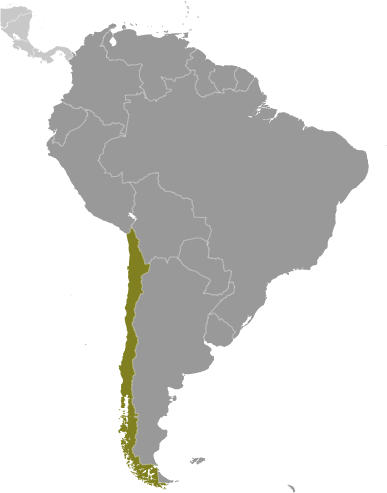

| CHILE Republic of Chile Republica de Chile Joined United Nations: 24 October 1945 Human Rights as assured by their constitution Click here Updated 17 October 2012 |

| CAPITAL |
| POPULATION |
| CHIEF OF STATE |
| SELECTION PROCESS |
Santiago
17,067,369 (July 2012 est.)
Dr. Miguel Juan Sebastián Piñera
Echenique
President since 11 March 2010
Echenique
President since 11 March 2010
President elected by popular vote for a single four-year term;
election last held 13 December 2009, with runoff election held
17 January 2010
Next scheduled election: December 2013
election last held 13 December 2009, with runoff election held
17 January 2010
Next scheduled election: December 2013
HEAD OF GOVERNMENT
SELECTION PROCESS
According to the Chilean Constitution, the president is both the
chief of state and head of government
chief of state and head of government
| DECLARATION OF HUMAN RIGHTS |
| ETHNIC GROUPS |
White and White-Amerindian 95.4%, Mapuche 4%, other indigenous groups 0.6% (2002 census)
| RELIGIONS |
Roman Catholic 70%, Evangelical 15.1%, Jehovah's Witness 1.1%, other Christian 1%, other 4.6%, none 8.3% (2002 census)
| GOVERNMENT STRUCTURE |
Republic -13 regions (regiones, singular - region); Legal system is based on Code of 1857 derived from Spanish law and subsequent
codes influenced by French and Austrian law; judicial review of legislative acts in the Supreme Court; has not accepted compulsory
ICJ jurisdiction; note - in June 2005, Chile completed overhaul of its criminal justice system to a new, US-style adversarial system
Executive: President elected by popular vote for a single four-year term; election last held 13 December 2009, with runoff election held 17
January 2010 (next to be held December 2013)
Legislative: Bicameral National Congress or Congreso Nacional consists of the Senate or Senado (38 seats elected by popular
vote; members serve eight-year terms - one-half elected every four years) and the Chamber of Deputies or Camara de Diputados
(120 seats; members are elected by popular vote to serve four-year terms)
elections: Senate - last held 13 December 2009 (next to be held December 2013); Chamber of Deputies - last held 13 December
2009 (next to be held December 2013)
Judicial: Supreme Court or Corte Suprema (judges are appointed by the president and ratified by the Senate from lists of
candidates provided by the court itself; the president of the Supreme Court is elected every three years by the 20-member court);
Constitutional Tribunal
codes influenced by French and Austrian law; judicial review of legislative acts in the Supreme Court; has not accepted compulsory
ICJ jurisdiction; note - in June 2005, Chile completed overhaul of its criminal justice system to a new, US-style adversarial system
Executive: President elected by popular vote for a single four-year term; election last held 13 December 2009, with runoff election held 17
January 2010 (next to be held December 2013)
Legislative: Bicameral National Congress or Congreso Nacional consists of the Senate or Senado (38 seats elected by popular
vote; members serve eight-year terms - one-half elected every four years) and the Chamber of Deputies or Camara de Diputados
(120 seats; members are elected by popular vote to serve four-year terms)
elections: Senate - last held 13 December 2009 (next to be held December 2013); Chamber of Deputies - last held 13 December
2009 (next to be held December 2013)
Judicial: Supreme Court or Corte Suprema (judges are appointed by the president and ratified by the Senate from lists of
candidates provided by the court itself; the president of the Supreme Court is elected every three years by the 20-member court);
Constitutional Tribunal
| LANGUAGES |
Spanish (official), Mapudungun, German, English
| BRIEF HISTORY |
Chilean territory was possibly among the last areas to be populated in the Americas, though the proposal that the initial arrival of
humans to the continent took place either along the Pacific coast southwards in a rather rapid expansion long preceding the Clovis
culture, or even trans-Pacific migration, is attracting with more interest in recent times. Pre-Hispanic Chile was home to over a
dozen different indigenous peoples. Despite such diversity, it is possible to classify them into three major cultural groups: The
northern peoples, who developed rich handicrafts and were influenced by pre-Incan cultures; the Mapuche culture, who inhabited
the area between the river Choapa and the island of Chiloé, and lived primarily off agriculture; and the Patagonian culture,
composed of various nomadic tribes, who supported themselves through fishing and hunting (and who in Pacific/Pacific Coast
immigration scenario would be descended partly from the most ancient settlers). As the Inca Empire expanded it was only able to
integrate the northern part of Chile. Incan attempts to colonize Central Chile were unsuccessful, having met fierce resistance by
Mapuche warriors. The Lircay river subsequently became the boundary between the Incan empire and the Mapuche lands. The first
European to sight Chilean territory was Ferdinand Magellan, who crossed the Strait of Magellan on November 1, 1520. However,
the title of discoverer of Chile is usually assigned to Diego de Almagro. De Almagro was Francisco Pizarro's partner, and he
received command of the southern part of the Inca Empire (Nueva Toledo). He organized an expedition that brought him to central
Chile in 1537, but he found little of value to compare with the gold and silver of the Incas in Peru. Left with the impression that the
inhabitants of the area were poor, he returned to Peru, later to die in a Civil War. After this initial excursion there was little interest
from colonial authorities in further exploring modern-day Chile. However, Pedro de Valdivia, captain of the army, realizing the
potential for expanding the Spanish empire southward, asked Pizarro permission to invade and conquer the southern lands. With a
couple of hundred men, he subdued the local inhabitants and founded the city of Santiago de Nueva Extremadura, now Santiago de
Chile, in February 12, 1541. Although Valdivia found little gold in Chile he could see the agricultural richness of the land. He
continued his explorations of the region west of the Andes and founded over a dozen towns and established the first encomiendas.
The greatest resistance to Spanish rule came from the Mapuche culture, who opposed European conquest and colonization until
1880s; this resistance is traditionally labelled as the Arauco War. Valdivia died at the Battle of Tucapel, defeated by Lautaro, a
young Mapuche toqui (war chief) but the European conquest was well underway. The Spaniards never subjugated the Mapuche
territories; various attempt at conquest, both by military and peaceful means, failed. The Great Uprising of 1600 swept all Spanish
presence south of the Bío-Bío River (except for Valdivia and Chiloé), and the great river became the frontier line between Mapuche
lands and the Spanish realm. North of that line cities grew up slowly, and Chilean lands eventually became an important source of
food for the Viceroyalty of Peru. Chile was the least wealthy realm of the Spanish Crown for most of its colonial history. Only in the
18th century did a steady economic and demographic growth begin, an effect of the reforms by Spain's Bourbon dynasty and a
more stable situation along the frontier. The drive for independence from Spain was precipitated by usurpation of the Spanish throne
by Napoleon's brother Joseph Bonaparte; and can be divided into 3 stages. A national junta was established in the name of
Ferdinand VII— the deposed king — on September 18, 1810. This period is known as the "Patria Vieja" (old republic). The
second was characterized by the Spanish attempts to reimpose arbitrary rule during the period known in Chile as the Reconquista
("Reconquest": the term echoes the Reconquista in which the Christian kingdoms retook Iberia from the Muslims) which in turn led
to a prolonged struggle under José de San Martín and Bernardo O'Higgins, Chile's most renowned patriot and a member of South
America's Irish diaspora. Other revolutionary leaders included the guerilla leader Manuel Rodríguez and the exiled British admiral
Thomas Cochrane, who commanded the Chilean Navy from 1817-1822. Chilean independence was formally proclaimed on
February 12, 1818, and the last of its territory, Chiloé, was wrested from Spanish rule by 1826. The political revolt brought little
social change, however, and nineteenth century Chilean society preserved the essence of the stratified colonial social structure,
family politics, and the influence of the Roman Catholic Church. The system of presidential power eventually predominated, but
wealthy landowners continued to control Chile. Toward the end of the nineteenth century, the government in Santiago consolidated
its position in the south by persistently suppressing the Mapuche during the Occupation of the Araucanía. In 1881, it signed a treaty
with Argentina confirming Chilean sovereignty over the Strait of Magellan, but conceding all of oriental Patagonia, and a
considerable fraction of the territory it had during colonial times. As a result of the War of the Pacific with Peru and Bolivia (1879-
1883), Chile expanded its territory northward by almost one-third and acquired valuable nitrate deposits, the exploitation of which
led to an era of national affluence. In the 1870s, the church influence started to diminish slightly with the passing of several laws that
took some old roles of the church into the State's hands such as the registry of births and marriages. In 1886, José Manuel
Balmaceda was elected president. His economic policies visibly changed the existing liberal policies. He began to violate the
constitution and slowly began to establish a dictatorship. Congress decided to depose Balmaceda, who refused to step down. Jorge
Montt, among others, directed an armed conflict against Balmaceda, which soon extended into the Chilean Civil War of 1891.
Defeated, Balmaceda fled to Argentina's embassy, where he committed suicide. Jorge Montt became the new president. By the
1920s, the emerging middle and working classes were powerful enough to elect a reformist president, whose program was
frustrated by a conservative congress. A military coup led by General Luis Altamirano in 1924 set off a period of great political
instability that lasted until 1932. The longest lasting of the ten governments between those years was that of Gen. Carlos Ibáñez,
who briefly held power in 1925 and then again between 1927 and 1931 in what was a de facto dictatorship. When constitutional
rule was restored in 1932, a strong middle-class party, the Radicals, emerged. It became the key force in coalition governments for
the next 20 years. In the presidential election of 1970, Salvador Allende gained the presidency of Chile. Allende was a Marxist and
a member of Chile's Socialist Party, who headed the "Popular Unity" (UP) coalition of the Socialist, Communist, Radical, and
Social-Democratic Parties, along with dissident Christian Democrats, the Popular Unitary Action Movement (MAPU), and the
Independent Popular Action. His program included land reform and the nationalization of U.S. interests in Chile's major copper
mines. Immediately after the election, the United States expressed its disapproval and raised a number of economic sanctions
against Chile. In addition, the CIA's website reports that the agency aided three different Chilean opposition groups during that time
period and "sought to instigate a coup to prevent Allende from taking office(.)" By 1973, Chilean society had grown highly
polarized, between strong opponents and equally strong supporters of Salvador Allende and his government. Military actions and
movements, separate from the civilian authority, began to manifest in the countryside. A failed military coup was attempted against
Allende in June 1973. In its "Declaration of the Breakdown of Chile’s Democracy", on August 22, 1973, the Chamber of Deputies
of Chile asserted that Chilean democracy had broken down and called for Allende's removal, by military force if necessary, to
restore constitutional rule. Less than a month later, on September 11, 1973, the Chilean military deposed Allende, who committed
suicide as the Presidential Palace was surrounded and bombed. Subsequently, rather than restore governmental authority to the
civilian legislature, Augusto Pinochet exploited his role as Commander of the Army to seize total power and to establish himself at
the head of a junta. Controversy surrounds alleged CIA involvement in the coup. As early as the Church Committee Report (1975),
publicly available documents have indicated that the CIA attempted to prevent Allende from taking office after he was elected in
1970; the CIA itself released documents in 2000 acknowledging this and that Pinochet was one of their favored alternatives to take
power. Still, they deny having taken any active role in the events in Chile after Allende took office. After the coup, Chileans
witnessed a large-scale repression, which started as soon as October 1973, with at least 70 persons murdered by the infamous
Caravan of Death. The four-man junta headed by General Augusto Pinochet abolished civil liberties, dissolved the national
congress, banned union activities, prohibited strikes and collective bargaining, and erased the Allende administration's agrarian and
economic reforms. The junta jailed, tortured, and executed thousands of Chileans. According to the Rettig commission and the
Valech Report, close to 3,200 were executed, murdered or "disappeared", and at least 29 000 imprisoned and tortured; higher
estimates exist. The Concertación coalition would dominate Chilean politics for the next two decades, with its most recent victory
being the 2006 election of Socialist candidate Michelle Bachelet. It established in February 1991 the National Commission for Truth
and Reconciliation, which released in February 1991 the Rettig Report on human rights violations during Augusto Pinochet's
dictatorship. The election of Sebastian Pinera on 17 January 2010 marks the return of conservatives to power.
Source: Wikipedia: History of Chile
humans to the continent took place either along the Pacific coast southwards in a rather rapid expansion long preceding the Clovis
culture, or even trans-Pacific migration, is attracting with more interest in recent times. Pre-Hispanic Chile was home to over a
dozen different indigenous peoples. Despite such diversity, it is possible to classify them into three major cultural groups: The
northern peoples, who developed rich handicrafts and were influenced by pre-Incan cultures; the Mapuche culture, who inhabited
the area between the river Choapa and the island of Chiloé, and lived primarily off agriculture; and the Patagonian culture,
composed of various nomadic tribes, who supported themselves through fishing and hunting (and who in Pacific/Pacific Coast
immigration scenario would be descended partly from the most ancient settlers). As the Inca Empire expanded it was only able to
integrate the northern part of Chile. Incan attempts to colonize Central Chile were unsuccessful, having met fierce resistance by
Mapuche warriors. The Lircay river subsequently became the boundary between the Incan empire and the Mapuche lands. The first
European to sight Chilean territory was Ferdinand Magellan, who crossed the Strait of Magellan on November 1, 1520. However,
the title of discoverer of Chile is usually assigned to Diego de Almagro. De Almagro was Francisco Pizarro's partner, and he
received command of the southern part of the Inca Empire (Nueva Toledo). He organized an expedition that brought him to central
Chile in 1537, but he found little of value to compare with the gold and silver of the Incas in Peru. Left with the impression that the
inhabitants of the area were poor, he returned to Peru, later to die in a Civil War. After this initial excursion there was little interest
from colonial authorities in further exploring modern-day Chile. However, Pedro de Valdivia, captain of the army, realizing the
potential for expanding the Spanish empire southward, asked Pizarro permission to invade and conquer the southern lands. With a
couple of hundred men, he subdued the local inhabitants and founded the city of Santiago de Nueva Extremadura, now Santiago de
Chile, in February 12, 1541. Although Valdivia found little gold in Chile he could see the agricultural richness of the land. He
continued his explorations of the region west of the Andes and founded over a dozen towns and established the first encomiendas.
The greatest resistance to Spanish rule came from the Mapuche culture, who opposed European conquest and colonization until
1880s; this resistance is traditionally labelled as the Arauco War. Valdivia died at the Battle of Tucapel, defeated by Lautaro, a
young Mapuche toqui (war chief) but the European conquest was well underway. The Spaniards never subjugated the Mapuche
territories; various attempt at conquest, both by military and peaceful means, failed. The Great Uprising of 1600 swept all Spanish
presence south of the Bío-Bío River (except for Valdivia and Chiloé), and the great river became the frontier line between Mapuche
lands and the Spanish realm. North of that line cities grew up slowly, and Chilean lands eventually became an important source of
food for the Viceroyalty of Peru. Chile was the least wealthy realm of the Spanish Crown for most of its colonial history. Only in the
18th century did a steady economic and demographic growth begin, an effect of the reforms by Spain's Bourbon dynasty and a
more stable situation along the frontier. The drive for independence from Spain was precipitated by usurpation of the Spanish throne
by Napoleon's brother Joseph Bonaparte; and can be divided into 3 stages. A national junta was established in the name of
Ferdinand VII— the deposed king — on September 18, 1810. This period is known as the "Patria Vieja" (old republic). The
second was characterized by the Spanish attempts to reimpose arbitrary rule during the period known in Chile as the Reconquista
("Reconquest": the term echoes the Reconquista in which the Christian kingdoms retook Iberia from the Muslims) which in turn led
to a prolonged struggle under José de San Martín and Bernardo O'Higgins, Chile's most renowned patriot and a member of South
America's Irish diaspora. Other revolutionary leaders included the guerilla leader Manuel Rodríguez and the exiled British admiral
Thomas Cochrane, who commanded the Chilean Navy from 1817-1822. Chilean independence was formally proclaimed on
February 12, 1818, and the last of its territory, Chiloé, was wrested from Spanish rule by 1826. The political revolt brought little
social change, however, and nineteenth century Chilean society preserved the essence of the stratified colonial social structure,
family politics, and the influence of the Roman Catholic Church. The system of presidential power eventually predominated, but
wealthy landowners continued to control Chile. Toward the end of the nineteenth century, the government in Santiago consolidated
its position in the south by persistently suppressing the Mapuche during the Occupation of the Araucanía. In 1881, it signed a treaty
with Argentina confirming Chilean sovereignty over the Strait of Magellan, but conceding all of oriental Patagonia, and a
considerable fraction of the territory it had during colonial times. As a result of the War of the Pacific with Peru and Bolivia (1879-
1883), Chile expanded its territory northward by almost one-third and acquired valuable nitrate deposits, the exploitation of which
led to an era of national affluence. In the 1870s, the church influence started to diminish slightly with the passing of several laws that
took some old roles of the church into the State's hands such as the registry of births and marriages. In 1886, José Manuel
Balmaceda was elected president. His economic policies visibly changed the existing liberal policies. He began to violate the
constitution and slowly began to establish a dictatorship. Congress decided to depose Balmaceda, who refused to step down. Jorge
Montt, among others, directed an armed conflict against Balmaceda, which soon extended into the Chilean Civil War of 1891.
Defeated, Balmaceda fled to Argentina's embassy, where he committed suicide. Jorge Montt became the new president. By the
1920s, the emerging middle and working classes were powerful enough to elect a reformist president, whose program was
frustrated by a conservative congress. A military coup led by General Luis Altamirano in 1924 set off a period of great political
instability that lasted until 1932. The longest lasting of the ten governments between those years was that of Gen. Carlos Ibáñez,
who briefly held power in 1925 and then again between 1927 and 1931 in what was a de facto dictatorship. When constitutional
rule was restored in 1932, a strong middle-class party, the Radicals, emerged. It became the key force in coalition governments for
the next 20 years. In the presidential election of 1970, Salvador Allende gained the presidency of Chile. Allende was a Marxist and
a member of Chile's Socialist Party, who headed the "Popular Unity" (UP) coalition of the Socialist, Communist, Radical, and
Social-Democratic Parties, along with dissident Christian Democrats, the Popular Unitary Action Movement (MAPU), and the
Independent Popular Action. His program included land reform and the nationalization of U.S. interests in Chile's major copper
mines. Immediately after the election, the United States expressed its disapproval and raised a number of economic sanctions
against Chile. In addition, the CIA's website reports that the agency aided three different Chilean opposition groups during that time
period and "sought to instigate a coup to prevent Allende from taking office(.)" By 1973, Chilean society had grown highly
polarized, between strong opponents and equally strong supporters of Salvador Allende and his government. Military actions and
movements, separate from the civilian authority, began to manifest in the countryside. A failed military coup was attempted against
Allende in June 1973. In its "Declaration of the Breakdown of Chile’s Democracy", on August 22, 1973, the Chamber of Deputies
of Chile asserted that Chilean democracy had broken down and called for Allende's removal, by military force if necessary, to
restore constitutional rule. Less than a month later, on September 11, 1973, the Chilean military deposed Allende, who committed
suicide as the Presidential Palace was surrounded and bombed. Subsequently, rather than restore governmental authority to the
civilian legislature, Augusto Pinochet exploited his role as Commander of the Army to seize total power and to establish himself at
the head of a junta. Controversy surrounds alleged CIA involvement in the coup. As early as the Church Committee Report (1975),
publicly available documents have indicated that the CIA attempted to prevent Allende from taking office after he was elected in
1970; the CIA itself released documents in 2000 acknowledging this and that Pinochet was one of their favored alternatives to take
power. Still, they deny having taken any active role in the events in Chile after Allende took office. After the coup, Chileans
witnessed a large-scale repression, which started as soon as October 1973, with at least 70 persons murdered by the infamous
Caravan of Death. The four-man junta headed by General Augusto Pinochet abolished civil liberties, dissolved the national
congress, banned union activities, prohibited strikes and collective bargaining, and erased the Allende administration's agrarian and
economic reforms. The junta jailed, tortured, and executed thousands of Chileans. According to the Rettig commission and the
Valech Report, close to 3,200 were executed, murdered or "disappeared", and at least 29 000 imprisoned and tortured; higher
estimates exist. The Concertación coalition would dominate Chilean politics for the next two decades, with its most recent victory
being the 2006 election of Socialist candidate Michelle Bachelet. It established in February 1991 the National Commission for Truth
and Reconciliation, which released in February 1991 the Rettig Report on human rights violations during Augusto Pinochet's
dictatorship. The election of Sebastian Pinera on 17 January 2010 marks the return of conservatives to power.
Source: Wikipedia: History of Chile
| ECONOMIC OVERVIEW |
Chile has a market-oriented economy characterized by a high level of foreign trade and a reputation for strong financial institutions
and sound policy that have given it the strongest sovereign bond rating in South America. Exports account for more than one-third
of GDP, with commodities making up some three-quarters of total exports. Copper alone provides one-third of government
revenue. During the early 1990s, Chile's reputation as a role model for economic reform was strengthened when the democratic
government of Patricio AYLWIN - which took over from the military in 1990 - deepened the economic reform initiated by the
military government. Since 1999, growth has averaged 4% per year. Chile deepened its longstanding commitment to trade
liberalization with the signing of a free trade agreement with the US, which took effect on 1 January 2004. Chile claims to have more
bilateral or regional trade agreements than any other country. It has 59 such agreements (not all of them full free trade agreements),
including with the European Union, Mercosur, China, India, South Korea, and Mexico. Over the past seven years, foreign direct
investment inflows have quadrupled to some $15 billion in 2010, but foreign direct investment had dropped to about $7 billion in
2009 in the face of diminished investment throughout the world. The Chilean government conducts a rule-based countercyclical
fiscal policy, accumulating surpluses in sovereign wealth funds during periods of high copper prices and economic growth, and
allowing deficit spending only during periods of low copper prices and growth. As of November 2011, those sovereign wealth
funds - kept mostly outside the country and separate from Central Bank reserves - amounted to more than $18 billion. Chile used
this fund to finance fiscal stimulus packages during the 2009 economic downturn. In December 2009, the OECD invited Chile to
become a full member, after a two year period of compliance with organization mandates, and in May 2010 Chile signed the OECD
Convention, becoming the first South American country to join the OECD. The economy started to show signs of a rebound in the
fourth quarter of 2009, and GDP grew 5.1% in 2010 and 6.5% in 2011. Chile achieved this growth despite the 8.8 magnitude
earthquake that struck in February 2010, which was one of the top 10 strongest earthquakes on record. The earthquake and
subsequent tsunamis it generated caused considerable damage near the epicenter, located about 70 miles from Concepcion - and
about 200 miles southwest of Santiago.
Source: CIA World Factbook (select Chile)
and sound policy that have given it the strongest sovereign bond rating in South America. Exports account for more than one-third
of GDP, with commodities making up some three-quarters of total exports. Copper alone provides one-third of government
revenue. During the early 1990s, Chile's reputation as a role model for economic reform was strengthened when the democratic
government of Patricio AYLWIN - which took over from the military in 1990 - deepened the economic reform initiated by the
military government. Since 1999, growth has averaged 4% per year. Chile deepened its longstanding commitment to trade
liberalization with the signing of a free trade agreement with the US, which took effect on 1 January 2004. Chile claims to have more
bilateral or regional trade agreements than any other country. It has 59 such agreements (not all of them full free trade agreements),
including with the European Union, Mercosur, China, India, South Korea, and Mexico. Over the past seven years, foreign direct
investment inflows have quadrupled to some $15 billion in 2010, but foreign direct investment had dropped to about $7 billion in
2009 in the face of diminished investment throughout the world. The Chilean government conducts a rule-based countercyclical
fiscal policy, accumulating surpluses in sovereign wealth funds during periods of high copper prices and economic growth, and
allowing deficit spending only during periods of low copper prices and growth. As of November 2011, those sovereign wealth
funds - kept mostly outside the country and separate from Central Bank reserves - amounted to more than $18 billion. Chile used
this fund to finance fiscal stimulus packages during the 2009 economic downturn. In December 2009, the OECD invited Chile to
become a full member, after a two year period of compliance with organization mandates, and in May 2010 Chile signed the OECD
Convention, becoming the first South American country to join the OECD. The economy started to show signs of a rebound in the
fourth quarter of 2009, and GDP grew 5.1% in 2010 and 6.5% in 2011. Chile achieved this growth despite the 8.8 magnitude
earthquake that struck in February 2010, which was one of the top 10 strongest earthquakes on record. The earthquake and
subsequent tsunamis it generated caused considerable damage near the epicenter, located about 70 miles from Concepcion - and
about 200 miles southwest of Santiago.
Source: CIA World Factbook (select Chile)
| POLITICAL CLIMATE |
The politics of Chile takes place in a framework of a presidential representative democratic republic, whereby the President of Chile
is both head of state and head of government, and of a multi-party system. Executive power is exercised by the government.
Legislative power is vested in both the government and the two chambers of the National Congress. The Judiciary is independent of
the executive and the legislature.
Chile's current Constitution was approved in a national plebiscite in September 1980, under the military government of dictator
Augusto Pinochet. It entered into force in March 1981. After Pinochet leaving power in the 1988, saying this country is ready to
keep going alone along with a plebiscite, the Constitution was amended to ease provisions for future amendments to the
Constitution. In September 2005, President Ricardo Lagos signed into law several constitutional amendments passed by Congress.
These include eliminating the positions of appointed senators and senators for life, granting the President authority to remove the
commanders-in-chief of the armed forces, and reducing the presidential term from six to four years.
Michele Bachelet was elected as the first woman president of Chile in January 2006. She was replaced with the election of
Sebastian Pinera on 17 January 2010. He is the first conservative elected president since the toppling of Pinochet.
Source: Wikipedia: Politics of Chile
is both head of state and head of government, and of a multi-party system. Executive power is exercised by the government.
Legislative power is vested in both the government and the two chambers of the National Congress. The Judiciary is independent of
the executive and the legislature.
Chile's current Constitution was approved in a national plebiscite in September 1980, under the military government of dictator
Augusto Pinochet. It entered into force in March 1981. After Pinochet leaving power in the 1988, saying this country is ready to
keep going alone along with a plebiscite, the Constitution was amended to ease provisions for future amendments to the
Constitution. In September 2005, President Ricardo Lagos signed into law several constitutional amendments passed by Congress.
These include eliminating the positions of appointed senators and senators for life, granting the President authority to remove the
commanders-in-chief of the armed forces, and reducing the presidential term from six to four years.
Michele Bachelet was elected as the first woman president of Chile in January 2006. She was replaced with the election of
Sebastian Pinera on 17 January 2010. He is the first conservative elected president since the toppling of Pinochet.
Source: Wikipedia: Politics of Chile
| INTERNATIONAL DISPUTES |
Chile and Peru rebuff Bolivia's reinvigorated claim to restore the Atacama corridor, ceded to Chile in 1884, but Chile has offered
instead unrestricted but not sovereign maritime access through Chile to Bolivian gas and other commodities; Chile rejects Peru's
unilateral legislation to change its latitudinal maritime boundary with Chile to an equidistance line with a southwestern axis favoring
Peru, in October 2007, Peru took its maritime complaint with Chile to the ICJ; territorial claim in Antarctica (Chilean Antarctic
Territory) partially overlaps Argentine and British claims; the joint boundary commission, established by Chile and Argentina in
2001, has yet to map and demarcate the delimited boundary in the inhospitable Andean Southern Ice Field (Campo de Hielo Sur)
instead unrestricted but not sovereign maritime access through Chile to Bolivian gas and other commodities; Chile rejects Peru's
unilateral legislation to change its latitudinal maritime boundary with Chile to an equidistance line with a southwestern axis favoring
Peru, in October 2007, Peru took its maritime complaint with Chile to the ICJ; territorial claim in Antarctica (Chilean Antarctic
Territory) partially overlaps Argentine and British claims; the joint boundary commission, established by Chile and Argentina in
2001, has yet to map and demarcate the delimited boundary in the inhospitable Andean Southern Ice Field (Campo de Hielo Sur)


| TRAFFICKING IN PERSONS |
None reported.
| ILLICIT DRUGS |
Transshipment country for cocaine destined for Europe and the region; some money laundering activity, especially through the
Iquique Free Trade Zone; imported precursors passed on to Bolivia; domestic cocaine consumption is rising, making Chile a
significant consumer of cocaine (2008)
Iquique Free Trade Zone; imported precursors passed on to Bolivia; domestic cocaine consumption is rising, making Chile a
significant consumer of cocaine (2008)
| HUMAN RIGHTS STATEMENTS, ANALYSIS AND CRITIQUES |
2011 Human Rights Report: Chile
Bureau of Democracy, Human Rights, and Labor
2011 Country Reports on Human Rights Practices
May 25, 2012
Chile is a constitutional multiparty democracy. In January 2010 voters chose Sebastian Pinera Echenique of the center-right
Coalition for Change as president in elections that were generally considered free and fair. Security forces reported to civilian
authorities.
The principal human rights problems reported during the year were poor prison conditions; allegations of excessive use of force
and mistreatment by police forces, including during student protests; and disputes between indigenous communities and the
government regarding land rights, development, and judicial matters.
Additional human rights concerns in the country included violence against women and child abuse.
The government generally took steps to prosecute officials who committed abuses, whether in the security services or elsewhere in
the government.
Click here to read more »
Bureau of Democracy, Human Rights, and Labor
2011 Country Reports on Human Rights Practices
May 25, 2012
Chile is a constitutional multiparty democracy. In January 2010 voters chose Sebastian Pinera Echenique of the center-right
Coalition for Change as president in elections that were generally considered free and fair. Security forces reported to civilian
authorities.
The principal human rights problems reported during the year were poor prison conditions; allegations of excessive use of force
and mistreatment by police forces, including during student protests; and disputes between indigenous communities and the
government regarding land rights, development, and judicial matters.
Additional human rights concerns in the country included violence against women and child abuse.
The government generally took steps to prosecute officials who committed abuses, whether in the security services or elsewhere in
the government.
Click here to read more »
21 September 2011
Committee on the Protection of the Rights of All Migrant Workers and Members of Their Families
Fifteenth session
12-23 September 2011
Consideration of reports submitted by States parties under article 74 of the Convention
Concluding observations of the Committee on the Protection of the Rights of All Migrant Workers and Members of
Their Families
Chile
A. Introduction
2. The Committee welcomes the State party’s comprehensive initial report, its detailed replies to the list of issues, and the precise
additional information provided by the delegation. The Committee is gratified by the level of the delegation and the constructive
dialogue that took place.
3. The Committee notes that some of the countries in which Chilean migrant workers are located are not yet parties to the
Convention, which constitutes an obstacle to the enjoyment by those workers of the rights to which they are entitled under the
Convention.
B. Positive aspects
5. The committee welcomes the promulgation of Law No. 20.507 of 1 April 2011 on trafficking in persons.
6. The Committee also welcomes the signing of agreements related to migrant workers, including:
(a) Intersectoral agreements to foster integration of the migrant population;
(b) International social security agreements;
(c) Agreements concluded by Chile as an associate member of MERCOSUR; and
(d) The cooperation agreement signed between the Chilean Prison Service and the International Organization for Migration.
C. Principal subjects of concern, suggestions and recommendations
1. General implementation measures (arts. 73 and 84)
Legislation and its application
8. The Committee notes that a draft law on migration is under preparation in the State party.
9. The Committee invites the State party to ensure that the draft law is passed as a law and that it fully complies with international
standards protecting the rights of migrant workers and members of their families and, in particular, with the provisions of the
Convention.
10. The Committee notes with concern that the State party made reservations to paragraph 5 of article 22 and paragraph 2 of article
48 of the Convention and that it is not reconsidering its decision on this matter.
11. The Committee invites the State party to consider withdrawing its reservations to article 22, paragraph 5, and article 48,
paragraph 2, of the Convention.
Click here to read more »
Committee on the Protection of the Rights of All Migrant Workers and Members of Their Families
Fifteenth session
12-23 September 2011
Consideration of reports submitted by States parties under article 74 of the Convention
Concluding observations of the Committee on the Protection of the Rights of All Migrant Workers and Members of
Their Families
Chile
A. Introduction
2. The Committee welcomes the State party’s comprehensive initial report, its detailed replies to the list of issues, and the precise
additional information provided by the delegation. The Committee is gratified by the level of the delegation and the constructive
dialogue that took place.
3. The Committee notes that some of the countries in which Chilean migrant workers are located are not yet parties to the
Convention, which constitutes an obstacle to the enjoyment by those workers of the rights to which they are entitled under the
Convention.
B. Positive aspects
5. The committee welcomes the promulgation of Law No. 20.507 of 1 April 2011 on trafficking in persons.
6. The Committee also welcomes the signing of agreements related to migrant workers, including:
(a) Intersectoral agreements to foster integration of the migrant population;
(b) International social security agreements;
(c) Agreements concluded by Chile as an associate member of MERCOSUR; and
(d) The cooperation agreement signed between the Chilean Prison Service and the International Organization for Migration.
C. Principal subjects of concern, suggestions and recommendations
1. General implementation measures (arts. 73 and 84)
Legislation and its application
8. The Committee notes that a draft law on migration is under preparation in the State party.
9. The Committee invites the State party to ensure that the draft law is passed as a law and that it fully complies with international
standards protecting the rights of migrant workers and members of their families and, in particular, with the provisions of the
Convention.
10. The Committee notes with concern that the State party made reservations to paragraph 5 of article 22 and paragraph 2 of article
48 of the Convention and that it is not reconsidering its decision on this matter.
11. The Committee invites the State party to consider withdrawing its reservations to article 22, paragraph 5, and article 48,
paragraph 2, of the Convention.
Click here to read more »
Freedom In The World 2012 Report
Political Rights Score: 1
Civil Liberties Score: 1
Status: Free
Overview
President Sebastián Piñera of the center-right Coalition for Change faced growing political challenges in the second half of 2011 due
principally to an impasse on education reform between the government and student leaders. The government’s harsh response and
inability to control the demonstrations resulted in plummeting popularity for both the president and his coalition. Separately, the
Chilean government continued to promote the economic development and increased rights of the Mapuche Indians.
Sebastián Piñera of the center-right Coalition for Change was elected president in January 2010. The new administration was
challenged by a massive earthquake that struck Chile in late February, but Piñera was able to carry out effective reconstruction due
to Chile’s sound public finances. The government also assumed full control of rescue operations after an accident trapped 33
miners in a gold and copper mine in northern Chile in August. Their successful rescue in October boosted Piñera’s popularity as
well as Chile’s international image. In response to the incident, Chile ratified an International Labour Organization convention in
April 2011 on occupational safety and health.
However, Piñera’s popularity was short-lived, plummeting to a record low 26 percent approval rate by mid-2011. The government’
s plan to build dams in Patagonia was met with fierce resistance from environmentalists and protesters. Months of student protests
and strikes beginning in April also brought hundreds of thousands to the streets of Chile’s large cities with demands for a major
overhaul of the education system. Students occupied more than 200 institutions of learning, calling for changes to Chile’s largely
privatized education system, including free public college education for low-income students. Piñera responded by replacing his
education minister in July, and promised $4 billion in new education spending financed by copper revenues, as well as a 24 percent
rise in student scholarships. In October, Congress also passed a law to cut interest rates on student loans by more than half.
However, the government’s attempts to criminalize the protests by imposing harsh sentences for arrested protesters prompted
increased student intransigence. At the end of 2011, there was still no resolution to what had easily become one of Chile’s most
intractable political problems in decades.
Click here to read more »
Political Rights Score: 1
Civil Liberties Score: 1
Status: Free
Overview
President Sebastián Piñera of the center-right Coalition for Change faced growing political challenges in the second half of 2011 due
principally to an impasse on education reform between the government and student leaders. The government’s harsh response and
inability to control the demonstrations resulted in plummeting popularity for both the president and his coalition. Separately, the
Chilean government continued to promote the economic development and increased rights of the Mapuche Indians.
Sebastián Piñera of the center-right Coalition for Change was elected president in January 2010. The new administration was
challenged by a massive earthquake that struck Chile in late February, but Piñera was able to carry out effective reconstruction due
to Chile’s sound public finances. The government also assumed full control of rescue operations after an accident trapped 33
miners in a gold and copper mine in northern Chile in August. Their successful rescue in October boosted Piñera’s popularity as
well as Chile’s international image. In response to the incident, Chile ratified an International Labour Organization convention in
April 2011 on occupational safety and health.
However, Piñera’s popularity was short-lived, plummeting to a record low 26 percent approval rate by mid-2011. The government’
s plan to build dams in Patagonia was met with fierce resistance from environmentalists and protesters. Months of student protests
and strikes beginning in April also brought hundreds of thousands to the streets of Chile’s large cities with demands for a major
overhaul of the education system. Students occupied more than 200 institutions of learning, calling for changes to Chile’s largely
privatized education system, including free public college education for low-income students. Piñera responded by replacing his
education minister in July, and promised $4 billion in new education spending financed by copper revenues, as well as a 24 percent
rise in student scholarships. In October, Congress also passed a law to cut interest rates on student loans by more than half.
However, the government’s attempts to criminalize the protests by imposing harsh sentences for arrested protesters prompted
increased student intransigence. At the end of 2011, there was still no resolution to what had easily become one of Chile’s most
intractable political problems in decades.
Click here to read more »
29 August 2012
Enforced Disappearances in the Americas are a crime of the present
The last time Victoria Montenegro saw her biological mother, Hilda Ramona Torres, she was just 13 days old.
On 13 February 1976, a military intelligence group forced their way into her home in Buenos Aires province, Argentina, killed her
parents (both political activists) and took her to a police station. Hernán Antonio Tetzlaff, who led the military operation, took her,
changed her name and adopted her as his daughter.
From that time Victoria Montenegro was known as Maria Sol Tetzlaff Eduartes, born on 28 May 1976 and daughter of Hernán
Antonio Tetzlaff and Maria del Carmen Eduartes.
It took 25 years for Victoria to find out her real identity and another decade for her to see seven high ranking military officers
(including the former de facto Presidents Jorge Videla and Reynaldo Bignone and an obstetrician) brought to justice – sentenced to
between 10 and 50 years in jail for their part in the systematic plan of appropriation of babies during Argentina’s military rule (1976-
1983).
Victoria is far from alone. The “Grandmothers of Plaza de Mayo” – the organization that has led the search for Argentina’s “stolen
babies” – has already helped 105 men and women recover their identity.
They believe there are hundreds more to be found.
Relatives of the disappeared in Argentina and other countries have led the fight for justice for the thousands of enforced
disappearances that took place across Latin America in the 60’s, 70’s and 80’s.
Their efforts have led to the creation of an International Day of the Victims of Enforced Disappearances on 30 August.
Steps forward
During 2011 – and despite obstacles in investigations and frequent setbacks – there were significant advances in the investigation
and prosecution of disappearances and other human rights abuses committed under military regimes across Latin America.
In Brazil, President Dilma Rousseff signed into law the creation of a Truth Commission to investigate human rights violations
committed between 1946 and 1988.
In Chile the number of cases of human rights violations under investigation by the courts rose to its highest level yet after a court
prosecutor submitted 726 new criminal cases and more than 1,000 complaints filed over the years by relatives of people executed
on political grounds during the military government of General Augusto Pinochet.
Click here to read more »
Enforced Disappearances in the Americas are a crime of the present
The last time Victoria Montenegro saw her biological mother, Hilda Ramona Torres, she was just 13 days old.
On 13 February 1976, a military intelligence group forced their way into her home in Buenos Aires province, Argentina, killed her
parents (both political activists) and took her to a police station. Hernán Antonio Tetzlaff, who led the military operation, took her,
changed her name and adopted her as his daughter.
From that time Victoria Montenegro was known as Maria Sol Tetzlaff Eduartes, born on 28 May 1976 and daughter of Hernán
Antonio Tetzlaff and Maria del Carmen Eduartes.
It took 25 years for Victoria to find out her real identity and another decade for her to see seven high ranking military officers
(including the former de facto Presidents Jorge Videla and Reynaldo Bignone and an obstetrician) brought to justice – sentenced to
between 10 and 50 years in jail for their part in the systematic plan of appropriation of babies during Argentina’s military rule (1976-
1983).
Victoria is far from alone. The “Grandmothers of Plaza de Mayo” – the organization that has led the search for Argentina’s “stolen
babies” – has already helped 105 men and women recover their identity.
They believe there are hundreds more to be found.
Relatives of the disappeared in Argentina and other countries have led the fight for justice for the thousands of enforced
disappearances that took place across Latin America in the 60’s, 70’s and 80’s.
Their efforts have led to the creation of an International Day of the Victims of Enforced Disappearances on 30 August.
Steps forward
During 2011 – and despite obstacles in investigations and frequent setbacks – there were significant advances in the investigation
and prosecution of disappearances and other human rights abuses committed under military regimes across Latin America.
In Brazil, President Dilma Rousseff signed into law the creation of a Truth Commission to investigate human rights violations
committed between 1946 and 1988.
In Chile the number of cases of human rights violations under investigation by the courts rose to its highest level yet after a court
prosecutor submitted 726 new criminal cases and more than 1,000 complaints filed over the years by relatives of people executed
on political grounds during the military government of General Augusto Pinochet.
Click here to read more »
Chile: Investigate Police Violence Against Mapuches
Rubber Bullets Wound 4 Children From Indigenous Community
August 10, 2012
The Chilean authorities should carry out a prompt, thorough, and impartial investigation into the alleged unlawful use of force by
police against members of the Mapuche indigenous community, Human Rights Watch said today. Officers found responsible for
any unlawful use of force should be held to account and the injured civilians ensured an effective remedy.
In two incidents on July 23, 2012, Caribineros police shot rubber bullets at members of the Ignacio Queipul community of
Temucuicui, in Ercilla in southern Chile. The rubber bullets wounded four children and several adults.
“The use of rubber bullets is acceptable only in very limited situations when law enforcement must confront violence and other less
violent means can’t be used or don’t work,” said José Miguel Vivanco, Americas director at Human Rights Watch. “The
circumstances of these shootings as they are known, including the fact that children were involved, strongly suggest that the use of
rubber bullets in this case was not justified.”
The first shooting occurred as Carabineros police were evicting community members from land they had occupied in Ercilla,
wounding as many as 12 people, according to press accounts, including a 12-year-old boy.
Later that day, Carabineros fired rubber bullets at a group of Mapuches outside a hospital in Collipulli where detainees who had
been injured during the earlier police action were receiving medical attention. According to a complaint filed by a witness from the
Defensoria Penal Mapuche, a state body that assists in the legal defense of Mapuches, Carabineros stationed outside the hospital
entrance opened fire at short range, without provocation or warning, on Mapuches who had come to visit the injured. Seven
people, including a 13-year-old girl and two 17-year-old boys, were wounded.
A senior police official later stated that the Mapuches had been armed with stones and sticks and had tried to rescue detainees as
they were being moved from the hospital to a police bus parked outside the hospital.
The United Nations Basic Principles on the Use of Force and Firearms by Law Enforcement Officials provide that security forces
shall as far as possible apply nonviolent means before resorting to the use of force. When use of force is unavoidable law
enforcement must exercise restraint and act in proportion to the seriousness of the offense and the legitimate objective to be
achieved; and shall minimize damage and injury.
Click here to read more »
Rubber Bullets Wound 4 Children From Indigenous Community
August 10, 2012
The Chilean authorities should carry out a prompt, thorough, and impartial investigation into the alleged unlawful use of force by
police against members of the Mapuche indigenous community, Human Rights Watch said today. Officers found responsible for
any unlawful use of force should be held to account and the injured civilians ensured an effective remedy.
In two incidents on July 23, 2012, Caribineros police shot rubber bullets at members of the Ignacio Queipul community of
Temucuicui, in Ercilla in southern Chile. The rubber bullets wounded four children and several adults.
“The use of rubber bullets is acceptable only in very limited situations when law enforcement must confront violence and other less
violent means can’t be used or don’t work,” said José Miguel Vivanco, Americas director at Human Rights Watch. “The
circumstances of these shootings as they are known, including the fact that children were involved, strongly suggest that the use of
rubber bullets in this case was not justified.”
The first shooting occurred as Carabineros police were evicting community members from land they had occupied in Ercilla,
wounding as many as 12 people, according to press accounts, including a 12-year-old boy.
Later that day, Carabineros fired rubber bullets at a group of Mapuches outside a hospital in Collipulli where detainees who had
been injured during the earlier police action were receiving medical attention. According to a complaint filed by a witness from the
Defensoria Penal Mapuche, a state body that assists in the legal defense of Mapuches, Carabineros stationed outside the hospital
entrance opened fire at short range, without provocation or warning, on Mapuches who had come to visit the injured. Seven
people, including a 13-year-old girl and two 17-year-old boys, were wounded.
A senior police official later stated that the Mapuches had been armed with stones and sticks and had tried to rescue detainees as
they were being moved from the hospital to a police bus parked outside the hospital.
The United Nations Basic Principles on the Use of Force and Firearms by Law Enforcement Officials provide that security forces
shall as far as possible apply nonviolent means before resorting to the use of force. When use of force is unavoidable law
enforcement must exercise restraint and act in proportion to the seriousness of the offense and the legitimate objective to be
achieved; and shall minimize damage and injury.
Click here to read more »
TRANSLATED FROM SPANISH BY GOOGLE TRANSLATE
Bill Protection of Labor Rights in Bankruptcy
August 2, 2012
The President, Sebastián Piñera, along with the ministers of Justice, Teodoro Ribera, Labor, Evelyn Matthei, and Economy, Pablo
Longueira, signed the bill into law on protection of labor rights in bankruptcy, which will enter the Congress to processing.
Why is this bill important?
For now, the current law does not explain what happens in case of bankruptcy of an employer, generating employment uncertainty,
since the employer is replaced by a third party or trustee in order to pay off their debts, for which dismisses all workers, citing as
grounds the "business necessity."
This creates a vicious circle for workers, and unpaid contributions which they are discovered, you can not make the releases and
the work must sue in court to be recognized debt, resulting in delay of payment. This delays the receipt of worker benefits and
retirement often, considering that the average duration of a court of bankruptcy is 4.5 years, and nearly 60% of the claimants to the
Superintendent of Bankruptcy are workers ( as).
Main proposals of the Bill
Declared bankruptcy court will have the following effects:
It will be legal grounds for termination of employment contract.
It entitles the worker to compensation alternatives to notice and for years of service, maintaining the practice of the trustees and
courts, but legal text level.
The settlement may be signed with unpaid contributions. The worker never gives up contributions are not paid at the time of the
contract term, while it has been signed between the employee and trustee, the settlement is sufficient to pay the trustee without a
lawsuit, which reduces the time worker's expected.
Provides access to individual account and Unemployment Solidarity Fund (unemployment insurance).
Rules are standardized on the ceilings applicable to workers preferences are included in the Labour Code and the Civil Code.
The charters are finished with the bankruptcy proceedings without judicial immunity, paying the compensation. In case of
maternity leave, plus compensation paid to represent the months of the jurisdiction that future earnings will no longer receive,
minus the maternity allowance tax charge.
Social credit quota granted by a Compensation Fund Family Allowance:
Unearned future, not the employer assumes the bankrupt and be a personal debt of the worker, but the shares and accrued
compensation and deducted by the employer, the employer assumes the bankruptcy.
Click here to read more »
Bill Protection of Labor Rights in Bankruptcy
August 2, 2012
The President, Sebastián Piñera, along with the ministers of Justice, Teodoro Ribera, Labor, Evelyn Matthei, and Economy, Pablo
Longueira, signed the bill into law on protection of labor rights in bankruptcy, which will enter the Congress to processing.
Why is this bill important?
For now, the current law does not explain what happens in case of bankruptcy of an employer, generating employment uncertainty,
since the employer is replaced by a third party or trustee in order to pay off their debts, for which dismisses all workers, citing as
grounds the "business necessity."
This creates a vicious circle for workers, and unpaid contributions which they are discovered, you can not make the releases and
the work must sue in court to be recognized debt, resulting in delay of payment. This delays the receipt of worker benefits and
retirement often, considering that the average duration of a court of bankruptcy is 4.5 years, and nearly 60% of the claimants to the
Superintendent of Bankruptcy are workers ( as).
Main proposals of the Bill
Declared bankruptcy court will have the following effects:
It will be legal grounds for termination of employment contract.
It entitles the worker to compensation alternatives to notice and for years of service, maintaining the practice of the trustees and
courts, but legal text level.
The settlement may be signed with unpaid contributions. The worker never gives up contributions are not paid at the time of the
contract term, while it has been signed between the employee and trustee, the settlement is sufficient to pay the trustee without a
lawsuit, which reduces the time worker's expected.
Provides access to individual account and Unemployment Solidarity Fund (unemployment insurance).
Rules are standardized on the ceilings applicable to workers preferences are included in the Labour Code and the Civil Code.
The charters are finished with the bankruptcy proceedings without judicial immunity, paying the compensation. In case of
maternity leave, plus compensation paid to represent the months of the jurisdiction that future earnings will no longer receive,
minus the maternity allowance tax charge.
Social credit quota granted by a Compensation Fund Family Allowance:
Unearned future, not the employer assumes the bankrupt and be a personal debt of the worker, but the shares and accrued
compensation and deducted by the employer, the employer assumes the bankruptcy.
Click here to read more »
TRANSLATED FROM SPANISH BY GOOGLE TRANSLATE
Human Rights Observers in Angol by Mapuche hunger strike:'''' They are dying
UPI | September 29, 2012
A team of human rights observers entered Saturday at Angol prison, in the Araucanía Region, which detected the precarious state
of health that are the four young Mapuche 33 days ago maintained a hunger strike.
According to a member of the Ethics Committee against Torture, Manuel Andrade, "they look pretty exhausted and affected, but
are quite intact.'re Very young children, are very thin.'ve Lost, on average, between 10 to 11 kilos."
For its part, the perception formed Codepu member, Felix Maradiaga, is that "they look pretty weak, have lost muscle mass, have
dizziness, stomach hurts them. The impression is that they are dying and nobody does anything ".
Human rights observers met for four hours with Levinao Daniel Montoya, Paulino Levipan Coyan, Rodrigo Montoya Montoya
Melinao and Eric Montoya. All are members of the community of Ercilla Mapu Winkul Wente.
Levipan Levinao Coyan and Montoya were sentenced to 11 years in prison on charges of attempted murder to police and illegal
possession of firearms.
Meanwhile, Montoya and Montoya Montoya Melinao are charged with an alleged attempted murder against a policeman guarding
the Centennial founded in August 2011.
The meeting took place in the courtyard of the Mapuche module, which also machis werkenes and conducted a prayer for the
young.
The member of the Ethical Commission Against Torture said that the strikers demand the annulment of their judgments and to
make a new process.
"They say that their judgments are flawed and are convicted of carrying out a struggle for the recovery of ancestral lands," he said.
He said he also requested the presence of any governmental authority, to the Patriot Act and militarization affecting Mapuche
territory.
Click here to read more »
Human Rights Observers in Angol by Mapuche hunger strike:'''' They are dying
UPI | September 29, 2012
A team of human rights observers entered Saturday at Angol prison, in the Araucanía Region, which detected the precarious state
of health that are the four young Mapuche 33 days ago maintained a hunger strike.
According to a member of the Ethics Committee against Torture, Manuel Andrade, "they look pretty exhausted and affected, but
are quite intact.'re Very young children, are very thin.'ve Lost, on average, between 10 to 11 kilos."
For its part, the perception formed Codepu member, Felix Maradiaga, is that "they look pretty weak, have lost muscle mass, have
dizziness, stomach hurts them. The impression is that they are dying and nobody does anything ".
Human rights observers met for four hours with Levinao Daniel Montoya, Paulino Levipan Coyan, Rodrigo Montoya Montoya
Melinao and Eric Montoya. All are members of the community of Ercilla Mapu Winkul Wente.
Levipan Levinao Coyan and Montoya were sentenced to 11 years in prison on charges of attempted murder to police and illegal
possession of firearms.
Meanwhile, Montoya and Montoya Montoya Melinao are charged with an alleged attempted murder against a policeman guarding
the Centennial founded in August 2011.
The meeting took place in the courtyard of the Mapuche module, which also machis werkenes and conducted a prayer for the
young.
The member of the Ethical Commission Against Torture said that the strikers demand the annulment of their judgments and to
make a new process.
"They say that their judgments are flawed and are convicted of carrying out a struggle for the recovery of ancestral lands," he said.
He said he also requested the presence of any governmental authority, to the Patriot Act and militarization affecting Mapuche
territory.
Click here to read more »
TRANSLATED FROM SPANISH BY GOOGLE TRANSLATE
Call specialization course for civil society on access to justice for detainees 2012
15 October 2012
The Human Rights Center of the Faculty of Law of the University of Chile (HRC) and the National Human Rights Institute (NHRI)
with support from the European Instrument for Democracy and Human Rights, is pleased to present the call to the course
specialization Access to justice detainees, aimed at the general public want to be trained in these matters.
This course is to review matters relating to international standards on access to justice for detainees, especially those related to the
application of disciplinary and analyze, in light of these standards, rules and regulations existing regulatory Chile on the matter.
The specialized course will be held at the Faculty of Law of the University of Chile and will last one day and half day. The course
will be held during the day on Thursday 29 and Friday 30 November 2012. On Thursday, the school day will be from 9:30 to 16:30
pm and on Friday from 9:30 to 13:00 hours.
The themes covered in this specialization course will:
1. Introduction to International Human Rights.
2. Standards of the international human rights on access to justice for persons deprived of liberty: the disciplinary system within the
prisons.
3. Regulatory and legal framework in prison in Chile.
4. The problem of applying disciplinary sanctions to persons deprived of liberty in light of international standards.
5. Access to justice for juvenile detainees.
6. Possible solutions to implement on access to justice for persons deprived of liberty: an inside perspective from the Public
Defender's Office, and the Chilean Gendarmerie Sename.
The specialist course is free and includes only 20 seats. These quotas do not include living expenses and transfer to persons not
resident in Santiago, so each participant will cover them if necessary.
The stakeholders and / as should apply by completing the Application Form and send it via email to cdh@derecho.uchile.cl under
the subject "Application specialist course access to justice for prisoners" until 21 November. In the selection priority will be given
to people who demonstrate academic or employment relationship with the course materials.
The selected and attend all activities in the program will receive a certificate issued by the Human Rights Centre of the Faculty of
Law of the University of Chile and the National Human Rights Institute.
Click here to read more>>
Call specialization course for civil society on access to justice for detainees 2012
15 October 2012
The Human Rights Center of the Faculty of Law of the University of Chile (HRC) and the National Human Rights Institute (NHRI)
with support from the European Instrument for Democracy and Human Rights, is pleased to present the call to the course
specialization Access to justice detainees, aimed at the general public want to be trained in these matters.
This course is to review matters relating to international standards on access to justice for detainees, especially those related to the
application of disciplinary and analyze, in light of these standards, rules and regulations existing regulatory Chile on the matter.
The specialized course will be held at the Faculty of Law of the University of Chile and will last one day and half day. The course
will be held during the day on Thursday 29 and Friday 30 November 2012. On Thursday, the school day will be from 9:30 to 16:30
pm and on Friday from 9:30 to 13:00 hours.
The themes covered in this specialization course will:
1. Introduction to International Human Rights.
2. Standards of the international human rights on access to justice for persons deprived of liberty: the disciplinary system within the
prisons.
3. Regulatory and legal framework in prison in Chile.
4. The problem of applying disciplinary sanctions to persons deprived of liberty in light of international standards.
5. Access to justice for juvenile detainees.
6. Possible solutions to implement on access to justice for persons deprived of liberty: an inside perspective from the Public
Defender's Office, and the Chilean Gendarmerie Sename.
The specialist course is free and includes only 20 seats. These quotas do not include living expenses and transfer to persons not
resident in Santiago, so each participant will cover them if necessary.
The stakeholders and / as should apply by completing the Application Form and send it via email to cdh@derecho.uchile.cl under
the subject "Application specialist course access to justice for prisoners" until 21 November. In the selection priority will be given
to people who demonstrate academic or employment relationship with the course materials.
The selected and attend all activities in the program will receive a certificate issued by the Human Rights Centre of the Faculty of
Law of the University of Chile and the National Human Rights Institute.
Click here to read more>>
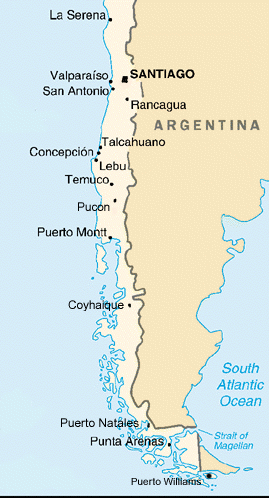
| Click map for larger view |
| Click flag for Country Report |



| INTERNALLY DISPLACED PERSONS (IDPS) |
None reported.

Dr. Miguel Juan Sebastián Piñera
Echenique
President since 11 March 2010
Echenique
President since 11 March 2010