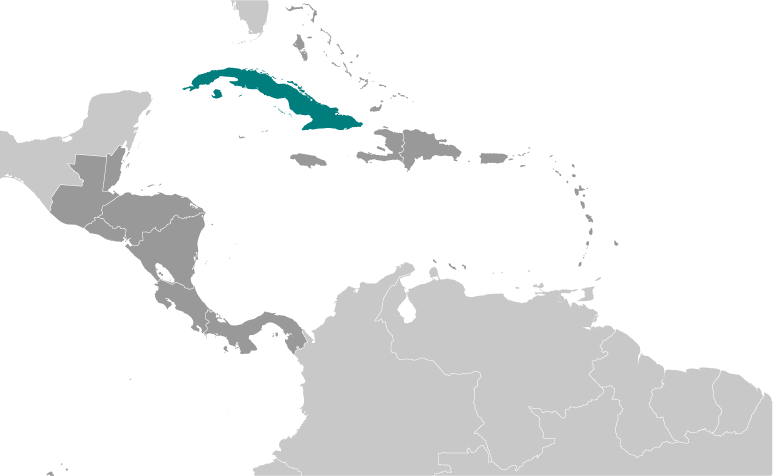

| CUBA Republic of Cuba Republica de Cuba Joined United Nations: 24 October 1945 Human Rights as assured by their constitution Click here Updated 25 January 2013 |

| CAPITAL |
| POPULATION |
| CHIEF OF STATE |
| SELECTION PROCESS |
Havana
11,075,244 (July 2012 est.)
President and Vice presidents elected by the National Assembly for
a term of five years; election last held 24 February 2008.
Next scheduled election: 3 February 2013
a term of five years; election last held 24 February 2008.
Next scheduled election: 3 February 2013
HEAD OF GOVERNMENT
SELECTION PROCESS
According to the Cuban Constitution, President is both the
Chief of State and Head of Government.
Chief of State and Head of Government.
| DECLARATION OF HUMAN RIGHTS |
| ETHNIC GROUPS |
White 65.1%, mulatto and mestizo 24.8%, black 10.1% (2002 census)
| RELIGIONS |
Nominally 85% Roman Catholic prior to Castro assuming power; Protestants, Jehovah's Witnesses, Jews, and Santeria are also
represented
represented
| GOVERNMENT STRUCTURE |
Communist state with 14 provinces (provincias, singular - provincia) and 1 special municipality (municipio especial); Legal system is
based on Spanish civil law and influenced by American legal concepts, with large elements of Communist legal theory; has not
accepted compulsory ICJ jurisdiction
Executive: President and Vice Presidents elected by the National Assembly for a term of five years; election last held 24 February 2008
(next to be held in 2013)
Legislative: Unicameral National Assembly of People's Power or Asemblea Nacional del Poder Popular (614 seats; members
elected directly from slates approved by special candidacy commissions to serve five-year terms)
elections: last held 20 January 2008 (next to be held on 3 February 2013)
Judicial: People's Supreme Court or Tribunal Supremo Popular (president, vice president, and other judges are elected by the
National Assembly)
based on Spanish civil law and influenced by American legal concepts, with large elements of Communist legal theory; has not
accepted compulsory ICJ jurisdiction
Executive: President and Vice Presidents elected by the National Assembly for a term of five years; election last held 24 February 2008
(next to be held in 2013)
Legislative: Unicameral National Assembly of People's Power or Asemblea Nacional del Poder Popular (614 seats; members
elected directly from slates approved by special candidacy commissions to serve five-year terms)
elections: last held 20 January 2008 (next to be held on 3 February 2013)
Judicial: People's Supreme Court or Tribunal Supremo Popular (president, vice president, and other judges are elected by the
National Assembly)
| LANGUAGES |
Spanish (official)
| BRIEF HISTORY |
The earliest inhabitants of Cuba were the Guanajatabey people, who migrated to the island from the forests of the South American
mainland as long ago as 5300 BC. Though the Guanajatabeyes are now considered to be a distinct population, early
anthropologists and historians mistakenly believed that they were the Ciboney people who occupied areas throughout the Antilles
islands of the Caribbean. Further evidence suggests that the Guanajatabeyes were driven to the west of the island by the arrival of
two subsequent waves of migrants, the Taíno and Ciboney. The Taíno cultivated the yucca root, harvested it and baked it to
produce cassava bread. They also grew cotton and tobacco, and ate maize and sweet potatoes. The first sighting of a Spanish boat
approaching the island was on October 28, 1492, probably at Baracoa on the eastern point of the island. During a second voyage
in 1494, Columbus passed along the south coast of the island, landing at various inlets including what was to become Guantánamo
Bay. The Spanish began to create permanent settlements on the island of Hispaniola, east of Cuba, soon after Columbus's arrival in
the Caribbean, but it wasn't until 1509 that the coast of Cuba was fully mapped by Sebastián de Ocampo. In 1511, Diego
Velázquez de Cuéllar set out with three ships and an army of 300 men from Hispaniola to form the first Spanish settlement in Cuba,
with orders from Spain to conquer the island. The settlement was at Baracoa, but the new settlers were to be greeted with stiff
resistance from the local Taíno population. The Taínos were initially organized by cacique (chieftain) Hatuey, who had himself
relocated from Hispaniola to escape the brutalities of Spanish rule on that island. After a prolonged guerrilla campaign, Hatuey and
successive chieftains were captured and burnt alive, and within three years the Spanish had gained control of the island. In 1514, a
settlement was founded in what was to become Havana. Despite the difficult relations between the local Cubans and the new
Europeans, some cooperation was in evidence. The Spanish were shown by the Native Cubans how to nurture tobacco and
consume it in the form of cigars. There were also many unions between the largely male Spanish colonists and indigenous women.
Their children were called mestizos, but the Native Cubans called them Guajiro, which translates as "one of us". The Spanish
established sugar and tobacco as Cuba's primary products, and the island soon supplanted Hispaniola as the prime Spanish base in
the Caribbean. The expansion of agriculture tempered by the rapid erosion of the native populations meant that further field labor
was required. African slaves were then imported to work the plantations as field labor. However, restrictive Spanish trade laws
made it difficult for Cubans to keep up with the 17th and 18th century advances in processing sugar cane pioneered in British
Barbados and French Saint Domingue (Haiti). Spain also restricted Cuba's access to the slave trade, which was dominated by the
British, French, and Dutch. One important turning point came in the Seven Years' War, when the British conquered the port of
Havana and introduced thousands of slaves in a ten month period. Another key event was the Haitian Revolution in nearby
Saint-Domingue, from 1791 to 1804. Thousands of French refugees, fleeing the slave rebellion in Saint Domingue, brought slaves
and expertise in sugar refining and coffee growing into eastern Cuba in the 1790 and early 1800s. Following from the 1868-1878
rebellion Ten Years' War, all slavery was abolished by 1884, making it the second to last country in the Western Hemisphere to
abolish slavery (Brazil was the last). Cuban independence from Spain was gained after three wars: the Ten Years' War;
1868-1878, the Little War; 1879-1880, and the War of '95, itself sometimes called the War of Independence, bleeding into the
Spanish-American War. When the US battleship Maine blew up on 15 February 1898, tensions escalated, and the U.S. would no
longer accept Spanish promises of eventual reform The U.S. declared the Spanish-American War. American marines landed in
Guantanamo and with the support of Cuban forces took that strategic harbor. On 17 July 1898, the Spanish surrendered. On
August 12, 1898 the U.S. and Spain signed a protocol of Peace in which Spain agreed to relinquish all claim of sovereignty over
and title of Cuba. On December 10, 1898, the U.S. and Spain signed the Treaty of Paris, Article I of which implicitly recognized
Cuban independence. In 1902, the United States handed over control to a Cuban government that as a condition of the transfer had
included in its constitution provisions implementing the requirements of the Platt Amendment, which among other things gave the
United States the right to intervene militarily in Cuba. President Tomás Estrada Palma was elected in 1902, and Cuba was declared
independent, though Guantanamo Bay was leased to the United States as part of the Platt Amendment. For three decades, the
country was led by former War of Independence leaders, who after being elected did not serve more than two constitutional terms.
In World War I, Cuba declared war on Imperial Germany on April 7th, 1917, the day after the US entered the war. Despite being
unable to send troops to fight in Europe, Cuba played a significant role as a base to protect the West Indies from U-Boat attacks. A
draft law was instituted, and 25,000 Cuban troops raised, but the war ended before they could be sent into action. In September
1933, there was a successful mutiny by enlisted soldiers and non-commissioned officers, taking the lower ranks of the Cuban Army
to power. A key figure in the process was Fulgencio Batista, an army sergeant holding a key post as a telegraph officer. In 1940,
Batista became the country's official president in an election which many people considered to be rigged. Batista was voted out of
office in 1944. He was succeeded by Dr. Ramón Grau San Martín, a populist physician, who had briefly held the presidency in the
1933 revolutionary process. President Grau passed a number of populist measures favoring workers and also had been instrumental
in passing the 1940 Constitution, which has been widely regarded as one of the most progressive ever written in terms of worker
protection and human rights. Batista, who was running for president in the 1952 elections, but was only expected to get a small
minority of votes, seized power in an almost bloodless coup three months before the election was to take place. Elections were held
in 1953 and Batista was elected. On July 26, 1953, Castro led a historic attack on the Moncada Barracks near Santiago de Cuba,
but failed. Many soldiers were killed by Castro's forces. Castro was captured, tried and sentenced to 15 years in prison. However,
he was released by the Batista government in 1956, when amnesty was given to many political prisoners, including the ones that
assaulted the Moncada barracks. Castro subsequently went into exile in Mexico where he met Ernesto "Che" Guevara. While in
Mexico, he organized the 26th of July Movement with the goal of overthrowing Batista. A group of over 80 men sailed to Cuba on
board the yacht Granma, landing in the eastern part of the island in December 1956. Batista fled on January 1, 1959. Within months
of taking control, Castro moved to consolidate power by brutally marginalizing other resistance groups and figures and imprisoning
and executing opponents and former supporters. As the revolution became more radical and continued its persecution of those who
did not agree with its direction, hundreds of thousands of Cubans fled the island. In response to the seizure of American properties,
the continued executions and violations of human rights, the U.S. broke diplomatic relations on January 3, 1961 and imposed the
U.S. embargo against Cuba on February 3, 1962. The embargo is still in effect as of 2007, although some humanitarian trade in
food and medicines is now allowed. The United States then sponsored an unsuccessful attack on Cuba, using conservative political
groups as the main source of support. The attack began on April 15, 1961, when exiles, flying planes provided by the United States
bombed several Cuban air force bases. This attack did not succeed in destroying all of Castro's air force. Tensions between the two
governments peaked again during the October 1962 Cuban missile crisis. When the Soviet Union broke up in late 1991, a major
boost to Cuba's economy was lost, leaving it essentially paralyzed because of the Cuban economy's narrow basis, focused on just a
few products with just a few buyers. On July 31, 2006, Fidel Castro delegated his duties as President of the Council of state,
President of the Council of Ministers, First Secretary of the Cuban Communist Party and the post of commander in chief of the
armed forces to his brother and First Vice President, Raúl Castro. This transfer of duties has been described as temporary while
Fidel Castro recovers from surgery undergone after suffering from an "acute intestinal crisis with sustained bleeding". In February
2008, Fidel Castro officially stepped down as president allowing fro the election of his brother Raul as President. In March 2012,
the now-retired Fidel Castro met Pope Benedict XVI during the latter's visit to Cuba; the two men discussed the role of the
Catholic Church in Cuba, which has a large Catholic community. In July 2012, Cuba received its first American goods shipment in
over 50 years, following the partial relaxation of the US embargo to permit humanitarian shipments. In October 2012, Cuba
announced the abolition of its much-disliked exit permit system, allowing its citizens more freedom to travel abroad.
Source: Wikipedia: History of Cuba
mainland as long ago as 5300 BC. Though the Guanajatabeyes are now considered to be a distinct population, early
anthropologists and historians mistakenly believed that they were the Ciboney people who occupied areas throughout the Antilles
islands of the Caribbean. Further evidence suggests that the Guanajatabeyes were driven to the west of the island by the arrival of
two subsequent waves of migrants, the Taíno and Ciboney. The Taíno cultivated the yucca root, harvested it and baked it to
produce cassava bread. They also grew cotton and tobacco, and ate maize and sweet potatoes. The first sighting of a Spanish boat
approaching the island was on October 28, 1492, probably at Baracoa on the eastern point of the island. During a second voyage
in 1494, Columbus passed along the south coast of the island, landing at various inlets including what was to become Guantánamo
Bay. The Spanish began to create permanent settlements on the island of Hispaniola, east of Cuba, soon after Columbus's arrival in
the Caribbean, but it wasn't until 1509 that the coast of Cuba was fully mapped by Sebastián de Ocampo. In 1511, Diego
Velázquez de Cuéllar set out with three ships and an army of 300 men from Hispaniola to form the first Spanish settlement in Cuba,
with orders from Spain to conquer the island. The settlement was at Baracoa, but the new settlers were to be greeted with stiff
resistance from the local Taíno population. The Taínos were initially organized by cacique (chieftain) Hatuey, who had himself
relocated from Hispaniola to escape the brutalities of Spanish rule on that island. After a prolonged guerrilla campaign, Hatuey and
successive chieftains were captured and burnt alive, and within three years the Spanish had gained control of the island. In 1514, a
settlement was founded in what was to become Havana. Despite the difficult relations between the local Cubans and the new
Europeans, some cooperation was in evidence. The Spanish were shown by the Native Cubans how to nurture tobacco and
consume it in the form of cigars. There were also many unions between the largely male Spanish colonists and indigenous women.
Their children were called mestizos, but the Native Cubans called them Guajiro, which translates as "one of us". The Spanish
established sugar and tobacco as Cuba's primary products, and the island soon supplanted Hispaniola as the prime Spanish base in
the Caribbean. The expansion of agriculture tempered by the rapid erosion of the native populations meant that further field labor
was required. African slaves were then imported to work the plantations as field labor. However, restrictive Spanish trade laws
made it difficult for Cubans to keep up with the 17th and 18th century advances in processing sugar cane pioneered in British
Barbados and French Saint Domingue (Haiti). Spain also restricted Cuba's access to the slave trade, which was dominated by the
British, French, and Dutch. One important turning point came in the Seven Years' War, when the British conquered the port of
Havana and introduced thousands of slaves in a ten month period. Another key event was the Haitian Revolution in nearby
Saint-Domingue, from 1791 to 1804. Thousands of French refugees, fleeing the slave rebellion in Saint Domingue, brought slaves
and expertise in sugar refining and coffee growing into eastern Cuba in the 1790 and early 1800s. Following from the 1868-1878
rebellion Ten Years' War, all slavery was abolished by 1884, making it the second to last country in the Western Hemisphere to
abolish slavery (Brazil was the last). Cuban independence from Spain was gained after three wars: the Ten Years' War;
1868-1878, the Little War; 1879-1880, and the War of '95, itself sometimes called the War of Independence, bleeding into the
Spanish-American War. When the US battleship Maine blew up on 15 February 1898, tensions escalated, and the U.S. would no
longer accept Spanish promises of eventual reform The U.S. declared the Spanish-American War. American marines landed in
Guantanamo and with the support of Cuban forces took that strategic harbor. On 17 July 1898, the Spanish surrendered. On
August 12, 1898 the U.S. and Spain signed a protocol of Peace in which Spain agreed to relinquish all claim of sovereignty over
and title of Cuba. On December 10, 1898, the U.S. and Spain signed the Treaty of Paris, Article I of which implicitly recognized
Cuban independence. In 1902, the United States handed over control to a Cuban government that as a condition of the transfer had
included in its constitution provisions implementing the requirements of the Platt Amendment, which among other things gave the
United States the right to intervene militarily in Cuba. President Tomás Estrada Palma was elected in 1902, and Cuba was declared
independent, though Guantanamo Bay was leased to the United States as part of the Platt Amendment. For three decades, the
country was led by former War of Independence leaders, who after being elected did not serve more than two constitutional terms.
In World War I, Cuba declared war on Imperial Germany on April 7th, 1917, the day after the US entered the war. Despite being
unable to send troops to fight in Europe, Cuba played a significant role as a base to protect the West Indies from U-Boat attacks. A
draft law was instituted, and 25,000 Cuban troops raised, but the war ended before they could be sent into action. In September
1933, there was a successful mutiny by enlisted soldiers and non-commissioned officers, taking the lower ranks of the Cuban Army
to power. A key figure in the process was Fulgencio Batista, an army sergeant holding a key post as a telegraph officer. In 1940,
Batista became the country's official president in an election which many people considered to be rigged. Batista was voted out of
office in 1944. He was succeeded by Dr. Ramón Grau San Martín, a populist physician, who had briefly held the presidency in the
1933 revolutionary process. President Grau passed a number of populist measures favoring workers and also had been instrumental
in passing the 1940 Constitution, which has been widely regarded as one of the most progressive ever written in terms of worker
protection and human rights. Batista, who was running for president in the 1952 elections, but was only expected to get a small
minority of votes, seized power in an almost bloodless coup three months before the election was to take place. Elections were held
in 1953 and Batista was elected. On July 26, 1953, Castro led a historic attack on the Moncada Barracks near Santiago de Cuba,
but failed. Many soldiers were killed by Castro's forces. Castro was captured, tried and sentenced to 15 years in prison. However,
he was released by the Batista government in 1956, when amnesty was given to many political prisoners, including the ones that
assaulted the Moncada barracks. Castro subsequently went into exile in Mexico where he met Ernesto "Che" Guevara. While in
Mexico, he organized the 26th of July Movement with the goal of overthrowing Batista. A group of over 80 men sailed to Cuba on
board the yacht Granma, landing in the eastern part of the island in December 1956. Batista fled on January 1, 1959. Within months
of taking control, Castro moved to consolidate power by brutally marginalizing other resistance groups and figures and imprisoning
and executing opponents and former supporters. As the revolution became more radical and continued its persecution of those who
did not agree with its direction, hundreds of thousands of Cubans fled the island. In response to the seizure of American properties,
the continued executions and violations of human rights, the U.S. broke diplomatic relations on January 3, 1961 and imposed the
U.S. embargo against Cuba on February 3, 1962. The embargo is still in effect as of 2007, although some humanitarian trade in
food and medicines is now allowed. The United States then sponsored an unsuccessful attack on Cuba, using conservative political
groups as the main source of support. The attack began on April 15, 1961, when exiles, flying planes provided by the United States
bombed several Cuban air force bases. This attack did not succeed in destroying all of Castro's air force. Tensions between the two
governments peaked again during the October 1962 Cuban missile crisis. When the Soviet Union broke up in late 1991, a major
boost to Cuba's economy was lost, leaving it essentially paralyzed because of the Cuban economy's narrow basis, focused on just a
few products with just a few buyers. On July 31, 2006, Fidel Castro delegated his duties as President of the Council of state,
President of the Council of Ministers, First Secretary of the Cuban Communist Party and the post of commander in chief of the
armed forces to his brother and First Vice President, Raúl Castro. This transfer of duties has been described as temporary while
Fidel Castro recovers from surgery undergone after suffering from an "acute intestinal crisis with sustained bleeding". In February
2008, Fidel Castro officially stepped down as president allowing fro the election of his brother Raul as President. In March 2012,
the now-retired Fidel Castro met Pope Benedict XVI during the latter's visit to Cuba; the two men discussed the role of the
Catholic Church in Cuba, which has a large Catholic community. In July 2012, Cuba received its first American goods shipment in
over 50 years, following the partial relaxation of the US embargo to permit humanitarian shipments. In October 2012, Cuba
announced the abolition of its much-disliked exit permit system, allowing its citizens more freedom to travel abroad.
Source: Wikipedia: History of Cuba
| ECONOMIC OVERVIEW |
The government continues to balance the need for loosening its socialist economic system against a desire for firm political control.
The government in April 2011 held the first Cuban Communist Party Congress in almost 13 years, during which leaders approved a
plan for wide-ranging economic changes. President Raul CASTRO said such changes were needed to update the economic model
to ensure the survival of socialism. The government has expanded opportunities for self employment and has introduced limited
reforms, some initially implemented in the 1990s, to increase enterprise efficiency and alleviate serious shortages of food, consumer
goods, services, and housing. The average Cuban's standard of living remains at a lower level than before the downturn of the
1990s, which was caused by the loss of Soviet aid and domestic inefficiencies. Since late 2000, Venezuela has been providing oil
on preferential terms, and it currently supplies over 100,000 barrels per day of petroleum products. Cuba has been paying for the
oil, in part, with the services of Cuban personnel in Venezuela including some 30,000 medical professionals.
Source: CIA World Factbook (select Cuba)
The government in April 2011 held the first Cuban Communist Party Congress in almost 13 years, during which leaders approved a
plan for wide-ranging economic changes. President Raul CASTRO said such changes were needed to update the economic model
to ensure the survival of socialism. The government has expanded opportunities for self employment and has introduced limited
reforms, some initially implemented in the 1990s, to increase enterprise efficiency and alleviate serious shortages of food, consumer
goods, services, and housing. The average Cuban's standard of living remains at a lower level than before the downturn of the
1990s, which was caused by the loss of Soviet aid and domestic inefficiencies. Since late 2000, Venezuela has been providing oil
on preferential terms, and it currently supplies over 100,000 barrels per day of petroleum products. Cuba has been paying for the
oil, in part, with the services of Cuban personnel in Venezuela including some 30,000 medical professionals.
Source: CIA World Factbook (select Cuba)
| POLITICAL CLIMATE |
The Communist Party of Cuba is constitutionally recognized as Cuba's only legal political party. In theory, no political party,
including the Communist Party of Cuba, is permitted to nominate or campaign for any candidate. Candidates are theoretically to be
nominated at local levels by the local population at small "Town Hall" type meetings, however, the Inter-American Commission on
Human Rights points out that in reality the Communist party has the final word on who is elected. Suffrage is afforded to Cuban
citizens resident for two years on the island who are aged over sixteen years and who have not been found guilty of a criminal
offence.
Cuba has an elected national legislature, the National Assembly of People's Power (Asamblea Nacional del Poder Popular). A
parliamentary election to the National Assembly of People's Power was held in Cuba on 20 January 2008. It has, though,
permanent commissions to look after issues of legislative interest. Among its permanent or temporary commissions are those in
charge of issues concerning the economy, the sugar industry, industries, transportation and communications, constructions, foreign
affairs, public health, defense and interior order. The National Assembly also has permanent departments that oversee the work of
the Commissions, Local Assemblies of the People's Power, International Relations, Judicial Affairs and the Administration. On 24
February 2008, the National Assembly began sitting for its new term, and Raúl Castro was elected President Alarcón was elected
as President of the National Assembly, while Jaime Crombet Hernández Vaquero was elected as its Vice-President and Miriam
Brito was elected as its Secretary.
The distinct nature of political participation in Cuba has also fostered discussion amongst political writers and philosophers. Varied
conclusions have been drawn, some of these have led to Cuba being described as a dictatorship, a totalitarian state, a grassroots
democracy, a centralized democracy or a revolutionary democracy, but not a liberal democracy.
Source: Wikipedia: Politics of Cuba
including the Communist Party of Cuba, is permitted to nominate or campaign for any candidate. Candidates are theoretically to be
nominated at local levels by the local population at small "Town Hall" type meetings, however, the Inter-American Commission on
Human Rights points out that in reality the Communist party has the final word on who is elected. Suffrage is afforded to Cuban
citizens resident for two years on the island who are aged over sixteen years and who have not been found guilty of a criminal
offence.
Cuba has an elected national legislature, the National Assembly of People's Power (Asamblea Nacional del Poder Popular). A
parliamentary election to the National Assembly of People's Power was held in Cuba on 20 January 2008. It has, though,
permanent commissions to look after issues of legislative interest. Among its permanent or temporary commissions are those in
charge of issues concerning the economy, the sugar industry, industries, transportation and communications, constructions, foreign
affairs, public health, defense and interior order. The National Assembly also has permanent departments that oversee the work of
the Commissions, Local Assemblies of the People's Power, International Relations, Judicial Affairs and the Administration. On 24
February 2008, the National Assembly began sitting for its new term, and Raúl Castro was elected President Alarcón was elected
as President of the National Assembly, while Jaime Crombet Hernández Vaquero was elected as its Vice-President and Miriam
Brito was elected as its Secretary.
The distinct nature of political participation in Cuba has also fostered discussion amongst political writers and philosophers. Varied
conclusions have been drawn, some of these have led to Cuba being described as a dictatorship, a totalitarian state, a grassroots
democracy, a centralized democracy or a revolutionary democracy, but not a liberal democracy.
Source: Wikipedia: Politics of Cuba
| INTERNATIONAL DISPUTES |
US Naval Base at Guantanamo Bay is leased to US and only mutual agreement or US abandonment of the facility can terminate the
lease
lease


| REFUGEES AND INTERNALLY DISPLACED PERSONS (IDPS) |
None reported.
| ILLICIT DRUGS |
Territorial waters and air space serve as transshipment zone for US- and European-bound drugs; established the death penalty
for certain drug-related crimes in 1999 (2008)
for certain drug-related crimes in 1999 (2008)
| HUMAN RIGHTS STATEMENTS, ANALYSIS AND CRITIQUES |
2011 Human Rights Report: Cuba
Bureau of Democracy, Human Rights, and Labor
2011 Country Reports on Human Rights Practices
May 25, 2012
Cuba is a totalitarian state led by Raul Castro, who is the chief of state, president of the council of state and council of ministers, and
commander in chief of the armed forces. At the Sixth Communist Party Congress held in April, delegates also elected Castro as party
first secretary. The constitution recognizes the Communist Party (CP) as the only legal party and “the superior leading force of society
and of the state.” The 2008 legislative elections were neither free nor fair. A CP candidacy commission preapproved all candidates, and
all 614 members ran unopposed. Security forces reported to a national leadership that included members of the military.
The principal human rights abuses were: abridgement of the right of citizens to change their government; government threats,
intimidation, mobs, harassment, and detentions to prevent citizens from assembling peacefully; and a significant increase in the number
of short-term detentions, which in December rose to the highest monthly number in 30 years.
The following additional human rights abuses continued: beatings, harsh prison conditions, and selective prosecution and denial of fair
trial. Authorities interfered with privacy and engaged in pervasive monitoring of private communications. The government also placed
severe limitations on freedom of speech and press, restricted freedom of movement, and limited freedom of religion. The government
refused to recognize independent human rights groups or permit them to function legally. In addition, the government continued to place
severe restrictions on worker rights, including the right to form independent unions.
Most human rights abuses were official acts committed at the direction of the government, and consequently the perpetrators enjoyed
impunity for their actions.
Click here to read more »
Bureau of Democracy, Human Rights, and Labor
2011 Country Reports on Human Rights Practices
May 25, 2012
Cuba is a totalitarian state led by Raul Castro, who is the chief of state, president of the council of state and council of ministers, and
commander in chief of the armed forces. At the Sixth Communist Party Congress held in April, delegates also elected Castro as party
first secretary. The constitution recognizes the Communist Party (CP) as the only legal party and “the superior leading force of society
and of the state.” The 2008 legislative elections were neither free nor fair. A CP candidacy commission preapproved all candidates, and
all 614 members ran unopposed. Security forces reported to a national leadership that included members of the military.
The principal human rights abuses were: abridgement of the right of citizens to change their government; government threats,
intimidation, mobs, harassment, and detentions to prevent citizens from assembling peacefully; and a significant increase in the number
of short-term detentions, which in December rose to the highest monthly number in 30 years.
The following additional human rights abuses continued: beatings, harsh prison conditions, and selective prosecution and denial of fair
trial. Authorities interfered with privacy and engaged in pervasive monitoring of private communications. The government also placed
severe limitations on freedom of speech and press, restricted freedom of movement, and limited freedom of religion. The government
refused to recognize independent human rights groups or permit them to function legally. In addition, the government continued to place
severe restrictions on worker rights, including the right to form independent unions.
Most human rights abuses were official acts committed at the direction of the government, and consequently the perpetrators enjoyed
impunity for their actions.
Click here to read more »
20 June 2011
Committee on the Rights of the Child
Fifty-seventh session
30 May – 17 June 2011
Consideration of reports submitted by States parties under article 44 of the Convention
Concluding observations: Cuba
I. Introduction
2. The Committee welcomes the submission of the second periodic as well as the written replies to its list of issues
(CRC/C/CUB/Q/2/Add.1). However, the Committee regrets the unusual delay in submission of the report. The Committee appreciates the
constructive dialogue with a high level and multisectoral delegation, which allowed the Committee to gain a better understanding of the
situation of children in the State party.
II. Follow-up measures and progress achieved by the State party
3. The Committee notes with appreciation the adoption of the following legislative measures notably:
a) The adoption of Instruction 187/07 (2008), which provides that the views of children over 7 years old will be heard in court
proceedings on parental authority involving them;
b) The adoption of Decree-Act No. 234 (Working Women’s Maternity Act) in 2003, which contains provisions to guarantee and
facilitate medical care during pregnancy, pre-natal and post-natal rest, breastfeeding, care for children and specialized treatment of
children with disabilities.
III. Factors and difficulties affecting the implementation of the Convention
5. The Committee notes that the effects of the embargo are reflected in the difficult economic and social situation prevailing in the
country, which has had repercussions on children’s enjoyment of their rights, in particular in the socioeconomic field, impeding the full
implementation of the Convention.
IV. Main areas of concern and recommendations
A. General measures of implementation (arts. 4, 42 and 44, para. 6 of the Convention)
Legislation
6. While the Committee takes note of the information provided by the delegation regarding the efforts of the State party to undertake
a revision of its domestic legislation to harmonize it with the Convention, it reiterates its concern about the national legislation in force in
the State party, which was enacted before the Convention, in particular the Family Code (1975), the Child and Youth Code (1978) and
the law on Adoption, Alternative care settings and Foster Families (Decree-Act No. 76 of 1984). The Committee is further concerned
that the State party is experiencing difficulties in adopting new or amended legislation, including the draft Family Code.
7. The Committee recommends that the State party strengthen efforts to conduct a comprehensive review of all legislation affecting
children and take all necessary measures to harmonize its legislation, in particular the Child and Youth Code, with the principles and
provisions of the Convention. The Committee urges the State party to take the necessary steps to adopt and implement the draft Family
Code.
Click here to read more »
Committee on the Rights of the Child
Fifty-seventh session
30 May – 17 June 2011
Consideration of reports submitted by States parties under article 44 of the Convention
Concluding observations: Cuba
I. Introduction
2. The Committee welcomes the submission of the second periodic as well as the written replies to its list of issues
(CRC/C/CUB/Q/2/Add.1). However, the Committee regrets the unusual delay in submission of the report. The Committee appreciates the
constructive dialogue with a high level and multisectoral delegation, which allowed the Committee to gain a better understanding of the
situation of children in the State party.
II. Follow-up measures and progress achieved by the State party
3. The Committee notes with appreciation the adoption of the following legislative measures notably:
a) The adoption of Instruction 187/07 (2008), which provides that the views of children over 7 years old will be heard in court
proceedings on parental authority involving them;
b) The adoption of Decree-Act No. 234 (Working Women’s Maternity Act) in 2003, which contains provisions to guarantee and
facilitate medical care during pregnancy, pre-natal and post-natal rest, breastfeeding, care for children and specialized treatment of
children with disabilities.
III. Factors and difficulties affecting the implementation of the Convention
5. The Committee notes that the effects of the embargo are reflected in the difficult economic and social situation prevailing in the
country, which has had repercussions on children’s enjoyment of their rights, in particular in the socioeconomic field, impeding the full
implementation of the Convention.
IV. Main areas of concern and recommendations
A. General measures of implementation (arts. 4, 42 and 44, para. 6 of the Convention)
Legislation
6. While the Committee takes note of the information provided by the delegation regarding the efforts of the State party to undertake
a revision of its domestic legislation to harmonize it with the Convention, it reiterates its concern about the national legislation in force in
the State party, which was enacted before the Convention, in particular the Family Code (1975), the Child and Youth Code (1978) and
the law on Adoption, Alternative care settings and Foster Families (Decree-Act No. 76 of 1984). The Committee is further concerned
that the State party is experiencing difficulties in adopting new or amended legislation, including the draft Family Code.
7. The Committee recommends that the State party strengthen efforts to conduct a comprehensive review of all legislation affecting
children and take all necessary measures to harmonize its legislation, in particular the Child and Youth Code, with the principles and
provisions of the Convention. The Committee urges the State party to take the necessary steps to adopt and implement the draft Family
Code.
Click here to read more »
Freedom House Condemns Prison Sentence of Cuban Dissident Santiesteban
Dec 19 2012 - 12:43pm
Freedom House condemns the decision to sentence award-winning Cuban writer and dissident Angel Santiesteban on December 8 to five
years in prison for assault and trespassing, and calls on Cuba to allow for a fair and just appeals process. This sentence followed a
politically motivated trial where there was a lack of compelling evidence.
The trial began four years ago, and while most of the charges were dropped and witnesses asserted Santiesteban’s innocence in their
testimonies, the trial concluded with a verdict against Santiesteban. Santiesteban, a member of the state-sponsored Union of Writers and
Artists of Cuba and recipient of the prestigious Casa de las Américas Prize and other awards by the Cuban state, became increasingly
critical of the lack of freedom of expression on the island in recent years. He was among the 20-or-so Cuban activists violently detained
during the wave of repression in November 2012.
Freedom House consistently places Cuba among the world’s most repressive societies. The country is ranked Not Free in Freedom in
the World 2012, Freedom House's survey of political rights and civil liberties, and Not Free in Freedom of the Press 2012. The island
nation also received the second-lowest ranking in Freedom on the Net, a study of internet freedom in 47 countries released in 2012.
Click here to read more »
Dec 19 2012 - 12:43pm
Freedom House condemns the decision to sentence award-winning Cuban writer and dissident Angel Santiesteban on December 8 to five
years in prison for assault and trespassing, and calls on Cuba to allow for a fair and just appeals process. This sentence followed a
politically motivated trial where there was a lack of compelling evidence.
The trial began four years ago, and while most of the charges were dropped and witnesses asserted Santiesteban’s innocence in their
testimonies, the trial concluded with a verdict against Santiesteban. Santiesteban, a member of the state-sponsored Union of Writers and
Artists of Cuba and recipient of the prestigious Casa de las Américas Prize and other awards by the Cuban state, became increasingly
critical of the lack of freedom of expression on the island in recent years. He was among the 20-or-so Cuban activists violently detained
during the wave of repression in November 2012.
Freedom House consistently places Cuba among the world’s most repressive societies. The country is ranked Not Free in Freedom in
the World 2012, Freedom House's survey of political rights and civil liberties, and Not Free in Freedom of the Press 2012. The island
nation also received the second-lowest ranking in Freedom on the Net, a study of internet freedom in 47 countries released in 2012.
Click here to read more »
Cuba: Transforming pain into hope: human rights defenders in the Americas
7 December 2012
LADIES IN WHITE
CUBA
Take Action Now
Support human rights defenders in the Americas
Human rights defenders in the Americas play a vital role in exposing and combating human rights violations. Many have paid a high price
for their courageous efforts to break cycles of injustice, discrimination and impunity. In the past few years, hundreds have been
persecuted and attacked. Despite the lack of effective protection for themselves and their families and widespread impunity, they
continue their struggle – transforming pain into hope.
Members of the Ladies in White in Cuba have been repeatedly subjected to short-term and arbitrary detention and intimidation. The
Ladies in White was formed by a group of women relatives of 75 prisoners of conscience who were imprisoned in 2003. All have since
been released and the Ladies in White now campaign for the release of other political prisoners and to lift restrictions on fundamental
freedoms in Cuba.
Join us in urging the Cuban authorities to take all necessary measures to put an end to all acts of harassment and intimidation against the
Ladies in White and other activists in Cuba, and ensure they can all exercise their peaceful human rights activities free from fear and
reprisals.
Dear President,
I am dismayed by the ongoing short-term and arbitrary detention, acts of repudiation and intimidation faced by the Ladies in White,
because of their peaceful calls for the release of all political prisoners and for the lifting of restrictions on fundamental civil and political
rights in Cuba.
I urge you to:
stop all forms of harassment and intimidation against the Ladies in White and other human rights activists, and publicly recognize the
legitimacy and importance of their role in society
immediately and unconditionally release anyone in Cuba detained solely for the peaceful exercise of the right to freedom of opinion,
expression, association or assembly.
Click here to read more »
7 December 2012
LADIES IN WHITE
CUBA
Take Action Now
Support human rights defenders in the Americas
Human rights defenders in the Americas play a vital role in exposing and combating human rights violations. Many have paid a high price
for their courageous efforts to break cycles of injustice, discrimination and impunity. In the past few years, hundreds have been
persecuted and attacked. Despite the lack of effective protection for themselves and their families and widespread impunity, they
continue their struggle – transforming pain into hope.
Members of the Ladies in White in Cuba have been repeatedly subjected to short-term and arbitrary detention and intimidation. The
Ladies in White was formed by a group of women relatives of 75 prisoners of conscience who were imprisoned in 2003. All have since
been released and the Ladies in White now campaign for the release of other political prisoners and to lift restrictions on fundamental
freedoms in Cuba.
Join us in urging the Cuban authorities to take all necessary measures to put an end to all acts of harassment and intimidation against the
Ladies in White and other activists in Cuba, and ensure they can all exercise their peaceful human rights activities free from fear and
reprisals.
Dear President,
I am dismayed by the ongoing short-term and arbitrary detention, acts of repudiation and intimidation faced by the Ladies in White,
because of their peaceful calls for the release of all political prisoners and for the lifting of restrictions on fundamental civil and political
rights in Cuba.
I urge you to:
stop all forms of harassment and intimidation against the Ladies in White and other human rights activists, and publicly recognize the
legitimacy and importance of their role in society
immediately and unconditionally release anyone in Cuba detained solely for the peaceful exercise of the right to freedom of opinion,
expression, association or assembly.
Click here to read more »
Cuba: On the Death of the Dissident Oswaldo Payá
July 23, 2012
(Washington, DC) – Human Rights Watch issued the following statement on the death on July 22, 2012, of the Cuban dissident Oswaldo
Payá, founder of the Varela Project, which challenged the government to undertake democratic reforms:
Oswaldo Payá’s long struggle for civil and political freedoms in Cuba was defined by an effective blend of idealism and pragmatism,
which laid bare the hostility of the Castro government toward calls for basic freedoms. The brilliance of Payá’s Varela Project was that it
used the Cuban government’s own laws to challenge its repressive tactics, through collecting more than 10,000 signatures in 2002 to
call for a constitutional referendum. The declaration advocated democratic reform, respect for human rights, and freedom for all political
prisoners.
It required both leadership and courage on the part of Payá and his fellow organizers to collect the signatures, and many paid the price
with brutal prison sentences in a 2003 crackdown, which followed the government’s resounding rejection of the project’s demands. It is
tragic that Payá did not live to see these freedoms respected by the Cuban government.
Click here to read more »
July 23, 2012
(Washington, DC) – Human Rights Watch issued the following statement on the death on July 22, 2012, of the Cuban dissident Oswaldo
Payá, founder of the Varela Project, which challenged the government to undertake democratic reforms:
Oswaldo Payá’s long struggle for civil and political freedoms in Cuba was defined by an effective blend of idealism and pragmatism,
which laid bare the hostility of the Castro government toward calls for basic freedoms. The brilliance of Payá’s Varela Project was that it
used the Cuban government’s own laws to challenge its repressive tactics, through collecting more than 10,000 signatures in 2002 to
call for a constitutional referendum. The declaration advocated democratic reform, respect for human rights, and freedom for all political
prisoners.
It required both leadership and courage on the part of Payá and his fellow organizers to collect the signatures, and many paid the price
with brutal prison sentences in a 2003 crackdown, which followed the government’s resounding rejection of the project’s demands. It is
tragic that Payá did not live to see these freedoms respected by the Cuban government.
Click here to read more »
STATEMENT MADE BY H.E. Mr. BRUNO RODRÍGUEZ PARRILLA, MINISTER FOR FOREIGN AFFAIRS OF THE
REPUBLIC OF CUBA, AT THE GENERAL DEBATE OF THE SIXTY SEVENTH SESSION OF THE UNITED NATIONS
GENERAL ASSEMBLY. NEW YORK. OCTOBER 1st, 2012.
Mr. President:
Today’s world is in no way similar to the one that was envisaged by those who drafted the United Nations Charter, over the ashes left
by the Second World War, when they determined to save our generations from the scourge of war, protect the fundamental rights of
human beings and equality among all nations, large and small; promote justice, dignity and social progress.
Right now, the overthrowing of governments through the use of force and violence is being blatantly encouraged; the “change of
regime” is being imposed from Washington and other NATO member countries’ capitals, and conquest wars are being waged for the
control of natural resources and strategically important areas.
The US and some European governments have decided to overthrow the Syrian government, for which they have armed, financed and
trained opposition groups. They have even resorted to the use of mercenaries.
Due mainly to the firm opposition by Russia and China, it has been impossible to manipulate the Security Council to impose the
interventionist formula applied in recent warmongering adventures.
Cuba reaffirms the right of the Syrian people to the full exercise of self-determination and sovereignty without any interference or
foreign intervention of any sort. For that, violence, massacres and the terrorist actions that have taken a high toll on innocent lives must
cease. The traffic in arms and money to help the insurgent groups as well as the shameful manipulation of reality by the media must also
come to an end.
It is the duty of the General Assembly to make use of its faculties to promote a peaceful solution to the current situation that is ruining
that Arab country and prevent a foreign military aggression which will have serious consequences for the entire Middle East region.
The General Assembly should act with resolve and recognize the Palestinian State as a full member of the United Nations Organization,
with the boundaries established prior to 1967 and with East Jerusalem as its capital; and it should do so now, with or without the
consent of the Security Council; with or without the United States veto; with or without new peace negotiations.
Click here to read more »
REPUBLIC OF CUBA, AT THE GENERAL DEBATE OF THE SIXTY SEVENTH SESSION OF THE UNITED NATIONS
GENERAL ASSEMBLY. NEW YORK. OCTOBER 1st, 2012.
Mr. President:
Today’s world is in no way similar to the one that was envisaged by those who drafted the United Nations Charter, over the ashes left
by the Second World War, when they determined to save our generations from the scourge of war, protect the fundamental rights of
human beings and equality among all nations, large and small; promote justice, dignity and social progress.
Right now, the overthrowing of governments through the use of force and violence is being blatantly encouraged; the “change of
regime” is being imposed from Washington and other NATO member countries’ capitals, and conquest wars are being waged for the
control of natural resources and strategically important areas.
The US and some European governments have decided to overthrow the Syrian government, for which they have armed, financed and
trained opposition groups. They have even resorted to the use of mercenaries.
Due mainly to the firm opposition by Russia and China, it has been impossible to manipulate the Security Council to impose the
interventionist formula applied in recent warmongering adventures.
Cuba reaffirms the right of the Syrian people to the full exercise of self-determination and sovereignty without any interference or
foreign intervention of any sort. For that, violence, massacres and the terrorist actions that have taken a high toll on innocent lives must
cease. The traffic in arms and money to help the insurgent groups as well as the shameful manipulation of reality by the media must also
come to an end.
It is the duty of the General Assembly to make use of its faculties to promote a peaceful solution to the current situation that is ruining
that Arab country and prevent a foreign military aggression which will have serious consequences for the entire Middle East region.
The General Assembly should act with resolve and recognize the Palestinian State as a full member of the United Nations Organization,
with the boundaries established prior to 1967 and with East Jerusalem as its capital; and it should do so now, with or without the
consent of the Security Council; with or without the United States veto; with or without new peace negotiations.
Click here to read more »
Cuba Cracks Down on Dissidents
on Human Rights Day
December 12, 2012
MIAMI – Cuban police detained more than 100 dissidents and put another 100 to 150 under house arrest in an island-wide crackdown to
block any gatherings on December 10, International Human Rights Day, according to news reports.
Among those detained were about 80 members and supporters of the Ladies in White, including dozens who were reportedly carted off
roughly during roundups in Havana and on their way to the Our Lady of Charity Basilica in the eastern town of El Cobre.
Security agents also sealed off several homes in eastern Cuba to avert gatherings of dissidents to mark the 60th anniversary of the
Universal Declaration of Human Rights, said Jose Daniel Ferrer Garcia, head of the opposition Cuban Patriotic Union.
The U.S. government swiftly denounced the arrests, saying it was “deeply concerned by the Cuban government’s repeated use of
arbitrary detention and violence to silence critics, disrupt peaceful assembly and intimidate independent civil society.”
“We call on the Cuban government to end” the arrests and violence “and we look forward to the day when all Cubans can freely express
their ideas,” State Department spokeswoman Victoria Nuland said Monday.
Cuban police and State Security agents usually round up scores of dissidents on or before December 10 each year to keep them from
staging any sort of events marking the day. The government critics are then released after a few hours or days.
About 45 Ladies in White and 10 supporters were arrested in Havana following their traditional march outside the Santa Rita church after
Sunday Mass, said Elizardo Sanchez Santa Cruz, head of the Cuban Commission for Human Rights and National Reconciliation.
The women usually are allowed to go home without incident after the marches, but this weekend were harassed by government agents.
When they sat down in protest, police dragged them roughly to three waiting buses, Sanchez said. Most were released by Sunday night.
Ferrer said another 34 Ladies in White and two young girls were detained, 16 of them “with violence,” over the weekend around eastern
Cuba as they tried to make their way to El Cobre to pray for human rights. All had been freed as of noon Monday.
Police intercepted three more at the gates to the church on Sunday and tried to seize two others already inside, Ferrer told The Miami
Herald by phone from his home in the nearby town of Palmarito de Cauto. But a priest in the church protected the women and drove
them home after the Mass.
Click here to read more »
on Human Rights Day
December 12, 2012
MIAMI – Cuban police detained more than 100 dissidents and put another 100 to 150 under house arrest in an island-wide crackdown to
block any gatherings on December 10, International Human Rights Day, according to news reports.
Among those detained were about 80 members and supporters of the Ladies in White, including dozens who were reportedly carted off
roughly during roundups in Havana and on their way to the Our Lady of Charity Basilica in the eastern town of El Cobre.
Security agents also sealed off several homes in eastern Cuba to avert gatherings of dissidents to mark the 60th anniversary of the
Universal Declaration of Human Rights, said Jose Daniel Ferrer Garcia, head of the opposition Cuban Patriotic Union.
The U.S. government swiftly denounced the arrests, saying it was “deeply concerned by the Cuban government’s repeated use of
arbitrary detention and violence to silence critics, disrupt peaceful assembly and intimidate independent civil society.”
“We call on the Cuban government to end” the arrests and violence “and we look forward to the day when all Cubans can freely express
their ideas,” State Department spokeswoman Victoria Nuland said Monday.
Cuban police and State Security agents usually round up scores of dissidents on or before December 10 each year to keep them from
staging any sort of events marking the day. The government critics are then released after a few hours or days.
About 45 Ladies in White and 10 supporters were arrested in Havana following their traditional march outside the Santa Rita church after
Sunday Mass, said Elizardo Sanchez Santa Cruz, head of the Cuban Commission for Human Rights and National Reconciliation.
The women usually are allowed to go home without incident after the marches, but this weekend were harassed by government agents.
When they sat down in protest, police dragged them roughly to three waiting buses, Sanchez said. Most were released by Sunday night.
Ferrer said another 34 Ladies in White and two young girls were detained, 16 of them “with violence,” over the weekend around eastern
Cuba as they tried to make their way to El Cobre to pray for human rights. All had been freed as of noon Monday.
Police intercepted three more at the gates to the church on Sunday and tried to seize two others already inside, Ferrer told The Miami
Herald by phone from his home in the nearby town of Palmarito de Cauto. But a priest in the church protected the women and drove
them home after the Mass.
Click here to read more »
TRANSLATED FROM SPANISH BY GOOGLE TRANSLATE
Calixto Ramón Martínez Arias takes more than four months in prison without trial
[24/01/2013]
Carlos Rios Otero
For the dissident jailed one month represents a year either DD.HH activist, political opponent or an independent journalist. For the
journalist, the prison system becomes more savage ostracism, the constant harassment and death threats, and survives in a perennial
state of helplessness.
The communicator, breaking the regime's censorship, becomes the sworn enemy of the Castro regime, precisely this is the crime of
Martinez, be reporting what the Department of Revolutionary Orientation (DOR) censorship.
He is charged with contempt of the historic leaders of the revolution, they are members of the National Assembly unpopular People,
read, deputies by the grace of the Politburo, the body that decides who will be legislators, and they are themselves
legislators, are historical constituents of that body which acts as a sort of supreme command of the revolution.
This ambiguous situation in the political and legal order, where the historic leaders of the executive branch while the legislature, and
constituents of the Politburo, in Cuba does not matter,-the chicken or the egg-no matter find Who evolved first, is the same thing.
If a citizen criticizes a minister (executive), either of Transportation, Education, Agriculture and Fisheries, Public Health,
Communications and Information, by administrative deficiencies or lack of information, which is a civil and legal rights of citizens , and
that the official at any level must respond, this, the salary he receives is the taxpayer to manage well and censor public events that must
respond to the people according to their charge.
Martinez, in the spring of 2012 processed a report epidemial the invasion of cholera in the eastern coastal city of Manzanillo.
Obviously, the government after the report had no choice but to inform, but minimizing the epidemiological situation in the city of the
Granma Province, in the grounds of the Sierra Maestra in the south coast of Cuba and 120 miles west of Haiti.
In September, Martinez inquired again and proposed administrative incompetence decrypt another, this time in Havana, a load of drugs
donated by WHO (World Health Organization), which was immortalized in the Air Terminal and José Martí was a deteriorating weather.
This time, Martinez was assaulted and held in contempt, and may be confined indefinitely as long as the authorities deem.
Is treated as a terrorist serving a foreign power and alleged a group of reporters free, but paid service "enemy of the people", as official
data, in order to be processed by the controversial Law 88, as defined in slang: "gag law".
In 2003, Law 88, bared his claws, was in the "Black Spring", when 75 dissidents were tried summarily, and one third of them were
journalists, sentenced 15 to 28 years of confinement in prisons more rigorously.
Who are the enemies of the people? Officials are telling the truth or lies camouflaged half.
It is known that the regime tries by all means to keep before the world the false status of medical power, data of disease and epidemic
situations is a secret jealously hidden by the state, safeguarding that tourism will not stampede.
When a Martinez, a Roberto de Jesús Guerra, a Aleaga, a Balmaseda, a Fornaris, a Odelín, or Norvis Magaly Otero, break the censorship
of the galley in search of truth, any reporter, correspondent and columnist becomes a sworn enemy of the historical leaders and his life
hangs in the balance.
Click here to read more>>
Calixto Ramón Martínez Arias takes more than four months in prison without trial
[24/01/2013]
Carlos Rios Otero
For the dissident jailed one month represents a year either DD.HH activist, political opponent or an independent journalist. For the
journalist, the prison system becomes more savage ostracism, the constant harassment and death threats, and survives in a perennial
state of helplessness.
The communicator, breaking the regime's censorship, becomes the sworn enemy of the Castro regime, precisely this is the crime of
Martinez, be reporting what the Department of Revolutionary Orientation (DOR) censorship.
He is charged with contempt of the historic leaders of the revolution, they are members of the National Assembly unpopular People,
read, deputies by the grace of the Politburo, the body that decides who will be legislators, and they are themselves
legislators, are historical constituents of that body which acts as a sort of supreme command of the revolution.
This ambiguous situation in the political and legal order, where the historic leaders of the executive branch while the legislature, and
constituents of the Politburo, in Cuba does not matter,-the chicken or the egg-no matter find Who evolved first, is the same thing.
If a citizen criticizes a minister (executive), either of Transportation, Education, Agriculture and Fisheries, Public Health,
Communications and Information, by administrative deficiencies or lack of information, which is a civil and legal rights of citizens , and
that the official at any level must respond, this, the salary he receives is the taxpayer to manage well and censor public events that must
respond to the people according to their charge.
Martinez, in the spring of 2012 processed a report epidemial the invasion of cholera in the eastern coastal city of Manzanillo.
Obviously, the government after the report had no choice but to inform, but minimizing the epidemiological situation in the city of the
Granma Province, in the grounds of the Sierra Maestra in the south coast of Cuba and 120 miles west of Haiti.
In September, Martinez inquired again and proposed administrative incompetence decrypt another, this time in Havana, a load of drugs
donated by WHO (World Health Organization), which was immortalized in the Air Terminal and José Martí was a deteriorating weather.
This time, Martinez was assaulted and held in contempt, and may be confined indefinitely as long as the authorities deem.
Is treated as a terrorist serving a foreign power and alleged a group of reporters free, but paid service "enemy of the people", as official
data, in order to be processed by the controversial Law 88, as defined in slang: "gag law".
In 2003, Law 88, bared his claws, was in the "Black Spring", when 75 dissidents were tried summarily, and one third of them were
journalists, sentenced 15 to 28 years of confinement in prisons more rigorously.
Who are the enemies of the people? Officials are telling the truth or lies camouflaged half.
It is known that the regime tries by all means to keep before the world the false status of medical power, data of disease and epidemic
situations is a secret jealously hidden by the state, safeguarding that tourism will not stampede.
When a Martinez, a Roberto de Jesús Guerra, a Aleaga, a Balmaseda, a Fornaris, a Odelín, or Norvis Magaly Otero, break the censorship
of the galley in search of truth, any reporter, correspondent and columnist becomes a sworn enemy of the historical leaders and his life
hangs in the balance.
Click here to read more>>
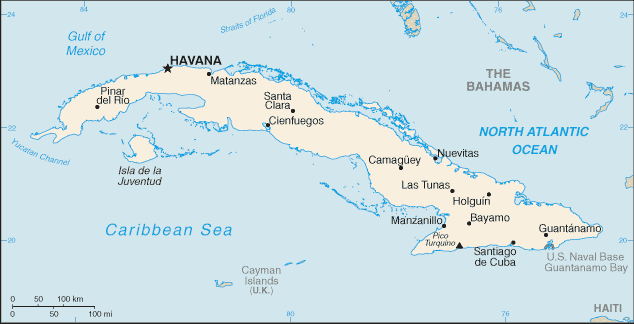
| Click map for larger view |
| Click flag for Country Report |



General Raul Castro Ruz
President of the Council of State and
President of the Council of Ministers since
24 February 2008
President of the Council of State and
President of the Council of Ministers since
24 February 2008
General Jose Ramon Machado Ventura
First Vice President of the Council of State and
First Vice President of the Council of Ministers
since 24 February 2008
First Vice President of the Council of State and
First Vice President of the Council of Ministers
since 24 February 2008
| TRAFFICKING IN PERSONS |
Current situation: Cuba is a source country for adults and some children subjected to forced labor and sex trafficking; prostitution
of children reportedly occurs in Cuba as prostitution is not criminalized for anyone above 16 years old; the scope of trafficking
within Cuba is particularly difficult to gauge due to the closed nature of the government and sparse non-governmental or
independent reporting
Tier rating: Tier 3 - Cuba does not fully comply with the minimum standards for the elimination of trafficking and is not making
significant efforts to do so; the government did not publicize information about government measures to address human trafficking
through prosecution, protection, or prevention efforts during the reporting period (2010)
of children reportedly occurs in Cuba as prostitution is not criminalized for anyone above 16 years old; the scope of trafficking
within Cuba is particularly difficult to gauge due to the closed nature of the government and sparse non-governmental or
independent reporting
Tier rating: Tier 3 - Cuba does not fully comply with the minimum standards for the elimination of trafficking and is not making
significant efforts to do so; the government did not publicize information about government measures to address human trafficking
through prosecution, protection, or prevention efforts during the reporting period (2010)



General Raul Castro Ruz
President of the Council of State and
President of the Council of Ministers since
24 February 2008
President of the Council of State and
President of the Council of Ministers since
24 February 2008