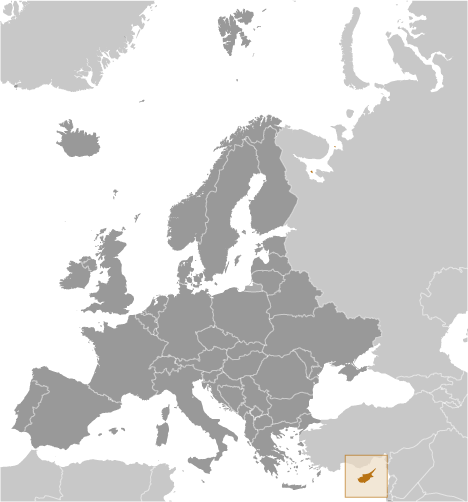
| CYPRUS Republic of Cyprus Kypriaki Dimokratia/Kibris Cumhuriyeti Joined United Nations: 25 September 1960 Human Rights as assured by their constitution Click here Updated 24 February 2013 |
| CAPITAL |
| POPULATION |
| CHIEF OF STATE |
| SELECTION PROCESS |
Nicosia (Lefkosia)
1,138,071 (July 2012 est.)
Nicos Anastasiades
President since 24 February 2013
President since 24 February 2013
President elected by popular vote for a five-year term; election
last held 17 and 24 February 2013. Note - post of vice
president is currently vacant; under the 1960 constitution, the
post is reserved for a Turkish Cypriot
Next scheduled election: February 2018
last held 17 and 24 February 2013. Note - post of vice
president is currently vacant; under the 1960 constitution, the
post is reserved for a Turkish Cypriot
Next scheduled election: February 2018
HEAD OF GOVERNMENT
SELECTION PROCESS
İrsen Küçük
Prime Minister since 17 May 2010
Prime Minister since 17 May 2010
Note: Dervis EROGLU became "president" of the "TRNC" on
23 April 2010 after "presidential" elections on 18 April 2010
23 April 2010 after "presidential" elections on 18 April 2010
| DECLARATION OF HUMAN RIGHTS |
| ETHNIC GROUPS |
Greek 77%, Turkish 18%, other 5% (2001)
| RELIGIONS |
Greek Orthodox 78%, Muslim 18%, Maronite, Armenian Apostolic, and other 4%
| GOVERNMENT STRUCTURE |
Republic comprised of 6 districts. Legal system is based on common law, with civil law modifications; accepts
compulsory ICJ jurisdiction, with reservations
Executive: The president is both the chief of state and head of government; post of vice president is currently vacant;
under the 1960 constitution, the post is reserved for a Turkish Cypriot
president elected by popular vote for a five-year term; election last held 17 and 24 February 2013 (next to be held in
February 2018)
Legislative: unicameral - Republic of Cyprus: House of Representatives or Vouli Antiprosopon (80 seats; 56 assigned
to the Greek Cypriots, 24 to Turkish Cypriots; note - only those assigned to Greek Cypriots are filled; members are
elected by popular vote to serve five-year terms); North Cyprus: Assembly of the Republic or Cumhuriyet Meclisi (50
seats; members are elected by popular vote to serve five-year terms)
elections: elections: area under government control: last held 19 April 2009 (next to be held in 2014); area administered
by Turkish Cypriots: last held 19 April 2009 (next to be held in 2014)
Judicial: Supreme Court (judges are appointed jointly by the president and vice president) note: there is also a
Supreme Court in north Cyprus
compulsory ICJ jurisdiction, with reservations
Executive: The president is both the chief of state and head of government; post of vice president is currently vacant;
under the 1960 constitution, the post is reserved for a Turkish Cypriot
president elected by popular vote for a five-year term; election last held 17 and 24 February 2013 (next to be held in
February 2018)
Legislative: unicameral - Republic of Cyprus: House of Representatives or Vouli Antiprosopon (80 seats; 56 assigned
to the Greek Cypriots, 24 to Turkish Cypriots; note - only those assigned to Greek Cypriots are filled; members are
elected by popular vote to serve five-year terms); North Cyprus: Assembly of the Republic or Cumhuriyet Meclisi (50
seats; members are elected by popular vote to serve five-year terms)
elections: elections: area under government control: last held 19 April 2009 (next to be held in 2014); area administered
by Turkish Cypriots: last held 19 April 2009 (next to be held in 2014)
Judicial: Supreme Court (judges are appointed jointly by the president and vice president) note: there is also a
Supreme Court in north Cyprus
| LANGUAGES |
Greek, Turkish, English
| BRIEF HISTORY |
| ECONOMIC OVERVIEW |
The area of the Republic of Cyprus under government control has a market economy dominated by the service sector,
which accounts for four-fifths of GDP. Tourism, financial services, and real estate are the most important sectors. Erratic
growth rates over the past decade reflect the economy's reliance on tourism, the profitability of which often fluctuates
with political instability in the region and economic conditions in Western Europe. Nevertheless, the economy in the area
under government control has grown at a rate well above the EU average since 2000. Cyprus joined the European
Exchange Rate Mechanism (ERM2) in May 2005 and adopted the euro as its national currency on 1 January 2008. An
aggressive austerity program in the preceding years, aimed at paving the way for the euro, helped turn a soaring fiscal
deficit (6.3% in 2003) into a surplus of 1.2% in 2008, and reduced inflation to 4.7%. This prosperity came under
pressure in 2009, as construction and tourism slowed in the face of reduced foreign demand triggered by the ongoing
global financial crisis. Although Cyprus lagged behind its EU peers in showing signs of stress from the global crisis, the
economy tipped into recession in 2009, contracting by 1.7%, and has been slow to bounce back since, posting an
anemic growth rate of 1.0% in 2010. A massive munitions blast in July 2011 at a Cypriot naval base triggered
country-wide energy outages, a collapse of the governing coalition, and a cabinet shuffle intensifying Cyprus's economic
problems. The economy experienced no economic growth in 2011. Serious Cypriot financial sector problems surfaced
in early 2011 as the Greek fiscal crisis and euro zone debt crisis deepened. Two of Cyprus's biggest banks are among
the largest holders of Greek bonds in Europe and have a substantial presence in Greece through bank branches and
subsidiaries. A liquidity squeeze is choking the financial sector and the real economy as many global investors doubt the
Cypriot economy can weather the EU crisis. Cyprus's borrowing costs have risen steadily because of its exposure to
Greek debt. The budget deficit is on the rise and reached 7.4% of GDP in 2011, a violation of the EU's budget deficit
criteria - no more than 3% of GDP. In response to the country's deteriorating finances and serious risk of contagion
from the Greek debt crisis, Nicosia is promising to implement measures to cut the cost of the state payroll, curb tax
evasion, and revamp social benefits. However, it has been slow to act, lacking a consensus in parliament and among the
social partners for its proposed measures.
Source: CIA World Factbook (select Cyprus)
which accounts for four-fifths of GDP. Tourism, financial services, and real estate are the most important sectors. Erratic
growth rates over the past decade reflect the economy's reliance on tourism, the profitability of which often fluctuates
with political instability in the region and economic conditions in Western Europe. Nevertheless, the economy in the area
under government control has grown at a rate well above the EU average since 2000. Cyprus joined the European
Exchange Rate Mechanism (ERM2) in May 2005 and adopted the euro as its national currency on 1 January 2008. An
aggressive austerity program in the preceding years, aimed at paving the way for the euro, helped turn a soaring fiscal
deficit (6.3% in 2003) into a surplus of 1.2% in 2008, and reduced inflation to 4.7%. This prosperity came under
pressure in 2009, as construction and tourism slowed in the face of reduced foreign demand triggered by the ongoing
global financial crisis. Although Cyprus lagged behind its EU peers in showing signs of stress from the global crisis, the
economy tipped into recession in 2009, contracting by 1.7%, and has been slow to bounce back since, posting an
anemic growth rate of 1.0% in 2010. A massive munitions blast in July 2011 at a Cypriot naval base triggered
country-wide energy outages, a collapse of the governing coalition, and a cabinet shuffle intensifying Cyprus's economic
problems. The economy experienced no economic growth in 2011. Serious Cypriot financial sector problems surfaced
in early 2011 as the Greek fiscal crisis and euro zone debt crisis deepened. Two of Cyprus's biggest banks are among
the largest holders of Greek bonds in Europe and have a substantial presence in Greece through bank branches and
subsidiaries. A liquidity squeeze is choking the financial sector and the real economy as many global investors doubt the
Cypriot economy can weather the EU crisis. Cyprus's borrowing costs have risen steadily because of its exposure to
Greek debt. The budget deficit is on the rise and reached 7.4% of GDP in 2011, a violation of the EU's budget deficit
criteria - no more than 3% of GDP. In response to the country's deteriorating finances and serious risk of contagion
from the Greek debt crisis, Nicosia is promising to implement measures to cut the cost of the state payroll, curb tax
evasion, and revamp social benefits. However, it has been slow to act, lacking a consensus in parliament and among the
social partners for its proposed measures.
Source: CIA World Factbook (select Cyprus)
| POLITICAL CLIMATE |
UN-sponsored negotiations to develop institutional arrangements acceptable to the Greek Cypriot and Turkish Cypriot
communities began in 1968; several sets of negotiations and other initiatives followed.
After the 1974 invasion following a Greek junta-based coup attempt, Makarios secured international recognition of his
Greek Cypriot government as the sole legal authority on Cyprus, which has proved to be a very significant strategic
advantage for the Greek Cypriots in the decades since. Negotiations continued in the years after 1974 with varying
degrees of regularity and success, but none resulted in a full reunification. On 15 November 1983 the Turkish Cypriot
North declared independence and the formation of the Turkish Republic of Northern Cyprus (TRNC), which has been
recognized only by Turkey. Both sides publicly call for the resolution of intercommunal differences and creation of a new
federal system (Greek Cypriot position) or confederate system (Turkish Cypriot position) of government.
Following the 1998 presidential election, Klerides tried to form a government of national unity, by including six ministers
from Klerides' Democratic Rally party, two ministers from the socialist EDEK, three from the Democratic Party (who
broke ranks with party leader Spyros Kyprianou) and one from the United Democrats. However, a national unity
government was not achieved do to the leftist AKEL and centrist Democratic Party rejecting the offer, preferring to
remain opposition parties.
Source: Wikipedia: Politics of Cyprus
communities began in 1968; several sets of negotiations and other initiatives followed.
After the 1974 invasion following a Greek junta-based coup attempt, Makarios secured international recognition of his
Greek Cypriot government as the sole legal authority on Cyprus, which has proved to be a very significant strategic
advantage for the Greek Cypriots in the decades since. Negotiations continued in the years after 1974 with varying
degrees of regularity and success, but none resulted in a full reunification. On 15 November 1983 the Turkish Cypriot
North declared independence and the formation of the Turkish Republic of Northern Cyprus (TRNC), which has been
recognized only by Turkey. Both sides publicly call for the resolution of intercommunal differences and creation of a new
federal system (Greek Cypriot position) or confederate system (Turkish Cypriot position) of government.
Following the 1998 presidential election, Klerides tried to form a government of national unity, by including six ministers
from Klerides' Democratic Rally party, two ministers from the socialist EDEK, three from the Democratic Party (who
broke ranks with party leader Spyros Kyprianou) and one from the United Democrats. However, a national unity
government was not achieved do to the leftist AKEL and centrist Democratic Party rejecting the offer, preferring to
remain opposition parties.
Source: Wikipedia: Politics of Cyprus
| INTERNATIONAL DISPUTES |
Hostilities in 1974 divided the island into two de facto autonomous entities, the internationally recognized Cypriot
Government and a Turkish-Cypriot community (north Cyprus); the 1,000-strong UN Peacekeeping Force in Cyprus
(UNFICYP) has served in Cyprus since 1964 and maintains the buffer zone between north and south; on 1 May 2004,
Cyprus entered the European Union still divided, with the EU's body of legislation and standards (acquis communitaire)
suspended in the north; Turkey protests Cypriot Government creating hydrocarbon blocks and maritime boundary with
Lebanon in March 2007
Government and a Turkish-Cypriot community (north Cyprus); the 1,000-strong UN Peacekeeping Force in Cyprus
(UNFICYP) has served in Cyprus since 1964 and maintains the buffer zone between north and south; on 1 May 2004,
Cyprus entered the European Union still divided, with the EU's body of legislation and standards (acquis communitaire)
suspended in the north; Turkey protests Cypriot Government creating hydrocarbon blocks and maritime boundary with
Lebanon in March 2007


| REFUGEES AND INTERNALLY DISPLACED PERSONS (IDP) |
IDPs: 210,000 (both Turkish and Greek Cypriots; many displaced since 1974) (2010)
| ILLICIT DRUGS |
Minor transit point for heroin and hashish via air routes and container traffic to Europe, especially from Lebanon and
Turkey; some cocaine transits as well; despite a strengthening of anti-money-laundering legislation, remains vulnerable to
money laundering; reporting of suspicious transactions in offshore sector remains weak (2008)
Turkey; some cocaine transits as well; despite a strengthening of anti-money-laundering legislation, remains vulnerable to
money laundering; reporting of suspicious transactions in offshore sector remains weak (2008)
| HUMAN RIGHTS STATEMENTS, ANALYSIS AND CRITIQUES |
2011 Human Rights Report: Cyprus
Bureau of Democracy, Human Rights, and Labor
2011 Country Reports on Human Rights Practices
May 25, 2012
Since 1974 the southern part of Cyprus has been under the control of the government of the Republic of Cyprus, while the
northern part, administered by Turkish Cypriots, proclaimed itself the "Turkish Republic of Northern Cyprus" ("TRNC") in 1983.
The United States does not recognize the "TRNC," nor does any country other than Turkey. A substantial number of Turkish
troops remained on the island. A buffer zone, or "green line," patrolled by the UN Peacekeeping Force in Cyprus (UNFICYP),
separates the two parts.
REPUBLIC OF CYPRUS
The Republic of Cyprus is a constitutional republic and multiparty presidential democracy. On May 22, 56 representatives were
elected to the 80-seat Vouli Antiprosopon (House of Representatives) in free and fair elections, and in 2008 President Demetris
Christofias was elected in free and fair elections. Security forces reported to civilian authorities.
The most significant problems during the year were reports of police abuse and degrading treatment of persons in custody and
asylum seekers; violence against women, including spousal abuse; and instances of discrimination and violence against members of
minority ethnic and national groups.
Other problems during the year included prison overcrowding; a few reports of societal abuses or discrimination based on religious
affiliation, belief, or practice; and several incidents of violence against children. Trafficking in persons for sexual exploitation
continued to be a problem, and trafficking for labor was also reported.
The government generally investigated and prosecuted corruption and abuse cases against officials but cases usually moved at a
slow pace.
THE AREA ADMINISTERED BY TURKISH CYPRIOTS
Since 1974 the northern part of Cyprus has been run by a Turkish Cypriot administration that proclaimed itself the “Turkish
Republic of Northern Cyprus” (“TRNC”) in 1983. The United States does not recognize the “TRNC,” nor does any country other
than Turkey. Dervish Eroglu was elected “president” in 2010 in free and fair elections. Elections to the “Assembly of the Republic”
in 2009 were also free and fair and resulted in the formation of a single-party “government” of the UBP (National Unity Party). The
“TRNC constitution” is the basis for the “laws” that govern the area administered by Turkish Cypriot “police” and security forces
were ultimately under the operational command of the Turkish military, per transitional article 10 of the “TRNC constitution,”
which cedes responsibility for public security and defense “temporarily” to Turkey.
The most significant problems reported during the year included police abuse of detainees and infringement on the right of
demonstrators to peacefully assemble. In addition, there were restrictions on the rights of asylum seekers and no regulatory
infrastructure to handle asylum applications or to protect their rights.
Other problems reported during the year included mistreatment of persons in custody, overcrowding in prisons, lack of separation
of incarcerated adults and juveniles, corruption and cronyism in the executive and legislative branches, domestic violence against
women, trafficking in persons, and criminalization of same-sex sexual activity between men.
While there were investigations of police abuse cases, no officials were prosecuted or punished. Officials sometimes engaged in
corrupt practices with impunity.
Click here to read more »
Bureau of Democracy, Human Rights, and Labor
2011 Country Reports on Human Rights Practices
May 25, 2012
Since 1974 the southern part of Cyprus has been under the control of the government of the Republic of Cyprus, while the
northern part, administered by Turkish Cypriots, proclaimed itself the "Turkish Republic of Northern Cyprus" ("TRNC") in 1983.
The United States does not recognize the "TRNC," nor does any country other than Turkey. A substantial number of Turkish
troops remained on the island. A buffer zone, or "green line," patrolled by the UN Peacekeeping Force in Cyprus (UNFICYP),
separates the two parts.
REPUBLIC OF CYPRUS
The Republic of Cyprus is a constitutional republic and multiparty presidential democracy. On May 22, 56 representatives were
elected to the 80-seat Vouli Antiprosopon (House of Representatives) in free and fair elections, and in 2008 President Demetris
Christofias was elected in free and fair elections. Security forces reported to civilian authorities.
The most significant problems during the year were reports of police abuse and degrading treatment of persons in custody and
asylum seekers; violence against women, including spousal abuse; and instances of discrimination and violence against members of
minority ethnic and national groups.
Other problems during the year included prison overcrowding; a few reports of societal abuses or discrimination based on religious
affiliation, belief, or practice; and several incidents of violence against children. Trafficking in persons for sexual exploitation
continued to be a problem, and trafficking for labor was also reported.
The government generally investigated and prosecuted corruption and abuse cases against officials but cases usually moved at a
slow pace.
THE AREA ADMINISTERED BY TURKISH CYPRIOTS
Since 1974 the northern part of Cyprus has been run by a Turkish Cypriot administration that proclaimed itself the “Turkish
Republic of Northern Cyprus” (“TRNC”) in 1983. The United States does not recognize the “TRNC,” nor does any country other
than Turkey. Dervish Eroglu was elected “president” in 2010 in free and fair elections. Elections to the “Assembly of the Republic”
in 2009 were also free and fair and resulted in the formation of a single-party “government” of the UBP (National Unity Party). The
“TRNC constitution” is the basis for the “laws” that govern the area administered by Turkish Cypriot “police” and security forces
were ultimately under the operational command of the Turkish military, per transitional article 10 of the “TRNC constitution,”
which cedes responsibility for public security and defense “temporarily” to Turkey.
The most significant problems reported during the year included police abuse of detainees and infringement on the right of
demonstrators to peacefully assemble. In addition, there were restrictions on the rights of asylum seekers and no regulatory
infrastructure to handle asylum applications or to protect their rights.
Other problems reported during the year included mistreatment of persons in custody, overcrowding in prisons, lack of separation
of incarcerated adults and juveniles, corruption and cronyism in the executive and legislative branches, domestic violence against
women, trafficking in persons, and criminalization of same-sex sexual activity between men.
While there were investigations of police abuse cases, no officials were prosecuted or punished. Officials sometimes engaged in
corrupt practices with impunity.
Click here to read more »
10 August 2012
Committee on the Rights of the Child
Sixtieth session
29 May – 15 June 2012
Consideration of reports submitted by States parties under article 44 of the Convention
Concluding observations: Cyprus
I. Introduction
2. The Committee welcomes the submission of the State party’s combined third and fourth periodic report (CRC/C/CYP/3-4),
submitted in accordance with the reporting guidelines of the Committee, as well as the written replies to its list of issues
(CRC/C/CYP/Q/3-4/Add.1). The Committee appreciates the constructive dialogue with the State party’s multisectoral delegation.
II. Follow-up measures undertaken and progress achieved by the State party
3. The Committee welcomes as positive the adoption of the following legislative measures:
(a) The amendment to the Protection of Young Persons at Work Law and the Safety and Health at Work (Protection of Youth)
Regulations, in 2012;
(b) The amendment of its Refugee Law, for increased compliance with the European Union Asylum Aquis and international
protection standards, in 2009;
III. Factors and difficulties impeding the implementation of the Convention
6. The Committee reiterates its observation (CRC/C/15/Add.205, para. 5) that the State party, as a consequence of events that
occurred in 1974 and that resulted in the occupation of part of the territory of Cyprus, is not in a position to exercise control over
all of its territory and consequently cannot ensure the application of the Convention in areas not under its control. However, it
remains a matter of concern to the Committee that no information on children living in the occupied territories could be provided.
IV. Main areas of concern and recommendations
A. General measures of implementation (arts. 4, 42 and 44, para. 6, of the Convention)
The Committee’s previous recommendations
7. While welcoming the State party’s efforts to implement the concluding observations on its previous report (CRC/C/15/Add.205),
the Committee is concerned that some of the recommendations contained therein have not been fully addressed.
8. The Committee urges the State party to take all necessary measures to effectively address the recommendations contained in the
concluding observations of the second periodic report that have yet to be implemented, particularly those on legislation, allocation
of resources, data collection and the administration of juvenile justice.
Click here to read more »
Committee on the Rights of the Child
Sixtieth session
29 May – 15 June 2012
Consideration of reports submitted by States parties under article 44 of the Convention
Concluding observations: Cyprus
I. Introduction
2. The Committee welcomes the submission of the State party’s combined third and fourth periodic report (CRC/C/CYP/3-4),
submitted in accordance with the reporting guidelines of the Committee, as well as the written replies to its list of issues
(CRC/C/CYP/Q/3-4/Add.1). The Committee appreciates the constructive dialogue with the State party’s multisectoral delegation.
II. Follow-up measures undertaken and progress achieved by the State party
3. The Committee welcomes as positive the adoption of the following legislative measures:
(a) The amendment to the Protection of Young Persons at Work Law and the Safety and Health at Work (Protection of Youth)
Regulations, in 2012;
(b) The amendment of its Refugee Law, for increased compliance with the European Union Asylum Aquis and international
protection standards, in 2009;
III. Factors and difficulties impeding the implementation of the Convention
6. The Committee reiterates its observation (CRC/C/15/Add.205, para. 5) that the State party, as a consequence of events that
occurred in 1974 and that resulted in the occupation of part of the territory of Cyprus, is not in a position to exercise control over
all of its territory and consequently cannot ensure the application of the Convention in areas not under its control. However, it
remains a matter of concern to the Committee that no information on children living in the occupied territories could be provided.
IV. Main areas of concern and recommendations
A. General measures of implementation (arts. 4, 42 and 44, para. 6, of the Convention)
The Committee’s previous recommendations
7. While welcoming the State party’s efforts to implement the concluding observations on its previous report (CRC/C/15/Add.205),
the Committee is concerned that some of the recommendations contained therein have not been fully addressed.
8. The Committee urges the State party to take all necessary measures to effectively address the recommendations contained in the
concluding observations of the second periodic report that have yet to be implemented, particularly those on legislation, allocation
of resources, data collection and the administration of juvenile justice.
Click here to read more »
Freedom In The World Report- 2012
Political Rights Score: 1
Civil Liberties Score: 1
Status: Free
Cyprus
Overview
Following May 2011 parliamentary elections, a massive explosion on a Cypriot naval base in July caused major political damage to
the new coalition government of President Demetris Christofias. The accident imperiled prospects for unification with Northern
Cyprus, as did an outbreak of tensions between Cyprus and Turkey over the exploration and exploitation of natural gas in the island’
s Exclusive Economic Zone.
In parliamentary elections held in May 2011, the Democratic Rally (DISY) took 20 seats, AKEL won 19 seats, and DIKO took 9
seats; three small parties captured the remaining 8 seats. In July, a massive explosion of confiscated weaponry occurred on a naval
base, killing the commander of the Cyprus Navy and severely threatening Cyprus’s economy. The explosion nearly destroyed
Cyprus’ largest power plant, prompting waves of blackouts that jeopardized tourism and disrupted an already beleaguered financial
system. The incident, considered the result of government oversight, resulted in the mass resignation of Christofias’s cabinet, the
withdrawal of DIKO from the coalition government, and widespread calls for the president’s resignation.
The dissolution of Christofias’s coalition, one of the most amenable to unification in decades, had a deleterious effect on
negotiations with Northern Cyprus. Hope for unification had already been diminished by the election of a nationalist, anti-unification
Northern Cypriot government in 2010. Tensions were further exacerbated in 2011 when Cyprus became embroiled in a diplomatic
dispute involving Turkey, Greece, and Israel over the exploration and extraction of natural resources, particularly natural gas, in the
eastern Mediterranean Sea. Nevertheless, the international community has made a renewed push for a unification agreement in light
of Cyprus’ assumption of the EU presidency in July 2012.
Click here to read more »
Northern (Turkish) Cyprus [Cyprus] (2012)
Political Rights Score: 2
Civil Liberties Score: 2
Status: Free
Overview
In October 2011, the latest round of UN-sponsored unification talks between the Turkish Cypriot president and his Greek Cypriot
counterpart failed to reach a tangible settlement. Also during the year, Northern Cyprus was the focal point of a dispute between
Turkey and Cyprus regarding drilling for natural resources in waters surrounding the island.
In April 2010, Eroğlu defeated Talat in a presidential election, capturing more than 50 percent of the vote. Eroğlu’s election was
seen as a mandate for maintaining the status quo. Nevertheless, in October the two sides opened a seventh border crossing near the
northwestern town of Limnitis, increasing the permeability of the Green Line.
Pressure on the TRNC government to implement fiscal austerity measures continued in 2011, and protesters demonstrated against
benefit cuts in October. Also that month, the latest round of UN-backed reunification negotiations between the island’s two
governments concluded without a breakthrough. In November, Turkey and the TRNC signed an energy agreement giving the
Turkish Petroleum Corporation permission to explore for natural gas in Turkish Cypriot territory, despite Greek Cypriot complaints
that it would not be recognized as legal by the international community.
Click here to read more »
Political Rights Score: 1
Civil Liberties Score: 1
Status: Free
Cyprus
Overview
Following May 2011 parliamentary elections, a massive explosion on a Cypriot naval base in July caused major political damage to
the new coalition government of President Demetris Christofias. The accident imperiled prospects for unification with Northern
Cyprus, as did an outbreak of tensions between Cyprus and Turkey over the exploration and exploitation of natural gas in the island’
s Exclusive Economic Zone.
In parliamentary elections held in May 2011, the Democratic Rally (DISY) took 20 seats, AKEL won 19 seats, and DIKO took 9
seats; three small parties captured the remaining 8 seats. In July, a massive explosion of confiscated weaponry occurred on a naval
base, killing the commander of the Cyprus Navy and severely threatening Cyprus’s economy. The explosion nearly destroyed
Cyprus’ largest power plant, prompting waves of blackouts that jeopardized tourism and disrupted an already beleaguered financial
system. The incident, considered the result of government oversight, resulted in the mass resignation of Christofias’s cabinet, the
withdrawal of DIKO from the coalition government, and widespread calls for the president’s resignation.
The dissolution of Christofias’s coalition, one of the most amenable to unification in decades, had a deleterious effect on
negotiations with Northern Cyprus. Hope for unification had already been diminished by the election of a nationalist, anti-unification
Northern Cypriot government in 2010. Tensions were further exacerbated in 2011 when Cyprus became embroiled in a diplomatic
dispute involving Turkey, Greece, and Israel over the exploration and extraction of natural resources, particularly natural gas, in the
eastern Mediterranean Sea. Nevertheless, the international community has made a renewed push for a unification agreement in light
of Cyprus’ assumption of the EU presidency in July 2012.
Click here to read more »
Northern (Turkish) Cyprus [Cyprus] (2012)
Political Rights Score: 2
Civil Liberties Score: 2
Status: Free
Overview
In October 2011, the latest round of UN-sponsored unification talks between the Turkish Cypriot president and his Greek Cypriot
counterpart failed to reach a tangible settlement. Also during the year, Northern Cyprus was the focal point of a dispute between
Turkey and Cyprus regarding drilling for natural resources in waters surrounding the island.
In April 2010, Eroğlu defeated Talat in a presidential election, capturing more than 50 percent of the vote. Eroğlu’s election was
seen as a mandate for maintaining the status quo. Nevertheless, in October the two sides opened a seventh border crossing near the
northwestern town of Limnitis, increasing the permeability of the Green Line.
Pressure on the TRNC government to implement fiscal austerity measures continued in 2011, and protesters demonstrated against
benefit cuts in October. Also that month, the latest round of UN-backed reunification negotiations between the island’s two
governments concluded without a breakthrough. In November, Turkey and the TRNC signed an energy agreement giving the
Turkish Petroleum Corporation permission to explore for natural gas in Turkish Cypriot territory, despite Greek Cypriot complaints
that it would not be recognized as legal by the international community.
Click here to read more »
Wire, September/October 2012. Vol. 42, issue 05
1 September 2012
Cyprus: punishment without a crime
They treat us as hardened criminals,” reads one of many letters detainees handed us recently at Cyprus’ Lakatameia police station
and Block 10 of Nicosia Central Prison.“We are kept here simply due to visa issues, we are asylum-seekers and refugees.”
Hundreds of people are kept here without having committed a crime, simply because Cyprus has no other immigration detention
facilities. Most are waiting to be deported. Others – like people from Syria – are just waiting: deportations to Syria have been
suspended because of the unrest there.
The people we met here have fled war, persecution or grinding poverty in countries such as Iran, and across Africa and Asia. They
are detained for months, even years. Some have gone on hunger strike or attempted suicide in their small, dirty cells. Another letter
said they have “no access to fresh air or exercise, no direct sun light, no TV or radio and no way to clean our clothes”. Families are
often separated: “My son is now depressed and my wife under too much stress,” wrote one inmate.
Cyprus is violating international human rights law, because irregular migrants should only be detained as a last resort. Free legal aid
is so limited that only a few people manage to challenge the legality of their detention. Even in cases where the Supreme Court has
ruled a detention unlawful, people have not been released.
This is quite simply wrong. As one letter writer put it: “I am human and I have rights.”
Click here to read more »
1 September 2012
Cyprus: punishment without a crime
They treat us as hardened criminals,” reads one of many letters detainees handed us recently at Cyprus’ Lakatameia police station
and Block 10 of Nicosia Central Prison.“We are kept here simply due to visa issues, we are asylum-seekers and refugees.”
Hundreds of people are kept here without having committed a crime, simply because Cyprus has no other immigration detention
facilities. Most are waiting to be deported. Others – like people from Syria – are just waiting: deportations to Syria have been
suspended because of the unrest there.
The people we met here have fled war, persecution or grinding poverty in countries such as Iran, and across Africa and Asia. They
are detained for months, even years. Some have gone on hunger strike or attempted suicide in their small, dirty cells. Another letter
said they have “no access to fresh air or exercise, no direct sun light, no TV or radio and no way to clean our clothes”. Families are
often separated: “My son is now depressed and my wife under too much stress,” wrote one inmate.
Cyprus is violating international human rights law, because irregular migrants should only be detained as a last resort. Free legal aid
is so limited that only a few people manage to challenge the legality of their detention. Even in cases where the Supreme Court has
ruled a detention unlawful, people have not been released.
This is quite simply wrong. As one letter writer put it: “I am human and I have rights.”
Click here to read more »
Joint Statement to Northern Cyprus Regarding Arrests Under Article 171
October 26, 2011
On 14, 15 and 16 October 2011 two groups of men were arrested in the Northern Cyprus under Article 171 of the 1929 Criminal
Code, which criminalizes male homosexuality. Article 171, brought in under British colonial rule, is the only legal provision in force
in Council of Europe territory that criminalises consensual adult male same-sex sexual activity and provides for a punishment for up
to five years in prison. In 1998, the parliament of the Republic of Cyprus decriminalized consensual same-sex conduct and Article
171 of the Criminal Code was repealed.
The European Court of Human Rights has explicitly ruled in Modinos v. Cyprus (1993) that Article 171 violates Article 8 (right to
respect for his private and family life) of the European Convention on Human Rights. This is consistent with the Court’s previous
judgements – Dudgeon v. UK (1981); Norris v. Ireland (1989). It also violates Article 17 (protection from arbitrary or unlawful
interference with his privacy and family life) of the International Covenant on Civil and Political Rights as indicated in the decision
of the United Nations Human Rights Committee in Toonen v. Australia (1994).
At least two of the seven men who have been arrested and detained have made allegations of ill-treatment whilst in police custody,
which must be promptly and independently investigated and anyone identified as responsible brought to justice.
Amnesty International; Human Rights Watch; the European Region of the International Lesbian, Gay, Bisexual, Trans and Intersex
Association (ILGA-Europe); the International Gay & Lesbian Human Rights Commission (IGLHRC); and Homofobiye Karşı
İnisiyatif (Initiative Against Homophobia) call for the immediate release of all men currently detained under Article 171, dropping of
all charges against those that are being prosecuted under the Article, and immediate repeal of Article 171.
Click here to read more »
October 26, 2011
On 14, 15 and 16 October 2011 two groups of men were arrested in the Northern Cyprus under Article 171 of the 1929 Criminal
Code, which criminalizes male homosexuality. Article 171, brought in under British colonial rule, is the only legal provision in force
in Council of Europe territory that criminalises consensual adult male same-sex sexual activity and provides for a punishment for up
to five years in prison. In 1998, the parliament of the Republic of Cyprus decriminalized consensual same-sex conduct and Article
171 of the Criminal Code was repealed.
The European Court of Human Rights has explicitly ruled in Modinos v. Cyprus (1993) that Article 171 violates Article 8 (right to
respect for his private and family life) of the European Convention on Human Rights. This is consistent with the Court’s previous
judgements – Dudgeon v. UK (1981); Norris v. Ireland (1989). It also violates Article 17 (protection from arbitrary or unlawful
interference with his privacy and family life) of the International Covenant on Civil and Political Rights as indicated in the decision
of the United Nations Human Rights Committee in Toonen v. Australia (1994).
At least two of the seven men who have been arrested and detained have made allegations of ill-treatment whilst in police custody,
which must be promptly and independently investigated and anyone identified as responsible brought to justice.
Amnesty International; Human Rights Watch; the European Region of the International Lesbian, Gay, Bisexual, Trans and Intersex
Association (ILGA-Europe); the International Gay & Lesbian Human Rights Commission (IGLHRC); and Homofobiye Karşı
İnisiyatif (Initiative Against Homophobia) call for the immediate release of all men currently detained under Article 171, dropping of
all charges against those that are being prosecuted under the Article, and immediate repeal of Article 171.
Click here to read more »
At UN session, Cyprus leader calls on Turkey to cease ‘gunboat diplomacy’
25 September 2012
President Demetris Christofias of the Republic of Cyprus today called on Turkish Cypriot leaders to return to talks to reunite the
divided island and accused Turkey of provocative behaviour, gunboat diplomacy and trying to alter the country’s ethnic make-up.
“Our commitment remains unchanged. Return to the negotiating table, continue the negotiations in good faith,” he told the United
Nations 67th General Assembly on the first day of its General Debate, at UN Headquarters in New York.
He said current the Turkish Cypriot leader, Dervis Eroglu, has abandoned negotiations aimed at setting up a bicommunal, bizonal
federation with a single sovereignty, single citizenship and single international personality, with political equality in the Mediterranean
island that has been divided since inter-communal violence erupted in 1964.
“Turkey, after invading Cyprus in 1974 continues to occupy, for 38 years, the northern part of the island, maintaining a strong
military force and continuing the mass transfer of settlers from Turkey, pursuant to its policy for demographic alteration of the
population of my country,” Mr. Christofias declared.
“Turkey continues to violate human rights and fundamental freedoms of tens of thousands of displaced persons, including the
usurpation of their property, the rights of the enclaved and the people who lost their loved ones and continue to search for them,” he
added.
President Christofias stressed that Turkey’s positive contribution for the two communities to take the unity process forward is crucial.
“Instead, Turkey has been pursuing ‘gunboat diplomacy’ with oft-repeated display of its military strength around Cyprus. Turkey’s
alarming behaviour has been escalating since last September when Cyprus proceeded with exploration activities in its exclusive
economic zone,” he said. “I call on Turkey, before this esteemed body to cease its provocative behaviour.”
In addition, in his statement to the Debate, the President strongly condemned the violence and massacres of innocent civilians in Syria,
calling for their immediate cessation, and appealed for an urgent resumption of Middle East peace talks aimed at the establishment of a
free and independent Palestinian State based on the pre-1967 borders while at the same time addressing the legitimate security
concerns of Israel.
Scores of the world’s heads of State and government and other high-level officials are expected to present their views and comment
on issues of individual national and international relevance at the Assembly’s General Debate, which ends on 1 October.
Click here to read more »
25 September 2012
President Demetris Christofias of the Republic of Cyprus today called on Turkish Cypriot leaders to return to talks to reunite the
divided island and accused Turkey of provocative behaviour, gunboat diplomacy and trying to alter the country’s ethnic make-up.
“Our commitment remains unchanged. Return to the negotiating table, continue the negotiations in good faith,” he told the United
Nations 67th General Assembly on the first day of its General Debate, at UN Headquarters in New York.
He said current the Turkish Cypriot leader, Dervis Eroglu, has abandoned negotiations aimed at setting up a bicommunal, bizonal
federation with a single sovereignty, single citizenship and single international personality, with political equality in the Mediterranean
island that has been divided since inter-communal violence erupted in 1964.
“Turkey, after invading Cyprus in 1974 continues to occupy, for 38 years, the northern part of the island, maintaining a strong
military force and continuing the mass transfer of settlers from Turkey, pursuant to its policy for demographic alteration of the
population of my country,” Mr. Christofias declared.
“Turkey continues to violate human rights and fundamental freedoms of tens of thousands of displaced persons, including the
usurpation of their property, the rights of the enclaved and the people who lost their loved ones and continue to search for them,” he
added.
President Christofias stressed that Turkey’s positive contribution for the two communities to take the unity process forward is crucial.
“Instead, Turkey has been pursuing ‘gunboat diplomacy’ with oft-repeated display of its military strength around Cyprus. Turkey’s
alarming behaviour has been escalating since last September when Cyprus proceeded with exploration activities in its exclusive
economic zone,” he said. “I call on Turkey, before this esteemed body to cease its provocative behaviour.”
In addition, in his statement to the Debate, the President strongly condemned the violence and massacres of innocent civilians in Syria,
calling for their immediate cessation, and appealed for an urgent resumption of Middle East peace talks aimed at the establishment of a
free and independent Palestinian State based on the pre-1967 borders while at the same time addressing the legitimate security
concerns of Israel.
Scores of the world’s heads of State and government and other high-level officials are expected to present their views and comment
on issues of individual national and international relevance at the Assembly’s General Debate, which ends on 1 October.
Click here to read more »
TRANSLATED FROM GREEK BY GOOGLE TRANSLATE
Ombudsman speech at a conference jointly organized by the Commission of Elected Women's Union of Cyprus
Municipalities and the Office of Ombudsman on gender equality
Wednesday 12/09/2012
The role of the Ombudsman's Office to promote equal treatment for men and women
In 2004, assigned to the Office of the Ombudsman the power to act as an independent mechanism to combat extrajudicial any
direct or indirect discrimination on grounds of sex in employment, occupation and vocational training, even covering the entire
spectrum of the labor market, public and private.
For purposes of activating this power, created the same year, in the Ombudsman's Office, the Equality Authority, which may
appeal by submitting a complaint, any person who believes that a victim of gender discrimination f not work. Simultaneously the
national legislation fully harmonized with EU legislation on gender equality with the n amendment of the Equal Treatment of Men
and Women in Employment and Vocational Training Law U. Allow me to give you an overview of what the law regards as
unlawful discrimination in the workplace.
First, the law prohibits unequal treatment of men and women in access to vocational guidance and training. For example, when in
vocational guidance women Ms. thodigountai to choose an occupation which is traditionally considered feminine, or discouraged to
choose vocational training in areas related to male-dominated occupations, it is possible there to be forbidden by law gender
discrimination. This is why such events should be reported to the Equality Authority.
Second, the Act prohibits unequal treatment of men and women f n the field of access to work. To give a simple example, gender
discrimination in access to jobs may exist when, a service plan shall be required for purposes of appointment specifically physical
characteristics which refer to the male gender, such as the strong physique ruling in a DTO way women candidates. Where the
nature of work does not justify such a requirement, it is obvious that we are dealing with gender discrimination.
Third, do the different treatment of the sexes during layoffs. Ie if an employer should dismiss staff are prohibited to dismiss the
first women because they consider that their salary is supportive for the family or because they believe that women due to
pregnancy or QT i can become pregnant, it is problematic for the business potential. The criteria for redundancies should be
objective and unrelated to the sex of the staff.
Fourthly, any discrimination on grounds of sex with regard to membership and involvement in an organization of workers or
employers, or any organization whose members carry on a particular profession, including the benefits provided for by such
organizations.
Click here to read more »
Ombudsman speech at a conference jointly organized by the Commission of Elected Women's Union of Cyprus
Municipalities and the Office of Ombudsman on gender equality
Wednesday 12/09/2012
The role of the Ombudsman's Office to promote equal treatment for men and women
In 2004, assigned to the Office of the Ombudsman the power to act as an independent mechanism to combat extrajudicial any
direct or indirect discrimination on grounds of sex in employment, occupation and vocational training, even covering the entire
spectrum of the labor market, public and private.
For purposes of activating this power, created the same year, in the Ombudsman's Office, the Equality Authority, which may
appeal by submitting a complaint, any person who believes that a victim of gender discrimination f not work. Simultaneously the
national legislation fully harmonized with EU legislation on gender equality with the n amendment of the Equal Treatment of Men
and Women in Employment and Vocational Training Law U. Allow me to give you an overview of what the law regards as
unlawful discrimination in the workplace.
First, the law prohibits unequal treatment of men and women in access to vocational guidance and training. For example, when in
vocational guidance women Ms. thodigountai to choose an occupation which is traditionally considered feminine, or discouraged to
choose vocational training in areas related to male-dominated occupations, it is possible there to be forbidden by law gender
discrimination. This is why such events should be reported to the Equality Authority.
Second, the Act prohibits unequal treatment of men and women f n the field of access to work. To give a simple example, gender
discrimination in access to jobs may exist when, a service plan shall be required for purposes of appointment specifically physical
characteristics which refer to the male gender, such as the strong physique ruling in a DTO way women candidates. Where the
nature of work does not justify such a requirement, it is obvious that we are dealing with gender discrimination.
Third, do the different treatment of the sexes during layoffs. Ie if an employer should dismiss staff are prohibited to dismiss the
first women because they consider that their salary is supportive for the family or because they believe that women due to
pregnancy or QT i can become pregnant, it is problematic for the business potential. The criteria for redundancies should be
objective and unrelated to the sex of the staff.
Fourthly, any discrimination on grounds of sex with regard to membership and involvement in an organization of workers or
employers, or any organization whose members carry on a particular profession, including the benefits provided for by such
organizations.
Click here to read more »
TRANSLATED FROM GREEK BY GOOGLE TRANSLATE
Farm worker ‘beaten, unpaid and jailed’
By Stefanos Evripidou Published on August 11, 2012
A FARM worker, allegedly beaten and left unpaid for the last six months, ended up behind bars when he went to report his
employer’s abusive behaviour after police discovered his work permit had expired, it was reported yesterday.
According to migrant support group KISA, the Indian national arrived in Cyprus last October to work on a farm in Pera Chorio,
after paying a significant sum to arrange his work placement here.
The farm worker told the NGO that his employer had assured him all his documents were in order. In fact the Cypriot employer
even kept all his employee’s documents in his possession, including the worker’s passport and bank booklet.
The Indian national complained to KISA that he has not received a wage since February, despite repeated pleas to his employer.
Last Saturday, he left the farm, where he worked and lived since October, after suffering “serious abuse” allegedly from the
employer’s brother in the presence of the employer. A state pathologist later confirmed that he had sustained “clear injuries to his
head”, said KISA representative Doros Polycarpou.
On Monday, he went to KISA to report the beating but was unable to communicate in a language the NGO could understand. He
returned on Wednesday, with a friend who helped translate.
The migrant support group advised him to go straight to Pera Chorio police station to report the abuse suffered.
He went to the station on the same day, “and after a long wait, he was detained without anyone explaining in a language he could
understand the reason for his arrest and detention”, said Polycarpou.
KISA later discovered that his work permit had expired in June.
“We consider the arrest and detention of the complainant migrant unacceptable given that it is not consistent with basic principles
of justice or with a series of EU laws and directives,” said Polycarpou.
“The arrest of a victim of a serious crime, who goes voluntarily to the police for help, shakes the confidence of citizens in general
and in this case, of migrants towards law enforcement agencies, and discourages victims from reporting offences committed
against them by employers, while being in conflict with the spirit of EU directives.
Click here to read more »
Farm worker ‘beaten, unpaid and jailed’
By Stefanos Evripidou Published on August 11, 2012
A FARM worker, allegedly beaten and left unpaid for the last six months, ended up behind bars when he went to report his
employer’s abusive behaviour after police discovered his work permit had expired, it was reported yesterday.
According to migrant support group KISA, the Indian national arrived in Cyprus last October to work on a farm in Pera Chorio,
after paying a significant sum to arrange his work placement here.
The farm worker told the NGO that his employer had assured him all his documents were in order. In fact the Cypriot employer
even kept all his employee’s documents in his possession, including the worker’s passport and bank booklet.
The Indian national complained to KISA that he has not received a wage since February, despite repeated pleas to his employer.
Last Saturday, he left the farm, where he worked and lived since October, after suffering “serious abuse” allegedly from the
employer’s brother in the presence of the employer. A state pathologist later confirmed that he had sustained “clear injuries to his
head”, said KISA representative Doros Polycarpou.
On Monday, he went to KISA to report the beating but was unable to communicate in a language the NGO could understand. He
returned on Wednesday, with a friend who helped translate.
The migrant support group advised him to go straight to Pera Chorio police station to report the abuse suffered.
He went to the station on the same day, “and after a long wait, he was detained without anyone explaining in a language he could
understand the reason for his arrest and detention”, said Polycarpou.
KISA later discovered that his work permit had expired in June.
“We consider the arrest and detention of the complainant migrant unacceptable given that it is not consistent with basic principles
of justice or with a series of EU laws and directives,” said Polycarpou.
“The arrest of a victim of a serious crime, who goes voluntarily to the police for help, shakes the confidence of citizens in general
and in this case, of migrants towards law enforcement agencies, and discourages victims from reporting offences committed
against them by employers, while being in conflict with the spirit of EU directives.
Click here to read more »
Remains of the oldest known settlement in Cyprus dating from this period can be seen in Khirokitia and Kalavassos
(Tenta), off the Nicosia-Limassol road. This civilization had developed along the North and South coasts. First only
stone vessels were used. After 5000 B.C., the art of pottery was invented. Most Chalcolithic establishments are found in
Western Cyprus, where a fertility cult develops. The copper of the island begins to be exploited and used. Copper is
more extensively exploited bringing wealth to Cyprus. Trade is built up with the Near East, Egypt and the Aegean. After
1400 BC, Mycenaeans from Greece reach the island, perhaps as merchants. During the 12th and 11th centuries several
waves of Achaean Greeks come to settle on the island bringing with them the Greek language, their religion, their
customs. They build new cities like Paphos, Salamis, Kition. Kourion. The island from now on is progressively
hellenised. There are ten Kingdoms in the island. Phoenicians settle at Kition. The 8th century B.C. is a period of great
prosperity. The era of prosperity continues, but the island falls prey to several conquerors. Cypriot Kingdoms try to
preserve their independence but come variously under the domination of Assyria, Egypt and Persia. King Evagoras of
Salamis (who ruled from 411-374 BC) rebels against Persia and unifies the island but, after a great siege has to conclude
peace with Persia and loses control of the whole island. Alexander the Great defeats Persia and Cyprus becomes part of
his empire. After the succession struggles, between Alexander's generals, Cyprus eventually comes under the Hellenistic
state of the Ptolemies of Egypt, and belongs from now onwards to the Greek Alexandrine world. The capital is now
Paphos. This is a period of wealth for Cyprus. Cyprus becomes part of the Roman Empire, first as part of the province
of Syria, then as a separate province under a proconsul. During the missionary journeys by Saints Paul and Barnabas,
the Proconsul, Sergius Paulus is converted to Christianity and Cyprus becomes the first country to be governed by
Christian. Destructive earthquakes occur during the 1st century B.C. and the 1at A.D. and cities are rebuilt. There is a
great loss of life when the Jews who lived in Salamis rebel in 116, and from the plague in 164 AD. In 313 the Edict of
Milan grants freedom of worship to Christians and Cypriot bishops attend the Council of Nicaea in 325. After the
division of the Roman Empire in two parts, Cyprus comes under the Eastern Roman Empire, known as Byzantium, with
Constantinople as its capital. Constantine the Great's mother, Helena is said to have stopped in Cyprus on her journey
from the Holy Land, with remnants of the Holy Cross and founded the monastery of Stavrovouni. More earthquakes
during the 4th century A.D. completely destroy the main cities. Cities lose their splendour and remain in ruins. New cities
arise, Constantia is now the capital, and large basilicas are built as from the 4-5th century A.D. In 488, after the tomb of
St. Barnabas is found, Emperor Zeno gives the Archibishop of Cyprus full autonomy and privileges including holding a
sceptre instead of a pastoral staff, wearing a purple mantle and signing in red ink. In 647 Arabs invade the island under
Muawiya. In 688 Emperor Justinian II and Caliph al-Malik sign a treaty neutralising Cyprus, but violations are reported,
and the island is also attacked by pirates until 965 when Emperor Nicephoros Phocas expels Arabs from Asia Minor
and Cyprus. Isaac Comnenus, self proclaimed governor of Cyprus, is discourteous to survivors of a shipwreck involving
ships of Richard I's fleet on their way to the Third Crusade. Richard defeats Isaac and takes possession of Cyprus,
marrying Berengaria of Navarree in Limassol, where she is crowned Queen of England. Richard then sells the island to
the Knights Templars for 100,000 dinars but they resell it at the same price to Guy de Lusignan, one of the Crusader
Knights. Cyprus is ruled on the feudal system and the Catholic church officially replaces the Greek Orthodox, although
the latter manages to survive. Many beautiful gothic buildings belong to this period including the Cathedrals of Ayia
Sophia in Nicosia, Saint Nicholas in Famagusta and Bellapais Abbey. The city of Famagusta becomes one of the richest
in the Near East, and Nicosia becomes the capital of Cyprus and the seat of the Lusignan Kings. The Lusignan dynasty
ends when the last queen Catherina Cornaro cedes Cyprus to Venice in 1489. Venetians see Cyprus as a last bastion
against the Ottomans in the east Mediterranean, and fortify the island tearing down lovely buildings in Nicosia to bring
the city into a tight encircled area defended by bastions and a moat which can still be seen today. They also build
impressive walls around Famagusta which were considered at the time as works of military art. In 1570 troops attack
Cyprus, capture Nicosia, slaughter the population (20,000) and lay siege to Famagusta for a year. After a brave defense
by Venetian commander Marc Antonio Bragadin, Famagusta capitulates to the Ottoman commander Lala Mustafa, who
first gives free passage to the besieged but when he sees how few they are, orders the flaying, drawing and quartering of
Bragadin and puts the others to death. On annexation to the Ottoman Empire, the Latin hierarchy are expelled or
converted to Islam and the Greek Orthodox faith restored; in time, the Archibishop as leader of the Greek Orthodox,
becomes their representative to the Porte. When the Greek War of Independence breaks out in 1821, the Archibishop
of Cyprus, Kyprianos, three bishops and hundreds of civic leaders are executed. Under the 1878 Cyprus Convention,
Britain assumes administration of the island, which remains formally part of the Ottoman Empire until 1914 when Britain
annexes Cyprus, after the Ottoman Empire enters the First World War on the side of Germany. In 1923 under the
Treaty of Lausanne, Turkey renounces any claim to Cyprus. In 1925 Cyprus is declared a Crown colony. In 1940
Cypriot volunteers serve in various branches of the British Armed Forces throughout the Second World War. Hopes for
self-determination now being granted to other countries in the post-war period are shattered by the British who consider
the island vitally strategic. An Armed Liberation Struggle, after all means of peaceful settling of the problem are
exhausted, breaks out in 1955 which last until 1959. According to the Zurich-London Treaty, Cyprus becomes an
independent republic on 16th August 1960. It is a member of the United Nations, the Council of Europe and the
Commonwealth as well as the Non-Aligned Movement. According to the above Treaty, Britain retains in the island two
Sovereign Bases, (158.5 sq km) at Dhekelia and Akrotiri-Episkopi. The 1960 Constitution of the Cyprus Republic
proves unworkable in many of its provisions, and this made impossible its smooth implementation. When in 1963, the
President of the Republic proposed some amendments to facilitate the functioning of the state, the Turkish community
responded with rebellion (Dec. 1963), the Turkish ministers withdrew from the Cabinet and the Turkish civil servants
ceased attending their offices while Turkey threatened to invade Cyprus. Ever since then, the aim of the Turkish Cypriot
leadership, acting on instructions from the Turkish Government, has been the partitioning of Cyprus and annexation by
Turkey. In July 1974, a coup is staged in Cyprus by the Military junta, then in power in Athens, for the overthrow of
President Makarios. On 20 July 1974, Turkey launched an invasion with 40,000 troops against defenseless Cyprus.
Since 1974, 37% of the island is under Turkish military occupation and 200,000 Greek Cypriots, 40% of the total
Greek Cypriot population, were forced to leave their homes in the occupied area and were turned into refugees. The
invasion of Turkey and the occupation of 37% of the island's territory as well as the continuing violation of the
fundamental human rights of the people of Cyprus have been condemned by international bodies, such as the UN
General Assembly, the Non-aligned Movement, the Commonwealth and the Council of Europe. The military junta was
defeated and the constitution restored but Turkish military did not leave the island and seized the northern third of the
island, Turkish Cypriots in the south fled to the north and Greek Cypriots in the north fled to the south. The de facto
state of Northern Cyprus was proclaimed in 1975 under the name "Turkish Federated State of Northern Cyprus". The
name was changed to its present form on 15 November 1983. The only country to formally recognise The "Turkish
Republic of Northern Cyprus" is Turkey. Turkey has repeatedly violated numerous UN Resolutions and refers to the
Republic of Cyprus as the "Greek Cypriot Administration of Southern Cyprus". In 2002 UN Secretary General Kofi
Annan started a new round of negotiations for the unification of the island. In 2004 after long negotiations between both
sides a plan for unification of the island emerged. The resulting plan was supported by UN, EU and the US. The
nationalists in both sides campaigned for the rejection of the plan but Turkish side accepted the plan while Greek side
rejected it. The rejection of the plan by the Greek Cypriots was harshly criticized by EU leaders. After the southern,
Greek speaking part of Cyprus became a member of the European Union in 2004, it adopted the Euro as its currency
on January 1, 2008, replacing the previously used Cypriot Pound; whilst the northern area continued to use the Turkish
Lira and on January 1, 2008 the New Turkish Lira.Presidential elections were held in Cyprus on 17 February 2013 and
there was no candidate that obtained 50,00% of the vote from the first round. A runoff was held on 24 February 2013
with Nicos Anastasiades as the winner of the election. Ex-president Demetris Christofias announced that he would not
be seeking re-election. Nicos Anastasiades, leader of the conservative Democratic Rally Party, won with 57.48% of the
votes.
Sources: Kypros Net: History of Cyprus Wikipedia: History of Cyprus
(Tenta), off the Nicosia-Limassol road. This civilization had developed along the North and South coasts. First only
stone vessels were used. After 5000 B.C., the art of pottery was invented. Most Chalcolithic establishments are found in
Western Cyprus, where a fertility cult develops. The copper of the island begins to be exploited and used. Copper is
more extensively exploited bringing wealth to Cyprus. Trade is built up with the Near East, Egypt and the Aegean. After
1400 BC, Mycenaeans from Greece reach the island, perhaps as merchants. During the 12th and 11th centuries several
waves of Achaean Greeks come to settle on the island bringing with them the Greek language, their religion, their
customs. They build new cities like Paphos, Salamis, Kition. Kourion. The island from now on is progressively
hellenised. There are ten Kingdoms in the island. Phoenicians settle at Kition. The 8th century B.C. is a period of great
prosperity. The era of prosperity continues, but the island falls prey to several conquerors. Cypriot Kingdoms try to
preserve their independence but come variously under the domination of Assyria, Egypt and Persia. King Evagoras of
Salamis (who ruled from 411-374 BC) rebels against Persia and unifies the island but, after a great siege has to conclude
peace with Persia and loses control of the whole island. Alexander the Great defeats Persia and Cyprus becomes part of
his empire. After the succession struggles, between Alexander's generals, Cyprus eventually comes under the Hellenistic
state of the Ptolemies of Egypt, and belongs from now onwards to the Greek Alexandrine world. The capital is now
Paphos. This is a period of wealth for Cyprus. Cyprus becomes part of the Roman Empire, first as part of the province
of Syria, then as a separate province under a proconsul. During the missionary journeys by Saints Paul and Barnabas,
the Proconsul, Sergius Paulus is converted to Christianity and Cyprus becomes the first country to be governed by
Christian. Destructive earthquakes occur during the 1st century B.C. and the 1at A.D. and cities are rebuilt. There is a
great loss of life when the Jews who lived in Salamis rebel in 116, and from the plague in 164 AD. In 313 the Edict of
Milan grants freedom of worship to Christians and Cypriot bishops attend the Council of Nicaea in 325. After the
division of the Roman Empire in two parts, Cyprus comes under the Eastern Roman Empire, known as Byzantium, with
Constantinople as its capital. Constantine the Great's mother, Helena is said to have stopped in Cyprus on her journey
from the Holy Land, with remnants of the Holy Cross and founded the monastery of Stavrovouni. More earthquakes
during the 4th century A.D. completely destroy the main cities. Cities lose their splendour and remain in ruins. New cities
arise, Constantia is now the capital, and large basilicas are built as from the 4-5th century A.D. In 488, after the tomb of
St. Barnabas is found, Emperor Zeno gives the Archibishop of Cyprus full autonomy and privileges including holding a
sceptre instead of a pastoral staff, wearing a purple mantle and signing in red ink. In 647 Arabs invade the island under
Muawiya. In 688 Emperor Justinian II and Caliph al-Malik sign a treaty neutralising Cyprus, but violations are reported,
and the island is also attacked by pirates until 965 when Emperor Nicephoros Phocas expels Arabs from Asia Minor
and Cyprus. Isaac Comnenus, self proclaimed governor of Cyprus, is discourteous to survivors of a shipwreck involving
ships of Richard I's fleet on their way to the Third Crusade. Richard defeats Isaac and takes possession of Cyprus,
marrying Berengaria of Navarree in Limassol, where she is crowned Queen of England. Richard then sells the island to
the Knights Templars for 100,000 dinars but they resell it at the same price to Guy de Lusignan, one of the Crusader
Knights. Cyprus is ruled on the feudal system and the Catholic church officially replaces the Greek Orthodox, although
the latter manages to survive. Many beautiful gothic buildings belong to this period including the Cathedrals of Ayia
Sophia in Nicosia, Saint Nicholas in Famagusta and Bellapais Abbey. The city of Famagusta becomes one of the richest
in the Near East, and Nicosia becomes the capital of Cyprus and the seat of the Lusignan Kings. The Lusignan dynasty
ends when the last queen Catherina Cornaro cedes Cyprus to Venice in 1489. Venetians see Cyprus as a last bastion
against the Ottomans in the east Mediterranean, and fortify the island tearing down lovely buildings in Nicosia to bring
the city into a tight encircled area defended by bastions and a moat which can still be seen today. They also build
impressive walls around Famagusta which were considered at the time as works of military art. In 1570 troops attack
Cyprus, capture Nicosia, slaughter the population (20,000) and lay siege to Famagusta for a year. After a brave defense
by Venetian commander Marc Antonio Bragadin, Famagusta capitulates to the Ottoman commander Lala Mustafa, who
first gives free passage to the besieged but when he sees how few they are, orders the flaying, drawing and quartering of
Bragadin and puts the others to death. On annexation to the Ottoman Empire, the Latin hierarchy are expelled or
converted to Islam and the Greek Orthodox faith restored; in time, the Archibishop as leader of the Greek Orthodox,
becomes their representative to the Porte. When the Greek War of Independence breaks out in 1821, the Archibishop
of Cyprus, Kyprianos, three bishops and hundreds of civic leaders are executed. Under the 1878 Cyprus Convention,
Britain assumes administration of the island, which remains formally part of the Ottoman Empire until 1914 when Britain
annexes Cyprus, after the Ottoman Empire enters the First World War on the side of Germany. In 1923 under the
Treaty of Lausanne, Turkey renounces any claim to Cyprus. In 1925 Cyprus is declared a Crown colony. In 1940
Cypriot volunteers serve in various branches of the British Armed Forces throughout the Second World War. Hopes for
self-determination now being granted to other countries in the post-war period are shattered by the British who consider
the island vitally strategic. An Armed Liberation Struggle, after all means of peaceful settling of the problem are
exhausted, breaks out in 1955 which last until 1959. According to the Zurich-London Treaty, Cyprus becomes an
independent republic on 16th August 1960. It is a member of the United Nations, the Council of Europe and the
Commonwealth as well as the Non-Aligned Movement. According to the above Treaty, Britain retains in the island two
Sovereign Bases, (158.5 sq km) at Dhekelia and Akrotiri-Episkopi. The 1960 Constitution of the Cyprus Republic
proves unworkable in many of its provisions, and this made impossible its smooth implementation. When in 1963, the
President of the Republic proposed some amendments to facilitate the functioning of the state, the Turkish community
responded with rebellion (Dec. 1963), the Turkish ministers withdrew from the Cabinet and the Turkish civil servants
ceased attending their offices while Turkey threatened to invade Cyprus. Ever since then, the aim of the Turkish Cypriot
leadership, acting on instructions from the Turkish Government, has been the partitioning of Cyprus and annexation by
Turkey. In July 1974, a coup is staged in Cyprus by the Military junta, then in power in Athens, for the overthrow of
President Makarios. On 20 July 1974, Turkey launched an invasion with 40,000 troops against defenseless Cyprus.
Since 1974, 37% of the island is under Turkish military occupation and 200,000 Greek Cypriots, 40% of the total
Greek Cypriot population, were forced to leave their homes in the occupied area and were turned into refugees. The
invasion of Turkey and the occupation of 37% of the island's territory as well as the continuing violation of the
fundamental human rights of the people of Cyprus have been condemned by international bodies, such as the UN
General Assembly, the Non-aligned Movement, the Commonwealth and the Council of Europe. The military junta was
defeated and the constitution restored but Turkish military did not leave the island and seized the northern third of the
island, Turkish Cypriots in the south fled to the north and Greek Cypriots in the north fled to the south. The de facto
state of Northern Cyprus was proclaimed in 1975 under the name "Turkish Federated State of Northern Cyprus". The
name was changed to its present form on 15 November 1983. The only country to formally recognise The "Turkish
Republic of Northern Cyprus" is Turkey. Turkey has repeatedly violated numerous UN Resolutions and refers to the
Republic of Cyprus as the "Greek Cypriot Administration of Southern Cyprus". In 2002 UN Secretary General Kofi
Annan started a new round of negotiations for the unification of the island. In 2004 after long negotiations between both
sides a plan for unification of the island emerged. The resulting plan was supported by UN, EU and the US. The
nationalists in both sides campaigned for the rejection of the plan but Turkish side accepted the plan while Greek side
rejected it. The rejection of the plan by the Greek Cypriots was harshly criticized by EU leaders. After the southern,
Greek speaking part of Cyprus became a member of the European Union in 2004, it adopted the Euro as its currency
on January 1, 2008, replacing the previously used Cypriot Pound; whilst the northern area continued to use the Turkish
Lira and on January 1, 2008 the New Turkish Lira.Presidential elections were held in Cyprus on 17 February 2013 and
there was no candidate that obtained 50,00% of the vote from the first round. A runoff was held on 24 February 2013
with Nicos Anastasiades as the winner of the election. Ex-president Demetris Christofias announced that he would not
be seeking re-election. Nicos Anastasiades, leader of the conservative Democratic Rally Party, won with 57.48% of the
votes.
Sources: Kypros Net: History of Cyprus Wikipedia: History of Cyprus


Click on map for larger view
Click on flag for Country Report



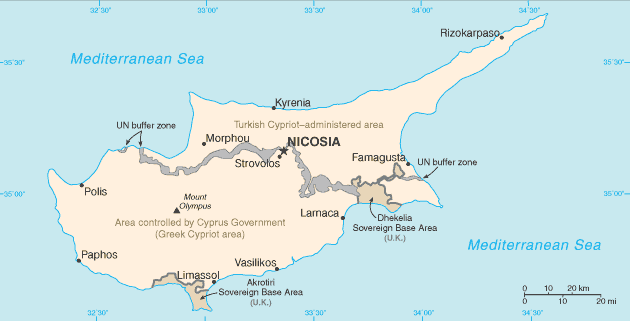

The president is both the chief of state and head of government
| GOVERNMENT OF TURKISH REPUBLIC OF NORTH CYPRUS |
Derviş Eroğlu
President since 23 April 2010
President since 23 April 2010
| TRAFFICKING IN PERSONS |
Current situation: Cyprus is primarily a destination country for a large number of women trafficked from Eastern and
Central Europe, the Philippines, and the Dominican Republic for the purpose of sexual exploitation; traffickers continued
to fraudulently recruit victims for work as dancers in cabarets and nightclubs on short-term "artiste" visas, for work in
pubs and bars on employment visas, or for illegal work on tourist or student visas
Tier rating: Tier 2 Watch List - Cyprus is on the Tier 2 Watch List for a third consecutive year for failure to show
evidence of increasing efforts to combat human trafficking during 2007; although Cyprus passed a new trafficking law
and opened a government trafficking shelter, these efforts are outweighed by its failure to show tangible and critically
needed progress in the areas of law enforcement, victim protection, and the prevention of trafficking (2008)
Central Europe, the Philippines, and the Dominican Republic for the purpose of sexual exploitation; traffickers continued
to fraudulently recruit victims for work as dancers in cabarets and nightclubs on short-term "artiste" visas, for work in
pubs and bars on employment visas, or for illegal work on tourist or student visas
Tier rating: Tier 2 Watch List - Cyprus is on the Tier 2 Watch List for a third consecutive year for failure to show
evidence of increasing efforts to combat human trafficking during 2007; although Cyprus passed a new trafficking law
and opened a government trafficking shelter, these efforts are outweighed by its failure to show tangible and critically
needed progress in the areas of law enforcement, victim protection, and the prevention of trafficking (2008)
Hüseyin Özgürgün
Deputy Prime Minister and Foreign
Minister since 17 May 2010
Deputy Prime Minister and Foreign
Minister since 17 May 2010