| DOMINICA Commonwealth of Dominica Commonwealth of Dominica Joined United Nations: 18 December 1978 Human Rights as assured by their constitution Click here Updated 23 August 2012 |
| CAPITAL |
| POPULATION |
| CHIEF OF STATE |
| SELECTION PROCESS |
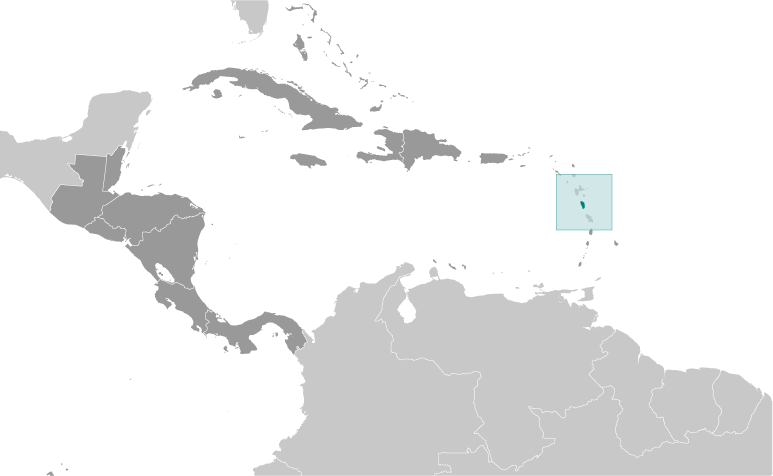
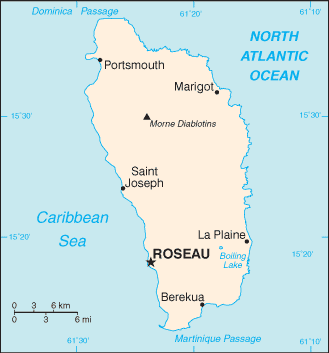
Roseau
73,126 (July 2012 est.)
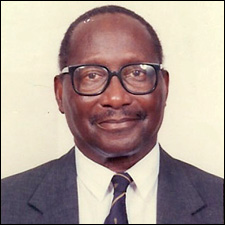
Nicholas J.O. Liverpool
President since 1 October 2003
President since 1 October 2003
President elected by the House of Assembly for a five-year
term; election last held 1 October 2003; NOTE- consented to a
second term in 2008 at the request of the prime minister and
leader of the opposition
Next scheduled election: October 2013
term; election last held 1 October 2003; NOTE- consented to a
second term in 2008 at the request of the prime minister and
leader of the opposition
Next scheduled election: October 2013
HEAD OF GOVERNMENT
SELECTION PROCESS
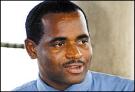
Roosevelt Skerrit
Prime Minister since 8 January 2004
Prime Minister since 8 January 2004
Prime minister appointed by the president
| DECLARATION OF HUMAN RIGHTS |
| ETHNIC GROUPS |
Black 86.8%, mixed 8.9%, Carib Amerindian 2.9%, white 0.8%, other 0.7% (2001 census)
| RELIGIONS |
Roman Catholic 61.4%, Seventh Day Adventist 6%, Pentecostal 5.6%, Baptist 4.1%, Methodist 3.7%, Church of
God 1.2%, Jehovah's Witnesses 1.2%, other Christian 7.7%, Rastafarian 1.3%, other or unspecified 1.6%, none
6.1% (2001 census)
God 1.2%, Jehovah's Witnesses 1.2%, other Christian 7.7%, Rastafarian 1.3%, other or unspecified 1.6%, none
6.1% (2001 census)
| GOVERNMENT STRUCTURE |
Parliamentary democracy with 10 parishes; Legal system is based on English common law ; does not accepts
compulsory ICJ jurisdiction
Executive: President elected by the House of Assembly for a five-year term; election last held 1 October 2003 (next to be
held October 2013); Note- consented to a second term in 2008 at the request of the prime minister and leader of the
opposition prime minister appointed by the president
Legislative: Unicameral House of Assembly (30 seats, 9 appointed senators, 21 elected by popular vote; members
serve five-year terms)
elections: last held 18 December 2009 (next to be held in 2015); note - tradition dictates that the election will be held
within five years of the last election, but technically it is five years from the first seating of parliament (12 May 2005)
plus a 90-day grace period
Judicial: Eastern Caribbean Supreme Court, consisting of the Court of Appeal and the High Court (located in Saint
Lucia; one of the six judges must reside in Dominica and preside over the Court of Summary Jurisdiction)
compulsory ICJ jurisdiction
Executive: President elected by the House of Assembly for a five-year term; election last held 1 October 2003 (next to be
held October 2013); Note- consented to a second term in 2008 at the request of the prime minister and leader of the
opposition prime minister appointed by the president
Legislative: Unicameral House of Assembly (30 seats, 9 appointed senators, 21 elected by popular vote; members
serve five-year terms)
elections: last held 18 December 2009 (next to be held in 2015); note - tradition dictates that the election will be held
within five years of the last election, but technically it is five years from the first seating of parliament (12 May 2005)
plus a 90-day grace period
Judicial: Eastern Caribbean Supreme Court, consisting of the Court of Appeal and the High Court (located in Saint
Lucia; one of the six judges must reside in Dominica and preside over the Court of Summary Jurisdiction)
| LANGUAGES |
English (official), French patois
| BRIEF HISTORY |
| ECONOMIC OVERVIEW |
The Dominican economy has been dependent on agriculture - primarily bananas - in years past, but increasingly has
been driven by tourism as the government seeks to promote Dominica as an "ecotourism" destination. In order to
diversify the island's production base, the government also is attempting to develop an offshore financial sector and
has signed an agreement with the EU to develop geothermal energy resources. In 2003, the government began a
comprehensive restructuring of the economy - including elimination of price controls, privatization of the state banana
company, and tax increases - to address an economic and financial crisis and to meet IMF requirements. This
restructuring paved the way for an economic recovery and helped to reduce the debt burden, which remains at about
80% of GDP. Hurricane Dean struck the island in August 2007 causing damages equivalent to 20% of GDP. In
2009, growth slowed as a result of the global recession; it picked up only slightly in 2010-11.
Source: CIA World Factbook (select Dominica)
been driven by tourism as the government seeks to promote Dominica as an "ecotourism" destination. In order to
diversify the island's production base, the government also is attempting to develop an offshore financial sector and
has signed an agreement with the EU to develop geothermal energy resources. In 2003, the government began a
comprehensive restructuring of the economy - including elimination of price controls, privatization of the state banana
company, and tax increases - to address an economic and financial crisis and to meet IMF requirements. This
restructuring paved the way for an economic recovery and helped to reduce the debt burden, which remains at about
80% of GDP. Hurricane Dean struck the island in August 2007 causing damages equivalent to 20% of GDP. In
2009, growth slowed as a result of the global recession; it picked up only slightly in 2010-11.
Source: CIA World Factbook (select Dominica)
| POLITICAL CLIMATE |
The House of Assembly has 32 members. 21 members are elected for a five year term in single-seat constituencies.
9 members are senators appointed by the President; 5 on the advice of the Prime Minister and 4 on the advice of the
leader of the opposition. A Speaker is elected by the elected members after an election. There is also 1 ex-officio
member, the clerk of the house. The head of state - the president - is elected by the House of Assembly and is
composed of 21 regional representatives and nine senators. The regional representatives decide whether senators are
to be elected or appointed. If appointed, five are chosen by the president with the advice of the prime minister and
four with the advice of the opposition leader. If elected, it is by vote of the regional representatives. Elections for
representatives and senators must be held at least every 5 years, although the prime minister can call elections any
time. Dominica has a two-party system, which means that there are two dominant political parties, with extreme
difficulty for anybody to achieve electoral success under the banner of any other party. Dominica was once a
three-party system, but in the past few years the Dominica Labour Party and the greatly diminished Dominica
Freedom Party have built a coalition.
Source: Wikipedia: Politics of Dominica
9 members are senators appointed by the President; 5 on the advice of the Prime Minister and 4 on the advice of the
leader of the opposition. A Speaker is elected by the elected members after an election. There is also 1 ex-officio
member, the clerk of the house. The head of state - the president - is elected by the House of Assembly and is
composed of 21 regional representatives and nine senators. The regional representatives decide whether senators are
to be elected or appointed. If appointed, five are chosen by the president with the advice of the prime minister and
four with the advice of the opposition leader. If elected, it is by vote of the regional representatives. Elections for
representatives and senators must be held at least every 5 years, although the prime minister can call elections any
time. Dominica has a two-party system, which means that there are two dominant political parties, with extreme
difficulty for anybody to achieve electoral success under the banner of any other party. Dominica was once a
three-party system, but in the past few years the Dominica Labour Party and the greatly diminished Dominica
Freedom Party have built a coalition.
Source: Wikipedia: Politics of Dominica
| INTERNATIONAL DISPUTES |
Dominica is the only Caribbean state to challenge Venezuela's sovereignty claim over Aves Island and joins the other
island nations in challenging whether the feature sustains human habitation, a criterion under the UN Convention on
the Law of the Sea (UNCLOS), which permits Venezuela to extend its Exclusive Economic Zone (EEZ) and
continental shelf claims over a large portion of the eastern Caribbean Sea
island nations in challenging whether the feature sustains human habitation, a criterion under the UN Convention on
the Law of the Sea (UNCLOS), which permits Venezuela to extend its Exclusive Economic Zone (EEZ) and
continental shelf claims over a large portion of the eastern Caribbean Sea


| REFUGEES AND INTERNALLY DISPLACED PERSONS (IDP) |
None reported.
| ILLICIT DRUGS |
Transshipment point for narcotics bound for the US and Europe; minor cannabis producer (2008)
| HUMAN RIGHTS STATEMENTS, ANALYSIS AND CRITIQUES |
2011 Human Rights Report: Dominica
Bureau of Democracy, Human Rights, and Labor
2011 Country Reports on Human Rights Practices
May 24, 2012
Dominica is a multiparty, parliamentary democracy. In 2009 elections Prime Minister Roosevelt Skerrit’s Dominica Labour Party
(DLP) prevailed over the opposition United Workers Party (UWP) by a margin of 18 seats to three seats. Although outside
observers found the elections generally free and fair, the opposition continued to boycott Parliament over alleged electoral abuses.
Security forces reported to civilian authorities.
The most serious human rights problems were the overcrowded prison and domestic violence against women and children.
Other human rights problems included adverse conditions experienced by indigenous Kalinago (Carib).
The government took steps to prosecute officials who committed abuses, and there were no known cases of impunity.
Click here to read more »
Bureau of Democracy, Human Rights, and Labor
2011 Country Reports on Human Rights Practices
May 24, 2012
Dominica is a multiparty, parliamentary democracy. In 2009 elections Prime Minister Roosevelt Skerrit’s Dominica Labour Party
(DLP) prevailed over the opposition United Workers Party (UWP) by a margin of 18 seats to three seats. Although outside
observers found the elections generally free and fair, the opposition continued to boycott Parliament over alleged electoral abuses.
Security forces reported to civilian authorities.
The most serious human rights problems were the overcrowded prison and domestic violence against women and children.
Other human rights problems included adverse conditions experienced by indigenous Kalinago (Carib).
The government took steps to prosecute officials who committed abuses, and there were no known cases of impunity.
Click here to read more »
26 January 2009
Committee on the Elimination of Discrimination against Women
Forty-third session
19 January-6 February 2009
Concluding observations of the Committee on the Elimination of Discrimination against Women
Dominica
1. The Committee considered the progress made in the implementation of the Convention on the Elimination of All Forms of
Discrimination against Women in Dominica in the absence of an initial and subsequent periodic reports at its 869th and 870th
meetings, on 21 January 2009. In the absence of a report and in the absence of responses to the Committee’s list of issues and
questions and taking into account all information available, the Committee adopted, during its forty-third session, the following
comments based on the dialogue with the representatives of the State party.
2. At its thirty-seventh session, in 2007, the Committee invited the State party to submit a report before March 2008, failing which
it would proceed with the consideration of the implementation of the Convention in the absence of the State party’s report. The
Committee notes with concern the State party’s failure to honour its reporting obligations under article 18 of the Convention, and
that no report had been submitted to the Committee since 1982, when its initial report was due.
3. The Committee expresses its appreciation for the constructive dialogue that was held between the Committee and the delegation
of the State party, represented by Alix Boyd-Knights, speaker of the House of Assembly, and Ruth Allport, Permanent Secretary of
the Ministry of Community Development, Culture, Gender Affairs and Information, which clarified the present status of
implementation of the Convention and provided some information on the State party’s non-compliance with its reporting obligation.
4. The Committee wishes to draw the attention of the State party to the fact that reporting is an obligation under article 18 of the
Convention and that non-compliance in this regard creates serious obstacles to the effective monitoring of the implementation of the
Convention at the national level..
Click here to read more »
Committee on the Elimination of Discrimination against Women
Forty-third session
19 January-6 February 2009
Concluding observations of the Committee on the Elimination of Discrimination against Women
Dominica
1. The Committee considered the progress made in the implementation of the Convention on the Elimination of All Forms of
Discrimination against Women in Dominica in the absence of an initial and subsequent periodic reports at its 869th and 870th
meetings, on 21 January 2009. In the absence of a report and in the absence of responses to the Committee’s list of issues and
questions and taking into account all information available, the Committee adopted, during its forty-third session, the following
comments based on the dialogue with the representatives of the State party.
2. At its thirty-seventh session, in 2007, the Committee invited the State party to submit a report before March 2008, failing which
it would proceed with the consideration of the implementation of the Convention in the absence of the State party’s report. The
Committee notes with concern the State party’s failure to honour its reporting obligations under article 18 of the Convention, and
that no report had been submitted to the Committee since 1982, when its initial report was due.
3. The Committee expresses its appreciation for the constructive dialogue that was held between the Committee and the delegation
of the State party, represented by Alix Boyd-Knights, speaker of the House of Assembly, and Ruth Allport, Permanent Secretary of
the Ministry of Community Development, Culture, Gender Affairs and Information, which clarified the present status of
implementation of the Convention and provided some information on the State party’s non-compliance with its reporting obligation.
4. The Committee wishes to draw the attention of the State party to the fact that reporting is an obligation under article 18 of the
Convention and that non-compliance in this regard creates serious obstacles to the effective monitoring of the implementation of the
Convention at the national level..
Click here to read more »
FREEDOM IN THE WORLD REPORT- 2012
Political Rights Score: 1
Civil Liberties Score: 1
Status: Free
Overview
Prime Minister Roosevelt Skerrit and Education Minister Petter Saint Jean went on trial in September 2011 for holding dual
citizenship at the time of their inauguration in 2009, which violates Dominican law and the validity of their election. The case was
pending at year’s end.
In the December 2009 legislative election, the DLP captured 18 seats, while the UWP took only 3 seats. The elections were deemed
generally fair by observer teams from both the Organization of American States and CARICOM. However, opposition members
accused the DLP of misconduct during the campaign and filed complaints of election irregularities, including having been denied
equal access to state media during the campaign period. They also accused Skerrit and Education Minister Petter Saint Jean of
holding dual citizenship at the time of the election, which under Dominican law should have made them ineligible to hold office. The
courts rejected all of the complaints in 2010, except for the dual citizenship case, which was brought to trial in September 2011 and
was pending at year’s end.
Skerrit’s administration continued to be plagued by accusations of corruption during the year. In July 2011, the government was
accused of theft of public funds due to its purchase of building supplies that were later possessed by an individual with close ties to
Trade Minister Dr. Colin McIntyre. In 2009, Dr. McIntyre’s brother had profited from the so-called “rubbish bin scandal,” in
which the government imported 2,700 garbage bins at four times their average retail price. The opposition also accused Skerrit of
establishing a network of spies to monitor his opponents during 2011.
The Dominica police force, which became responsible for security after the military was disbanded in 1981, operates professionally
and with few human rights complaints. However, in 2011, the government was accused of illegally establishing a National Joint
Intelligence Committee, comprised of police officers selected by Skerrit, to intercept email and phone messages, as well as monitor
the activities of select residences and businesses.
Women are underrepresented in government and hold just four seats in the House of Assembly. There are no laws mandating equal
pay for equal work in private-sector jobs, and while there is no specific law that criminalizes domestic abuse, the Protection against
Domestic Violence Act allows abused persons to appear before a judge and request a protective order without seeking legal counsel.
Click here to read more »
Political Rights Score: 1
Civil Liberties Score: 1
Status: Free
Overview
Prime Minister Roosevelt Skerrit and Education Minister Petter Saint Jean went on trial in September 2011 for holding dual
citizenship at the time of their inauguration in 2009, which violates Dominican law and the validity of their election. The case was
pending at year’s end.
In the December 2009 legislative election, the DLP captured 18 seats, while the UWP took only 3 seats. The elections were deemed
generally fair by observer teams from both the Organization of American States and CARICOM. However, opposition members
accused the DLP of misconduct during the campaign and filed complaints of election irregularities, including having been denied
equal access to state media during the campaign period. They also accused Skerrit and Education Minister Petter Saint Jean of
holding dual citizenship at the time of the election, which under Dominican law should have made them ineligible to hold office. The
courts rejected all of the complaints in 2010, except for the dual citizenship case, which was brought to trial in September 2011 and
was pending at year’s end.
Skerrit’s administration continued to be plagued by accusations of corruption during the year. In July 2011, the government was
accused of theft of public funds due to its purchase of building supplies that were later possessed by an individual with close ties to
Trade Minister Dr. Colin McIntyre. In 2009, Dr. McIntyre’s brother had profited from the so-called “rubbish bin scandal,” in
which the government imported 2,700 garbage bins at four times their average retail price. The opposition also accused Skerrit of
establishing a network of spies to monitor his opponents during 2011.
The Dominica police force, which became responsible for security after the military was disbanded in 1981, operates professionally
and with few human rights complaints. However, in 2011, the government was accused of illegally establishing a National Joint
Intelligence Committee, comprised of police officers selected by Skerrit, to intercept email and phone messages, as well as monitor
the activities of select residences and businesses.
Women are underrepresented in government and hold just four seats in the House of Assembly. There are no laws mandating equal
pay for equal work in private-sector jobs, and while there is no specific law that criminalizes domestic abuse, the Protection against
Domestic Violence Act allows abused persons to appear before a judge and request a protective order without seeking legal counsel.
Click here to read more »
Suggested recommendations to states considered in the sixth round of Universal Periodic Review, November-December
2009
1 October 2009
Recommendations to the government of Dominica
International Criminal Court
· To accede to the Agreement on the Privileges and Immunities of the International Criminal Court and implement it in national law.
Click here to read more »
2009
1 October 2009
Recommendations to the government of Dominica
International Criminal Court
· To accede to the Agreement on the Privileges and Immunities of the International Criminal Court and implement it in national law.
Click here to read more »
UN Human Rights Council: A Stunning Development Against Violence
Unprecedented Support for Statement on Sexual Orientation and Gender Identity
March 22, 2011
In a stunning development for the principles of the Universal Declaration of Human Rights, at the United Nations Human Rights
Council (UNHRC) in Geneva, today, Colombia delivered a Joint Statement during General Debate (Agenda Item 8 - Follow-up and
implementation of the Vienna Declaration and Program of Action) that called on States to end violence, criminal sanctions and
related human rights violations based on sexual orientation and gender identity, and urged the Human Rights Council to address
these important human rights issues. The statement was delivered on behalf of a broad grouping of 85 States from all regions of the
world.
Today's statement enjoyed the support of the largest group of countries to-date, on the topic of sexual orientation, gender identity
and human rights. It builds on a similar statement delivered by Norway at the Human Rights Council in 2006 (on behalf of 54
States), and a joint statement delivered by Argentina at the General Assembly in 2008 (on behalf of 66 States). It is clear that every
time these issues are addressed there is measurable increase in state support.
Signatories to the Human Rights Council joint statement include: Albania, Andorra, Argentina, Armenia, Australia, Austria, Belgium,
Bolivia, Bosnia-Herzegovina, Brazil, Bulgaria, Canada, Central African Republic, Chile, Colombia, Costa Rica, Croatia, Cuba,
Cyprus, Czech Republic, Denmark, Dominica, Dominican Republic, Ecuador, El Salvador, Estonia, Fiji, Finland, France, Georgia,
Germany, Greece, Guatemala, Honduras, Hungary, Iceland, Ireland, Israel, Italy, Japan, Latvia, Liechtenstein, Lithuania,
Luxembourg, Malta, Marshall Islands, Mexico, Micronesia, Monaco, Mongolia, Montenegro, Nauru, Nepal, Netherlands, New
Zealand, Nicaragua, Norway, Palau, Panama, Paraguay, Poland, Portugal, Romania, Rwanda, Samoa, San Marino, Serbia,
Seychelles, Sierra Leone, Slovakia, Slovenia, South Africa, Spain, Sweden, Switzerland, Thailand, Timor-Leste, Tuvalu, Ukraine,
United Kingdom of Great Britain and Northern Ireland, United States of America, Uruguay, Vanuatu, Venezuela, and the Former
Yugoslav Republic of Macedonia.
Click here to read more »
Unprecedented Support for Statement on Sexual Orientation and Gender Identity
March 22, 2011
In a stunning development for the principles of the Universal Declaration of Human Rights, at the United Nations Human Rights
Council (UNHRC) in Geneva, today, Colombia delivered a Joint Statement during General Debate (Agenda Item 8 - Follow-up and
implementation of the Vienna Declaration and Program of Action) that called on States to end violence, criminal sanctions and
related human rights violations based on sexual orientation and gender identity, and urged the Human Rights Council to address
these important human rights issues. The statement was delivered on behalf of a broad grouping of 85 States from all regions of the
world.
Today's statement enjoyed the support of the largest group of countries to-date, on the topic of sexual orientation, gender identity
and human rights. It builds on a similar statement delivered by Norway at the Human Rights Council in 2006 (on behalf of 54
States), and a joint statement delivered by Argentina at the General Assembly in 2008 (on behalf of 66 States). It is clear that every
time these issues are addressed there is measurable increase in state support.
Signatories to the Human Rights Council joint statement include: Albania, Andorra, Argentina, Armenia, Australia, Austria, Belgium,
Bolivia, Bosnia-Herzegovina, Brazil, Bulgaria, Canada, Central African Republic, Chile, Colombia, Costa Rica, Croatia, Cuba,
Cyprus, Czech Republic, Denmark, Dominica, Dominican Republic, Ecuador, El Salvador, Estonia, Fiji, Finland, France, Georgia,
Germany, Greece, Guatemala, Honduras, Hungary, Iceland, Ireland, Israel, Italy, Japan, Latvia, Liechtenstein, Lithuania,
Luxembourg, Malta, Marshall Islands, Mexico, Micronesia, Monaco, Mongolia, Montenegro, Nauru, Nepal, Netherlands, New
Zealand, Nicaragua, Norway, Palau, Panama, Paraguay, Poland, Portugal, Romania, Rwanda, Samoa, San Marino, Serbia,
Seychelles, Sierra Leone, Slovakia, Slovenia, South Africa, Spain, Sweden, Switzerland, Thailand, Timor-Leste, Tuvalu, Ukraine,
United Kingdom of Great Britain and Northern Ireland, United States of America, Uruguay, Vanuatu, Venezuela, and the Former
Yugoslav Republic of Macedonia.
Click here to read more »
Kalinago community encouraged to press on
Written by GIS Dominica on 05 July 2012.
Dominica’s indigenous people have been advised to consolidate the gains made in the Kalinago Territory since attaining ownership of
the lands over a century ago.
On Wednesday July 4th,, the Kalinago’s Indigenous Nation Developers (K.I.N.D) organized a special torch relay activity in
recognition of the one hundred and nine years since the establishment of the Kalinago Territory.
Gregory Rabess, Senior Cultural Officer and a native of the Kalinago Territory says the Kalinago people have evolved over the years.
Rabess notes that much effort has been made to preserve the Kalinago history through the formation of several cultural groups.
“We will remember the work of the Karifuna cultural group, their appearances in DOMFESTA and all over Dominica. This brought
about a new sense of respect and pride for the Kalinago people not just in Dominica but across the region.”
Rabess says Dominicans now look at the Kalinago people with a new set of eyes.
“We use to sort of look down on the Kalinago people. There was the perception that the Kalinago people didn’t have anything
important to bring to our civilization that was the thinking, but this is no more.”
Rabess is advocating that the Kalinago people look back on their achievements as a native people and strive to excel further.
“We have come a long way, we have made some significant gains; we have done many things, and let us not take them for granted.
What we need to do now is to take it to the next level, mobilizing young people using the latest communication technologies to assist
with the documentation process and to create new Kalinago products.”
The Kalinago Barana Aute is one example of the Kalinago products now operating in the Kalinago Territory.
The Kalinago Territory is made up of 3700 acres of land with over three thousand native Indians residing there.
Click here to read more »
Written by GIS Dominica on 05 July 2012.
Dominica’s indigenous people have been advised to consolidate the gains made in the Kalinago Territory since attaining ownership of
the lands over a century ago.
On Wednesday July 4th,, the Kalinago’s Indigenous Nation Developers (K.I.N.D) organized a special torch relay activity in
recognition of the one hundred and nine years since the establishment of the Kalinago Territory.
Gregory Rabess, Senior Cultural Officer and a native of the Kalinago Territory says the Kalinago people have evolved over the years.
Rabess notes that much effort has been made to preserve the Kalinago history through the formation of several cultural groups.
“We will remember the work of the Karifuna cultural group, their appearances in DOMFESTA and all over Dominica. This brought
about a new sense of respect and pride for the Kalinago people not just in Dominica but across the region.”
Rabess says Dominicans now look at the Kalinago people with a new set of eyes.
“We use to sort of look down on the Kalinago people. There was the perception that the Kalinago people didn’t have anything
important to bring to our civilization that was the thinking, but this is no more.”
Rabess is advocating that the Kalinago people look back on their achievements as a native people and strive to excel further.
“We have come a long way, we have made some significant gains; we have done many things, and let us not take them for granted.
What we need to do now is to take it to the next level, mobilizing young people using the latest communication technologies to assist
with the documentation process and to create new Kalinago products.”
The Kalinago Barana Aute is one example of the Kalinago products now operating in the Kalinago Territory.
The Kalinago Territory is made up of 3700 acres of land with over three thousand native Indians residing there.
Click here to read more »
2/16/2011
Williams is the first Kalinago Lawyer in Dominica
Waitikubuli/Dominica (UCTP Taino News) – Pearl Diane Williams, is the first indigenous Kalinago Carib person from Waitikubuli
(Dominica) and possibly the Eastern Caribbean to be admitted to the Bar in the Commonwealth of Dominica. Ms. Williams pursued
her bachelors degree in Law at the Cave-Hill Campus at the University of the West Indies in Barbados, where she successfully
completed her degree with second class honours.
Miss Williams was one of the first indigenous persons from the Eastern Caribbean to have benefited from the Sir Arthur Lewis
Indigenous Scholarship program launched in 2005. After she completed her studies in Barbados, she proceeded to the Hugh
Wooding Law School in Trinidad and Tobago where she successfully obtained the Legal Education Certificate, which qualified her
to be admitted to the Bar in Dominica.
Miss Williams is the daughter of Margaret and Charles Williams (former Kalinago Carib Chief of Waitikubuli/Dominica). The young
lawyer believes that the Indigenous Peoples in the region have not been inadequately recognized and represented but that her calling
to the Bar signifies a “new beginning” for her people.
Click here to read more »
Williams is the first Kalinago Lawyer in Dominica
Waitikubuli/Dominica (UCTP Taino News) – Pearl Diane Williams, is the first indigenous Kalinago Carib person from Waitikubuli
(Dominica) and possibly the Eastern Caribbean to be admitted to the Bar in the Commonwealth of Dominica. Ms. Williams pursued
her bachelors degree in Law at the Cave-Hill Campus at the University of the West Indies in Barbados, where she successfully
completed her degree with second class honours.
Miss Williams was one of the first indigenous persons from the Eastern Caribbean to have benefited from the Sir Arthur Lewis
Indigenous Scholarship program launched in 2005. After she completed her studies in Barbados, she proceeded to the Hugh
Wooding Law School in Trinidad and Tobago where she successfully obtained the Legal Education Certificate, which qualified her
to be admitted to the Bar in Dominica.
Miss Williams is the daughter of Margaret and Charles Williams (former Kalinago Carib Chief of Waitikubuli/Dominica). The young
lawyer believes that the Indigenous Peoples in the region have not been inadequately recognized and represented but that her calling
to the Bar signifies a “new beginning” for her people.
Click here to read more »
DOMINICA : CEDAW Alternative Information
to the Committee on the Elimination of All Forms of Discrimination Against Women 43rd CEDAW Session
(19 January 2009 – 6 February 2009)
Prepared by theNational Coalition of Dominican Women
Violence Against Women in Dominica
The Constitution of Dominica provides for equal and inalienable rights for all persons. The state has enacted many laws and
policies, as well as has ratified the present international treaty, all of which aim to remove discriminatory practices that prevent
women from performing to their full potential. Some examples are:
• Children and Young Persons Act Chapter 37:50
• Sexual Offences Act No. 1 of 1998,
These above instruments uphold the principles of fundamental human rights and beliefs. However, available data and information
from in-depth research on violence against women highlight an increase in violence against women and girls and a growing culture
of violence within the society.
A recent report by the Government on the health situation in Dominica revealed that injuries caused by violence were among the
three leading health issues of concern for the health ministry.. A study on Domestic Violence conducted in 2001 by the Women’s
Bureau, revealed that various forms of abuse take place between partners in relationships in all districts in Dominica, regardless of
social status and age, which affect women specifically. Thirty-one percent (31.8%) of the respondents revealed that they had
experienced some form of abuse either in a current or former relationship. Reported cases from police files, records of patients at
the hospitals, and counseling records show physical battering of women still continues. This impact of violence on women is
backed by the work experience of the Dominican National council of Women, wherein despite having an open door policy on
providing services for violence related issues, we found that in surveying our clientele for past 2 years, (2006-2008) 82% of all our
clients were women.
Click here to read more»
to the Committee on the Elimination of All Forms of Discrimination Against Women 43rd CEDAW Session
(19 January 2009 – 6 February 2009)
Prepared by theNational Coalition of Dominican Women
Violence Against Women in Dominica
The Constitution of Dominica provides for equal and inalienable rights for all persons. The state has enacted many laws and
policies, as well as has ratified the present international treaty, all of which aim to remove discriminatory practices that prevent
women from performing to their full potential. Some examples are:
• Children and Young Persons Act Chapter 37:50
• Sexual Offences Act No. 1 of 1998,
These above instruments uphold the principles of fundamental human rights and beliefs. However, available data and information
from in-depth research on violence against women highlight an increase in violence against women and girls and a growing culture
of violence within the society.
A recent report by the Government on the health situation in Dominica revealed that injuries caused by violence were among the
three leading health issues of concern for the health ministry.. A study on Domestic Violence conducted in 2001 by the Women’s
Bureau, revealed that various forms of abuse take place between partners in relationships in all districts in Dominica, regardless of
social status and age, which affect women specifically. Thirty-one percent (31.8%) of the respondents revealed that they had
experienced some form of abuse either in a current or former relationship. Reported cases from police files, records of patients at
the hospitals, and counseling records show physical battering of women still continues. This impact of violence on women is
backed by the work experience of the Dominican National council of Women, wherein despite having an open door policy on
providing services for violence related issues, we found that in surveying our clientele for past 2 years, (2006-2008) 82% of all our
clients were women.
Click here to read more»
The island of Dominica's indigenous Arawak people were expelled or exterminated by Caribs in the 14th century.
The Arawaks were guided to Dominica, and other islands of the Caribbean, by the South Equatorial current from the
waters of the Orinoco River. These descendants of the early Tainos were overthrown by the Kalinago tribe of the
Caribs. The Caribs, or Island-Caribs, not to be confused with the proper Caribs of the mainland, occupied the
Wayward Islands, Guadeloupe, and maybe a few of the southern Leewards during the time of Christopher
Columbus who landed on the island in November 1493. Spanish ships frequently landed on Dominica during the
16th century, but fierce resistance by the Caribs discouraged Spain's efforts at settlement. Carib people presently
inhabit the island, but the numbers of Carib population had decreased dramatically with European colonization. The
British settlers devastated much of the Carib tribe. Many of the remaining Carib people live in Dominica's Carib
Reserve, which is over 100 years old. In 1635, France claimed Dominica. Shortly thereafter, French missionaries
became the first European inhabitants of the island. Carib incursions continued, though, and in 1660, the French and
British agreed that both Dominica and St. Vincent should be abandoned. Dominica was officially neutral for the next
century, but the attraction of its resources remained; rival expeditions of British and French foresters were harvesting
timber by the start of the 18th century. Largely due to Dominica's position between Martinique and Guadeloupe,
France eventually became predominant, and a French settlement was established and grew. As part of the 1763
Treaty of Paris that ended the Seven Years' War, the island became a British possession. In 1778, during the
American Revolutionary War, the French mounted a successful invasion with the active cooperation of the
population, which was largely French. The 1783 Treaty of Paris, which ended the war, returned the island to Britain.
French invasions in 1795 and 1805 ended in failure. In 1763, the British established a legislative assembly,
representing only the white population. In 1831, reflecting a liberalization of official British racial attitudes, the Brown
Privilege Bill conferred political and social rights on free nonwhites. Three Blacks were elected to the legislative
assembly the following year. Following the abolition of slavery, in 1838 Dominica became the first and only British
Caribbean colony to have a Black-controlled legislature in the 19th century. Most Black legislators were small
holders or merchants who held economic and social views diametrically opposed to the interests of the small,
wealthy English planter class. Reacting to a perceived threat, the planters lobbied for more direct British rule. In
1865, after much agitation and tension, the colonial office replaced the elective assembly with one comprised of
one-half elected members and one-half appointed. The elected legislators were outmaneuvered on numerous
occasions by planters allied with colonial administrators. In 1871, Dominica became part of the Leeward Island
Federation. The power of the Black population progressively eroded. Crown Colony government was re-established
in 1896. All political rights for the vast majority of the population were effectively curtailed. Development aid, offered
as compensation for disenfranchisement, proved to have a negligible effect. Following World War I, an upsurge of
political consciousness throughout the Caribbean led to the formation of the representative government association.
Marshaling public frustration with the lack of a voice in the governing of Dominica, this group won one-third of the
popularly elected seats of the legislative assembly in 1924 and one-half in 1936. Shortly thereafter, Dominica was
transferred from the Leeward Island Administration and was governed as part of the Windwards until 1958, when it
joined the short-lived West Indies Federation. In 1961, a Dominica Labor Party government led by Edward Oliver
LeBlanc was elected. After the federation dissolved, Dominica became an associated state of the United Kingdom
on February 27, 1967 and formally took responsibility for its internal affairs. LeBlanc retired in 1974 and was
replaced by Patrick John. On November 3, 1978, the Commonwealth of Dominica was granted independence by
the United Kingdom. Independence did little to solve problems stemming from centuries of economic
underdevelopment, and in mid-1979, political discontent led to the formation of an interim government, led by Oliver
Seraphin. It was replaced after the 1980 elections by a government led by the Dominica Freedom Party under Prime
Minister Eugenia Charles, the Caribbean's first female prime minister. Chronic economic problems were
compounded by the severe impact of hurricanes in 1979 and in 1980. By the end of the 1980s, the economy had
made a healthy recovery, which weakened in the 1990s due to a decrease in banana prices. In 1995 the government
was defeated in elections by the United Workers Party of Edison James. James became prime minister, serving until
the February 2000 elections, when the Dominica United Workers Party (DUWP) was defeated by the Dominica
Labour Party (DLP), led by Rosie Douglas. He was a former socialist activist, and many feared that his approach to
politics might be impractical. However, these were somewhat quieted when he formed a coalition with the more
conservative Dominica Freedom Party. Douglas died suddenly after only a few months in office, on October 1,
2000, and was replaced by Pierre Charles, also of the DLP. In 2003, Nicholas Liverpool was elected and sworn in
as president, succeeding Vernon Shaw.. On January 6, 2004, Prime Minister Pierre Charles, who had been suffering
from heart problems since 2003, died. He became the second consecutive prime minister of Dominica to die in office
of a heart attack. The foreign minister, Osborne Riviere immediately became prime minister, but the education
minister, Roosevelt Skerrit succeeded him as prime minister and became the new leader of the Dominica Labour
Party. Elections were held on May 5, 2005 with the ruling coalition maintaining power.
Sources: Wikipedia: History of Dominica
The Arawaks were guided to Dominica, and other islands of the Caribbean, by the South Equatorial current from the
waters of the Orinoco River. These descendants of the early Tainos were overthrown by the Kalinago tribe of the
Caribs. The Caribs, or Island-Caribs, not to be confused with the proper Caribs of the mainland, occupied the
Wayward Islands, Guadeloupe, and maybe a few of the southern Leewards during the time of Christopher
Columbus who landed on the island in November 1493. Spanish ships frequently landed on Dominica during the
16th century, but fierce resistance by the Caribs discouraged Spain's efforts at settlement. Carib people presently
inhabit the island, but the numbers of Carib population had decreased dramatically with European colonization. The
British settlers devastated much of the Carib tribe. Many of the remaining Carib people live in Dominica's Carib
Reserve, which is over 100 years old. In 1635, France claimed Dominica. Shortly thereafter, French missionaries
became the first European inhabitants of the island. Carib incursions continued, though, and in 1660, the French and
British agreed that both Dominica and St. Vincent should be abandoned. Dominica was officially neutral for the next
century, but the attraction of its resources remained; rival expeditions of British and French foresters were harvesting
timber by the start of the 18th century. Largely due to Dominica's position between Martinique and Guadeloupe,
France eventually became predominant, and a French settlement was established and grew. As part of the 1763
Treaty of Paris that ended the Seven Years' War, the island became a British possession. In 1778, during the
American Revolutionary War, the French mounted a successful invasion with the active cooperation of the
population, which was largely French. The 1783 Treaty of Paris, which ended the war, returned the island to Britain.
French invasions in 1795 and 1805 ended in failure. In 1763, the British established a legislative assembly,
representing only the white population. In 1831, reflecting a liberalization of official British racial attitudes, the Brown
Privilege Bill conferred political and social rights on free nonwhites. Three Blacks were elected to the legislative
assembly the following year. Following the abolition of slavery, in 1838 Dominica became the first and only British
Caribbean colony to have a Black-controlled legislature in the 19th century. Most Black legislators were small
holders or merchants who held economic and social views diametrically opposed to the interests of the small,
wealthy English planter class. Reacting to a perceived threat, the planters lobbied for more direct British rule. In
1865, after much agitation and tension, the colonial office replaced the elective assembly with one comprised of
one-half elected members and one-half appointed. The elected legislators were outmaneuvered on numerous
occasions by planters allied with colonial administrators. In 1871, Dominica became part of the Leeward Island
Federation. The power of the Black population progressively eroded. Crown Colony government was re-established
in 1896. All political rights for the vast majority of the population were effectively curtailed. Development aid, offered
as compensation for disenfranchisement, proved to have a negligible effect. Following World War I, an upsurge of
political consciousness throughout the Caribbean led to the formation of the representative government association.
Marshaling public frustration with the lack of a voice in the governing of Dominica, this group won one-third of the
popularly elected seats of the legislative assembly in 1924 and one-half in 1936. Shortly thereafter, Dominica was
transferred from the Leeward Island Administration and was governed as part of the Windwards until 1958, when it
joined the short-lived West Indies Federation. In 1961, a Dominica Labor Party government led by Edward Oliver
LeBlanc was elected. After the federation dissolved, Dominica became an associated state of the United Kingdom
on February 27, 1967 and formally took responsibility for its internal affairs. LeBlanc retired in 1974 and was
replaced by Patrick John. On November 3, 1978, the Commonwealth of Dominica was granted independence by
the United Kingdom. Independence did little to solve problems stemming from centuries of economic
underdevelopment, and in mid-1979, political discontent led to the formation of an interim government, led by Oliver
Seraphin. It was replaced after the 1980 elections by a government led by the Dominica Freedom Party under Prime
Minister Eugenia Charles, the Caribbean's first female prime minister. Chronic economic problems were
compounded by the severe impact of hurricanes in 1979 and in 1980. By the end of the 1980s, the economy had
made a healthy recovery, which weakened in the 1990s due to a decrease in banana prices. In 1995 the government
was defeated in elections by the United Workers Party of Edison James. James became prime minister, serving until
the February 2000 elections, when the Dominica United Workers Party (DUWP) was defeated by the Dominica
Labour Party (DLP), led by Rosie Douglas. He was a former socialist activist, and many feared that his approach to
politics might be impractical. However, these were somewhat quieted when he formed a coalition with the more
conservative Dominica Freedom Party. Douglas died suddenly after only a few months in office, on October 1,
2000, and was replaced by Pierre Charles, also of the DLP. In 2003, Nicholas Liverpool was elected and sworn in
as president, succeeding Vernon Shaw.. On January 6, 2004, Prime Minister Pierre Charles, who had been suffering
from heart problems since 2003, died. He became the second consecutive prime minister of Dominica to die in office
of a heart attack. The foreign minister, Osborne Riviere immediately became prime minister, but the education
minister, Roosevelt Skerrit succeeded him as prime minister and became the new leader of the Dominica Labour
Party. Elections were held on May 5, 2005 with the ruling coalition maintaining power.
Sources: Wikipedia: History of Dominica


Click on map for larger view
Click on flag for Country Report




| TRAFFICKING IN PERSONS |
None reported.