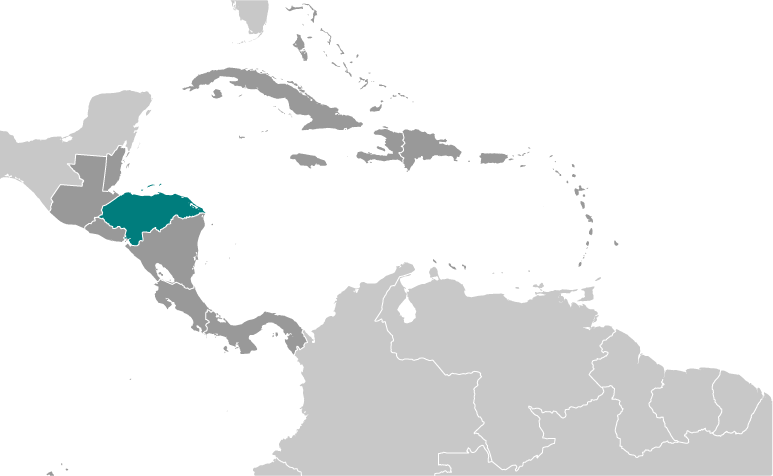
| HONDURAS Republic of Honduras Republica de Honduras Joined United Nations: 17 December 1945 Human Rights as assured by their constitution Click here Updated 27 July 2012 |

| CAPITAL |
| POPULATION |
| CHIEF OF STATE |
| SELECTION PROCESS |
Tegucigalpa
8,296,693
note: estimates for this country explicitly take into account the effects of excess mortality
due to AIDS; this can result in lower life expectancy, higher infant mortality, higher
death rates, lower population growth rates, and changes in the distribution of
population by age and sex than would otherwise be expected (July 2012 est.)
note: estimates for this country explicitly take into account the effects of excess mortality
due to AIDS; this can result in lower life expectancy, higher infant mortality, higher
death rates, lower population growth rates, and changes in the distribution of
population by age and sex than would otherwise be expected (July 2012 est.)
Porfirio "Pepe" Lobo Sosa
President since 27 January 2010
President since 27 January 2010
President and Vice President elected by popular vote for a
four-year term; election last held: 29 November 2009
Next scheduled election: November 2013
four-year term; election last held: 29 November 2009
Next scheduled election: November 2013
HEAD OF GOVERNMENT
According to the Honduras Constitution, the president is both
the chief of state and head of government.
the chief of state and head of government.
| DECLARATION OF HUMAN RIGHTS |
| ETHNIC GROUPS |
Mestizo (mixed Amerindian and European) 90%, Amerindian 7%, black 2%, white 1%
| RELIGIONS |
Roman Catholic 97%, Protestant 3%
| GOVERNMENT STRUCTURE |
Democratic constitutional republic -18 departments (departamentos, singular - departamento) . Legal system is rooted in Roman and
Spanish civil law with increasing influence of English common law; recent judicial reforms include abandoning Napoleonic legal
codes in favor of the oral adversarial system; accepts ICJ jurisdiction, with reservations
Executive: president elected by popular vote for a four-year term; election last held 29 November 2009 (next to be held in November 2013)
Legislative: Unicameral National Congress or Congreso Nacional (128 seats; members are elected proportionally to the number
of votes their party's presidential candidate receives to serve four-year terms)
elections: last held 29 November 2009 (next to be held in November 2013)
Judicial: Supreme Court of Justice or Corte Suprema de Justicia (judges are elected for seven-year terms by the National
Congress)
Spanish civil law with increasing influence of English common law; recent judicial reforms include abandoning Napoleonic legal
codes in favor of the oral adversarial system; accepts ICJ jurisdiction, with reservations
Executive: president elected by popular vote for a four-year term; election last held 29 November 2009 (next to be held in November 2013)
Legislative: Unicameral National Congress or Congreso Nacional (128 seats; members are elected proportionally to the number
of votes their party's presidential candidate receives to serve four-year terms)
elections: last held 29 November 2009 (next to be held in November 2013)
Judicial: Supreme Court of Justice or Corte Suprema de Justicia (judges are elected for seven-year terms by the National
Congress)
| LANGUAGES |
Spanish, Amerindian dialects
| BRIEF HISTORY |
Honduras was inhabited by indigenous tribes of a great linguistic and cultural diversity. The most powerful and advanced of these
were the Mayans, who also populated Yucatán, Belize, and the northeast of Guatemala and built their sacred city and ceremonial
metropolis in Copán, in the western part of Honduras. After the collapse of Mayan culture, different groups slowly settled in various
parts of the Honduran territory. Their languages reveal a relationship with the Toltecs and Aztecs of Mexico, the Chibchas of
Colombia, and even tribes from the southwestern United States. The western-central part of Honduras was inhabited by the
Lencas, who spoke a language of unknown origin. These autonomous groups had their conflicts but maintained their commercial
relationships with each other and with other populations as distant as Panama and Mexico. Descendants of these peoples and of the
Mayas were the aborigines, who would later oppose the Spanish conquest and produce the legendary figures of Tecún Uman,
Lempira, Atlacatl, Diriagúan, Nicarao and Urraca, leaders for autonomy among the native populations of Central America.
Christopher Columbus landed on mainland Honduras near modern Trujillo in 1502, giving the country its name (which means
depths) in reference to the deep water off the coast. Spaniard Hernán Cortés arrived in 1524. Some local tribes and nations
continued to fight the Spanish invaders through the late 1530s; one native defender, Lempira, was leader of the Lenca people, and
is now considered a national hero whom the currency is named after. As the Spanish began founding settlements along the coast,
Honduras came under the control of the Captaincy General of Guatemala. The spaniards developed mining activity and sugar
Plantations. The Indians were enslaved to work for the spaniards. The cities of Comayagua and Tegucigalpa developed as early
mining centers. The Indian population decreased dramatically because of the diseases brought by the Europeans , the hard work-
conditions and their resistance-war against the invaders. So the spaniards began to ship black slaves from Africa to replace the
Indians. Honduras, along with the other Central American provinces, gained independence from Spain in 1821; it then briefly was
annexed to the Mexican Empire. In 1823, Honduras joined the newly formed United Provinces of Central America. Before long,
social and economic differences between Honduras and its regional neighbors exacerbated harsh partisan strife among its leaders,
bringing about the federation's collapse in 1838-39. General Francisco Morazán, a Honduran national hero, led unsuccessful efforts
to maintain the federation. Restoring Central American unity remained the officially stated chief aim of Honduran foreign policy until
after World War I. In 1888, a projected railroad line from the Caribbean coast to the capital, Tegucigalpa, ran out of money when
it reached San Pedro Sula, resulting in its growth into the nation's main industrial center and second largest city. Since independence,
Honduras has had 300 internal rebellions, civil wars, and changes of government--more than half occurring during the 20th century.
Traditionally lacking both an economic infrastructure and social and political integration, Honduras's agriculturally based economy
came to be dominated by United States companies, notably United Fruit Company and Standard Fruit Company, which established
vast banana plantations along the north coast. The economic dominance and political influence of these companies was so great
from the late 19th until the mid 20th century that it coined the term banana republic. During the relatively stable years of the Great
Depression, authoritarian General Tiburcio Carías Andino controlled Honduras. His ties to dictators in neighboring countries and to
U.S. banana companies helped him maintain power until 1948. By then, provincial military leaders had begun to gain control of the
two major parties, the National Party of Honduras (PNH) and the Liberal Party of Honduras (PLH).In October 1955, after a
general strike by banana workers on the north coast in 1954, young military reformists staged a coup that installed a provisional
junta. The death penalty was abolished in 1956, though the last person to be executed was in 1940 (The current PNH presidential
candidate Porfirio "Pepe" Lobo wants to bring it back). There were constituent assembly elections in 1957 which appointed Ramon
Villeda Morales as President, and itself becoming a national Congress with a 6-year term. The PLH ruled during 1957-63. The
military began to become a professional institution independent of politics, with the newly created military academy graduating its
first class in 1960. In October 1963, conservative military officers preempted constitutional elections and deposed Villeda in a
bloody coup. These officers exiled PLH members and governed under General Oswaldo López Arellano until 1970. In July 1969,
Honduras was invaded by El Salvador in the short Football war. Tensions in the aftermath of the conflict remain. A civilian president
for the PNH, Ramón Ernesto Cruz Uclés, took power briefly in 1970 until, in December 1972, López staged another coup. This
time round, he adopted more progressive policies, including land reform. López's successors continued armed forces modernization
programs, building army and security forces, and concentrating on Honduran air force superiority over its neighbors. During the
governments of General Juan Alberto Melgar Castro (1975-78) and General Policarpo Paz García (1978-83), Honduras built most
of its physical infrastructure and electricity and terrestrial telecommunications systems, both of which are state monopolies. The
country experienced economic growth during this period, with greater international demand for its products and the increased
availability of foreign commercial capital.In 1979, the country returned to civilian rule. A constituent assembly was popularly elected
in April 1980 and general elections were held in November 1981. A new constitution was approved in 1982 and the PLH
government of Roberto Suazo Córdova assumed power. Between 1979 and 1985, under John Negroponte's appointment as U.S.
diplomat from 1981 to 1985, U.S. military and economic aid to Honduras jumped from $31 million to $282 million. Honduras
agreed in exchange to become a base for an estimated 15,000 Nicaraguan Contras, providing logistical and intelligence support,
and joining the U.S. military in joint maneuvers. Negroponte himself supervised the construction of the El Aguacate air base where
Contras were trained (they also used Lepaterique, where Argentinian Batallón de Inteligencia 601 was training Contras). Battalion
3-16, a special intelligence unit involved in the assassination of hundreds of people, including U.S. missionaries, was trained by the
CIA and the Argentine military. Negroponte, currently Director of National Intelligence, was later accused by the Honduras
Commission on Human Rights of human rights violations. In August 2001, 185 corpses, including two Americans, were discovered
at the Aguacate base. Between 1979 and 1985, U.S. development aid fell from 80% of the total to 6%.As the November 1985
election approached, the Liberal Party had difficulty settling on a candidate, and interpreted election law as permitting multiple
presidential candidates from one party. In September 1992, the border dispute between Honduras and El Salvador reached a
culmination, as the Court awarded most of the disputed territory to Honduras. In October 1998, Hurricane Mitch devastated
Honduras, leaving more than 5,000 people dead and 1.5 million displaced. Damages totaled nearly ’3 billion. President Maduro has
been a strong supporter of the global war on terrorism and joined the U.S.-led coalition in Iraq with a contribution of 370 troops.
Under President Maduro's guidance, Honduras also participated in the successful Central America Free Trade Agreement talks and
actively promoted greater Central American economic integration. On 27 November 2005 the PLH candidate Manuel Zelaya beat
the PNH candidate and current Head of Congress Porfirio "Pepe" Lobo, and became the new President on 27 January 2006. In
2009 Zelaya caused controversy with his call to have a constitutional referendum in June to decide about convening a Constitutional
National Assembly to formulate a new constitution. The constitution explicitly bars changes to some of its clauses, including the term
limit, and the move precipitated a Constitutional Crisis. An injunction against holding the referendum was issued by the Honduran
Supreme Court. On June 28, 2009, the military removed Zelaya from office and deported him to Costa Rica, a neutral country.
Elvin Santos, the vice-president during the start of Zelaya's term, had resigned in order to run for president in the coming elections,
and by presidential line of succession the head of Congress, Roberto Micheletti, was appointed president. However, due to the
stance taken by the United Nations and the Organization of American States on use of military force to depose a president, most
countries in the region and in the world continued to recognize Zelaya as the President of Honduras and denounced the actions as
an assault on democracy. Honduras continued to be ruled Micheletti's administration under strong foreign pressure. On November
29, democratic general elections were held, with former Congressional president and 2005 nominee, Pepe Lobo as victor.
Inaugurated on January 27, 2010, Pepe Lobo and his administration focused throughout the first year for foreign recognition of
presidential legitimacy and Hondura's reinstitution in the OAS.
Sources Honduras.com History of Honduras; Wikipedia History of Honduras
were the Mayans, who also populated Yucatán, Belize, and the northeast of Guatemala and built their sacred city and ceremonial
metropolis in Copán, in the western part of Honduras. After the collapse of Mayan culture, different groups slowly settled in various
parts of the Honduran territory. Their languages reveal a relationship with the Toltecs and Aztecs of Mexico, the Chibchas of
Colombia, and even tribes from the southwestern United States. The western-central part of Honduras was inhabited by the
Lencas, who spoke a language of unknown origin. These autonomous groups had their conflicts but maintained their commercial
relationships with each other and with other populations as distant as Panama and Mexico. Descendants of these peoples and of the
Mayas were the aborigines, who would later oppose the Spanish conquest and produce the legendary figures of Tecún Uman,
Lempira, Atlacatl, Diriagúan, Nicarao and Urraca, leaders for autonomy among the native populations of Central America.
Christopher Columbus landed on mainland Honduras near modern Trujillo in 1502, giving the country its name (which means
depths) in reference to the deep water off the coast. Spaniard Hernán Cortés arrived in 1524. Some local tribes and nations
continued to fight the Spanish invaders through the late 1530s; one native defender, Lempira, was leader of the Lenca people, and
is now considered a national hero whom the currency is named after. As the Spanish began founding settlements along the coast,
Honduras came under the control of the Captaincy General of Guatemala. The spaniards developed mining activity and sugar
Plantations. The Indians were enslaved to work for the spaniards. The cities of Comayagua and Tegucigalpa developed as early
mining centers. The Indian population decreased dramatically because of the diseases brought by the Europeans , the hard work-
conditions and their resistance-war against the invaders. So the spaniards began to ship black slaves from Africa to replace the
Indians. Honduras, along with the other Central American provinces, gained independence from Spain in 1821; it then briefly was
annexed to the Mexican Empire. In 1823, Honduras joined the newly formed United Provinces of Central America. Before long,
social and economic differences between Honduras and its regional neighbors exacerbated harsh partisan strife among its leaders,
bringing about the federation's collapse in 1838-39. General Francisco Morazán, a Honduran national hero, led unsuccessful efforts
to maintain the federation. Restoring Central American unity remained the officially stated chief aim of Honduran foreign policy until
after World War I. In 1888, a projected railroad line from the Caribbean coast to the capital, Tegucigalpa, ran out of money when
it reached San Pedro Sula, resulting in its growth into the nation's main industrial center and second largest city. Since independence,
Honduras has had 300 internal rebellions, civil wars, and changes of government--more than half occurring during the 20th century.
Traditionally lacking both an economic infrastructure and social and political integration, Honduras's agriculturally based economy
came to be dominated by United States companies, notably United Fruit Company and Standard Fruit Company, which established
vast banana plantations along the north coast. The economic dominance and political influence of these companies was so great
from the late 19th until the mid 20th century that it coined the term banana republic. During the relatively stable years of the Great
Depression, authoritarian General Tiburcio Carías Andino controlled Honduras. His ties to dictators in neighboring countries and to
U.S. banana companies helped him maintain power until 1948. By then, provincial military leaders had begun to gain control of the
two major parties, the National Party of Honduras (PNH) and the Liberal Party of Honduras (PLH).In October 1955, after a
general strike by banana workers on the north coast in 1954, young military reformists staged a coup that installed a provisional
junta. The death penalty was abolished in 1956, though the last person to be executed was in 1940 (The current PNH presidential
candidate Porfirio "Pepe" Lobo wants to bring it back). There were constituent assembly elections in 1957 which appointed Ramon
Villeda Morales as President, and itself becoming a national Congress with a 6-year term. The PLH ruled during 1957-63. The
military began to become a professional institution independent of politics, with the newly created military academy graduating its
first class in 1960. In October 1963, conservative military officers preempted constitutional elections and deposed Villeda in a
bloody coup. These officers exiled PLH members and governed under General Oswaldo López Arellano until 1970. In July 1969,
Honduras was invaded by El Salvador in the short Football war. Tensions in the aftermath of the conflict remain. A civilian president
for the PNH, Ramón Ernesto Cruz Uclés, took power briefly in 1970 until, in December 1972, López staged another coup. This
time round, he adopted more progressive policies, including land reform. López's successors continued armed forces modernization
programs, building army and security forces, and concentrating on Honduran air force superiority over its neighbors. During the
governments of General Juan Alberto Melgar Castro (1975-78) and General Policarpo Paz García (1978-83), Honduras built most
of its physical infrastructure and electricity and terrestrial telecommunications systems, both of which are state monopolies. The
country experienced economic growth during this period, with greater international demand for its products and the increased
availability of foreign commercial capital.In 1979, the country returned to civilian rule. A constituent assembly was popularly elected
in April 1980 and general elections were held in November 1981. A new constitution was approved in 1982 and the PLH
government of Roberto Suazo Córdova assumed power. Between 1979 and 1985, under John Negroponte's appointment as U.S.
diplomat from 1981 to 1985, U.S. military and economic aid to Honduras jumped from $31 million to $282 million. Honduras
agreed in exchange to become a base for an estimated 15,000 Nicaraguan Contras, providing logistical and intelligence support,
and joining the U.S. military in joint maneuvers. Negroponte himself supervised the construction of the El Aguacate air base where
Contras were trained (they also used Lepaterique, where Argentinian Batallón de Inteligencia 601 was training Contras). Battalion
3-16, a special intelligence unit involved in the assassination of hundreds of people, including U.S. missionaries, was trained by the
CIA and the Argentine military. Negroponte, currently Director of National Intelligence, was later accused by the Honduras
Commission on Human Rights of human rights violations. In August 2001, 185 corpses, including two Americans, were discovered
at the Aguacate base. Between 1979 and 1985, U.S. development aid fell from 80% of the total to 6%.As the November 1985
election approached, the Liberal Party had difficulty settling on a candidate, and interpreted election law as permitting multiple
presidential candidates from one party. In September 1992, the border dispute between Honduras and El Salvador reached a
culmination, as the Court awarded most of the disputed territory to Honduras. In October 1998, Hurricane Mitch devastated
Honduras, leaving more than 5,000 people dead and 1.5 million displaced. Damages totaled nearly ’3 billion. President Maduro has
been a strong supporter of the global war on terrorism and joined the U.S.-led coalition in Iraq with a contribution of 370 troops.
Under President Maduro's guidance, Honduras also participated in the successful Central America Free Trade Agreement talks and
actively promoted greater Central American economic integration. On 27 November 2005 the PLH candidate Manuel Zelaya beat
the PNH candidate and current Head of Congress Porfirio "Pepe" Lobo, and became the new President on 27 January 2006. In
2009 Zelaya caused controversy with his call to have a constitutional referendum in June to decide about convening a Constitutional
National Assembly to formulate a new constitution. The constitution explicitly bars changes to some of its clauses, including the term
limit, and the move precipitated a Constitutional Crisis. An injunction against holding the referendum was issued by the Honduran
Supreme Court. On June 28, 2009, the military removed Zelaya from office and deported him to Costa Rica, a neutral country.
Elvin Santos, the vice-president during the start of Zelaya's term, had resigned in order to run for president in the coming elections,
and by presidential line of succession the head of Congress, Roberto Micheletti, was appointed president. However, due to the
stance taken by the United Nations and the Organization of American States on use of military force to depose a president, most
countries in the region and in the world continued to recognize Zelaya as the President of Honduras and denounced the actions as
an assault on democracy. Honduras continued to be ruled Micheletti's administration under strong foreign pressure. On November
29, democratic general elections were held, with former Congressional president and 2005 nominee, Pepe Lobo as victor.
Inaugurated on January 27, 2010, Pepe Lobo and his administration focused throughout the first year for foreign recognition of
presidential legitimacy and Hondura's reinstitution in the OAS.
Sources Honduras.com History of Honduras; Wikipedia History of Honduras
| ECONOMIC OVERVIEW |
Honduras, the second poorest country in Central America, suffers from extraordinarily unequal distribution of income, as well as
high underemployment. While historically dependent on the export of bananas and coffee, Honduras has diversified its export base
to include apparel and automobile wire harnessing. Nearly half of Honduras's economic activity is directly tied to the US, with
exports to the US accounting for 30% of GDP and remittances for another 20%. The US-Central America Free Trade Agreement
(CAFTA) came into force in 2006 and has helped foster foreign direct investment, but physical and political insecurity, as well as
crime and perceptions of corruption, may deter potential investors; about 70% of FDI is from US firms. The economy registered
sluggish economic growth in 2010, insufficient to improve living standards for the nearly 65% of the population in poverty. The
LOBO administration inherited a difficult fiscal position with off-budget debts accrued in previous administrations and government
salaries nearly equivalent to tax collections. His government has displayed a commitment to improving tax collection and cutting
expenditures, and attracting foreign investment. This enabled Tegucigalpa to secure an IMF Precautionary Stand-By agreement in
October 2010. The IMF agreement has helped renew multilateral and bilateral donor confidence in Honduras following the
ZELAYA administration's economic mismanagement and the 2009 coup.
high underemployment. While historically dependent on the export of bananas and coffee, Honduras has diversified its export base
to include apparel and automobile wire harnessing. Nearly half of Honduras's economic activity is directly tied to the US, with
exports to the US accounting for 30% of GDP and remittances for another 20%. The US-Central America Free Trade Agreement
(CAFTA) came into force in 2006 and has helped foster foreign direct investment, but physical and political insecurity, as well as
crime and perceptions of corruption, may deter potential investors; about 70% of FDI is from US firms. The economy registered
sluggish economic growth in 2010, insufficient to improve living standards for the nearly 65% of the population in poverty. The
LOBO administration inherited a difficult fiscal position with off-budget debts accrued in previous administrations and government
salaries nearly equivalent to tax collections. His government has displayed a commitment to improving tax collection and cutting
expenditures, and attracting foreign investment. This enabled Tegucigalpa to secure an IMF Precautionary Stand-By agreement in
October 2010. The IMF agreement has helped renew multilateral and bilateral donor confidence in Honduras following the
ZELAYA administration's economic mismanagement and the 2009 coup.
| POLITICAL CLIMATE |
There is a great feeling of insecurity amongst the population about the chronically poor security situation in Honduras. The major
problem is rooted in the gangs, who are called maras in Spanish (ants in English). These include the Mara Salvatrucha and the Mara
18. The gangs are rooted in the poverty of Honduras, and in the ready availability of crack cocaine. Honduras is not only a transit
point for cocaine running between Colombia and the US but also has an internal market, creating all sorts of inner city urban
problems. The gangs sell the crack, commit other crimes, and hire themselves out to the seriously organised drug smugglers. Those
engaged in international trafficking are better resourced than the state authorities combating them. An argument some would use to
justify increasing US military aid to Honduras to help fight the organised drug gangs, while others would say that Honduras would be
better off legalizing drugs, thus avoiding military solutions to Honduran security problems.
In the early hours of 28 June 2009, approximately 200 members of the Honduran Army entered the Presidential Palace, arrested
Zelaya, forced his resignation and placed him in exile in Costa Rica at the behest of the Honduras Supreme Court as Zelaya
intended to move forward with a Constitutional referendum to amend the constitution to allow a third presidential term despite a
defeat in the courts. He was replaced by Speaker of the National Assembly Roberto Micheletti.
The Honduran general election, 2009 was held in Honduras on 29 November 2009, including presidential, parliamentary and local
elections. Porfirio Lobo Sosa, popularly known as Pepe Lobo, of the opposition conservative National Party was elected to
succeed Micheletti. Early reports gave Lobo over 50% of the popular vote, with Elvin Santos the closest opponent with around
35%. While some regional nations did not accept the election as valid, others including the United States have supported its
legitimacy. While exiled President Manuel Zelaya called for a boycott of the election, turnout ranged from around 30% in poorer
areas to 70% in more wealthy communities. Lobo previously served in the Honduran Congress. He has hinted that charges against
Zelaya will be dropped.
Source: Wikipedia: Politics of Honduras
problem is rooted in the gangs, who are called maras in Spanish (ants in English). These include the Mara Salvatrucha and the Mara
18. The gangs are rooted in the poverty of Honduras, and in the ready availability of crack cocaine. Honduras is not only a transit
point for cocaine running between Colombia and the US but also has an internal market, creating all sorts of inner city urban
problems. The gangs sell the crack, commit other crimes, and hire themselves out to the seriously organised drug smugglers. Those
engaged in international trafficking are better resourced than the state authorities combating them. An argument some would use to
justify increasing US military aid to Honduras to help fight the organised drug gangs, while others would say that Honduras would be
better off legalizing drugs, thus avoiding military solutions to Honduran security problems.
In the early hours of 28 June 2009, approximately 200 members of the Honduran Army entered the Presidential Palace, arrested
Zelaya, forced his resignation and placed him in exile in Costa Rica at the behest of the Honduras Supreme Court as Zelaya
intended to move forward with a Constitutional referendum to amend the constitution to allow a third presidential term despite a
defeat in the courts. He was replaced by Speaker of the National Assembly Roberto Micheletti.
The Honduran general election, 2009 was held in Honduras on 29 November 2009, including presidential, parliamentary and local
elections. Porfirio Lobo Sosa, popularly known as Pepe Lobo, of the opposition conservative National Party was elected to
succeed Micheletti. Early reports gave Lobo over 50% of the popular vote, with Elvin Santos the closest opponent with around
35%. While some regional nations did not accept the election as valid, others including the United States have supported its
legitimacy. While exiled President Manuel Zelaya called for a boycott of the election, turnout ranged from around 30% in poorer
areas to 70% in more wealthy communities. Lobo previously served in the Honduran Congress. He has hinted that charges against
Zelaya will be dropped.
Source: Wikipedia: Politics of Honduras
| INTERNATIONAL DISPUTES |
International Court of Justice (ICJ) ruled on the delimitation of "bolsones" (disputed areas) along the El Salvador-Honduras border
in 1992 with final settlement by the parties in 2006 after an Organization of American States survey and a further ICJ ruling in 2003;
the 1992 ICJ ruling advised a tripartite resolution to a maritime boundary in the Gulf of Fonseca with consideration of Honduran
access to the Pacific; El Salvador continues to claim tiny Conejo Island, not mentioned in the ICJ ruling, off Honduras in the Gulf of
Fonseca; Honduras claims the Belizean-administered Sapodilla Cays off the coast of Belize in its constitution, but agreed to a joint
ecological park around the cays should Guatemala consent to a maritime corridor in the Caribbean under the OAS-sponsored 2002
Belize-Guatemala Differendum.
in 1992 with final settlement by the parties in 2006 after an Organization of American States survey and a further ICJ ruling in 2003;
the 1992 ICJ ruling advised a tripartite resolution to a maritime boundary in the Gulf of Fonseca with consideration of Honduran
access to the Pacific; El Salvador continues to claim tiny Conejo Island, not mentioned in the ICJ ruling, off Honduras in the Gulf of
Fonseca; Honduras claims the Belizean-administered Sapodilla Cays off the coast of Belize in its constitution, but agreed to a joint
ecological park around the cays should Guatemala consent to a maritime corridor in the Caribbean under the OAS-sponsored 2002
Belize-Guatemala Differendum.


| REFUGEES AND INTERNALLY DISPLACED PERSONS (IDP) |
None reported.
| ILLICIT DRUGS |
Transshipment point for drugs and narcotics; illicit producer of cannabis, cultivated on small plots and used principally for local
consumption; corruption is a major problem; some money-laundering activity
consumption; corruption is a major problem; some money-laundering activity
| HUMAN RIGHTS STATEMENTS, ANALYSIS AND CRITIQUES |
2011 Human Rights Report: Honduras
Bureau of Democracy, Human Rights, and Labor
2011 Country Reports on Human Rights Practices
May 25, 2012
EXECUTIVE SUMMARY
Honduras is a constitutional, multiparty republic. Following November 2009 elections, which the international community generally
recognized as free and fair, Porfirio “Pepe” Lobo assumed the presidency in January 2010 and formed a government of national
unity including all five registered political parties. Security forces reported to civilian authorities, but there were instances in which
elements of the security forces acted independently of civilian control.
Among the most serious human rights problems were corruption within the national police force, institutional weakness of the
judiciary, and discrimination and violence against vulnerable populations.
Police and government agents committed unlawful killings. Vigilantes and former members of the security forces carried out
arbitrary and summary killings. There continued to be reports of killings of agricultural workers, private security guards, and
security forces related to a land dispute in the Bajo Aguan region. Other human rights problems included harsh prison conditions,
violence against detainees, lengthy pretrial detentions and failure to provide legal due process, child prostitution and abuse,
trafficking in persons, ineffective enforcement of labor laws, and child labor.
The government took important steps to strengthen respect for human rights and promote national reconciliation, as well as to
prosecute and punish officials who committed abuses. However, corruption and impunity were serious problems that impeded the
effectiveness of the National Police.
Click here to read more »
Bureau of Democracy, Human Rights, and Labor
2011 Country Reports on Human Rights Practices
May 25, 2012
EXECUTIVE SUMMARY
Honduras is a constitutional, multiparty republic. Following November 2009 elections, which the international community generally
recognized as free and fair, Porfirio “Pepe” Lobo assumed the presidency in January 2010 and formed a government of national
unity including all five registered political parties. Security forces reported to civilian authorities, but there were instances in which
elements of the security forces acted independently of civilian control.
Among the most serious human rights problems were corruption within the national police force, institutional weakness of the
judiciary, and discrimination and violence against vulnerable populations.
Police and government agents committed unlawful killings. Vigilantes and former members of the security forces carried out
arbitrary and summary killings. There continued to be reports of killings of agricultural workers, private security guards, and
security forces related to a land dispute in the Bajo Aguan region. Other human rights problems included harsh prison conditions,
violence against detainees, lengthy pretrial detentions and failure to provide legal due process, child prostitution and abuse,
trafficking in persons, ineffective enforcement of labor laws, and child labor.
The government took important steps to strengthen respect for human rights and promote national reconciliation, as well as to
prosecute and punish officials who committed abuses. However, corruption and impunity were serious problems that impeded the
effectiveness of the National Police.
Click here to read more »
23 June 2009
COMMITTEE AGAINST TORTURE
Forty-second session
Geneva, 27 April to 15 May 2009
CONSIDERATION OF REPORTS SUBMITTED BY STATES PARTIES UNDER ARTICLE 19 OF THE CONVENTION
Concluding observations of the Committee against Torture
HONDURAS
A. Introduction
2. The Committee welcomes the submission of the initial report of Honduras and commends the State party for its frank and open
assessment on the implementation of the Convention in the State party. Nevertheless, it regrets that the initial report was submitted
with a 10-year delay. The Committee notes with satisfaction the constructive efforts made by the multisectoral State party
delegation to provide additional information and explanations during the dialogue.
B. Positive aspects
3. The Committee welcomes the ratification of the following international instruments:
(a) Convention on the Rights of Persons with Disabilities and the Second Optional Protocol to the International Covenant on Civil
and Political Rights on the abolition of the death penalty (18 April 2008);
(b) International Convention for the Protection of All Persons from Enforced Disappearance (1 April 2008);
C. Principal subjects of concern and recommendations
Definition of torture
7. While noting the criminalization of torture by amendment to the Honduran Criminal Code in 1996, the Committee is concerned
that the national legislation is not yet fully harmonized with the Convention, as article 209-A of the Honduran Criminal Code does
not contain intimidation, or coercion of the victim or a third person and discrimination of any kind as a purpose or reason for
inflicting torture. It further lacks provisions criminalizing torture inflicted at the instigation of or with the consent or acquiescence
of a public official or other person acting in an official capacity. The Committee also notes that, in contravention of article 1 of the
Convention, the Honduran Criminal Code allows for adjustments in the sanction depending on the pain or suffering inflicted. The
Committee notes that the crimes of coercion, discrimination and ill-treatment are prohibited in other articles of the Criminal Code; it
however expresses concern at the different sanctions provided for those crimes (art. 1).
The Committee encourages the State party to continue its commitment to revise the definition of torture contained in article 209-A
of the Honduran Criminal Code and recommends that the provision be harmonized in strict conformity with article 1 of
the Convention. It further recommends that the State party make torture an imprescriptible offence.
Click here to read more »
COMMITTEE AGAINST TORTURE
Forty-second session
Geneva, 27 April to 15 May 2009
CONSIDERATION OF REPORTS SUBMITTED BY STATES PARTIES UNDER ARTICLE 19 OF THE CONVENTION
Concluding observations of the Committee against Torture
HONDURAS
A. Introduction
2. The Committee welcomes the submission of the initial report of Honduras and commends the State party for its frank and open
assessment on the implementation of the Convention in the State party. Nevertheless, it regrets that the initial report was submitted
with a 10-year delay. The Committee notes with satisfaction the constructive efforts made by the multisectoral State party
delegation to provide additional information and explanations during the dialogue.
B. Positive aspects
3. The Committee welcomes the ratification of the following international instruments:
(a) Convention on the Rights of Persons with Disabilities and the Second Optional Protocol to the International Covenant on Civil
and Political Rights on the abolition of the death penalty (18 April 2008);
(b) International Convention for the Protection of All Persons from Enforced Disappearance (1 April 2008);
C. Principal subjects of concern and recommendations
Definition of torture
7. While noting the criminalization of torture by amendment to the Honduran Criminal Code in 1996, the Committee is concerned
that the national legislation is not yet fully harmonized with the Convention, as article 209-A of the Honduran Criminal Code does
not contain intimidation, or coercion of the victim or a third person and discrimination of any kind as a purpose or reason for
inflicting torture. It further lacks provisions criminalizing torture inflicted at the instigation of or with the consent or acquiescence
of a public official or other person acting in an official capacity. The Committee also notes that, in contravention of article 1 of the
Convention, the Honduran Criminal Code allows for adjustments in the sanction depending on the pain or suffering inflicted. The
Committee notes that the crimes of coercion, discrimination and ill-treatment are prohibited in other articles of the Criminal Code; it
however expresses concern at the different sanctions provided for those crimes (art. 1).
The Committee encourages the State party to continue its commitment to revise the definition of torture contained in article 209-A
of the Honduran Criminal Code and recommends that the provision be harmonized in strict conformity with article 1 of
the Convention. It further recommends that the State party make torture an imprescriptible offence.
Click here to read more »
Journalist Death in Honduras Highlights Continuing Danger
May 16 2012 - 6:11pm
Freedom House mourns the tragic death of journalist Angel Alfredo Villatoro, who was found dead last night in the outskirts of
Tegucigalpa, and calls on Honduran authorities to follow through on their stated commitment to bring his killer to justice, and to do
more ensure the protection of journalists.
Villatorio was kidnapped on May 9 by unknown individuals. His body was found in police clothing with his face covered with a
red bandanna with two shots to the head. He had worked for more than 20 years as news coordinator for the morning show of one
of Hondura's most important radio station, HRN. His kidnapping was widely condemned in Honduras and internationally and
Honduran officials have stated that they will employ all the state resources to prosecute this case.
“Unfortunately killings of journalists in Honduras are not isolated cases." said Viviana Giacaman, Regional Director for Latin
America. “The pervasive violence against the press, along with almost total impunity makes Honduras one of the worst
environments for the press in all of Latin America."
Villatoro is the 22nd journalist killed in Honduras in the past two years, and is considered the second most dangerous country in the
world for journalists.
Honduras is ranked partly free in the Freedom in the World 2012, Freedom House's survey of political rights and civil liberties, and
Not Free in Freedom of the Press 2012.
Click here to read more »
May 16 2012 - 6:11pm
Freedom House mourns the tragic death of journalist Angel Alfredo Villatoro, who was found dead last night in the outskirts of
Tegucigalpa, and calls on Honduran authorities to follow through on their stated commitment to bring his killer to justice, and to do
more ensure the protection of journalists.
Villatorio was kidnapped on May 9 by unknown individuals. His body was found in police clothing with his face covered with a
red bandanna with two shots to the head. He had worked for more than 20 years as news coordinator for the morning show of one
of Hondura's most important radio station, HRN. His kidnapping was widely condemned in Honduras and internationally and
Honduran officials have stated that they will employ all the state resources to prosecute this case.
“Unfortunately killings of journalists in Honduras are not isolated cases." said Viviana Giacaman, Regional Director for Latin
America. “The pervasive violence against the press, along with almost total impunity makes Honduras one of the worst
environments for the press in all of Latin America."
Villatoro is the 22nd journalist killed in Honduras in the past two years, and is considered the second most dangerous country in the
world for journalists.
Honduras is ranked partly free in the Freedom in the World 2012, Freedom House's survey of political rights and civil liberties, and
Not Free in Freedom of the Press 2012.
Click here to read more »
18 May 2012
PUBLIC LETTER TO THE HONDURAN GOVERNMENT
NO MORE KILLINGS, ATTACKS OR THREATS AGAINST
JOURNALISTS AND HUMAN RIGHTS DEFENDERS
Amnesty International is extremely concerned about the wave of threats and attacks against journalists and human rights defenders
and is making an urgent public appeal to the President and his government to address this wave of attacks promptly and effectively.
Since the beginning of this year, Amnesty International has documented a serious deterioration in the security situation of journalists
and human rights defenders.
On 15 May, the lifeless body of Alfredo Villatoro, the news manager at HRN radio, was found in southern Tegucigalpa. He had
been kidnapped a week earlier. His death occurred a few days after the murder of Erick Martínez, an activist from the LGBTI
community as well as a journalist, who was killed on 7 May.
In January journalists Itsmania Pineda Platero and Gilda Silvestrucci and her family received death threats via anonymous phone
calls and text messages. They are both members of “Journalists for Life and Freedom of Expression” “Periodistas por la Vida y la
Libertad de Expresión”. The group was set up in December 2011 following the murder of journalist Luz Marina Paz Villalobos on 6
December 2011, to demand justice and call attention to the large number of journalists who had been assaulted and murdered in
recent months.
In February two other human rights defenders from the Bajo Aguán region were the targets of a threat. Wilfredo Paz (the
spokesperson for the Observatorio Permanente de Derechos Humanos del Aguán, Permanent Human Rights Observatory of Aguán,
and a member of the Frente Nacional de Resistencia Popular, National Front of Popular Resistance) received a threat directed at
Juan Chinchilla (an activist from the Movimiento Unificado Campesino del Aguán (MUCA), Unified Peasant Movement of Aguán),
sent in a text message. Both the Observatory and MUCA had been involved in organizing an International Human Rights Meeting in
Solidarity with Honduras which had been held in Aguán two days earlier.
Also in February of this year, Mavis Ethel Cruz, a journalist in the city of San Pedro Sula, received a death threat in a telephone call,
shortly after finishing her programme “Noticias a la Hora” on Radio Libertad. Her programme that day had included news and
discussion of labour rights problems, corruption and police reform. The person who made the call threatened to kill her son.
Click here to read more »
PUBLIC LETTER TO THE HONDURAN GOVERNMENT
NO MORE KILLINGS, ATTACKS OR THREATS AGAINST
JOURNALISTS AND HUMAN RIGHTS DEFENDERS
Amnesty International is extremely concerned about the wave of threats and attacks against journalists and human rights defenders
and is making an urgent public appeal to the President and his government to address this wave of attacks promptly and effectively.
Since the beginning of this year, Amnesty International has documented a serious deterioration in the security situation of journalists
and human rights defenders.
On 15 May, the lifeless body of Alfredo Villatoro, the news manager at HRN radio, was found in southern Tegucigalpa. He had
been kidnapped a week earlier. His death occurred a few days after the murder of Erick Martínez, an activist from the LGBTI
community as well as a journalist, who was killed on 7 May.
In January journalists Itsmania Pineda Platero and Gilda Silvestrucci and her family received death threats via anonymous phone
calls and text messages. They are both members of “Journalists for Life and Freedom of Expression” “Periodistas por la Vida y la
Libertad de Expresión”. The group was set up in December 2011 following the murder of journalist Luz Marina Paz Villalobos on 6
December 2011, to demand justice and call attention to the large number of journalists who had been assaulted and murdered in
recent months.
In February two other human rights defenders from the Bajo Aguán region were the targets of a threat. Wilfredo Paz (the
spokesperson for the Observatorio Permanente de Derechos Humanos del Aguán, Permanent Human Rights Observatory of Aguán,
and a member of the Frente Nacional de Resistencia Popular, National Front of Popular Resistance) received a threat directed at
Juan Chinchilla (an activist from the Movimiento Unificado Campesino del Aguán (MUCA), Unified Peasant Movement of Aguán),
sent in a text message. Both the Observatory and MUCA had been involved in organizing an International Human Rights Meeting in
Solidarity with Honduras which had been held in Aguán two days earlier.
Also in February of this year, Mavis Ethel Cruz, a journalist in the city of San Pedro Sula, received a death threat in a telephone call,
shortly after finishing her programme “Noticias a la Hora” on Radio Libertad. Her programme that day had included news and
discussion of labour rights problems, corruption and police reform. The person who made the call threatened to kill her son.
Click here to read more »
Honduras: Investigate Killing of Four Civilians
Counternarcotics Operations Should Abide by Standards on Use of Force
May 17, 2012
(Washington, DC) – Honduran and US authorities should ensure a prompt, thorough, and impartial investigation of the alleged
killing of four civilians and wounding of four others during a joint counternarcotics operation in the Mosquitia region of Honduras.
In the pre-dawn hours of May 11, a helicopter carrying members of the Honduran National Police and agents of the United States
Drug Enforcement Administration (DEA) opened fire on a boat traveling on a river in the Mosquitia region. According to credible
news reports, four civilians were killed, two of whom were pregnant women, and four civilians were wounded, including at least
one minor.
“It is critical that both Honduran and US authorities ensure that the killings are thoroughly investigated to determine whether the use
of lethal force was justified,” said Jose Miguel Vivanco, Americas director at Human Rights Watch. “If evidence demonstrates that
security forces violated international standards, they must be held accountable.”
International law enforcement standards strictly limit the use of lethal force against fleeing suspects. Principal 9 of the Basic
Principles on the Use of Force and Firearms by Law Enforcement Officials (adopted in 1990 by the Eighth UN Congress on the
Prevention of Crime and the Treatment of Offenders) permits the intentional use of lethal force by law enforcement officials only
“when strictly unavoidable to protect life.” Firearms may be used against criminal suspects only “in self-defense or defense of
others against the imminent threat of death or serious injury” or a “grave threat to life” and only when “less extreme means are
insufficient.”
The director of Honduras’s National Police said in a press conference that members carried out a security operation on May 11 to
intercept illicit drugs in which people were killed, and that individuals in the helicopter opened fire only after being shot at from the
ground by armed men. The US Embassy in Honduras confirmed in a written statement to the press that “the US assisted Honduran
forces in this operation.”
Click here to read more »
Counternarcotics Operations Should Abide by Standards on Use of Force
May 17, 2012
(Washington, DC) – Honduran and US authorities should ensure a prompt, thorough, and impartial investigation of the alleged
killing of four civilians and wounding of four others during a joint counternarcotics operation in the Mosquitia region of Honduras.
In the pre-dawn hours of May 11, a helicopter carrying members of the Honduran National Police and agents of the United States
Drug Enforcement Administration (DEA) opened fire on a boat traveling on a river in the Mosquitia region. According to credible
news reports, four civilians were killed, two of whom were pregnant women, and four civilians were wounded, including at least
one minor.
“It is critical that both Honduran and US authorities ensure that the killings are thoroughly investigated to determine whether the use
of lethal force was justified,” said Jose Miguel Vivanco, Americas director at Human Rights Watch. “If evidence demonstrates that
security forces violated international standards, they must be held accountable.”
International law enforcement standards strictly limit the use of lethal force against fleeing suspects. Principal 9 of the Basic
Principles on the Use of Force and Firearms by Law Enforcement Officials (adopted in 1990 by the Eighth UN Congress on the
Prevention of Crime and the Treatment of Offenders) permits the intentional use of lethal force by law enforcement officials only
“when strictly unavoidable to protect life.” Firearms may be used against criminal suspects only “in self-defense or defense of
others against the imminent threat of death or serious injury” or a “grave threat to life” and only when “less extreme means are
insufficient.”
The director of Honduras’s National Police said in a press conference that members carried out a security operation on May 11 to
intercept illicit drugs in which people were killed, and that individuals in the helicopter opened fire only after being shot at from the
ground by armed men. The US Embassy in Honduras confirmed in a written statement to the press that “the US assisted Honduran
forces in this operation.”
Click here to read more »
TRANSLATED FROM SPANISH BY GOOGLE TRANSLATE
ING. MARIO CANAHUATI
GENERAL DEBATE UNITED NATIONS GENERAL ASSEMBLY 65
NEW YORK, NY, SEPTEMBER 24, 2010 DCE
STATEMENT BY MINISTER FOR FOREIGN AFFAIRS
Mr. President
In our government, lies the challenge of achieving more responsibly meeting the Millennium Development Goals by 2015.
In view of the results achieved, and what remains to be done, President Porfirio Lobo Sosa has appealed, so that as soon as we
start to discuss a new global agreement to guide our actions and targets from 2015 .
We firmly believe that poverty is not only the lack of material goods but also the lack of opportunity, and we are committed to
respect for human dignity, common good, in the sub-si-day-variety and the human solidarity.
These four principles are not only a moral imperative.
In the case of Honduras is a national imperative.
In this regard, with wide consultation of civil society, political parties and other independent sectors, we passed a Country Vision
and the National Plan defines four axes for meeting our national targets, inspired by the Millennium Development Goals:
• A Honduras without poverty, educated, healthy, well-established systems of social security;
• A place in Honduras that democracy, safely and without violence, in absolute respect for human rights.
• A productive Honduras, generating opportunities and decent work, sustainable manner that takes advantage of its resources and
reduce environmental vulnerability;
• A modern state, transparent, accountable, efficient and competitive, with complete separation of powers.
Its realization depends on the cohesion of our society, unity and reconciliation, governance, coexistence and peace.
So we are dedicated to building an inclusive society, for no country is so poor that they can be in solidarity with the even poorer.
Our first commitment is to help people in extreme poverty through a program called "Bono 10,000".
Bonus 10,000 is a transfer program that greatly strengthen the household economy and also conditional on actions that improve
access for disadvantaged Hondurans to education, health and nutrition through the wide coverage of the School Lunch and other
programs for food security.
Click here to read more »
ING. MARIO CANAHUATI
GENERAL DEBATE UNITED NATIONS GENERAL ASSEMBLY 65
NEW YORK, NY, SEPTEMBER 24, 2010 DCE
STATEMENT BY MINISTER FOR FOREIGN AFFAIRS
Mr. President
In our government, lies the challenge of achieving more responsibly meeting the Millennium Development Goals by 2015.
In view of the results achieved, and what remains to be done, President Porfirio Lobo Sosa has appealed, so that as soon as we
start to discuss a new global agreement to guide our actions and targets from 2015 .
We firmly believe that poverty is not only the lack of material goods but also the lack of opportunity, and we are committed to
respect for human dignity, common good, in the sub-si-day-variety and the human solidarity.
These four principles are not only a moral imperative.
In the case of Honduras is a national imperative.
In this regard, with wide consultation of civil society, political parties and other independent sectors, we passed a Country Vision
and the National Plan defines four axes for meeting our national targets, inspired by the Millennium Development Goals:
• A Honduras without poverty, educated, healthy, well-established systems of social security;
• A place in Honduras that democracy, safely and without violence, in absolute respect for human rights.
• A productive Honduras, generating opportunities and decent work, sustainable manner that takes advantage of its resources and
reduce environmental vulnerability;
• A modern state, transparent, accountable, efficient and competitive, with complete separation of powers.
Its realization depends on the cohesion of our society, unity and reconciliation, governance, coexistence and peace.
So we are dedicated to building an inclusive society, for no country is so poor that they can be in solidarity with the even poorer.
Our first commitment is to help people in extreme poverty through a program called "Bono 10,000".
Bonus 10,000 is a transfer program that greatly strengthen the household economy and also conditional on actions that improve
access for disadvantaged Hondurans to education, health and nutrition through the wide coverage of the School Lunch and other
programs for food security.
Click here to read more »
TRANSLATED FROM SPANISH BY GOOGLE TRANSLATE
16 March 2012
Right to life, freedom of expression and information
He said that with what is happening in the country, the journalist and the same media begin to have fears because no one knows
what may expose you to danger.
He said the deaths of journalists shows a tendency within the sociedadhondureñaque pathological cause for concern, especially
when the state lacks adequate research to determine the direct or indirect ownership of these deaths.
We continue in the same limbo and uncertainty, he said, because for about three years we see that some journalists have had to go
into exile and others have been threatened more than a dozen have died.
"That results in the limitation of self-censorship because they burn sesabe what will endanger" he said.
Questioned the safety authorities because so far have failed and those responsible for crimes against journalists remain unpunished.
"I think there has been no proper investigation of the police," said Honduran ombudsman.
Custodio reiterated his call to the authorities responsible for investigating such crimes if they have the ability, at least they should
get help to those governments that both criticize the country.
"In life you have to learn, if I must DoSomething and I have the ability to seek help, consult, study, diagnosis and seeking solutions
for when a system or part of the state knows there is a problem and still allow, that's acquiescence or tolerance of the state, "said
That means, he added, Queno there will, no fear or simply want to tolerate the killing of journalists.
The owner of CONADEH reiterated that almost all murders contraperiodistas lead to self-censorship of the media or other
journalists and, in that sense, if it affects the freedom of expression.
He said right now there is emerging right to truth and that right is imposed when there is just a guild hazards against vulnerable as
journalists.
He said that the right to truth requires that the state has particular interest in each case that tengainterés to reveal the cause of these
muertesy to reveal the names of those responsible for then not subject to manipulation by political opponents who say that all who
have died represent the political opposition in this country, which I do not know if it's true or not.
Click here to read more »
16 March 2012
Right to life, freedom of expression and information
He said that with what is happening in the country, the journalist and the same media begin to have fears because no one knows
what may expose you to danger.
He said the deaths of journalists shows a tendency within the sociedadhondureñaque pathological cause for concern, especially
when the state lacks adequate research to determine the direct or indirect ownership of these deaths.
We continue in the same limbo and uncertainty, he said, because for about three years we see that some journalists have had to go
into exile and others have been threatened more than a dozen have died.
"That results in the limitation of self-censorship because they burn sesabe what will endanger" he said.
Questioned the safety authorities because so far have failed and those responsible for crimes against journalists remain unpunished.
"I think there has been no proper investigation of the police," said Honduran ombudsman.
Custodio reiterated his call to the authorities responsible for investigating such crimes if they have the ability, at least they should
get help to those governments that both criticize the country.
"In life you have to learn, if I must DoSomething and I have the ability to seek help, consult, study, diagnosis and seeking solutions
for when a system or part of the state knows there is a problem and still allow, that's acquiescence or tolerance of the state, "said
That means, he added, Queno there will, no fear or simply want to tolerate the killing of journalists.
The owner of CONADEH reiterated that almost all murders contraperiodistas lead to self-censorship of the media or other
journalists and, in that sense, if it affects the freedom of expression.
He said right now there is emerging right to truth and that right is imposed when there is just a guild hazards against vulnerable as
journalists.
He said that the right to truth requires that the state has particular interest in each case that tengainterés to reveal the cause of these
muertesy to reveal the names of those responsible for then not subject to manipulation by political opponents who say that all who
have died represent the political opposition in this country, which I do not know if it's true or not.
Click here to read more »
International Accompaniers in Honduras receive Death Threats
Posted on April 30, 2012
The Committee of the Families of the Detained and Disappeared in Honduras (COFADEH) and the Honduras Accompaniment
Project (PROAH) would like to express our concern at the death threats received by members of PROAH, an international
organization that provides accompaniment for human rights defenders at risk in Honduras.
On the 26th of April in the afternoon, a member of the PROAH team received a text message on her mobile phone from a telephone
company website with the following message: “cam[1] > YOU SHITS. UNTIL WE STICK A BULLET IN YOUR HEAD YOU’RE
GOING TO KEEP QUIET”[2].
On the 22nd of April at 4.14pm, another member of the PROAH team had received a message, also from a phone company website
to her mobile phone, referring to members of an organisation that PROAH accompanies: “From: CAM 14/88> who do we begin
with. pedro, elena or alan[3], …in the end, the result will be the same**”[4]. Members of this organization also received the two
threats.
COFADEH and PROAH consider the death threats targeted at members of PROAH to be directly related to their work in defense of
human rights, and have been issued in a context of intensified intimidation and attacks against human rights defenders in Honduras
over the past few months.
On the 24th of April COFADEH held a press conference to report on the marked increase in threats, harassments and even physical
attacks directed towards their staff and family members.
The threats from CAM directed towards international accompaniers are in addition to others sent to human rights defenders in
Honduras over the past few weeks. These human rights defenders are at high risk because of their work and therefore urgently
require international accompaniment.
COFADEH and PROAH ask the international and national community:
To urge the Honduran authorities to:
· Take the necessary measures to stop the harassment and threats directed at all members of PROAH in particular, and against the
community of human rights defenders in general.
· Immediately conduct a thorough and impartial investigation into these threats, and request that the results of the investigation are
made public and that those responsible for these threats are brought to justice.
· Take urgent and concrete measures to implement the Declaration on the Right and Responsibility of Individuals, Groups and
Organs of Society to Promote and Protect Universally Recognized Human Rights and Fundamental Freedoms, adopted by the
United Nations General Assembly on 9 December 1998.
Click here to read more »
Posted on April 30, 2012
The Committee of the Families of the Detained and Disappeared in Honduras (COFADEH) and the Honduras Accompaniment
Project (PROAH) would like to express our concern at the death threats received by members of PROAH, an international
organization that provides accompaniment for human rights defenders at risk in Honduras.
On the 26th of April in the afternoon, a member of the PROAH team received a text message on her mobile phone from a telephone
company website with the following message: “cam[1] > YOU SHITS. UNTIL WE STICK A BULLET IN YOUR HEAD YOU’RE
GOING TO KEEP QUIET”[2].
On the 22nd of April at 4.14pm, another member of the PROAH team had received a message, also from a phone company website
to her mobile phone, referring to members of an organisation that PROAH accompanies: “From: CAM 14/88> who do we begin
with. pedro, elena or alan[3], …in the end, the result will be the same**”[4]. Members of this organization also received the two
threats.
COFADEH and PROAH consider the death threats targeted at members of PROAH to be directly related to their work in defense of
human rights, and have been issued in a context of intensified intimidation and attacks against human rights defenders in Honduras
over the past few months.
On the 24th of April COFADEH held a press conference to report on the marked increase in threats, harassments and even physical
attacks directed towards their staff and family members.
The threats from CAM directed towards international accompaniers are in addition to others sent to human rights defenders in
Honduras over the past few weeks. These human rights defenders are at high risk because of their work and therefore urgently
require international accompaniment.
COFADEH and PROAH ask the international and national community:
To urge the Honduran authorities to:
· Take the necessary measures to stop the harassment and threats directed at all members of PROAH in particular, and against the
community of human rights defenders in general.
· Immediately conduct a thorough and impartial investigation into these threats, and request that the results of the investigation are
made public and that those responsible for these threats are brought to justice.
· Take urgent and concrete measures to implement the Declaration on the Right and Responsibility of Individuals, Groups and
Organs of Society to Promote and Protect Universally Recognized Human Rights and Fundamental Freedoms, adopted by the
United Nations General Assembly on 9 December 1998.
Click here to read more »
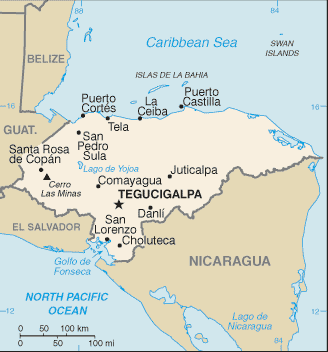
| Click map for larger view |
| Click flag for Country Report |




| TRAFFICKING IN PERSONS |
None reported.
Maria Antonieta Guillen de Bogran
Vice President since 27 January 2010
Vice President since 27 January 2010