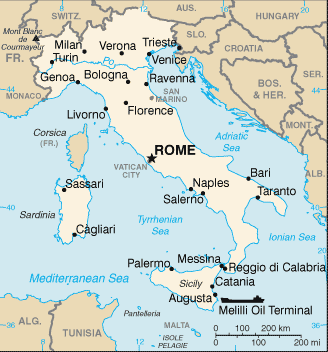
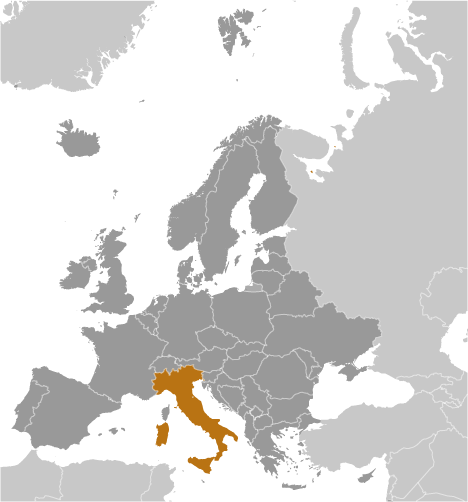
| ITALY Italian Republic Repubblica Italiana Joined United Nations: 14 December 1955 Human Rights as assured by their constitution Click here Updated 23 March 2013 |

| CAPITAL |
| POPULATION |
| CHIEF OF STATE |
| SELECTION PROCESS |
Rome
61,261,254 (July 2012 est.)
Pier Luigi Bersani
Prime Minister
(President of the Council of Ministers)
since 22 March 2013
Prime Minister
(President of the Council of Ministers)
since 22 March 2013
President elected by an electoral college consisting of both houses of
parliament and 58 regional representatives for a seven-year term (no
term limits); election last held 10 May 2006
Next scheduled election: May 2013
parliament and 58 regional representatives for a seven-year term (no
term limits); election last held 10 May 2006
Next scheduled election: May 2013
HEAD OF GOVERNMENT
SELECTION PROCESS
Prime minister appointed by the President and confirmed by
parliament; note - in Italy the prime minister is referred to as the
President of the Council of Ministers; February 24-25 elections
proved to be a political stalemate which were settled by formal
talks to form a new government to start on 22 March 2013
Next scheduled election: April 2018
parliament; note - in Italy the prime minister is referred to as the
President of the Council of Ministers; February 24-25 elections
proved to be a political stalemate which were settled by formal
talks to form a new government to start on 22 March 2013
Next scheduled election: April 2018
| DECLARATION OF HUMAN RIGHTS |
| ETHNIC GROUPS |
Italian (includes small clusters of German-, French-, and Slovene-Italians in the north and Albanian-Italians and Greek-Italians in
the south)
the south)
| RELIGIONS |
Christian 80% (overwhelming Roman Catholic with very small groups of Jehova Witnesses and Protestants), Muslims NEGL
(about 700,000 but growing), Atheists and Agnostics 20%
(about 700,000 but growing), Atheists and Agnostics 20%
| GOVERNMENT STRUCTURE |
Republic with 15 regions (regioni, singular - regione) and 5 autonomous regions* (regioni autonome, singular - regione autonoma);
Legal system is based on civil law system; appeals treated as new trials; judicial review under certain conditions in Constitutional
Court; has not accepted compulsory ICJ jurisdiction
Executive: President elected by an electoral college consisting of both houses of parliament and 58 regional representatives for a
seven-year term (no term limits); election last held 10 May 2006 (next to be held in April 2013); prime minister appointed by the
president and confirmed by parliament
Legislative: Bicameral Parliament or Parlamento consists of the Senate or Senato della Repubblica (315 seats; members elected
by proportional vote with the winning coalition in each region receiving 55% of seats from that region; to serve five-year terms) and
the Chamber of Deputies or Camera dei Deputati (630 seats; members elected by popular vote with the winning national coalition
receiving 54% of chamber seats; to serve five-year terms)
elections: Senate - last held on 24-25 February 2013 (next to be held in April 2018); Chamber of Deputies - last held on 24-25
February 2013 (next to be held in April 2018)
Judicial: Constitutional Court or Corte Costituzionale (composed of 15 judges: one-third appointed by the president, one-third
elected by parliament, one-third elected by the ordinary and administrative Supreme Courts)
Legal system is based on civil law system; appeals treated as new trials; judicial review under certain conditions in Constitutional
Court; has not accepted compulsory ICJ jurisdiction
Executive: President elected by an electoral college consisting of both houses of parliament and 58 regional representatives for a
seven-year term (no term limits); election last held 10 May 2006 (next to be held in April 2013); prime minister appointed by the
president and confirmed by parliament
Legislative: Bicameral Parliament or Parlamento consists of the Senate or Senato della Repubblica (315 seats; members elected
by proportional vote with the winning coalition in each region receiving 55% of seats from that region; to serve five-year terms) and
the Chamber of Deputies or Camera dei Deputati (630 seats; members elected by popular vote with the winning national coalition
receiving 54% of chamber seats; to serve five-year terms)
elections: Senate - last held on 24-25 February 2013 (next to be held in April 2018); Chamber of Deputies - last held on 24-25
February 2013 (next to be held in April 2018)
Judicial: Constitutional Court or Corte Costituzionale (composed of 15 judges: one-third appointed by the president, one-third
elected by parliament, one-third elected by the ordinary and administrative Supreme Courts)
| LANGUAGES |
Italian (official), German (parts of Trentino-Alto Adige region are predominantly German speaking), French (small
French-speaking minority in Valle d'Aosta region), Slovene (Slovene-speaking minority in the Trieste-Gorizia area)
French-speaking minority in Valle d'Aosta region), Slovene (Slovene-speaking minority in the Trieste-Gorizia area)
| BRIEF HISTORY |
The name Italy (Italia) is an ancient name for the country and people of Central Italy. Its origin is clear: the name Italia was imposed
upon the Roman Republic by the conquering Italic tribes of the contemporary Abruzzo region, centering in the area of Corfinium
(Corfinio). Terramare culture takes its name from the black earth (terremare) residue of settlement mounds.. The occupations of the
terramare people as compared with their Neolithic predecessors may be inferred with comparative certainty. They were still
hunters, but had domesticated animals; they were fairly skilful metallurgists. It is thought the Terremare culture may be an early
manifestation of Italic-speaking Indo-Europeans. Villanovan culture brought iron-working to the Italian peninsula; Villanovans
practiced cremation and buried the ashes of their dead in pottery urns of distinctive double-cone shape. Generally speaking,
Villanovan settlements were centered in the Po River valley and Etruria round Bologna, later an important Etruscan center, and
areas in Emilia Romagna (at Verruchio and Fermi), in Tuscany and Lazio. Further south, in Campania, a region where inhumation
was the general practice, Villanovan cremation burials have been identified at Capua, at the "princely tombs" of Pontecagnano near
queer (finds conserved in the Museum of Agro Picentino) and at Sala Consilina. Culture that is identifiably and certainly Etruscan
developed in Italy after about 800 BC approximately over the range of the preceding Iron Age Villanovan culture. The latter gave
way in the 7th century to an increasingly orientalizing culture that was influenced by Greek traders and Greek neighbors in Magna
Graecia, the Hellenic civilization of southern Italy. The Etruscans are generally believed to have spoken a non-Indo-European
language. In the 8th and 7th centuries, driven by unsettled conditions at home, Greek colonies were established in Sicily and the
southern part of the Italian peninsula. During the Early Middle Ages, following the Gothic War that was disastrous for the region,
new waves of Byzantine Christian Greeks came to Magna Graecia from Greece and Asia Minor, as southern Italy remained loosely
governed by the Eastern Roman Empire until the advent first of the Lombards, then of the Normans. In the following centuries,
Rome started expanding its territory, defeating its neighbours (Veium, the other Latins, the Sannites) one after the other. During the
Republic, Italia was not a province, but rather the territory of the city of Rome, thus having a special status. After the death of
emperor Theodosius I (395), Italia became part of the Western Roman Empire. Then came the years of the barbarian invasions,
and the capital was moved from Mediolanum to Ravenna. In 476, with the death of Romulus Augustus and the return of the imperial
ensigns to Constantinople, the Western Roman Empire ends; for a few years Italia stayed united under the rule of Odovacer, but
later it was divided between several kingdoms, and did not reunite under a single ruler until thirteen centuries later. In 476, the last
Roman Emperor was overthrown by the Germanic general Odoacer who ruled Italy until 493, largely maintaining Roman customs
and culture. Odoacer's rule came to an end when the Ostrogoths under the leadership of Theodoric conquered Italy. This led to the
Gothic War during which the armies of Eastern Roman Emperor Justinian won a pyrrhic victory over the Goths in Italy. The Gothic
War destroyed the infrastructure of Italy and allowed the more barbarous Germanic tribe, the Lombards to take control of Italy.
The Lombards established a kingdom in northern Italy and three principalities in the South. After the Lombard invasion, the popes
(for example, St. Gregory) were nominally subject to the eastern emperor, but often received little help from Constantinople, and
had to fill the lack of stately power, providing essential services (such as food for the needy) and protecting Rome from Lombard
incursions; in this way, the popes started building an independent state. Facing a new Lombard offensive, the papacy appealed to
the Franks for aid. In 756 Frankish forces defeated the Lombards and gave the Papacy legal authority over much of central Italy,
thus creating the Papal States. In the twelfth century those Italian cities which lay in the Holy Roman Empire launched a successful
effort to win autonomy from the Holy Roman Empire; this made north Italy a land of quasi-independent or independent city-states
until the 19th century. By 1158 the Byzantine army had left Italy, with only a few permanent gains. By the late Middle Ages, central
and southern Italy, once the heartland of the Roman Empire, was far poorer than the north. Rome was a city largely in ruins, and the
Papal States were a loosely administered region with little law and order. Partly because of this, the Papacy had relocated to
Avignon in France. Naples, Sicily, and Sardinia had for some time been under foreign domination. The Italian trade routes that
covered the Mediterranean and beyond were major conduits of culture and knowledge. The city-states of Italy expanded greatly
during this period and grew in power to become de facto fully independent of the Holy Roman Empire. A series of foreign invasions
of Italy known as the Italian Wars that would continue for several decades. These began with the 1494 invasion by France that
wreaked widespread devastation on Northern Italy and ended the independence of many of the city-states. Most damaging was the
May 6, 1527, Spanish and German troops sacking Rome that all but ended the role of the Papacy as the largest patron of
Renaissance art and architecture. The history of Italy in the Early Modern period was characterized by foreign domination:
Following the Italian Wars (1494 to 1559), Italy saw a long period of relative peace, first under Habsburg Spain (1559 to 1713)
and then under Habsburg Austria (1713 to 1796). During the Napoleonic era, Italy was a client state of the French Republic (1796
to 1814). The Congress of Vienna (1814) restored the situation of the late 18th century, which was however quickly overturned by
the incipient movement of Italian unification. It is difficult to pin down exact dates for the beginning and end of Italian reunification,
but most scholars agree that it began with the end of Napoleonic rule and the Congress of Vienna in 1815, and approximately
ended with the Franco-Prussian War in 1871, though the last "città irredente" did not join the Kingdom of Italy until the Italian
victory in World War I. Italy became a nation-state belatedly — on March 17, 1861, when most of the states of the peninsula were
united under king Victor Emmanuel II of the Savoy dynasty, which ruled over Piedmont. At the beginning of World War I Italy
remained neutral. The Italian government claimed that the Triple Alliance was only for defensive purposes. The Fascist government
of Prime Minister and dictator Benito Mussolini that took over in 1922 led to the alliance with Germany (the Axis) and Japan.
Ultimately the alliance led to defeat in World War II. The Allied Powers invaded Sicily in 1943 and gradually made their way to the
Italian mainland. After the war, on June 2, 1946, a referendum on the monarchy resulted in the establishment of the Italian Republic,
which led to the adoption of a new constitution on January 1, 1948. Italy is a charter member of the North Atlantic Treaty
Organization and the European Union. It joined the growing political and economic unification of Western Europe, including the
introduction of the Euro in 1999. In 2001 the center-right took the government and Berlusconi was able to remain in power for the
complete five year mandate but having to pass through a crisis and a government's reshuffle. In 2006 returned Prodi in the
government with a slim majority. This was short lived as Berlusconi regain control of parliament in April 2008. Berlusconi won the
last snap elections in 2008, with the People of Freedom party (fusion of his previous Forza Italia party and of Fini's Alleanza
Nazionale) against Walter Veltroni of the Democratic Party. In 2010, Berlusconi's party saw the splintering of Gianfranco Fini's new
faction, which formed a parliamentary group and voted against him in a no-confidence vote on 14 December 2010. Berlusconi's
government was able to avoid no-confidence thanks to support from sparse MPs, but has lost a consistent majority in the lower
Chamber. Mario Monti was appointed to replace Silvio Berlusconi upon his resignation on 16 November 2011 amidst criminal
charges and a national economic crisis and resigned on 21 December 2012 but Parliamentary elections on 24 and 25 February
2013 netted no clear leader and a Prime Minister has yet to be named in order to form a government thus Monti has remained on
board as a caretaker government. On March 22, President Giorgio Napolitano selected Pier Luigi Bersani, Secretary of the
Democratic Party (DP), Italy's leading center-left party, to head the government if he can cobble together a governing coalition.
Source: Wikipedia: History of Italy
upon the Roman Republic by the conquering Italic tribes of the contemporary Abruzzo region, centering in the area of Corfinium
(Corfinio). Terramare culture takes its name from the black earth (terremare) residue of settlement mounds.. The occupations of the
terramare people as compared with their Neolithic predecessors may be inferred with comparative certainty. They were still
hunters, but had domesticated animals; they were fairly skilful metallurgists. It is thought the Terremare culture may be an early
manifestation of Italic-speaking Indo-Europeans. Villanovan culture brought iron-working to the Italian peninsula; Villanovans
practiced cremation and buried the ashes of their dead in pottery urns of distinctive double-cone shape. Generally speaking,
Villanovan settlements were centered in the Po River valley and Etruria round Bologna, later an important Etruscan center, and
areas in Emilia Romagna (at Verruchio and Fermi), in Tuscany and Lazio. Further south, in Campania, a region where inhumation
was the general practice, Villanovan cremation burials have been identified at Capua, at the "princely tombs" of Pontecagnano near
queer (finds conserved in the Museum of Agro Picentino) and at Sala Consilina. Culture that is identifiably and certainly Etruscan
developed in Italy after about 800 BC approximately over the range of the preceding Iron Age Villanovan culture. The latter gave
way in the 7th century to an increasingly orientalizing culture that was influenced by Greek traders and Greek neighbors in Magna
Graecia, the Hellenic civilization of southern Italy. The Etruscans are generally believed to have spoken a non-Indo-European
language. In the 8th and 7th centuries, driven by unsettled conditions at home, Greek colonies were established in Sicily and the
southern part of the Italian peninsula. During the Early Middle Ages, following the Gothic War that was disastrous for the region,
new waves of Byzantine Christian Greeks came to Magna Graecia from Greece and Asia Minor, as southern Italy remained loosely
governed by the Eastern Roman Empire until the advent first of the Lombards, then of the Normans. In the following centuries,
Rome started expanding its territory, defeating its neighbours (Veium, the other Latins, the Sannites) one after the other. During the
Republic, Italia was not a province, but rather the territory of the city of Rome, thus having a special status. After the death of
emperor Theodosius I (395), Italia became part of the Western Roman Empire. Then came the years of the barbarian invasions,
and the capital was moved from Mediolanum to Ravenna. In 476, with the death of Romulus Augustus and the return of the imperial
ensigns to Constantinople, the Western Roman Empire ends; for a few years Italia stayed united under the rule of Odovacer, but
later it was divided between several kingdoms, and did not reunite under a single ruler until thirteen centuries later. In 476, the last
Roman Emperor was overthrown by the Germanic general Odoacer who ruled Italy until 493, largely maintaining Roman customs
and culture. Odoacer's rule came to an end when the Ostrogoths under the leadership of Theodoric conquered Italy. This led to the
Gothic War during which the armies of Eastern Roman Emperor Justinian won a pyrrhic victory over the Goths in Italy. The Gothic
War destroyed the infrastructure of Italy and allowed the more barbarous Germanic tribe, the Lombards to take control of Italy.
The Lombards established a kingdom in northern Italy and three principalities in the South. After the Lombard invasion, the popes
(for example, St. Gregory) were nominally subject to the eastern emperor, but often received little help from Constantinople, and
had to fill the lack of stately power, providing essential services (such as food for the needy) and protecting Rome from Lombard
incursions; in this way, the popes started building an independent state. Facing a new Lombard offensive, the papacy appealed to
the Franks for aid. In 756 Frankish forces defeated the Lombards and gave the Papacy legal authority over much of central Italy,
thus creating the Papal States. In the twelfth century those Italian cities which lay in the Holy Roman Empire launched a successful
effort to win autonomy from the Holy Roman Empire; this made north Italy a land of quasi-independent or independent city-states
until the 19th century. By 1158 the Byzantine army had left Italy, with only a few permanent gains. By the late Middle Ages, central
and southern Italy, once the heartland of the Roman Empire, was far poorer than the north. Rome was a city largely in ruins, and the
Papal States were a loosely administered region with little law and order. Partly because of this, the Papacy had relocated to
Avignon in France. Naples, Sicily, and Sardinia had for some time been under foreign domination. The Italian trade routes that
covered the Mediterranean and beyond were major conduits of culture and knowledge. The city-states of Italy expanded greatly
during this period and grew in power to become de facto fully independent of the Holy Roman Empire. A series of foreign invasions
of Italy known as the Italian Wars that would continue for several decades. These began with the 1494 invasion by France that
wreaked widespread devastation on Northern Italy and ended the independence of many of the city-states. Most damaging was the
May 6, 1527, Spanish and German troops sacking Rome that all but ended the role of the Papacy as the largest patron of
Renaissance art and architecture. The history of Italy in the Early Modern period was characterized by foreign domination:
Following the Italian Wars (1494 to 1559), Italy saw a long period of relative peace, first under Habsburg Spain (1559 to 1713)
and then under Habsburg Austria (1713 to 1796). During the Napoleonic era, Italy was a client state of the French Republic (1796
to 1814). The Congress of Vienna (1814) restored the situation of the late 18th century, which was however quickly overturned by
the incipient movement of Italian unification. It is difficult to pin down exact dates for the beginning and end of Italian reunification,
but most scholars agree that it began with the end of Napoleonic rule and the Congress of Vienna in 1815, and approximately
ended with the Franco-Prussian War in 1871, though the last "città irredente" did not join the Kingdom of Italy until the Italian
victory in World War I. Italy became a nation-state belatedly — on March 17, 1861, when most of the states of the peninsula were
united under king Victor Emmanuel II of the Savoy dynasty, which ruled over Piedmont. At the beginning of World War I Italy
remained neutral. The Italian government claimed that the Triple Alliance was only for defensive purposes. The Fascist government
of Prime Minister and dictator Benito Mussolini that took over in 1922 led to the alliance with Germany (the Axis) and Japan.
Ultimately the alliance led to defeat in World War II. The Allied Powers invaded Sicily in 1943 and gradually made their way to the
Italian mainland. After the war, on June 2, 1946, a referendum on the monarchy resulted in the establishment of the Italian Republic,
which led to the adoption of a new constitution on January 1, 1948. Italy is a charter member of the North Atlantic Treaty
Organization and the European Union. It joined the growing political and economic unification of Western Europe, including the
introduction of the Euro in 1999. In 2001 the center-right took the government and Berlusconi was able to remain in power for the
complete five year mandate but having to pass through a crisis and a government's reshuffle. In 2006 returned Prodi in the
government with a slim majority. This was short lived as Berlusconi regain control of parliament in April 2008. Berlusconi won the
last snap elections in 2008, with the People of Freedom party (fusion of his previous Forza Italia party and of Fini's Alleanza
Nazionale) against Walter Veltroni of the Democratic Party. In 2010, Berlusconi's party saw the splintering of Gianfranco Fini's new
faction, which formed a parliamentary group and voted against him in a no-confidence vote on 14 December 2010. Berlusconi's
government was able to avoid no-confidence thanks to support from sparse MPs, but has lost a consistent majority in the lower
Chamber. Mario Monti was appointed to replace Silvio Berlusconi upon his resignation on 16 November 2011 amidst criminal
charges and a national economic crisis and resigned on 21 December 2012 but Parliamentary elections on 24 and 25 February
2013 netted no clear leader and a Prime Minister has yet to be named in order to form a government thus Monti has remained on
board as a caretaker government. On March 22, President Giorgio Napolitano selected Pier Luigi Bersani, Secretary of the
Democratic Party (DP), Italy's leading center-left party, to head the government if he can cobble together a governing coalition.
Source: Wikipedia: History of Italy
| ECONOMIC OVERVIEW |
Italy has a diversified industrial economy, which is divided into a developed industrial north, dominated by private companies, and a
less-developed, highly subsidized, agricultural south, with high unemployment. The Italian economy is driven in large part by the
manufacture of high-quality consumer goods produced by small and medium-sized enterprises, many of them family owned. Italy
also has a sizable underground economy, which by some estimates accounts for as much as 17% of GDP. These activities are most
common within the agriculture, construction, and service sectors. Italy is the third-largest economy in the euro-zone, but its
exceptionally high public debt and structural impediments to growth have rendered it vulnerable to scrutiny by financial markets.
Public debt has increased steadily since 2007, topping 126% of GDP in 2012, and investor concerns about the broader euro-zone
crisis at times have caused borrowing costs on sovereign government debt to rise to euro-era records. During the second half of
2011 the government passed a series of three austerity packages to balance its budget and decrease its public debt. These
measures included a hike in the value-added tax, pension reforms, and cuts to public administration. The government also faces
pressure from investors and European partners to sustain its recent efforts to address Italy's long-standing structural impediments to
growth, such as an inflexible labor market and widespread tax evasion. In 2012 economic growth and labor market conditions
deteriorated, with growth at -2.3% and unemployment rising to nearly 11%. Although the government has undertaken several
economic reform iniatiatives, in the longer-term Italy's low fertility rate, productivity, and foreign investment will increasingly strain its
economy. Italy's GDP is now 7% below its 2007 pre-crisis level.
Source: CIA World Factbook (select Italy)
less-developed, highly subsidized, agricultural south, with high unemployment. The Italian economy is driven in large part by the
manufacture of high-quality consumer goods produced by small and medium-sized enterprises, many of them family owned. Italy
also has a sizable underground economy, which by some estimates accounts for as much as 17% of GDP. These activities are most
common within the agriculture, construction, and service sectors. Italy is the third-largest economy in the euro-zone, but its
exceptionally high public debt and structural impediments to growth have rendered it vulnerable to scrutiny by financial markets.
Public debt has increased steadily since 2007, topping 126% of GDP in 2012, and investor concerns about the broader euro-zone
crisis at times have caused borrowing costs on sovereign government debt to rise to euro-era records. During the second half of
2011 the government passed a series of three austerity packages to balance its budget and decrease its public debt. These
measures included a hike in the value-added tax, pension reforms, and cuts to public administration. The government also faces
pressure from investors and European partners to sustain its recent efforts to address Italy's long-standing structural impediments to
growth, such as an inflexible labor market and widespread tax evasion. In 2012 economic growth and labor market conditions
deteriorated, with growth at -2.3% and unemployment rising to nearly 11%. Although the government has undertaken several
economic reform iniatiatives, in the longer-term Italy's low fertility rate, productivity, and foreign investment will increasingly strain its
economy. Italy's GDP is now 7% below its 2007 pre-crisis level.
Source: CIA World Factbook (select Italy)
| POLITICAL CLIMATE |
From 1992 to 1997, Italy faced significant challenges, as voters, disenchanted with past political paralysis, massive government
debt, extensive corruption, and organized crime's considerable influence--collectively called Tangentopoli after being uncovered by
Mani pulite)--demanded political, economic, and ethical reforms. The 1994 elections also swept media magnate Silvio Berlusconi
(leader of "House of Freedoms" coalition) into office as Prime Minister. Berlusconi, however, was forced to step down in
December 1994 when the Lega Nord withdrew support. The Berlusconi government was succeeded by a technical government
headed by Prime Minister Lamberto Dini, which left office in early 1996.
National elections held on May 13, 2001 returned Berlusconi to power at the head of the five-party center-right "Freedom House"
coalition, comprising the prime minister's own party, Forza Italia, the National Alliance, the Northern League, the Christian
Democratic Center, and the Democrats' Center Union. Between May 17, 2006 and Feb 21 2007, Romano Prodi served as Prime
Minister of Italy following the narrow victory of his l'Unione coalition over the Casa delle Libertà led by Silvio Berlusconi in the
April 2006 Italian elections. Following a government crisis, Prodi submitted his resignation on February 21, 2007. Three days later
he was asked by the Italian President, Giorgio Napolitano to stay on as Prime Minister and he agreed to do so. On 28 February
2007, Prodi narrowly survived a senate no confidence vote but was replaced by Berlusconi in April 2008. In 2010, Berlusconi's
party saw the splintering of Gianfranco Fini's new faction, which formed a parliamentary group and voted against him in a no-
confidence vote on 14 December 2010. Berlusconi's government was able to avoid no-confidence thanks to support from sparse
MPs, but has lost a consistent majority in the lower Chamber. Mario Monti was appointed to replace Silvio Berlusconi upon his
resignation on 16 November 2011 amidst criminal charges and a national economic crisis and resigned on 21 December 2012 but
Parliamentary elections on 24 and 25 February 2013 netted no clear leader and a Prime Minister has yet to be named in order to
form a government thus Monti has remained on board as a caretaker government. On March 22, President Giorgio Napolitano
selected Pier Luigi Bersani, Secretary of the Democratic Party (DP), Italy's leading center-left party, to head the government if he
can cobble together a governing coalition.
In general there is wide consensus on the fact that Italian politics has been undergoing a slow involution over at least the last decade.
This has been sometimes cited, even by some Italian politicians, as a cause of the general feeling of lack of representation Italians
recently seem to suffer from. Corruption is still widespread and the Italian administration is often perceived as inefficient and
expensive, with even technical positions assigned for political reasons (at best). As a matter of fact an enormous amount of
unjustified privileges are presently connected to political and administrative positions, regardless of skill, integrity and efficiency of
the holder.
Source: Wikipedia: Politics of Italy
debt, extensive corruption, and organized crime's considerable influence--collectively called Tangentopoli after being uncovered by
Mani pulite)--demanded political, economic, and ethical reforms. The 1994 elections also swept media magnate Silvio Berlusconi
(leader of "House of Freedoms" coalition) into office as Prime Minister. Berlusconi, however, was forced to step down in
December 1994 when the Lega Nord withdrew support. The Berlusconi government was succeeded by a technical government
headed by Prime Minister Lamberto Dini, which left office in early 1996.
National elections held on May 13, 2001 returned Berlusconi to power at the head of the five-party center-right "Freedom House"
coalition, comprising the prime minister's own party, Forza Italia, the National Alliance, the Northern League, the Christian
Democratic Center, and the Democrats' Center Union. Between May 17, 2006 and Feb 21 2007, Romano Prodi served as Prime
Minister of Italy following the narrow victory of his l'Unione coalition over the Casa delle Libertà led by Silvio Berlusconi in the
April 2006 Italian elections. Following a government crisis, Prodi submitted his resignation on February 21, 2007. Three days later
he was asked by the Italian President, Giorgio Napolitano to stay on as Prime Minister and he agreed to do so. On 28 February
2007, Prodi narrowly survived a senate no confidence vote but was replaced by Berlusconi in April 2008. In 2010, Berlusconi's
party saw the splintering of Gianfranco Fini's new faction, which formed a parliamentary group and voted against him in a no-
confidence vote on 14 December 2010. Berlusconi's government was able to avoid no-confidence thanks to support from sparse
MPs, but has lost a consistent majority in the lower Chamber. Mario Monti was appointed to replace Silvio Berlusconi upon his
resignation on 16 November 2011 amidst criminal charges and a national economic crisis and resigned on 21 December 2012 but
Parliamentary elections on 24 and 25 February 2013 netted no clear leader and a Prime Minister has yet to be named in order to
form a government thus Monti has remained on board as a caretaker government. On March 22, President Giorgio Napolitano
selected Pier Luigi Bersani, Secretary of the Democratic Party (DP), Italy's leading center-left party, to head the government if he
can cobble together a governing coalition.
In general there is wide consensus on the fact that Italian politics has been undergoing a slow involution over at least the last decade.
This has been sometimes cited, even by some Italian politicians, as a cause of the general feeling of lack of representation Italians
recently seem to suffer from. Corruption is still widespread and the Italian administration is often perceived as inefficient and
expensive, with even technical positions assigned for political reasons (at best). As a matter of fact an enormous amount of
unjustified privileges are presently connected to political and administrative positions, regardless of skill, integrity and efficiency of
the holder.
Source: Wikipedia: Politics of Italy
| INTERNATIONAL DISPUTES |
Italy's long coastline and developed economy entices tens of thousands of illegal immigrants from southeastern Europe and northern
Africa
Africa


| REFUGEES AND INTERNALLY DISPLACED PERSONS (IDPS) |
None reported.
| ILLICIT DRUGS |
Important gateway for and consumer of Latin American cocaine and Southwest Asian heroin entering the European market;
money laundering by organized crime and from smuggling
money laundering by organized crime and from smuggling
| HUMAN RIGHTS STATEMENTS, ANALYSIS AND CRITIQUES |
2011 Human Rights Report: Italy
Bureau of Democracy, Human Rights, and Labor
2011 Country Reports on Human Rights Practices
May 25, 2012
Italy is a multiparty parliamentary democracy with a bicameral parliament consisting of the Chamber of Deputies and the Senate. The
constitution vests executive authority in the Council of Ministers, headed by the prime minister, who is the president of the council. The
president, who is the head of state, nominates the prime minister after consulting with the leaders of all political forces in the parliament.
International observers considered the 2008 national parliamentary elections free and fair. Security forces reported to civilian authorities.
Principal human rights problems included the continued incarceration of pretrial detainees with convicted criminals; substandard living
conditions in overcrowded prisons and detention centers for undocumented migrants; and societal prejudice and some municipal
mistreatment of Roma, which exacerbated their social exclusion and restricted their access to education, health care, employment, and
other social services.
Other human rights problems included an inefficient judicial system that did not always provide speedy access to justice, government
corruption, harassment and violence against women, sexual exploitation of children, and anti-Semitic vandalism. Trafficking for sexual
and labor exploitation occurred, but the government prosecuted traffickers and assisted victims. A few cases of violence against gay
men and lesbians and labor discrimination based on sexual orientation were also reported.
The government prosecuted and punished officials who committed crimes and abuses.
Click here to read more »
Bureau of Democracy, Human Rights, and Labor
2011 Country Reports on Human Rights Practices
May 25, 2012
Italy is a multiparty parliamentary democracy with a bicameral parliament consisting of the Chamber of Deputies and the Senate. The
constitution vests executive authority in the Council of Ministers, headed by the prime minister, who is the president of the council. The
president, who is the head of state, nominates the prime minister after consulting with the leaders of all political forces in the parliament.
International observers considered the 2008 national parliamentary elections free and fair. Security forces reported to civilian authorities.
Principal human rights problems included the continued incarceration of pretrial detainees with convicted criminals; substandard living
conditions in overcrowded prisons and detention centers for undocumented migrants; and societal prejudice and some municipal
mistreatment of Roma, which exacerbated their social exclusion and restricted their access to education, health care, employment, and
other social services.
Other human rights problems included an inefficient judicial system that did not always provide speedy access to justice, government
corruption, harassment and violence against women, sexual exploitation of children, and anti-Semitic vandalism. Trafficking for sexual
and labor exploitation occurred, but the government prosecuted traffickers and assisted victims. A few cases of violence against gay
men and lesbians and labor discrimination based on sexual orientation were also reported.
The government prosecuted and punished officials who committed crimes and abuses.
Click here to read more »
9 March 2012
Committee on the Elimination of Racial Discrimination Eightieth session
13 February–9 March 2012
Consideration of reports submitted by States parties under article 9 of the convention
Concluding observations of the Committee on the Elimination of Racial Discrimination
Italy*
A. Introduction
2. The Committee welcomes the report and commends the regularity with which the State party has interacted with the Committee. It
expresses appreciation for the dialogue held with the large delegation of the State party and thanks it for the information provided orally
to complement the report. The Committee welcomes the positive and constructive dialogue with the delegation of the State party as well
as its efforts to answer to the questions put by Committee members.
B. Positive aspects
3.The Committee notes with interest the upcoming revision of Law No. 482/1999 to allow the recognition of Roma, Sinti and Camminanti
communities as minorities.
4. The Committee also notes the strengthening of the National Office against Racial Discrimination (UNAR) and the relevant activities
undertaken by UNAR during the period under review.
5. The Committee welcomes the legislative measures reversing the burden of proof on the defendant for civil cases of racial
discrimination.
C. Concerns and recommendations
11. The Committee takes note of the statistical data provided on foreigners and on UNAR’s activities but regrets the absence in the
report of data on the ethnic composition of the population. It is also extremely concerned by the census which took place further to the
state of emergency imposed in May 2008 and the “Nomad Emergency Decree” (NED) regarding the settlements of nomad communities
in Italy. It is concerned by the information that this census, in the course of which fingerprints and photographs of camps’ residents
Roma and Sinti including children have been collected.
The Committee notes the declaration made by the State party that data has since been destroyed. The Committee invites the State party
to compile disaggregated data on the ethnic composition of its population. In view of its general recommendation No. 8 (1990) on
identification with a particular racial or ethnic group, the Committee wishes to recall that the ways in which individuals are identified as
members of racial or ethnic groups should be established on a voluntary and anonymous basis, and on the basis of self- identification by
the individuals concerned. The Committee also recommends that the State party refrain from conducting emergency censuses targeted at
minority groups.
Click here to read more »
Committee on the Elimination of Racial Discrimination Eightieth session
13 February–9 March 2012
Consideration of reports submitted by States parties under article 9 of the convention
Concluding observations of the Committee on the Elimination of Racial Discrimination
Italy*
A. Introduction
2. The Committee welcomes the report and commends the regularity with which the State party has interacted with the Committee. It
expresses appreciation for the dialogue held with the large delegation of the State party and thanks it for the information provided orally
to complement the report. The Committee welcomes the positive and constructive dialogue with the delegation of the State party as well
as its efforts to answer to the questions put by Committee members.
B. Positive aspects
3.The Committee notes with interest the upcoming revision of Law No. 482/1999 to allow the recognition of Roma, Sinti and Camminanti
communities as minorities.
4. The Committee also notes the strengthening of the National Office against Racial Discrimination (UNAR) and the relevant activities
undertaken by UNAR during the period under review.
5. The Committee welcomes the legislative measures reversing the burden of proof on the defendant for civil cases of racial
discrimination.
C. Concerns and recommendations
11. The Committee takes note of the statistical data provided on foreigners and on UNAR’s activities but regrets the absence in the
report of data on the ethnic composition of the population. It is also extremely concerned by the census which took place further to the
state of emergency imposed in May 2008 and the “Nomad Emergency Decree” (NED) regarding the settlements of nomad communities
in Italy. It is concerned by the information that this census, in the course of which fingerprints and photographs of camps’ residents
Roma and Sinti including children have been collected.
The Committee notes the declaration made by the State party that data has since been destroyed. The Committee invites the State party
to compile disaggregated data on the ethnic composition of its population. In view of its general recommendation No. 8 (1990) on
identification with a particular racial or ethnic group, the Committee wishes to recall that the ways in which individuals are identified as
members of racial or ethnic groups should be established on a voluntary and anonymous basis, and on the basis of self- identification by
the individuals concerned. The Committee also recommends that the State party refrain from conducting emergency censuses targeted at
minority groups.
Click here to read more »
Freedom In The World Report 2012
Political Rights: 1
Civil Rights: 1
Status: Free
A technocratic government led by Mario Monti, a former member of the European Commission, took power in November 2011 after the
country’s economic woes forced Prime Minister Silvio Berlusconi to step down. Opposition to unpopular austerity measures had led to
massive protests that turned violent the previous month.
In the month preceding the March 2010 regional elections, which resulted in key losses for the center-left opposition, the state-owned
RAI television network suspended political discussion on its three channels, ostensibly due to the difficulty of ensuring “equality of
treatment” for all parties. Critics viewed the move as an attempt by Berlusconi’s government to limit potentially critical commentary.
The country’s major trade unions called a national strike in June 2010 to protest fiscal austerity measures taken by the government in
response to a global economic downturn that began in late 2008. In 2011, Italy’s growing public debt, at 120 percent of gross domestic
product, fueled international concerns about the sustainability of the country’s finances. A crucial austerity package was passed by both
houses of Parliament in November, allowing the sale of state assets and hikes in the value-added tax, the retirement age, and fuel prices.
The increasingly unpopular Berlusconi had pledged to resign once the legislation was approved, and he duly made way for a technocratic
government led by the respected economist Mario Monti, a former member of the European Commission. The new government ushered
yet another austerity package through Parliament in December.
In the months leading up to his resignation, Berlusconi had faced a series of personal legal difficulties that damaged his political standing
and apparently influenced legislative priorities. In February, women across Italy held demonstrations to protest the prime minister’s
multiple sex scandals, including one in which he allegedly paid an underage girl for sex. In March, Berlusconi appeared in court for the
first time since 2003 to face charges of corruption. The lower house approved a bill in April that would cut short the length of some
trials and potentially end a bribery case against Berlusconi, though it had yet to pass the Senate at year’s end. The prime minister was
cleared in a fraud and embezzlement case in October. Also that month, the lower house resumed discussion of a bill passed by the
Senate in June 2010 that would limit the use of wiretaps and force news websites to publish corrections automatically. The bill, which
was seen primarily as an effort to keep embarrassing information about politicians out of the news, was opposed by all of the major
newspapers in Italy.
Click here to read more »
Political Rights: 1
Civil Rights: 1
Status: Free
A technocratic government led by Mario Monti, a former member of the European Commission, took power in November 2011 after the
country’s economic woes forced Prime Minister Silvio Berlusconi to step down. Opposition to unpopular austerity measures had led to
massive protests that turned violent the previous month.
In the month preceding the March 2010 regional elections, which resulted in key losses for the center-left opposition, the state-owned
RAI television network suspended political discussion on its three channels, ostensibly due to the difficulty of ensuring “equality of
treatment” for all parties. Critics viewed the move as an attempt by Berlusconi’s government to limit potentially critical commentary.
The country’s major trade unions called a national strike in June 2010 to protest fiscal austerity measures taken by the government in
response to a global economic downturn that began in late 2008. In 2011, Italy’s growing public debt, at 120 percent of gross domestic
product, fueled international concerns about the sustainability of the country’s finances. A crucial austerity package was passed by both
houses of Parliament in November, allowing the sale of state assets and hikes in the value-added tax, the retirement age, and fuel prices.
The increasingly unpopular Berlusconi had pledged to resign once the legislation was approved, and he duly made way for a technocratic
government led by the respected economist Mario Monti, a former member of the European Commission. The new government ushered
yet another austerity package through Parliament in December.
In the months leading up to his resignation, Berlusconi had faced a series of personal legal difficulties that damaged his political standing
and apparently influenced legislative priorities. In February, women across Italy held demonstrations to protest the prime minister’s
multiple sex scandals, including one in which he allegedly paid an underage girl for sex. In March, Berlusconi appeared in court for the
first time since 2003 to face charges of corruption. The lower house approved a bill in April that would cut short the length of some
trials and potentially end a bribery case against Berlusconi, though it had yet to pass the Senate at year’s end. The prime minister was
cleared in a fraud and embezzlement case in October. Also that month, the lower house resumed discussion of a bill passed by the
Senate in June 2010 that would limit the use of wiretaps and force news websites to publish corrections automatically. The bill, which
was seen primarily as an effort to keep embarrassing information about politicians out of the news, was opposed by all of the major
newspapers in Italy.
Click here to read more »
Italy: Municipality of Rome denies social housing to Roma living in formal camps
Rome, 27 February 2013
Romani families living in formal camps in Rome will not be able to gain access to social housing, according to new guidance from the
local authorities. Scores of families had already filed their applications and many more were about to do so, when news of the
discriminatory new guidance emerged.
Rights groups Amnesty International, Associazione 21 Luglio, the European Roma Rights Centre (ERRC) and the Open Society
Foundations (OSF) sent a letter today to the local authorities in Rome. The letter highlights that the recently adopted policies on housing,
which prevent Romani families from escaping segregated formal camps in the city, breach international and EU legislation and represent
a new low in discrimination against Roma in the country. The groups are also calling on the new national government to act immediately
to end this discrimination. Social housing in Rome is allocated with a points-based system. In recent weeks, Romani families who live in
formal camps in Rome have been told by Rome’s authorities they cannot receive the points they need to give them a concrete chance to
access to social housing, as they are already living in ‘permanent structures’.
Roma living in formal camps are segregated from the rest of the city, often far from basic services. The distance from the centre makes
it difficult to get to school or find work. Almost all camps are fenced in and monitored by cameras and guards. Segregated camps,
which offer no chance of integration or social inclusion, are the most noticeable results of Rome's "Nomad Plan". The authorities of
Rome have continued with this widely discredited approach, despite the fact that Italy’s ‘nomad emergency’ was declared unlawful by
the Council of State, Italy’s highest administrative court, in November 2011.
Roma living in camps were previously excluded from access to social housing in Rome, because of the requirements for applying and
criteria for allocation of housing units. The criterion which has until recently triggered the assignation of social housing in Rome was
lawful eviction from private accommodation – a situation which does not apply under current legislation to Romani families living in
camps. This situation seemed to change when, on 31 December 2012, a new Public Notice was published by the municipality of Rome,
saying that the maximum score (category A1) would be granted to those in "greatly disadvantaged housing conditions", including families
living "in centres, public dormitories or any other appropriate structures temporarily provided by entities, institutions and recognised and
authorised charitable organisations dedicated to public assistance".
This move was welcomed by Romani families living in formal camps and NGOs working to end discrimination against Roma in Italy.
The housing and living conditions of Romani families residing in formal camps seemed to match precisely those described in Category
A1 of the public notice. However, the city authorities swiftly moved to prevent Roma from being able to take up their rights to social
housing.
Click here to read more »
Rome, 27 February 2013
Romani families living in formal camps in Rome will not be able to gain access to social housing, according to new guidance from the
local authorities. Scores of families had already filed their applications and many more were about to do so, when news of the
discriminatory new guidance emerged.
Rights groups Amnesty International, Associazione 21 Luglio, the European Roma Rights Centre (ERRC) and the Open Society
Foundations (OSF) sent a letter today to the local authorities in Rome. The letter highlights that the recently adopted policies on housing,
which prevent Romani families from escaping segregated formal camps in the city, breach international and EU legislation and represent
a new low in discrimination against Roma in the country. The groups are also calling on the new national government to act immediately
to end this discrimination. Social housing in Rome is allocated with a points-based system. In recent weeks, Romani families who live in
formal camps in Rome have been told by Rome’s authorities they cannot receive the points they need to give them a concrete chance to
access to social housing, as they are already living in ‘permanent structures’.
Roma living in formal camps are segregated from the rest of the city, often far from basic services. The distance from the centre makes
it difficult to get to school or find work. Almost all camps are fenced in and monitored by cameras and guards. Segregated camps,
which offer no chance of integration or social inclusion, are the most noticeable results of Rome's "Nomad Plan". The authorities of
Rome have continued with this widely discredited approach, despite the fact that Italy’s ‘nomad emergency’ was declared unlawful by
the Council of State, Italy’s highest administrative court, in November 2011.
Roma living in camps were previously excluded from access to social housing in Rome, because of the requirements for applying and
criteria for allocation of housing units. The criterion which has until recently triggered the assignation of social housing in Rome was
lawful eviction from private accommodation – a situation which does not apply under current legislation to Romani families living in
camps. This situation seemed to change when, on 31 December 2012, a new Public Notice was published by the municipality of Rome,
saying that the maximum score (category A1) would be granted to those in "greatly disadvantaged housing conditions", including families
living "in centres, public dormitories or any other appropriate structures temporarily provided by entities, institutions and recognised and
authorised charitable organisations dedicated to public assistance".
This move was welcomed by Romani families living in formal camps and NGOs working to end discrimination against Roma in Italy.
The housing and living conditions of Romani families residing in formal camps seemed to match precisely those described in Category
A1 of the public notice. However, the city authorities swiftly moved to prevent Roma from being able to take up their rights to social
housing.
Click here to read more »
Italy turns its back on children seeking refuge
January 27, 2013
Every year, hundreds of boys travel alone, at great risk, from Afghanistan to Italy. They‘re looking for refuge, for an education, for an
opportunity to escape the war zone in their country. And yet Italy turns away many of them, barring their entrance and taking no steps
for their protection or care.
I met one such boy, “Ahmed S.,” last summer, as we did research on the topic. Ahmed said he fled his home in Afghanistan in 2011,
fearing for his life. Only 17 years old, he traveled alone to Greece, where he made his way to the port city of Patras. Ahmed managed to
hide underneath a truck that boarded a boat headed for an Italian port. He lay wedged on top of a box between axles for 18 hours while
the boat crossed the Adriatic Sea. On arrival, Ahmed was met by Italian police, who promptly detained him.
“I told them the whole story [of what happened in Afghanistan], showed the scar,” he said, saying that men associated with the Taliban
had attacked him near his home. Ahmed wanted to apply for asylum, but he never had a chance to speak with a lawyer or meet a
representative of nongovernmental groups that are supposed to help boys like him in Italy. No one told him his rights. Instead, just four
hours after his arrival, Italian port officials sent him back to Greece on the same ship he had come on. This time, he traveled in a cell in
the ship’s machine room, with only bread and butter to eat and no access to a bathroom.
Instead of offering protection to children who make these treacherous journeys, Italy is sending them back to face horrible risks. In
Greece, migrant children face destitution, law enforcement abuse, and appalling detention conditions. The situation is so bad that the
European Court of Human Rights ruled that Greece is not a safe country of asylum. Greece’s dysfunctional asylum system leaves
children, like all asylum seekers, without a fair chance to receive protection.
Without asylum in Greece, they may be deported back to Afghanistan, where they face risks of recruitment to become child soldiers,
violence, and lack of access to basic needs including shelter and food. And if children try to leave Greece again to reach Italy—as the
majority will do—they will face once more the risk of police abuse in Greek ports and the risks of the journey itself, including loss of
limbs or death, while hanging underneath a commercial truck or hiding inside refrigerated containers or fuel tanks.
You would think Italy would help children at risk—yet none of the boys we interviewed for the report were given adequate assistance
upon arrival in Italy. Ali M., for example, said: “I hadn’t eaten in two days. As soon as the truck arrived in Italy, I was very hungry so I
got out and I took only a few steps and the police caught me.…They asked me, I said I was 15. They talked to the Greek authorities and
put me on a boat back to [the Greek port city of] Igoumenitsa.” None of the boys we talked to were allowed into Italy; all were turned
around within hours.
Italy has agreed to standards that require unaccompanied migrant children like Ahmed and Ali be granted access to Italy to determine
what next steps are in their best interests.
Click here to read more »
January 27, 2013
Every year, hundreds of boys travel alone, at great risk, from Afghanistan to Italy. They‘re looking for refuge, for an education, for an
opportunity to escape the war zone in their country. And yet Italy turns away many of them, barring their entrance and taking no steps
for their protection or care.
I met one such boy, “Ahmed S.,” last summer, as we did research on the topic. Ahmed said he fled his home in Afghanistan in 2011,
fearing for his life. Only 17 years old, he traveled alone to Greece, where he made his way to the port city of Patras. Ahmed managed to
hide underneath a truck that boarded a boat headed for an Italian port. He lay wedged on top of a box between axles for 18 hours while
the boat crossed the Adriatic Sea. On arrival, Ahmed was met by Italian police, who promptly detained him.
“I told them the whole story [of what happened in Afghanistan], showed the scar,” he said, saying that men associated with the Taliban
had attacked him near his home. Ahmed wanted to apply for asylum, but he never had a chance to speak with a lawyer or meet a
representative of nongovernmental groups that are supposed to help boys like him in Italy. No one told him his rights. Instead, just four
hours after his arrival, Italian port officials sent him back to Greece on the same ship he had come on. This time, he traveled in a cell in
the ship’s machine room, with only bread and butter to eat and no access to a bathroom.
Instead of offering protection to children who make these treacherous journeys, Italy is sending them back to face horrible risks. In
Greece, migrant children face destitution, law enforcement abuse, and appalling detention conditions. The situation is so bad that the
European Court of Human Rights ruled that Greece is not a safe country of asylum. Greece’s dysfunctional asylum system leaves
children, like all asylum seekers, without a fair chance to receive protection.
Without asylum in Greece, they may be deported back to Afghanistan, where they face risks of recruitment to become child soldiers,
violence, and lack of access to basic needs including shelter and food. And if children try to leave Greece again to reach Italy—as the
majority will do—they will face once more the risk of police abuse in Greek ports and the risks of the journey itself, including loss of
limbs or death, while hanging underneath a commercial truck or hiding inside refrigerated containers or fuel tanks.
You would think Italy would help children at risk—yet none of the boys we interviewed for the report were given adequate assistance
upon arrival in Italy. Ali M., for example, said: “I hadn’t eaten in two days. As soon as the truck arrived in Italy, I was very hungry so I
got out and I took only a few steps and the police caught me.…They asked me, I said I was 15. They talked to the Greek authorities and
put me on a boat back to [the Greek port city of] Igoumenitsa.” None of the boys we talked to were allowed into Italy; all were turned
around within hours.
Italy has agreed to standards that require unaccompanied migrant children like Ahmed and Ali be granted access to Italy to determine
what next steps are in their best interests.
Click here to read more »
CONSCIENTIOUS OBJECTION AND BIOETHICS
Published on the 30th of July 2012
Presentation
The NBC has perceived the need to address in general the issue of conscientious objection in bioethics, as previously called for on
several occasions with regard to specific questions, and it has set up a working group coordinated by Prof. Andrea
Nicolussi, and composed of the following members, Profs. Salvatore Amato, Luisella Battaglia, Adriano Bompiani, Stefano Canestrari,
Roberto Colombo, Francesco D'Agostino, Antonio Da Re, Lorenzo d'Avack, Emma Fattorini, Carlo Flamigni, Silvio Garattini, Marianna
Gensabella, Assuntina Morresi, Demetrio Neri, Laura Palazzani, Vittorio Possenti, Giancarlo Umani Ronchi and Monica Toraldo di
Francia.
The document examines the moral aspects of conscientious objection and focuses on the legal side, to which the objector ultimately
turns to when requesting to be allowed not to fulfill legal commands contrary to his conscience. The new frontiers of bioethics
increasingly offer a new challenge to the democratic constitutional and pluralistic State. On the one hand, this is to avoid imposing
obligations contrary to conscience and the instrumental use of those who exercise a profession. It is often overlooked that the
recognition of rights implies a projection of requirements and therefore the claim to behaviours that may even not be compatible with
professional deontology. What emerges is, a larger problem of the protection of professional autonomy both from the viewpoint of
freedom of the community of professionals to personally reflect and to determine the specific purposes of the profession exercised, as
well as from the viewpoint of the freedom of the professional individual in relation to a possible legal hetero-determination regarding
the aims of their work. The exercise of a profession involves not only technical discretion, but also deontology .
Moreover, the consciousness of the individual is not confined to the deontological dimension; it concerns the individual as a person not
just a professional. The right to conscientious objection (CO) presents itself, therefore, in the first place as a right of the person which a
State that is constitutionalised and sensitive to freedom of conscience can not but legally safeguard. But it is precisely because it is legally
protected that this right should be integrated into the legal system, as is the case with all rights, and also because the powerto evade a
legal command must be justified and not mortify the principles of legality and legal certainty indispensable to the experience of law. First
of all conscientious objection can not be limited to an arbitrary refusal to obey, but- with the exception of individual reasons- it must also
have an intersubjective significance which in bioethics can be perceived in reference to inviolable human rights recognised at the basis of
constitutionalised right. In this perspective, CO not only protects the freedom of the individual conscience, but it is a democratic
institution, because it prevents, in the case of highly controversial matters inherent to fundamental values, a majority of them from
"requisitioning" even the problematicity and rejection of doubt. However, the recognition of CO does not imply a kind of power
to boycott the law, whose validity must be guaranteed as well is that of the exercise of rights provided for therein. It is in this perspective
that legally tenable CO is configured.
Click here to read more »
Published on the 30th of July 2012
Presentation
The NBC has perceived the need to address in general the issue of conscientious objection in bioethics, as previously called for on
several occasions with regard to specific questions, and it has set up a working group coordinated by Prof. Andrea
Nicolussi, and composed of the following members, Profs. Salvatore Amato, Luisella Battaglia, Adriano Bompiani, Stefano Canestrari,
Roberto Colombo, Francesco D'Agostino, Antonio Da Re, Lorenzo d'Avack, Emma Fattorini, Carlo Flamigni, Silvio Garattini, Marianna
Gensabella, Assuntina Morresi, Demetrio Neri, Laura Palazzani, Vittorio Possenti, Giancarlo Umani Ronchi and Monica Toraldo di
Francia.
The document examines the moral aspects of conscientious objection and focuses on the legal side, to which the objector ultimately
turns to when requesting to be allowed not to fulfill legal commands contrary to his conscience. The new frontiers of bioethics
increasingly offer a new challenge to the democratic constitutional and pluralistic State. On the one hand, this is to avoid imposing
obligations contrary to conscience and the instrumental use of those who exercise a profession. It is often overlooked that the
recognition of rights implies a projection of requirements and therefore the claim to behaviours that may even not be compatible with
professional deontology. What emerges is, a larger problem of the protection of professional autonomy both from the viewpoint of
freedom of the community of professionals to personally reflect and to determine the specific purposes of the profession exercised, as
well as from the viewpoint of the freedom of the professional individual in relation to a possible legal hetero-determination regarding
the aims of their work. The exercise of a profession involves not only technical discretion, but also deontology .
Moreover, the consciousness of the individual is not confined to the deontological dimension; it concerns the individual as a person not
just a professional. The right to conscientious objection (CO) presents itself, therefore, in the first place as a right of the person which a
State that is constitutionalised and sensitive to freedom of conscience can not but legally safeguard. But it is precisely because it is legally
protected that this right should be integrated into the legal system, as is the case with all rights, and also because the powerto evade a
legal command must be justified and not mortify the principles of legality and legal certainty indispensable to the experience of law. First
of all conscientious objection can not be limited to an arbitrary refusal to obey, but- with the exception of individual reasons- it must also
have an intersubjective significance which in bioethics can be perceived in reference to inviolable human rights recognised at the basis of
constitutionalised right. In this perspective, CO not only protects the freedom of the individual conscience, but it is a democratic
institution, because it prevents, in the case of highly controversial matters inherent to fundamental values, a majority of them from
"requisitioning" even the problematicity and rejection of doubt. However, the recognition of CO does not imply a kind of power
to boycott the law, whose validity must be guaranteed as well is that of the exercise of rights provided for therein. It is in this perspective
that legally tenable CO is configured.
Click here to read more »
| COMITATO PER LA PROMOZIONE E PROTEZIONE DEI DIRITTI UMANI/ COMMITTEE FOR THE PROMOTION AND PROTECTION OF HUMAN RIGHTS |
TRANSLATED FROM ITALIAN BY GOOGLE TRANSLATE
The next government go back to being a leader in the fight against poverty
February 25, 2013
While we wait for the election results dellla elections, we invite you to read an article published yesterday by The Printed by Bill Gates,
Co-chair of the Bill & Melinda Gates Foundation, on the challenges that the new government, regardless of the strength policy that will
have a majority, will have to face in terms of development cooperation.
The next government may once again be a leader in the fight against poverty
Bill Gates *
In the last few years have been hard on the Italian government for the cuts made to the budget for development cooperation. Currently,
Italy destination for international aid less than 0.2% of its gross national income.
A rate well below the average of OECD countries and which places Italy in last place among donors. I am convinced that the Italians
want to help people in the poorest countries and recognize their right to lead a healthy and productive life. Last year, the Italian
government has made encouraging steps by increasing funds for development cooperation and initiating a process of reforms in order to
make development policy more effective.
The global financial crisis that five years ago led Italy to cut funds for aid, has also led governments around the world to focus on the
impact measurable investment. When used in an effective way, the money donated to the development cooperation works. On the other
hand, if the investment to improve health and international development were so ineffective and inefficient as some cynics argue,
certainly there would invest the resources of my foundation.
Take for example the vaccines: it is demonstrated that they protect children from a large number of diseases, which are relatively
inexpensive and easy to provide, and their impact is measurable. We know how many children are vaccinated in poor countries, and in
this way we can constantly evaluate and improve our effectiveness. For example, over the past two decades, the percentage of children
vaccinated in Ghana has grown from 58 to 91 percent, a fact that has helped reduce the infant mortality rate in the same period by 35
percent.
The number of lives saved is just one of the ways through which to assess the impact of vaccines. Another way is to consider the tens
of millions of people whose quality of life has improved thanks to vaccinations. If fewer children get sick in fact, fewer of them will
suffer the debilitating consequences of diseases that can result in blocking of the physical and neurological examination. E 'is therefore
evident that the vaccines lighten the burden resulting from disease hampers the socio-economic development in many poor countries.
Italy is the fifth largest donor of Gavi (Global Alliance for Vaccines and Immunisation), an organization that ensures the provision of
vaccines for children in poor countries like Ghana. In addition, Italy has introduced new funding mechanisms for Gavi exploiting market
forces to accelerate the innovation process. In doing so, the Italian Government has guaranteed its taxpayers an even higher return on
investment.
Italy has always been an important supporter of another organization, the Global Fund to Fight AIDS, Tuberculosis and Malaria. The
Global Fund finances the purchase of simple supplies such as bed nets to protect children from malaria and anti-retroviral drugs that
keep life in patients who are infected with AIDS. The Global Fund currently provides lifesaving treatment for HIV to more than 4 million
people and more than 80 percent of global support in the fight against tuberculosis, a disease that in an ever more serious threat not only
of the people ' Africa and Asia but also in Europe.
Click here to read more »
The next government go back to being a leader in the fight against poverty
February 25, 2013
While we wait for the election results dellla elections, we invite you to read an article published yesterday by The Printed by Bill Gates,
Co-chair of the Bill & Melinda Gates Foundation, on the challenges that the new government, regardless of the strength policy that will
have a majority, will have to face in terms of development cooperation.
The next government may once again be a leader in the fight against poverty
Bill Gates *
In the last few years have been hard on the Italian government for the cuts made to the budget for development cooperation. Currently,
Italy destination for international aid less than 0.2% of its gross national income.
A rate well below the average of OECD countries and which places Italy in last place among donors. I am convinced that the Italians
want to help people in the poorest countries and recognize their right to lead a healthy and productive life. Last year, the Italian
government has made encouraging steps by increasing funds for development cooperation and initiating a process of reforms in order to
make development policy more effective.
The global financial crisis that five years ago led Italy to cut funds for aid, has also led governments around the world to focus on the
impact measurable investment. When used in an effective way, the money donated to the development cooperation works. On the other
hand, if the investment to improve health and international development were so ineffective and inefficient as some cynics argue,
certainly there would invest the resources of my foundation.
Take for example the vaccines: it is demonstrated that they protect children from a large number of diseases, which are relatively
inexpensive and easy to provide, and their impact is measurable. We know how many children are vaccinated in poor countries, and in
this way we can constantly evaluate and improve our effectiveness. For example, over the past two decades, the percentage of children
vaccinated in Ghana has grown from 58 to 91 percent, a fact that has helped reduce the infant mortality rate in the same period by 35
percent.
The number of lives saved is just one of the ways through which to assess the impact of vaccines. Another way is to consider the tens
of millions of people whose quality of life has improved thanks to vaccinations. If fewer children get sick in fact, fewer of them will
suffer the debilitating consequences of diseases that can result in blocking of the physical and neurological examination. E 'is therefore
evident that the vaccines lighten the burden resulting from disease hampers the socio-economic development in many poor countries.
Italy is the fifth largest donor of Gavi (Global Alliance for Vaccines and Immunisation), an organization that ensures the provision of
vaccines for children in poor countries like Ghana. In addition, Italy has introduced new funding mechanisms for Gavi exploiting market
forces to accelerate the innovation process. In doing so, the Italian Government has guaranteed its taxpayers an even higher return on
investment.
Italy has always been an important supporter of another organization, the Global Fund to Fight AIDS, Tuberculosis and Malaria. The
Global Fund finances the purchase of simple supplies such as bed nets to protect children from malaria and anti-retroviral drugs that
keep life in patients who are infected with AIDS. The Global Fund currently provides lifesaving treatment for HIV to more than 4 million
people and more than 80 percent of global support in the fight against tuberculosis, a disease that in an ever more serious threat not only
of the people ' Africa and Asia but also in Europe.
Click here to read more »
A powerful institutional offensive against the Roma in Milan (Italy)
Friday, September 28, 2012, by EveryOne Group
Milan, September 26, 2012. The authorities have unleashed a terrible offensive against the Roma in Milan. The activity of "manghel",
(begging) is being fought as though it were a widescale criminal racket.
The judiciary in Milan, together with the police, are creating an atmosphere that is spreading hatred and disdain against poor Roma. It is
very powerful propaganda led by those in power. We are appealing for a European commission of inquiry to look into the problem.
We have fought this propaganda against the “beggars' racket” armed with data and articles in the past, during which we received threats
but succeeded in stopping anti-Roma sentiments through the press. Today we are in need of help from Europe because the forces
involved are too powerful. This propaganda will result in the removal of many Roma children from their families and the criminalization
of the Roma both in Milan and throughout Italy.
It is important to note that the laws of the Roma people condemn violence against people with disabilities and their enslavement.
However, in Milan there are Roma families who are caring for disabled people, people who, just like the other members of the family, go
out to beg in order to contribute to the family's survival. See the articles in the leading Italian newspapers and the website of the local
police:
Click here to read more>>
Friday, September 28, 2012, by EveryOne Group
Milan, September 26, 2012. The authorities have unleashed a terrible offensive against the Roma in Milan. The activity of "manghel",
(begging) is being fought as though it were a widescale criminal racket.
The judiciary in Milan, together with the police, are creating an atmosphere that is spreading hatred and disdain against poor Roma. It is
very powerful propaganda led by those in power. We are appealing for a European commission of inquiry to look into the problem.
We have fought this propaganda against the “beggars' racket” armed with data and articles in the past, during which we received threats
but succeeded in stopping anti-Roma sentiments through the press. Today we are in need of help from Europe because the forces
involved are too powerful. This propaganda will result in the removal of many Roma children from their families and the criminalization
of the Roma both in Milan and throughout Italy.
It is important to note that the laws of the Roma people condemn violence against people with disabilities and their enslavement.
However, in Milan there are Roma families who are caring for disabled people, people who, just like the other members of the family, go
out to beg in order to contribute to the family's survival. See the articles in the leading Italian newspapers and the website of the local
police:
Click here to read more>>
| Click map for larger view |
| Click flag for Country Report |



Giorgio Napolitano
President since 15 May 2006
President since 15 May 2006
| TRAFFICKING IN PERSONS |
None reported.