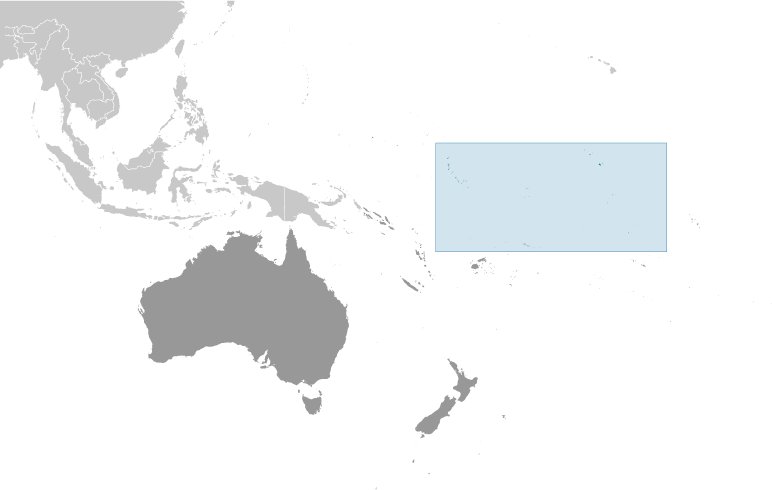

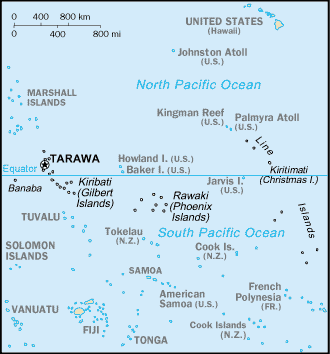
| KIRIBATI Republic of Kiribati Republic of Kiribati Joined United Nations: 14 September 1999 Human Rights as assured by their constitution Click here Updated 03 December 2012 |

| CAPITAL |
| POPULATION |
| CHIEF OF STATE |
| SELECTION PROCESS |
South Tarawa
101,998 (July 2012 est.)
The House of Parliament chooses the presidential candidates from
among its members and then those candidates compete in a general
election; President is elected by popular vote for a four-year term;
Vice President appointed by the President (eligible for one more
term); election last held 13 January 2012
Next scheduled election: 2015
among its members and then those candidates compete in a general
election; President is elected by popular vote for a four-year term;
Vice President appointed by the President (eligible for one more
term); election last held 13 January 2012
Next scheduled election: 2015
HEAD OF GOVERNMENT
SELECTION PROCESS
According to the Kiribati Constitution, the President is both the
Chief of State and Head of Government
Chief of State and Head of Government
| DECLARATION OF HUMAN RIGHTS |
| ETHNIC GROUPS |
Micronesian 98.8%, other 1.2% (2000 census)
| RELIGIONS |
Roman Catholic 52%, Protestant (Congregational) 40%, other (includes Seventh-Day Adventist, Muslim, Baha'i, Latter-day
Saints, Church of God) 8% (1999)
Saints, Church of God) 8% (1999)
| GOVERNMENT STRUCTURE |
Republic with 3 units, 6 districts and 21 island councils; Legal system is based on English common law with strong indigenous
traditions
Executive: The House of Parliament chooses the presidential candidates from among its members and then those candidates
compete in a general election; president is elected by popular vote for a four-year term (eligible for two more terms); election last
held 13 January 2012 (next to be held in 2015); vice president appointed by the president
Legislative: Unicameral House of Parliament or Maneaba Ni Maungatabu (46 seats; 44 members elected by popular vote, 1 ex
officio member - the attorney general, 1 nominated by the Rabi Council of Leaders (representing Banaba Island); to serve four-year
terms)
elections: legislative elections were held in two rounds - the first round on 21 October 2011 and the second round on 28 October
2011 (next to be held in 2015)
Judicial: Court of Appeal; High Court; 26 Magistrates' courts; judges at all levels are appointed by the president
traditions
Executive: The House of Parliament chooses the presidential candidates from among its members and then those candidates
compete in a general election; president is elected by popular vote for a four-year term (eligible for two more terms); election last
held 13 January 2012 (next to be held in 2015); vice president appointed by the president
Legislative: Unicameral House of Parliament or Maneaba Ni Maungatabu (46 seats; 44 members elected by popular vote, 1 ex
officio member - the attorney general, 1 nominated by the Rabi Council of Leaders (representing Banaba Island); to serve four-year
terms)
elections: legislative elections were held in two rounds - the first round on 21 October 2011 and the second round on 28 October
2011 (next to be held in 2015)
Judicial: Court of Appeal; High Court; 26 Magistrates' courts; judges at all levels are appointed by the president
| LANGUAGES |
I-Kiribati, English (official)
| BRIEF HISTORY |
The I-Kiribati people (or Gilbertese) settled what would become known as the Gilbert Islands (named for British captain Thomas
Gilbert by von Krusenstern in 1820) between 3000 and 2000 years ago. Subsequent invasions by Samoans and Tongans
introduced Polynesian elements to the previously installed Micronesian culture and invasions by Fijians introduced Melanesian
elements, but extensive intermarriage produced a population reasonably homogeneous in appearance, language and traditions.
European contact began in the 16th century. Whalers, slave traders, and merchant vessels arrived in great numbers in the 1800s,
and the resulting upheaval fomented local tribal conflicts and introduced damaging European diseases. In an effort to restore a
measure of order, the Kiribati were forced to becoming British protectorates in 1892. Banaba (Ocean Island) was annexed in 1901
after the discovery of phosphate-rich guano deposits. The entire collection, plus Fanning and Washington islands (Line Islands), was
made a British colony in 1916, as part of the British Western Pacific Territories (a colonial entity created in 1877, governed by a
single High Commissioner) until 1971, only five years before its abolition. One very famous Colonial Office proconsul was Sir
Arthur Grimble, first as cadet officer in 1914, then as Resident Commissioner in 1926. Most of the Line Islands including Christmas
Island, the Phoenix and even the Union (Tokelau) islands (until 1925) were incorporated piecemeal over the next 20 years. Japan
seized part of the islands during World War II to form part of their island defenses. In November 1943, Allied forces threw
themselves against Japanese positions at Tarawa Atoll in the Gilberts, resulting in some of the bloodiest fighting of the Pacific
campaign. The battle was a major turning point in the war for the Allies. Britain began expanding self-government in the islands
during the 1960s. In 1975 the Ellice Islands separated from the colony to form the independent state of Tuvalu. The Gilberts
obtained internal self-government in 1977, and after general elections held in February, 1978 (Chief Minister: Ieremia Tabai, 27),
formally became an independent nation on July 12, 1979 under the name of Kiribati (the rendition of Gilberts, in Gilbertese
language). The United States gave up its claims to 14 islands of the Line and Phoenix chains in the 1979 Treaty of Tarawa.
Post-independence politics were initially dominated by the youngest Commonwealth's Head of State, Ieremia Tabai, just 29,
Kiribati's first Beretitenti (i.e. President, pronounced te pereseetensee), who served for three terms from 1979 to 1991. Teburoro
Tito (or Tiito, pronounced Seetoh) was elected Beretitenti in 1994, and reelected in 1998 and 2002. However, in the previous
parliamentary elections in 2002, Tito's opponents won major victories, and in March 2003 he was ousted in a no-confidence vote
(having served the maximum three terms, he is barred by the constitution to run for another term). His temporary replacement was
Tian Otang, the Council of State chairman. Following the constitution, another presidential election was held, in which two brothers,
Anote and Harry Tong, were the two main candidates (the third one, Banuera Berina won just 9,1%). Anote Tong, London School
of Economics graduate, won on 4th July 2003, and was sworn in as president soon afterward. An emotional issue has been the
protracted bid by the residents of Banaba Island to secede and have their island placed under the protection of Fiji. Because
Banaba was devastated by phosphate mining, the vast majority of Banabans moved to the island of Rabi in the Fiji Islands in the
1940s. They enjoy full Fiji citizenship. The Kiribati Government has responded by including several special provisions in the
Constitution, such as the designation of a Banaban seat in the legislature and the return of land previously acquired by the
government for phosphate mining. Only 200-300 people remain on Banaba.
Source: Wikipedia: History of Kiribati
Gilbert by von Krusenstern in 1820) between 3000 and 2000 years ago. Subsequent invasions by Samoans and Tongans
introduced Polynesian elements to the previously installed Micronesian culture and invasions by Fijians introduced Melanesian
elements, but extensive intermarriage produced a population reasonably homogeneous in appearance, language and traditions.
European contact began in the 16th century. Whalers, slave traders, and merchant vessels arrived in great numbers in the 1800s,
and the resulting upheaval fomented local tribal conflicts and introduced damaging European diseases. In an effort to restore a
measure of order, the Kiribati were forced to becoming British protectorates in 1892. Banaba (Ocean Island) was annexed in 1901
after the discovery of phosphate-rich guano deposits. The entire collection, plus Fanning and Washington islands (Line Islands), was
made a British colony in 1916, as part of the British Western Pacific Territories (a colonial entity created in 1877, governed by a
single High Commissioner) until 1971, only five years before its abolition. One very famous Colonial Office proconsul was Sir
Arthur Grimble, first as cadet officer in 1914, then as Resident Commissioner in 1926. Most of the Line Islands including Christmas
Island, the Phoenix and even the Union (Tokelau) islands (until 1925) were incorporated piecemeal over the next 20 years. Japan
seized part of the islands during World War II to form part of their island defenses. In November 1943, Allied forces threw
themselves against Japanese positions at Tarawa Atoll in the Gilberts, resulting in some of the bloodiest fighting of the Pacific
campaign. The battle was a major turning point in the war for the Allies. Britain began expanding self-government in the islands
during the 1960s. In 1975 the Ellice Islands separated from the colony to form the independent state of Tuvalu. The Gilberts
obtained internal self-government in 1977, and after general elections held in February, 1978 (Chief Minister: Ieremia Tabai, 27),
formally became an independent nation on July 12, 1979 under the name of Kiribati (the rendition of Gilberts, in Gilbertese
language). The United States gave up its claims to 14 islands of the Line and Phoenix chains in the 1979 Treaty of Tarawa.
Post-independence politics were initially dominated by the youngest Commonwealth's Head of State, Ieremia Tabai, just 29,
Kiribati's first Beretitenti (i.e. President, pronounced te pereseetensee), who served for three terms from 1979 to 1991. Teburoro
Tito (or Tiito, pronounced Seetoh) was elected Beretitenti in 1994, and reelected in 1998 and 2002. However, in the previous
parliamentary elections in 2002, Tito's opponents won major victories, and in March 2003 he was ousted in a no-confidence vote
(having served the maximum three terms, he is barred by the constitution to run for another term). His temporary replacement was
Tian Otang, the Council of State chairman. Following the constitution, another presidential election was held, in which two brothers,
Anote and Harry Tong, were the two main candidates (the third one, Banuera Berina won just 9,1%). Anote Tong, London School
of Economics graduate, won on 4th July 2003, and was sworn in as president soon afterward. An emotional issue has been the
protracted bid by the residents of Banaba Island to secede and have their island placed under the protection of Fiji. Because
Banaba was devastated by phosphate mining, the vast majority of Banabans moved to the island of Rabi in the Fiji Islands in the
1940s. They enjoy full Fiji citizenship. The Kiribati Government has responded by including several special provisions in the
Constitution, such as the designation of a Banaban seat in the legislature and the return of land previously acquired by the
government for phosphate mining. Only 200-300 people remain on Banaba.
Source: Wikipedia: History of Kiribati
| ECONOMIC OVERVIEW |
A remote country of 33 scattered coral atolls, Kiribati has few natural resources and is one of the least developed Pacific Islands.
Commercially viable phosphate deposits were exhausted at the time of independence from the UK in 1979. Copra and fish now
represent the bulk of production and exports. The economy has fluctuated widely in recent years. Economic development is
constrained by a shortage of skilled workers, weak infrastructure, and remoteness from international markets. Tourism provides
more than one-fifth of GDP. Private sector initiatives and a financial sector are in the early stages of development. Foreign financial
aid from the EU, UK, US, Japan, Australia, New Zealand, Canada, UN agencies, and Taiwan accounts for 20-25% of GDP.
Remittances from seamen on merchant ships abroad account for more than $5 million each year. Kiribati receives around $15
million annually for the government budget from an Australian trust fund.
Source: CIA World Factbook (select Kiribati)
Commercially viable phosphate deposits were exhausted at the time of independence from the UK in 1979. Copra and fish now
represent the bulk of production and exports. The economy has fluctuated widely in recent years. Economic development is
constrained by a shortage of skilled workers, weak infrastructure, and remoteness from international markets. Tourism provides
more than one-fifth of GDP. Private sector initiatives and a financial sector are in the early stages of development. Foreign financial
aid from the EU, UK, US, Japan, Australia, New Zealand, Canada, UN agencies, and Taiwan accounts for 20-25% of GDP.
Remittances from seamen on merchant ships abroad account for more than $5 million each year. Kiribati receives around $15
million annually for the government budget from an Australian trust fund.
Source: CIA World Factbook (select Kiribati)
| POLITICAL CLIMATE |
After each general election, the new House of Assembly nominates three or four of its members to stand as candidates for President
(Te Beretitenti). The voting public then elects the Beretitenti from among these candidates. The Beretitenti appoints a
Kauoman-ni-Beretitenti (Vice-President) and up to ten other Cabinet Ministers from among the members of the Maneaba. The
Attorney-General is also a member of Cabinet.
Political parties exist but are more similar to informal coalitions in behavior. They do not have official platforms or party structures.
Most candidates formally present themselves as independents.
A major source of conflict has been the protracted bid by the residents of Banaban Island to secede and have their island placed
under the protection of Fiji. The government's attempts to placate the Banabans include several special provisions in the constitution,
such as the designation of a Banaban seat in the legislature and the return of land previously acquired by the government for
phosphate mining.
A presidential election was held in Kiribati on 13 January 2012, following a two-round parliamentary election held in October
2011. Incumbent President Anote Tong sought re-election to a third four-year term, ending months of speculation about his
decision.The election, initially scheduled for 30 December 2011, was postponed to 13 January 2012 in order to allow citizens of
the country to travel to celebrate the New Year.
Source: Wikipedia: Politics of Kiribati
(Te Beretitenti). The voting public then elects the Beretitenti from among these candidates. The Beretitenti appoints a
Kauoman-ni-Beretitenti (Vice-President) and up to ten other Cabinet Ministers from among the members of the Maneaba. The
Attorney-General is also a member of Cabinet.
Political parties exist but are more similar to informal coalitions in behavior. They do not have official platforms or party structures.
Most candidates formally present themselves as independents.
A major source of conflict has been the protracted bid by the residents of Banaban Island to secede and have their island placed
under the protection of Fiji. The government's attempts to placate the Banabans include several special provisions in the constitution,
such as the designation of a Banaban seat in the legislature and the return of land previously acquired by the government for
phosphate mining.
A presidential election was held in Kiribati on 13 January 2012, following a two-round parliamentary election held in October
2011. Incumbent President Anote Tong sought re-election to a third four-year term, ending months of speculation about his
decision.The election, initially scheduled for 30 December 2011, was postponed to 13 January 2012 in order to allow citizens of
the country to travel to celebrate the New Year.
Source: Wikipedia: Politics of Kiribati
| INTERNATIONAL DISPUTES |
None reported.


| REFUGEES AND INTERNALLY DISPLACED PERSONS (IDPS) |
None reported.
| ILLICIT DRUGS |
None reported.
| HUMAN RIGHTS STATEMENTS, ANALYSIS AND CRITIQUES |
2011 Human Rights Reports: Kiribati
Bureau of Democracy, Human Rights, and Labor
2011 Country Reports on Human Rights Practices
May 25, 2012
Kiribati is a constitutional multiparty republic. The president exercises executive authority and is popularly elected for a four-year term.
The legislative assembly nominates at least three, and no more than four, presidential candidates from among its members. Parliamentary
elections held in October were considered generally free and fair. Anote Tong of the Boutokaan Te Koaua party remained president at
year’s end pending a presidential election scheduled for January 2012. Security forces reported to civilian authorities.
Violence and discrimination against women, child abuse, and commercial sexual exploitation of children were the main human rights
problems during the year.
There were no reports that government officials committed human rights abuses.
Click here to read more »
Bureau of Democracy, Human Rights, and Labor
2011 Country Reports on Human Rights Practices
May 25, 2012
Kiribati is a constitutional multiparty republic. The president exercises executive authority and is popularly elected for a four-year term.
The legislative assembly nominates at least three, and no more than four, presidential candidates from among its members. Parliamentary
elections held in October were considered generally free and fair. Anote Tong of the Boutokaan Te Koaua party remained president at
year’s end pending a presidential election scheduled for January 2012. Security forces reported to civilian authorities.
Violence and discrimination against women, child abuse, and commercial sexual exploitation of children were the main human rights
problems during the year.
There were no reports that government officials committed human rights abuses.
Click here to read more »
Kiribati must urgently address rights to safe water, sanitation – UN expert
25 July 2012
An independent United Nations expert has called on the Government of Kiribati to urgently address the human rights to safe water and
sanitation, which could help to tackle the high child mortality rate in the Pacific island nation.
“I was shocked by the child mortality rate in Kiribati, which is the highest in the Pacific,” said the Special Rapporteur on the right to
water and sanitation, Catarina de Albuquerque, who is currently on an official visit to the country.
“If the country seriously wants to reduce preventable deaths of children, then sanitation and hygiene are two vital issues to be addressed
as a matter of urgency,” she added.
She noted in a news release that a large proportion of the population in Kiribati practises open defecation, which means that people use
the sea and bushes as their toilets. This has serious implications for people’s health, as human waste spreads diseases.
This is particularly the case in overcrowded South Tarawa, the capital of Kiribati. “Inadequate waste water management systems for
existing toilets, a lack of hand washing habits and open defecation result in an explosive combination leading to many preventable child
deaths,” noted the release.
Ms. de Albuquerque said a first step to improve the situation is to explicitly assign responsibilities for sanitation to a Government
department and to provide it with the necessary human and financial resources.
She added that the current water supply situation in the country is “unsustainable,” and requires urgent measures to ensure that all
Kiribatians have access to a sufficient quantity of water for their personal and domestic uses.
“Every individual in Kiribati has the human right to access drinking water and adequate sanitation that is accessible, available, affordable,
acceptable and safe.”
Among her recommendations is to increase the country’s rainwater harvesting and storage capacity, as well as to boost efforts to
reserve the precious groundwater sources.
Independent experts, or special rapporteurs, are appointed by the Geneva-based UN Human Rights Council to examine and report back
on a country situation or a specific human rights theme. The positions are honorary and the experts are not UN staff, nor are they paid
for their work.
Click here to read more »
25 July 2012
An independent United Nations expert has called on the Government of Kiribati to urgently address the human rights to safe water and
sanitation, which could help to tackle the high child mortality rate in the Pacific island nation.
“I was shocked by the child mortality rate in Kiribati, which is the highest in the Pacific,” said the Special Rapporteur on the right to
water and sanitation, Catarina de Albuquerque, who is currently on an official visit to the country.
“If the country seriously wants to reduce preventable deaths of children, then sanitation and hygiene are two vital issues to be addressed
as a matter of urgency,” she added.
She noted in a news release that a large proportion of the population in Kiribati practises open defecation, which means that people use
the sea and bushes as their toilets. This has serious implications for people’s health, as human waste spreads diseases.
This is particularly the case in overcrowded South Tarawa, the capital of Kiribati. “Inadequate waste water management systems for
existing toilets, a lack of hand washing habits and open defecation result in an explosive combination leading to many preventable child
deaths,” noted the release.
Ms. de Albuquerque said a first step to improve the situation is to explicitly assign responsibilities for sanitation to a Government
department and to provide it with the necessary human and financial resources.
She added that the current water supply situation in the country is “unsustainable,” and requires urgent measures to ensure that all
Kiribatians have access to a sufficient quantity of water for their personal and domestic uses.
“Every individual in Kiribati has the human right to access drinking water and adequate sanitation that is accessible, available, affordable,
acceptable and safe.”
Among her recommendations is to increase the country’s rainwater harvesting and storage capacity, as well as to boost efforts to
reserve the precious groundwater sources.
Independent experts, or special rapporteurs, are appointed by the Geneva-based UN Human Rights Council to examine and report back
on a country situation or a specific human rights theme. The positions are honorary and the experts are not UN staff, nor are they paid
for their work.
Click here to read more »
Freedom In The World 2012 Report
Political Rights Score: 1
Civil Liberties Score: 1
Status: Free
Overview
The ruling Pillars of Truth Party secured the most seats in the October 2011 parliamentary elections. The Kiribati government continued
throughout the year to seek access to overseas settlements for citizens threatened by rising sea levels, as well as more foreign assistance
with training and employment for its people.
Tong has vigorously called for international attention to the growing threats Kiribati faces from rising sea levels and dwindling fresh-
water supplies. He has warned that relocation of the entire population might be necessary if ongoing climate change makes inundation
inevitable. New Zealand has pledged to accept environmental refugees from Kiribati, and some have already moved there. In March
2011, Tong declared that more coastal villages need resettlement because the sea walls are no longer sufficient to protect them, and that
those who move overseas need resettlement assistance.
The government is the main employer in Kiribati, and many residents practice subsistence agriculture. The economy depends
considerably on interest from a trust fund built on royalties from phosphate mining, overseas worker remittances, and foreign assistance.
In 2011, New Zealand committed $23 million to help Kiribati develop its fishing industry, while Australia announced a Seasonal Worker
Program to begin in July 2012 open to horticulture workers from many Pacific Islands, including Kiribati.
Parliamentary elections took place in 2011 over two rounds, on October 21 and 28. Thirty incumbents were reelected; the ruling BTK
won 15 seats, with the opposition Karikirakean Tei-Kiribati (KTK) and Maurin Kiribati (MKP) parties taking 10 seats and 3 seats,
respectively. Independents won the remaining seats. In November, Parliament nominated three candidates for the upcoming presidential
elections, including the BTK’s Tong, Tetaua Taitai of the KTK, and Rimeta Beniamina of the MKP. Although the elections were initially
scheduled for December 30, they were postponed until January 2012 to avoid low voter turnout during the holiday season.
Kiribati is an electoral democracy. The president is popularly elected in a two-step process whereby Parliament nominates candidates
from its own ranks and voters then choose one to be president. Forty-four representatives are popularly elected to the unicameral House
of Parliament for four-year terms. The attorney general holds a seat ex officio, and the Rabi Island Council nominates one additional
member. (Although Rabi Island is part of Fiji, many of its residents were originally from Kiribati’s Banaba Island; British authorities
forced them to move to Rabi when phosphate mining made Banaba uninhabitable.) The president, vested with executive authority by the
constitution, is limited to three four-year terms.
Click here to read more »
Political Rights Score: 1
Civil Liberties Score: 1
Status: Free
Overview
The ruling Pillars of Truth Party secured the most seats in the October 2011 parliamentary elections. The Kiribati government continued
throughout the year to seek access to overseas settlements for citizens threatened by rising sea levels, as well as more foreign assistance
with training and employment for its people.
Tong has vigorously called for international attention to the growing threats Kiribati faces from rising sea levels and dwindling fresh-
water supplies. He has warned that relocation of the entire population might be necessary if ongoing climate change makes inundation
inevitable. New Zealand has pledged to accept environmental refugees from Kiribati, and some have already moved there. In March
2011, Tong declared that more coastal villages need resettlement because the sea walls are no longer sufficient to protect them, and that
those who move overseas need resettlement assistance.
The government is the main employer in Kiribati, and many residents practice subsistence agriculture. The economy depends
considerably on interest from a trust fund built on royalties from phosphate mining, overseas worker remittances, and foreign assistance.
In 2011, New Zealand committed $23 million to help Kiribati develop its fishing industry, while Australia announced a Seasonal Worker
Program to begin in July 2012 open to horticulture workers from many Pacific Islands, including Kiribati.
Parliamentary elections took place in 2011 over two rounds, on October 21 and 28. Thirty incumbents were reelected; the ruling BTK
won 15 seats, with the opposition Karikirakean Tei-Kiribati (KTK) and Maurin Kiribati (MKP) parties taking 10 seats and 3 seats,
respectively. Independents won the remaining seats. In November, Parliament nominated three candidates for the upcoming presidential
elections, including the BTK’s Tong, Tetaua Taitai of the KTK, and Rimeta Beniamina of the MKP. Although the elections were initially
scheduled for December 30, they were postponed until January 2012 to avoid low voter turnout during the holiday season.
Kiribati is an electoral democracy. The president is popularly elected in a two-step process whereby Parliament nominates candidates
from its own ranks and voters then choose one to be president. Forty-four representatives are popularly elected to the unicameral House
of Parliament for four-year terms. The attorney general holds a seat ex officio, and the Rabi Island Council nominates one additional
member. (Although Rabi Island is part of Fiji, many of its residents were originally from Kiribati’s Banaba Island; British authorities
forced them to move to Rabi when phosphate mining made Banaba uninhabitable.) The president, vested with executive authority by the
constitution, is limited to three four-year terms.
Click here to read more »
Document - Suggested recommendations to states considered in the eighth round of the Universal Periodic Review,
May 2010
Recommendations to the government of Kiribati
Citizenship and right to a nationality
*To amend the citizenship section of the Constitution as well as the Citizenship Act to ensure equal citizenship rights for iKiribati women
and their families.
Gender discrimination
*To amend the Constitution of Kiribati to include the words “sex” or “gender” as prohibited grounds of discrimination;
*To review all relevant laws which discriminate or impact negatively on women;
*To amend laws and change policies and practices which either expressly discriminate against or perpetuate the discrimination and
marginalisation of women.
International human rights standards
*To accede to the Convention on the Rights of Persons with Disabilities, the International Covenant on Civil and Political Rights and its
Optional Protocols, and the International Covenant on Economic, Social and Cultural Rights and its Optional Protocol, and to enact laws
through Parliament to reflect the provisions of these standards, as well as other human rights treaties to which Kiribati is a party, in
domestic laws;
*To report on its obligations under the Convention on the Elimination of All forms of Discrimination Against Women;
*To legislate the principles of these treaties so that they are applicable in the courts.
Accessibility of land on Tarawa
*To consult with relevant stakeholders and civil society on how to effectively address issues of human rights in informal settlements;
*To promote and protect the rights of people currently living in the informal settlements to accessing adequate health services, water
and sanitation.
Violence against women
*To immediately undertake to enact appropriate legislation to address domestic violence after adequate consultation with relevant
stakeholders;
*To ensure that there is a mandatory policy or provision within the law for the prosecution of domestic violence;
*To ensure that training on the prevention of domestic violence is mainstreamed within the training programme of the police service and
to implement greater awareness programmes;
Click here to read more »
May 2010
Recommendations to the government of Kiribati
Citizenship and right to a nationality
*To amend the citizenship section of the Constitution as well as the Citizenship Act to ensure equal citizenship rights for iKiribati women
and their families.
Gender discrimination
*To amend the Constitution of Kiribati to include the words “sex” or “gender” as prohibited grounds of discrimination;
*To review all relevant laws which discriminate or impact negatively on women;
*To amend laws and change policies and practices which either expressly discriminate against or perpetuate the discrimination and
marginalisation of women.
International human rights standards
*To accede to the Convention on the Rights of Persons with Disabilities, the International Covenant on Civil and Political Rights and its
Optional Protocols, and the International Covenant on Economic, Social and Cultural Rights and its Optional Protocol, and to enact laws
through Parliament to reflect the provisions of these standards, as well as other human rights treaties to which Kiribati is a party, in
domestic laws;
*To report on its obligations under the Convention on the Elimination of All forms of Discrimination Against Women;
*To legislate the principles of these treaties so that they are applicable in the courts.
Accessibility of land on Tarawa
*To consult with relevant stakeholders and civil society on how to effectively address issues of human rights in informal settlements;
*To promote and protect the rights of people currently living in the informal settlements to accessing adequate health services, water
and sanitation.
Violence against women
*To immediately undertake to enact appropriate legislation to address domestic violence after adequate consultation with relevant
stakeholders;
*To ensure that there is a mandatory policy or provision within the law for the prosecution of domestic violence;
*To ensure that training on the prevention of domestic violence is mainstreamed within the training programme of the police service and
to implement greater awareness programmes;
Click here to read more »
Cluster Bomb Ban Powers Ahead Despite US Absence
Major Meeting of Convention Concludes in Lebanon
September 17, 2011
(Beirut) – The new international convention banning cluster bombs is already having a powerful impact despite the absence of the United
States and other major powers, Human Rights Watch said on September 17, 2011, as a diplomatic meeting of the convention concluded
in Beirut, Lebanon.
“This week’s meeting has shown how the cluster bomb ban is not only working, it is powering ahead in bringing more states on board
and in destroying cluster munitions. The US and other nations should join them,” said Steve Goose, director of the Arms Division at
Human Rights Watch and co-chair of the Cluster Munition Coalition (CMC). “Every cluster munition destroyed represents future lives
saved.”
The week-long Second Meeting of States Parties to the 2008 Convention on Cluster Munitions concluded on September 16 in Lebanon, a
country which remains seriously contaminated by cluster munitions. A total of 131 governments participated in the meeting, including 40
observer nations that have not yet joined the convention, an extraordinarily high number.
Participants adopted the Beirut Declaration, a commitment of support for the convention that strongly condemns the use of cluster
munitions by any actor and states, “Together, we are compelled to do more for to accomplish our collective goal – a world free of
cluster munitions.”
During the meeting, Swaziland joined the Convention on Cluster Munitions, becoming the 110th nation and 63rd state party. Many
signatories, including Czech Republic, Hungary, Italy, and Mauritania, announced that their ratification of the convention is nearing
completion. Delegates from non-signatory nations Malaysia, Gabon, Kiribati, Tajikistan, and newly independent South Sudan all indicated
that they plan to accede to the convention.
Click here to read more »
Major Meeting of Convention Concludes in Lebanon
September 17, 2011
(Beirut) – The new international convention banning cluster bombs is already having a powerful impact despite the absence of the United
States and other major powers, Human Rights Watch said on September 17, 2011, as a diplomatic meeting of the convention concluded
in Beirut, Lebanon.
“This week’s meeting has shown how the cluster bomb ban is not only working, it is powering ahead in bringing more states on board
and in destroying cluster munitions. The US and other nations should join them,” said Steve Goose, director of the Arms Division at
Human Rights Watch and co-chair of the Cluster Munition Coalition (CMC). “Every cluster munition destroyed represents future lives
saved.”
The week-long Second Meeting of States Parties to the 2008 Convention on Cluster Munitions concluded on September 16 in Lebanon, a
country which remains seriously contaminated by cluster munitions. A total of 131 governments participated in the meeting, including 40
observer nations that have not yet joined the convention, an extraordinarily high number.
Participants adopted the Beirut Declaration, a commitment of support for the convention that strongly condemns the use of cluster
munitions by any actor and states, “Together, we are compelled to do more for to accomplish our collective goal – a world free of
cluster munitions.”
During the meeting, Swaziland joined the Convention on Cluster Munitions, becoming the 110th nation and 63rd state party. Many
signatories, including Czech Republic, Hungary, Italy, and Mauritania, announced that their ratification of the convention is nearing
completion. Delegates from non-signatory nations Malaysia, Gabon, Kiribati, Tajikistan, and newly independent South Sudan all indicated
that they plan to accede to the convention.
Click here to read more »
H.E. TE BERETITENTI ANOTE TONG ADDRESSES THE NATION WITH GOVERNMENT POLICY STATEMENT
16 April 2012
H.E. Anote Tong addressed the nation with his Government policy statement during the opening of the Tenth Parliament that
commenced on Monday 16 April 2012.
The program started at 10.00 a.m. with the blowing of the conch shell while the procession of the mace was led by the Sergeant-At-
Arms followed by Hon. Speaker Taomati Iuta and H.E. Te Beretitenti Anote Tong, and then the Clerk Mr Eni Tekanene with Mr Ioeru
Tokantetaake Commissioner of Police.
The official opening of the programme started with a welcome remark delivered by Hon. Speaker Iuta followed by the delivery of the
Government Policy Statement by the Head of State, H.E Te Berretitenti. The whole proceeding in the House was broadcasted live on
Radio Kiribati. Few remarks in his statement, H.E. Tong mentioned Early Childhood saying that it is an essential foundation to start
learning from a young age and his government is committed in providing as much support needed at this level.
The other issue was Natural Resources for Economic Growth. H.E. Tong mentioned that even though Kiribati is not well endowed with
the richness of natural resources, “we own the largest Exclusive Economic Zone (EEZ) in the world meaning we have abundant fisheries
and marine resources. What we need is an effective policy to ensure we reap the highest benefit from our resources”.
Since Kiribati population is rapidly growing, it is evident that the 2010 population census indicated the figure of 100,000 thus
Government should work closely with Non-Government Organisations (NGOs), the communities and Churches to combat problems
arise from the rapid increase of population. In addition, women and youth are seen to comprise a majority of percentage
of the population. Seeing their contributions to the development of the nation, the government has decided to add a new Ministry of
Women and Youth to take care of women and gender issues in general.
Click here to read more »
16 April 2012
H.E. Anote Tong addressed the nation with his Government policy statement during the opening of the Tenth Parliament that
commenced on Monday 16 April 2012.
The program started at 10.00 a.m. with the blowing of the conch shell while the procession of the mace was led by the Sergeant-At-
Arms followed by Hon. Speaker Taomati Iuta and H.E. Te Beretitenti Anote Tong, and then the Clerk Mr Eni Tekanene with Mr Ioeru
Tokantetaake Commissioner of Police.
The official opening of the programme started with a welcome remark delivered by Hon. Speaker Iuta followed by the delivery of the
Government Policy Statement by the Head of State, H.E Te Berretitenti. The whole proceeding in the House was broadcasted live on
Radio Kiribati. Few remarks in his statement, H.E. Tong mentioned Early Childhood saying that it is an essential foundation to start
learning from a young age and his government is committed in providing as much support needed at this level.
The other issue was Natural Resources for Economic Growth. H.E. Tong mentioned that even though Kiribati is not well endowed with
the richness of natural resources, “we own the largest Exclusive Economic Zone (EEZ) in the world meaning we have abundant fisheries
and marine resources. What we need is an effective policy to ensure we reap the highest benefit from our resources”.
Since Kiribati population is rapidly growing, it is evident that the 2010 population census indicated the figure of 100,000 thus
Government should work closely with Non-Government Organisations (NGOs), the communities and Churches to combat problems
arise from the rapid increase of population. In addition, women and youth are seen to comprise a majority of percentage
of the population. Seeing their contributions to the development of the nation, the government has decided to add a new Ministry of
Women and Youth to take care of women and gender issues in general.
Click here to read more »
Aia Maea Ainen Kiribati conference is underway in Kiribati
14:49 June 22, 2010
A 6th general assembly of the Kiribati women’s organisation, Aia Maea Ainen Kiribati (AMAK) is underway in the capital Tarawa, of the
Pacific nation of Kiribati.
High on the agenda is the discussion on the future of the organisation after it broke away from the government, reports Kiribati national
paper, Te Uekera.
Vice president of AMAK and former radio manager of the Broadcasting and Publications Authority, Moia Tetoa, says the assembly will
go through the government’s policies for women’s organisation, and the organisation’s 3 year strategic plan.
Moia Tetoa says they expect around forty women participants from around the country to attend the conference with a few arrived last
week ahead of this meeting to participate in a series of training workshops organised by the Taiwan-based embassy. At the workshops,
women were taught modern skills and techniques in planting, cooking, feeding and caring for pigs.
Tetoa says the skills learned from these workshops are very helpful to women, especially those coming from the rural areas. She
thanked the Taiwan ambassador for funding the workshops.
Government of Kiribati provides AUD$40,000 towards the costs of the conference and travel expenses of the participants.
A Kiribati resident and businessman, Borerei Uriam, says many have raised questions over the decision of the women’s council to
become a non-government body after many years of depending on the state for support.
The conference is opened to the public and will run for one week only.
Another women activist group in Kiribati known as the Kiribati Women Activist Network (K-WAN) is not satisfied with the progress of
women.
In its submission to the United Nations Universal Periodic Review, May 2010, the group says Kiribati is a state party of the Convention
on the Elimination of All Forms of Discrimination Against Women. But up to these days, they have not submitted their CEDAW state
report.
This group is working with KANGO-Kiribati Association of Non-Government Organisation to prepare their shadow CEDAW report
excluding AMAK because it is a quasi-government organisation.
Other areas highlighted by K-WAN include employment laws, and the distribution of lands to men under the customary practices and
domestic violence. Women are still unfairly treated and represented when it comes to these matters.
This activist group believes a lot of work is needed to be done to improve the status of women in Kiribati, and has urged the government
to complete its CEDAW state report as a matter of priority, and to look into areas where women are not equally represented.
Click here to read more »
14:49 June 22, 2010
A 6th general assembly of the Kiribati women’s organisation, Aia Maea Ainen Kiribati (AMAK) is underway in the capital Tarawa, of the
Pacific nation of Kiribati.
High on the agenda is the discussion on the future of the organisation after it broke away from the government, reports Kiribati national
paper, Te Uekera.
Vice president of AMAK and former radio manager of the Broadcasting and Publications Authority, Moia Tetoa, says the assembly will
go through the government’s policies for women’s organisation, and the organisation’s 3 year strategic plan.
Moia Tetoa says they expect around forty women participants from around the country to attend the conference with a few arrived last
week ahead of this meeting to participate in a series of training workshops organised by the Taiwan-based embassy. At the workshops,
women were taught modern skills and techniques in planting, cooking, feeding and caring for pigs.
Tetoa says the skills learned from these workshops are very helpful to women, especially those coming from the rural areas. She
thanked the Taiwan ambassador for funding the workshops.
Government of Kiribati provides AUD$40,000 towards the costs of the conference and travel expenses of the participants.
A Kiribati resident and businessman, Borerei Uriam, says many have raised questions over the decision of the women’s council to
become a non-government body after many years of depending on the state for support.
The conference is opened to the public and will run for one week only.
Another women activist group in Kiribati known as the Kiribati Women Activist Network (K-WAN) is not satisfied with the progress of
women.
In its submission to the United Nations Universal Periodic Review, May 2010, the group says Kiribati is a state party of the Convention
on the Elimination of All Forms of Discrimination Against Women. But up to these days, they have not submitted their CEDAW state
report.
This group is working with KANGO-Kiribati Association of Non-Government Organisation to prepare their shadow CEDAW report
excluding AMAK because it is a quasi-government organisation.
Other areas highlighted by K-WAN include employment laws, and the distribution of lands to men under the customary practices and
domestic violence. Women are still unfairly treated and represented when it comes to these matters.
This activist group believes a lot of work is needed to be done to improve the status of women in Kiribati, and has urged the government
to complete its CEDAW state report as a matter of priority, and to look into areas where women are not equally represented.
Click here to read more »
Historic meeting of Regional integrity agency heads
23 March 2010
About 40 ombudsmen or their equivalents and other colleagues from around the Asia–Pacific met in Canberra, Australia last week to
promote international engagement, liaison and best practice in the pursuit of good governance within our region.
The Australian Office of the Commonwealth Ombudsman hosted the important event—the 1st general meeting of the Pacific
Ombudsman Alliance (POA) and the 25th anniversary conference of the Australasian and Pacific Ombudsman Region (APOR).
Acting Commonwealth Ombudsman, Mr Ron Brent, explained that POA and APOR provided forums for cooperation between
ombudsman offices in Australia and the Pacific and for development of government complaint handling in the region.
‘As a group, we are committed to sharing our experiences in handling complaints about government agencies, fostering good public
administration and developing a network of ombudsmen that is self-supporting and ultimately self-sustaining,’ Mr Brent said.
‘We meet annually and collaborate regularly with ombudsman offices in neighbouring countries on investigations, training, staff
exchanges, publications, managing rising complaint numbers and developing new and specialist functions.’
The Australian Parliamentary Secretary for International Development Assistance, Mr Bob McMullan, emphasised to the group of
ombudsmen and representatives from allied bodies the importance of improving public governance and strengthening accountability.
Mr McMullan said that good administrative frameworks provided benefits for whole societies. He suggested, for example, that countries
with such frameworks suffered less damage from harmful occurrences, even those over which they had no control, such as natural
disasters.
Key discussions at the historic two–day gathering covered access to information, integrity frameworks, accountability tools, and new
functions, such as the anti-corruption role played by ombudsmen in some countries. Outcomes included agreement to:
continue support for a non-legislative complaint-handling scheme being trialed in Niue with assistance from New Zealand (NZ)
support the new nominee Ombudsman in Palau by providing training and advice
partner a volunteer in the Australian Youth Ambassadors Development scheme to undertake a one-year placement in the Vanuatu
Ombudsman’s office
find ways to legally share information where there has been cross-border corruption
develop and deliver specific training on basic forensic accounting for investigations, with the Papua New Guinea (PNG) Ombudsman
Commission to take the lead.
A new POA Board was elected: Mr Brent (Chair); Ms Janet Maki, Cook Islands Ombudsman; Ms Beverley Wakem, NZ Chief
Ombudsman; Mr Bruce Barbour, NSW Ombudsman; Mr Chronox Manek, PNG Chief Ombudsman; and Ms Wiriki Tooma, Secretary to
the Kiribati Cabinet and representative on the Board of Non-Ombudsman Small Island States.
Ms Wakem was re-elected as APOR’s Regional Vice President to the International Ombudsman Institute; Mr Manek and Hong Kong
Ombudsman Mr Alan Lai were re-elected also as regional representatives to the Institute.
Meeting delegates came from Australia (Commonwealth and state ombudsmen), Cook Islands, Federated States of Micronesia, Hong
Kong, Kiribati, NZ, Niue, Palau, PNG, Samoa, Solomon Islands, Taiwan, Timore Leste, Tonga and Vanuatu.
The event coincided with the Government’s announcement to provide more than $10 million over two years to the Pacific Islands
Forum Secretariat to continue its work in the region.
Click here to read more>>
23 March 2010
About 40 ombudsmen or their equivalents and other colleagues from around the Asia–Pacific met in Canberra, Australia last week to
promote international engagement, liaison and best practice in the pursuit of good governance within our region.
The Australian Office of the Commonwealth Ombudsman hosted the important event—the 1st general meeting of the Pacific
Ombudsman Alliance (POA) and the 25th anniversary conference of the Australasian and Pacific Ombudsman Region (APOR).
Acting Commonwealth Ombudsman, Mr Ron Brent, explained that POA and APOR provided forums for cooperation between
ombudsman offices in Australia and the Pacific and for development of government complaint handling in the region.
‘As a group, we are committed to sharing our experiences in handling complaints about government agencies, fostering good public
administration and developing a network of ombudsmen that is self-supporting and ultimately self-sustaining,’ Mr Brent said.
‘We meet annually and collaborate regularly with ombudsman offices in neighbouring countries on investigations, training, staff
exchanges, publications, managing rising complaint numbers and developing new and specialist functions.’
The Australian Parliamentary Secretary for International Development Assistance, Mr Bob McMullan, emphasised to the group of
ombudsmen and representatives from allied bodies the importance of improving public governance and strengthening accountability.
Mr McMullan said that good administrative frameworks provided benefits for whole societies. He suggested, for example, that countries
with such frameworks suffered less damage from harmful occurrences, even those over which they had no control, such as natural
disasters.
Key discussions at the historic two–day gathering covered access to information, integrity frameworks, accountability tools, and new
functions, such as the anti-corruption role played by ombudsmen in some countries. Outcomes included agreement to:
continue support for a non-legislative complaint-handling scheme being trialed in Niue with assistance from New Zealand (NZ)
support the new nominee Ombudsman in Palau by providing training and advice
partner a volunteer in the Australian Youth Ambassadors Development scheme to undertake a one-year placement in the Vanuatu
Ombudsman’s office
find ways to legally share information where there has been cross-border corruption
develop and deliver specific training on basic forensic accounting for investigations, with the Papua New Guinea (PNG) Ombudsman
Commission to take the lead.
A new POA Board was elected: Mr Brent (Chair); Ms Janet Maki, Cook Islands Ombudsman; Ms Beverley Wakem, NZ Chief
Ombudsman; Mr Bruce Barbour, NSW Ombudsman; Mr Chronox Manek, PNG Chief Ombudsman; and Ms Wiriki Tooma, Secretary to
the Kiribati Cabinet and representative on the Board of Non-Ombudsman Small Island States.
Ms Wakem was re-elected as APOR’s Regional Vice President to the International Ombudsman Institute; Mr Manek and Hong Kong
Ombudsman Mr Alan Lai were re-elected also as regional representatives to the Institute.
Meeting delegates came from Australia (Commonwealth and state ombudsmen), Cook Islands, Federated States of Micronesia, Hong
Kong, Kiribati, NZ, Niue, Palau, PNG, Samoa, Solomon Islands, Taiwan, Timore Leste, Tonga and Vanuatu.
The event coincided with the Government’s announcement to provide more than $10 million over two years to the Pacific Islands
Forum Secretariat to continue its work in the region.
Click here to read more>>
| Click map for larger view |
| Click flag for Country Report |



Anote Tong
President since 10 July 2003
President since 10 July 2003
Teima Onorio
Vice President since 10 July 2003
Vice President since 10 July 2003
| TRAFFICKING IN PERSONS |
None reported.


Anote Tong
President since 10 July 2003
President since 10 July 2003