


| MACEDONIA Republic of Macedonia Republika Makedonija (The former Yugoslav Republic of Macedonia) Joined United Nations: 8 April 1993 Human Rights as assured by their constitution Click here Updated 06 January 2013 |
| CAPITAL |
| POPULATION |
| CHIEF OF STATE |
| SELECTION PROCESS |
Skopje
2,082,370 (July 2012 est.)
Gjorge Ivanov
President since 12 May 2009
President since 12 May 2009
President elected by popular vote for a five-year term (eligible
for a second term); two-round election: first round held 22
March 2009, second round to be held 5 April 2009
Next scheduled election: March 2014
for a second term); two-round election: first round held 22
March 2009, second round to be held 5 April 2009
Next scheduled election: March 2014
HEAD OF GOVERNMENT
SELECTION PROCESS
Nikola Grievski
Prime Minister since 28 August 2006
Prime Minister since 28 August 2006
Prime Minister elected by the Assembly following legislative
elections; elections: last held 5 June 2011
Next scheduled election: June 2015
elections; elections: last held 5 June 2011
Next scheduled election: June 2015
| DECLARATION OF HUMAN RIGHTS |
| ETHNIC GROUPS |
Macedonian 64.2%, Albanian 25.2%, Turkish 3.9%, Roma 2.7%, Serb 1.8%, other 2.2% (2002 census)
| RELIGIONS |
Macedonian Orthodox 64.7%, other Christian 0.37%, Muslim 33.3%, other and unspecified 1.63% (2002 census)
| GOVERNMENT STRUCTURE |
Parliamentary Democracy comprised of 85 municipalities (opstini, singular - opstina); Legal system is based on civil
law system; with judicial review of legislative acts
Executive: President elected by popular vote for a five-year term (eligible for a second term); two-round election:
first round held on 22 March 2009, second round held on 5 April 2009 (next to be held in March 2014); prime
minister elected by the Assembly following legislative elections;
Legislative: unicameral Assembly or Sobranie (123 seats; all members elected by popular vote from party lists
based on the percentage of the overall vote the parties gain in each of six electoral and three diaspora districts;
members serve four-year terms)
elections: last held on 5 June 2011 (next to be held by June 2015)
Judicial: Supreme Court - the Assembly appoints the judges; Constitutional Court - the Assembly appoints the
judges; Republican Judicial Council - the Assembly appoints the judges
law system; with judicial review of legislative acts
Executive: President elected by popular vote for a five-year term (eligible for a second term); two-round election:
first round held on 22 March 2009, second round held on 5 April 2009 (next to be held in March 2014); prime
minister elected by the Assembly following legislative elections;
Legislative: unicameral Assembly or Sobranie (123 seats; all members elected by popular vote from party lists
based on the percentage of the overall vote the parties gain in each of six electoral and three diaspora districts;
members serve four-year terms)
elections: last held on 5 June 2011 (next to be held by June 2015)
Judicial: Supreme Court - the Assembly appoints the judges; Constitutional Court - the Assembly appoints the
judges; Republican Judicial Council - the Assembly appoints the judges
| LANGUAGES |
Macedonian 66.5%, Albanian 25.1%, Turkish 3.5%, Roma 1.9%, Serbian 1.2%, other 1.8% (2002 census)
| BRIEF HISTORY |
| ECONOMIC OVERVIEW |
Macedonia is vulnerable to economic developments in Europe - due to strong banking and trade ties - and
dependent on regional integration and progress toward EU membership for continued economic growth. At
independence in September 1991, Macedonia was the least developed of the Yugoslav republics, producing a mere
5% of the total federal output of goods and services. The collapse of the Socialist Federal Republic of Yugoslavia
ended transfer payments from the central government and eliminated advantages from inclusion in a de facto free
trade area. An absence of infrastructure, UN sanctions on the downsized Yugoslavia, and a Greek economic
embargo over a dispute about the country's constitutional name and flag hindered economic growth until 1996. Since
then, Macedonia has maintained macroeconomic stability with low inflation, but it has so far lagged the region in
attracting foreign investment and creating jobs, despite making extensive fiscal and business sector reforms. Official
unemployment remains high at 29.1%, but may be overstated based on the existence of an extensive gray market,
estimated to be between 20% and 45% of GDP, that is not captured by official statistics. In the wake of the global
economic downturn, Macedonia has experienced decreased foreign direct investment, lowered credit availability,
and a large trade deficit. However, as a result of conservative fiscal policies and a sound financial system, in 2010 the
country credit rating improved slightly to BB+ and was kept at that level in 2011. Macroeconomic stability has been
maintained by a prudent monetary policy, which keeps the domestic currency pegged against the euro. As a result,
GDP growth was modest, but positive, in 2010 and 2011, and inflation was under control.
Source: CIA World Factbook (select Macedonia)
dependent on regional integration and progress toward EU membership for continued economic growth. At
independence in September 1991, Macedonia was the least developed of the Yugoslav republics, producing a mere
5% of the total federal output of goods and services. The collapse of the Socialist Federal Republic of Yugoslavia
ended transfer payments from the central government and eliminated advantages from inclusion in a de facto free
trade area. An absence of infrastructure, UN sanctions on the downsized Yugoslavia, and a Greek economic
embargo over a dispute about the country's constitutional name and flag hindered economic growth until 1996. Since
then, Macedonia has maintained macroeconomic stability with low inflation, but it has so far lagged the region in
attracting foreign investment and creating jobs, despite making extensive fiscal and business sector reforms. Official
unemployment remains high at 29.1%, but may be overstated based on the existence of an extensive gray market,
estimated to be between 20% and 45% of GDP, that is not captured by official statistics. In the wake of the global
economic downturn, Macedonia has experienced decreased foreign direct investment, lowered credit availability,
and a large trade deficit. However, as a result of conservative fiscal policies and a sound financial system, in 2010 the
country credit rating improved slightly to BB+ and was kept at that level in 2011. Macroeconomic stability has been
maintained by a prudent monetary policy, which keeps the domestic currency pegged against the euro. As a result,
GDP growth was modest, but positive, in 2010 and 2011, and inflation was under control.
Source: CIA World Factbook (select Macedonia)
| POLITICAL CLIMATE |
A presidential election was held in the Republic of Macedonia on 22 March 2009, at the same time as local
elections; a run-off round was held on 5 April 2009. Gjorge Ivanov, the candidate of the center-right VMRO–
DPMNE party, won the election in the second round. The incumbent president Branko Crvenkovski did not stand
for re-election. There was a significant number of invalid ballots in both rounds, 3.15% in the first round and even
5.87% in the runoff. According to media reports, this was due to voter apathy and disenchantment with the
candidates. An early parliamentary election was held in the Republic of Macedonia on 5 June 2011, a year earlier
than necessary. The parliamentary election in Macedonia was due in mid-2012, after the ruling coalition between
VMRO-DPMNE and DUI won over two thirds of the parliamentary seats in the 2008 early election. A bitter
dispute between the ruling coalition and the opposition was triggered when a police-assisted raid of public revenue
officers took place on 25 November 2010, on a group of related companies including a private TV station, three
daily newspapers, and other companies, for alleged tax evasion offenses. The opposition claimed that the media
were raided due to their anti-government inclination. Presidential elections are scheduled to take place in 2014.
Click here to read more »
elections; a run-off round was held on 5 April 2009. Gjorge Ivanov, the candidate of the center-right VMRO–
DPMNE party, won the election in the second round. The incumbent president Branko Crvenkovski did not stand
for re-election. There was a significant number of invalid ballots in both rounds, 3.15% in the first round and even
5.87% in the runoff. According to media reports, this was due to voter apathy and disenchantment with the
candidates. An early parliamentary election was held in the Republic of Macedonia on 5 June 2011, a year earlier
than necessary. The parliamentary election in Macedonia was due in mid-2012, after the ruling coalition between
VMRO-DPMNE and DUI won over two thirds of the parliamentary seats in the 2008 early election. A bitter
dispute between the ruling coalition and the opposition was triggered when a police-assisted raid of public revenue
officers took place on 25 November 2010, on a group of related companies including a private TV station, three
daily newspapers, and other companies, for alleged tax evasion offenses. The opposition claimed that the media
were raided due to their anti-government inclination. Presidential elections are scheduled to take place in 2014.
Click here to read more »
| INTERNATIONAL DISPUTES |
Kosovo and Macedonia completed demarcation of their boundary in September 2008; Greece continues to reject
the use of the name Macedonia or Republic of Macedonia
the use of the name Macedonia or Republic of Macedonia


| REFUGEES AND INTERNALLY DISPLACED PERSONS (IDP) |
None reported.
| ILLICIT DRUGS |
Major transshipment point for Southwest Asian heroin and hashish; minor transit point for South American cocaine
destined for Europe; although not a financial center and most criminal activity is thought to be domestic, money
laundering is a problem due to a mostly cash-based economy and weak enforcement
destined for Europe; although not a financial center and most criminal activity is thought to be domestic, money
laundering is a problem due to a mostly cash-based economy and weak enforcement
| HUMAN RIGHTS STATEMENTS, ANALYSIS AND CRITIQUES |
2011 Human Rights Report: Macedonia
Bureau of Democracy, Human Rights, and Labor
2011 Country Reports on Human Rights Practices
May 25, 2012
The Republic of Macedonia is a parliamentary democracy. A popularly elected president is head of state and commander in chief of
the armed forces. A unicameral parliament (Sobranie) exercises legislative authority. On June 5, the country held national
parliamentary elections that international observers assessed as meeting most international standards for democratic elections.
Security forces report to civilian authorities.
The most important human rights problem was the government’s failure to fully respect the rule of law, which was reflected in its
interference in the judiciary and the media, selective prosecution of political opponents of the country’s leaders, and significant
levels of government corruption and police impunity. Tensions between the ethnic Albanian and Macedonian communities, as well
as societal discrimination against Roma and other ethnic and religious minorities, constituted another area of human rights concern.
Other significant human rights problems reported during the year included poor conditions and overcrowding in some of the
country’s prisons, domestic violence, and some discrimination against women and persons with disabilities. There was societal
prejudice against members of the lesbian, gay, bisexual, and transgender (LGBT) community, who were the subject of harassment
and use of derogatory language, including in the media. Macedonia was also a source, destination, and transit country for men,
women, and children for sex trafficking and forced labor.
The government took some steps to punish police officials guilty of excessive force or impunity and strengthen the internal police
investigation unit, but impunity continued to be a problem. There were credible claims during the year that the government
interfered in high-profile cases involving abuse of office or misuse of official position to coerce officials or party members or
intimidate key opposition leaders.
Click here to read more »
Bureau of Democracy, Human Rights, and Labor
2011 Country Reports on Human Rights Practices
May 25, 2012
The Republic of Macedonia is a parliamentary democracy. A popularly elected president is head of state and commander in chief of
the armed forces. A unicameral parliament (Sobranie) exercises legislative authority. On June 5, the country held national
parliamentary elections that international observers assessed as meeting most international standards for democratic elections.
Security forces report to civilian authorities.
The most important human rights problem was the government’s failure to fully respect the rule of law, which was reflected in its
interference in the judiciary and the media, selective prosecution of political opponents of the country’s leaders, and significant
levels of government corruption and police impunity. Tensions between the ethnic Albanian and Macedonian communities, as well
as societal discrimination against Roma and other ethnic and religious minorities, constituted another area of human rights concern.
Other significant human rights problems reported during the year included poor conditions and overcrowding in some of the
country’s prisons, domestic violence, and some discrimination against women and persons with disabilities. There was societal
prejudice against members of the lesbian, gay, bisexual, and transgender (LGBT) community, who were the subject of harassment
and use of derogatory language, including in the media. Macedonia was also a source, destination, and transit country for men,
women, and children for sex trafficking and forced labor.
The government took some steps to punish police officials guilty of excessive force or impunity and strengthen the internal police
investigation unit, but impunity continued to be a problem. There were credible claims during the year that the government
interfered in high-profile cases involving abuse of office or misuse of official position to coerce officials or party members or
intimidate key opposition leaders.
Click here to read more »
11 June 2010
COMMITTEE ON THE RIGHTS OF THE CHILD
Fifty-Fourth session
CONSIDERATION OF REPORTS SUBMITTED BY STATES PARTIES UNDER ARTICLE 44 OF THE CONVENTION
Concluding observations:
THE FORMER YUGOSLAV REPUBLIC OF MACEDONIA
A. Introduction
2. The Committee welcomes the submission of the State party’s periodic report (CRC/C/MKD/2) and the written replies to its
list of issues (CRC/C/MKD/Q/2/Add.1). The Committee also notes with appreciation the informative and constructive dialogue held
with the high-level multi-sectoral delegation of the State party, led by the Minister of Labour and Social Policy.
B. Follow-up measures undertaken and progress achieved by the State party
4. The Committee welcomes the following positive developments, aimed at protecting and promoting the rights of children:
(a) the entry into force in June 2009 of the law on juvenile justice introducing restorative justice and prevention of juvenile
delinquency, as well as the adoption of the 2008-2009 Action Plan and secondary legislation for its implementation;
(b) several health programmes initiated in 2010, in particular the Program for active health protection of mothers and children
(Official Gazette of the Republic of Macedonia No 07/2010) and the Program for systematic check-ups of pupils and students
(Official Gazette of the Republic of Macedonia No 20/2010);
C. Main areas of concern and recommendations
1. General measures of implementation
(arts. 4, 42 and 44, para. 6 of the Convention)
The Committee’s previous recommendations
6. The Committee notes that some of its concerns and recommendations made upon the consideration of the State party’s
initial report (CRC/C/15/Add.118, 2000) have been addressed. However, it regrets that many of its concerns and recommendations
have been insufficiently or only partly addressed.
7. The Committee urges the State party to take all necessary measures to address those recommendations from the concluding
observations of the initial that no specific funds have been earmarked for this purpose, including for the monitoring and evaluation
of the NPA.
13. The Committee recommends that the State party accelerate the implementation of the NPA, encourage the remaining
municipalities to adopt local plans for children, ensure adequate allocation of human, technical and financial resources, and take into
account the outcome document, “A World Fit for Children”, of the 2002 United Nations General Assembly special session on
children, and its Mid-Term Review in 2007.
Click here to read more »
COMMITTEE ON THE RIGHTS OF THE CHILD
Fifty-Fourth session
CONSIDERATION OF REPORTS SUBMITTED BY STATES PARTIES UNDER ARTICLE 44 OF THE CONVENTION
Concluding observations:
THE FORMER YUGOSLAV REPUBLIC OF MACEDONIA
A. Introduction
2. The Committee welcomes the submission of the State party’s periodic report (CRC/C/MKD/2) and the written replies to its
list of issues (CRC/C/MKD/Q/2/Add.1). The Committee also notes with appreciation the informative and constructive dialogue held
with the high-level multi-sectoral delegation of the State party, led by the Minister of Labour and Social Policy.
B. Follow-up measures undertaken and progress achieved by the State party
4. The Committee welcomes the following positive developments, aimed at protecting and promoting the rights of children:
(a) the entry into force in June 2009 of the law on juvenile justice introducing restorative justice and prevention of juvenile
delinquency, as well as the adoption of the 2008-2009 Action Plan and secondary legislation for its implementation;
(b) several health programmes initiated in 2010, in particular the Program for active health protection of mothers and children
(Official Gazette of the Republic of Macedonia No 07/2010) and the Program for systematic check-ups of pupils and students
(Official Gazette of the Republic of Macedonia No 20/2010);
C. Main areas of concern and recommendations
1. General measures of implementation
(arts. 4, 42 and 44, para. 6 of the Convention)
The Committee’s previous recommendations
6. The Committee notes that some of its concerns and recommendations made upon the consideration of the State party’s
initial report (CRC/C/15/Add.118, 2000) have been addressed. However, it regrets that many of its concerns and recommendations
have been insufficiently or only partly addressed.
7. The Committee urges the State party to take all necessary measures to address those recommendations from the concluding
observations of the initial that no specific funds have been earmarked for this purpose, including for the monitoring and evaluation
of the NPA.
13. The Committee recommends that the State party accelerate the implementation of the NPA, encourage the remaining
municipalities to adopt local plans for children, ensure adequate allocation of human, technical and financial resources, and take into
account the outcome document, “A World Fit for Children”, of the 2002 United Nations General Assembly special session on
children, and its Mid-Term Review in 2007.
Click here to read more »
Hungary and Ukraine at Forefront of Democratic Decline in Central and Eastern Europe
Jun 6 2012 - 8:03am
Negative developments in Hungary and Ukraine are at the forefront of an antidemocratic trend in Central and Eastern Europe that
raises serious questions about the durability of the European Union’s young democracies, as well as prospects for aspiring
members, according to a report released by Freedom House today. Nations in Transit 2012 is the latest edition of Freedom House’s
annual analysis of democratic development in Central and Eastern Europe and Eurasia. At a time of growing economic uncertainty,
the report warns of rising antidemocratic tendencies in Hungary and Ukraine that have the potential to take root elsewhere in the
region.
“Hungarian prime minister Viktor Orbán and Ukrainian president Viktor Yanukovych, under the pretext of so-called reforms, have
been systematically breaking down critical checks and balances,” said David J. Kramer, president of Freedom House. “They appear
to be pursuing the ‘Putinization’ of their countries, which is ironic, given that in Russia itself Putinism has been largely discredited
over the past year, as ordinary Russians increasingly seek guarantees of government accountability and transparency.”
The report notes Hungary’s year-on-year performance as the most glaring example of democratic decline among the newer
European Union (EU) members, where the combination of weak traditions of democratic practice, resilient networks of corruption
and clientelism, low levels of public trust, and shaky economic conditions have hampered the achievement of indelible democratic
reforms. Five other EU member states in the region—Bulgaria, the Czech Republic, Lithuania, Romania, and Slovakia—have also
experienced net declines over the past five years.
Ukraine, which saw a brief democratic opening after the Orange Revolution in 2004, has suffered significant decline in an
alarmingly short period of time. Under the Yanukovych government, Ukraine’s Nations in Transit ratings worsened in five
categories year on year, with a steep decline in judicial framework and independence and an overall democracy score that is rapidly
approaching its pre–Orange Revolution level. Ukraine’s downward trajectory, like the negative trend among a number of EU
hopefuls in the Balkans, raises real doubts about the prospects for widening the circle of democratic states in Europe.
“As we see the high achievers of the past two decades, the new EU states, showing signs of trouble, it is time for a greater
international focus on the deepening challenges to democratic consolidation in Central and Southeastern Europe,” said Sylvana
Habdank-Kołaczkowska, project director for Nations in Transit.
Additional key findings:
In Russia, fraudulent parliamentary elections and the promise of a predetermined presidential succession sparked widespread
protests in December, but the authorities refrained from massive crackdowns against civil society. However, the regime continued
to use the judiciary as a means of intimidating and persecuting activists, and to defend or deny the authorities’ role in the 2009
death of whistleblowing lawyer Sergey Magnitsky.
Critical reforms stalled in nearly all Balkan states. While Croatia demonstrated its commitment to winning EU membership by
cooperating with high-profile anticorruption investigations, four other Balkan countries—Albania, Bosnia and Herzegovina, Kosovo,
and Macedonia—experienced declines in the areas of electoral process, national democratic governance, judicial framework and
independence, and independent media.
Click here to read more »
Jun 6 2012 - 8:03am
Negative developments in Hungary and Ukraine are at the forefront of an antidemocratic trend in Central and Eastern Europe that
raises serious questions about the durability of the European Union’s young democracies, as well as prospects for aspiring
members, according to a report released by Freedom House today. Nations in Transit 2012 is the latest edition of Freedom House’s
annual analysis of democratic development in Central and Eastern Europe and Eurasia. At a time of growing economic uncertainty,
the report warns of rising antidemocratic tendencies in Hungary and Ukraine that have the potential to take root elsewhere in the
region.
“Hungarian prime minister Viktor Orbán and Ukrainian president Viktor Yanukovych, under the pretext of so-called reforms, have
been systematically breaking down critical checks and balances,” said David J. Kramer, president of Freedom House. “They appear
to be pursuing the ‘Putinization’ of their countries, which is ironic, given that in Russia itself Putinism has been largely discredited
over the past year, as ordinary Russians increasingly seek guarantees of government accountability and transparency.”
The report notes Hungary’s year-on-year performance as the most glaring example of democratic decline among the newer
European Union (EU) members, where the combination of weak traditions of democratic practice, resilient networks of corruption
and clientelism, low levels of public trust, and shaky economic conditions have hampered the achievement of indelible democratic
reforms. Five other EU member states in the region—Bulgaria, the Czech Republic, Lithuania, Romania, and Slovakia—have also
experienced net declines over the past five years.
Ukraine, which saw a brief democratic opening after the Orange Revolution in 2004, has suffered significant decline in an
alarmingly short period of time. Under the Yanukovych government, Ukraine’s Nations in Transit ratings worsened in five
categories year on year, with a steep decline in judicial framework and independence and an overall democracy score that is rapidly
approaching its pre–Orange Revolution level. Ukraine’s downward trajectory, like the negative trend among a number of EU
hopefuls in the Balkans, raises real doubts about the prospects for widening the circle of democratic states in Europe.
“As we see the high achievers of the past two decades, the new EU states, showing signs of trouble, it is time for a greater
international focus on the deepening challenges to democratic consolidation in Central and Southeastern Europe,” said Sylvana
Habdank-Kołaczkowska, project director for Nations in Transit.
Additional key findings:
In Russia, fraudulent parliamentary elections and the promise of a predetermined presidential succession sparked widespread
protests in December, but the authorities refrained from massive crackdowns against civil society. However, the regime continued
to use the judiciary as a means of intimidating and persecuting activists, and to defend or deny the authorities’ role in the 2009
death of whistleblowing lawyer Sergey Magnitsky.
Critical reforms stalled in nearly all Balkan states. While Croatia demonstrated its commitment to winning EU membership by
cooperating with high-profile anticorruption investigations, four other Balkan countries—Albania, Bosnia and Herzegovina, Kosovo,
and Macedonia—experienced declines in the areas of electoral process, national democratic governance, judicial framework and
independence, and independent media.
Click here to read more »
13 December 2012
Historic ruling on Europe’s role in CIA renditions
Today’s ruling on the CIA’s detention and rendition of German national Khaled El-Masri is a historic moment because for the first
time it holds a European state accountable for its involvement in the secret US-led programmes and is a milestone in the fight
against impunity, Amnesty International and the International Commission of Jurists (ICJ) said.
The European Court of Human Rights held unanimously that the former Yugoslav Republic of Macedonia (Macedonia) was
responsible for the German national’s unlawful detention, enforced disappearance, torture and other ill-treatment, and for his
transfer out of Macedonia to locations where he suffered further serious violations of his human rights.
Further, that Macedonia did not satisfy its obligation to carry out an effective investigation.
“This judgment confirms the role Macedonia played in the Central Intelligence Agency (CIA) rendition and secret detention
programmes, and is an important step towards accountability for European complicity in rendition and torture,” said Julia Hall,
Amnesty International’s expert on counter-terrorism and human rights.
“Macedonia is not alone. Many other European governments colluded with the USA to abduct, transfer, ‘disappear’ and torture
people in the course of rendition operations. This judgment represents progress, but much more needs to be done to ensure
accountability across Europe.”
“This ruling is historic. It recognizes that the CIA rendition and secret detention system involved torture and enforced
disappearances. It emphasizes that both the victims and the public have the right to know the truth about these serious violations. It
affirms without doubt that Europe cannot be an area of impunity but it must be a place of redress and accountability where
international human rights law obligations are not bypassed but fulfilled,” said Wilder Tayler, Secretary General of the ICJ.
“Other European governments – such as Poland, Lithuania, and Romania, against which cases are also pending with the Court –
should note today’s European Court judgment and take measures to ensure that the truth is told, thorough, effective, independent
and impartial investigations are carried out and those responsible are held accountable.”
The Court’s ruling also serves to highlight the absence of accountability and remedy in the USA, noting that the claim filed against
the CIA by Khaled El-Masri was dismissed by the US courts after the US administration invoked the “state secrets privilege”.
On 31 December 2003, the Macedonian authorities arrested El-Masri, who is of Lebanese descent, after he entered Macedonia
from Serbia.
Click here to read more »
Historic ruling on Europe’s role in CIA renditions
Today’s ruling on the CIA’s detention and rendition of German national Khaled El-Masri is a historic moment because for the first
time it holds a European state accountable for its involvement in the secret US-led programmes and is a milestone in the fight
against impunity, Amnesty International and the International Commission of Jurists (ICJ) said.
The European Court of Human Rights held unanimously that the former Yugoslav Republic of Macedonia (Macedonia) was
responsible for the German national’s unlawful detention, enforced disappearance, torture and other ill-treatment, and for his
transfer out of Macedonia to locations where he suffered further serious violations of his human rights.
Further, that Macedonia did not satisfy its obligation to carry out an effective investigation.
“This judgment confirms the role Macedonia played in the Central Intelligence Agency (CIA) rendition and secret detention
programmes, and is an important step towards accountability for European complicity in rendition and torture,” said Julia Hall,
Amnesty International’s expert on counter-terrorism and human rights.
“Macedonia is not alone. Many other European governments colluded with the USA to abduct, transfer, ‘disappear’ and torture
people in the course of rendition operations. This judgment represents progress, but much more needs to be done to ensure
accountability across Europe.”
“This ruling is historic. It recognizes that the CIA rendition and secret detention system involved torture and enforced
disappearances. It emphasizes that both the victims and the public have the right to know the truth about these serious violations. It
affirms without doubt that Europe cannot be an area of impunity but it must be a place of redress and accountability where
international human rights law obligations are not bypassed but fulfilled,” said Wilder Tayler, Secretary General of the ICJ.
“Other European governments – such as Poland, Lithuania, and Romania, against which cases are also pending with the Court –
should note today’s European Court judgment and take measures to ensure that the truth is told, thorough, effective, independent
and impartial investigations are carried out and those responsible are held accountable.”
The Court’s ruling also serves to highlight the absence of accountability and remedy in the USA, noting that the claim filed against
the CIA by Khaled El-Masri was dismissed by the US courts after the US administration invoked the “state secrets privilege”.
On 31 December 2003, the Macedonian authorities arrested El-Masri, who is of Lebanese descent, after he entered Macedonia
from Serbia.
Click here to read more »
Macedonia: Group Wins HIV and Rights Award
Advocacy on Behalf of Sex Workers, Drug Users Honored at International AIDS Conference
July 20, 2010
(Vienna) - Healthy Options Project Skopje (HOPS) is the recipient of the 2010 international Award for Action on HIV/AIDS and
Human Rights, the Canadian HIV/AIDS Legal Network and Human Rights Watch announced today. The award, which recognizes
outstanding individuals and organizations that protect the rights and dignity of people living with or affected by HIV/AIDS, was
presented in Vienna on July 20, 2010, at the XVIII International AIDS Conference.
"Sex workers routinely face human rights abuses, including the discriminatory denial of health services, arbitrary detention by
police, harassment, and sexual and physical violence," said Richard Elliott, executive director of the Canadian HIV/AIDS Legal
Network. "This award recognizes the tremendous contribution of HOPS to seeking justice for sex workers and improving their
access to health, social, and legal services."
Started in 1997 in Skopje, Macedonia, HOPS is a citizen association that initially operated as Macedonia's first needle exchange
program. Since then, it has successfully operated a range of harm-reduction programs, preventing the spread of HIV/AIDS and
other sexually transmitted and blood-borne infections. It also operates programs to foster social reintegration and re-socialization
among youth and vulnerable groups such as drug users and sex workers and their families.
"I am honored to accept this award on behalf of Healthy Options Project Skopje," said Vlatko Dekov, executive director of HOPS.
"I am proud that our advocacy has contributed to creating policy changes but furthermore, that our outreach activities and drop-in
center have encouraged safer behaviors among Macedonian sex workers and helped create a sense of community and greater
empowerment for sex workers, people who use drugs, and other socially marginalized people."
HOPS carried out a video advocacy campaign following a November 2008 police raid targeting sex workers. Authorities forcibly
tested those they detained for HIV and hepatitis C virus and published photos and videos of the detained sex workers. The
campaign drew international attention and opened a dialogue with law enforcement officials to reduce the number of violent
incidents committed against sex workers by police officers and improved police response when sex workers experience violence at
the hands of others.
"The International AIDS Conference presents a forum to focus worldwide attention on human rights abuses against sex workers
and the courageous work of HOPS," said Joseph Amon, director of the Health and Human Rights Program at Human Rights
Watch. "Police violence against sex workers increases their vulnerability to HIV infection and drives them away from care and
treatment."
Click here to read more »
Advocacy on Behalf of Sex Workers, Drug Users Honored at International AIDS Conference
July 20, 2010
(Vienna) - Healthy Options Project Skopje (HOPS) is the recipient of the 2010 international Award for Action on HIV/AIDS and
Human Rights, the Canadian HIV/AIDS Legal Network and Human Rights Watch announced today. The award, which recognizes
outstanding individuals and organizations that protect the rights and dignity of people living with or affected by HIV/AIDS, was
presented in Vienna on July 20, 2010, at the XVIII International AIDS Conference.
"Sex workers routinely face human rights abuses, including the discriminatory denial of health services, arbitrary detention by
police, harassment, and sexual and physical violence," said Richard Elliott, executive director of the Canadian HIV/AIDS Legal
Network. "This award recognizes the tremendous contribution of HOPS to seeking justice for sex workers and improving their
access to health, social, and legal services."
Started in 1997 in Skopje, Macedonia, HOPS is a citizen association that initially operated as Macedonia's first needle exchange
program. Since then, it has successfully operated a range of harm-reduction programs, preventing the spread of HIV/AIDS and
other sexually transmitted and blood-borne infections. It also operates programs to foster social reintegration and re-socialization
among youth and vulnerable groups such as drug users and sex workers and their families.
"I am honored to accept this award on behalf of Healthy Options Project Skopje," said Vlatko Dekov, executive director of HOPS.
"I am proud that our advocacy has contributed to creating policy changes but furthermore, that our outreach activities and drop-in
center have encouraged safer behaviors among Macedonian sex workers and helped create a sense of community and greater
empowerment for sex workers, people who use drugs, and other socially marginalized people."
HOPS carried out a video advocacy campaign following a November 2008 police raid targeting sex workers. Authorities forcibly
tested those they detained for HIV and hepatitis C virus and published photos and videos of the detained sex workers. The
campaign drew international attention and opened a dialogue with law enforcement officials to reduce the number of violent
incidents committed against sex workers by police officers and improved police response when sex workers experience violence at
the hands of others.
"The International AIDS Conference presents a forum to focus worldwide attention on human rights abuses against sex workers
and the courageous work of HOPS," said Joseph Amon, director of the Health and Human Rights Program at Human Rights
Watch. "Police violence against sex workers increases their vulnerability to HIV infection and drives them away from care and
treatment."
Click here to read more »
Third decade is a decade of the generations born in freedom - celebration of the Independence Day
Saturday, 08 September 2012 11:09
The Independence Day of the Republic of Macedonia, September 8, when we celebrate 21 year of independence and the start of the
democratic development, was also celebrated at the Presidential Villa Vodno. More than a hundred primary school students from
several schools in Macedonia, together with President Ivanov and his wife attended the changing of the flag in front of the presidential
office.
The Guard unit of the Army of the Republic of Macedonia, traditionally, changed the flag of the Republic of Macedonia in front of the
Office of the President, while the students, attentively, in the rhythm of the military drum, followed the ceremony. Young citizens of
the Republic of Macedonia had the opportunity to see the working premises of the President and to talk to him. President Ivanov
awarded all of them with a symbolic gift on the occasion of the Independence Day.
The celebration continued at the Macedonian Opera and Ballet, where President Ivanov hosted the evening gala academy. The
President, at the beginning of his address, which was attended by the President of the Assembly, Trajko Veljanoski, Prime Minister
Nikola Gruevski, ministers, representatives of political parties, religious communities, diplomatic corps in the country, reiterated that
the country will be as we are going to create it, pointing at the global situation in economic and security terms, which, as he said, can
not circumvent the Republic of Macedonia, and that it is our obligation to prepare Macedonian society for everything that is ahead.
“That is our responsibility. Responsibility of every individual, regardless of its ethnic, religious or any other affiliation. Responsibility
of each community, each political party. Responsibility of each institution, including me as President, the government, the opposition,
the judiciary, the administration, media, civil society. Simply, everyone has a stake and responsibility in attaining the strategic goals.
There is no room for excuses and avoidance of obligations and responsibilities”, President Ivanov stressed.
Third decade of independent Macedonia has to be a decade of success. Decade of the generations born in freedom who, through their
work, commitment and optimism, need to experience the well-being here in Macedonia, President Ivanov said on the occasion of
Independence Day, September 8.
“Every day that we live in an independent Macedonia is an Independence Day. Independence that we will preserve, promote and hand
over to the next generations only if we do not deviate from the fundamental values of our common homeland. It is a pride but also a
commitment to be Macedonian. Pride is to live in Macedonia, pride and commitment is to be a citizen of the Republic of Macedonia,
regardless of ethnic, religious or any other affiliation”, the President said.
In his address, President Ivanov paid greatest attention to the generations born in freedom. Generations born in independent, sovereign
and autonomous Macedonia.
Click here to read more »
Saturday, 08 September 2012 11:09
The Independence Day of the Republic of Macedonia, September 8, when we celebrate 21 year of independence and the start of the
democratic development, was also celebrated at the Presidential Villa Vodno. More than a hundred primary school students from
several schools in Macedonia, together with President Ivanov and his wife attended the changing of the flag in front of the presidential
office.
The Guard unit of the Army of the Republic of Macedonia, traditionally, changed the flag of the Republic of Macedonia in front of the
Office of the President, while the students, attentively, in the rhythm of the military drum, followed the ceremony. Young citizens of
the Republic of Macedonia had the opportunity to see the working premises of the President and to talk to him. President Ivanov
awarded all of them with a symbolic gift on the occasion of the Independence Day.
The celebration continued at the Macedonian Opera and Ballet, where President Ivanov hosted the evening gala academy. The
President, at the beginning of his address, which was attended by the President of the Assembly, Trajko Veljanoski, Prime Minister
Nikola Gruevski, ministers, representatives of political parties, religious communities, diplomatic corps in the country, reiterated that
the country will be as we are going to create it, pointing at the global situation in economic and security terms, which, as he said, can
not circumvent the Republic of Macedonia, and that it is our obligation to prepare Macedonian society for everything that is ahead.
“That is our responsibility. Responsibility of every individual, regardless of its ethnic, religious or any other affiliation. Responsibility
of each community, each political party. Responsibility of each institution, including me as President, the government, the opposition,
the judiciary, the administration, media, civil society. Simply, everyone has a stake and responsibility in attaining the strategic goals.
There is no room for excuses and avoidance of obligations and responsibilities”, President Ivanov stressed.
Third decade of independent Macedonia has to be a decade of success. Decade of the generations born in freedom who, through their
work, commitment and optimism, need to experience the well-being here in Macedonia, President Ivanov said on the occasion of
Independence Day, September 8.
“Every day that we live in an independent Macedonia is an Independence Day. Independence that we will preserve, promote and hand
over to the next generations only if we do not deviate from the fundamental values of our common homeland. It is a pride but also a
commitment to be Macedonian. Pride is to live in Macedonia, pride and commitment is to be a citizen of the Republic of Macedonia,
regardless of ethnic, religious or any other affiliation”, the President said.
In his address, President Ivanov paid greatest attention to the generations born in freedom. Generations born in independent, sovereign
and autonomous Macedonia.
Click here to read more »
10 December 2012
Skopje
MESSAGE OF THE OMBUDSMAN REGARDING THE 10 TH OF DECEMBER INTERNATIONAL HUMAN RIGHTS DAY
This year the 10th of December- The International Human Rights Day is a possibility for all who work in human rights protection
to remind themselves of the Universal Declaration of Human Rights according to which everyone is born free with equal rights and
dignity.
This year’ celebration of the day of human rights and freedoms is dedicated to all people- young, old, women, children, persons
with handicap, domicile citizens, minorities, poor and marginalized persons. With one word everyone who contributes to the
development of the society.
The young people move the world forward, the old ones with their wisdom advise, the children give hope, the women fight for
equality, the persons with handicap prove that they are not different from the others. Everyone fights in order to be heard, to be
equally included in the creation of the future.
The basic value of the human rights is even more important if they are seen from the eye of equality, when their respect is without
discrimination, stereotypes and prejudices, i.e. without encouraging the violence and the hatred to each other.
The efforts to secure respect for the human rights is an aim towards each of us should aim for. The implementation of the human
rights should be a road map in order to be able to talk about a real development in this field.
That is why this day should be an encouragement and inspiration for all human rights defenders in direction towards strengthening
of all activities in this field, a guide towards understanding and tolerance, equality and mutual respect.
This day should encourage us to continue protecting the human rights together with all citizens who fight for their own place in the
society, for respect and dignity. That is the only way for a success on the road to a fairer society, in direction toward respect and
implementation of the rule of law and creation of conditions where everyone will enjoy their own rights while respecting the others.
Click here to read more »
Skopje
MESSAGE OF THE OMBUDSMAN REGARDING THE 10 TH OF DECEMBER INTERNATIONAL HUMAN RIGHTS DAY
This year the 10th of December- The International Human Rights Day is a possibility for all who work in human rights protection
to remind themselves of the Universal Declaration of Human Rights according to which everyone is born free with equal rights and
dignity.
This year’ celebration of the day of human rights and freedoms is dedicated to all people- young, old, women, children, persons
with handicap, domicile citizens, minorities, poor and marginalized persons. With one word everyone who contributes to the
development of the society.
The young people move the world forward, the old ones with their wisdom advise, the children give hope, the women fight for
equality, the persons with handicap prove that they are not different from the others. Everyone fights in order to be heard, to be
equally included in the creation of the future.
The basic value of the human rights is even more important if they are seen from the eye of equality, when their respect is without
discrimination, stereotypes and prejudices, i.e. without encouraging the violence and the hatred to each other.
The efforts to secure respect for the human rights is an aim towards each of us should aim for. The implementation of the human
rights should be a road map in order to be able to talk about a real development in this field.
That is why this day should be an encouragement and inspiration for all human rights defenders in direction towards strengthening
of all activities in this field, a guide towards understanding and tolerance, equality and mutual respect.
This day should encourage us to continue protecting the human rights together with all citizens who fight for their own place in the
society, for respect and dignity. That is the only way for a success on the road to a fairer society, in direction toward respect and
implementation of the rule of law and creation of conditions where everyone will enjoy their own rights while respecting the others.
Click here to read more »
MHRMI and AMHRC strongly condemn racist slur by EU Ambassador
November 20, 2012
The Macedonian Human Rights Movement International (MHRMI) and Australian Macedonian Human Rights Committee (AMHRC)
strongly condemn the racist slur by the Head of the EU Delegation to the Republic of Macedonia, Mr Aivo Orav. In comments
made last week to the European Parliament’s Committee on Foreign Affairs, Mr Orav referred to Macedonians as “Slav
Macedonians.”
The term “Slav Macedonian” is not a term of self-identification and therefore is totally rejected by Macedonians in the Republic of
Macedonia and beyond. As well as being offensive and insulting, such terminology has been used in the past as a term of abuse by
various states where Macedonians have and continue to reside.
MHRMI/AMHRC would also like to remind Mr Orav that the use of “Slav Macedonian” is fundamentally incompatible with the
basic principles of the European Union. For example, Article 2 of the Treaty on the European Union begins by declaring that: “The
Union is founded on the values of respect for human dignity, freedom, democracy, equality, the rule of law and respect for human
rights...”, while Article 22 of the Charter of Fundamental Rights of the European Union stipulates that: “The Union shall respect
cultural, religious and linguistic diversity.”
Mr Orav has responded to the public outrage in Macedonia over his offensive comments by claiming that: “I used language
understandable to those present at the meeting... nor did I have an intention to offend anyone.”
MHRMI/AMHRC finds it hard to believe that Mr Orav was not aware that his reference to “Slav Macedonians” would cause
offense. Moreover, if it was not his “intention” to cause offence, then what exactly was his intention? Was it to deny Macedonians
the right to self-identification? Was it his intention to violate the EU’s Charter of Fundamental Rights? Or was it his desire simply to
appease and use “language understandable” to certain members of the Committee before which he was appearing?
Given that Mr Orav has refused to publically apologise for his use of the offensive “Slav Macedonian” remark, it is now incumbent
upon the EU’s High Representative for Foreign Affairs and Security Policy, Catherine Ashton, to instruct him to do so. Moreover,
Mr Orav ought to publicly re-commit himself to the basic principles of the EU, including respect for the right to self-identification.
In future he should simply refer to ethnic Macedonians as Macedonians.
Failing a public apology from Mr Orav, Ms Ashton has a moral obligation to remove him from the post.
MHRMI/AMHRC has formally written to Mr Orav and Ms Ashton in relation to this matter and we encourage all Macedonians to
do the same:
Click here to read more »
November 20, 2012
The Macedonian Human Rights Movement International (MHRMI) and Australian Macedonian Human Rights Committee (AMHRC)
strongly condemn the racist slur by the Head of the EU Delegation to the Republic of Macedonia, Mr Aivo Orav. In comments
made last week to the European Parliament’s Committee on Foreign Affairs, Mr Orav referred to Macedonians as “Slav
Macedonians.”
The term “Slav Macedonian” is not a term of self-identification and therefore is totally rejected by Macedonians in the Republic of
Macedonia and beyond. As well as being offensive and insulting, such terminology has been used in the past as a term of abuse by
various states where Macedonians have and continue to reside.
MHRMI/AMHRC would also like to remind Mr Orav that the use of “Slav Macedonian” is fundamentally incompatible with the
basic principles of the European Union. For example, Article 2 of the Treaty on the European Union begins by declaring that: “The
Union is founded on the values of respect for human dignity, freedom, democracy, equality, the rule of law and respect for human
rights...”, while Article 22 of the Charter of Fundamental Rights of the European Union stipulates that: “The Union shall respect
cultural, religious and linguistic diversity.”
Mr Orav has responded to the public outrage in Macedonia over his offensive comments by claiming that: “I used language
understandable to those present at the meeting... nor did I have an intention to offend anyone.”
MHRMI/AMHRC finds it hard to believe that Mr Orav was not aware that his reference to “Slav Macedonians” would cause
offense. Moreover, if it was not his “intention” to cause offence, then what exactly was his intention? Was it to deny Macedonians
the right to self-identification? Was it his intention to violate the EU’s Charter of Fundamental Rights? Or was it his desire simply to
appease and use “language understandable” to certain members of the Committee before which he was appearing?
Given that Mr Orav has refused to publically apologise for his use of the offensive “Slav Macedonian” remark, it is now incumbent
upon the EU’s High Representative for Foreign Affairs and Security Policy, Catherine Ashton, to instruct him to do so. Moreover,
Mr Orav ought to publicly re-commit himself to the basic principles of the EU, including respect for the right to self-identification.
In future he should simply refer to ethnic Macedonians as Macedonians.
Failing a public apology from Mr Orav, Ms Ashton has a moral obligation to remove him from the post.
MHRMI/AMHRC has formally written to Mr Orav and Ms Ashton in relation to this matter and we encourage all Macedonians to
do the same:
Click here to read more »
South Slavic tribes settled in the territory of present-day Republic of Macedonia in the 6th century. The Slavic
settlements were referred to by Byzantine Greek historians as "Sklavines". The Sklavines participated in several
assaults against the Byzantine Empire - alone or aided by Bulgars or Avars. By the time of Constans II (who also
organized campaigns against the Slavs), the significant number of the Slavs of Macedonia were captured and
transferred to central Asia Minor where they were forced to recognize the authority of the Byzantine emperor and
serve in its ranks. There are no Byzantine records of "Sklavines" after 836/837 as the Slavs of Macedonia were
assimilated into the First Bulgarian Empire. Slavic influence in the region strengthened along with the rise of this state,
which incorporated entire region to its domain in 837 AD. Saints Cyril and Methodius, Byzantines, born in
Thessaloniki, were the creators of the first Slavic Glagolitic alphabet and Old Church Slavonic language, and also
apostles-christianizators of the Slavic world. At the end of the 10th century what is now Vardar Macedonia
(Republic of Macedonia) was turned into the political and cultural center of the First Bulgarian Empire under tsar
Samuil. After several decades of almost incessant war, Bulgaria fell under Byzantine rule in 1018. The whole of
Macedonia was incorporated into the Byzantine Empire as the province of Bulgaria and the Bulgarian Patriarchate
was reduced in rank to an archbishopric. In the 13th and 14th century Byzantine control was punctuated by periods
of Bulgarian and Serbian rule. Skopje became a capital of Serbian Empire. Conquered by the Ottoman army in the
first half of the 15th century, region remained a part of the Ottoman Empire for nearly 500 years, during which it
gained a substantial Turkish minority. During the Ottoman rule, Skopje and Bitola were capitals of Ottoman
provinces (eyalets). The region was captured by Serbia during First Balkan War of 1912 and was subsequently
annexed to Serbia in the post-war peace treaties. It had no administrative autonomy and was called Južna Srbija
("Southern Serbia") or Stara Srbija ("Old Serbia"). After the First World War, the Kingdom of Serbia joined the
newly formed Kingdom of Serbs, Croats and Slovenes. In 1929, the kingdom was officially renamed the Kingdom
of Yugoslavia and was divided into provinces called banovinas. During World War II, the Vardar Banovina was
occupied between 1941 and 1944 by Italian-ruled Albania, which annexed the Albanian-populated western regions,
and pro-German Bulgaria, which occupied the remainder. The occupying powers persecuted the province's
inhabitants which opposed the regime, which prompted many of them to join the Communist resistance movement of
Josip Broz Tito. However, the Bulgarian army was partially recruited from the local population, which formed as
much as 40% of the soldiers in certain battalions. Following World War II, Yugoslavia was reconstituted as a federal
state under the leadership of Tito's Yugoslav Communist Party. When the former Vardar province was established in
1944, most of its territory was transferred into a separate republic while the northernmost parts of the province
remained with Serbia. In 1946, the new republic was given federal status as an autonomous "People's Republic of
Macedonia" within the new Socialist Federal Republic of Yugoslavia. In the 1963 Constitution of Yugoslavia it was
slightly renamed, to bring it in line with the other Yugoslav republics, as the "Socialist Republic of Macedonia".
Greece was offended by the Yugoslav government's actions, as they were seen as pretext for future territorial claims,
since the Greek province of "Northern Greece", which in 1988 was renamed to province of "Macedonia", was part
of the spoils that Greece received during the Balkan Wars and to which both Serbia and Bulgaria have made historic
claims. The Yugoslav authorities also promoted the development of the Macedonians' ethnic identity and
Macedonian language. The Macedonian language was codified in 1944 (Keith 2003), from the language spoken by
the majority of the population in the Republic of Macedonia. This angered both Greece and Bulgaria, because of the
possible territorial claims of the new states to the Greek and Bulgarian parts of the region of Macedonia received
after the Balkan Wars. During the Greek Civil War (1944-1949), many Macedonians (regardless of ethnicity)
participated in the ELAS resistance movement organized by the Greek Communist Party. ELAS and Yugoslavia
were on good terms until 1949, when they split due to Tito's lack of allegiance to Stalin (cf. Cominform). On
September 8, 1991, the Socialist Republic of Macedonia held a referendum that established its independence from
Yugoslavia, under the name of the Republic of Macedonia. However, international recognition of the new country
was delayed by Greece's objection to the use of what it considered a Hellenic name and national symbols, as well as
controversial clauses in the Republic's constitution. To compromise, the United Nations recognised the state under
the name of "the former Yugoslav Republic of Macedonia" in 1993. Greece was still dissatisfied and it imposed a
trade blockade in February 1994. The sanctions were lifted in September 1995 after the Republic of Macedonia
changed its flag and aspects of its constitution that were perceived as granting it the right to intervene in the affairs of
other countries. The two neighbours immediately went ahead with normalizing their relations, but the state's name
remains a source of local and international controversy. The usage of each name remains controversial to supporters
of the other. After the state was admitted to the United Nations under the temporary reference "the former Yugoslav
Republic of Macedonia", other international organisations adopted the same convention. The undetermined status of
neighboring Kosovo, implementation of the Framework Agreement - which ended the 2001 ethnic Albanian armed
insurgency - and a weak economy continue to be challenges for Macedonia. On 26 February 2004, President Boris
Trajkovski died in a plane crash near Mostar, Bosnia and Herzegovina. In August 2005, Poland became the 112th
country, out of 191 total members of UN, to recognize Republic of Macedonia under its constitutional name. A
permanent agreement between Greece and the Republic of Macedonia's name has not yet been reached. The latest
publicized proposal was 'Republika Makedonija-Skopje' (with that spelling), but was rejected by the Republic of
Macedonia. A presidential election was held in the Republic of Macedonia on 22 March 2009, at the same time as
local elections; a run-off round was held on 5 April 2009. Gjorge Ivanov, the candidate of the center-right VMRO–
DPMNE party, won the election in the second round. The incumbent president Branko Crvenkovski did not stand
for re-election. There was a significant number of invalid ballots in both rounds, 3.15% in the first round and even
5.87% in the runoff. According to media reports, this was due to voter apathy and disenchantment with the
candidates. An early parliamentary election was held in the Republic of Macedonia on 5 June 2011, a year earlier
than necessary. The parliamentary election in Macedonia was due in mid-2012, after the ruling coalition between
VMRO-DPMNE and DUI won over two thirds of the parliamentary seats in the 2008 early election. A bitter
dispute between the ruling coalition and the opposition was triggered when a police-assisted raid of public revenue
officers took place on 25 November 2010, on a group of related companies including a private TV station, three
daily newspapers, and other companies, for alleged tax evasion offenses. The opposition claimed that the media
were raided due to their anti-government inclination.
Sources: Wikipedia History of the Republic of Macedonia; CIA World Factbook (select Macedonia)
settlements were referred to by Byzantine Greek historians as "Sklavines". The Sklavines participated in several
assaults against the Byzantine Empire - alone or aided by Bulgars or Avars. By the time of Constans II (who also
organized campaigns against the Slavs), the significant number of the Slavs of Macedonia were captured and
transferred to central Asia Minor where they were forced to recognize the authority of the Byzantine emperor and
serve in its ranks. There are no Byzantine records of "Sklavines" after 836/837 as the Slavs of Macedonia were
assimilated into the First Bulgarian Empire. Slavic influence in the region strengthened along with the rise of this state,
which incorporated entire region to its domain in 837 AD. Saints Cyril and Methodius, Byzantines, born in
Thessaloniki, were the creators of the first Slavic Glagolitic alphabet and Old Church Slavonic language, and also
apostles-christianizators of the Slavic world. At the end of the 10th century what is now Vardar Macedonia
(Republic of Macedonia) was turned into the political and cultural center of the First Bulgarian Empire under tsar
Samuil. After several decades of almost incessant war, Bulgaria fell under Byzantine rule in 1018. The whole of
Macedonia was incorporated into the Byzantine Empire as the province of Bulgaria and the Bulgarian Patriarchate
was reduced in rank to an archbishopric. In the 13th and 14th century Byzantine control was punctuated by periods
of Bulgarian and Serbian rule. Skopje became a capital of Serbian Empire. Conquered by the Ottoman army in the
first half of the 15th century, region remained a part of the Ottoman Empire for nearly 500 years, during which it
gained a substantial Turkish minority. During the Ottoman rule, Skopje and Bitola were capitals of Ottoman
provinces (eyalets). The region was captured by Serbia during First Balkan War of 1912 and was subsequently
annexed to Serbia in the post-war peace treaties. It had no administrative autonomy and was called Južna Srbija
("Southern Serbia") or Stara Srbija ("Old Serbia"). After the First World War, the Kingdom of Serbia joined the
newly formed Kingdom of Serbs, Croats and Slovenes. In 1929, the kingdom was officially renamed the Kingdom
of Yugoslavia and was divided into provinces called banovinas. During World War II, the Vardar Banovina was
occupied between 1941 and 1944 by Italian-ruled Albania, which annexed the Albanian-populated western regions,
and pro-German Bulgaria, which occupied the remainder. The occupying powers persecuted the province's
inhabitants which opposed the regime, which prompted many of them to join the Communist resistance movement of
Josip Broz Tito. However, the Bulgarian army was partially recruited from the local population, which formed as
much as 40% of the soldiers in certain battalions. Following World War II, Yugoslavia was reconstituted as a federal
state under the leadership of Tito's Yugoslav Communist Party. When the former Vardar province was established in
1944, most of its territory was transferred into a separate republic while the northernmost parts of the province
remained with Serbia. In 1946, the new republic was given federal status as an autonomous "People's Republic of
Macedonia" within the new Socialist Federal Republic of Yugoslavia. In the 1963 Constitution of Yugoslavia it was
slightly renamed, to bring it in line with the other Yugoslav republics, as the "Socialist Republic of Macedonia".
Greece was offended by the Yugoslav government's actions, as they were seen as pretext for future territorial claims,
since the Greek province of "Northern Greece", which in 1988 was renamed to province of "Macedonia", was part
of the spoils that Greece received during the Balkan Wars and to which both Serbia and Bulgaria have made historic
claims. The Yugoslav authorities also promoted the development of the Macedonians' ethnic identity and
Macedonian language. The Macedonian language was codified in 1944 (Keith 2003), from the language spoken by
the majority of the population in the Republic of Macedonia. This angered both Greece and Bulgaria, because of the
possible territorial claims of the new states to the Greek and Bulgarian parts of the region of Macedonia received
after the Balkan Wars. During the Greek Civil War (1944-1949), many Macedonians (regardless of ethnicity)
participated in the ELAS resistance movement organized by the Greek Communist Party. ELAS and Yugoslavia
were on good terms until 1949, when they split due to Tito's lack of allegiance to Stalin (cf. Cominform). On
September 8, 1991, the Socialist Republic of Macedonia held a referendum that established its independence from
Yugoslavia, under the name of the Republic of Macedonia. However, international recognition of the new country
was delayed by Greece's objection to the use of what it considered a Hellenic name and national symbols, as well as
controversial clauses in the Republic's constitution. To compromise, the United Nations recognised the state under
the name of "the former Yugoslav Republic of Macedonia" in 1993. Greece was still dissatisfied and it imposed a
trade blockade in February 1994. The sanctions were lifted in September 1995 after the Republic of Macedonia
changed its flag and aspects of its constitution that were perceived as granting it the right to intervene in the affairs of
other countries. The two neighbours immediately went ahead with normalizing their relations, but the state's name
remains a source of local and international controversy. The usage of each name remains controversial to supporters
of the other. After the state was admitted to the United Nations under the temporary reference "the former Yugoslav
Republic of Macedonia", other international organisations adopted the same convention. The undetermined status of
neighboring Kosovo, implementation of the Framework Agreement - which ended the 2001 ethnic Albanian armed
insurgency - and a weak economy continue to be challenges for Macedonia. On 26 February 2004, President Boris
Trajkovski died in a plane crash near Mostar, Bosnia and Herzegovina. In August 2005, Poland became the 112th
country, out of 191 total members of UN, to recognize Republic of Macedonia under its constitutional name. A
permanent agreement between Greece and the Republic of Macedonia's name has not yet been reached. The latest
publicized proposal was 'Republika Makedonija-Skopje' (with that spelling), but was rejected by the Republic of
Macedonia. A presidential election was held in the Republic of Macedonia on 22 March 2009, at the same time as
local elections; a run-off round was held on 5 April 2009. Gjorge Ivanov, the candidate of the center-right VMRO–
DPMNE party, won the election in the second round. The incumbent president Branko Crvenkovski did not stand
for re-election. There was a significant number of invalid ballots in both rounds, 3.15% in the first round and even
5.87% in the runoff. According to media reports, this was due to voter apathy and disenchantment with the
candidates. An early parliamentary election was held in the Republic of Macedonia on 5 June 2011, a year earlier
than necessary. The parliamentary election in Macedonia was due in mid-2012, after the ruling coalition between
VMRO-DPMNE and DUI won over two thirds of the parliamentary seats in the 2008 early election. A bitter
dispute between the ruling coalition and the opposition was triggered when a police-assisted raid of public revenue
officers took place on 25 November 2010, on a group of related companies including a private TV station, three
daily newspapers, and other companies, for alleged tax evasion offenses. The opposition claimed that the media
were raided due to their anti-government inclination.
Sources: Wikipedia History of the Republic of Macedonia; CIA World Factbook (select Macedonia)


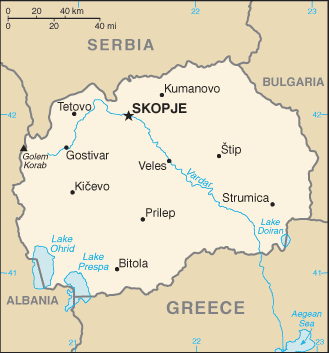
Click on map for larger view
Click on flag for Country Report





| TRAFFICKING IN PERSONS |
None reported.

