


| PERU Republic of Peru Republica del Peru Joined United Nations: 31 October 1945 Human Rights as assured by their constitution Click here Updated 28 August 2012 |
| CAPITAL |
| POPULATION |
| CHIEF OF STATE |
| SELECTION PROCESS |
Lima
29,549,517 (July 2012 est.)
Ollanta Humala Tasso
President since 28 July 2011
President since 28 July 2011
President elected by popular vote for a five-year term (eligible
for nonconsecutive reelection); presidential and congressional
elections last held on 10 April 2011 with runoff election held on
6 June 2011
Next scheduled election: April 2016
for nonconsecutive reelection); presidential and congressional
elections last held on 10 April 2011 with runoff election held on
6 June 2011
Next scheduled election: April 2016
HEAD OF GOVERNMENT
SELECTION PROCESS
Juan Federico Jimenez Mayor
Prime Minister since 23 July 2012
Prime Minister since 23 July 2012
The president is both the chief of state and head of government.
The prime minister does not exercise executive power; this
power is in the hands of the president and is selected by the
president
Next scheduled election: April 2016
The prime minister does not exercise executive power; this
power is in the hands of the president and is selected by the
president
Next scheduled election: April 2016
| DECLARATION OF HUMAN RIGHTS |
| ETHNIC GROUPS |
Amerindian 45%, mestizo (mixed Amerindian and white) 37%, white 15%, black, Japanese, Chinese, and other 3%
| RELIGIONS |
Roman Catholic 81.3%, Evangelical 12.5%, other 3.3%, unspecified or none 2.9% (2007 Census)
| GOVERNMENT STRUCTURE |
Constitutional republic with 25 regions (regiones, singular - region) and 1 province. Legal system is based on civil law
system; accepts compulsory ICJ jurisdiction, with reservations
Executive: President elected by popular vote for a five-year term (eligible for nonconsecutive reelection); presidential
and congressional elections last held on 10 April 2011 with runoff election held on 6 June 2011 (next to be held in April
2016)
Legislative: unicameral Congress of the Republic of Peru or Congreso de la Republica del Peru (130 seats; members
are elected by popular vote to serve five-year terms)
elections: last held on 10 April 2011 (next to be held in April 2016)
Judicial: Supreme Court of Justice or Corte Suprema de Justicia (judges are appointed by the National Council of the
Judiciary)
system; accepts compulsory ICJ jurisdiction, with reservations
Executive: President elected by popular vote for a five-year term (eligible for nonconsecutive reelection); presidential
and congressional elections last held on 10 April 2011 with runoff election held on 6 June 2011 (next to be held in April
2016)
Legislative: unicameral Congress of the Republic of Peru or Congreso de la Republica del Peru (130 seats; members
are elected by popular vote to serve five-year terms)
elections: last held on 10 April 2011 (next to be held in April 2016)
Judicial: Supreme Court of Justice or Corte Suprema de Justicia (judges are appointed by the National Council of the
Judiciary)
| LANGUAGES |
Spanish (official), Quechua (official), Aymara, and a large number of minor Amazonian languages
| BRIEF HISTORY |
Numerous indigenous cultures thrived in Ecuador for thousands of years before the Inca conquered the area. The Valdivia
culture in the Pacific coast region is the earliest known Ecuadorian culture. Ancient Valdivian artifacts from as early as
3500 B.C have been found along the coast north of the Guayas Province in the modern city of Santa Elena. Several other
cultures, including the Quituscaras and the Cañaris, emerged in other parts of Ecuador after the Valdivians. There are
other major archaeological sites in the coastal provinces of Manabí and Esmeraldas and in the middle Andean highland
provinces of Tungurahua and Chimborazo. With the archaeological evidence uncovered to date, we know that Ecuador
was inhabited for at least 4,500 years before the Inca arrived, however, many believe that the area was populated even
earlier, possibly as far back as 10,000 B.C. Great tracts of Ecuador, including almost all of the Oriente, remain unknown
to archaeologists; a fact that adds credence to the possibility the country was populated before 3500 B.C. The history of
Ecuador is better known from the point of the Inca expansion than during the Pre-Columbian era, though even after the
Inca conquered Ecuador many holes remain because of the limited recorded history they kept. In AD 1463, the Inca
warrior Pachacuti and his son Tupac Yupanqui began the incorporation of Ecuador into Inca rule. By the end of 15th
century, despite fierce resistance by several Ecuadorian native tribes, Huayna Capac, Topa Yupanqui's son, conquered all
of Ecuador. The Inca ruled the Ecuadorian Kingdoms until the arrival of Francisco Pizarro, Diego de Almargo and a force
of Spanish conquistadors in 1532. During the period of Inca control, the Ecuadorian tribesmen adopted agricultural
practices and the social organization of their Inca rulers, but maintained their traditional religious beliefs and many customs.
Ecuador's indigenous population would suffer far worse under Spanish colonial rule than it did under the Inca. Pizarro set
out on his third expedition during the final months of 1531 from Panama. The expedition would end in the defeat of the
Inca Empire and the Spanish colonization and conquest of Ecuador. He began the campaign with less than two hundred
men while his partner, Almargo, remained in Panama to gather more troops. When Pizarro's expedition finally arrived in
the recently founded Inca capital of Cajamarca, the new Inca king, Atahualpa Capac, was resting at nearby thermal baths
after prevailing in a bitter civil war with his brother. Atahualpa reluctantly returned to Cajamarca with thousands of his best
troops to greet Pizarro. When he went to Cajamarca's central plaza to meet the Conquistador, instead of Pizarro he found
a pompous Fray Vicente de Valverde waiting for him. Promptly after Atahualpa refused to submit to the Catholicism and
Spanish king, hiding Spanish soldiers and mercenaries slaughtered thousands of the Inca defenders and took Atahualpa
prisoner. Within a year of his capture, Atahualpa was executed. Ecuador was part of the Viceroyalty of Peru ruled from
Lima from 1544 until 1720, when it joined the newly created Viceroyalty of Nueva Granada ruled from Bogota.In
October 1820, in Guayaquil, a junta under the leadership of José Joaquín Olmedo declared Ecuador's independence from
its colonial master. García Moreno's conservative reign arguably gave the Roman Catholic Church more power in
Ecuador during the nineteenth century than it had in any other country in the world. Church turned factory during the
transition from Conservatism to Liberalism. After the Liberal Revolution and thirty years of Liberal rule, the Catholic
Church lost much of its hold on Ecuador. After World War II, a recovery in the market for agricultural commodities and
the growth of the banana industry helped restore prosperity and political peace. From 1948-60, three presidents -
beginning with Galo Plaza Lasso - were freely elected and completed their terms.In 1972, a nationalist military regime
overthrew José María Velasco Ibarra for the last time and used the new oil wealth and foreign borrowing to pay for a
program of industrialization, land reform, and subsidies for urban consumers. In May 1997, following the demonstrations
that led to the ousting of Bucaram and appointment of Alarcón, the people of Ecuador called for a National Assembly to
reform the Constitution and the country's political structure. After a little more than a year, the National Assembly
produced a new Constitution. 2001 saw the election of Alejandro Toledo, the first Quechua ethnic democratically
elected. The newly elected government took office on July 28, 2001. The Toledo Administration managed to restore
some degree of democracy to Peru following the authoritarianism and corruption that plagued both the Fujimori and
García governments. Innocents wrongfully tried by military courts during the war against terrorism (1980–2000) were
allowed to receive new trials in civilian courts. On August 28, 2003, the Truth and Reconciliation Commission (CVR),
which had been charged with studying the roots of the violence of the 1980–2000 period, presented its formal report to
the President. On July 28, 2006 former president Alan García became the current President of Peru. He won the 2006
elections after winning in a runoff against Ollanta Humala.On June 5, 2011, Ollanta Humala was elected President in a run-
off against Keiko Fujimori, the daughter of Alberto Fujimori and former First Lady of Peru, in the 2011 elections, making
him the first leftist president of Peru since Juan Velasco Alvarado. In December 2011, the state of emergency was
declared following popular opposition to some major mining project and environmental concerns.
Source: Wikipedia History of Ecuador
culture in the Pacific coast region is the earliest known Ecuadorian culture. Ancient Valdivian artifacts from as early as
3500 B.C have been found along the coast north of the Guayas Province in the modern city of Santa Elena. Several other
cultures, including the Quituscaras and the Cañaris, emerged in other parts of Ecuador after the Valdivians. There are
other major archaeological sites in the coastal provinces of Manabí and Esmeraldas and in the middle Andean highland
provinces of Tungurahua and Chimborazo. With the archaeological evidence uncovered to date, we know that Ecuador
was inhabited for at least 4,500 years before the Inca arrived, however, many believe that the area was populated even
earlier, possibly as far back as 10,000 B.C. Great tracts of Ecuador, including almost all of the Oriente, remain unknown
to archaeologists; a fact that adds credence to the possibility the country was populated before 3500 B.C. The history of
Ecuador is better known from the point of the Inca expansion than during the Pre-Columbian era, though even after the
Inca conquered Ecuador many holes remain because of the limited recorded history they kept. In AD 1463, the Inca
warrior Pachacuti and his son Tupac Yupanqui began the incorporation of Ecuador into Inca rule. By the end of 15th
century, despite fierce resistance by several Ecuadorian native tribes, Huayna Capac, Topa Yupanqui's son, conquered all
of Ecuador. The Inca ruled the Ecuadorian Kingdoms until the arrival of Francisco Pizarro, Diego de Almargo and a force
of Spanish conquistadors in 1532. During the period of Inca control, the Ecuadorian tribesmen adopted agricultural
practices and the social organization of their Inca rulers, but maintained their traditional religious beliefs and many customs.
Ecuador's indigenous population would suffer far worse under Spanish colonial rule than it did under the Inca. Pizarro set
out on his third expedition during the final months of 1531 from Panama. The expedition would end in the defeat of the
Inca Empire and the Spanish colonization and conquest of Ecuador. He began the campaign with less than two hundred
men while his partner, Almargo, remained in Panama to gather more troops. When Pizarro's expedition finally arrived in
the recently founded Inca capital of Cajamarca, the new Inca king, Atahualpa Capac, was resting at nearby thermal baths
after prevailing in a bitter civil war with his brother. Atahualpa reluctantly returned to Cajamarca with thousands of his best
troops to greet Pizarro. When he went to Cajamarca's central plaza to meet the Conquistador, instead of Pizarro he found
a pompous Fray Vicente de Valverde waiting for him. Promptly after Atahualpa refused to submit to the Catholicism and
Spanish king, hiding Spanish soldiers and mercenaries slaughtered thousands of the Inca defenders and took Atahualpa
prisoner. Within a year of his capture, Atahualpa was executed. Ecuador was part of the Viceroyalty of Peru ruled from
Lima from 1544 until 1720, when it joined the newly created Viceroyalty of Nueva Granada ruled from Bogota.In
October 1820, in Guayaquil, a junta under the leadership of José Joaquín Olmedo declared Ecuador's independence from
its colonial master. García Moreno's conservative reign arguably gave the Roman Catholic Church more power in
Ecuador during the nineteenth century than it had in any other country in the world. Church turned factory during the
transition from Conservatism to Liberalism. After the Liberal Revolution and thirty years of Liberal rule, the Catholic
Church lost much of its hold on Ecuador. After World War II, a recovery in the market for agricultural commodities and
the growth of the banana industry helped restore prosperity and political peace. From 1948-60, three presidents -
beginning with Galo Plaza Lasso - were freely elected and completed their terms.In 1972, a nationalist military regime
overthrew José María Velasco Ibarra for the last time and used the new oil wealth and foreign borrowing to pay for a
program of industrialization, land reform, and subsidies for urban consumers. In May 1997, following the demonstrations
that led to the ousting of Bucaram and appointment of Alarcón, the people of Ecuador called for a National Assembly to
reform the Constitution and the country's political structure. After a little more than a year, the National Assembly
produced a new Constitution. 2001 saw the election of Alejandro Toledo, the first Quechua ethnic democratically
elected. The newly elected government took office on July 28, 2001. The Toledo Administration managed to restore
some degree of democracy to Peru following the authoritarianism and corruption that plagued both the Fujimori and
García governments. Innocents wrongfully tried by military courts during the war against terrorism (1980–2000) were
allowed to receive new trials in civilian courts. On August 28, 2003, the Truth and Reconciliation Commission (CVR),
which had been charged with studying the roots of the violence of the 1980–2000 period, presented its formal report to
the President. On July 28, 2006 former president Alan García became the current President of Peru. He won the 2006
elections after winning in a runoff against Ollanta Humala.On June 5, 2011, Ollanta Humala was elected President in a run-
off against Keiko Fujimori, the daughter of Alberto Fujimori and former First Lady of Peru, in the 2011 elections, making
him the first leftist president of Peru since Juan Velasco Alvarado. In December 2011, the state of emergency was
declared following popular opposition to some major mining project and environmental concerns.
Source: Wikipedia History of Ecuador
| ECONOMIC OVERVIEW |
Peru's economy reflects its varied geography - an arid coastal region, the Andes further inland, and tropical lands
bordering Colombia and Brazil. Important mineral resources are found in the mountainous and coastal areas, and Peru's
coastal waters provide excellent fishing grounds. The Peruvian economy has been growing by an average of 6.4% per
year since 2002 with a stable/slightly appreciating exchange rate and low inflation. Growth in 2010 was close to 9%
and in 2011 almost 7%, due partly to a leap in private investment, especially in the extractive sector, which accounts for
more than 60% of Peru's total exports. At 3.4%, inflation in 2011 exceeded somewhat the upper range of the Central
Bank's 1%-3% target. Despite Peru's strong macroeconomic performance, dependence on minerals and metals
exports and imported foodstuffs subjects the economy to fluctuations in world prices. Poor infrastructure hinders the
spread of growth to Peru's non-coastal areas. Peru's rapid expansion coupled with cash transfers and other programs
have helped to reduce the national poverty rate by 23 percentage points since 2002. A growing number of Peruvians
are sharing in the benefits of growth but inequality persists posing a challenge for the new Ollanta HUMALA
administration, which has championed indigenous and local disenfranchised groups. The administration seems
committed to Peru's free-trade path. Since 2006, Peru has signed trade deals with the US, Canada, Singapore, China,
Korea, Mexico, and Japan, concluded negotiations with the European Free Trade Association and Chile, and begun
trade talks with Central American countries and others. The US-Peru Trade Promotion Agreement entered into force 1
February 2009, opening the way to greater trade and investment between the two economies. Trade agreements with
South Korea, Japan, and Mexico also were signed in 2011. Although Peru has continued to attract foreign investment,
political disputes and protests may impede development of some projects related to natural resource extraction.
bordering Colombia and Brazil. Important mineral resources are found in the mountainous and coastal areas, and Peru's
coastal waters provide excellent fishing grounds. The Peruvian economy has been growing by an average of 6.4% per
year since 2002 with a stable/slightly appreciating exchange rate and low inflation. Growth in 2010 was close to 9%
and in 2011 almost 7%, due partly to a leap in private investment, especially in the extractive sector, which accounts for
more than 60% of Peru's total exports. At 3.4%, inflation in 2011 exceeded somewhat the upper range of the Central
Bank's 1%-3% target. Despite Peru's strong macroeconomic performance, dependence on minerals and metals
exports and imported foodstuffs subjects the economy to fluctuations in world prices. Poor infrastructure hinders the
spread of growth to Peru's non-coastal areas. Peru's rapid expansion coupled with cash transfers and other programs
have helped to reduce the national poverty rate by 23 percentage points since 2002. A growing number of Peruvians
are sharing in the benefits of growth but inequality persists posing a challenge for the new Ollanta HUMALA
administration, which has championed indigenous and local disenfranchised groups. The administration seems
committed to Peru's free-trade path. Since 2006, Peru has signed trade deals with the US, Canada, Singapore, China,
Korea, Mexico, and Japan, concluded negotiations with the European Free Trade Association and Chile, and begun
trade talks with Central American countries and others. The US-Peru Trade Promotion Agreement entered into force 1
February 2009, opening the way to greater trade and investment between the two economies. Trade agreements with
South Korea, Japan, and Mexico also were signed in 2011. Although Peru has continued to attract foreign investment,
political disputes and protests may impede development of some projects related to natural resource extraction.
| POLITICAL CLIMATE |
The Republic of Peru is in a state of ongoing democratization. Led by President Alan García, the executive branch is
attempting to be transparent and accountable. Previously a rubberstamp body, Peru's unicameral Congress is emerging
as a strong counterbalance to the once-dominant executive branch, with increased oversight and investigative powers.
The executive branch and Congress are attempting to reform the judicial branch, antiquated and rife with corruption.
Other important political currents stem from the ongoing investigation of Fujimori-era corruption (notably the
proceedings against Fujimori's former advisor, Vladimiro Montesinos), and an increase in activities by the insurgent
group Sendero Luminoso. The recent trial of Abimael Guzmán has been suspended, due in part to Guzmán's use of it
as a forum for broadcasting Sendero Luminoso propaganda.
After a bitter and often vitriolic campaign, disgraced former President Alan Garcia won with 53.1% of the vote.
Nationalist rival and former coup-plotter, Ollanta Humala, received 46.9%. Mr Garcia, whose first presidency in
1985-1990 was blighted by record-breaking hyperinflation, debt-default, wide-scale corruption and a Maoist
insurgency, says that he's learned from his mistakes. Humala won the presidency from Garcia in 2011.
Source: Wikipedia: Politics of Peru
attempting to be transparent and accountable. Previously a rubberstamp body, Peru's unicameral Congress is emerging
as a strong counterbalance to the once-dominant executive branch, with increased oversight and investigative powers.
The executive branch and Congress are attempting to reform the judicial branch, antiquated and rife with corruption.
Other important political currents stem from the ongoing investigation of Fujimori-era corruption (notably the
proceedings against Fujimori's former advisor, Vladimiro Montesinos), and an increase in activities by the insurgent
group Sendero Luminoso. The recent trial of Abimael Guzmán has been suspended, due in part to Guzmán's use of it
as a forum for broadcasting Sendero Luminoso propaganda.
After a bitter and often vitriolic campaign, disgraced former President Alan Garcia won with 53.1% of the vote.
Nationalist rival and former coup-plotter, Ollanta Humala, received 46.9%. Mr Garcia, whose first presidency in
1985-1990 was blighted by record-breaking hyperinflation, debt-default, wide-scale corruption and a Maoist
insurgency, says that he's learned from his mistakes. Humala won the presidency from Garcia in 2011.
Source: Wikipedia: Politics of Peru
| INTERNATIONAL DISPUTES |
Chile and Ecuador rejected Peru's November 2005 unilateral legislation to shift the axis of their joint treaty-defined
maritime boundaries along the parallels of latitude to equidistance lines which favor Peru; organized illegal narcotics
operations in Colombia have penetrated Peru's shared border; Peru rejects Bolivia's claim to restore maritime access
through a sovereign corridor through Chile along the Peruvian border
maritime boundaries along the parallels of latitude to equidistance lines which favor Peru; organized illegal narcotics
operations in Colombia have penetrated Peru's shared border; Peru rejects Bolivia's claim to restore maritime access
through a sovereign corridor through Chile along the Peruvian border


| REFUGEES AND INTERNALLY DISPLACED PERSONS (IDP) |
IDPs: 150,000 (civil war from 1980-2000; most IDPs are indigenous peasants in Andean and Amazonian regions)
(2011)
(2011)
| ILLICIT DRUGS |
Until 1996 the world's largest coca leaf producer, Peru is now the world's second largest producer of coca leaf, though
it lags far behind Colombia; cultivation of coca in Peru was estimated at 40,000 hectares in 2009, a slight decrease
over 2008; second largest producer of cocaine, estimated at 225 metric tons of potential pure cocaine in 2009; finished
cocaine is shipped out from Pacific ports to the international drug market; increasing amounts of base and finished
cocaine, however, are being moved to Brazil, Chile, Argentina, and Bolivia for use in the Southern Cone or
transshipment to Europe and Africa; increasing domestic drug consumption
it lags far behind Colombia; cultivation of coca in Peru was estimated at 40,000 hectares in 2009, a slight decrease
over 2008; second largest producer of cocaine, estimated at 225 metric tons of potential pure cocaine in 2009; finished
cocaine is shipped out from Pacific ports to the international drug market; increasing amounts of base and finished
cocaine, however, are being moved to Brazil, Chile, Argentina, and Bolivia for use in the Southern Cone or
transshipment to Europe and Africa; increasing domestic drug consumption
| HUMAN RIGHTS STATEMENTS, ANALYSIS AND CRITIQUES |
2011 Human Rights Report: Peru
Bureau of Democracy, Human Rights, and Labor
2011 Country Reports on Human Rights Practices
May 24, 2012
Peru is a constitutional, multiparty republic. Ollanta Humala Tasso of the Peruvian Nationalist Party (part of the Gana Peru electoral
alliance) won the June presidential run-off elections in a vote considered free and fair and assumed office on July 28. Security
forces reported to civilian authorities.
The most serious human rights problems included violence against women and children, trafficking in persons, and government
corruption.
The following human rights problems also were reported: killings by security forces of protesters during demonstrations, harsh
prison conditions, abuse of detainees and inmates by prison security forces, lengthy pretrial detention and inordinate trial delays,
intimidation of the media, incomplete registration of internally displaced persons, and discrimination against women. There also was
discrimination against individuals with disabilities; members of racial and ethnic minority groups; indigenous persons; lesbian, gay,
bisexual, and transgender persons; and persons with HIV/AIDS. Other problems were a lack of labor law enforcement and the
exploitation of child labor, particularly in informal sectors.
The government took steps to investigate and in some cases prosecute or otherwise punish public officials who committed abuses.
Officials sometimes engaged in corrupt practices with impunity.
The terrorist organization Sendero Luminoso (Shining Path) was responsible for killings and other human rights abuses, including
the recruitment of child soldiers, extortion, and intimidation.
Click here to read more »
Bureau of Democracy, Human Rights, and Labor
2011 Country Reports on Human Rights Practices
May 24, 2012
Peru is a constitutional, multiparty republic. Ollanta Humala Tasso of the Peruvian Nationalist Party (part of the Gana Peru electoral
alliance) won the June presidential run-off elections in a vote considered free and fair and assumed office on July 28. Security
forces reported to civilian authorities.
The most serious human rights problems included violence against women and children, trafficking in persons, and government
corruption.
The following human rights problems also were reported: killings by security forces of protesters during demonstrations, harsh
prison conditions, abuse of detainees and inmates by prison security forces, lengthy pretrial detention and inordinate trial delays,
intimidation of the media, incomplete registration of internally displaced persons, and discrimination against women. There also was
discrimination against individuals with disabilities; members of racial and ethnic minority groups; indigenous persons; lesbian, gay,
bisexual, and transgender persons; and persons with HIV/AIDS. Other problems were a lack of labor law enforcement and the
exploitation of child labor, particularly in informal sectors.
The government took steps to investigate and in some cases prosecute or otherwise punish public officials who committed abuses.
Officials sometimes engaged in corrupt practices with impunity.
The terrorist organization Sendero Luminoso (Shining Path) was responsible for killings and other human rights abuses, including
the recruitment of child soldiers, extortion, and intimidation.
Click here to read more »
Peru: Investigate Killings at Mining Protests
Cajamarca Response Requires Restraint, Respect for Rule of Law
July 6, 2012
The Peruvian authorities should carry out a prompt, thorough, and impartial investigation into the killing of five civilians during
violent protests against mining activities in the Cajamarca region. The authorities should also investigate the circumstances
surrounding the arrest of an environmental activist, Marco Arana, and his treatment in detention.
Three civilians died from gunshot wounds on July 3, 2012, in the city of Celendín during a confrontation between protesters and
police and army units outside the city hall. More than 30 other civilians were injured, several of them reportedly with bullet wounds,
according to local hospital officials. The government declared a state of emergency in three of Cajamarca department’s provinces.
“The state has a responsibility to protect people from violence and to prosecute any protesters who used it,” said José Miguel
Vivanco, Americas director at Human Rights Watch. “But even if law enforcement was responding to violence, any use of lethal
force needs to be thoroughly investigated to determine whether police or soldiers acted lawfully.”
For several months there have been strikes and protests in Cajamarca against a large open-cast gold mine. The media reported that
the violence on July 3 began when a group of construction workers were protesting non-payment of wages for a school building
project. Those who died on July 3 – Faustino Silva Sánchez, José Eleuterio García Rojas, and César Medina Aguilar, a 17-year-old
high school student – appear to have been shot after army units moved in to help the police. Another civilian, José Antonio
Sánchez, who was gravely injured by a bullet wound in the throat, died in a hospital on July 5.
Joselito Vásquez Jambo was killed on July 4 during a clash between demonstrators and police in the town of Bambamarca in
circumstances that remain unclear.
The Interior Ministry said in a public statement that two policemen guarding the town hall in Celendín had been hit in the legs with
bullets fired by demonstrators trying to force their way into the building, and blamed leaders of the protests for the violence. Three
soldiers were also seriously injured, the ministry said.
The United Nations Basic Principles on the Use of Force and Firearms by Law Enforcement Officials require law enforcement
officials, in carrying out their duty, as far as possible, to apply non-lethal force before resorting to firearms in violent protests.
Whenever the use of firearms is unavoidable, law enforcement officials should use restraint and act in proportion to the seriousness
of the risk faced. The legitimate objective should be achieved with minimal damage and injury, and preservation of human life
respected.
Click here to read more »
Cajamarca Response Requires Restraint, Respect for Rule of Law
July 6, 2012
The Peruvian authorities should carry out a prompt, thorough, and impartial investigation into the killing of five civilians during
violent protests against mining activities in the Cajamarca region. The authorities should also investigate the circumstances
surrounding the arrest of an environmental activist, Marco Arana, and his treatment in detention.
Three civilians died from gunshot wounds on July 3, 2012, in the city of Celendín during a confrontation between protesters and
police and army units outside the city hall. More than 30 other civilians were injured, several of them reportedly with bullet wounds,
according to local hospital officials. The government declared a state of emergency in three of Cajamarca department’s provinces.
“The state has a responsibility to protect people from violence and to prosecute any protesters who used it,” said José Miguel
Vivanco, Americas director at Human Rights Watch. “But even if law enforcement was responding to violence, any use of lethal
force needs to be thoroughly investigated to determine whether police or soldiers acted lawfully.”
For several months there have been strikes and protests in Cajamarca against a large open-cast gold mine. The media reported that
the violence on July 3 began when a group of construction workers were protesting non-payment of wages for a school building
project. Those who died on July 3 – Faustino Silva Sánchez, José Eleuterio García Rojas, and César Medina Aguilar, a 17-year-old
high school student – appear to have been shot after army units moved in to help the police. Another civilian, José Antonio
Sánchez, who was gravely injured by a bullet wound in the throat, died in a hospital on July 5.
Joselito Vásquez Jambo was killed on July 4 during a clash between demonstrators and police in the town of Bambamarca in
circumstances that remain unclear.
The Interior Ministry said in a public statement that two policemen guarding the town hall in Celendín had been hit in the legs with
bullets fired by demonstrators trying to force their way into the building, and blamed leaders of the protests for the violence. Three
soldiers were also seriously injured, the ministry said.
The United Nations Basic Principles on the Use of Force and Firearms by Law Enforcement Officials require law enforcement
officials, in carrying out their duty, as far as possible, to apply non-lethal force before resorting to firearms in violent protests.
Whenever the use of firearms is unavoidable, law enforcement officials should use restraint and act in proportion to the seriousness
of the risk faced. The legitimate objective should be achieved with minimal damage and injury, and preservation of human life
respected.
Click here to read more »
Peru Must Investigate Police Attacks Against Media During Protest
Jun 15 2012 - 3:50pm
Freedom House is concerned by reports that journalists from local and national Peruvian media outlets were assaulted on June 14 by
police while covering clashes between anti-mining protesters and police in the city of Cajamarca. Protesters were on their 15th day
of a strike against the Conga mining project.
According to the journalists, police beat them with sticks and intentionally destroyed their camera equipment. Three female
journalists covering the protests from North TV, Sun TV, and Channel 15 were blatantly attacked despite the fact they were wearing
press vests. Edwin Lozano, a correspondent with Frequencia Latina, sustained several wounds after attacked, as well as extensive
damage to his camera. The Interior Ministry issued a statement condemning the attacks against the press and told the public that
those police officers involved in the attacks will be investigated.
While Freedom House welcomes the Peruvian government’s public condemnation of attacks, we are worried about increasing
violence against the media and protesters, and urge the government to take action to prevent further violence.
Peru is ranked Free in Freedom of the World 2012, Freedom House’s annual global assessment of political rights and civil liberties,
and Partly Free in Freedom of the Press 2012. There have been an increasing number of attacks against journalists. In May, four
individuals were killed following police violence at an anti-mining strike. According to el Instituto de Prensa y Sociedad (IPYS), the
month of May saw the highest number of attacks so far in 2012.
Click here to read more »
Jun 15 2012 - 3:50pm
Freedom House is concerned by reports that journalists from local and national Peruvian media outlets were assaulted on June 14 by
police while covering clashes between anti-mining protesters and police in the city of Cajamarca. Protesters were on their 15th day
of a strike against the Conga mining project.
According to the journalists, police beat them with sticks and intentionally destroyed their camera equipment. Three female
journalists covering the protests from North TV, Sun TV, and Channel 15 were blatantly attacked despite the fact they were wearing
press vests. Edwin Lozano, a correspondent with Frequencia Latina, sustained several wounds after attacked, as well as extensive
damage to his camera. The Interior Ministry issued a statement condemning the attacks against the press and told the public that
those police officers involved in the attacks will be investigated.
While Freedom House welcomes the Peruvian government’s public condemnation of attacks, we are worried about increasing
violence against the media and protesters, and urge the government to take action to prevent further violence.
Peru is ranked Free in Freedom of the World 2012, Freedom House’s annual global assessment of political rights and civil liberties,
and Partly Free in Freedom of the Press 2012. There have been an increasing number of attacks against journalists. In May, four
individuals were killed following police violence at an anti-mining strike. According to el Instituto de Prensa y Sociedad (IPYS), the
month of May saw the highest number of attacks so far in 2012.
Click here to read more »
30 May 2012
Committee on Economic, Social and Cultural Rights
Forty-eighth session
30 April-18 May 2012
Consideration of reports submitted by States parties under articles 16 and 17 of the Covenant
Concluding observations of the Committee on Economic, Social and Cultural Rights
Peru
A. Introduction
2. The Committee welcomes the submission of the combined second to fourth periodic reports of Peru, albeit with a
significant delay, and the written replies to its list of issues. It also notes with appreciation the high level of the State party’s
delegation, and its positive and constructive engagement with the Committee.
B. Positive aspects
3. The Committee notes with appreciation efforts made by the State party in promoting the implementation of economic, social
and cultural rights. It notes that the State party has made significant progress since the Committee’s previous interactive dialogue in
1997, and notes with appreciation the State party’s commitment to place human rights and social inclusion at the centre of its
policies.
4. The Committee welcomes in particular:
(a) The adoption of the Equal Opportunities for Men and Women Act (No.28983) on 16 March 2007;
(b) The adoption of the 2011-2016 National Action Plan to Combat Human Trafficking;
C. Principal subjects of concern and recommendations
5. The Committee notes with concern that there is no specific legislation prohibiting discrimination against persons based on
sexual orientation, and that lesbian, gay, bisexual or transgender persons have faced such discrimination in employment, housing,
and access to education and health care (art.2).
The Committee recommends that the State party expedite the adoption of specific legislation prohibiting discrimination against
persons based on sexual orientation and take measures, in particular awareness-raising, to ensure that LGBT persons are not
discriminated against on the basis of their sexual orientation and gender identity.
6. The Committee notes with concern that, despite legislative steps, persons with disabilities still face discrimination in
accessing employment (art.2).
The Committee recommends that the State party take steps to promote the employment of persons with disabilities, as well as to
protect them from discrimination in the workplace. The Committee also recommends that the State party ensure effective
compliance by public institutions with the 3 per cent quota accorded to persons with disabilities.
Click here to read more »
Committee on Economic, Social and Cultural Rights
Forty-eighth session
30 April-18 May 2012
Consideration of reports submitted by States parties under articles 16 and 17 of the Covenant
Concluding observations of the Committee on Economic, Social and Cultural Rights
Peru
A. Introduction
2. The Committee welcomes the submission of the combined second to fourth periodic reports of Peru, albeit with a
significant delay, and the written replies to its list of issues. It also notes with appreciation the high level of the State party’s
delegation, and its positive and constructive engagement with the Committee.
B. Positive aspects
3. The Committee notes with appreciation efforts made by the State party in promoting the implementation of economic, social
and cultural rights. It notes that the State party has made significant progress since the Committee’s previous interactive dialogue in
1997, and notes with appreciation the State party’s commitment to place human rights and social inclusion at the centre of its
policies.
4. The Committee welcomes in particular:
(a) The adoption of the Equal Opportunities for Men and Women Act (No.28983) on 16 March 2007;
(b) The adoption of the 2011-2016 National Action Plan to Combat Human Trafficking;
C. Principal subjects of concern and recommendations
5. The Committee notes with concern that there is no specific legislation prohibiting discrimination against persons based on
sexual orientation, and that lesbian, gay, bisexual or transgender persons have faced such discrimination in employment, housing,
and access to education and health care (art.2).
The Committee recommends that the State party expedite the adoption of specific legislation prohibiting discrimination against
persons based on sexual orientation and take measures, in particular awareness-raising, to ensure that LGBT persons are not
discriminated against on the basis of their sexual orientation and gender identity.
6. The Committee notes with concern that, despite legislative steps, persons with disabilities still face discrimination in
accessing employment (art.2).
The Committee recommends that the State party take steps to promote the employment of persons with disabilities, as well as to
protect them from discrimination in the workplace. The Committee also recommends that the State party ensure effective
compliance by public institutions with the 3 per cent quota accorded to persons with disabilities.
Click here to read more »
5 July 2012
Peru: Appeal for calm after fatal violence at mine protest
Local authorities and social leaders in Peru’s northern Cajamarca region must urgently appeal for calm, Amnesty International said
after violence erupted at protests against a goldmine, killing at least four people.
Since Wednesday, Peruvian authorities imposed a state of emergency in three northern provinces in response to the clashes, which
have also resulted in more than 20 injured people – including civilians and members of the security forces – and scores of arrests
over the past two days.
“The worrying intensification of social conflicts over natural resources in Peru is paving the way for a series of grave human rights
violations,” said Guadalupe Marengo, Deputy Americas Programme Director at Amnesty International.
“A full, independent and impartial investigation into the recent clashes is crucial, and those responsible for the loss of life must be
held to account. Security forces may only use the minimum amount of force necessary to avoid loss of life or serious injury to
themselves or others.”
Among those temporarily detained on Wednesday was Marco Arana, one of the leaders of the movement against the construction
of Peru’s largest goldmine nearby – known as Conga – which is overseen by US mining firm Newmont and a local subsidiary.
Marco Arana reported that police beat him in custody.
Amnesty International is deeply concerned about the situation of detainees and the ability of human rights defenders to carry on
their work without fear of reprisals.
“Even in a state of emergency the authorities must respect individuals’ right to life and physical integrity, and detainees must be
guaranteed their due process rights,” said Guadalupe Marengo.
Click here to read more »
Peru: Appeal for calm after fatal violence at mine protest
Local authorities and social leaders in Peru’s northern Cajamarca region must urgently appeal for calm, Amnesty International said
after violence erupted at protests against a goldmine, killing at least four people.
Since Wednesday, Peruvian authorities imposed a state of emergency in three northern provinces in response to the clashes, which
have also resulted in more than 20 injured people – including civilians and members of the security forces – and scores of arrests
over the past two days.
“The worrying intensification of social conflicts over natural resources in Peru is paving the way for a series of grave human rights
violations,” said Guadalupe Marengo, Deputy Americas Programme Director at Amnesty International.
“A full, independent and impartial investigation into the recent clashes is crucial, and those responsible for the loss of life must be
held to account. Security forces may only use the minimum amount of force necessary to avoid loss of life or serious injury to
themselves or others.”
Among those temporarily detained on Wednesday was Marco Arana, one of the leaders of the movement against the construction
of Peru’s largest goldmine nearby – known as Conga – which is overseen by US mining firm Newmont and a local subsidiary.
Marco Arana reported that police beat him in custody.
Amnesty International is deeply concerned about the situation of detainees and the ability of human rights defenders to carry on
their work without fear of reprisals.
“Even in a state of emergency the authorities must respect individuals’ right to life and physical integrity, and detainees must be
guaranteed their due process rights,” said Guadalupe Marengo.
Click here to read more »
TRANSLATED FROM SPANISH BY GOOGLE TRANSLATE
Deputy Minister Announces Creation of Virtual Observatory to monitor the National Human Rights Plan
Posted on August 15, 2012
Virtual Observatory
Deputy Minister of Human Rights and Access to Justice, Jose Avila, announced the launch of the Virtual Observatory, publicly
accessible tool that will help track the development and goals of the National Plan on Human Rights 2012-2016.
"Our main concern is to design mechanisms to ensure compliance with the National Plan. That's why this year we will launch this
Observatory to work a measurable plan, serious, responsible and real, "he said.
Avila Herrera said the National Human Rights Plan will be a tool for social inclusion, which will contain the views and needs of the
most vulnerable people, making it the first working document participatory and comprehensive, which will include the promotion of
Nations United to achieve respect for human dignity.
"Our commitment is to return the results of the 21 hearings to regional governments to develop their own Regional Plan on Human
Rights, within the guidelines of the National Plan. The country's decentralization process can not be complete without a component
for the satisfaction of human rights, "he added.
Deputy Minister of Human Rights and Access to Justice participated in the closing of the twenty-first public hearing, which is
closed with a round of consultations organized population, and regional and local governments nationwide on the National Human
Rights Plan 2012-2016.
At the ceremony attended by the mayor of Lima, Susana Villar, Jose Antonio Burnet, technical secretary of the National Council of
Human Rights, Alejandro Silva, a member of the core team of the National Human Rights and Carmen de la Vega, coordinator
Metropolitan Bureau of Agreement on Poverty Reduction.
Click here to read more »
Deputy Minister Announces Creation of Virtual Observatory to monitor the National Human Rights Plan
Posted on August 15, 2012
Virtual Observatory
Deputy Minister of Human Rights and Access to Justice, Jose Avila, announced the launch of the Virtual Observatory, publicly
accessible tool that will help track the development and goals of the National Plan on Human Rights 2012-2016.
"Our main concern is to design mechanisms to ensure compliance with the National Plan. That's why this year we will launch this
Observatory to work a measurable plan, serious, responsible and real, "he said.
Avila Herrera said the National Human Rights Plan will be a tool for social inclusion, which will contain the views and needs of the
most vulnerable people, making it the first working document participatory and comprehensive, which will include the promotion of
Nations United to achieve respect for human dignity.
"Our commitment is to return the results of the 21 hearings to regional governments to develop their own Regional Plan on Human
Rights, within the guidelines of the National Plan. The country's decentralization process can not be complete without a component
for the satisfaction of human rights, "he added.
Deputy Minister of Human Rights and Access to Justice participated in the closing of the twenty-first public hearing, which is
closed with a round of consultations organized population, and regional and local governments nationwide on the National Human
Rights Plan 2012-2016.
At the ceremony attended by the mayor of Lima, Susana Villar, Jose Antonio Burnet, technical secretary of the National Council of
Human Rights, Alejandro Silva, a member of the core team of the National Human Rights and Carmen de la Vega, coordinator
Metropolitan Bureau of Agreement on Poverty Reduction.
Click here to read more »
TRANSLATED FROM SPANISH BY GOOGLE TRANSLATE
Lima, Tuesday August 28, 2012
On behalf of victims of violence:
Ombudsman urges the State address memory demands, justice and reparation.
Advances on reparations, justice and memory are still insufficient, to nine years in the delivery of the report of the TRC.
Nine years after the delivery of the Report of the Commission of Truth and Reconciliation Commission (TRC), the Ombudsman
(e), Eduardo Vega, acknowledged that the initial efforts of the state to cater to civilian casualties, police and military, not have been
sufficient to enable them to access comprehensive repairs, timely and dignified.
"While there have been efforts, they have focused on collective reparations, however there is still more work to individual repairs,
especially in health, education and economic. Unfortunately there are victims who have died without having received a fair and
appropriate care, "said the representative of the Ombudsman.
In that context, he recalled the pending amendment of DS No. 051-2011 - PCM, and the recognition of the transfer of the right in
favor of the children of the direct victims, in education.
Gisella Vignolo, Deputy for Human Rights and Persons with Disabilities of the Ombudsman said in justice that there have been
some setbacks. For example, he said the recent ruling on the Colina group that ignored international standards of human rights
binding on the State.
On the other hand, questioned the pending implementation of a National Plan Exhumation allowing the location and identification of
more than 15,000 missing we left the era of terrorism.
"The exhumation process has presented several difficulties: lack of financial resources, training of judges, forensic experts largest
number of specialized inputs for DNA testing, among others. In conclusion, we have a policy of searching for missing persons, "he
said Vignolo.
Click here to read more »
Lima, Tuesday August 28, 2012
On behalf of victims of violence:
Ombudsman urges the State address memory demands, justice and reparation.
Advances on reparations, justice and memory are still insufficient, to nine years in the delivery of the report of the TRC.
Nine years after the delivery of the Report of the Commission of Truth and Reconciliation Commission (TRC), the Ombudsman
(e), Eduardo Vega, acknowledged that the initial efforts of the state to cater to civilian casualties, police and military, not have been
sufficient to enable them to access comprehensive repairs, timely and dignified.
"While there have been efforts, they have focused on collective reparations, however there is still more work to individual repairs,
especially in health, education and economic. Unfortunately there are victims who have died without having received a fair and
appropriate care, "said the representative of the Ombudsman.
In that context, he recalled the pending amendment of DS No. 051-2011 - PCM, and the recognition of the transfer of the right in
favor of the children of the direct victims, in education.
Gisella Vignolo, Deputy for Human Rights and Persons with Disabilities of the Ombudsman said in justice that there have been
some setbacks. For example, he said the recent ruling on the Colina group that ignored international standards of human rights
binding on the State.
On the other hand, questioned the pending implementation of a National Plan Exhumation allowing the location and identification of
more than 15,000 missing we left the era of terrorism.
"The exhumation process has presented several difficulties: lack of financial resources, training of judges, forensic experts largest
number of specialized inputs for DNA testing, among others. In conclusion, we have a policy of searching for missing persons, "he
said Vignolo.
Click here to read more »
TRANSLATED FROM SPANISH BY GOOGLE TRANSLATE
Aug 28th 2012
SECCIONES: Affirmation of identity, News
For a national education system to reassess our diversity
Rivera Zea Tarcila indigenous leader said that education for diversity should be a key pillar to form new citizens.
He called for a national education system during intercultural forum at the Congress.
A national education system to reassess our diversity claimed the indigenous leader Tarcila Rivera, president and general
coordinator CHIRAPAQ Continental Network of Indigenous Women of the Americas ECMIA. Rivera participated in Forum: Racial
Discrimination and Social Inclusion held last Friday at the Congress.
"It is not enough just to intercultural education program focused on one or two regions. We require that the national education
system to insert the topic of multiculturalism for youth from schools in the capital know the value of our diverse cultures, "he said
in his presentation.
For Quechua leader, besides generating education and also create a self-esteem skills. "Education for diversity has to be the
cornerstone for creating a new citizenship and full citizen and subject of its own transformation."
Rivera said that the formation of female leadership, work on self-esteem and strengthening our identities are also educational
elements. "We can not walk without building common areas of struggle against racism, as was the National Commission
Interethnic of Peru, where together with Amazonian and Afro brothers shook hands and began an interesting learning process and
experiences to create policies against discrimination and exclusion, visible forms of racism, "he recalled.
Coinciding with the board members in creating policies that include the diversity of our people as a constitution of which we as
Peruvians, Rivera listed the challenges and possible ways to help us understand the scope and impact of racism within our society.
"Understand that racism is part of the colonial imposed from outside, focus on strengthening the identity processes to understand
and reassess, rescue and reinterpret our ancestral wisdom and knowledge are an alternative to the systemic crisis which we live,"
he said.
With full capacity and with a young main auditorium, a fact that was emphasized by all speakers, the activity ended with a tribute to
women of African descent. The event was organized by the office of Congresswoman Rosa Mavila Leon and Amnesty
International.
Click here to read more>>
Aug 28th 2012
SECCIONES: Affirmation of identity, News
For a national education system to reassess our diversity
Rivera Zea Tarcila indigenous leader said that education for diversity should be a key pillar to form new citizens.
He called for a national education system during intercultural forum at the Congress.
A national education system to reassess our diversity claimed the indigenous leader Tarcila Rivera, president and general
coordinator CHIRAPAQ Continental Network of Indigenous Women of the Americas ECMIA. Rivera participated in Forum: Racial
Discrimination and Social Inclusion held last Friday at the Congress.
"It is not enough just to intercultural education program focused on one or two regions. We require that the national education
system to insert the topic of multiculturalism for youth from schools in the capital know the value of our diverse cultures, "he said
in his presentation.
For Quechua leader, besides generating education and also create a self-esteem skills. "Education for diversity has to be the
cornerstone for creating a new citizenship and full citizen and subject of its own transformation."
Rivera said that the formation of female leadership, work on self-esteem and strengthening our identities are also educational
elements. "We can not walk without building common areas of struggle against racism, as was the National Commission
Interethnic of Peru, where together with Amazonian and Afro brothers shook hands and began an interesting learning process and
experiences to create policies against discrimination and exclusion, visible forms of racism, "he recalled.
Coinciding with the board members in creating policies that include the diversity of our people as a constitution of which we as
Peruvians, Rivera listed the challenges and possible ways to help us understand the scope and impact of racism within our society.
"Understand that racism is part of the colonial imposed from outside, focus on strengthening the identity processes to understand
and reassess, rescue and reinterpret our ancestral wisdom and knowledge are an alternative to the systemic crisis which we live,"
he said.
With full capacity and with a young main auditorium, a fact that was emphasized by all speakers, the activity ended with a tribute to
women of African descent. The event was organized by the office of Congresswoman Rosa Mavila Leon and Amnesty
International.
Click here to read more>>

Marisol Espinoza Cruz
First Vice President since 28 July 2011
First Vice President since 28 July 2011
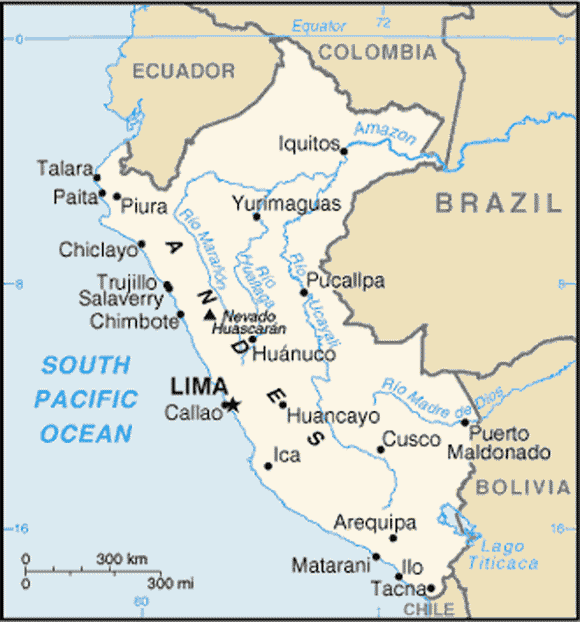
| Click map for larger view |
| Click flag for Country Report |

Vacant
Second Vice President since 18 January 2012
Second Vice President since 18 January 2012



| TRAFFICKING IN PERSONS |
None reported.



Ollanta Humala Tasso
President since 28 July 2011
President since 28 July 2011

