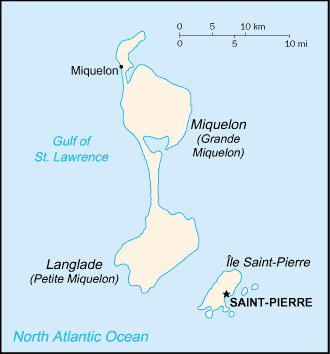
| SAINT-PIERRE AND MIQUELON Territorial Collectivity of Saint-Pierre and Miquelon Departement de Saint-Pierre et Miquelon (Overseas Department of France) Joined United Nations: 24 October 1945 Human Rights as assured by their constitution Click here Updated 04 January 2013 |

| CAPITAL |
| POPULATION |
| CHIEF OF STATE |
| SELECTION PROCESS |
Saint-Pierre
6,345 (July 2011 est.)
Stéphane Artano
President of the Territorial Council
since 21 February 2007
President of the Territorial Council
since 21 February 2007
French president elected by popular vote for a five-year term;
prefect appointed by the French president on the advice of the
French Ministry of Interior; election last held 22 April and 6 May
2012
Next scheduled election: Spring 2017
prefect appointed by the French president on the advice of the
French Ministry of Interior; election last held 22 April and 6 May
2012
Next scheduled election: Spring 2017
HEAD OF GOVERNMENT
SELECTION PROCESS
President of the Territorial Council is elected by the members of
the council; election last held 18 March 2012
Next scheduled election: March 2018
the council; election last held 18 March 2012
Next scheduled election: March 2018
| DECLARATION OF HUMAN RIGHTS |
| ETHNIC GROUPS |
Basques and Bretons (French fishermen)
| RELIGIONS |
Roman Catholic 99%, other 1%
| GOVERNMENT STRUCTURE |
Self-governing territorial overseas collectivity of France with two communes; Legal system are the laws of France, where applicable
Executive: French president elected by popular vote for a five-year term; election last held 22 April and 6 May 2012 (next to be
held in Spring 2017); prefect appointed by the French president on the advice of the French Ministry of Interior; president of the
territorial Council is elected by the members of the council
Legislative: Unicameral General Council or Conseil General (19 seats, 15 from Saint Pierre and four from Miquelon; members are
elected by popular vote to serve six-year terms)
elections: elections last held 18 March 2012 (next to be held in March 2018)
note: Saint Pierre and Miquelon elect one member to the French Senate; elections last held on 21 September 2008 (next to be held
in September 2014); Saint Pierre and Miquelon also elects one member to the French National Assembly; elections last held on 17
June 2012 (next to be held by June 2017);
Judicial: Superior Tribunal of Appeals or Tribunal Superieur d'Appel
Executive: French president elected by popular vote for a five-year term; election last held 22 April and 6 May 2012 (next to be
held in Spring 2017); prefect appointed by the French president on the advice of the French Ministry of Interior; president of the
territorial Council is elected by the members of the council
Legislative: Unicameral General Council or Conseil General (19 seats, 15 from Saint Pierre and four from Miquelon; members are
elected by popular vote to serve six-year terms)
elections: elections last held 18 March 2012 (next to be held in March 2018)
note: Saint Pierre and Miquelon elect one member to the French Senate; elections last held on 21 September 2008 (next to be held
in September 2014); Saint Pierre and Miquelon also elects one member to the French National Assembly; elections last held on 17
June 2012 (next to be held by June 2017);
Judicial: Superior Tribunal of Appeals or Tribunal Superieur d'Appel
| LANGUAGES |
French (official)
| BRIEF HISTORY |
Some of the native artifacts found on the islands of Saint Pierre and Miquelon date back to 6000 BC. There is no record of native
habitation of Saint Pierre and Miquelon by the time that Europeans arrived. Beothuk and Paleoeskimo or Dorset culture artifacts
have been uncovered on the island Saint-Pierre at Anse à Henry, north of the town of Saint-Pierre. The Beothuk painted themselves
with red ochre, which was the origin of the term "Red Indian". The Beothuk did not survive long after their first encounters with
Europeans. The first map that showed Saint Pierre and Miquelon was the Mappa mundi of 1500 created by Juan de la Cosa,
where they were labelled 'Illa de la Trenidat'. There are some who argue that the 'Green Islands' encountered during the two
pre-1472 Portuguese expeditions under João Vaz Corte-Real and the 1501 Portuguese expedition under his son Gaspar
Corte-Real were St. Pierre and the islands near it. A map drawn by Johannes Ruysch published in 1507 depicts Miquelon, St.
Pierre and the surrounding islands, and labelled as Barbatos. Portuguese explorer João Álvares Fagundes on the 21st of October
1520 named the St. Pierre island group the 'Eleven Thousand Virgins'. Jacques Cartier of France referred to Saint Pierre and
Miquelon and the neighboring islands as the 'Islands of Saint-Pierre' in a written report after his visit in 1536. This was the earliest
known written reference to the name 'Saint-Pierre'. The first use of the name 'Miquelon' for the large western island in the St. Pierre
island group appears in Les voyages aventureux du Capitaine Martin de Hoyarsal, habitant du çubiburu a reference book for sailors
known as a "navigational pilot", written by Basque seaman Martin de Hoyarçabal in 1579. During the 16th century, the islands were
used as a base for the seasonal cod fishery by the French of La Rochelle, Granville, Saint-Malo and the Basque Country. French
explorer Jacques Cartier was in Saint-Pierre in 1536. By this time, Basque, Breton and Norman fishermen had been fishing in the
waters off these islands for over 30 years. The first written evidence of year-round residents on the islands was in a report in 1670
by the first intendant of New France, Jean Talon, who recorded the presence of 13 fishermen and 4 sedentary residents. By 1687,
there were 3 families living on the islands, a small chapel was built in 1689 and a military post was constructed in 1690 in
Saint-Pierre. Two long wars between France and England, King William's War, extending from 1689 to 1697 and Queen Anne's
War, from 1702 to 1712 were associated with at least five British attacks on the islands. This led to the abandonment of the islands
by many of the French settlers by 1708. Some of the settlers that left went to Cape Breton Island to live in the new French fishing
colony of Ile Royale. The Treaty of Utrecht brought these wars to an end, and France ceded possession of Saint Pierre and
Miquelon, as well as Newfoundland, to the English. After they took control of the islands in 1713, the English changed the name of
St. Pierre to "Saint Peter's". In the summer of 1763, after England had agreed to return the islands to French possession, James
Cook mapped the islands of Saint Pierre and Miquelon. Between 1763 and 1778, the islands became a place of refuge for Acadian
deportees from Nova Scotia. In 1778 the islands were attacked by a force led by Newfoundland's Governor John Montagu and
the population deported by the British as retaliation for French support of the American Revolutionary War. The residents were sent
to France and their homes were destroyed. France regained the islands in 1783 after the Treaty of Versailles and some residents
returned to the islands. In May of 1793, British hostility to the French Revolution and the fact that France had declared war on the
United Kingdom as part of the War of the First Coalition, led to another British attack on the islands under Captain William Affleck
of Halifax. The seasonal fishermen and French military forces were deported in 1793, followed by the 950 residents in 1794, who
were shipped to Halifax and held for two years. English fishermen took possession of the islands. Only 2 years later, French forces
under Rear-Admiral de Richery attacked the islands in 1796, sinking 80 British vessels. The English abandoned the islands, and the
French destroyed the town. After this, the islands remained deserted until 1816. The islands were finally returned to France after the
second abdication of Napoleon in 1815. The increasing French presence on the French Shore led to tension between the French
and English inhabitants, and extensive negotations between France and Britain. These negotiations resulted in a convention in 1857
in which Britain agreed to allow French settlements on the French Shore and eventually their exclusive use of this territory.
Submarine trans-Atlantic telegraph cables from France in the 1800s typically were routed from the French mainland through stations
on Miquelon or St. Pierre, and then on to Nova Scotia or the United States. The first was laid in 1869. The First World War
resulted in disruptions of supplies from France between 1914 and 1918, and the death of over 100 residents in the trenches of
Europe. Starting in 1920, the US passed the Eighteenth Amendment to the United States Constitution which led to Prohibition. As a
result, St. Pierre and Miquelon became the transshipment point for bringing illegal alcohol from Canada into the United States.
Many gangsters including Al Capone and Bill McCoy set up operations in the islands, using them as a base to smuggle alcohol into
the US. As quickly as it began, the boom collapsed when Prohibition was repealed, leaving a depressed local economy. On
Christmas Eve 1941, Free French forces led by Rear-Admiral Émile Muselier "invaded" the islands on behalf of Charles de Gaulle,
commanding three corvettes and the submarine Surcouf. The Vichy administration on the islands immediately surrendered. This
"invasion" by Free French forces exploded into a major international incidence because the use of military force by Free France was
contrary to the Monroe Doctrine. The United States and Canada both threatened invasion of the islands, despite Free France being
a nominal ally of both countries. However, the "liberation" of St. Pierre and Miquelon had graced the front pages of major
newspapers in both countries as one of the first territories to be removed from Axis control. At the end of the second World War in
1945, Saint Pierre and Miquelon resumed its place as a center for cod-fishing. Other nations joined the French fleet to fish in the
waters around the islands. The economy was not as prosperous as it had been, and by the 1960s French government subsidies
constituted half the budget of the islands. This led to the reputation of the island residents as being "the world's most expensive
Frenchmen". In the late 1950s De Gaulle offered all French colonies political and financial independence. Saint Pierre and Miquelon
chose to remain part of France. A political leadership crisis in Saint Pierre and Miquelon erupted in 1965. France sent in an armed
force of 'gardes mobiles'. In response, the residents of Saint Pierre and Miquelon mounted a three-day general strike in protest of
this interference in local affairs. The islands became a full département d'outre mer of France in 1976. This status was modified in
1985 and the islands became a territory with special status (collectivité territoriale à statut particulier). After the constitutional reform
of 2003, it became a collectivité d'outre-mer, while keeping its particular name of collectivité territoriale de
Saint-Pierre-et-Miquelon. To the consternation of law enforcement officials, there continues to be smuggling of alcohol and tobacco
from Saint Pierre and Miquelon to Newfoundland. This illegal trade has a long history and tradition, and is partly driven by a
depressed local economy. At this point, Saint Pierre and Miquelon represent the sole remaining vestige of France's once vast North
American possessions. They have always been most important as a fishing centre, being in easy travelling distance of the Grand
Banks of Newfoundland, some of the world's richest fishing grounds. However, they are slowly diversifying their economy into
tourism and other activities, with the assistance of the French government. As a result of an agreement {ref} between the European
Union and France, the Euro became the legal currency of the French overseas territories of French Guiana, Réunion, Saint Pierre
and Miquelon, Guadeloupe, Martinique and Mayotte in 2002. The Territorial Council (Conseil territorial) is the legislative branch of
the government of the French territory. It was previously known as General Council (Conseil général), but the name was changed
into Territorial Council by the French law of February 22, 2007 which also increased the council's powers. The Territorial Council
Building is an orange two story structure located at Church Square in Saint-Pierre.
Source: Wikipedia: History of Saint-Pierre and Miquelon
habitation of Saint Pierre and Miquelon by the time that Europeans arrived. Beothuk and Paleoeskimo or Dorset culture artifacts
have been uncovered on the island Saint-Pierre at Anse à Henry, north of the town of Saint-Pierre. The Beothuk painted themselves
with red ochre, which was the origin of the term "Red Indian". The Beothuk did not survive long after their first encounters with
Europeans. The first map that showed Saint Pierre and Miquelon was the Mappa mundi of 1500 created by Juan de la Cosa,
where they were labelled 'Illa de la Trenidat'. There are some who argue that the 'Green Islands' encountered during the two
pre-1472 Portuguese expeditions under João Vaz Corte-Real and the 1501 Portuguese expedition under his son Gaspar
Corte-Real were St. Pierre and the islands near it. A map drawn by Johannes Ruysch published in 1507 depicts Miquelon, St.
Pierre and the surrounding islands, and labelled as Barbatos. Portuguese explorer João Álvares Fagundes on the 21st of October
1520 named the St. Pierre island group the 'Eleven Thousand Virgins'. Jacques Cartier of France referred to Saint Pierre and
Miquelon and the neighboring islands as the 'Islands of Saint-Pierre' in a written report after his visit in 1536. This was the earliest
known written reference to the name 'Saint-Pierre'. The first use of the name 'Miquelon' for the large western island in the St. Pierre
island group appears in Les voyages aventureux du Capitaine Martin de Hoyarsal, habitant du çubiburu a reference book for sailors
known as a "navigational pilot", written by Basque seaman Martin de Hoyarçabal in 1579. During the 16th century, the islands were
used as a base for the seasonal cod fishery by the French of La Rochelle, Granville, Saint-Malo and the Basque Country. French
explorer Jacques Cartier was in Saint-Pierre in 1536. By this time, Basque, Breton and Norman fishermen had been fishing in the
waters off these islands for over 30 years. The first written evidence of year-round residents on the islands was in a report in 1670
by the first intendant of New France, Jean Talon, who recorded the presence of 13 fishermen and 4 sedentary residents. By 1687,
there were 3 families living on the islands, a small chapel was built in 1689 and a military post was constructed in 1690 in
Saint-Pierre. Two long wars between France and England, King William's War, extending from 1689 to 1697 and Queen Anne's
War, from 1702 to 1712 were associated with at least five British attacks on the islands. This led to the abandonment of the islands
by many of the French settlers by 1708. Some of the settlers that left went to Cape Breton Island to live in the new French fishing
colony of Ile Royale. The Treaty of Utrecht brought these wars to an end, and France ceded possession of Saint Pierre and
Miquelon, as well as Newfoundland, to the English. After they took control of the islands in 1713, the English changed the name of
St. Pierre to "Saint Peter's". In the summer of 1763, after England had agreed to return the islands to French possession, James
Cook mapped the islands of Saint Pierre and Miquelon. Between 1763 and 1778, the islands became a place of refuge for Acadian
deportees from Nova Scotia. In 1778 the islands were attacked by a force led by Newfoundland's Governor John Montagu and
the population deported by the British as retaliation for French support of the American Revolutionary War. The residents were sent
to France and their homes were destroyed. France regained the islands in 1783 after the Treaty of Versailles and some residents
returned to the islands. In May of 1793, British hostility to the French Revolution and the fact that France had declared war on the
United Kingdom as part of the War of the First Coalition, led to another British attack on the islands under Captain William Affleck
of Halifax. The seasonal fishermen and French military forces were deported in 1793, followed by the 950 residents in 1794, who
were shipped to Halifax and held for two years. English fishermen took possession of the islands. Only 2 years later, French forces
under Rear-Admiral de Richery attacked the islands in 1796, sinking 80 British vessels. The English abandoned the islands, and the
French destroyed the town. After this, the islands remained deserted until 1816. The islands were finally returned to France after the
second abdication of Napoleon in 1815. The increasing French presence on the French Shore led to tension between the French
and English inhabitants, and extensive negotations between France and Britain. These negotiations resulted in a convention in 1857
in which Britain agreed to allow French settlements on the French Shore and eventually their exclusive use of this territory.
Submarine trans-Atlantic telegraph cables from France in the 1800s typically were routed from the French mainland through stations
on Miquelon or St. Pierre, and then on to Nova Scotia or the United States. The first was laid in 1869. The First World War
resulted in disruptions of supplies from France between 1914 and 1918, and the death of over 100 residents in the trenches of
Europe. Starting in 1920, the US passed the Eighteenth Amendment to the United States Constitution which led to Prohibition. As a
result, St. Pierre and Miquelon became the transshipment point for bringing illegal alcohol from Canada into the United States.
Many gangsters including Al Capone and Bill McCoy set up operations in the islands, using them as a base to smuggle alcohol into
the US. As quickly as it began, the boom collapsed when Prohibition was repealed, leaving a depressed local economy. On
Christmas Eve 1941, Free French forces led by Rear-Admiral Émile Muselier "invaded" the islands on behalf of Charles de Gaulle,
commanding three corvettes and the submarine Surcouf. The Vichy administration on the islands immediately surrendered. This
"invasion" by Free French forces exploded into a major international incidence because the use of military force by Free France was
contrary to the Monroe Doctrine. The United States and Canada both threatened invasion of the islands, despite Free France being
a nominal ally of both countries. However, the "liberation" of St. Pierre and Miquelon had graced the front pages of major
newspapers in both countries as one of the first territories to be removed from Axis control. At the end of the second World War in
1945, Saint Pierre and Miquelon resumed its place as a center for cod-fishing. Other nations joined the French fleet to fish in the
waters around the islands. The economy was not as prosperous as it had been, and by the 1960s French government subsidies
constituted half the budget of the islands. This led to the reputation of the island residents as being "the world's most expensive
Frenchmen". In the late 1950s De Gaulle offered all French colonies political and financial independence. Saint Pierre and Miquelon
chose to remain part of France. A political leadership crisis in Saint Pierre and Miquelon erupted in 1965. France sent in an armed
force of 'gardes mobiles'. In response, the residents of Saint Pierre and Miquelon mounted a three-day general strike in protest of
this interference in local affairs. The islands became a full département d'outre mer of France in 1976. This status was modified in
1985 and the islands became a territory with special status (collectivité territoriale à statut particulier). After the constitutional reform
of 2003, it became a collectivité d'outre-mer, while keeping its particular name of collectivité territoriale de
Saint-Pierre-et-Miquelon. To the consternation of law enforcement officials, there continues to be smuggling of alcohol and tobacco
from Saint Pierre and Miquelon to Newfoundland. This illegal trade has a long history and tradition, and is partly driven by a
depressed local economy. At this point, Saint Pierre and Miquelon represent the sole remaining vestige of France's once vast North
American possessions. They have always been most important as a fishing centre, being in easy travelling distance of the Grand
Banks of Newfoundland, some of the world's richest fishing grounds. However, they are slowly diversifying their economy into
tourism and other activities, with the assistance of the French government. As a result of an agreement {ref} between the European
Union and France, the Euro became the legal currency of the French overseas territories of French Guiana, Réunion, Saint Pierre
and Miquelon, Guadeloupe, Martinique and Mayotte in 2002. The Territorial Council (Conseil territorial) is the legislative branch of
the government of the French territory. It was previously known as General Council (Conseil général), but the name was changed
into Territorial Council by the French law of February 22, 2007 which also increased the council's powers. The Territorial Council
Building is an orange two story structure located at Church Square in Saint-Pierre.
Source: Wikipedia: History of Saint-Pierre and Miquelon
| ECONOMIC OVERVIEW |
TThe inhabitants have traditionally earned their livelihood by fishing and by servicing fishing fleets operating off the coast of
Newfoundland. The economy has been declining, however, because of disputes with Canada over fishing quotas and a steady
decline in the number of ships stopping at Saint Pierre. In 1992, an arbitration panel awarded the islands an exclusive economic
zone of 12,348 sq km to settle a longstanding territorial dispute with Canada, although it represents only 25% of what France had
sought. France heavily subsidizes the islands to the great betterment of living standards. The government hopes an expansion of
tourism will boost economic prospects. Fish farming, crab fishing, and agriculture are being developed to diversify the local
economy. Recent test drilling for oil may pave the way for development of the energy sector.
Source: CIA World Factbook (select Saint-Pierre and Miquelon)
Newfoundland. The economy has been declining, however, because of disputes with Canada over fishing quotas and a steady
decline in the number of ships stopping at Saint Pierre. In 1992, an arbitration panel awarded the islands an exclusive economic
zone of 12,348 sq km to settle a longstanding territorial dispute with Canada, although it represents only 25% of what France had
sought. France heavily subsidizes the islands to the great betterment of living standards. The government hopes an expansion of
tourism will boost economic prospects. Fish farming, crab fishing, and agriculture are being developed to diversify the local
economy. Recent test drilling for oil may pave the way for development of the energy sector.
Source: CIA World Factbook (select Saint-Pierre and Miquelon)
| POLITICAL CLIMATE |
Politics of Saint Pierre and Miquelon takes place in a framework of a parliamentary representative democratic French overseas
collectivity, whereby the President of the Territorial Council is the head of government, and of a pluriform multi-party system.
Executive power is exercised by the government.
The head of state is President Nicolas Sarkozy of France as represented by Préfet (Prefect) Albert Dupuy (since 10 January 2005).
The Prefect is essentially the Governor of the territory.
The Territorial Council of Saint-Pierre and Miquelon (French: Conseil territorial de Saint-Pierre-et-Miquelon), which was known
until February 22, 2007 as the General Council (Conseil général), has 19 members, elected for a three year term in single seat
constituencies. The council sits at the Territorial Council Building, a two storey, two tone aqua colour building on St. Pierre.
The judiciary of the territory consists of the Superior Tribunal of Appeals (Tribunal Superieur d'Appel).
The court resides at the Palais de Justice or Courthouse and are located at Church Square in St. Pierre.
Source: Wikipedia: Politics of Saint-Pierre and Miquelon
collectivity, whereby the President of the Territorial Council is the head of government, and of a pluriform multi-party system.
Executive power is exercised by the government.
The head of state is President Nicolas Sarkozy of France as represented by Préfet (Prefect) Albert Dupuy (since 10 January 2005).
The Prefect is essentially the Governor of the territory.
The Territorial Council of Saint-Pierre and Miquelon (French: Conseil territorial de Saint-Pierre-et-Miquelon), which was known
until February 22, 2007 as the General Council (Conseil général), has 19 members, elected for a three year term in single seat
constituencies. The council sits at the Territorial Council Building, a two storey, two tone aqua colour building on St. Pierre.
The judiciary of the territory consists of the Superior Tribunal of Appeals (Tribunal Superieur d'Appel).
The court resides at the Palais de Justice or Courthouse and are located at Church Square in St. Pierre.
Source: Wikipedia: Politics of Saint-Pierre and Miquelon
| INTERNATIONAL DISPUTES |
None reported.


| REFUGEES AND INTERNALLY DISPLACED PERSONS (IDPS) |
None reported.
| ILLICIT DRUGS |
None reported.
| HUMAN RIGHTS STATEMENTS, ANALYSIS AND CRITIQUES |
Limits in the Seas
No. 57
Canada- St.-Pierre and Miquelon
Territorial Sea Boundary
The Governments of Canada and the French Republic signed an agreement on March 27, 1972, concerning their mutual fishing relations
off the Atlantic coast of Canada. The agreement entered into force on the date of signing. Annexed to the agreement was a declaration
delimiting the territorial sea between the Canadian province of Newfoundland and the French overseas territory of St.-Pierre and
Miquelon. Neither country is party to the 1958 Geneva Convention on the Territorial Sea and Contiguous Zone.
The Agreement Between Canada and France on Their Mutual Fishing Relations, Having regard to the fact that the Canadian Government
has deemed it necessary, notably with a view to ensuring the protection of Canadian fisheries, to adopt certain measures relating to the
delimitation of the territorial sea and the fishing zones of Canada,
Considering it desirable to adapt to present circumstances their mutual relations in fishery
matters.
Click here to read more »
No. 57
Canada- St.-Pierre and Miquelon
Territorial Sea Boundary
The Governments of Canada and the French Republic signed an agreement on March 27, 1972, concerning their mutual fishing relations
off the Atlantic coast of Canada. The agreement entered into force on the date of signing. Annexed to the agreement was a declaration
delimiting the territorial sea between the Canadian province of Newfoundland and the French overseas territory of St.-Pierre and
Miquelon. Neither country is party to the 1958 Geneva Convention on the Territorial Sea and Contiguous Zone.
The Agreement Between Canada and France on Their Mutual Fishing Relations, Having regard to the fact that the Canadian Government
has deemed it necessary, notably with a view to ensuring the protection of Canadian fisheries, to adopt certain measures relating to the
delimitation of the territorial sea and the fishing zones of Canada,
Considering it desirable to adapt to present circumstances their mutual relations in fishery
matters.
Click here to read more »
TRANSLATED FROM FRENCH BY GOOGLE TRANSLATE
Committee of Human Rights
Consideration of reports submitted by States parties under article 40 of the Covenant
Fifth periodic report of States parties
France *
[3 August 2012]
Introduction
1. France asks the Committee of Human Rights kindly find below the fifth periodic report on the implementation of the International
Covenant on Civil and Political Rights.
2. The preparation of this report was carried out in consultation with civil society through the National Consultative Commission on
Human Rights (CNCDH). This national institution, which has existed since 1947 and that Act No. 2007-292 of 5 March 2007 endorsed
the existence, is composed of 30 representatives of civil society (NGOs and trade unions), 30 qualified persons (representatives of
religions and currents of thought, independent experts in international human rights, Former Ministers and senior officials, lawyers,
judges, academics) and the Defender of Rights, a representative of the economic, social and environmental a member and a senator. It is
intended to ensure the promotion and protection of human rights.
3. Promotion and protection of culture
73. The Ministry of Culture is present in Guadeloupe, Guyana, Martinique, Réunion, Mayotte and Saint-Pierre and Miquelon through the
Regional Directorates of Cultural Affairs (DRAC). The DCRAC is responsible for conducting the cultural policy of the State, particularly
in the areas of knowledge, conservation and promotion of heritage, the promotion of architecture, support for the creation and
dissemination artistic all their components, the development of books and reading, arts education and cultural transmission of knowledge,
the promotion of cultural diversity and audience development, the development of the economy culture and cultural industries, the
promotion of the French language and the languages of France. It conducts the actions of the state, develops cooperation with local
authorities to which it can provide, as necessary, technical support.
74. Actions taken for the protection of indigenous culture are many and varied. Include the twenty museums in the overseas departments
but also the Musée du Quai Branly. Opened in June 2006, it showcases the arts and civilizations of Africa, Asia, Oceania and the
Americas to travel the world to discover the indigenous peoples and their cultures and traditions, including a large space dedicated to the
civilizations of communities overseas.
Click here to read more »
Committee of Human Rights
Consideration of reports submitted by States parties under article 40 of the Covenant
Fifth periodic report of States parties
France *
[3 August 2012]
Introduction
1. France asks the Committee of Human Rights kindly find below the fifth periodic report on the implementation of the International
Covenant on Civil and Political Rights.
2. The preparation of this report was carried out in consultation with civil society through the National Consultative Commission on
Human Rights (CNCDH). This national institution, which has existed since 1947 and that Act No. 2007-292 of 5 March 2007 endorsed
the existence, is composed of 30 representatives of civil society (NGOs and trade unions), 30 qualified persons (representatives of
religions and currents of thought, independent experts in international human rights, Former Ministers and senior officials, lawyers,
judges, academics) and the Defender of Rights, a representative of the economic, social and environmental a member and a senator. It is
intended to ensure the promotion and protection of human rights.
3. Promotion and protection of culture
73. The Ministry of Culture is present in Guadeloupe, Guyana, Martinique, Réunion, Mayotte and Saint-Pierre and Miquelon through the
Regional Directorates of Cultural Affairs (DRAC). The DCRAC is responsible for conducting the cultural policy of the State, particularly
in the areas of knowledge, conservation and promotion of heritage, the promotion of architecture, support for the creation and
dissemination artistic all their components, the development of books and reading, arts education and cultural transmission of knowledge,
the promotion of cultural diversity and audience development, the development of the economy culture and cultural industries, the
promotion of the French language and the languages of France. It conducts the actions of the state, develops cooperation with local
authorities to which it can provide, as necessary, technical support.
74. Actions taken for the protection of indigenous culture are many and varied. Include the twenty museums in the overseas departments
but also the Musée du Quai Branly. Opened in June 2006, it showcases the arts and civilizations of Africa, Asia, Oceania and the
Americas to travel the world to discover the indigenous peoples and their cultures and traditions, including a large space dedicated to the
civilizations of communities overseas.
Click here to read more »
No Reports from Freedom House mentioning Saint Pierre and Miquelon after exhaustive search of their database. Please
forward any information you may have regarding Freedom House efforts on behalf of Saint Pierre and Miquelon to the Pax
Gaea World Report editor at the link below
Contact the editor »
forward any information you may have regarding Freedom House efforts on behalf of Saint Pierre and Miquelon to the Pax
Gaea World Report editor at the link below
Contact the editor »
No Reports from Amnesty International mentioning Saint Pierre and Miquelon after exhaustive search of their database.
Please forward any information you may have regarding Amnesty International efforts on behalf of Saint Pierre and
Miquelon to the Pax Gaea World Report editor at the link below
Contact the editor »
Please forward any information you may have regarding Amnesty International efforts on behalf of Saint Pierre and
Miquelon to the Pax Gaea World Report editor at the link below
Contact the editor »
No Reports from Human Rights Watch mentioning Saint Pierre and Miquelon after exhaustive search of their database.
Please forward any information you may have regarding Human Rights Watch efforts on behalf of Saint Pierre and Miquelon
to the Pax Gaea World Report editor at the link below
Contact the editor »
Please forward any information you may have regarding Human Rights Watch efforts on behalf of Saint Pierre and Miquelon
to the Pax Gaea World Report editor at the link below
Contact the editor »
TRANSLATED FROM FRENCH BY GOOGLE TRANSLATE
Justice establishes defamation accuracies Stéphane Artano
23 October 2012
I never wanted to discuss the issue publicly judicial complaint against X for defamation not to pollute the local atmosphere.
This is also why the Parisian court was seized at the time, but after the publication of an article on Tuesday partly reflecting the outcome
of the case and posted on the website of the Future Cap, I want to make the following clarifications:
1. The Paris Correctional Court admits defamatory against the Territorial Council:
In the working copy (unsigned copy) awarded by the court to my lawyer, it is noted that the continued contain much about the
imputation of embezzlement.
The court noted that suspicion led to the referral by Annick Girardin and Yannick CAMBRAY the prosecutor. A criminal investigation
was opened and dismissed by the prosecutor of the Archipelago. Why advisers opposition so fond of comments, do not they release at
the time?
Judge considers that the defamatory continued concern only the Territorial Council and its deliberations and non Stéphane Artano as
such, even if the "President Artano" is quoted in the text. Rarely has a meeting divert public funds if the offense was made!
In summary:
1. The judge therefore recognizes the defamatory nature of certain statements continued. Good faith alleged by the defendant was not
adopted by the Court and the judge noted that the lawyer raises Annick Girardin "rightly" about the aim pursued only Territorial Council.
2. The discussion focuses on the identity of the victim. We decided to appeal this decision, I asked for € 1 in damages at trial.
2. Annick Girardin is dismissed by the administrative judge's action to cancel my functional protection:
Annick Girardin asked the Administrative Court of Saint-Pierre and Miquelon cancellation of the decision giving me, as the law provides
functional protection of the Community.
The administrative judge, by judgment of 26 September 2012, dismissed the appeal Annick Girardin Whereas, therefore my protection by
the Territorial Council was due. On this issue initiated by Annick Girardin, the community has defended its legal department, so here are
some reassurance.
Finally, Annick Girardin may submit to the National Assembly a bill to remove for elected officials (like officials elsewhere) the right to
protection if it is functional if it abérant, she this ambition?
Reduce my only functional protection that folder is a shortcut.
What is the next step? A new criticism on the compensation of elected officials? In this case, we will look at all the elect ... Local politics
out she grew up in this kind of demonstration?
Archipelago deserves the highest level debates on its future, but some find it difficult to raise, I'm sorry.
Click here to read more »
Justice establishes defamation accuracies Stéphane Artano
23 October 2012
I never wanted to discuss the issue publicly judicial complaint against X for defamation not to pollute the local atmosphere.
This is also why the Parisian court was seized at the time, but after the publication of an article on Tuesday partly reflecting the outcome
of the case and posted on the website of the Future Cap, I want to make the following clarifications:
1. The Paris Correctional Court admits defamatory against the Territorial Council:
In the working copy (unsigned copy) awarded by the court to my lawyer, it is noted that the continued contain much about the
imputation of embezzlement.
The court noted that suspicion led to the referral by Annick Girardin and Yannick CAMBRAY the prosecutor. A criminal investigation
was opened and dismissed by the prosecutor of the Archipelago. Why advisers opposition so fond of comments, do not they release at
the time?
Judge considers that the defamatory continued concern only the Territorial Council and its deliberations and non Stéphane Artano as
such, even if the "President Artano" is quoted in the text. Rarely has a meeting divert public funds if the offense was made!
In summary:
1. The judge therefore recognizes the defamatory nature of certain statements continued. Good faith alleged by the defendant was not
adopted by the Court and the judge noted that the lawyer raises Annick Girardin "rightly" about the aim pursued only Territorial Council.
2. The discussion focuses on the identity of the victim. We decided to appeal this decision, I asked for € 1 in damages at trial.
2. Annick Girardin is dismissed by the administrative judge's action to cancel my functional protection:
Annick Girardin asked the Administrative Court of Saint-Pierre and Miquelon cancellation of the decision giving me, as the law provides
functional protection of the Community.
The administrative judge, by judgment of 26 September 2012, dismissed the appeal Annick Girardin Whereas, therefore my protection by
the Territorial Council was due. On this issue initiated by Annick Girardin, the community has defended its legal department, so here are
some reassurance.
Finally, Annick Girardin may submit to the National Assembly a bill to remove for elected officials (like officials elsewhere) the right to
protection if it is functional if it abérant, she this ambition?
Reduce my only functional protection that folder is a shortcut.
What is the next step? A new criticism on the compensation of elected officials? In this case, we will look at all the elect ... Local politics
out she grew up in this kind of demonstration?
Archipelago deserves the highest level debates on its future, but some find it difficult to raise, I'm sorry.
Click here to read more »
TRANSLATED FROM FRENCH BY GOOGLE TRANSLATE
Environmental cleanup of a former fish factory in Saint-Pierre
SAINT-PIERRE, Saint Pierre and Miquelon, 26 February 2012
Extensive environmental cleanup, to transfer ammonia refrigeration systems of the former factory SPM Seafood, began this weekend in
St. Peter under the authority of the ADEME, according to the prefect of Saint-Pierre and Miquelon.
To extract nearly 6 tonnes of industrial waste, potentially toxic, a perimeter was set up around the processing plant seafood, then closed
into liquidation in May 2011, it was said.
The waste is packaged in bottles Special themselves locked in a secure container that will ship next week to Halifax, Nova Scotia
(Canada). Another ship take care of the transfer to the Netherlands, all of which are then transported by road via Belgium to Saint-Priest
(Rhône).
The industrial waste will be valued according to ADEME (French Agency for Environment and Energy Management), mandated by the
prefecture of Saint Pierre and Miquelon to drive this clean-up operation, a cost around 200,000 euros. Extraction of ammonia by two
technicians metropolitan society EMT (Ortec General Pollution).
In August 2011 Ammonia leak had forced the legal representative of SPM Seafood to switch off the refrigeration plant that was built in
1971 and destroyed the stock of 90 tons of frozen fish become unfit for human consumption .
This clearance operation is a new symbol of the judgment of the fishing activity in Saint Pierre and Miquelon.
According to the head office of the Prefect, he would indeed "9-12 months" to any new operator to reset circuit refrigeration plants.
Long and expensive investment for a plant that has, to date, shown any prospect of profitability.
The other plant in Saint-Pierre, the New Fisheries, was put into liquidation in November 2010. Currently, only the processing plant
Miquelon is active.
The Ministry of Agriculture, which oversees the restructuring of the sector in the archipelago, recommends the creation of a Single Pole
Transformation, a body responsible for allocating quotas and manage investments between the different plants of the archipelago .
Click here to read more »
Environmental cleanup of a former fish factory in Saint-Pierre
SAINT-PIERRE, Saint Pierre and Miquelon, 26 February 2012
Extensive environmental cleanup, to transfer ammonia refrigeration systems of the former factory SPM Seafood, began this weekend in
St. Peter under the authority of the ADEME, according to the prefect of Saint-Pierre and Miquelon.
To extract nearly 6 tonnes of industrial waste, potentially toxic, a perimeter was set up around the processing plant seafood, then closed
into liquidation in May 2011, it was said.
The waste is packaged in bottles Special themselves locked in a secure container that will ship next week to Halifax, Nova Scotia
(Canada). Another ship take care of the transfer to the Netherlands, all of which are then transported by road via Belgium to Saint-Priest
(Rhône).
The industrial waste will be valued according to ADEME (French Agency for Environment and Energy Management), mandated by the
prefecture of Saint Pierre and Miquelon to drive this clean-up operation, a cost around 200,000 euros. Extraction of ammonia by two
technicians metropolitan society EMT (Ortec General Pollution).
In August 2011 Ammonia leak had forced the legal representative of SPM Seafood to switch off the refrigeration plant that was built in
1971 and destroyed the stock of 90 tons of frozen fish become unfit for human consumption .
This clearance operation is a new symbol of the judgment of the fishing activity in Saint Pierre and Miquelon.
According to the head office of the Prefect, he would indeed "9-12 months" to any new operator to reset circuit refrigeration plants.
Long and expensive investment for a plant that has, to date, shown any prospect of profitability.
The other plant in Saint-Pierre, the New Fisheries, was put into liquidation in November 2010. Currently, only the processing plant
Miquelon is active.
The Ministry of Agriculture, which oversees the restructuring of the sector in the archipelago, recommends the creation of a Single Pole
Transformation, a body responsible for allocating quotas and manage investments between the different plants of the archipelago .
Click here to read more »
TRANSLATED FROM FRENCH BY GOOGLE TRANSLATE
Projection: International Day "violence against women"
November 30, 2012
The delegation of women's rights and equality between women and men organized a projection-trade during the International Day for the
Elimination of Violence against Women.
On this occasion, we offer a meeting about the film "La domination masculine" followed by a time of sharing on the prevention and
management of violence against women. Educational tools available to the Bibliothèque Municipale de Saint-Pierre will be presented.
Come many and many at the meeting on:
Friday, November 30, 2012 at 20:30
Movie theater of the Cultural Center and Sports
Through sequences funny, bewildering and sometimes dramatic, the film shows us that if these trends may initially seem marginal, it
seems that our attitudes rarely adhere to our speech.
This projection was made possible thanks to the support of the Cultural Center and Sports Territorial and Municipal Library of Saint-
Pierre, is free
Click here to read more>>
Projection: International Day "violence against women"
November 30, 2012
The delegation of women's rights and equality between women and men organized a projection-trade during the International Day for the
Elimination of Violence against Women.
On this occasion, we offer a meeting about the film "La domination masculine" followed by a time of sharing on the prevention and
management of violence against women. Educational tools available to the Bibliothèque Municipale de Saint-Pierre will be presented.
Come many and many at the meeting on:
Friday, November 30, 2012 at 20:30
Movie theater of the Cultural Center and Sports
Through sequences funny, bewildering and sometimes dramatic, the film shows us that if these trends may initially seem marginal, it
seems that our attitudes rarely adhere to our speech.
This projection was made possible thanks to the support of the Cultural Center and Sports Territorial and Municipal Library of Saint-
Pierre, is free
Click here to read more>>
| Click map for larger view |
| Click flag for Country Report |



Francois Hollande
President of France since 15 May 2012
President of France since 15 May 2012
Represented by
Patrice Latron
Prefect since 16 November 2011
Patrice Latron
Prefect since 16 November 2011
| TRAFFICKING IN PERSONS |
None reported.