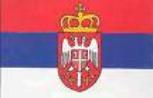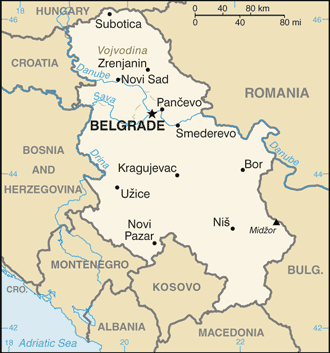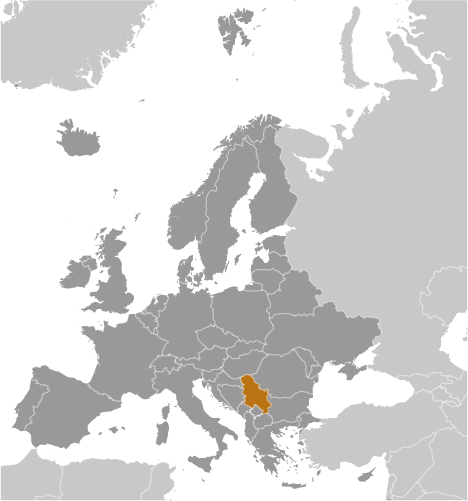
| SERBIA Republic of Serbia Republika Srbija Joined United Nations: 1 November 2000 Human Rights as assured by their constitution Click here Updated 11 November 2012 |
| CAPITAL |
| POPULATION |
| CHIEF OF STATE |
| SELECTION PROCESS |
Belgrade
7,276,604 (July 2012 est.)
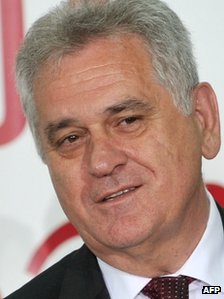
Tomislav Nikolic
President since 31 May 2012
President since 31 May 2012
President elected by direct vote for a five-year term (eligible
for a second term); election last held 20 May 2012
Next election to be held: 2017
for a second term); election last held 20 May 2012
Next election to be held: 2017
| HEAD OF GOVERNMENT |
SELECTION PROCESS
Ivica Dacic
Prime Minister since 23 July 2012
Prime Minister since 23 July 2012
Prime Minister elected by the National Assembly;
Elections: last held 6 May 2012
Next election to be held: May 2016
Elections: last held 6 May 2012
Next election to be held: May 2016
| DECLARATION OF HUMAN RIGHTS |
| ETHNIC GROUPS |
Serb 82.9%, Hungarian 3.9%, Romany (Gypsy) 1.4%, Yugoslavs 1.1%, Bosniaks 1.8%, Montenegrin 0.9%, other
8% (2002 census)
8% (2002 census)
| RELIGIONS |
Serbian Orthodox 85%, Catholic 5.5%, Protestant 1.1%, Muslim 3.2%, unspecified 2.6%, other, unknown, or
atheist 2.6% (2002 census)
atheist 2.6% (2002 census)
| GOVERNMENT STRUCTURE |
Republic with 167 municipalities (opcinas, singular - opcina). Legal system is based on civil law system
Executive: President elected by direct vote for a five-year term (eligible for a second term); election last held last held
on 20 May 2012 (next to be held in 2017); prime minister elected by the National Assembly
Legislative: Unicameral National Assembly (250 seats; deputies elected by direct vote to serve four-year terms)
elections: last held on 6 May 2012 (next to be held by May 2016)
Judicial: Serbia- Constitutional Court, Supreme Court (to become court of cassation under new constitution),
appellate courts, district courts, municipal courts; Kosovo: Supreme Court, district courts, municipal courts, minor
offense courts; note - Ministry of Justice was created on 20 December 2004; UNMIK appoints all judges and
prosecutors; UNMIK is working on transferring competencies
Executive: President elected by direct vote for a five-year term (eligible for a second term); election last held last held
on 20 May 2012 (next to be held in 2017); prime minister elected by the National Assembly
Legislative: Unicameral National Assembly (250 seats; deputies elected by direct vote to serve four-year terms)
elections: last held on 6 May 2012 (next to be held by May 2016)
Judicial: Serbia- Constitutional Court, Supreme Court (to become court of cassation under new constitution),
appellate courts, district courts, municipal courts; Kosovo: Supreme Court, district courts, municipal courts, minor
offense courts; note - Ministry of Justice was created on 20 December 2004; UNMIK appoints all judges and
prosecutors; UNMIK is working on transferring competencies
| LANGUAGES |
Serbian 88.3% (official), Hungarian 3.8%, Bosniak 1.8%, Romany (Gypsy) 1.1%, other 4.1%, unknown 0.9%
(2002 census)
note: Romanian, Hungarian, Slovak, Ukrainian, and Croatian all official in Vojvodina
(2002 census)
note: Romanian, Hungarian, Slovak, Ukrainian, and Croatian all official in Vojvodina
| BRIEF HISTORY |
The Serbs entered their present territory early in the 7th century, settling in six distinct tribal delimitations. The first entry
point was at Stari Vlah in Serbia. The first recorded Serb princes were Višeslav, Radoslav, Prosigoj, and Vlastimir. By
that time, the country had entirely accepted Christianity. In Zeta, today's Montenegro, King Mihailo was crowned by the
Pope in 1077. At this time, Serbs were Catholics as well as Orthodox. Serbs have not been united since the Middle
Ages. The nation was split into several states, which were at times independent but at other times united. The names of
those states were Duklja (Zeta), Zahumlje (today's Hercegovina, with the city Dubrovnik), Travunija (Trebinje, part of
today's Bosnia and Croatia), Pagania (today's eastern Dalmatia with the Islands), Bosna (Bosnia) and Rascia (today's
Sandžak). Eventually Rascia emerged as the strongest and took the name Serbia instead. The first Serb-organized state
emerged under Časlav Klonimirović in the mid-10th century in Rascia. The first half of the 11th century saw the rise of the
Vojislavljević family in Zeta. Marked by disintegration and crises, it lasted until the end of 12th century. Medieval Serbia
enjoyed a high political, economic, and cultural reputation in Europe. It was one of the few states that did not practice the
feudal order. Medieval Serbia reached its apex in the mid-14th century, during the rule of Tsar Stefan Dušan. This is the
period of the Dušanov Zakonik (Dušan's Code, 1349), a juridical achievement unique among the European states of the
time. Unfortunately, he died in December 1355 at the age 47. Modern abduction of the emperor's body revealed that he
was poisoned. He was succeeded by his son Uroš, called the Weak, a term that might also apply to the state of the
kingdom slowly sliding into feudal anarchy. This was a period marked by the rise of a new threat: the Ottoman Turk
sultanate which, gradually spread from Asia to Europe conquering Byzantium first and then the remaining Balkans states.
Two of the most powerful barons in the Serbian Empire, Mrnjavčević brothers, gathered a great army to fight and push
back the Turks. They marched into Turkish territory in 1371 to attack the enemy but they were too confident in
themselves. They built an overnight camp near the river Maritsa at Chermen in today's Bulgaria, and started celebrating
and getting drunk. During the night, a detachment of Turkish forces attacked the drunken Serbian knights and drove them
back to the river. Most of the Serbs were either drowned or killed, thereby annihilating the Serbian army that was
gathered from southern states. The event eventually become known as Battle of Maritsa. Serbs heavily defeated Turks in
Battle of Plocnik in 1386.The most famous Serbian knight Milos Obilic was wounded by arrow in battle. The Battle of
Kosovo was a turning point in the war. Vassal troops commanded by Prince Lazar, the strongest regional ruler in Serbia
at the time, killed Turkish sultan Murad I but suffered a defeat, due to the legendary "sudden departure" of Vuk
Branković's troops. The Battle of Kosovo defined the fate of Serbia, because after it no force capable of standing up to
the Turks existed. The Turks continued their conquest until they finally seized the entire northern Serbian territory in 1459
when Smederevo fell into their hands. Only free Serbian territories were parts of Bosnia and Zeta, but they lasted only
until 1496. The present-day Serbian territory would be ruled by the Ottoman Empire for the next four centuries. European
powers, and Austria in particular, fought many wars against the Ottoman Empire, relying on the help of the Serbs that
lived under Ottoman rule. After a peace treaty was signed in Požarevac, the Ottomans lost all its possessions in the
Danube basin, as well as northern Serbia and northern Bosnia, parts of Dalmatia and the Peloponnesos. The last Austrian-
Ottoman war was the so-called Dubica War (1788–91), when the Austrians urged the Christians in Bosnia to rebel. No
wars were fought afterwards until the 20th century that marked the fall of both mighty empires. Serbia gained its autonomy
from the Ottoman Empire in two uprisings in 1804 (led by Đorđe Petrović - Karađorđe) and 1815 (led by Miloš
Obrenović), although Turkish troops continued to garrison the capital, Belgrade, until 1867. Resulting from the uprisings
and subsequent wars against the Ottoman Empire, the independent Principality of Serbia was formed and granted
international recognition in 1878. Serbia was a principality or kneževina (knjaževina), between 1817 and 1882, and a
kingdom between 1882 and 1918, during which time the internal politics revolved largely around dynastic rivalry between
the Obrenović and Karađorđević families. In the second half of 19th century, Serbia was integrated into the constellation
of European states and the first political parties were founded thus giving new momentum to political life. The coup d'état
in 1903, bringing Karađorđe's grandson to the throne with the title of King Petar I opened the way for parliamentary
democracy in Serbia. Having received a European education, this liberal king translated "On Liberty" by John Stuart Mill
and gave his country a democratic constitution. The June 28, 1914 assassination of Austrian Crown Prince Franz
Ferdinand in the Bosnian capital Sarajevo, served as a pretext for the Austrian declaration of war on Serbia, marking the
beginning of World War I, despite Serbia's acceptance (on July 25) of nearly all of Austria-Hungary's demands. A
successful Allied offensive in September 1918 secured first Bulgaria's surrender and then the liberation of the occupied
Serbian territories (November 1918). On November 25, the Assembly of Serbs, Bunjevci, and other nations of
Vojvodina in Novi Sad voted to join the region to Serbia. Also, on November 29 the National Assembly of Montenegro
voted for union with Serbia, and two days later an assembly of leaders of Austria–Hungary's southern Slav regions voted
to join the new State of Slovenes, Croats and Serbs. With the end of World War I and the collapse of both the Austro-
Hungarian and Ottoman Empires the conditions were met for proclaiming the Kingdom of Serbs, Croats and Slovenes in
December of 1918. At the beginning of the 1940s, Yugoslavia found itself surrounded by hostile countries. Except for
Greece, all other neighboring countries had signed agreements with either Germany or Italy. Hitler was strongly pressuring
Yugoslavia to join the Axis powers. The government was even prepared to reach a compromise with him, but the spirit in
the country was completely different. Public demonstrations against Nazism prompted a brutal reaction. In April of 1941,
the Luftwaffe bombed Belgrade and other major cities. Ground forces from Germany, Italy, Hungary, and Bulgaria
invaded Yugoslavia. After a brief war, Yugoslavia surrendered unconditionally. In Serbia, the German occupation
authorities organized several concentration camps for Jews and members of the partisan resistance movement. The
ruthless attitude of the German occupation forces and the genocidal policy of the Croatian Ustaša regime, aimed at Serbs,
Jews, Gypsies and anti-Ustaša Croats, created a strong anti-fascist resistance in the NDH. While the war was still raging,
in 1943, a revolutionary change of the social and state system was proclaimed with the abolition of monarchy in favor of
the republic. Josip Broz Tito became the first president of the new — socialist — Yugoslavia. The 1974 constitution
produced a significantly less centralized federation, increasing the autonomy of Yugoslavia's republics as well as the
autonomous provinces of Serbia. When Tito died in 1980, he was succeeded by a rotating presidency that led to a further
weakening of ties between the republics. The Socialist Federal Republic of Yugoslavia broke up in 1991/1992 following
the independence of Slovenia, Croatia, Bosnia and Herzegovina, and Macedonia. Two remaining republics of Yugoslavia,
Serbia and Montenegro, formed in 1992 a new federation named Federal Republic of Yugoslavia (In 2003 this state was
transformed into the State Union of Serbia and Montenegro). Between 1998 and 1999, continued reported clashes in
Kosovo between Serbian/Yugoslav security forces and the K.L.A in most of the western media led to NATO aerial
bombardment, which would last for 78 days. Following Montenegro's vote for full independence in the plebiscite of May
21, 2006, Montenegro declared independence on June 3, 2006. This was followed on June 5, 2006 by Serbia's
declaration of independence, marking the final dissolution of the State Union of Serbia and Montenegro, and the re-
emergence of Serbia as an independent state, under its own name, for the first time since 1918. A new Serbian
constitution was approved in October 2006 and adopted the following month. After 15 months of inconclusive
negotiations mediated by the UN and four months of further inconclusive negotiations mediated by the US, EU, and
Russia, on 17 February 2008, the UNMIK-administered province of Kosovo declared itself independent of Serbia. The
declaration was officially recognized by the U.S., Austria, Great Britain, Germany, France, Turkey and dozen other
countries. Serbia, Russia, China, Spain, India, Brazil, Greece, Romania and other countries oppose this declaration and
consider it illegal. In July of 2010, the United Nations International Court of Justice deemed the separation of Kosovo
legal, and Kosovo officials plan a 2011 application to the UN. Serbia officially applied for European Union membership
on 22 December 2009. Despite its setbacks in the political field, on 7 December 2009 the EU unfroze the trade
agreement with Serbia and the Schengen countries dropped the visa requirement for Serbian citizens on 19 December
2009. A Stabilisation and Association Agreement (SAA) was signed in 2008 and entered into force in 2011.
Source: Wikipedia: History of Serbia
point was at Stari Vlah in Serbia. The first recorded Serb princes were Višeslav, Radoslav, Prosigoj, and Vlastimir. By
that time, the country had entirely accepted Christianity. In Zeta, today's Montenegro, King Mihailo was crowned by the
Pope in 1077. At this time, Serbs were Catholics as well as Orthodox. Serbs have not been united since the Middle
Ages. The nation was split into several states, which were at times independent but at other times united. The names of
those states were Duklja (Zeta), Zahumlje (today's Hercegovina, with the city Dubrovnik), Travunija (Trebinje, part of
today's Bosnia and Croatia), Pagania (today's eastern Dalmatia with the Islands), Bosna (Bosnia) and Rascia (today's
Sandžak). Eventually Rascia emerged as the strongest and took the name Serbia instead. The first Serb-organized state
emerged under Časlav Klonimirović in the mid-10th century in Rascia. The first half of the 11th century saw the rise of the
Vojislavljević family in Zeta. Marked by disintegration and crises, it lasted until the end of 12th century. Medieval Serbia
enjoyed a high political, economic, and cultural reputation in Europe. It was one of the few states that did not practice the
feudal order. Medieval Serbia reached its apex in the mid-14th century, during the rule of Tsar Stefan Dušan. This is the
period of the Dušanov Zakonik (Dušan's Code, 1349), a juridical achievement unique among the European states of the
time. Unfortunately, he died in December 1355 at the age 47. Modern abduction of the emperor's body revealed that he
was poisoned. He was succeeded by his son Uroš, called the Weak, a term that might also apply to the state of the
kingdom slowly sliding into feudal anarchy. This was a period marked by the rise of a new threat: the Ottoman Turk
sultanate which, gradually spread from Asia to Europe conquering Byzantium first and then the remaining Balkans states.
Two of the most powerful barons in the Serbian Empire, Mrnjavčević brothers, gathered a great army to fight and push
back the Turks. They marched into Turkish territory in 1371 to attack the enemy but they were too confident in
themselves. They built an overnight camp near the river Maritsa at Chermen in today's Bulgaria, and started celebrating
and getting drunk. During the night, a detachment of Turkish forces attacked the drunken Serbian knights and drove them
back to the river. Most of the Serbs were either drowned or killed, thereby annihilating the Serbian army that was
gathered from southern states. The event eventually become known as Battle of Maritsa. Serbs heavily defeated Turks in
Battle of Plocnik in 1386.The most famous Serbian knight Milos Obilic was wounded by arrow in battle. The Battle of
Kosovo was a turning point in the war. Vassal troops commanded by Prince Lazar, the strongest regional ruler in Serbia
at the time, killed Turkish sultan Murad I but suffered a defeat, due to the legendary "sudden departure" of Vuk
Branković's troops. The Battle of Kosovo defined the fate of Serbia, because after it no force capable of standing up to
the Turks existed. The Turks continued their conquest until they finally seized the entire northern Serbian territory in 1459
when Smederevo fell into their hands. Only free Serbian territories were parts of Bosnia and Zeta, but they lasted only
until 1496. The present-day Serbian territory would be ruled by the Ottoman Empire for the next four centuries. European
powers, and Austria in particular, fought many wars against the Ottoman Empire, relying on the help of the Serbs that
lived under Ottoman rule. After a peace treaty was signed in Požarevac, the Ottomans lost all its possessions in the
Danube basin, as well as northern Serbia and northern Bosnia, parts of Dalmatia and the Peloponnesos. The last Austrian-
Ottoman war was the so-called Dubica War (1788–91), when the Austrians urged the Christians in Bosnia to rebel. No
wars were fought afterwards until the 20th century that marked the fall of both mighty empires. Serbia gained its autonomy
from the Ottoman Empire in two uprisings in 1804 (led by Đorđe Petrović - Karađorđe) and 1815 (led by Miloš
Obrenović), although Turkish troops continued to garrison the capital, Belgrade, until 1867. Resulting from the uprisings
and subsequent wars against the Ottoman Empire, the independent Principality of Serbia was formed and granted
international recognition in 1878. Serbia was a principality or kneževina (knjaževina), between 1817 and 1882, and a
kingdom between 1882 and 1918, during which time the internal politics revolved largely around dynastic rivalry between
the Obrenović and Karađorđević families. In the second half of 19th century, Serbia was integrated into the constellation
of European states and the first political parties were founded thus giving new momentum to political life. The coup d'état
in 1903, bringing Karađorđe's grandson to the throne with the title of King Petar I opened the way for parliamentary
democracy in Serbia. Having received a European education, this liberal king translated "On Liberty" by John Stuart Mill
and gave his country a democratic constitution. The June 28, 1914 assassination of Austrian Crown Prince Franz
Ferdinand in the Bosnian capital Sarajevo, served as a pretext for the Austrian declaration of war on Serbia, marking the
beginning of World War I, despite Serbia's acceptance (on July 25) of nearly all of Austria-Hungary's demands. A
successful Allied offensive in September 1918 secured first Bulgaria's surrender and then the liberation of the occupied
Serbian territories (November 1918). On November 25, the Assembly of Serbs, Bunjevci, and other nations of
Vojvodina in Novi Sad voted to join the region to Serbia. Also, on November 29 the National Assembly of Montenegro
voted for union with Serbia, and two days later an assembly of leaders of Austria–Hungary's southern Slav regions voted
to join the new State of Slovenes, Croats and Serbs. With the end of World War I and the collapse of both the Austro-
Hungarian and Ottoman Empires the conditions were met for proclaiming the Kingdom of Serbs, Croats and Slovenes in
December of 1918. At the beginning of the 1940s, Yugoslavia found itself surrounded by hostile countries. Except for
Greece, all other neighboring countries had signed agreements with either Germany or Italy. Hitler was strongly pressuring
Yugoslavia to join the Axis powers. The government was even prepared to reach a compromise with him, but the spirit in
the country was completely different. Public demonstrations against Nazism prompted a brutal reaction. In April of 1941,
the Luftwaffe bombed Belgrade and other major cities. Ground forces from Germany, Italy, Hungary, and Bulgaria
invaded Yugoslavia. After a brief war, Yugoslavia surrendered unconditionally. In Serbia, the German occupation
authorities organized several concentration camps for Jews and members of the partisan resistance movement. The
ruthless attitude of the German occupation forces and the genocidal policy of the Croatian Ustaša regime, aimed at Serbs,
Jews, Gypsies and anti-Ustaša Croats, created a strong anti-fascist resistance in the NDH. While the war was still raging,
in 1943, a revolutionary change of the social and state system was proclaimed with the abolition of monarchy in favor of
the republic. Josip Broz Tito became the first president of the new — socialist — Yugoslavia. The 1974 constitution
produced a significantly less centralized federation, increasing the autonomy of Yugoslavia's republics as well as the
autonomous provinces of Serbia. When Tito died in 1980, he was succeeded by a rotating presidency that led to a further
weakening of ties between the republics. The Socialist Federal Republic of Yugoslavia broke up in 1991/1992 following
the independence of Slovenia, Croatia, Bosnia and Herzegovina, and Macedonia. Two remaining republics of Yugoslavia,
Serbia and Montenegro, formed in 1992 a new federation named Federal Republic of Yugoslavia (In 2003 this state was
transformed into the State Union of Serbia and Montenegro). Between 1998 and 1999, continued reported clashes in
Kosovo between Serbian/Yugoslav security forces and the K.L.A in most of the western media led to NATO aerial
bombardment, which would last for 78 days. Following Montenegro's vote for full independence in the plebiscite of May
21, 2006, Montenegro declared independence on June 3, 2006. This was followed on June 5, 2006 by Serbia's
declaration of independence, marking the final dissolution of the State Union of Serbia and Montenegro, and the re-
emergence of Serbia as an independent state, under its own name, for the first time since 1918. A new Serbian
constitution was approved in October 2006 and adopted the following month. After 15 months of inconclusive
negotiations mediated by the UN and four months of further inconclusive negotiations mediated by the US, EU, and
Russia, on 17 February 2008, the UNMIK-administered province of Kosovo declared itself independent of Serbia. The
declaration was officially recognized by the U.S., Austria, Great Britain, Germany, France, Turkey and dozen other
countries. Serbia, Russia, China, Spain, India, Brazil, Greece, Romania and other countries oppose this declaration and
consider it illegal. In July of 2010, the United Nations International Court of Justice deemed the separation of Kosovo
legal, and Kosovo officials plan a 2011 application to the UN. Serbia officially applied for European Union membership
on 22 December 2009. Despite its setbacks in the political field, on 7 December 2009 the EU unfroze the trade
agreement with Serbia and the Schengen countries dropped the visa requirement for Serbian citizens on 19 December
2009. A Stabilisation and Association Agreement (SAA) was signed in 2008 and entered into force in 2011.
Source: Wikipedia: History of Serbia
| ECONOMIC OVERVIEW |
Serbia has a transitional economy mostly dominated by market forces, but the state sector remains large and many
institutional reforms are needed. The economy relies on manufacturing and exports, driven largely by foreign investment.
MILOSEVIC-era mismanagement of the economy, an extended period of international economic sanctions, and the
damage to Yugoslavia's infrastructure and industry during the NATO airstrikes in 1999 left the economy only half the size
it was in 1990. After the ousting of former Federal Yugoslav President MILOSEVIC in September 2000, the Democratic
Opposition of Serbia (DOS) coalition government implemented stabilization measures and embarked on a market reform
program. After renewing its membership in the IMF in December 2000, Yugoslavia continued to reintegrate into the
international community by rejoining the World Bank (IBRD) and the European Bank for Reconstruction and
Development (EBRD). Serbia has made progress in trade liberalization and enterprise restructuring and privatization, but
many large enterprises - including the power utilities, telecommunications company, natural gas company, national air
carrier, and others - remain in state hands. Serbia has made some progress towards EU membership, signing a
Stabilization and Association Agreement with Brussels in May 2008, and with full implementation of the Interim Trade
Agreement with the EU in February 2010, but a decision on candidate status has been postponed to 2012. Serbia is also
pursuing membership in the World Trade Organization, and accession negotiations are at an advanced stage. Structural
economic reforms needed to ensure the country's long-term prosperity have largely stalled since the onset of the global
financial crisis. Serbia, however, is slowly recovering from the crisis. Economic growth in 2011 was 2.0%, following a
modest 1.0% increase in 2010 and a 3.5% contraction in 2009. High unemployment and stagnant household incomes are
ongoing political and economic problems. Serbia signed a new $1.3 billion Precautionary Stand By Arrangement with the
IMF in September 2011 that was set to expire in March 2013, but the program was frozen in early 2012 because the
2012 budget approved by parliament deviates from the program parameters. Growing deficits constrain the use of
stimulus efforts to revive the economy, while Serbia's concerns about inflation and exchange rate stability preclude the use
of expansionary monetary policy. Serbia adopted a new long-term economic growth plan in 2010 that calls for a
quadrupling of exports over ten years and heavy investments in basic infrastructure. Since the plan was adopted, Serbia
has increased its exports significantly. Major challenges ahead include: high unemployment rates and the need for job
creation; high government expenditures for salaries, pensions and unemployment benefits; a growing need for new
government borrowing; rising public and private foreign debt; attracting new foreign direct investment; and getting the IMF
program back on track. Other serious challenges include an inefficient judicial system, high levels of corruption, and an
aging population. Factors favorable to Serbia's economic growth include a strategic location, a relatively inexpensive and
skilled labor force, free trade agreements with the EU, Russia, Turkey, and Central European Free Trade agreement
countries; and a generous package of incentives for foreign investments.
Source: CIA World Factbook (select Serbia)
institutional reforms are needed. The economy relies on manufacturing and exports, driven largely by foreign investment.
MILOSEVIC-era mismanagement of the economy, an extended period of international economic sanctions, and the
damage to Yugoslavia's infrastructure and industry during the NATO airstrikes in 1999 left the economy only half the size
it was in 1990. After the ousting of former Federal Yugoslav President MILOSEVIC in September 2000, the Democratic
Opposition of Serbia (DOS) coalition government implemented stabilization measures and embarked on a market reform
program. After renewing its membership in the IMF in December 2000, Yugoslavia continued to reintegrate into the
international community by rejoining the World Bank (IBRD) and the European Bank for Reconstruction and
Development (EBRD). Serbia has made progress in trade liberalization and enterprise restructuring and privatization, but
many large enterprises - including the power utilities, telecommunications company, natural gas company, national air
carrier, and others - remain in state hands. Serbia has made some progress towards EU membership, signing a
Stabilization and Association Agreement with Brussels in May 2008, and with full implementation of the Interim Trade
Agreement with the EU in February 2010, but a decision on candidate status has been postponed to 2012. Serbia is also
pursuing membership in the World Trade Organization, and accession negotiations are at an advanced stage. Structural
economic reforms needed to ensure the country's long-term prosperity have largely stalled since the onset of the global
financial crisis. Serbia, however, is slowly recovering from the crisis. Economic growth in 2011 was 2.0%, following a
modest 1.0% increase in 2010 and a 3.5% contraction in 2009. High unemployment and stagnant household incomes are
ongoing political and economic problems. Serbia signed a new $1.3 billion Precautionary Stand By Arrangement with the
IMF in September 2011 that was set to expire in March 2013, but the program was frozen in early 2012 because the
2012 budget approved by parliament deviates from the program parameters. Growing deficits constrain the use of
stimulus efforts to revive the economy, while Serbia's concerns about inflation and exchange rate stability preclude the use
of expansionary monetary policy. Serbia adopted a new long-term economic growth plan in 2010 that calls for a
quadrupling of exports over ten years and heavy investments in basic infrastructure. Since the plan was adopted, Serbia
has increased its exports significantly. Major challenges ahead include: high unemployment rates and the need for job
creation; high government expenditures for salaries, pensions and unemployment benefits; a growing need for new
government borrowing; rising public and private foreign debt; attracting new foreign direct investment; and getting the IMF
program back on track. Other serious challenges include an inefficient judicial system, high levels of corruption, and an
aging population. Factors favorable to Serbia's economic growth include a strategic location, a relatively inexpensive and
skilled labor force, free trade agreements with the EU, Russia, Turkey, and Central European Free Trade agreement
countries; and a generous package of incentives for foreign investments.
Source: CIA World Factbook (select Serbia)
| POLITICAL CLIMATE |
The presidential election took place on 6 May 2012 in Serbia, on the same date as the parliamentary election. The
election was called following President Boris Tadić's early resignation in order to coincide with the parliamentary and local
elections to be held on the same date. The Speaker of the Parliament, Slavica Đukić Dejanović, took over as the Acting
President.As no candidate won a majority, a runoff was on 20 May, with incumbent Tadić facing Tomislav Nikolić of the
Serbian Progressive Party. According to preliminary results published by CeSID, Ipsos and RIK, Tomislav Nikolić has
beaten his opponent Boris Tadić and is the new President of Serbia.[7] Official results confirmed that, putting Nikolić at
51.12% against Tadić's 48.88%
The Serbian parliamentary election, 2012 was held on 6 May 2012 to elect members of the National Assembly. The
parliamentary elections were held simultaneously with provincial, local, and presidential elections. About 6.7 million
people were eligible to vote in the elections. The OSCE undertook the organisation of voting for the roughly 109,000
Serb voters in Kosovo. Voting stations were open from 7:00 to 20:00[51] with no incidents reported across the country.
Voter turnout by 18:00 was 46.34% in Belgrade, 48.37% in central Serbia and 47.89% in Vojvodina. Voter turnout in
Kosovo was 32%.
Source: Wikipedia: Politics of Serbia
election was called following President Boris Tadić's early resignation in order to coincide with the parliamentary and local
elections to be held on the same date. The Speaker of the Parliament, Slavica Đukić Dejanović, took over as the Acting
President.As no candidate won a majority, a runoff was on 20 May, with incumbent Tadić facing Tomislav Nikolić of the
Serbian Progressive Party. According to preliminary results published by CeSID, Ipsos and RIK, Tomislav Nikolić has
beaten his opponent Boris Tadić and is the new President of Serbia.[7] Official results confirmed that, putting Nikolić at
51.12% against Tadić's 48.88%
The Serbian parliamentary election, 2012 was held on 6 May 2012 to elect members of the National Assembly. The
parliamentary elections were held simultaneously with provincial, local, and presidential elections. About 6.7 million
people were eligible to vote in the elections. The OSCE undertook the organisation of voting for the roughly 109,000
Serb voters in Kosovo. Voting stations were open from 7:00 to 20:00[51] with no incidents reported across the country.
Voter turnout by 18:00 was 46.34% in Belgrade, 48.37% in central Serbia and 47.89% in Vojvodina. Voter turnout in
Kosovo was 32%.
Source: Wikipedia: Politics of Serbia
| INTERNATIONAL DISPUTES |
Serbia with several other states protest the U.S. and other states' recognition of Kosovo's declaration of its status as a
sovereign and independent state in February 2008; ethnic Serbian municipalities along Kosovo's northern border
challenge final status of Kosovo-Serbia boundary; several thousand NATO-led Kosovo Force peacekeepers under
United Nations Interim Administration Mission in Kosovo authority continue to keep the peace within Kosovo between
the ethnic Albanian majority and the Serb minority in Kosovo; Serbia delimited about half of the boundary with Bosnia
and Herzegovina, but sections along the Drina River remain in dispute
sovereign and independent state in February 2008; ethnic Serbian municipalities along Kosovo's northern border
challenge final status of Kosovo-Serbia boundary; several thousand NATO-led Kosovo Force peacekeepers under
United Nations Interim Administration Mission in Kosovo authority continue to keep the peace within Kosovo between
the ethnic Albanian majority and the Serb minority in Kosovo; Serbia delimited about half of the boundary with Bosnia
and Herzegovina, but sections along the Drina River remain in dispute


| REFUGEES AND INTERNALLY DISPLACED PERSONS (IDP) |
Refugees (country of origin): 52,483 (Croatia); 21,047 (Bosnia and Herzegovina) (2010)
| ILLICIT DRUGS |
Transshipment point for Southwest Asian heroin moving to Western Europe on the Balkan route; economy vulnerable to
money laundering.
money laundering.
| HUMAN RIGHTS STATEMENTS, ANALYSIS AND CRITIQUES |
2011 Human Rights Report: Serbia
Bureau of Democracy, Human Rights, and Labor
2011 Country Reports on Human Rights Practices
May 25, 2012
The Republic of Serbia is a multiparty, parliamentary democracy. Boris Tadic was reelected president in February 2008. In May
2008 voters elected a new parliament in which some minority ethnic parties won seats. Observers considered both elections to be
mostly in line with international standards. Security forces reported to civilian authorities.
The most serious human rights problems during the year included: discrimination and societal violence against minorities;
corruption in healthcare, education, and multiple branches of government, including the police; and an inefficient judicial system
which resulted in lengthy and delayed trials, as well as long periods of pretrial detention.
Other reported abuses included: physical mistreatment of detainees by police; harassment of journalists, human rights advocates,
and others critical of the government; lack of durable solutions for large numbers of internally displaced persons (IDPs); societal
and domestic violence against women and children; and trafficking in persons.
The government generally took steps to prosecute officials, both in the police and elsewhere in the government, when abuses were
made public. Nevertheless, many observers believed that there were numerous cases of corruption, police mistreatment, and other
abuses that went unreported and unpunished.
Click here to read more »
Bureau of Democracy, Human Rights, and Labor
2011 Country Reports on Human Rights Practices
May 25, 2012
The Republic of Serbia is a multiparty, parliamentary democracy. Boris Tadic was reelected president in February 2008. In May
2008 voters elected a new parliament in which some minority ethnic parties won seats. Observers considered both elections to be
mostly in line with international standards. Security forces reported to civilian authorities.
The most serious human rights problems during the year included: discrimination and societal violence against minorities;
corruption in healthcare, education, and multiple branches of government, including the police; and an inefficient judicial system
which resulted in lengthy and delayed trials, as well as long periods of pretrial detention.
Other reported abuses included: physical mistreatment of detainees by police; harassment of journalists, human rights advocates,
and others critical of the government; lack of durable solutions for large numbers of internally displaced persons (IDPs); societal
and domestic violence against women and children; and trafficking in persons.
The government generally took steps to prosecute officials, both in the police and elsewhere in the government, when abuses were
made public. Nevertheless, many observers believed that there were numerous cases of corruption, police mistreatment, and other
abuses that went unreported and unpunished.
Click here to read more »
24 March 2011
Human Rights Committee
101st session
New York, 14 March - 1April 2011
Consideration of reports submitted by States parties under article 40 of the Covenant
Concluding observations of the Human Rights Committee
Serbia
A. Introduction
1. The Committee considered the second periodic report submitted by the Republic of Serbia (CCPR/C/SRB/2) at its 2780th
and 2781st meetings (CCPR/C/SR.2780 and CCPR/C/SR.2781), held on 17 and 18 March 2011. At its 2796 meeting, held on 29
March 2011, it adopted the following concluding observations.
2. The Committee welcomes the submission of the second periodic report of the Republic of Serbia. It expresses appreciation
for the constructive dialogue with the delegation and the oral and written answers provided, as well as for the written responses
submitted to the list of issues (CCPR/SRB/Q/2/Add.1).
B. Positive aspects
4. The Committee welcomes the following positive developments, in particular in light of the reforms engaged in as a result of
the State party’s candidacy to the European Union:
(a) the adoption of a new Constitution in 2006, which allows the Constitutional Court to examine individual complaints
on human rights violations (article 170 of the Constitution);
(b) the adoption, in March 2009, of the Law on the Prohibition of Discrimination and the election, by the National Assembly in
May 2010, of the Commissioner for Protection of Equality, empowered to examine complaints on discrimination and to make
recommendations thereon;
C. Principal matters of concern and recommendations
5. The Committee has noted the information that the provisions of the international human rights treaties, including those under
the Covenant, are part of the State party’s law and can be invoked directly in court. The Committee notes, however, that there are
only limited examples where the Covenant’s provisions have been invoked in particular cases. While welcoming the delegation’s
contention that the provisions of the Covenant will be part of the curricula of the Judicial Academy, the Committee expresses
concern about an insufficient awareness of the Covenant's provisions among the judiciary and the wider legal community and the
Covenant’s practical application in the domestic legal system. (art. 2)
The State party should ensure that its authorities, including judges, prosecutors, and lawyers, are adequately trained and
fully aware of the Covenant’s provisions, and of their applicability in the State party. The State party should also take effective
measures to widely disseminate the Covenant in the State party.
Click here to read more »
Human Rights Committee
101st session
New York, 14 March - 1April 2011
Consideration of reports submitted by States parties under article 40 of the Covenant
Concluding observations of the Human Rights Committee
Serbia
A. Introduction
1. The Committee considered the second periodic report submitted by the Republic of Serbia (CCPR/C/SRB/2) at its 2780th
and 2781st meetings (CCPR/C/SR.2780 and CCPR/C/SR.2781), held on 17 and 18 March 2011. At its 2796 meeting, held on 29
March 2011, it adopted the following concluding observations.
2. The Committee welcomes the submission of the second periodic report of the Republic of Serbia. It expresses appreciation
for the constructive dialogue with the delegation and the oral and written answers provided, as well as for the written responses
submitted to the list of issues (CCPR/SRB/Q/2/Add.1).
B. Positive aspects
4. The Committee welcomes the following positive developments, in particular in light of the reforms engaged in as a result of
the State party’s candidacy to the European Union:
(a) the adoption of a new Constitution in 2006, which allows the Constitutional Court to examine individual complaints
on human rights violations (article 170 of the Constitution);
(b) the adoption, in March 2009, of the Law on the Prohibition of Discrimination and the election, by the National Assembly in
May 2010, of the Commissioner for Protection of Equality, empowered to examine complaints on discrimination and to make
recommendations thereon;
C. Principal matters of concern and recommendations
5. The Committee has noted the information that the provisions of the international human rights treaties, including those under
the Covenant, are part of the State party’s law and can be invoked directly in court. The Committee notes, however, that there are
only limited examples where the Covenant’s provisions have been invoked in particular cases. While welcoming the delegation’s
contention that the provisions of the Covenant will be part of the curricula of the Judicial Academy, the Committee expresses
concern about an insufficient awareness of the Covenant's provisions among the judiciary and the wider legal community and the
Covenant’s practical application in the domestic legal system. (art. 2)
The State party should ensure that its authorities, including judges, prosecutors, and lawyers, are adequately trained and
fully aware of the Covenant’s provisions, and of their applicability in the State party. The State party should also take effective
measures to widely disseminate the Covenant in the State party.
Click here to read more »
FREEDOM IN THE WORLD 2012 REPORT
Political Rights Score: 2
Civil Liberties Score: 2
Status: Free
Overview
Serbia in 2011 arrested the last fugitive war crimes suspects from the conflicts of the 1990s, allowing the country to progress on
its path to European Union candidacy. However, the deadlock between Belgrade and Pristina over Kosovo’s sovereignty remained
unresolved. Separately, in October, the government barred a gay pride parade on the grounds that related violence by extremist
groups would jeopardize national security.
In 2009, the parliament passed legislation to improve conditions for nongovernmental organizations (NGOs) and a statute that
defined and expanded Vojvodina’s autonomy. The country also received praise for its cooperation with the International Criminal
Tribunal for the former Yugoslavia (ICTY), and secured visa-free travel to EU countries for Serbian citizens. By year’s end, Serbia
had formally submitted its application for EU membership, and the government’s regional reconciliation efforts continued in 2010.
However, the country suffered a major diplomatic defeat in July of that year, when the International Court of Justice (ICJ) ruled
that Kosovo’s declaration of independence did not violate international law.
In May 2011, Serbian authorities arrested and extradited former Bosnian Serb military commander Ratko Mladić, a longtime fugitive
who was wanted by the ICTY for alleged war crimes. Croatian Serb wartime leader Goran Hadžić, the last of 161 suspected war
criminals indicted by the ICTY to remain at large, was arrested and extradited from Serbia in July. The two arrests marked a major
step forward for Serbia’s bid for EU candidacy.
While EU-brokered negotiations yielded progress on trade and travel issues between Serbia and Kosovo during 2011, Belgrade
maintained its opposition to Kosovo’s sovereignty. In August, German chancellor Angela Merkel warned that Serbia must abolish
its parallel governing structures in the Serb-populated northern portion of Kosovo before it could join the EU. The country’s formal
status as an EU candidate had yet to be confirmed at year’s end. Meanwhile, the SRS asked Serbian prosecutors to initiate criminal
proceedings against Tadić and Cvetković for negotiating terms with the Kosovo authorities that “endangered Serbia’s territorial
integrity”, though no charges were brought by year’s end.
Serbia is an electoral democracy. The president, elected to a five-year term, plays a largely ceremonial role. The National Assembly
is a unicameral, 250-seat legislature, with deputies elected to four-year terms according to party lists. The prime minister is elected
by the assembly. Both the presidential and parliamentary elections in 2008 were deemed largely free and fair by international
monitoring groups.
Click here to read more »
Political Rights Score: 2
Civil Liberties Score: 2
Status: Free
Overview
Serbia in 2011 arrested the last fugitive war crimes suspects from the conflicts of the 1990s, allowing the country to progress on
its path to European Union candidacy. However, the deadlock between Belgrade and Pristina over Kosovo’s sovereignty remained
unresolved. Separately, in October, the government barred a gay pride parade on the grounds that related violence by extremist
groups would jeopardize national security.
In 2009, the parliament passed legislation to improve conditions for nongovernmental organizations (NGOs) and a statute that
defined and expanded Vojvodina’s autonomy. The country also received praise for its cooperation with the International Criminal
Tribunal for the former Yugoslavia (ICTY), and secured visa-free travel to EU countries for Serbian citizens. By year’s end, Serbia
had formally submitted its application for EU membership, and the government’s regional reconciliation efforts continued in 2010.
However, the country suffered a major diplomatic defeat in July of that year, when the International Court of Justice (ICJ) ruled
that Kosovo’s declaration of independence did not violate international law.
In May 2011, Serbian authorities arrested and extradited former Bosnian Serb military commander Ratko Mladić, a longtime fugitive
who was wanted by the ICTY for alleged war crimes. Croatian Serb wartime leader Goran Hadžić, the last of 161 suspected war
criminals indicted by the ICTY to remain at large, was arrested and extradited from Serbia in July. The two arrests marked a major
step forward for Serbia’s bid for EU candidacy.
While EU-brokered negotiations yielded progress on trade and travel issues between Serbia and Kosovo during 2011, Belgrade
maintained its opposition to Kosovo’s sovereignty. In August, German chancellor Angela Merkel warned that Serbia must abolish
its parallel governing structures in the Serb-populated northern portion of Kosovo before it could join the EU. The country’s formal
status as an EU candidate had yet to be confirmed at year’s end. Meanwhile, the SRS asked Serbian prosecutors to initiate criminal
proceedings against Tadić and Cvetković for negotiating terms with the Kosovo authorities that “endangered Serbia’s territorial
integrity”, though no charges were brought by year’s end.
Serbia is an electoral democracy. The president, elected to a five-year term, plays a largely ceremonial role. The National Assembly
is a unicameral, 250-seat legislature, with deputies elected to four-year terms according to party lists. The prime minister is elected
by the assembly. Both the presidential and parliamentary elections in 2008 were deemed largely free and fair by international
monitoring groups.
Click here to read more »
Serbia: After Belvil, Serbia needs new laws against forced eviction
17 October 2012
On 26 April 2012, almost 1,000 Roma (around 250 families), living in an informal settlement at Belvil in Belgrade were forcibly
evicted by the city authorities.
Approximately 124 families were evicted from their homes and resettled in metal containers around Belgrade. Around 133 other
families were forced to return to inadequate housing in poor municipalities mainly in southern Serbia.
Other Belvil residents were not evicted that day. The 93 “Sava Bridge” families were notified in 2011 that they will be evicted due to
the European Investment Bank (EIB)-funded Sava Bridge development project. These families have been assured that they will be
resettled into permanent housing during 2013.
However, the families evicted on 26 April were not part of this group. Amnesty International considers this eviction to be a forced
eviction, due to the lack of adequate notice, genuine consultation and adequate resettlement by the Belgrade authorities. The eviction
also led to further human rights violations, including of their rights to freedom of movement and work.
The impact of the April 2012 forced eviction on Roma living at Belvil powerfully demonstrates the need for a legal framework to
prevent any more forced evictions in Serbia.
This briefing is based on research carried out by Amnesty International in Serbia in April and June 2012, and on continued contact
with the community. It focuses on the eviction of 26 April 2012, and also refers to the forthcoming eviction, also from Belvil, of
other Romani families, due to be evicted before access roads to the Sava Bridge are built (see page 10).
FAILURE TO RESPECT INTERNATIONAL STANDARDS
International human rights standards require states to ensure certain safeguards prior to, during and after evictions. The Belgrade
authorities did respect some international standards while conducting the April 2012 eviction in Belvil: Roma and their possessions
were removed from their homes without violence; UN representatives were asked to observe the eviction and NGOs including
Amnesty International were also present.
However, the authorities completely failed to apply crucial safeguards prior to the eviction, including consultation with affected
communities to explore all feasible alternatives to eviction and on resettlement. They failed to provide people with information, even
on the reason for the eviction, adequate notice or legal remedies, and failed to provide adequate housing options for resettlement.
Click here to read more »
17 October 2012
On 26 April 2012, almost 1,000 Roma (around 250 families), living in an informal settlement at Belvil in Belgrade were forcibly
evicted by the city authorities.
Approximately 124 families were evicted from their homes and resettled in metal containers around Belgrade. Around 133 other
families were forced to return to inadequate housing in poor municipalities mainly in southern Serbia.
Other Belvil residents were not evicted that day. The 93 “Sava Bridge” families were notified in 2011 that they will be evicted due to
the European Investment Bank (EIB)-funded Sava Bridge development project. These families have been assured that they will be
resettled into permanent housing during 2013.
However, the families evicted on 26 April were not part of this group. Amnesty International considers this eviction to be a forced
eviction, due to the lack of adequate notice, genuine consultation and adequate resettlement by the Belgrade authorities. The eviction
also led to further human rights violations, including of their rights to freedom of movement and work.
The impact of the April 2012 forced eviction on Roma living at Belvil powerfully demonstrates the need for a legal framework to
prevent any more forced evictions in Serbia.
This briefing is based on research carried out by Amnesty International in Serbia in April and June 2012, and on continued contact
with the community. It focuses on the eviction of 26 April 2012, and also refers to the forthcoming eviction, also from Belvil, of
other Romani families, due to be evicted before access roads to the Sava Bridge are built (see page 10).
FAILURE TO RESPECT INTERNATIONAL STANDARDS
International human rights standards require states to ensure certain safeguards prior to, during and after evictions. The Belgrade
authorities did respect some international standards while conducting the April 2012 eviction in Belvil: Roma and their possessions
were removed from their homes without violence; UN representatives were asked to observe the eviction and NGOs including
Amnesty International were also present.
However, the authorities completely failed to apply crucial safeguards prior to the eviction, including consultation with affected
communities to explore all feasible alternatives to eviction and on resettlement. They failed to provide people with information, even
on the reason for the eviction, adequate notice or legal remedies, and failed to provide adequate housing options for resettlement.
Click here to read more »
Serbia/Kosovo: Halt Arbitrary Arrests
Wave of Detentions Threatens Free Movement
March 31, 2012
(Berlin) – Serbia should immediately release two Kosovo Albanians arbitrarily arrested on March 28, 2012 in “retaliation” for the
arrest of four Serbs on March 27, Human Rights Watch said today. Kosovo should facilitate an urgent review by an EU Kosovo
mission judge of the charges and house arrest of the four Serbs, Human Rights Watch said.
The four Kosovo Serbs, including the Mayor of the town of Vitina, were arrested by Kosovo police as they tried to cross back into
Kosovo at the Belja Zemlja administrative border between Serbia and Kosovo and were subsequently charged with “incitement to
hatred and intolerance among ethnic groups.” They were carrying materials for elections that Kosovo Serbs say will be held in Serb-
controlled areas of Northern Kosovo on May 6. While the planned elections have been condemned by the EU rule of law mission in
Kosovo (EULEX) as contrary to international law, it is not clear how possessing election materials can constitute a criminal
offense, Human Rights Watch said.
“The purported justification for the detention of the two Kosovo Albanians lacks any legal basis and is therefore arbitrary,” said
Lydia Gall, Balkans and Eastern Europe researcher at Human Rights Watch. “The case of the four Serbs requires review by a
EULEX judge to determine whether the charges and house arrests were justified.”
On March 28, Serbian border police arrested two Kosovo Albanians at a border crossing near Gjilan, Kosovo. Serbia’s interior
minister, Ivica Dacic, described the arrests of the two trade unionists, Hasan Abazi and Adem Urseli, as retaliation for the arrest of
the four Serbs.
The two Albanians were charged with espionage and drug trafficking and transferred to Vranje in southern Serbia, where they
remain in custody pending a decision on whether they should remain in detention. On March 29, the Kosovska Kamenica municipal
court decided on a 30 day pre-trial house arrest for the four Serbs. The decision has been appealed.
Serbia and Kosovo signed an agreement on December 26, 2011 guaranteeing free movement across the border. Under the deal,
Kosovars with documents issues by the Republic of Kosovo are entitled to temporary Serbian identity documents and car
registration, to allow them to travel in Serbia.
Tensions have risen over Serbia’s support for local elections in Serb-controlled areas of northern Kosovo, which EULEX has said
contravenes the UN Security Council resolution placing Kosovo under international administration. The Kosovo government has
declared that it will try to prevent the elections.
The incidents follow the arrest in Gijlan on February 25 of six alleged members of Serbia’s Ministry of Internal Affairs in Kosovo
for allegedly exerting undue pressure on citizens of the town of Partes not to recognize Kosovo institutions. The Serbian interior
minister responded to the arrests by threatening to arrest employees of Kosovo institutions in retaliation. One man was released and
the other five remain in detention after a Kosovo court on March 27 extended their detention by another 60 days.
Click here to read more »
Wave of Detentions Threatens Free Movement
March 31, 2012
(Berlin) – Serbia should immediately release two Kosovo Albanians arbitrarily arrested on March 28, 2012 in “retaliation” for the
arrest of four Serbs on March 27, Human Rights Watch said today. Kosovo should facilitate an urgent review by an EU Kosovo
mission judge of the charges and house arrest of the four Serbs, Human Rights Watch said.
The four Kosovo Serbs, including the Mayor of the town of Vitina, were arrested by Kosovo police as they tried to cross back into
Kosovo at the Belja Zemlja administrative border between Serbia and Kosovo and were subsequently charged with “incitement to
hatred and intolerance among ethnic groups.” They were carrying materials for elections that Kosovo Serbs say will be held in Serb-
controlled areas of Northern Kosovo on May 6. While the planned elections have been condemned by the EU rule of law mission in
Kosovo (EULEX) as contrary to international law, it is not clear how possessing election materials can constitute a criminal
offense, Human Rights Watch said.
“The purported justification for the detention of the two Kosovo Albanians lacks any legal basis and is therefore arbitrary,” said
Lydia Gall, Balkans and Eastern Europe researcher at Human Rights Watch. “The case of the four Serbs requires review by a
EULEX judge to determine whether the charges and house arrests were justified.”
On March 28, Serbian border police arrested two Kosovo Albanians at a border crossing near Gjilan, Kosovo. Serbia’s interior
minister, Ivica Dacic, described the arrests of the two trade unionists, Hasan Abazi and Adem Urseli, as retaliation for the arrest of
the four Serbs.
The two Albanians were charged with espionage and drug trafficking and transferred to Vranje in southern Serbia, where they
remain in custody pending a decision on whether they should remain in detention. On March 29, the Kosovska Kamenica municipal
court decided on a 30 day pre-trial house arrest for the four Serbs. The decision has been appealed.
Serbia and Kosovo signed an agreement on December 26, 2011 guaranteeing free movement across the border. Under the deal,
Kosovars with documents issues by the Republic of Kosovo are entitled to temporary Serbian identity documents and car
registration, to allow them to travel in Serbia.
Tensions have risen over Serbia’s support for local elections in Serb-controlled areas of northern Kosovo, which EULEX has said
contravenes the UN Security Council resolution placing Kosovo under international administration. The Kosovo government has
declared that it will try to prevent the elections.
The incidents follow the arrest in Gijlan on February 25 of six alleged members of Serbia’s Ministry of Internal Affairs in Kosovo
for allegedly exerting undue pressure on citizens of the town of Partes not to recognize Kosovo institutions. The Serbian interior
minister responded to the arrests by threatening to arrest employees of Kosovo institutions in retaliation. One man was released and
the other five remain in detention after a Kosovo court on March 27 extended their detention by another 60 days.
Click here to read more »
Uncompromising fight against organised crime, corruption
Belgrade, 9 Nov 2012
Minister of Justice and Public Administration Nikola Selakovic said today in a meeting with Italian Ambassador to Serbia Armando
Varricchio that one of the main pririorities of the ministry and the government is the uncompromising fight against organised crime
and corruption.
The Ministry of Justice and Public Administration states that Selakovic also announced that the first draft of the strategy for the
fight against corruption will be completed by mid-November.
He presented the Ambassador of Italy the institution of the Judiciary Academy and its influence on the further development and
improvement of the judicial system, especially when it comes to the education of legal experts.
Varricchio said that he supports the efforts of the whole country to fulfill all the conditions necessary for Serbia to accelerate its
path towards the EU.
He expressed satisfaction that the Ministry has commenced the development of strategies aimed at improving the situation in the
Serbian judiciary and correcting the errors made during the judicial reform as it is in the interest of citizens, and in line with EU
recommendations.
A strategic partnership agreement between Italy and Serbia signed in 2009 represents a good basis for further development of
cooperation between the two countries, said Varricchio.
Click here to read more »
Belgrade, 9 Nov 2012
Minister of Justice and Public Administration Nikola Selakovic said today in a meeting with Italian Ambassador to Serbia Armando
Varricchio that one of the main pririorities of the ministry and the government is the uncompromising fight against organised crime
and corruption.
The Ministry of Justice and Public Administration states that Selakovic also announced that the first draft of the strategy for the
fight against corruption will be completed by mid-November.
He presented the Ambassador of Italy the institution of the Judiciary Academy and its influence on the further development and
improvement of the judicial system, especially when it comes to the education of legal experts.
Varricchio said that he supports the efforts of the whole country to fulfill all the conditions necessary for Serbia to accelerate its
path towards the EU.
He expressed satisfaction that the Ministry has commenced the development of strategies aimed at improving the situation in the
Serbian judiciary and correcting the errors made during the judicial reform as it is in the interest of citizens, and in line with EU
recommendations.
A strategic partnership agreement between Italy and Serbia signed in 2009 represents a good basis for further development of
cooperation between the two countries, said Varricchio.
Click here to read more »
TRANSLATED FROM SERBIAN BY GOOGLE TRANSLATE
Press Ombudsman Sasa Jankovic and the Commissioner for Information of Public Importance Rodoljub Sabic
information regarding the illegal surveillance of Communications State President Tomislav Nikolic and Deputy Prime
Minister Aleksandar Vucic
Friday, 02 Novembar 2012
Ombudsman Sasa Jankovic and Commissioner for Information of Public Importance and Personal Data Protection Rodoljub Sabic
express deep concern about reports that the head of state and Nikolic Deputy Prime Minister Aleksandar Vucic been targeted by
illegal surveillance of communications.
It shows the most dramatic way how serious and relevant the results of control and presented their findings three months ago
about the massive illegal invasion of privacy of communications, and up to a million a year, and the door wide open for abuse.
According to available information, communication Nikolic and Vucic were subject to unconstitutional precisely control the way
that the Ombudsman and the Commissioner described in detail and found that citizens are going on a daily basis.
Jankovic Sabic and express the hope that the perpetrators will be promptly identified and punished, and that will then be applied 14
measures proposed two control authorities and the competent authorities of executive power so far only supported him, and which
reduce the normative and practical freedom unacceptably dangerous and unconstitutional intrusion into the communication that
now exists.
The Constitutional Court of Serbia in early 2012, after more than a year reviewing, as suggested by the Ombudsman and the
Commissioner poglasio unconstitutional provisions of the military security services that allowed obtaining listings and other
information on the talks on the basis of the Director's decision services or persons authorized by him, the leaving ample room for
abuse. The police then said Jankovic and Sabic will continue to access listings without the court because they are the Code of
Criminal Procedure to authorize it. Since it is a "power" patently unconstitutional, as in the case of the military security services,
protector and confidant initiated proceedings reviews the constitutionality of the CPC in relation to the Constitutional Court to the
decision on the constitutionality of the temporary injunction suspending the application of the challenged provisions.
Click here to read more »
Press Ombudsman Sasa Jankovic and the Commissioner for Information of Public Importance Rodoljub Sabic
information regarding the illegal surveillance of Communications State President Tomislav Nikolic and Deputy Prime
Minister Aleksandar Vucic
Friday, 02 Novembar 2012
Ombudsman Sasa Jankovic and Commissioner for Information of Public Importance and Personal Data Protection Rodoljub Sabic
express deep concern about reports that the head of state and Nikolic Deputy Prime Minister Aleksandar Vucic been targeted by
illegal surveillance of communications.
It shows the most dramatic way how serious and relevant the results of control and presented their findings three months ago
about the massive illegal invasion of privacy of communications, and up to a million a year, and the door wide open for abuse.
According to available information, communication Nikolic and Vucic were subject to unconstitutional precisely control the way
that the Ombudsman and the Commissioner described in detail and found that citizens are going on a daily basis.
Jankovic Sabic and express the hope that the perpetrators will be promptly identified and punished, and that will then be applied 14
measures proposed two control authorities and the competent authorities of executive power so far only supported him, and which
reduce the normative and practical freedom unacceptably dangerous and unconstitutional intrusion into the communication that
now exists.
The Constitutional Court of Serbia in early 2012, after more than a year reviewing, as suggested by the Ombudsman and the
Commissioner poglasio unconstitutional provisions of the military security services that allowed obtaining listings and other
information on the talks on the basis of the Director's decision services or persons authorized by him, the leaving ample room for
abuse. The police then said Jankovic and Sabic will continue to access listings without the court because they are the Code of
Criminal Procedure to authorize it. Since it is a "power" patently unconstitutional, as in the case of the military security services,
protector and confidant initiated proceedings reviews the constitutionality of the CPC in relation to the Constitutional Court to the
decision on the constitutionality of the temporary injunction suspending the application of the challenged provisions.
Click here to read more »
Regarding complaints sent by YUCOM and BCHR the Commissioner for Protection of Equality gave an opinion and
recommendation on the 7th May 2012 (May 18, 2012)
Lawyers' Committee for Human Rights - YUCOM and Belgrade Center for Human Rights – BCHR made a complaint to the
Commissioner for Protection of Equality regarding the conduct of the Secretariat for Social Welfare of the City of Belgrade.
The complaint has been sent because the Secretariat organized a public transportation of persons with disabilities, but only the
persons with disabilities from the area of the city center of Belgrade have access to this service. The persons with disabilities living
far away from the city center had to fulfill an additional condition to using this service – the need to have at least three other
persons with disabilities from the same part that have applied for this form of public transport.
Regarding complaints sent by YUCOM and BCHR, the Commissioner for Protection of Equality gave an opinion and
recommendation on the 7th May 2012. It was found that the Secretariat of Social Welfare violated the principle of equal rights and
obligations and discriminated users of public transportation who do not live in the center of Belgrade.
Secretariat was instructed to immediately undertake all necessary measures to organize the public transport of persons with
disabilities in the manner to allow the free access of the right to use public transport, regardless the number of users and the place
where the persons with disabilities live. The secretariat is obliged, within 30 days to act upon this recommendation and to redress
the violation.
YUCOM and BCHR are welcoming the decision of the Commissioner and are expecting that the secretariat will fulfill all the
obligations in due time, thus enabling persons with dissabilities to enjoy their rights without discrimination and according to the
inclusion policy that Serbia is implementing.
YUCOM team
Click here to read more »
recommendation on the 7th May 2012 (May 18, 2012)
Lawyers' Committee for Human Rights - YUCOM and Belgrade Center for Human Rights – BCHR made a complaint to the
Commissioner for Protection of Equality regarding the conduct of the Secretariat for Social Welfare of the City of Belgrade.
The complaint has been sent because the Secretariat organized a public transportation of persons with disabilities, but only the
persons with disabilities from the area of the city center of Belgrade have access to this service. The persons with disabilities living
far away from the city center had to fulfill an additional condition to using this service – the need to have at least three other
persons with disabilities from the same part that have applied for this form of public transport.
Regarding complaints sent by YUCOM and BCHR, the Commissioner for Protection of Equality gave an opinion and
recommendation on the 7th May 2012. It was found that the Secretariat of Social Welfare violated the principle of equal rights and
obligations and discriminated users of public transportation who do not live in the center of Belgrade.
Secretariat was instructed to immediately undertake all necessary measures to organize the public transport of persons with
disabilities in the manner to allow the free access of the right to use public transport, regardless the number of users and the place
where the persons with disabilities live. The secretariat is obliged, within 30 days to act upon this recommendation and to redress
the violation.
YUCOM and BCHR are welcoming the decision of the Commissioner and are expecting that the secretariat will fulfill all the
obligations in due time, thus enabling persons with dissabilities to enjoy their rights without discrimination and according to the
inclusion policy that Serbia is implementing.
YUCOM team
Click here to read more »

| Click map for larger view |
| Click flag for Country Report |




| TRAFFICKING IN PERSONS |
None reported.