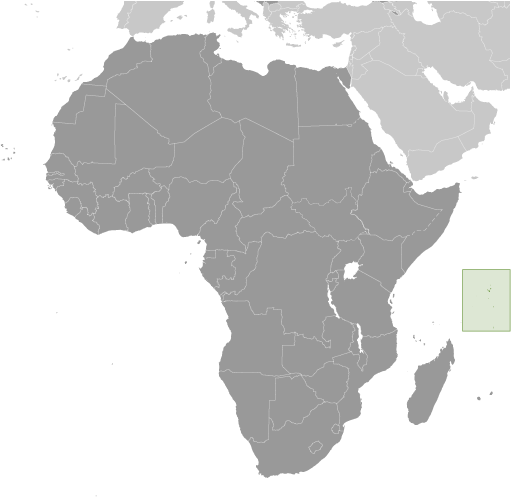
| SEYCHELLES Republic of Seychelles Republic of Seychelles Joined United Nations: 21 September 1976 Human Rights as assured by their constitution Click here Updated 04 February 2013 |

| CAPITAL |
| POPULATION |
| CHIEF OF STATE |
| SELECTION PROCESS |
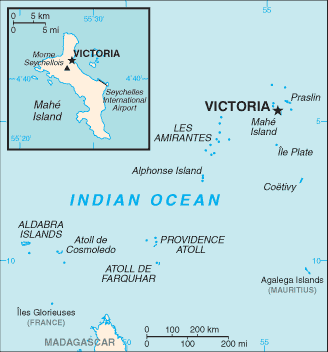
Victoria
90,024 (July 2012 est.)
President and Vice President elected by popular vote for a five-year
term (eligible for two more terms); election last held 19-21 May
2011
Next scheduled election: 2016
term (eligible for two more terms); election last held 19-21 May
2011
Next scheduled election: 2016
HEAD OF GOVERNMENT
SELECTION PROCESS
According to the Seychelles Constitution, the President is both
the Chief of State and Head of Government
the Chief of State and Head of Government
| DECLARATION OF HUMAN RIGHTS |
| ETHNIC GROUPS |
Mixed French, African, Indian, Chinese, and Arab
| RELIGIONS |
Roman Catholic 82.3%, Anglican 6.4%, Seventh Day Adventist 1.1%, other Christian 3.4%, Hindu 2.1%, Muslim 1.1%, other
non-Christian 1.5%, unspecified 1.5%, none 0.6% (2002 census)
non-Christian 1.5%, unspecified 1.5%, none 0.6% (2002 census)
| GOVERNMENT STRUCTURE |
Republic with 23 administrative districts; Legal system is based on English common law, French civil law, and customary law
Executive: President and Vice President elected by popular vote for a five-year term (eligible for two more terms); election last
held 9-21 May 2011 (next to be held in 2016)
Legislative: Unicameral National Assembly or Assemblee Nationale (34 seats; 25 members elected by popular vote, 9 allocated
on a proportional basis to parties winning at least 10% of the vote; to serve five-year terms)
elections: last held 29 September - 1 October 2011 (next to be held in 2016); note - the National Assembly was dissolved in July
2011 resulting in early elections
Judicial: Court of Appeal; Supreme Court; judges for both courts are appointed by the president
Executive: President and Vice President elected by popular vote for a five-year term (eligible for two more terms); election last
held 9-21 May 2011 (next to be held in 2016)
Legislative: Unicameral National Assembly or Assemblee Nationale (34 seats; 25 members elected by popular vote, 9 allocated
on a proportional basis to parties winning at least 10% of the vote; to serve five-year terms)
elections: last held 29 September - 1 October 2011 (next to be held in 2016); note - the National Assembly was dissolved in July
2011 resulting in early elections
Judicial: Court of Appeal; Supreme Court; judges for both courts are appointed by the president
| LANGUAGES |
Creole 91.8%, English 4.9% (official), other 3.1%, unspecified 0.2% (2002 census)
| BRIEF HISTORY |
The early (pre-European colonisation) history of Isle de Séchelles - Seychelles is unknown. Malays from Borneo, who eventually
settled on Madagascar, perhaps lingered here circa 200-300 BC. Arab navigators on trading voyages across the Indian Ocean,
were probably aware of the islands, although they did not settle them. A manuscript dated AD 851, written by an Arab merchant,
refers to the Maldives and higher islands beyond them, possibly Seychelles. In 1502, Vasco da Gama, crossing from India to East
Africa, sighted islands which became known as the Amirantes. The granitic islands began to appear on Portuguese charts as the
Seven Sisters. In March 1608, a trading fleet of the English East India Company set sail for India. Lost in a storm, the Ascension's
crew saw "high land" on 19 January 1609 and headed for it. They anchored "as in a pond". They found plentiful fresh water, fish,
coconuts, birds, turtles and giant tortoises with which to replenish their stores. The Ascension sailed, and reported what they had
found, but the British took no action. Towards the end of the 17th century, pirates arrived in the Indian Ocean from the Caribbean
and made a base in Madagascar, from where they preyed upon vessels approaching and leaving the Red Sea and the Gulf. The
French had occupied the Ile de France (renamed Mauritius by the British in 1810) since 1710. This colony was growing in
importance, and in 1735 an energetic administrator, Bertrand François de la Bourdonnais (1699-1723) was appointed. His brief
was to protect the French sea route to India. On 21 November 1742, the Elisabeth and the Charles anchored off Mahé at Anse
Boileau (not Baie Lazare, later mistakenly named as Picault's landing place). They found a land of plenty. In fact, Picault named the
island Ile d'Abondonce. The outbreak of war between England and France reminded the authorities on Mauritius about the islands.
Two ships were sent to claim them, commanded by Corneille Nicholas Morphey. He renamed the largest island Isle de Séchelles in
honour of Viscount Jean Moreau de Seychelles, Minister of Finance during the reign of Louis XV The king (later Anglicised to
Seychelles). This was later used for the island group, whilst Mahé was again used for the largest granitic island. Morphey took
possession for his king and the French East India Company on 1 November 1756. The end of the Seven Years War, France's loss
of Canada and its status in India, caused the decline of the French East India Company, which had formerly controlled Mauritius.
This settlement, and thus Seychelles, now came under direct royal authority. On 12 August 1770, 15 white colonists, seven slaves,
five Indians and one negress settled on St Anne. Du Barré stayed in Mauritius seeking funds. After reports of initial success, he
begged the government for more money. However, reports reached the authorities that ship captains could get no supplies of fresh
produce from the islands. When British ships were seen around Seychelles, the authorities were spurred into action, dispatching a
garrison under Lieutenant de Romainville. They built Etablissement du Roi (Royal Settlement) on the site of modern Victoria. In
1790, as a result of the French Revolution, the settlers formed a Colonial Assembly, and decided they would run their colony
themselves, according to their own constitution. The British made no effort to take over the Seychelles; it was considered a waste of
resources. The settlers decided that unless they were sent a garrison, they could not be expected to defend the French flag.
Therefore they would remain neutral, supplying all comers. The strategy worked. On 11 July, 1801 the French frigate Chiffonne
arrived with a cargo of French prisoners sent into exile by Napoleon. The British tightened the blockade on the French Indian
Ocean colonies. Réunion surrendered, followed in December 1810 by Mauritius. In April 1811, Captain Beaver arrived in
Seychelles on the Nisus to announce the preferential terms of Quincy's capitulation should stand, but Seychelles must recognise the
terms of the Mauritian surrender. The first civilian administrator of the British regime was Edward Madge. The British had allowed
all customary French practices to remain in place. The administrator may have been British, reporting to London, but he governed
according to French rules. The biggest grievance the colonists had with their new masters was the colony's dependence on
Mauritius. The other cloud on the planters' horizon was British anti-slavery legislation. In 1835, slavery was completely abolished.
Seychelles yearned to be a colony in its own right. The authorities in the mother colony supported them. Sir Arthur Gordon, the
Mauritian governor, sent a petition on their behalf to London. Concessions were made, but Seychelles did not become a Crown
Colony in its own right until 1903, when its first Governor, Sir Ernest Bickham Sweet-Escott took office. The British, like the
French before them, saw Seychelles as a useful place to exile troublesome political prisoners. Over the years, Seychelles became a
home to prisoners from Zanzibar, Egypt, Cyprus and Palestine, to name but a few. World War One caused great hardship in the
islands. Ships could not bring in essential goods, nor take away exports. During World War II, a seaplane depot was established on
St Anne to monitor regional shipping. A garrison was stationed in the islands and a battery built at Pointe Conan to protect the
harbour. Some 2,000 Seychellois men served in the Pioneer Companies, in Egypt, Palestine and Italy. The first political party, the
Taxpayers Association, was formed in 1939. In 1958, the French bought back the Glorioso islands from the Seychelles. In March
1970, colonial and political representatives of Seychelles met in London for a constitutional convention, with the Seychelles
Democratic Party (SDP) of James Mancham advocating closer integration with the UK, and the Seychelles People's United Party
(SPUP) of France-Albert René advocating independence. Elections in November 1970 brought a new constitution into effect, with
Mancham as Chief Minister. Further elections were held in April 1974, in which both major political parties campaigned for
independence. Following this election, negotiations with the British resulted in an agreement under which the Seychelles became an
independent republic within the Commonwealth on June 29, 1976. On June 5, 1977, a coup d'état saw Mancham deposed while
overseas, and France-Albert René became President. The Seychelles became a one-party state, with the SPUP becoming the
Seychelles People's Progressive Front (SPPF). In 1981, the country experienced a failed coup attempt by Mike Hoare and a team
of South African backed mercenaries. John Perkins has alleged that this was part of a covert action to re-install the pro-American
former president in the face of concerns about United States access to its military bases in Diego Garcia. In 1984 after the
assassination of the exile Leader SNM/MPR in London Mr Gerrard Houreau, The Seychelles community in Exile put together a
program titled SIROP - Seychelles International Repatriation and Onward Program involving the Alliance,CDU, DP, SNP and
SNP it required the exile to negotiate a peaceful return supported by a strong economic program. At an Extraordinary Congress of
the Seychelles People's Progressive Front (SPPF) on December 4, 1991, President Rene announced a return to the multiparty
system of government after almost 16 years of one-party rule. On December 27, 1991, the Constitution of Seychelles was
amended to allow for the registration of political parties. July 23-26, 1993 saw the first multiparty presidential and legislative
elections held under the new constitution, as well as a resounding victory for President Rene. During the rule of President René, Mr.
Michel was the head of the Seychellois economy on several occasions. In these 27 years, the Seychelles has experienced an
economic boom based on its tourism and fishery sectors. The new Seychellois leader also played a role in the country's slow
democratisation process, which started with multi-party elections in 1993. Seychelles however still suffers from limited freedom and
transparency of the press and, according to the opposition, rigged elections. According to official results, President René and his
Seychelles People's Progressive Front party won presidential and legislative elections in 2001 and 2002 respectively, with about
54% of the vote in both cases. Seychelles' opposition leader, Wavel Ramkalawan, has expressed increased concern over the
negative trends in the national economy and demanded more dialogue with the ruling party. The leader of the Seychelles National
Party furthermore said that he would be cooperating with President Michel. Michel won the presidential election of July 28–30,
2006, taking 53.7% of the vote. In 2011 he was sworn in for his new term on August 1. The results continue a similar trend seen in
previous presidential elections in Seychelles, with James Michel winning 55% of the votes. The results were announced late at night
on Saturday 21 May 2011. The main opposition candidate Wavel Ramkalawan obtained 41%.A presidential election was held in
Seychelles from 19 May to 21 May 2011. An early parliamentary election was held in Seychelles from 29 September to 1 October
2011. The National Assembly was almost dissolved a year early on 12 July 2011. The dissolution was temporarily invalidated by
the Constitutional Court on 18 July 2011 on procedural grounds; the Court ordered the Assembly to reconvene on 19 July 2011.
However, the Assembly was dissolved in July. The Seychelles National Party, the main opposition party, had decided to boycott
the election, in protest of the government's failure to revise electoral laws about the amount of money parties can spend on
campaigning.
Source: Wikipedia: History of Seychelles
settled on Madagascar, perhaps lingered here circa 200-300 BC. Arab navigators on trading voyages across the Indian Ocean,
were probably aware of the islands, although they did not settle them. A manuscript dated AD 851, written by an Arab merchant,
refers to the Maldives and higher islands beyond them, possibly Seychelles. In 1502, Vasco da Gama, crossing from India to East
Africa, sighted islands which became known as the Amirantes. The granitic islands began to appear on Portuguese charts as the
Seven Sisters. In March 1608, a trading fleet of the English East India Company set sail for India. Lost in a storm, the Ascension's
crew saw "high land" on 19 January 1609 and headed for it. They anchored "as in a pond". They found plentiful fresh water, fish,
coconuts, birds, turtles and giant tortoises with which to replenish their stores. The Ascension sailed, and reported what they had
found, but the British took no action. Towards the end of the 17th century, pirates arrived in the Indian Ocean from the Caribbean
and made a base in Madagascar, from where they preyed upon vessels approaching and leaving the Red Sea and the Gulf. The
French had occupied the Ile de France (renamed Mauritius by the British in 1810) since 1710. This colony was growing in
importance, and in 1735 an energetic administrator, Bertrand François de la Bourdonnais (1699-1723) was appointed. His brief
was to protect the French sea route to India. On 21 November 1742, the Elisabeth and the Charles anchored off Mahé at Anse
Boileau (not Baie Lazare, later mistakenly named as Picault's landing place). They found a land of plenty. In fact, Picault named the
island Ile d'Abondonce. The outbreak of war between England and France reminded the authorities on Mauritius about the islands.
Two ships were sent to claim them, commanded by Corneille Nicholas Morphey. He renamed the largest island Isle de Séchelles in
honour of Viscount Jean Moreau de Seychelles, Minister of Finance during the reign of Louis XV The king (later Anglicised to
Seychelles). This was later used for the island group, whilst Mahé was again used for the largest granitic island. Morphey took
possession for his king and the French East India Company on 1 November 1756. The end of the Seven Years War, France's loss
of Canada and its status in India, caused the decline of the French East India Company, which had formerly controlled Mauritius.
This settlement, and thus Seychelles, now came under direct royal authority. On 12 August 1770, 15 white colonists, seven slaves,
five Indians and one negress settled on St Anne. Du Barré stayed in Mauritius seeking funds. After reports of initial success, he
begged the government for more money. However, reports reached the authorities that ship captains could get no supplies of fresh
produce from the islands. When British ships were seen around Seychelles, the authorities were spurred into action, dispatching a
garrison under Lieutenant de Romainville. They built Etablissement du Roi (Royal Settlement) on the site of modern Victoria. In
1790, as a result of the French Revolution, the settlers formed a Colonial Assembly, and decided they would run their colony
themselves, according to their own constitution. The British made no effort to take over the Seychelles; it was considered a waste of
resources. The settlers decided that unless they were sent a garrison, they could not be expected to defend the French flag.
Therefore they would remain neutral, supplying all comers. The strategy worked. On 11 July, 1801 the French frigate Chiffonne
arrived with a cargo of French prisoners sent into exile by Napoleon. The British tightened the blockade on the French Indian
Ocean colonies. Réunion surrendered, followed in December 1810 by Mauritius. In April 1811, Captain Beaver arrived in
Seychelles on the Nisus to announce the preferential terms of Quincy's capitulation should stand, but Seychelles must recognise the
terms of the Mauritian surrender. The first civilian administrator of the British regime was Edward Madge. The British had allowed
all customary French practices to remain in place. The administrator may have been British, reporting to London, but he governed
according to French rules. The biggest grievance the colonists had with their new masters was the colony's dependence on
Mauritius. The other cloud on the planters' horizon was British anti-slavery legislation. In 1835, slavery was completely abolished.
Seychelles yearned to be a colony in its own right. The authorities in the mother colony supported them. Sir Arthur Gordon, the
Mauritian governor, sent a petition on their behalf to London. Concessions were made, but Seychelles did not become a Crown
Colony in its own right until 1903, when its first Governor, Sir Ernest Bickham Sweet-Escott took office. The British, like the
French before them, saw Seychelles as a useful place to exile troublesome political prisoners. Over the years, Seychelles became a
home to prisoners from Zanzibar, Egypt, Cyprus and Palestine, to name but a few. World War One caused great hardship in the
islands. Ships could not bring in essential goods, nor take away exports. During World War II, a seaplane depot was established on
St Anne to monitor regional shipping. A garrison was stationed in the islands and a battery built at Pointe Conan to protect the
harbour. Some 2,000 Seychellois men served in the Pioneer Companies, in Egypt, Palestine and Italy. The first political party, the
Taxpayers Association, was formed in 1939. In 1958, the French bought back the Glorioso islands from the Seychelles. In March
1970, colonial and political representatives of Seychelles met in London for a constitutional convention, with the Seychelles
Democratic Party (SDP) of James Mancham advocating closer integration with the UK, and the Seychelles People's United Party
(SPUP) of France-Albert René advocating independence. Elections in November 1970 brought a new constitution into effect, with
Mancham as Chief Minister. Further elections were held in April 1974, in which both major political parties campaigned for
independence. Following this election, negotiations with the British resulted in an agreement under which the Seychelles became an
independent republic within the Commonwealth on June 29, 1976. On June 5, 1977, a coup d'état saw Mancham deposed while
overseas, and France-Albert René became President. The Seychelles became a one-party state, with the SPUP becoming the
Seychelles People's Progressive Front (SPPF). In 1981, the country experienced a failed coup attempt by Mike Hoare and a team
of South African backed mercenaries. John Perkins has alleged that this was part of a covert action to re-install the pro-American
former president in the face of concerns about United States access to its military bases in Diego Garcia. In 1984 after the
assassination of the exile Leader SNM/MPR in London Mr Gerrard Houreau, The Seychelles community in Exile put together a
program titled SIROP - Seychelles International Repatriation and Onward Program involving the Alliance,CDU, DP, SNP and
SNP it required the exile to negotiate a peaceful return supported by a strong economic program. At an Extraordinary Congress of
the Seychelles People's Progressive Front (SPPF) on December 4, 1991, President Rene announced a return to the multiparty
system of government after almost 16 years of one-party rule. On December 27, 1991, the Constitution of Seychelles was
amended to allow for the registration of political parties. July 23-26, 1993 saw the first multiparty presidential and legislative
elections held under the new constitution, as well as a resounding victory for President Rene. During the rule of President René, Mr.
Michel was the head of the Seychellois economy on several occasions. In these 27 years, the Seychelles has experienced an
economic boom based on its tourism and fishery sectors. The new Seychellois leader also played a role in the country's slow
democratisation process, which started with multi-party elections in 1993. Seychelles however still suffers from limited freedom and
transparency of the press and, according to the opposition, rigged elections. According to official results, President René and his
Seychelles People's Progressive Front party won presidential and legislative elections in 2001 and 2002 respectively, with about
54% of the vote in both cases. Seychelles' opposition leader, Wavel Ramkalawan, has expressed increased concern over the
negative trends in the national economy and demanded more dialogue with the ruling party. The leader of the Seychelles National
Party furthermore said that he would be cooperating with President Michel. Michel won the presidential election of July 28–30,
2006, taking 53.7% of the vote. In 2011 he was sworn in for his new term on August 1. The results continue a similar trend seen in
previous presidential elections in Seychelles, with James Michel winning 55% of the votes. The results were announced late at night
on Saturday 21 May 2011. The main opposition candidate Wavel Ramkalawan obtained 41%.A presidential election was held in
Seychelles from 19 May to 21 May 2011. An early parliamentary election was held in Seychelles from 29 September to 1 October
2011. The National Assembly was almost dissolved a year early on 12 July 2011. The dissolution was temporarily invalidated by
the Constitutional Court on 18 July 2011 on procedural grounds; the Court ordered the Assembly to reconvene on 19 July 2011.
However, the Assembly was dissolved in July. The Seychelles National Party, the main opposition party, had decided to boycott
the election, in protest of the government's failure to revise electoral laws about the amount of money parties can spend on
campaigning.
Source: Wikipedia: History of Seychelles
| ECONOMIC OVERVIEW |
Since independence in 1976, per capita output in this Indian Ocean archipelago has expanded to roughly seven times the
pre-independence, near-subsistence level, moving the island into the upper-middle income group of countries. Growth has been led
by the tourist sector, which employs about 30% of the labor force and provides more than 70% of hard currency earnings, and by
tuna fishing. In recent years, the government has encouraged foreign investment to upgrade hotels and other services. At the same
time, the government has moved to reduce the dependence on tourism by promoting the development of farming, fishing, and
small-scale manufacturing. In July 2008 the government defaulted on a Euro amortizing note worth roughly US$80 million, leading
to a downgrading of Seychelles credit rating. In an effort to obtain loans to service its debt, Seychelles in November 2008 signed a
standby arrangement with the IMF that mandated floating the exchange rate, removing foreign exchange controls, cutting
government spending, and tightening monetary policy. In response to Seychelles' successful implementation of these policies, the
IMF upgraded Seychelles to a three-year extended fund facility (EFF) of $31 million in December 2009. In 2008, GDP fell more
than 1% due to declining tourism and the initial effects of liberalization, but the economy recovered in 2010-11 after the reforms
took hold and tourism increased. Growth slowed again in 2012 with flagging tourism from Russia and the United Arab Emirates.
Seychelles is attempting to implement further structural reforms, including overhauling the tax system, reorganizing of state
enterprises, and deregulating the finance and communications sectors.
Source: CIA World Factbook (select Seychelles)
pre-independence, near-subsistence level, moving the island into the upper-middle income group of countries. Growth has been led
by the tourist sector, which employs about 30% of the labor force and provides more than 70% of hard currency earnings, and by
tuna fishing. In recent years, the government has encouraged foreign investment to upgrade hotels and other services. At the same
time, the government has moved to reduce the dependence on tourism by promoting the development of farming, fishing, and
small-scale manufacturing. In July 2008 the government defaulted on a Euro amortizing note worth roughly US$80 million, leading
to a downgrading of Seychelles credit rating. In an effort to obtain loans to service its debt, Seychelles in November 2008 signed a
standby arrangement with the IMF that mandated floating the exchange rate, removing foreign exchange controls, cutting
government spending, and tightening monetary policy. In response to Seychelles' successful implementation of these policies, the
IMF upgraded Seychelles to a three-year extended fund facility (EFF) of $31 million in December 2009. In 2008, GDP fell more
than 1% due to declining tourism and the initial effects of liberalization, but the economy recovered in 2010-11 after the reforms
took hold and tourism increased. Growth slowed again in 2012 with flagging tourism from Russia and the United Arab Emirates.
Seychelles is attempting to implement further structural reforms, including overhauling the tax system, reorganizing of state
enterprises, and deregulating the finance and communications sectors.
Source: CIA World Factbook (select Seychelles)
| POLITICAL CLIMATE |
After almost sixteen years of one-party rule, President Rene announced a return to the multiparty system of government at an
Extraordinary Congress of the Seychelles People's Progressive Front on December 4, 1991. On December 27, 1991, the
Constitution of Seychelles was amended to allow for the registration of political parties. Among the exiles returning to Seychelles
was Mr. James Mancham, who returned in April 1992 to revive his party, the Democratic Party (DP). By the end of that month,
eight political parties had registered to contest the first stage of the transition process: election to the Constitutional Commission,
which took place on July 23-26, 1992.
Early elections originally set for 2003 were called in August/September 2001. The Government Party SPPF once again prevailed,
although the main Opposition Party, Seychelles National Party (previously known as the United Opposition Party) headed by Rev.
Wavel Ramkalawan, made a surprisingly strong showing and collected 46% of the total votes. The DP, headed by Mr. Mancham,
did not take part in the elections.
In April 2004, Rene retired as President passing the office to his Vice President, James Michel. At the next Presidential election in
July 2006, James Michel polled 53.7% of valid votes, Wavel Ramkalawan 45.7% and Phillip Boulle 0.6%. In the May 2007
National Assembly elections, Seychelles Peoples Progressive Front took 56.2% of votes and Seychelles National Party in coalition
with Seychelles Democratic Party took 43.8%. In 2011 he was sworn in for his new term on August 1. The results continue a
similar trend seen in previous presidential elections in Seychelles, with James Michel winning 55% of the votes. The results were
announced late at night on Saturday 21 May 2011. The main opposition candidate Wavel Ramkalawan obtained 41%.A
presidential election was held in Seychelles from 19 May to 21 May 2011. An early parliamentary election was held in Seychelles
from 29 September to 1 October 2011. The National Assembly was almost dissolved a year early on 12 July 2011. The dissolution
was temporarily invalidated by the Constitutional Court on 18 July 2011 on procedural grounds; the Court ordered the Assembly to
reconvene on 19 July 2011. However, the Assembly was dissolved in July. The Seychelles National Party, the main opposition
party, had decided to boycott the election, in protest of the government's failure to revise electoral laws about the amount of money
parties can spend on campaigning.
Source: Wikipedia: Politics of Seychelles
Extraordinary Congress of the Seychelles People's Progressive Front on December 4, 1991. On December 27, 1991, the
Constitution of Seychelles was amended to allow for the registration of political parties. Among the exiles returning to Seychelles
was Mr. James Mancham, who returned in April 1992 to revive his party, the Democratic Party (DP). By the end of that month,
eight political parties had registered to contest the first stage of the transition process: election to the Constitutional Commission,
which took place on July 23-26, 1992.
Early elections originally set for 2003 were called in August/September 2001. The Government Party SPPF once again prevailed,
although the main Opposition Party, Seychelles National Party (previously known as the United Opposition Party) headed by Rev.
Wavel Ramkalawan, made a surprisingly strong showing and collected 46% of the total votes. The DP, headed by Mr. Mancham,
did not take part in the elections.
In April 2004, Rene retired as President passing the office to his Vice President, James Michel. At the next Presidential election in
July 2006, James Michel polled 53.7% of valid votes, Wavel Ramkalawan 45.7% and Phillip Boulle 0.6%. In the May 2007
National Assembly elections, Seychelles Peoples Progressive Front took 56.2% of votes and Seychelles National Party in coalition
with Seychelles Democratic Party took 43.8%. In 2011 he was sworn in for his new term on August 1. The results continue a
similar trend seen in previous presidential elections in Seychelles, with James Michel winning 55% of the votes. The results were
announced late at night on Saturday 21 May 2011. The main opposition candidate Wavel Ramkalawan obtained 41%.A
presidential election was held in Seychelles from 19 May to 21 May 2011. An early parliamentary election was held in Seychelles
from 29 September to 1 October 2011. The National Assembly was almost dissolved a year early on 12 July 2011. The dissolution
was temporarily invalidated by the Constitutional Court on 18 July 2011 on procedural grounds; the Court ordered the Assembly to
reconvene on 19 July 2011. However, the Assembly was dissolved in July. The Seychelles National Party, the main opposition
party, had decided to boycott the election, in protest of the government's failure to revise electoral laws about the amount of money
parties can spend on campaigning.
Source: Wikipedia: Politics of Seychelles
| INTERNATIONAL DISPUTES |
Together with Mauritius, Seychelles claims the Chagos Archipelago (UK-administered British Indian Ocean Territory).


| REFUGEES AND INTERNALLY DISPLACED PERSONS (IDPS) |
None reported.
| ILLICIT DRUGS |
None reported.
| HUMAN RIGHTS STATEMENTS, ANALYSIS AND CRITIQUES |
2011 Human Rights Report: Seychelles
Bureau of Democracy, Human Rights, and Labor
2011 Country Reports on Human Rights Practices
May 25, 2012
Seychelles is a multiparty republic. In elections held May 19-21, voters reelected President James Michel. International observers deemed
the process credible, although there were complaints of unfair campaign practices. The president and the People’s Party, formerly the
Seychelles People’s Progressive Front, dominated the country through a pervasive system of political patronage and control over
government jobs, contracts, and resources. Security forces reported to civilian authorities.
The most significant human rights problems in the country were an inefficient and politically influenced judiciary, and restrictions on
freedom of assembly and labor rights.
The following human rights problems also were reported: poor prison conditions; prolonged pretrial detention; restrictions on speech,
press, and association; restrictions on political participation; official corruption; violence against women and children; and trafficking in
persons.
The government took steps to punish officials who committed abuses, whether in the security services or elsewhere in the government.
Click here to read more »
Bureau of Democracy, Human Rights, and Labor
2011 Country Reports on Human Rights Practices
May 25, 2012
Seychelles is a multiparty republic. In elections held May 19-21, voters reelected President James Michel. International observers deemed
the process credible, although there were complaints of unfair campaign practices. The president and the People’s Party, formerly the
Seychelles People’s Progressive Front, dominated the country through a pervasive system of political patronage and control over
government jobs, contracts, and resources. Security forces reported to civilian authorities.
The most significant human rights problems in the country were an inefficient and politically influenced judiciary, and restrictions on
freedom of assembly and labor rights.
The following human rights problems also were reported: poor prison conditions; prolonged pretrial detention; restrictions on speech,
press, and association; restrictions on political participation; official corruption; violence against women and children; and trafficking in
persons.
The government took steps to punish officials who committed abuses, whether in the security services or elsewhere in the government.
Click here to read more »
6 October 2011
Committee on the Rights of the Child
Fifty-eighth session
19 September – 7 October 2011
Consideration of reports submitted by States parties under article 44 of the Convention
Concluding observations: Seychelles
I. Introduction
2. The Committee welcomes the submission of the State party’s second, third and fourth periodic report as well as the written
replies to its list of issues and commends the frank nature of the report, which allows a better understanding of the situation of children
in the State party. The Committee appreciates the open and fruitful dialogue held with the high-level delegation.
3. The Committee reminds the State party that the present concluding observations should be read in conjunction with its previous
concluding observations adopted on the State party’s initial report on 9 October 2002, contained in CRC/C/15/Add.189.
II. Follow-up measures and progress achieved by the State party
4. The Committee welcomes a number of positive developments in the reporting period, including the adoption of legislative
measures taken with a view to implementing the Convention, such as:
a) The Welfare Agency Act, 2008 which guides assistance to needy families;
b) The Children (Amendment) Act, 2005 which introduced the principle of the interest of the child and respect for the views of the
child;
c) The Education Act, 2004.
III. Factors and difficulties impeding the implementation of the Convention
7. The Committee is well aware that climate change is a major obstacle to the achievement of sustainable development goals in
Seychelles, adding pressure on scarce arable land, limited water resources and fragile biodiversity, all of which may have negative
impacts on children and the enjoyment of their rights. The State party is also confronted with the scourge of piracy, which represents a
new form of vulnerability for the country, results in additional costs affecting budget allocations and puts heavy pressure on the State
party’s legal, judicial, investigation and detention systems.
IV. Main areas of concern and recommendations
A. General measures of implementation (arts. 4, 42 and 44, para. 6 of the Convention)
The Committee’s previous recommendations
8. The Committee, while welcoming the State party’s efforts to implement the concluding observations on the State party’s initial
report (CRC/C/15/Add.189 of 2002), notes with regret that a number of the recommendations contained therein have not been given
sufficient follow-up.
9. The Committee urges the State party to take all necessary measures to address those recommendations from the concluding
observations on the State party’s initial report that have not yet been, or not sufficiently, implemented, including on such issues as
minimum age of marriage, coordination, non-discrimination, respect for the views of the child, family environment, children with
disabilities, adolescent health, drug and substance abuse and sexual exploitation. In this context, the Committee draws the attention of the
State party to its General Comment No. 5 (2004) on general measures of implementation of the Convention on the Rights of the Child.
Click here to read more »
Committee on the Rights of the Child
Fifty-eighth session
19 September – 7 October 2011
Consideration of reports submitted by States parties under article 44 of the Convention
Concluding observations: Seychelles
I. Introduction
2. The Committee welcomes the submission of the State party’s second, third and fourth periodic report as well as the written
replies to its list of issues and commends the frank nature of the report, which allows a better understanding of the situation of children
in the State party. The Committee appreciates the open and fruitful dialogue held with the high-level delegation.
3. The Committee reminds the State party that the present concluding observations should be read in conjunction with its previous
concluding observations adopted on the State party’s initial report on 9 October 2002, contained in CRC/C/15/Add.189.
II. Follow-up measures and progress achieved by the State party
4. The Committee welcomes a number of positive developments in the reporting period, including the adoption of legislative
measures taken with a view to implementing the Convention, such as:
a) The Welfare Agency Act, 2008 which guides assistance to needy families;
b) The Children (Amendment) Act, 2005 which introduced the principle of the interest of the child and respect for the views of the
child;
c) The Education Act, 2004.
III. Factors and difficulties impeding the implementation of the Convention
7. The Committee is well aware that climate change is a major obstacle to the achievement of sustainable development goals in
Seychelles, adding pressure on scarce arable land, limited water resources and fragile biodiversity, all of which may have negative
impacts on children and the enjoyment of their rights. The State party is also confronted with the scourge of piracy, which represents a
new form of vulnerability for the country, results in additional costs affecting budget allocations and puts heavy pressure on the State
party’s legal, judicial, investigation and detention systems.
IV. Main areas of concern and recommendations
A. General measures of implementation (arts. 4, 42 and 44, para. 6 of the Convention)
The Committee’s previous recommendations
8. The Committee, while welcoming the State party’s efforts to implement the concluding observations on the State party’s initial
report (CRC/C/15/Add.189 of 2002), notes with regret that a number of the recommendations contained therein have not been given
sufficient follow-up.
9. The Committee urges the State party to take all necessary measures to address those recommendations from the concluding
observations on the State party’s initial report that have not yet been, or not sufficiently, implemented, including on such issues as
minimum age of marriage, coordination, non-discrimination, respect for the views of the child, family environment, children with
disabilities, adolescent health, drug and substance abuse and sexual exploitation. In this context, the Committee draws the attention of the
State party to its General Comment No. 5 (2004) on general measures of implementation of the Convention on the Rights of the Child.
Click here to read more »
Freedom In The World 2012 Report
Political Rights Score: 3
Civil Liberties Score: 3
Status: Partly Free
Overview
President James Michel won a May 2011 presidential election, defeating opposition leader Wavel Ramkalawan. In parliamentary balloting
in September, Michel’s People’s Party captured all but one of the seats in the National Assembly, after Ramkalawan’s Seychelles
National Party boycotted the vote in protest of the government’s failure to implement electoral reforms.
Michel, running for the People’s Party (Parti Lepep, or PP)—the new name for the SPPF—won a new term in the May 2011 presidential
election. He defeated Ramkalawan, 55 percent to 41 percent. Ramkalawan accused the PP of bribing voters; however, observers from
the Commonwealth called the election “credible.” The SNP boycotted parliamentary elections held in late September and early October,
citing alleged misconduct by the PP in the presidential vote and Michel’s failure to implement promised electoral reforms. That allowed
the PP to claim all 25 directly elected seats and 8 of the 9 proportional seats available; the Popular Democratic Movement, formed by a
dissident SNP member who disagreed with its decision to boycott the elections, took the remaining proportional seat. Observers from
the Southern African Development Community said the voting was “credible and transparent.”
In 2011, the Seychelles continued to take action to combat Indian Ocean piracy. In February, a Seychellois court sentenced 10 Somalis
to 20 years in prison for piracy. In September, the Seychelles hosted an antipiracy conference that was attended by representatives of
the European Union, NATO, regional governments, and the maritime industry.
The Seychelles is an electoral democracy. The 2011 presidential and parliamentary elections were generally viewed as having met basic
international norms, despite the opposition boycott of the latter. However, the ruling PP’s control over state resources and most media
gives it a significant advantage. The president and the unicameral National Assembly are elected by universal adult suffrage for five-year
terms. The head of government is the president, who appoints the cabinet. Of the National Assembly’s 34 members, 25 are directly
elected and 9 are allocated on a proportional basis to parties gaining at least 10 percent of the vote.
The PP remains the dominant party, and the opposition SNP has claimed that its sympathizers are harassed by police and victimized by
job-related security investigations in the public sector.
Click here to read more »
Political Rights Score: 3
Civil Liberties Score: 3
Status: Partly Free
Overview
President James Michel won a May 2011 presidential election, defeating opposition leader Wavel Ramkalawan. In parliamentary balloting
in September, Michel’s People’s Party captured all but one of the seats in the National Assembly, after Ramkalawan’s Seychelles
National Party boycotted the vote in protest of the government’s failure to implement electoral reforms.
Michel, running for the People’s Party (Parti Lepep, or PP)—the new name for the SPPF—won a new term in the May 2011 presidential
election. He defeated Ramkalawan, 55 percent to 41 percent. Ramkalawan accused the PP of bribing voters; however, observers from
the Commonwealth called the election “credible.” The SNP boycotted parliamentary elections held in late September and early October,
citing alleged misconduct by the PP in the presidential vote and Michel’s failure to implement promised electoral reforms. That allowed
the PP to claim all 25 directly elected seats and 8 of the 9 proportional seats available; the Popular Democratic Movement, formed by a
dissident SNP member who disagreed with its decision to boycott the elections, took the remaining proportional seat. Observers from
the Southern African Development Community said the voting was “credible and transparent.”
In 2011, the Seychelles continued to take action to combat Indian Ocean piracy. In February, a Seychellois court sentenced 10 Somalis
to 20 years in prison for piracy. In September, the Seychelles hosted an antipiracy conference that was attended by representatives of
the European Union, NATO, regional governments, and the maritime industry.
The Seychelles is an electoral democracy. The 2011 presidential and parliamentary elections were generally viewed as having met basic
international norms, despite the opposition boycott of the latter. However, the ruling PP’s control over state resources and most media
gives it a significant advantage. The president and the unicameral National Assembly are elected by universal adult suffrage for five-year
terms. The head of government is the president, who appoints the cabinet. Of the National Assembly’s 34 members, 25 are directly
elected and 9 are allocated on a proportional basis to parties gaining at least 10 percent of the vote.
The PP remains the dominant party, and the opposition SNP has claimed that its sympathizers are harassed by police and victimized by
job-related security investigations in the public sector.
Click here to read more »
Suggested recommendations to States considered in the 11th round of Universal Periodic Review, 2-13 May 2011
1 April 2011
Recommendations to the government of Seychelles
Ratification of international human rights instruments
· To accede to and implement under national law the Agreement on the Privileges and Immunities of the International Criminal Court, and
to sign, ratify and implement without delay the Second Optional Protocol to the International Covenant on Civil and Political Rights
aiming at the abolition of the death penalty, the Optional Protocol to the International Covenant of Economic, Social and Cultural Rights,
opting-in to its inquiry and inter-state procedures, and the International Convention for the Protection of All Persons from Enforced
Disappearance.
Click here to read more »
1 April 2011
Recommendations to the government of Seychelles
Ratification of international human rights instruments
· To accede to and implement under national law the Agreement on the Privileges and Immunities of the International Criminal Court, and
to sign, ratify and implement without delay the Second Optional Protocol to the International Covenant on Civil and Political Rights
aiming at the abolition of the death penalty, the Optional Protocol to the International Covenant of Economic, Social and Cultural Rights,
opting-in to its inquiry and inter-state procedures, and the International Convention for the Protection of All Persons from Enforced
Disappearance.
Click here to read more »
Q & A: US Targeted Killings and International Law
December 19, 2011
Following the attacks against the United States on September 11, 2001, President George W. Bush began a campaign of “targeted
killings” against suspected members of al Qaeda and other armed groups. It has continued under the administration of President Barack
Obama.
This Q&A focuses on legal and policy issues related to targeted killings, primarily attacks using unmanned aerial vehicles, known as
drones, conducted by the US Armed Forces and the Central Intelligence Agency (CIA). Human Rights Watch raised many of the issues
addressed here in a December 2010 letter to President Obama.
Human Rights Watch calls upon the US government to clarify fully and publicly its legal rationale for conducting targeted killings and the
legal limits on such strikes.
9. How has the US carried out targeted killings in Somalia?
The US government has conducted targeted airstrikes against alleged al Qaeda members in Somalia since 2006. At his confirmation
hearing in June 2011, Vice Adm. William McRaven of the US Special Operations Command saidthat there was a need for greater use of
drones in Somalia to enhance the chance of successful strikes. Beginning that month, the US initiated drone attacks on suspected
members of the Islamist armed group al-Shabaab, which is fighting the US-backed Transitional Federal Government. On June 23, in the
only publicly acknowledged attack, the US conducted a drone strike targeting two high-ranking members of al-Shabaab who allegedly
had "direct ties" to American cleric Anwar al-Awlaki in Yemen (see below). There have been reports of new drone attacks since June,
yet corroborating these reports has been particularly difficult because all have been reported in al-Shabaab-controlled areas where access
and communication is severely restricted. The US confirmed that it has refurbished an airbase at Arba Minch in southern Ethiopia for
the purpose of launching drones to fly over Somalia, although it claimed the flights were for surveillance purposes only. The US also
reportedly operates drone missions over Somalia from a base in the Seychelles, an archipelago in the Indian Ocean.
Click here to read more »
December 19, 2011
Following the attacks against the United States on September 11, 2001, President George W. Bush began a campaign of “targeted
killings” against suspected members of al Qaeda and other armed groups. It has continued under the administration of President Barack
Obama.
This Q&A focuses on legal and policy issues related to targeted killings, primarily attacks using unmanned aerial vehicles, known as
drones, conducted by the US Armed Forces and the Central Intelligence Agency (CIA). Human Rights Watch raised many of the issues
addressed here in a December 2010 letter to President Obama.
Human Rights Watch calls upon the US government to clarify fully and publicly its legal rationale for conducting targeted killings and the
legal limits on such strikes.
9. How has the US carried out targeted killings in Somalia?
The US government has conducted targeted airstrikes against alleged al Qaeda members in Somalia since 2006. At his confirmation
hearing in June 2011, Vice Adm. William McRaven of the US Special Operations Command saidthat there was a need for greater use of
drones in Somalia to enhance the chance of successful strikes. Beginning that month, the US initiated drone attacks on suspected
members of the Islamist armed group al-Shabaab, which is fighting the US-backed Transitional Federal Government. On June 23, in the
only publicly acknowledged attack, the US conducted a drone strike targeting two high-ranking members of al-Shabaab who allegedly
had "direct ties" to American cleric Anwar al-Awlaki in Yemen (see below). There have been reports of new drone attacks since June,
yet corroborating these reports has been particularly difficult because all have been reported in al-Shabaab-controlled areas where access
and communication is severely restricted. The US confirmed that it has refurbished an airbase at Arba Minch in southern Ethiopia for
the purpose of launching drones to fly over Somalia, although it claimed the flights were for surveillance purposes only. The US also
reportedly operates drone missions over Somalia from a base in the Seychelles, an archipelago in the Indian Ocean.
Click here to read more »
Government does not tolerate violation of rights of workers -- President
October 31, 2012
The government does not tolerate any form of violation of the rights of workers, foreigners and Seychellois alike, President James
Michel said last Sunday.
He was commenting on a recent incident involving Chinese workers who complained they had not been paid salaries by their employers
for several months.
Mr Michel’s comments followed the recent incident where Chinese foreign workers have publicly voiced out their discontent with the
way they are being treated by their employers and also claimed they have not been paid their salaries for several months.
President Michel admitted that there has not been enough monitoring and supervision, thus allowing contractors and employers to
mistreat their employees.
But he stressed that the government, through the Ministry of Labour and Human Resource Development, is stepping up measures to
prevent a repeat of such incidents.
He said the ministry is beefing up the division concerned to carry out more site visits and inspect living quarters of foreign workers.
The ministry is also making sure that the workers’ contracts are in order to ensure necessary actions are taken against employers who
violate their employees’ rights, Mr Michel pointed out.
“We cannot tolerate such inhumane acts. We are a civilised country and we should treat not only Seychellois workers but all foreigners
who come to contribute to the development of our country well and ensure employers treat them well too,” Mr Michel stressed.
He noted that the ministry concerned has already increased the number of visits in work places but added that this should be reinforced.
Click here to read more »
October 31, 2012
The government does not tolerate any form of violation of the rights of workers, foreigners and Seychellois alike, President James
Michel said last Sunday.
He was commenting on a recent incident involving Chinese workers who complained they had not been paid salaries by their employers
for several months.
Mr Michel’s comments followed the recent incident where Chinese foreign workers have publicly voiced out their discontent with the
way they are being treated by their employers and also claimed they have not been paid their salaries for several months.
President Michel admitted that there has not been enough monitoring and supervision, thus allowing contractors and employers to
mistreat their employees.
But he stressed that the government, through the Ministry of Labour and Human Resource Development, is stepping up measures to
prevent a repeat of such incidents.
He said the ministry is beefing up the division concerned to carry out more site visits and inspect living quarters of foreign workers.
The ministry is also making sure that the workers’ contracts are in order to ensure necessary actions are taken against employers who
violate their employees’ rights, Mr Michel pointed out.
“We cannot tolerate such inhumane acts. We are a civilised country and we should treat not only Seychellois workers but all foreigners
who come to contribute to the development of our country well and ensure employers treat them well too,” Mr Michel stressed.
He noted that the ministry concerned has already increased the number of visits in work places but added that this should be reinforced.
Click here to read more »
Office of the Ombudsman
2012-02-13
History
There is no dedicated anti-corruption unit in the Seychelles.The responsibility for investigating corruption falls on the police and
occasionally the Ombudsman.
The Office of the Ombudsman is established by the Constitution of the Republic of Seychelles 1993 in Articles 143 and 144.
Function
Schedule 5 of the Constitution defines the powers of the Ombudsman.
According to this schedule, the Ombudsman may:
(1)investigate an action taken by a public authority or the President, Minister, officer or member of the public authority, being action
taken in the exercise of the administrative functions of the public authority in certain circumstances;
(2)investigate an allegation of fraud or corruption in connection with the exercise by a person of a function of a public authority;
(3)assist an individual complainant in respect of legal proceedings in relation to a contravention of the provisions of the Charter;
(4)with leave of the Court hearing proceedings relating to a contravention of the provisions of the Charter, become a party to the
proceedings;
(5)initiate proceedings relating to the constitutionality of a law or of the provisions of a law.
Structure
The Ombudsman is appointed by the President from candidates nominated by the Constitutional Appointments Authority and serves a
term of seven years which is renewable.
Achievement
Seychelles Ombudsman Services provides an opportunity for informal discussion of problems and complaints outside formal channels.
The Seychelles Ombudsman listens, discusses, answers questions, provides information, and identifies options and strategies for
resolving a conflict situation.As a neutral and confidential moderator, the Seychelles Ombudsman serves as a dispute resolution advocate
and peacekeeper diplomat.
Seychelles Ombudspersons are employed or work as independent consultants in many Seychelles corporations, Seychelles non-profits,
Seychelles state and Seychelles government agencies.The Organizational Ombudsman has a good working knowledge and experience in
their expertise field or industry.The Seychelles ombudsman is trained in dispute resolution and understands how to resolve situations
before that become harmful confrontations.
Click here to read more »
2012-02-13
History
There is no dedicated anti-corruption unit in the Seychelles.The responsibility for investigating corruption falls on the police and
occasionally the Ombudsman.
The Office of the Ombudsman is established by the Constitution of the Republic of Seychelles 1993 in Articles 143 and 144.
Function
Schedule 5 of the Constitution defines the powers of the Ombudsman.
According to this schedule, the Ombudsman may:
(1)investigate an action taken by a public authority or the President, Minister, officer or member of the public authority, being action
taken in the exercise of the administrative functions of the public authority in certain circumstances;
(2)investigate an allegation of fraud or corruption in connection with the exercise by a person of a function of a public authority;
(3)assist an individual complainant in respect of legal proceedings in relation to a contravention of the provisions of the Charter;
(4)with leave of the Court hearing proceedings relating to a contravention of the provisions of the Charter, become a party to the
proceedings;
(5)initiate proceedings relating to the constitutionality of a law or of the provisions of a law.
Structure
The Ombudsman is appointed by the President from candidates nominated by the Constitutional Appointments Authority and serves a
term of seven years which is renewable.
Achievement
Seychelles Ombudsman Services provides an opportunity for informal discussion of problems and complaints outside formal channels.
The Seychelles Ombudsman listens, discusses, answers questions, provides information, and identifies options and strategies for
resolving a conflict situation.As a neutral and confidential moderator, the Seychelles Ombudsman serves as a dispute resolution advocate
and peacekeeper diplomat.
Seychelles Ombudspersons are employed or work as independent consultants in many Seychelles corporations, Seychelles non-profits,
Seychelles state and Seychelles government agencies.The Organizational Ombudsman has a good working knowledge and experience in
their expertise field or industry.The Seychelles ombudsman is trained in dispute resolution and understands how to resolve situations
before that become harmful confrontations.
Click here to read more »
Remembering Matthew Servina
4-18-12
Matthew Servina, a former minister during the one-party state, and human rights activist since 1998 passed away Monday after a long
illness. Whilst many may remember Matthew Servina for his role in the early days of Seychelles’ politics, it is his involvement as a
human rights promoter that gave him the most satisfaction and for which the country will remember him most.
Since the creation of the Centre for Rights and Development in Seychelles, Matthew showed the greatest sensitivity and awareness as a
leader of a non-governmental organisation involved in the noble and complex task as human rights and development.
Through his devotion and hard work over the years, he was able, almost single handedly, to raise the profile of the activist group despite
the very difficult circumstances prevalent in Seychelles. Through his work, the country played a pioneering role in the small arms
initiative in Africa and brought the voice of the small islands states to the world platform.
Servina who was schooled at Seychelles College, served for a spell on the Royal Fleet Auxilliary (RAF) tanker “Fort Sandusky”, and
began his political career as a trade unionist in the late 1960’s helping to launch the two main SPUPaffiliated unions – the Government
Workers’ Union and the Transport and General Workers’ Union.
Matthew as he is colloquially known, went into partisan politics in 1970 as a joint candidate for the Seychelles People’s United Party
(SPUP) in Praslin, then a doublebarrel constituency, alongside Joseph Albert senior (father of local businessman Joe Albert) against the
Seychelles Democratic Party’s (SDP) candidates, incumbents David Joubert and Stanley Pereira.
The elections were to replace the former Governing Council with a Legislative Council with 15 elected members from whom the
Governor would appoint a Chief Minister best able to command majority support.
The SPUP lost those elections gaining only five seats against the SDP’s ten and Servina was to resume his trade unionist activities,
working alongside the late Guy Sinon and Philibert Loizeau, also former ministers in the one party state, to help organise several strikes
for better salaries.
One notable event during that period was the general strike of April 1972 which almost coincided with the official visit of HM Queen
Elizabeth II of Great Britain who was in Seychelles on 20 March 1972 to for the official inauguration of Seychelles’ International Airport.
According to the historian, William McAteer, rumours were rife in early March that the unions would strike during the royal visit, but a
statement issued by Matthew Servina, as the Union’s secretary general confirmed that no strike action would be taken out of respect for
the Queen.
Another historical strike was staged by Seychellois employees of Cable & Wireless calling for equal pay with their expatriate counterpart.
In that strike, in which Albert Payet, an assistant engineer played a leading role, another Cable & Wireless technician, assistant
accountant James Michel (current President of the Republic) was also very active in the strike and admits as much in his autobiography,
“Distant Horizons” which even carries a photo of his first wife Ninette and their infant son marching with the workers.
Matthew claimed that he had introduced Michel who left the company after the strike to former president Albert René, as the SPUP was
looking for someone to write for the party’s mouthpiece “The People”. In his autobiography, Michel confirms that after he lost his job
following the strike he joined the party and was later nominated to the Central Committee, which he said was because “Sylvette Frichot,
backed by Matthew Servina and Maxime Ferrari” had got him elected.
Matthew was nominated to the then Governing Council along with five other party officials in 1975, and an equal number from the SDP.
This part of the coalition Government deal struck with the British which was to ensure a peaceful transition to independence. As such he
formed part of the Pre-independence constitution talks at Malborough House in 1975 and again in 1976.
The 5 June Coup in 1977 brought a change of fortune for Matthew, who became one of seven ministers overnight.
However, the historians have claimed that he had not been privy to the coup plot. Ex-President Mancham says so in his memoirs
“Seychelles, Global citizen” that some SPUP officials, notably Guy Sinon, Mathew Servina and Philibert Loizeau were purposefully left
out of the conspiracy, since they were satisfied that the coalition was working well and therefore they could not be trusted.
In the one-party state Matthew was initially made Minister of Health, Labour and Welfare and was later given the Tourism and Transport
portfolios. It was as minister for tourism that he organized an extravaganza, including a motorcade at Beau Vallon.
It was during his period as Minister for Agriculture that he was summoned to step down. According to the official statement from the
SPPF congress that year, Matthew Servina had decided to resign to study abroad. Few people believed that and it was alleged that the
main reason was because Mathew had entertained some “ambitions” which he had shared with certain persons.
Differences with former president René surfaced after the return of multi-party democracy and Matthew set up a “Forum for Progress”
through which he addressed the constitutional conference of 1992. Mr René had been cynical throughout the presentation and at one
point even told those present that he was getting sleepy.
On 10 December 1998 Matthew launched the Centre for Rights and Development (CEFRAD), a non-governmental organisation
committed to promoting and educating the new multi-party democracy on human rights. He was behind many workshops in Seychelles
and attended several high-level international conferences in that capacity.
Click here to read more>>
4-18-12
Matthew Servina, a former minister during the one-party state, and human rights activist since 1998 passed away Monday after a long
illness. Whilst many may remember Matthew Servina for his role in the early days of Seychelles’ politics, it is his involvement as a
human rights promoter that gave him the most satisfaction and for which the country will remember him most.
Since the creation of the Centre for Rights and Development in Seychelles, Matthew showed the greatest sensitivity and awareness as a
leader of a non-governmental organisation involved in the noble and complex task as human rights and development.
Through his devotion and hard work over the years, he was able, almost single handedly, to raise the profile of the activist group despite
the very difficult circumstances prevalent in Seychelles. Through his work, the country played a pioneering role in the small arms
initiative in Africa and brought the voice of the small islands states to the world platform.
Servina who was schooled at Seychelles College, served for a spell on the Royal Fleet Auxilliary (RAF) tanker “Fort Sandusky”, and
began his political career as a trade unionist in the late 1960’s helping to launch the two main SPUPaffiliated unions – the Government
Workers’ Union and the Transport and General Workers’ Union.
Matthew as he is colloquially known, went into partisan politics in 1970 as a joint candidate for the Seychelles People’s United Party
(SPUP) in Praslin, then a doublebarrel constituency, alongside Joseph Albert senior (father of local businessman Joe Albert) against the
Seychelles Democratic Party’s (SDP) candidates, incumbents David Joubert and Stanley Pereira.
The elections were to replace the former Governing Council with a Legislative Council with 15 elected members from whom the
Governor would appoint a Chief Minister best able to command majority support.
The SPUP lost those elections gaining only five seats against the SDP’s ten and Servina was to resume his trade unionist activities,
working alongside the late Guy Sinon and Philibert Loizeau, also former ministers in the one party state, to help organise several strikes
for better salaries.
One notable event during that period was the general strike of April 1972 which almost coincided with the official visit of HM Queen
Elizabeth II of Great Britain who was in Seychelles on 20 March 1972 to for the official inauguration of Seychelles’ International Airport.
According to the historian, William McAteer, rumours were rife in early March that the unions would strike during the royal visit, but a
statement issued by Matthew Servina, as the Union’s secretary general confirmed that no strike action would be taken out of respect for
the Queen.
Another historical strike was staged by Seychellois employees of Cable & Wireless calling for equal pay with their expatriate counterpart.
In that strike, in which Albert Payet, an assistant engineer played a leading role, another Cable & Wireless technician, assistant
accountant James Michel (current President of the Republic) was also very active in the strike and admits as much in his autobiography,
“Distant Horizons” which even carries a photo of his first wife Ninette and their infant son marching with the workers.
Matthew claimed that he had introduced Michel who left the company after the strike to former president Albert René, as the SPUP was
looking for someone to write for the party’s mouthpiece “The People”. In his autobiography, Michel confirms that after he lost his job
following the strike he joined the party and was later nominated to the Central Committee, which he said was because “Sylvette Frichot,
backed by Matthew Servina and Maxime Ferrari” had got him elected.
Matthew was nominated to the then Governing Council along with five other party officials in 1975, and an equal number from the SDP.
This part of the coalition Government deal struck with the British which was to ensure a peaceful transition to independence. As such he
formed part of the Pre-independence constitution talks at Malborough House in 1975 and again in 1976.
The 5 June Coup in 1977 brought a change of fortune for Matthew, who became one of seven ministers overnight.
However, the historians have claimed that he had not been privy to the coup plot. Ex-President Mancham says so in his memoirs
“Seychelles, Global citizen” that some SPUP officials, notably Guy Sinon, Mathew Servina and Philibert Loizeau were purposefully left
out of the conspiracy, since they were satisfied that the coalition was working well and therefore they could not be trusted.
In the one-party state Matthew was initially made Minister of Health, Labour and Welfare and was later given the Tourism and Transport
portfolios. It was as minister for tourism that he organized an extravaganza, including a motorcade at Beau Vallon.
It was during his period as Minister for Agriculture that he was summoned to step down. According to the official statement from the
SPPF congress that year, Matthew Servina had decided to resign to study abroad. Few people believed that and it was alleged that the
main reason was because Mathew had entertained some “ambitions” which he had shared with certain persons.
Differences with former president René surfaced after the return of multi-party democracy and Matthew set up a “Forum for Progress”
through which he addressed the constitutional conference of 1992. Mr René had been cynical throughout the presentation and at one
point even told those present that he was getting sleepy.
On 10 December 1998 Matthew launched the Centre for Rights and Development (CEFRAD), a non-governmental organisation
committed to promoting and educating the new multi-party democracy on human rights. He was behind many workshops in Seychelles
and attended several high-level international conferences in that capacity.
Click here to read more>>
| Click map for larger view |
| Click flag for Country Report |



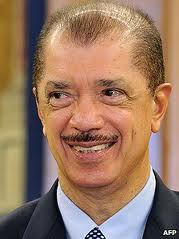
James Alix Michel
President since 14 April 2004
President since 14 April 2004
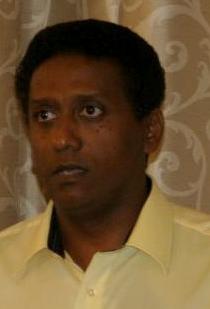
Danny Faure
Vice President since 1 July 2010
Vice President since 1 July 2010
| TRAFFICKING IN PERSONS |
None reported.

James Alix Michel
President since 14 April 2004
President since 14 April 2004