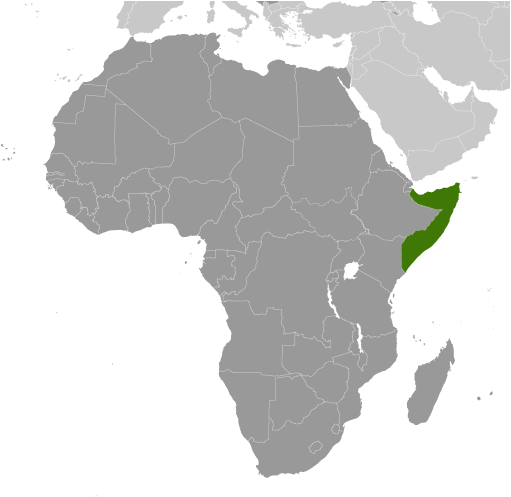

| SOMALIA Somalia Jamhuuriyada Demuqraadiga Soomaaliyeed Joined United Nations: 20 September 1960 Human Rights as assured by their constitution Click here Updated 29 March 2013 |

| CAPITAL |
| POPULATION |
| CHIEF OF STATE |
| SELECTION PROCESS |
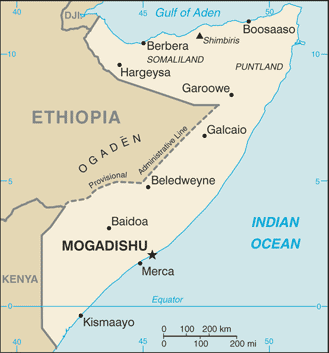
Mogadishu
10,251,568
note: this estimate was derived from an official census taken in 1975 by the Somali
Government; population counting in Somalia is complicated by the large number of
nomads and by refugee movements in response to famine and clan warfare (July 2013 est.)
note: this estimate was derived from an official census taken in 1975 by the Somali
Government; population counting in Somalia is complicated by the large number of
nomads and by refugee movements in response to famine and clan warfare (July 2013 est.)
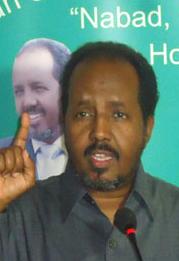
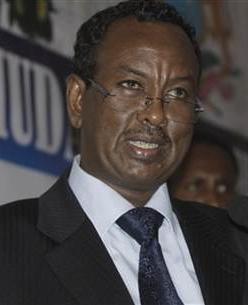
Abdi Farah Shirdon Said
Prime Minister since 06 October 2012
Prime Minister since 06 October 2012
Elected by the Parliament on 10 September 2012
Next scheduled election: September 2016
Next scheduled election: September 2016
HEAD OF GOVERNMENT
SELECTION PROCESS
Prime minister selected by the President
| DECLARATION OF HUMAN RIGHTS |
| ETHNIC GROUPS |
Somali 85%, Bantu and other non-Somali 15% (including Arabs 30,000)
| RELIGIONS |
Sunni Muslim
| GOVERNMENT STRUCTURE |
Federal parliamentary Republic with 18 regions (plural - NA, singular - gobolka); There is no national legal system but instead a
mixture of English common law, Italian law, Islamic Shari'a, and Somali customary law; accepts compulsory ICJ jurisdiction with
reservations
Executive: President elected by the National Parliament; president chooses the prime minister, who is then elected by National
Parliament election last held 10 September 2012 (next election: 2016)
Legislative: Bicameral National Parliament consisting of the House of the People of the Federal Parliament (275 seats, elected by
Somali citizens) and the Upper House of the Federal Parliament (54 seats, elected by people of the Federal member states)
note: the inaugural House of the People in September 2012 was appointed by clan elders; as of April 2013, the Upper House has
not been formed
Judicial: A Supreme Court based in Mogadishu as well as an Appeals Court form the core of the judiciary. Smaller local courts
also exist. A Judicial Service Council directs all judiciary and advises the President.
mixture of English common law, Italian law, Islamic Shari'a, and Somali customary law; accepts compulsory ICJ jurisdiction with
reservations
Executive: President elected by the National Parliament; president chooses the prime minister, who is then elected by National
Parliament election last held 10 September 2012 (next election: 2016)
Legislative: Bicameral National Parliament consisting of the House of the People of the Federal Parliament (275 seats, elected by
Somali citizens) and the Upper House of the Federal Parliament (54 seats, elected by people of the Federal member states)
note: the inaugural House of the People in September 2012 was appointed by clan elders; as of April 2013, the Upper House has
not been formed
Judicial: A Supreme Court based in Mogadishu as well as an Appeals Court form the core of the judiciary. Smaller local courts
also exist. A Judicial Service Council directs all judiciary and advises the President.
| LANGUAGES |
Somali (official), Arabic, Italian, English
| BRIEF HISTORY |
Greek merchants and explorers in the Erythraean (Red) Sea referred to Somalia as two regions, the Berber Coast (the Red Sea
Coast of Somalia) and Azania, which actually included the coasts of modern Kenya and Tanzania as well as the Somali East Coast.
Traders made the journey to Somalia in order to purchase Myrrh and Frankincense, both highly valuable commodities as they were
required for many religious ceremonies and in perfumes, in great demand throughout the Roman Empire, Asia, India and China.
Between the 13th and 14th centuries Somalia was visited by two famous Muslim explorers Ibn Battuta and Zheng He. Ibn Battuta
in 1331 visited Mogadishu, which he described as a town of enormous size and its merchants possessed vast resources; they
owned large numbers of camels, of which they slaughtered hundreds every day for food, and also had large quantities of sheep. The
woven fabrics that were manufactured there he claimed were unequalled and were exported as far as Egypt and elsewhere. Zheng
He on his fifth voyage (1417-19) visited several city states on the Somali coast including Mogadishu. Muslim Somalia enjoyed
friendly relations with neighboring Christian Ethiopia for centuries. Despite jihad raging everywhere else in the Muslim world,
Muhammad had issued a hadith proscribing Muslims from attacking Ethiopia (so long as Ethiopia was not the aggressor), as it had
sheltered some of Islam's first converts from persecution in modern-day Saudi Arabia. Parts of northwestern Somalia (modern
northwestern Somaliland) came under the rule of the Solomonic Ethiopian Kingdom in medieval times, especially during the reign of
Amda Seyon I (r. 1314-1344). In 1403 or 1415 (under Emperor Dawit I or Emperor Yeshaq I, respectively) measures were taken
against the medieval Muslim kingdom of Adal (located in eastern Ethiopia and western Somalia, centered around Harar and
populated by both Somalis and Afars), a tributary kingdom that revolted and whose raids were disrupting rule in adjacent areas.
The area remained under Ethiopian control for another century or so. However, starting around 1527 under the charismatic
leadership of Imam Ahmad ibn Ibrihim al-Ghazi (Gurey in Somali, Gragn in Amharic, both meaning "left-handed), Adal revolted and
invaded Ethiopia. Regrouped Muslim armies with Ottoman support and arms marched into Ethiopia employing scorched earth
tactics and slaughtered any Ethiopian who refused to convert from Ethiopian Orthodox Christianity to Islam. The Portuguese had
been in the area earlier in early 16th centuries (in search of the legendary priest-king Prester John), and although a diplomatic
mission from Portugal, led by Rodrigo de Lima, had failed to improve relations between the countries, they responded to the
Ethiopian pleas for help and sent a military expedition to their fellow Christians. On February 21, 1543, however, a joint
Portuguese-Ethiopian force defeated the Muslim army at the Battle of Wayna Daga, in which Ahmed Gurey was killed and the war
won. On the other side of East Africa in the 14th century, the Ajuuran dynasty formed a centralized state in the lower Shabeelle
valley, ruling over a territory that stretched as far inland as modern Qalafo and towards the coast almost to Mogadishu. Due to
Portuguese predations, internal discord, and encroaching nomads from the north, the Ajuuran sultanate disintegrated at the end of
the 17th century. According to Said Samatar, almost a full century passed before a successor state emerged: the Geledi Sultanate,
which was based in the town of Afgooye and ruled over the lower Shabeelle region. In the 17th century, Somalia fell under the
sway of the rapidly expanding Ottoman Empire, who exercised control through hand picked local Somali governors. In 1728 the
Ottomans evicted the last Portuguese occupation and claimed sovereignty over the whole Horn of Africa. However, their actual
exercise of control was fairly modest, as they demanded only a token annual tribute and appointed an Ottoman judge to act as a
kind of Supreme Court for interpretations of Islamic law. By the 1850s Ottoman power was in decline. Starting in 1875 the age of
imperialism in Europe transformed Somalia. Britain, France, and Italy all made territorial claims on the peninsula. Italy had just
recently been reunited and was an inexperienced colonialist. They were happy to grab up any African land they didn't have to fight
other Europeans for. They took control of the southern part of Somalia, which would become the largest European claim in the
country, but the least strategically significant. Somali resistance to foreign powers began in 1899 under the leadership of religious
scholar Sayyid Mohammed Abdullah Hassan, Ogaden sub-lineage of the Darod tribe and his mother was Dulbahante sub-lineage of
the Darod tribe. The dervish struggle was one of the longest and bloodiest anti-Imperial resistance wars in sub-Saharan Africa, and
cost the lives of nearly a third of northern Somalia's population. By 1935, the British were ready to cut their losses in British
Somaliland. The dervishes refused to accept any negotiations. Even after they had been soundly defeated in 1920, sporadic violence
continued for the entire duration of British occupation. To make matters worse, Italy invaded and conquered Ethiopia in 1936,
whom the British had been using to help their effort to put down the Somali uprisings. Now with Ethiopia unavailable, the British
were faced with the option of doing the dirty work themselves, or packing up and looking for friendlier territory. By this time many
thousand Italian immigrants were living in Romanesque villas on extensive plantations in the south. On May 9 1936, Mussolini
proclaimed the creation of the Italian Empire, calling it the "Africa Orientale Italiana" (A.O.I.) and formed by Ethiopia, Eritrea and
Italian Somalia. Many investments in infrastructure were made by the Italians in their Empire, like the Strada Imperiale ("imperial
road") between Addis Abeba and Mogadishu. Italian hegemony of Somalia was short-lived, because of World War II. At the start
of the war, Mussolini realized he would have to concentrate his resources primarily on the home front to survive the Allied onslaught.
The Italians conquered the British Somaliland in August 1940, but the British were able to totally reconquer Somalia by 1941.
Italian officers organized an Italian guerrilla with Italian colonial troops, that lasted in Somalia from the end of 1941 to spring 1943.
After the war, the British gradually relaxed military control of Somalia, and attempted to introduce democracy, and numerous native
Somalian political parties sprang into existence. In 1948 a commission led by representatives of the victorious Allied nations wanted
to decide the Somali question once and for all. They made one particular decision, granting Ogaden to Ethiopia, which would spark
war decades later. After months of vaciliations and eventually turning the debate over to the United Nations, in 1949 it was decided
that in recognition of its genuine economic improvements to the country, Italy would retain a nominal trusteeship of Somalia for the
next 10 years, after which it would gain full independence. Although Somalis had received their primary political education under
British and post-war Italian tutelage, the virulently anti-Imperialist parties rejected the European's advice whole cloth, and threw
their lot in with the Soviet Union and the People's Republic of China. The stage was set for a coup d'état, but the event that
precipitated the coup was unplanned. On 15 October 1969, a bodyguard killed president Shermarke while prime minister Igaal was
out of the country. The country was renamed the Somali Democratic Republic. By September 1977 Mogadishu controlled 100
percent of the Ogaden and had followed retreating Ethiopian forces into non-Somali regions of Harerge, Bale, and Sidamo. In May
of 1991, the northern portion of the country declared its independence as Somaliland; although de facto independent and relatively
stable compared to the tumultuous south, it has not been recognized by any foreign government. Starting in May 2006 with the
Second Battle of Mogadishu, civil war wracked Somalia as the Islamic Courts Union (ICU) fought with warlords, including the
Alliance for the Restoration of Peace and Counter-Terrorism (ARPCT), pirates, other separatists of Jubaland and Puntland, the
internationally-backed Transitional Federal Government (TFG) and Ethiopian troops to bring unity, security and Sharia law to
Somalia. On June 5, 2006 forces associated with the Islamic Court Union claimed to have taken control of Mogadishu. On
December 20, 2006, active fighting broke out between the ICU and Ethiopia in the Battle of Baidoa. The ICU considered the
conflict a jihad. Ethiopia was allied with the TFG and Puntland in its counterattacks against the ICU. The ICU troops and technicals
proved no match to Ethiopia's tanks and aircraft and on 26 December, the ICU was forced to retreat to Mogadishu.On January 8,
2007, as the Battle of Ras Kamboni raged, TFG President and founder Abdullahi Yusuf Ahmed, a former colonel in the Somali
Army and decorated war hero, entered Mogadishu for the first time since being elected to office. The government then relocated to
Villa Somalia in the capital from its interim location in Baidoa. This marked the first time since the fall of the Siad Barre regime in
1991 that the federal government controlled most of the country. Between May 31 and June 9, 2008, representatives of Somalia's
federal government and the moderate Alliance for the Re-liberation of Somalia (ARS) group of Islamist rebels participated in peace
talks in Djibouti brokered by the former United Nations Special Envoy to Somalia, Ahmedou Ould-Abdallah. As a truce, in March
2009, Somalia's coalition government announced that it would re-implement Shari'a as the nation's official judicial system. On
October 14, 2010, diplomat Mohamed Abdullahi Mohamed (Farmajo) was appointed the new Prime Minister of Somalia. On June
19, 2011, Mohamed Abdullahi Mohamed resigned from his position as Prime Minister of Somalia. Abdiweli Mohamed Ali,
Mohamed's former Minister of Planning and International Cooperation, was later named permanent Prime Minister. In February
2012, Somali government officials met in the northeastern town of Garowe to discuss post-transition arrangements. On June 23,
2012, the Somali federal and regional leaders met again and approved a draft constitution after several days of deliberation. The
National Constituent Assembly overwhelmingly passed the new constitution on August . A presidential election in Somalia took
place on 10 September 2012. The newly-appointed Federal Parliament elected Hassan Sheikh Mohamoud as the first President of
Somalia since the dissolution of the Transitional Federal Government (TFG).
Source: Wikipedia: History of Somalia
Coast of Somalia) and Azania, which actually included the coasts of modern Kenya and Tanzania as well as the Somali East Coast.
Traders made the journey to Somalia in order to purchase Myrrh and Frankincense, both highly valuable commodities as they were
required for many religious ceremonies and in perfumes, in great demand throughout the Roman Empire, Asia, India and China.
Between the 13th and 14th centuries Somalia was visited by two famous Muslim explorers Ibn Battuta and Zheng He. Ibn Battuta
in 1331 visited Mogadishu, which he described as a town of enormous size and its merchants possessed vast resources; they
owned large numbers of camels, of which they slaughtered hundreds every day for food, and also had large quantities of sheep. The
woven fabrics that were manufactured there he claimed were unequalled and were exported as far as Egypt and elsewhere. Zheng
He on his fifth voyage (1417-19) visited several city states on the Somali coast including Mogadishu. Muslim Somalia enjoyed
friendly relations with neighboring Christian Ethiopia for centuries. Despite jihad raging everywhere else in the Muslim world,
Muhammad had issued a hadith proscribing Muslims from attacking Ethiopia (so long as Ethiopia was not the aggressor), as it had
sheltered some of Islam's first converts from persecution in modern-day Saudi Arabia. Parts of northwestern Somalia (modern
northwestern Somaliland) came under the rule of the Solomonic Ethiopian Kingdom in medieval times, especially during the reign of
Amda Seyon I (r. 1314-1344). In 1403 or 1415 (under Emperor Dawit I or Emperor Yeshaq I, respectively) measures were taken
against the medieval Muslim kingdom of Adal (located in eastern Ethiopia and western Somalia, centered around Harar and
populated by both Somalis and Afars), a tributary kingdom that revolted and whose raids were disrupting rule in adjacent areas.
The area remained under Ethiopian control for another century or so. However, starting around 1527 under the charismatic
leadership of Imam Ahmad ibn Ibrihim al-Ghazi (Gurey in Somali, Gragn in Amharic, both meaning "left-handed), Adal revolted and
invaded Ethiopia. Regrouped Muslim armies with Ottoman support and arms marched into Ethiopia employing scorched earth
tactics and slaughtered any Ethiopian who refused to convert from Ethiopian Orthodox Christianity to Islam. The Portuguese had
been in the area earlier in early 16th centuries (in search of the legendary priest-king Prester John), and although a diplomatic
mission from Portugal, led by Rodrigo de Lima, had failed to improve relations between the countries, they responded to the
Ethiopian pleas for help and sent a military expedition to their fellow Christians. On February 21, 1543, however, a joint
Portuguese-Ethiopian force defeated the Muslim army at the Battle of Wayna Daga, in which Ahmed Gurey was killed and the war
won. On the other side of East Africa in the 14th century, the Ajuuran dynasty formed a centralized state in the lower Shabeelle
valley, ruling over a territory that stretched as far inland as modern Qalafo and towards the coast almost to Mogadishu. Due to
Portuguese predations, internal discord, and encroaching nomads from the north, the Ajuuran sultanate disintegrated at the end of
the 17th century. According to Said Samatar, almost a full century passed before a successor state emerged: the Geledi Sultanate,
which was based in the town of Afgooye and ruled over the lower Shabeelle region. In the 17th century, Somalia fell under the
sway of the rapidly expanding Ottoman Empire, who exercised control through hand picked local Somali governors. In 1728 the
Ottomans evicted the last Portuguese occupation and claimed sovereignty over the whole Horn of Africa. However, their actual
exercise of control was fairly modest, as they demanded only a token annual tribute and appointed an Ottoman judge to act as a
kind of Supreme Court for interpretations of Islamic law. By the 1850s Ottoman power was in decline. Starting in 1875 the age of
imperialism in Europe transformed Somalia. Britain, France, and Italy all made territorial claims on the peninsula. Italy had just
recently been reunited and was an inexperienced colonialist. They were happy to grab up any African land they didn't have to fight
other Europeans for. They took control of the southern part of Somalia, which would become the largest European claim in the
country, but the least strategically significant. Somali resistance to foreign powers began in 1899 under the leadership of religious
scholar Sayyid Mohammed Abdullah Hassan, Ogaden sub-lineage of the Darod tribe and his mother was Dulbahante sub-lineage of
the Darod tribe. The dervish struggle was one of the longest and bloodiest anti-Imperial resistance wars in sub-Saharan Africa, and
cost the lives of nearly a third of northern Somalia's population. By 1935, the British were ready to cut their losses in British
Somaliland. The dervishes refused to accept any negotiations. Even after they had been soundly defeated in 1920, sporadic violence
continued for the entire duration of British occupation. To make matters worse, Italy invaded and conquered Ethiopia in 1936,
whom the British had been using to help their effort to put down the Somali uprisings. Now with Ethiopia unavailable, the British
were faced with the option of doing the dirty work themselves, or packing up and looking for friendlier territory. By this time many
thousand Italian immigrants were living in Romanesque villas on extensive plantations in the south. On May 9 1936, Mussolini
proclaimed the creation of the Italian Empire, calling it the "Africa Orientale Italiana" (A.O.I.) and formed by Ethiopia, Eritrea and
Italian Somalia. Many investments in infrastructure were made by the Italians in their Empire, like the Strada Imperiale ("imperial
road") between Addis Abeba and Mogadishu. Italian hegemony of Somalia was short-lived, because of World War II. At the start
of the war, Mussolini realized he would have to concentrate his resources primarily on the home front to survive the Allied onslaught.
The Italians conquered the British Somaliland in August 1940, but the British were able to totally reconquer Somalia by 1941.
Italian officers organized an Italian guerrilla with Italian colonial troops, that lasted in Somalia from the end of 1941 to spring 1943.
After the war, the British gradually relaxed military control of Somalia, and attempted to introduce democracy, and numerous native
Somalian political parties sprang into existence. In 1948 a commission led by representatives of the victorious Allied nations wanted
to decide the Somali question once and for all. They made one particular decision, granting Ogaden to Ethiopia, which would spark
war decades later. After months of vaciliations and eventually turning the debate over to the United Nations, in 1949 it was decided
that in recognition of its genuine economic improvements to the country, Italy would retain a nominal trusteeship of Somalia for the
next 10 years, after which it would gain full independence. Although Somalis had received their primary political education under
British and post-war Italian tutelage, the virulently anti-Imperialist parties rejected the European's advice whole cloth, and threw
their lot in with the Soviet Union and the People's Republic of China. The stage was set for a coup d'état, but the event that
precipitated the coup was unplanned. On 15 October 1969, a bodyguard killed president Shermarke while prime minister Igaal was
out of the country. The country was renamed the Somali Democratic Republic. By September 1977 Mogadishu controlled 100
percent of the Ogaden and had followed retreating Ethiopian forces into non-Somali regions of Harerge, Bale, and Sidamo. In May
of 1991, the northern portion of the country declared its independence as Somaliland; although de facto independent and relatively
stable compared to the tumultuous south, it has not been recognized by any foreign government. Starting in May 2006 with the
Second Battle of Mogadishu, civil war wracked Somalia as the Islamic Courts Union (ICU) fought with warlords, including the
Alliance for the Restoration of Peace and Counter-Terrorism (ARPCT), pirates, other separatists of Jubaland and Puntland, the
internationally-backed Transitional Federal Government (TFG) and Ethiopian troops to bring unity, security and Sharia law to
Somalia. On June 5, 2006 forces associated with the Islamic Court Union claimed to have taken control of Mogadishu. On
December 20, 2006, active fighting broke out between the ICU and Ethiopia in the Battle of Baidoa. The ICU considered the
conflict a jihad. Ethiopia was allied with the TFG and Puntland in its counterattacks against the ICU. The ICU troops and technicals
proved no match to Ethiopia's tanks and aircraft and on 26 December, the ICU was forced to retreat to Mogadishu.On January 8,
2007, as the Battle of Ras Kamboni raged, TFG President and founder Abdullahi Yusuf Ahmed, a former colonel in the Somali
Army and decorated war hero, entered Mogadishu for the first time since being elected to office. The government then relocated to
Villa Somalia in the capital from its interim location in Baidoa. This marked the first time since the fall of the Siad Barre regime in
1991 that the federal government controlled most of the country. Between May 31 and June 9, 2008, representatives of Somalia's
federal government and the moderate Alliance for the Re-liberation of Somalia (ARS) group of Islamist rebels participated in peace
talks in Djibouti brokered by the former United Nations Special Envoy to Somalia, Ahmedou Ould-Abdallah. As a truce, in March
2009, Somalia's coalition government announced that it would re-implement Shari'a as the nation's official judicial system. On
October 14, 2010, diplomat Mohamed Abdullahi Mohamed (Farmajo) was appointed the new Prime Minister of Somalia. On June
19, 2011, Mohamed Abdullahi Mohamed resigned from his position as Prime Minister of Somalia. Abdiweli Mohamed Ali,
Mohamed's former Minister of Planning and International Cooperation, was later named permanent Prime Minister. In February
2012, Somali government officials met in the northeastern town of Garowe to discuss post-transition arrangements. On June 23,
2012, the Somali federal and regional leaders met again and approved a draft constitution after several days of deliberation. The
National Constituent Assembly overwhelmingly passed the new constitution on August . A presidential election in Somalia took
place on 10 September 2012. The newly-appointed Federal Parliament elected Hassan Sheikh Mohamoud as the first President of
Somalia since the dissolution of the Transitional Federal Government (TFG).
Source: Wikipedia: History of Somalia
| ECONOMIC OVERVIEW |
Despite the lack of effective national governance, Somalia has maintained a healthy informal economy, largely based on livestock,
remittance/money transfer companies, and telecommunications. Agriculture is the most important sector with livestock normally
accounting for about 40% of GDP and more than 50% of export earnings. Nomads and semi-pastoralists, who are dependent upon
livestock for their livelihood, make up a large portion of the population. Livestock, hides, fish, charcoal, and bananas are Somalia's
principal exports, while sugar, sorghum, corn, qat, and machined goods are the principal imports. Somalia's small industrial sector,
based on the processing of agricultural products, has largely been looted and the machinery sold as scrap metal. Somalia's service
sector has grown. Telecommunication firms provide wireless services in most major cities and offer the lowest international call rates
on the continent. In the absence of a formal banking sector, money transfer/remittance services have sprouted throughout the
country, handling up to $1.6 billion in remittances annually. Mogadishu's main market offers a variety of goods from food to the
newest electronic gadgets. Hotels continue to operate and are supported with private-security militias. Somalia's arrears to the IMF
have continued to grow.
Source: CIA World Factbook (select Somalia)
remittance/money transfer companies, and telecommunications. Agriculture is the most important sector with livestock normally
accounting for about 40% of GDP and more than 50% of export earnings. Nomads and semi-pastoralists, who are dependent upon
livestock for their livelihood, make up a large portion of the population. Livestock, hides, fish, charcoal, and bananas are Somalia's
principal exports, while sugar, sorghum, corn, qat, and machined goods are the principal imports. Somalia's small industrial sector,
based on the processing of agricultural products, has largely been looted and the machinery sold as scrap metal. Somalia's service
sector has grown. Telecommunication firms provide wireless services in most major cities and offer the lowest international call rates
on the continent. In the absence of a formal banking sector, money transfer/remittance services have sprouted throughout the
country, handling up to $1.6 billion in remittances annually. Mogadishu's main market offers a variety of goods from food to the
newest electronic gadgets. Hotels continue to operate and are supported with private-security militias. Somalia's arrears to the IMF
have continued to grow.
Source: CIA World Factbook (select Somalia)
| POLITICAL CLIMATE |
Somalia had no central functioning government following the United Somali Congress (USC) ouster of Major General Mohamed
Siad Barre on January 27, 1991. The political situation of the Somali Civil War has been marked by chaos, interclan fighting,
random banditry, internecine warfare between proto-governments and resistance to the state. The breakaway states such as
Somaliland and Puntland put together functional regional governance. In the rest of the country there are a wide range of
semi-functional governments and anarchic conditions under various warlords.
In 2000, the international community recognised the Transitional National Government, originally headed by Abdulkassim Salat
Hassan, as the government for the entire country. The government only recently was able to enter the capital because of the violence
(see Fall of Mogadishu).
On October 14, 2004 Somali members of parliament elected warlord Abdullahi Yusuf Ahmed, previously president of Puntland, to
be the next president. He appointed a cabinet led by Prime Minister Ali Mohamed Ghedi. Because of the situation in Mogadishu,
the election was held in a sports centre in Nairobi, Kenya. Yusuf was elected transitional President by Somalia's transitional
parliament. He won 189 of the 275 votes from members of parliament. The session of Parliament was also held in neighbouring
Kenya. His government is recognized by most western nations as legitimate, although his actual authority is still limited.
On 16 December 2008, Abdullahi Yusuf Ahmed appointed a new prime minister -- but the previous prime minister is refusing to
accept his dismissal. The Somali parliament on Monday backed Nur Hassan Hussein, who has been prime minister for about 13
months, in his power struggle with the president.
On 23 June, TFG and regional leaders approved a draft constitution after several days of deliberation. The National Constituent
Assembly overwhelmingly passed the new constitution on 1 August, with 96% of the 645 delegates present voting for it, 2% against
it and 2% abstaining. A presidential election in Somalia took place on 10 September 2012. The newly-appointed Federal
Parliament elected Hassan Sheikh Mohamoud as the first President of Somalia since the dissolution of the Transitional Federal
Government (TFG). The election had previously been scheduled for 20 August, the same day that the mandate of the TFG expired,
but was rescheduled for a later date.
Source: Wikipedia: Politics of Somalia
Siad Barre on January 27, 1991. The political situation of the Somali Civil War has been marked by chaos, interclan fighting,
random banditry, internecine warfare between proto-governments and resistance to the state. The breakaway states such as
Somaliland and Puntland put together functional regional governance. In the rest of the country there are a wide range of
semi-functional governments and anarchic conditions under various warlords.
In 2000, the international community recognised the Transitional National Government, originally headed by Abdulkassim Salat
Hassan, as the government for the entire country. The government only recently was able to enter the capital because of the violence
(see Fall of Mogadishu).
On October 14, 2004 Somali members of parliament elected warlord Abdullahi Yusuf Ahmed, previously president of Puntland, to
be the next president. He appointed a cabinet led by Prime Minister Ali Mohamed Ghedi. Because of the situation in Mogadishu,
the election was held in a sports centre in Nairobi, Kenya. Yusuf was elected transitional President by Somalia's transitional
parliament. He won 189 of the 275 votes from members of parliament. The session of Parliament was also held in neighbouring
Kenya. His government is recognized by most western nations as legitimate, although his actual authority is still limited.
On 16 December 2008, Abdullahi Yusuf Ahmed appointed a new prime minister -- but the previous prime minister is refusing to
accept his dismissal. The Somali parliament on Monday backed Nur Hassan Hussein, who has been prime minister for about 13
months, in his power struggle with the president.
On 23 June, TFG and regional leaders approved a draft constitution after several days of deliberation. The National Constituent
Assembly overwhelmingly passed the new constitution on 1 August, with 96% of the 645 delegates present voting for it, 2% against
it and 2% abstaining. A presidential election in Somalia took place on 10 September 2012. The newly-appointed Federal
Parliament elected Hassan Sheikh Mohamoud as the first President of Somalia since the dissolution of the Transitional Federal
Government (TFG). The election had previously been scheduled for 20 August, the same day that the mandate of the TFG expired,
but was rescheduled for a later date.
Source: Wikipedia: Politics of Somalia
| INTERNATIONAL DISPUTES |
Ethiopian forces invaded southern Somalia and routed Islamist Courts from Mogadishu in January 2007; "Somaliland" secessionists
provide port facilities in Berbera to landlocked Ethiopia and have established commercial ties with other regional states; "Puntland"
and "Somaliland" "governments" seek international support in their secessionist aspirations and overlapping border claims; the
undemarcated former British administrative line has little meaning as a political separation to rival clans within Ethiopia's Ogaden and
southern Somalia's Oromo region; Kenya works hard to prevent the clan and militia fighting in Somalia from spreading south across
the border, which has long been open to nomadic pastoralists
provide port facilities in Berbera to landlocked Ethiopia and have established commercial ties with other regional states; "Puntland"
and "Somaliland" "governments" seek international support in their secessionist aspirations and overlapping border claims; the
undemarcated former British administrative line has little meaning as a political separation to rival clans within Ethiopia's Ogaden and
southern Somalia's Oromo region; Kenya works hard to prevent the clan and militia fighting in Somalia from spreading south across
the border, which has long been open to nomadic pastoralists


| REFUGEES AND INTERNALLY DISPLACED PERSONS (IDPS) |
IDPs: 1.36 million (civil war since 1988, clan-based competition for resources; 2011 famine; insecurity because of fighting between
al-Shabaab and TFG allied forces) (2011)
al-Shabaab and TFG allied forces) (2011)
| ILLICIT DRUGS |
None reported.
| HUMAN RIGHTS STATEMENTS, ANALYSIS AND CRITIQUES |
2011 Human Rights Reports: Somalia
Bureau of Democracy, Human Rights, and Labor
2011 Country Reports on Human Rights Practices
May 24, 2012
Somalia is fragmented into regions led in whole or in part by different entities, including: the Transitional Federal Government (TFG) in
Mogadishu, the self-declared Republic of Somaliland in the Northwest, Puntland in the Northeast, and Galmuduug in the central region.
The TFG was formed in 2004 with a five-year mandate to establish permanent, representative governmental institutions and organize
national elections. In 2009 a 550-member Transitional Federal Parliament (TFP), established under the internationally backed Djibouti
Peace Process, extended the TFG’s mandate until August 2011 and elected Sheikh Sharif Sheikh Ahmed as TFG president. On February
3, the TFP unilaterally extended its mandate by a further three years.
On June 9, following a six-month stalemate between the TFP and the TFG (collectively referred to as the Transitional Federal
Institutions, or TFIs) over ending the transitional period, both the president and the parliamentary speaker, Sharif Hassan Sheikh Aden,
signed the Kampala Accord. That accord extended the transition period to August 20, 2012, and stated that elections for president and
parliamentary speaker should take place prior to that date. On September 6, the TFIs as well as regional and political stakeholders
endorsed a Roadmap for Ending the Transition that includes the key essential tasks to be completed before August 2012. On December
13, members of the TFP passed a vote of no confidence against parliamentary speaker Sharif Hassan. The TFG, African Union,
Intergovernmental Authority on Development, and Speaker Sharif Hassan himself all deemed the no-confidence vote to be a violation of
the Kampala Accord and questioned whether the vote followed proper parliamentary procedure. At year’s end Sharif Hassan remained in
the speakership position.
Conflict-related abuses, including killings, displacement, and restriction of humanitarian assistance continued to severely impact civilians.
According to the UN, there were 1.36 million internally displaced persons (IDPs) in the country and 955,000 persons had taken refuge in
other countries, primarily due to conflict, famine, and drought. Approximately 300,000 Somali refugees arrived in Kenya, Ethiopia,
Djibouti, and Yemen during the year. The rule of law was largely nonexistent. Al-Shabaab controlled most of the south and central
regions, where it committed human rights abuses including killings, torture, restriction of humanitarian assistance, and extortion. On
August 6, al-Shabaab withdrew from most areas of Mogadishu, but in the following months it continued attacks in the city.
In Mogadishu, Puntland, and Somaliland, severe human rights abuses included killings by security forces, militias, al-Shabaab, and
unknown gunmen; restrictions on freedom of the press, including violence against journalists; and discrimination and violence against
women and girls, including rape and female genital mutilation.
Other major human rights abuses included harsh and life-threatening prison conditions; arbitrary arrest and detention; denial of a fair trial;
restrictions on freedom of assembly and association; corruption; restrictions on the right of citizens to peacefully change their
government; child abuse; recruitment of child soldiers; trafficking in persons; abuse of and discrimination against clan and religious
minorities; restrictions on workers’ rights; forced labor; and child labor. Al-Shabaab committed human rights abuses including
extrajudicial killings; disappearances; cruel and unusual punishment; rape; restrictions on civil liberties and freedom of movement;
restrictions on nongovernmental organizations (NGOs) and humanitarian assistance; and use of child soldiers. Militias, including those
affiliated with the TFG, also committed abuses. Pirates abducted and killed persons.
TFG, Somaliland, and Puntland authorities generally did not take steps to prosecute or punish officials who committed abuses, and
impunity was the norm
Click here to read more »
Bureau of Democracy, Human Rights, and Labor
2011 Country Reports on Human Rights Practices
May 24, 2012
Somalia is fragmented into regions led in whole or in part by different entities, including: the Transitional Federal Government (TFG) in
Mogadishu, the self-declared Republic of Somaliland in the Northwest, Puntland in the Northeast, and Galmuduug in the central region.
The TFG was formed in 2004 with a five-year mandate to establish permanent, representative governmental institutions and organize
national elections. In 2009 a 550-member Transitional Federal Parliament (TFP), established under the internationally backed Djibouti
Peace Process, extended the TFG’s mandate until August 2011 and elected Sheikh Sharif Sheikh Ahmed as TFG president. On February
3, the TFP unilaterally extended its mandate by a further three years.
On June 9, following a six-month stalemate between the TFP and the TFG (collectively referred to as the Transitional Federal
Institutions, or TFIs) over ending the transitional period, both the president and the parliamentary speaker, Sharif Hassan Sheikh Aden,
signed the Kampala Accord. That accord extended the transition period to August 20, 2012, and stated that elections for president and
parliamentary speaker should take place prior to that date. On September 6, the TFIs as well as regional and political stakeholders
endorsed a Roadmap for Ending the Transition that includes the key essential tasks to be completed before August 2012. On December
13, members of the TFP passed a vote of no confidence against parliamentary speaker Sharif Hassan. The TFG, African Union,
Intergovernmental Authority on Development, and Speaker Sharif Hassan himself all deemed the no-confidence vote to be a violation of
the Kampala Accord and questioned whether the vote followed proper parliamentary procedure. At year’s end Sharif Hassan remained in
the speakership position.
Conflict-related abuses, including killings, displacement, and restriction of humanitarian assistance continued to severely impact civilians.
According to the UN, there were 1.36 million internally displaced persons (IDPs) in the country and 955,000 persons had taken refuge in
other countries, primarily due to conflict, famine, and drought. Approximately 300,000 Somali refugees arrived in Kenya, Ethiopia,
Djibouti, and Yemen during the year. The rule of law was largely nonexistent. Al-Shabaab controlled most of the south and central
regions, where it committed human rights abuses including killings, torture, restriction of humanitarian assistance, and extortion. On
August 6, al-Shabaab withdrew from most areas of Mogadishu, but in the following months it continued attacks in the city.
In Mogadishu, Puntland, and Somaliland, severe human rights abuses included killings by security forces, militias, al-Shabaab, and
unknown gunmen; restrictions on freedom of the press, including violence against journalists; and discrimination and violence against
women and girls, including rape and female genital mutilation.
Other major human rights abuses included harsh and life-threatening prison conditions; arbitrary arrest and detention; denial of a fair trial;
restrictions on freedom of assembly and association; corruption; restrictions on the right of citizens to peacefully change their
government; child abuse; recruitment of child soldiers; trafficking in persons; abuse of and discrimination against clan and religious
minorities; restrictions on workers’ rights; forced labor; and child labor. Al-Shabaab committed human rights abuses including
extrajudicial killings; disappearances; cruel and unusual punishment; rape; restrictions on civil liberties and freedom of movement;
restrictions on nongovernmental organizations (NGOs) and humanitarian assistance; and use of child soldiers. Militias, including those
affiliated with the TFG, also committed abuses. Pirates abducted and killed persons.
TFG, Somaliland, and Puntland authorities generally did not take steps to prosecute or punish officials who committed abuses, and
impunity was the norm
Click here to read more »
29 August 2011
Human Rights Council
Eighteenth session
Agenda item 10
Technical assistance and capacity–building
Report of the independent expert on the situation of human rights in Somalia, Shamsul B
Summary
The unending saga of human rights deprivations in Somalia over the past two decades have now been compounded by another
humanitarian crisis. The devastating drought currently ravaging the Horn of Africa, compounded by conflict and the denial of
humanitarian assistance, has resulted in a declaration of famine in two regions of South- Central Somalia. Already in the course of the
independent expert’s sixth visit to Somalia, in February 2011, the drought had taken a heavy toll on livestock and food reserves. The full
impact of the drought can be seen on the Somali population, a large number of whom have been forced to flee their homes in search of
food and succour. Deaths caused by malnutrition have been documented among new arrivals in refugee camps in Kenya and Ethiopia
and into Mogadishu. The United Nations has already warned that, unless urgent measures are taken to increase the response, the famine
will spread to the whole of southern Somalia within the next two months. This should not be allowed to happen and become another blot
on the conscience of mankind.
Apart from the drought and famine, the armed conflicts between Islamist insurgents and the Transitional Federal Government, supported
by the troops of the African Union Mission in Somalia (AMISOM), continues to cause deaths and injury to the civilian population.
Indiscriminate shelling and firing in urban areas, and suicide and improvised explosive attacks by the insurgent group Al-Shabaab, are the
main causes.
Recent offensive has resulted in territorial gains for AMISOM and Transitional Federal Government forces. On 6 August 2011, Al-
Shabaab announced its withdrawal from positions it had held in Mogadishu for nearly two years. Although Al-Shabaab has been under
military pressure in Mogadishu from the combined operations of AMISOM and Transitional Federal Government forces for some time,
its sudden withdrawal came as a surprise.
Click here to read more »
Human Rights Council
Eighteenth session
Agenda item 10
Technical assistance and capacity–building
Report of the independent expert on the situation of human rights in Somalia, Shamsul B
Summary
The unending saga of human rights deprivations in Somalia over the past two decades have now been compounded by another
humanitarian crisis. The devastating drought currently ravaging the Horn of Africa, compounded by conflict and the denial of
humanitarian assistance, has resulted in a declaration of famine in two regions of South- Central Somalia. Already in the course of the
independent expert’s sixth visit to Somalia, in February 2011, the drought had taken a heavy toll on livestock and food reserves. The full
impact of the drought can be seen on the Somali population, a large number of whom have been forced to flee their homes in search of
food and succour. Deaths caused by malnutrition have been documented among new arrivals in refugee camps in Kenya and Ethiopia
and into Mogadishu. The United Nations has already warned that, unless urgent measures are taken to increase the response, the famine
will spread to the whole of southern Somalia within the next two months. This should not be allowed to happen and become another blot
on the conscience of mankind.
Apart from the drought and famine, the armed conflicts between Islamist insurgents and the Transitional Federal Government, supported
by the troops of the African Union Mission in Somalia (AMISOM), continues to cause deaths and injury to the civilian population.
Indiscriminate shelling and firing in urban areas, and suicide and improvised explosive attacks by the insurgent group Al-Shabaab, are the
main causes.
Recent offensive has resulted in territorial gains for AMISOM and Transitional Federal Government forces. On 6 August 2011, Al-
Shabaab announced its withdrawal from positions it had held in Mogadishu for nearly two years. Although Al-Shabaab has been under
military pressure in Mogadishu from the combined operations of AMISOM and Transitional Federal Government forces for some time,
its sudden withdrawal came as a surprise.
Click here to read more »
Freedom Alert
Somali Broadcast Journalist Murdered
Mar 5 2012 - 3:03pm
Somali reporter Ali Ahmed Abdi was killed Sunday, March 4 in Galkayo, Somalia when masked gunmen reportedly shot him in the head
after stopping him in the street. Abdi was a reporter for an online Somali news site and formerly a journalist with Galkayo Radio. He was
an outspoken advocate for press freedom in Somalia, often highlighting cases of murdered journalists in the country. Freedom House is
saddened by his vicious murder and calls for a full investigation and increased efforts to protect media freedom in the country.
Abdi is the 30th journalist murdered in Somalia since 2007, according to the National Union of Somali Journalists and the third journalist
killed in Somalia in 2012. Freedom House ranked Somalia as “Not Free” in Freedom of the Press 2011 because of the frequent killings of
reporters, harsh legal restrictions, and political instability. The Somali constitution affords press freedom, but the political volatility has
largely prevented effective exercise of such freedoms.
Click here to read more»;
Somali Broadcast Journalist Murdered
Mar 5 2012 - 3:03pm
Somali reporter Ali Ahmed Abdi was killed Sunday, March 4 in Galkayo, Somalia when masked gunmen reportedly shot him in the head
after stopping him in the street. Abdi was a reporter for an online Somali news site and formerly a journalist with Galkayo Radio. He was
an outspoken advocate for press freedom in Somalia, often highlighting cases of murdered journalists in the country. Freedom House is
saddened by his vicious murder and calls for a full investigation and increased efforts to protect media freedom in the country.
Abdi is the 30th journalist murdered in Somalia since 2007, according to the National Union of Somali Journalists and the third journalist
killed in Somalia in 2012. Freedom House ranked Somalia as “Not Free” in Freedom of the Press 2011 because of the frequent killings of
reporters, harsh legal restrictions, and political instability. The Somali constitution affords press freedom, but the political volatility has
largely prevented effective exercise of such freedoms.
Click here to read more»;
Press releases
13 August 2012
Somalia must end impunity for killing of media workers
The Somali authorities and the international community must act to end impunity for the killing of media workers Amnesty International
said today, following the deaths of two journalists in separate incidents in the capital Mogadishu at the weekend.
Yusif Ali Osman, a former veteran journalist and official in Somalia's Ministry of Information, was shot dead in the Dharkenley district
of the capital on Sunday morning by two young men reported to have been wearing school uniforms.
Another journalist, Mohamoud Ali Keyre (Buneyste), was reportedly killed by stray bullets during a fight between government troops in
the Yaqshid district of the city that same afternoon.
Yesterday's deaths bring to 10 the toll of media workers killed in Somalia since December 2011. Not a single person has been brought to
justice for the killings of journalists in Somalia this year, nor in previous years.
"Somalia's Transitional Federal Government (TFG) should urgently open and complete thorough investigations into the killings of all
journalists and media workers in the country, bring the perpetrators to justice, and ensure that it responds to the continuing threats on
journalists' lives," said Bénédicte Goderiaux, Somalia researcher at Amnesty International.
"The TFG however has shown no willingness to address the killings. The international community should establish an independent
Commission of Inquiry to investigate and document crimes under international law committed in Somalia, including the killings of
journalists.
Yusuf Ali Osman used to be the Director of the government-run radio station Radio Mogadishu before he started working for the
Ministry of Information.
The Islamist armed group al-Shabab has reportedly claimed responsibility for his death, calling him an enemy working for the TFG.
The killing of Mohamoud Ali Keyre came four days after members of the TFG signed the National Security and Stabilization Plan, which
among other issues is meant to address the lack of discipline and chain-of-command in the TFG security forces.
Mohamoud Ali Keyre used to work for radio station Radio Hamar (Voice of Democracy) but in recent years worked for Somali websites
based in Kenya's capital Nairobi.
Click here to read more »
13 August 2012
Somalia must end impunity for killing of media workers
The Somali authorities and the international community must act to end impunity for the killing of media workers Amnesty International
said today, following the deaths of two journalists in separate incidents in the capital Mogadishu at the weekend.
Yusif Ali Osman, a former veteran journalist and official in Somalia's Ministry of Information, was shot dead in the Dharkenley district
of the capital on Sunday morning by two young men reported to have been wearing school uniforms.
Another journalist, Mohamoud Ali Keyre (Buneyste), was reportedly killed by stray bullets during a fight between government troops in
the Yaqshid district of the city that same afternoon.
Yesterday's deaths bring to 10 the toll of media workers killed in Somalia since December 2011. Not a single person has been brought to
justice for the killings of journalists in Somalia this year, nor in previous years.
"Somalia's Transitional Federal Government (TFG) should urgently open and complete thorough investigations into the killings of all
journalists and media workers in the country, bring the perpetrators to justice, and ensure that it responds to the continuing threats on
journalists' lives," said Bénédicte Goderiaux, Somalia researcher at Amnesty International.
"The TFG however has shown no willingness to address the killings. The international community should establish an independent
Commission of Inquiry to investigate and document crimes under international law committed in Somalia, including the killings of
journalists.
Yusuf Ali Osman used to be the Director of the government-run radio station Radio Mogadishu before he started working for the
Ministry of Information.
The Islamist armed group al-Shabab has reportedly claimed responsibility for his death, calling him an enemy working for the TFG.
The killing of Mohamoud Ali Keyre came four days after members of the TFG signed the National Security and Stabilization Plan, which
among other issues is meant to address the lack of discipline and chain-of-command in the TFG security forces.
Mohamoud Ali Keyre used to work for radio station Radio Hamar (Voice of Democracy) but in recent years worked for Somali websites
based in Kenya's capital Nairobi.
Click here to read more »
Somaliland: Stop Deporting Ethiopian Refugees
Dozens, Including Women, Children, Forced Back to Ethiopia
September 4, 2012
(Nairobi) – The Somaliland authorities should immediately stop deporting Ethiopian refugees and asylum seekers to Ethiopia. On August
31, 2012, dozens of Ethiopians, mostly women and children, were forcibly returned to Ethiopia in violation of international legal
prohibitions against sending people to places where they might face persecution or threats to their lives.
The Somaliland authorities deported Ethiopians arrested after police raids on August 30 and 31 on an informal settlement known as the
Social Welfare Centre in Somaliland’s main city, Hargeisa, where several hundred asylum seekers and migrants from Ethiopia have lived
for almost a year. The exact number and immigration status of those returned is unclear, but a witness estimated seeing around 100
people sent across the border. In late December 2011, Somaliland attempted to forcibly return 20 Ethiopian refugees and asylum seekers
and tried to close down the Social Welfare Centre.
“Rounding up and deporting asylum seekers is not the way to treat vulnerable people seeking Somaliland’s protection,” said Leslie
Lefkow, deputy Africa director at Human Rights Watch. “Somaliland authorities should instead ensure that Ethiopian asylum seekers are
registered and given the protection and assistance to which they are entitled.”
Human Rights Watch said deporting registered refugees and asylum seekers constitutes refoulement, the unlawful return of anyone to
persecution or to a place where their life or freedom is threatened. International law prohibits the deportation of anyone seeking asylum
before they have received a fair determination of their claim.
Local sources told Human Rights Watch that on the morning of August 30 the owner of land surrounding the Social Welfare Centre told
the Ethiopians living there to leave. When they refused, fighting broke out and police arrived. According to witnesses, police fired live
ammunition during the ensuing struggle and wounded at least six Ethiopians, including one who was shot in the arm and the leg. The
sources also said Ethiopians at the centre may have injured four police officers.
The police then arrested 56 of the Ethiopians, including the majority of those injured, and took them to different detention facilities in
Hargeisa. 25 registered refugees and two asylum seekers were detained at the Central Police Station. One of those refugees told Human
Rights Watch that six injured refugees had not received medical assistance for three days before they were released.
Click here to read more »
Dozens, Including Women, Children, Forced Back to Ethiopia
September 4, 2012
(Nairobi) – The Somaliland authorities should immediately stop deporting Ethiopian refugees and asylum seekers to Ethiopia. On August
31, 2012, dozens of Ethiopians, mostly women and children, were forcibly returned to Ethiopia in violation of international legal
prohibitions against sending people to places where they might face persecution or threats to their lives.
The Somaliland authorities deported Ethiopians arrested after police raids on August 30 and 31 on an informal settlement known as the
Social Welfare Centre in Somaliland’s main city, Hargeisa, where several hundred asylum seekers and migrants from Ethiopia have lived
for almost a year. The exact number and immigration status of those returned is unclear, but a witness estimated seeing around 100
people sent across the border. In late December 2011, Somaliland attempted to forcibly return 20 Ethiopian refugees and asylum seekers
and tried to close down the Social Welfare Centre.
“Rounding up and deporting asylum seekers is not the way to treat vulnerable people seeking Somaliland’s protection,” said Leslie
Lefkow, deputy Africa director at Human Rights Watch. “Somaliland authorities should instead ensure that Ethiopian asylum seekers are
registered and given the protection and assistance to which they are entitled.”
Human Rights Watch said deporting registered refugees and asylum seekers constitutes refoulement, the unlawful return of anyone to
persecution or to a place where their life or freedom is threatened. International law prohibits the deportation of anyone seeking asylum
before they have received a fair determination of their claim.
Local sources told Human Rights Watch that on the morning of August 30 the owner of land surrounding the Social Welfare Centre told
the Ethiopians living there to leave. When they refused, fighting broke out and police arrived. According to witnesses, police fired live
ammunition during the ensuing struggle and wounded at least six Ethiopians, including one who was shot in the arm and the leg. The
sources also said Ethiopians at the centre may have injured four police officers.
The police then arrested 56 of the Ethiopians, including the majority of those injured, and took them to different detention facilities in
Hargeisa. 25 registered refugees and two asylum seekers were detained at the Central Police Station. One of those refugees told Human
Rights Watch that six injured refugees had not received medical assistance for three days before they were released.
Click here to read more »
Opening Statement of
H.E. Dr. Abdiweli Mohamed Ali, Prime Minister of Somalia
Istanbul II Conference May 31 – June 1, 2012
Honorable guests, ladies and gentlemen, I would like to take this opportunity to speak to the Somali people and our friends across the
globe.
I shall take this opportunity to set out a vision for Somalia’s future, the obstacles we face and the task at hand we must deliver on. It’s
no great secret that my administration inherited a pile of problems and little practical support or solutions to proceed with.
Our progress report is thus. We’ve regained control of the capital city Mogadishu and large swathes of the previously ungovernable
Southern and Central regions in less than nine months. The Al-Shabaab element will not survive for too long, their reckless tactics have
sapped them of all support.
The Roadmap towards forming a permanent government is nearing completion. The number of MPs in the new parliament will be
reduced to a sensible 225, and women will represent 30% of the MPs in the New Somalia.
The new provisional constitution that will ensure the basic elements of dignity, justice and equality that are integral to the new Somalia, is
in its final draft and will soon be debated and adopted by the National Constituent Assembly.
My goal is to bring stability that will lead to the Somali people taking charge of their country. We need to guide Somalia towards a new
direction, a fresh start, away from labels such as “the world’s worst failed state” – back to the proud independent nation we’ve always
been, a nation of autonomous, vital, self-reliant men and women, the nation of poets, respected in this part of the world for nearly a
millennia. Somalia is more than hungry faces in the news, pirates or extremists; it is a diverse, rich land with historical pedigree.
I can foresee a day where Somalia has an active, vibrant economy buoyed by modern infrastructure and by highways, a Somalia with a
highly educated young professional class, a Somalia where one can travel in peace in the dead of the night, a Somalia where we play an
essential part of an ‘East African Economic zone’, with trade booming across this region, fuelling the global economy. A Somalia with
an export-led economy rather than an import-fuelled economy. A Somalia that is a business hub, connecting Asia and Africa. A Somalia
where our society is fed by a rich cultural life. THIS IS WHAT I THINK SOMALIA CAN AND WILL BE – Inshallah.
Our country is abundant in resources – we have the longest coastline in Africa, 9 million acres of fertile land, the highest per capita
livestock in the world. We have oil and minerals. We are strategically located at the gateway of the Middle East and Africa, at the corner
of the Indian Ocean and the Red Sea.
Despite the conflict for the last 21 years, we have one of the best and cheapest telecommunications around the world. Somalis in the
Diaspora have established huge businesses around the globe whether it is in Dubai, Kenya, South Africa and other parts of the world.
Click here to read more
H.E. Dr. Abdiweli Mohamed Ali, Prime Minister of Somalia
Istanbul II Conference May 31 – June 1, 2012
Honorable guests, ladies and gentlemen, I would like to take this opportunity to speak to the Somali people and our friends across the
globe.
I shall take this opportunity to set out a vision for Somalia’s future, the obstacles we face and the task at hand we must deliver on. It’s
no great secret that my administration inherited a pile of problems and little practical support or solutions to proceed with.
Our progress report is thus. We’ve regained control of the capital city Mogadishu and large swathes of the previously ungovernable
Southern and Central regions in less than nine months. The Al-Shabaab element will not survive for too long, their reckless tactics have
sapped them of all support.
The Roadmap towards forming a permanent government is nearing completion. The number of MPs in the new parliament will be
reduced to a sensible 225, and women will represent 30% of the MPs in the New Somalia.
The new provisional constitution that will ensure the basic elements of dignity, justice and equality that are integral to the new Somalia, is
in its final draft and will soon be debated and adopted by the National Constituent Assembly.
My goal is to bring stability that will lead to the Somali people taking charge of their country. We need to guide Somalia towards a new
direction, a fresh start, away from labels such as “the world’s worst failed state” – back to the proud independent nation we’ve always
been, a nation of autonomous, vital, self-reliant men and women, the nation of poets, respected in this part of the world for nearly a
millennia. Somalia is more than hungry faces in the news, pirates or extremists; it is a diverse, rich land with historical pedigree.
I can foresee a day where Somalia has an active, vibrant economy buoyed by modern infrastructure and by highways, a Somalia with a
highly educated young professional class, a Somalia where one can travel in peace in the dead of the night, a Somalia where we play an
essential part of an ‘East African Economic zone’, with trade booming across this region, fuelling the global economy. A Somalia with
an export-led economy rather than an import-fuelled economy. A Somalia that is a business hub, connecting Asia and Africa. A Somalia
where our society is fed by a rich cultural life. THIS IS WHAT I THINK SOMALIA CAN AND WILL BE – Inshallah.
Our country is abundant in resources – we have the longest coastline in Africa, 9 million acres of fertile land, the highest per capita
livestock in the world. We have oil and minerals. We are strategically located at the gateway of the Middle East and Africa, at the corner
of the Indian Ocean and the Red Sea.
Despite the conflict for the last 21 years, we have one of the best and cheapest telecommunications around the world. Somalis in the
Diaspora have established huge businesses around the globe whether it is in Dubai, Kenya, South Africa and other parts of the world.
Click here to read more
Sister Somalia Celebrates Its First Year
Changing Lives and the Global Conversation on Rape in Somalia
August
2012
Even with a great support network in place, it takes tenacious effort and boldness, as well as relentless courage, to start a new
program…. and to rebuild your life after being raped. It demands qualities that most of us only hope we have.
In Somalia, Fartun, her daughter Ilwad, the Sister Somalia staff and the women and girls they serve face even greater, virtually
incomprehensible,
difficulties. In a country whose institutions and infrastructure have been decimated by more than 20 years without a functioning
government, they face the daily threat of being killed by TFG militia/police or Al-Shabaab terrorists who learn about them and their work.
I have often wondered: Just how far do they have to dig within themselves each day for the mettle to keep going? But dig they obviously
do, with creativity and courage to spare, and with amazing results. In celebrating our 1st anniversary, we honor Fartun, Ilwad, the
Center staff, and every Somali Sister who is working to rebuild her life, along with every donor whose generosity has made their work
possible.
Here is a list of Sister Somalia’s accomplishments in our first year — it’s lengthy, but well worth the read!
Our Founding and Its Immediate Global Impact:
In early July 2011, Lisa Shannon and Katy Grant, flew to Mogadishu to meet with Fartun Adan and 17 rape survivors at the Elman
Peace and Human Rights Center (the Elman Center) and to launch Sister Somalia. It was a humble and heartfelt, if audacious beginning
sparked by a tiny group of 30 grassroots women who pledged to donate $10 each month. Lisa committed to raising $120,000 over the
course of the year to fund the program
and hand-carried donors’ personal notes of love and encouragement to our first sisters. Prism Partnerships (Katy) would handle
administration, receive donations and disburse funds to the program, and would vet and monitor records and reports on program
delivery. Fartun would create the program from scratch through the Elman Center, shepherd its day-to-day operations, and be
responsible for meeting international accountability standards.Global press coverage on Sister Somalia took hold immediately and
highlighted the frequency and severity of sexual violence there. First, Lisa was interviewed on PRI’s The World. Then New York
Times’ columnist Nicholas Kristof featured a guest blog by Lisa in his online blog, On the Ground. An Op-Ed by Lisa in the U.K.’s
revered newspaper The Guardian further reinforced the seriousness of the sexual violence occurring in Somalia. The foundation for
Sister Somalia’s global impact on media coverage was in place.
Within weeks, news of the Somalia famine was dominating international headlines. Hundreds of thousands of people being displaced by
starvation crowded into camps outside Mogadishu. Many of them were unaccompanied women with their children. In the chaos, the
incidence of rape, and the need for the lifeline Sister Somalia’s was providing to survivors, was skyrocketing. As the sole sexual violence
program, Sister Somalia provided a frequent focal point for media coverage, which began to include the issue of gender based violence
and the desperate needs of survivors.
Click here to read more »
Changing Lives and the Global Conversation on Rape in Somalia
August
2012
Even with a great support network in place, it takes tenacious effort and boldness, as well as relentless courage, to start a new
program…. and to rebuild your life after being raped. It demands qualities that most of us only hope we have.
In Somalia, Fartun, her daughter Ilwad, the Sister Somalia staff and the women and girls they serve face even greater, virtually
incomprehensible,
difficulties. In a country whose institutions and infrastructure have been decimated by more than 20 years without a functioning
government, they face the daily threat of being killed by TFG militia/police or Al-Shabaab terrorists who learn about them and their work.
I have often wondered: Just how far do they have to dig within themselves each day for the mettle to keep going? But dig they obviously
do, with creativity and courage to spare, and with amazing results. In celebrating our 1st anniversary, we honor Fartun, Ilwad, the
Center staff, and every Somali Sister who is working to rebuild her life, along with every donor whose generosity has made their work
possible.
Here is a list of Sister Somalia’s accomplishments in our first year — it’s lengthy, but well worth the read!
Our Founding and Its Immediate Global Impact:
In early July 2011, Lisa Shannon and Katy Grant, flew to Mogadishu to meet with Fartun Adan and 17 rape survivors at the Elman
Peace and Human Rights Center (the Elman Center) and to launch Sister Somalia. It was a humble and heartfelt, if audacious beginning
sparked by a tiny group of 30 grassroots women who pledged to donate $10 each month. Lisa committed to raising $120,000 over the
course of the year to fund the program
and hand-carried donors’ personal notes of love and encouragement to our first sisters. Prism Partnerships (Katy) would handle
administration, receive donations and disburse funds to the program, and would vet and monitor records and reports on program
delivery. Fartun would create the program from scratch through the Elman Center, shepherd its day-to-day operations, and be
responsible for meeting international accountability standards.Global press coverage on Sister Somalia took hold immediately and
highlighted the frequency and severity of sexual violence there. First, Lisa was interviewed on PRI’s The World. Then New York
Times’ columnist Nicholas Kristof featured a guest blog by Lisa in his online blog, On the Ground. An Op-Ed by Lisa in the U.K.’s
revered newspaper The Guardian further reinforced the seriousness of the sexual violence occurring in Somalia. The foundation for
Sister Somalia’s global impact on media coverage was in place.
Within weeks, news of the Somalia famine was dominating international headlines. Hundreds of thousands of people being displaced by
starvation crowded into camps outside Mogadishu. Many of them were unaccompanied women with their children. In the chaos, the
incidence of rape, and the need for the lifeline Sister Somalia’s was providing to survivors, was skyrocketing. As the sole sexual violence
program, Sister Somalia provided a frequent focal point for media coverage, which began to include the issue of gender based violence
and the desperate needs of survivors.
Click here to read more »
SOMALI MEDIA STAKEHOLDERS CELEBRATE WORLD PRESS FREEDOM DAY IN MOGADISHU
Written by Administrator
Saturday, 07 May 2011
The National Union of Somali Journalists (NUSOJ), Mogadishu Media House (MMHouse) and Somali Coalition for Free Expression
(SOCFEX) mark May 3rd 2011, to celebrate the 20th anniversary of the Windhoek Declaration with the theme “Somali Media:
challenges and Barriers” in a well organized event held at Ambasador Hotel in Mogadishu on Tuesday.
In the occasion of the World Press Freedom Day, Somali journalists honored their slain colleague journalists who were killed while
performing their duties as Somalia is regarded in one of the most dangerous countries to work for journalists in Africa.
The event which is celebrated annually on May 3rd, the date on which the Windhoek Declaration was adopted, was attended by the
Somali media stakeholders, civil society organizations, human rights defenders and government officials and the chairman of the
Parliamentary Media Committee, Mr. Awad Ahmed Hasharo, who all underlined the need to give tribute to the slain Somali journalists,
which as well encourages the Somali journalists and other stakeholders.
On the 20th Anniversary of the World Press Freedom Day symbolizes the importance of freedom of the press. Press freedom is
considered to be a cornerstone of human rights and a guarantee of other freedoms. It encourages transparency and good governance
and it ensures that society enjoys the rule of true justice. Freedom of the press is a bridge of understanding and knowledge. It is essential
for the exchange of ideas between nations and cultures which is a condition for true understanding and lasting cooperation.
May 3rd now serves as an occasion to inform the public of violations of the right to freedom of expression and as a reminder that many
journalists brave death or jail to bring people their daily news.
The Secretary General of the National Union of Somali Journalists, Mohammed Ibrahim highlighted the importance of the World Press
Freedom Day and the conditions the Somali Journalists’ work in this war-torn country, while facing all sorts of oppressions. Mr.
Ibrahim paid a tribute for the courageous work the journalists have undertaken in a hostile environment while performing their duties,
even some of them paying their last price.
“The Somali journalists are working in one of the most dangerous cities in the world, worth to be honored and awarded, many have been
killed, wounded, arrested, tortured, threatened in the country as a whole, as today is the World’s Press Freedom day.” Mohammed
Ibrahim, NUSOJ Secretary General said, “We must not be discouraged by any sort of violations meant to silence the independent media
and if that happens, the media freedom is gone.”
Click here to read more>>
Written by Administrator
Saturday, 07 May 2011
The National Union of Somali Journalists (NUSOJ), Mogadishu Media House (MMHouse) and Somali Coalition for Free Expression
(SOCFEX) mark May 3rd 2011, to celebrate the 20th anniversary of the Windhoek Declaration with the theme “Somali Media:
challenges and Barriers” in a well organized event held at Ambasador Hotel in Mogadishu on Tuesday.
In the occasion of the World Press Freedom Day, Somali journalists honored their slain colleague journalists who were killed while
performing their duties as Somalia is regarded in one of the most dangerous countries to work for journalists in Africa.
The event which is celebrated annually on May 3rd, the date on which the Windhoek Declaration was adopted, was attended by the
Somali media stakeholders, civil society organizations, human rights defenders and government officials and the chairman of the
Parliamentary Media Committee, Mr. Awad Ahmed Hasharo, who all underlined the need to give tribute to the slain Somali journalists,
which as well encourages the Somali journalists and other stakeholders.
On the 20th Anniversary of the World Press Freedom Day symbolizes the importance of freedom of the press. Press freedom is
considered to be a cornerstone of human rights and a guarantee of other freedoms. It encourages transparency and good governance
and it ensures that society enjoys the rule of true justice. Freedom of the press is a bridge of understanding and knowledge. It is essential
for the exchange of ideas between nations and cultures which is a condition for true understanding and lasting cooperation.
May 3rd now serves as an occasion to inform the public of violations of the right to freedom of expression and as a reminder that many
journalists brave death or jail to bring people their daily news.
The Secretary General of the National Union of Somali Journalists, Mohammed Ibrahim highlighted the importance of the World Press
Freedom Day and the conditions the Somali Journalists’ work in this war-torn country, while facing all sorts of oppressions. Mr.
Ibrahim paid a tribute for the courageous work the journalists have undertaken in a hostile environment while performing their duties,
even some of them paying their last price.
“The Somali journalists are working in one of the most dangerous cities in the world, worth to be honored and awarded, many have been
killed, wounded, arrested, tortured, threatened in the country as a whole, as today is the World’s Press Freedom day.” Mohammed
Ibrahim, NUSOJ Secretary General said, “We must not be discouraged by any sort of violations meant to silence the independent media
and if that happens, the media freedom is gone.”
Click here to read more>>
| Click map for larger view |
| Click flag for Country Report |



Hassan Sheikh Mohamud
President since 10 September 2012
President since 10 September 2012
| TRAFFICKING IN PERSONS |
None reported.