
| VIETNAM Socialist Republic of Vietnam Cong Hoa Xa Hoi Chu Nghia Viet Nam Joined United Nations: 20 September 1977 Human Rights as assured by their constitution Click here Updated 07 January 2013 |

| CAPITAL |
| POPULATION |
| CHIEF OF STATE |
| SELECTION PROCESS |
Hanoi
91,519,289 (July 2012 est.)
Nguyen Tan Dung
Prime Minister since 27 June 2006
Prime Minister since 27 June 2006
President elected by the National Assembly from among its
members for five-year term; last held 25 July 2011
Next scheduled election: July 2016
members for five-year term; last held 25 July 2011
Next scheduled election: July 2016
HEAD OF GOVERNMENT
SELECTION PROCESS
Prime minister appointed by the president from among the members of the National Assembly; deputy
prime ministers appointed by the prime minister; appointment of prime minister and deputy prime
ministers confirmed by National Assembly
prime ministers appointed by the prime minister; appointment of prime minister and deputy prime
ministers confirmed by National Assembly
| DECLARATION OF HUMAN RIGHTS |
| ETHNIC GROUPS |
Kinh (Viet) 86.2%, Tay 1.9%, Thai 1.7%, Muong 1.5%, Khome 1.4%, Hoa 1.1%, Nun 1.1%, Hmong 1%, others 4.1% (1999
census)
census)
| RELIGIONS |
Buddhist 9.3%, Catholic 6.7%, Hoa Hao 1.5%, Cao Dai 1.1%, Protestant 0.5%, Muslim 0.1%, none 80.8% (1999 census)
| GOVERNMENT STRUCTURE |
Communist state with 59 provinces (tinh, singular and plural) and 5 municipalities (thanh pho, singular and plural); Legal system is
based on communist legal theory and French civil law system has not accepted compulsory ICJ jurisdiction
Executive: President elected by the National Assembly from among its members for five-year term; last held 25 July 2011 (next to
be held in July 2016); prime minister appointed by the president from among the members of the National Assembly; deputy prime
ministers appointed by the prime minister; appointment of prime minister and deputy prime ministers confirmed by National
Assembly
Legislative: Unicameral National Assembly or Quoc Hoi (500 seats; members elected by popular vote to serve five-year terms)
elections: last held 22 May 2011 (next to be held in May 2016
Judicial: Supreme People's Court (chief justice is elected for a five-year term by the National Assembly on the recommendation of
the president)
based on communist legal theory and French civil law system has not accepted compulsory ICJ jurisdiction
Executive: President elected by the National Assembly from among its members for five-year term; last held 25 July 2011 (next to
be held in July 2016); prime minister appointed by the president from among the members of the National Assembly; deputy prime
ministers appointed by the prime minister; appointment of prime minister and deputy prime ministers confirmed by National
Assembly
Legislative: Unicameral National Assembly or Quoc Hoi (500 seats; members elected by popular vote to serve five-year terms)
elections: last held 22 May 2011 (next to be held in May 2016
Judicial: Supreme People's Court (chief justice is elected for a five-year term by the National Assembly on the recommendation of
the president)
| LANGUAGES |
Vietnamese (official), English (increasingly favored as a second language), some French, Chinese, and Khmer; mountain area
languages (Mon-Khmer and Malayo-Polynesian)
languages (Mon-Khmer and Malayo-Polynesian)
| BRIEF HISTORY |
Evidence of the earliest established society other than the Đông Sơn culture in Northern Vietnam was found in Cổ Loa, the ancient
city situated near present-day Hà Nội. According to Chinese sources, Qin's renegade general Zhao Tuo (Triệu Đà) subjugated the
region of Tây Âu Lạc, located in Northern Vietnam, to be part of his Nan Yue (Nam Việt) Empire. According to Vietnamese myths
the first Vietnamese peoples descended from the Dragon Lord Lạc Long Quân and the Immortal Fairy Âu Cơ. The eldest son
became the first in a line of earliest Vietnamese kings, collectively known as the Hùng kings (Hùng Vương or the Hồng Bàng
Dynasty). The Hùng kings called the country, which was then located on the Red River delta in present-day northern Vietnam, Văn
Lang. The people of Văn Lang were referred to as the Lạc Việt. In ancient times, many tribes living south of the Yangtze River
called themselves the Yue (Việt in Vietnamese). Most of these tribes were linguistically related to the northern Chinese; even today,
Cantonese people and their language are still referred to as Yue. Văn Lang was thought to be a matriarchal society, similar to many
other matriarchal societies common in Southeast Asia and in the Pacific islands at the time. Various archaeological sites in northern
Vietnam, such as Đông Sơn have yielded metal weapons and tools from this age. In 111 BC, Chinese troops invaded Nanyue and
established new territories, dividing Vietnam into Giao Chỉ, pinyin: Jiaozhi, now the Red river delta; Cửu Chân now from Thanhhoa
to Hatinh; and Nhật Nam, now from Quangbinh to Hue. While the Chinese were governors and top officials, the original
Vietnamese nobles (Lạc Hầu, Lạc Tướng) still managed some highlands. Early in the 10th century AD, as China became politically
fragmented, successive lords from the Khúc family, followed by Dương Đình Nghệ, ruled Giao Châu autonomously under the Tang
title of Tiết Độ Sứ (Virtuous Lord), yet stopping short of proclaiming themselves kings. In 938, the kingdom of Southern Han sent
troops to conquer autonomous Giao Châu. Ngô Quyền, Dương Đình Nghệ's son-in-law, defeated the Southern Han fleet at the
Battle of Bach Dang River (938). He then proclaimed himself King Ngô and effectively began the age of independence for Vietnam.
When the king Lê Long Đĩnh died in 1009 AD, a Palace Guard Commander named Lý Công Uẩn was nominated by the court to
take over the throne, and founded the Lý dynasty. This event is regarded as the beginning of a golden era in Vietnamese history,
with great following dynasties. The Lý Dynasty had two major wars with Song China, and a few conquests against neighboring
Champa in the south. During the Trần Dynasty, Đại Việt repelled three invasions (in 1257 AD, 1284 AD, and 1288 AD) by the
Mongols under Kublai Khan, who had occupied China and founded the Yuan dynasty. It was also during this period that the Trần
kings waged many wars against the southern kingdom of Champa, continuing the Viets' long history of southern expansion (known
as Nam Tiến) that had begun shortly after gaining independence from China. Hồ Quý Ly forced the last Trần king to resign and
assumed the throne in 1400. The Lê dynasty was overthrown by its general named Mạc Đăng Dung in 1527. He killed the Lê
emperor and proclaimed himself emperor, starting the Mạc Dynasty. After defeating many revolutions for two years, Mạc Đăng
Dung adopted the Trần Dynasty's practice and ceded the throne to his son, Mạc Đăng Doanh, and became Thái Thượng Hoàng.
Meanwhile, Nguyễn Kim, a former official in the Lê court, revolted against the Mạc and helped king Lê Trang Tông restore the Lê
court in the Thanh Hóa area. Thus a civil war began between the Northern Court (Mạc) and the Southern Court (Restored Lê).
Nguyễn Kim's side controlled the southern part of Đại Việt (from Thanhhoa to the south), leaving the north (including Đông Kinh-
Hanoi) under Mạc control. The West's involvement in Vietnam dates back to 166 BC with the arrival of merchants from the Roman
Empire, 1292 with the visit of Marco Polo, and the early 1500s with the arrival of Portuguese and other European traders and
missionaries. Alexandre de Rhodes, a French Jesuit priest, improved on earlier work by Portuguese missionaries and developed the
Vietnamese romanized alphabet Quốc Ngữ in Dictionarium Annamiticum Lusitanam et Latinum in 1651. Between 1627 and 1775,
two powerful families had partitioned the country: the Nguyễn Lords ruled the South and the Trịnh Lords ruled the North. The Trịnh-
Nguyễn War gave European traders the opportunities to support each side with weapons and technology: The Portuguese assisted
the Nguyễn while the Dutch helped the Trịnh. After Nguyễn Ánh established the Nguyễn Dynasty in 1802, he tolerated Catholicism
and employed some Europeans in his court as advisors. However, he and his successors were conservative Confucians who
resisted Westernization. The next Nguyễn emperors, Ming Mạng, Thiệu Trị, and Tự Đức brutally suppressed Catholicism and
pursued a 'closed door' policy, perceiving the Westerners as a threat. Under the orders of Napoleon III of France, French gunships
under Rigault de Genouilly attacked the port of Đà Nẵng in 1858, causing significant damages, yet failed to gain any foothold. De
Genouilly decided to sail south and captured the poorly defended city of Gia Định (present-day Saigon). From 1859 to 1867,
French troops expanded their control over all 6 provinces on the Mekong delta and formed a French Colony known as Cochin
China. A few years later, French troops landed in northern Vietnam (which they called Tonkin) and captured Hà Nội twice in 1873
and 1882. France assumed control over the whole of Vietnam after the Franco-Chinese War (1884-1885). In the early 20th
century, Vietnamese patriots realized that they could not defeat France without modernization. Also, having been exposed to
Western philosophy, they aimed to establish a republic upon independence, departing from the royalist sentiments of the Cần
Vương movements. In 1940, during World War II, Japan invaded Indochina yet kept the Vichy French colonial administration in
place as a Japanese puppet. In 1941 Hồ Chí Minh, formerly known as Nguyễn Ái Quốc, arrived in northern Vietnam to form Việt
Minh Front (short for Việt Nam Độc Lập Đồng Minh Hội). Việt Minh Front was supposed to be an umbrella group for all parties
fighting for Vietnam's independence, yet it was dominated by the Communist Party. Within Vietnam, Việt Minh had a very modest
armed force, which worked with the American OSS to collect intelligence on the Japanese. In August 1945, the Japanese
surrendered to the Allies, creating a power vacuum in Vietnam. The Việt Minh launched the "August Revolution" across the country
to seize government offices. Emperor Bảo Ðại abdicated on August 25, 1945, ending the Nguyễn Dynasty. On September 2, 1945
Hồ Chí Minh declared Vietnam independent under the new name of Democratic Republic of Vietnam (DRV) and held the position
of Chairman (Chủ Tịch). In southern Vietnam, British forces landed in Saigon to disarm the Japanese, followed by French troops
trying to re-establish their rule. In 1947, full scale war broke out between Viet Minh and France. Realizing that colonialism was
coming to an end worldwide, France fashioned a semi-independent State of Vietnam, within the French Union, with Bảo Đại as
Head of State. On May 7 1954, French troops at Điện Biên Phủ, under Christian de Castries, surrendered to Viet Minh. On July
1954, the Geneva Accord was signed between France and Viet-Minh, paving the way for France to leave Vietnam. The Geneva
Conference of 1954 ended France's colonial presence in Vietnam and temporarily partitioned the country into 2 states at the 17th
parallel (pending unification on the basis of internationally supervised free elections). The Republic of Vietnam (RVN) was
proclaimed in Saigon on October 22, 1955. The United States began to provide military and economic aid to the RVN, training
RVN personnel, and sending U.S. advisors to assist in building the infrastructure for the new government. The Geneva Accord had
promised elections to determine the government for a unified Vietnam. However, as only France and Viet Minh (Democratic
Republic of Vietnam) had signed the document, the United States and Ngô Đình Diệm's government refused to abide by the
agreement, fearing that Hồ Chí Minh would win the election due to his war popularity, and would establish Communism in the whole
of Vietnam. Although the Tết Offensive was a catastrophic military defeat for the Việt Cộng, it was a stunning political victory as it
led many Americans to view the war as unwinnable. Duong Van Minh ordered a surrender on April 30 1975, sparing Saigon from
destruction. In 1976, Vietnam was officially unified and renamed Socialist Republic of Vietnam (SRVN), with its capital in Hà Nội.
In 1986, the Communist Party of Vietnam changed its economic policy and began reforms of the private sector similar to those in
China. Since the mid-1980s, Vietnam has enjoyed substantial economic growth and some reduction in political repression.
Source: Wikipedia: History of Vietnam
city situated near present-day Hà Nội. According to Chinese sources, Qin's renegade general Zhao Tuo (Triệu Đà) subjugated the
region of Tây Âu Lạc, located in Northern Vietnam, to be part of his Nan Yue (Nam Việt) Empire. According to Vietnamese myths
the first Vietnamese peoples descended from the Dragon Lord Lạc Long Quân and the Immortal Fairy Âu Cơ. The eldest son
became the first in a line of earliest Vietnamese kings, collectively known as the Hùng kings (Hùng Vương or the Hồng Bàng
Dynasty). The Hùng kings called the country, which was then located on the Red River delta in present-day northern Vietnam, Văn
Lang. The people of Văn Lang were referred to as the Lạc Việt. In ancient times, many tribes living south of the Yangtze River
called themselves the Yue (Việt in Vietnamese). Most of these tribes were linguistically related to the northern Chinese; even today,
Cantonese people and their language are still referred to as Yue. Văn Lang was thought to be a matriarchal society, similar to many
other matriarchal societies common in Southeast Asia and in the Pacific islands at the time. Various archaeological sites in northern
Vietnam, such as Đông Sơn have yielded metal weapons and tools from this age. In 111 BC, Chinese troops invaded Nanyue and
established new territories, dividing Vietnam into Giao Chỉ, pinyin: Jiaozhi, now the Red river delta; Cửu Chân now from Thanhhoa
to Hatinh; and Nhật Nam, now from Quangbinh to Hue. While the Chinese were governors and top officials, the original
Vietnamese nobles (Lạc Hầu, Lạc Tướng) still managed some highlands. Early in the 10th century AD, as China became politically
fragmented, successive lords from the Khúc family, followed by Dương Đình Nghệ, ruled Giao Châu autonomously under the Tang
title of Tiết Độ Sứ (Virtuous Lord), yet stopping short of proclaiming themselves kings. In 938, the kingdom of Southern Han sent
troops to conquer autonomous Giao Châu. Ngô Quyền, Dương Đình Nghệ's son-in-law, defeated the Southern Han fleet at the
Battle of Bach Dang River (938). He then proclaimed himself King Ngô and effectively began the age of independence for Vietnam.
When the king Lê Long Đĩnh died in 1009 AD, a Palace Guard Commander named Lý Công Uẩn was nominated by the court to
take over the throne, and founded the Lý dynasty. This event is regarded as the beginning of a golden era in Vietnamese history,
with great following dynasties. The Lý Dynasty had two major wars with Song China, and a few conquests against neighboring
Champa in the south. During the Trần Dynasty, Đại Việt repelled three invasions (in 1257 AD, 1284 AD, and 1288 AD) by the
Mongols under Kublai Khan, who had occupied China and founded the Yuan dynasty. It was also during this period that the Trần
kings waged many wars against the southern kingdom of Champa, continuing the Viets' long history of southern expansion (known
as Nam Tiến) that had begun shortly after gaining independence from China. Hồ Quý Ly forced the last Trần king to resign and
assumed the throne in 1400. The Lê dynasty was overthrown by its general named Mạc Đăng Dung in 1527. He killed the Lê
emperor and proclaimed himself emperor, starting the Mạc Dynasty. After defeating many revolutions for two years, Mạc Đăng
Dung adopted the Trần Dynasty's practice and ceded the throne to his son, Mạc Đăng Doanh, and became Thái Thượng Hoàng.
Meanwhile, Nguyễn Kim, a former official in the Lê court, revolted against the Mạc and helped king Lê Trang Tông restore the Lê
court in the Thanh Hóa area. Thus a civil war began between the Northern Court (Mạc) and the Southern Court (Restored Lê).
Nguyễn Kim's side controlled the southern part of Đại Việt (from Thanhhoa to the south), leaving the north (including Đông Kinh-
Hanoi) under Mạc control. The West's involvement in Vietnam dates back to 166 BC with the arrival of merchants from the Roman
Empire, 1292 with the visit of Marco Polo, and the early 1500s with the arrival of Portuguese and other European traders and
missionaries. Alexandre de Rhodes, a French Jesuit priest, improved on earlier work by Portuguese missionaries and developed the
Vietnamese romanized alphabet Quốc Ngữ in Dictionarium Annamiticum Lusitanam et Latinum in 1651. Between 1627 and 1775,
two powerful families had partitioned the country: the Nguyễn Lords ruled the South and the Trịnh Lords ruled the North. The Trịnh-
Nguyễn War gave European traders the opportunities to support each side with weapons and technology: The Portuguese assisted
the Nguyễn while the Dutch helped the Trịnh. After Nguyễn Ánh established the Nguyễn Dynasty in 1802, he tolerated Catholicism
and employed some Europeans in his court as advisors. However, he and his successors were conservative Confucians who
resisted Westernization. The next Nguyễn emperors, Ming Mạng, Thiệu Trị, and Tự Đức brutally suppressed Catholicism and
pursued a 'closed door' policy, perceiving the Westerners as a threat. Under the orders of Napoleon III of France, French gunships
under Rigault de Genouilly attacked the port of Đà Nẵng in 1858, causing significant damages, yet failed to gain any foothold. De
Genouilly decided to sail south and captured the poorly defended city of Gia Định (present-day Saigon). From 1859 to 1867,
French troops expanded their control over all 6 provinces on the Mekong delta and formed a French Colony known as Cochin
China. A few years later, French troops landed in northern Vietnam (which they called Tonkin) and captured Hà Nội twice in 1873
and 1882. France assumed control over the whole of Vietnam after the Franco-Chinese War (1884-1885). In the early 20th
century, Vietnamese patriots realized that they could not defeat France without modernization. Also, having been exposed to
Western philosophy, they aimed to establish a republic upon independence, departing from the royalist sentiments of the Cần
Vương movements. In 1940, during World War II, Japan invaded Indochina yet kept the Vichy French colonial administration in
place as a Japanese puppet. In 1941 Hồ Chí Minh, formerly known as Nguyễn Ái Quốc, arrived in northern Vietnam to form Việt
Minh Front (short for Việt Nam Độc Lập Đồng Minh Hội). Việt Minh Front was supposed to be an umbrella group for all parties
fighting for Vietnam's independence, yet it was dominated by the Communist Party. Within Vietnam, Việt Minh had a very modest
armed force, which worked with the American OSS to collect intelligence on the Japanese. In August 1945, the Japanese
surrendered to the Allies, creating a power vacuum in Vietnam. The Việt Minh launched the "August Revolution" across the country
to seize government offices. Emperor Bảo Ðại abdicated on August 25, 1945, ending the Nguyễn Dynasty. On September 2, 1945
Hồ Chí Minh declared Vietnam independent under the new name of Democratic Republic of Vietnam (DRV) and held the position
of Chairman (Chủ Tịch). In southern Vietnam, British forces landed in Saigon to disarm the Japanese, followed by French troops
trying to re-establish their rule. In 1947, full scale war broke out between Viet Minh and France. Realizing that colonialism was
coming to an end worldwide, France fashioned a semi-independent State of Vietnam, within the French Union, with Bảo Đại as
Head of State. On May 7 1954, French troops at Điện Biên Phủ, under Christian de Castries, surrendered to Viet Minh. On July
1954, the Geneva Accord was signed between France and Viet-Minh, paving the way for France to leave Vietnam. The Geneva
Conference of 1954 ended France's colonial presence in Vietnam and temporarily partitioned the country into 2 states at the 17th
parallel (pending unification on the basis of internationally supervised free elections). The Republic of Vietnam (RVN) was
proclaimed in Saigon on October 22, 1955. The United States began to provide military and economic aid to the RVN, training
RVN personnel, and sending U.S. advisors to assist in building the infrastructure for the new government. The Geneva Accord had
promised elections to determine the government for a unified Vietnam. However, as only France and Viet Minh (Democratic
Republic of Vietnam) had signed the document, the United States and Ngô Đình Diệm's government refused to abide by the
agreement, fearing that Hồ Chí Minh would win the election due to his war popularity, and would establish Communism in the whole
of Vietnam. Although the Tết Offensive was a catastrophic military defeat for the Việt Cộng, it was a stunning political victory as it
led many Americans to view the war as unwinnable. Duong Van Minh ordered a surrender on April 30 1975, sparing Saigon from
destruction. In 1976, Vietnam was officially unified and renamed Socialist Republic of Vietnam (SRVN), with its capital in Hà Nội.
In 1986, the Communist Party of Vietnam changed its economic policy and began reforms of the private sector similar to those in
China. Since the mid-1980s, Vietnam has enjoyed substantial economic growth and some reduction in political repression.
Source: Wikipedia: History of Vietnam
| ECONOMIC OVERVIEW |
Vietnam is a densely-populated developing country that in the last 30 years has had to recover from the ravages of war, the loss of
financial support from the old Soviet Bloc, and the rigidities of a centrally-planned economy. While Vietnam's economy remains
dominated by state-owned enterprises, which still produce about 40% of GDP, Vietnamese authorities have reaffirmed their
commitment to economic liberalization and international integration. They have moved to implement the structural reforms needed to
modernize the economy and to produce more competitive export-driven industries. Vietnam joined the World Trade Organization in
January 2007 following more than a decade-long negotiation process. Vietnam became an official negotiating partner in the
developing Trans-Pacific Partnership trade agreement in 2010. Agriculture's share of economic output has continued to shrink from
about 25% in 2000 to about 22% in 2011, while industry's share increased from 36% to 40% in the same period. Deep poverty
has declined significantly, and Vietnam is working to create jobs to meet the challenge of a labor force that is growing by more than
one million people every year. The global recession has hurt Vietnam's export-oriented economy, with GDP in 2009-11 growing
less than the 7% per annum average achieved during the last decade. In 2011, exports increased by more than 33%, year-on-year,
and the trade deficit, while reduced from 2010, remained high, prompting the government to maintain administrative trade measures
to limit the trade deficit. Vietnam's managed currency, the dong, continues to face downward pressure due to a persistent trade
imbalance. Since 2008, the government devalued it in excess of 20% through a series of small devaluations. Foreign donors pledged
nearly $8 billion in new development assistance for 2011. However, the government's strong growth-oriented economic policies
have caused it to struggle to control one of the region's highest inflation rates, which reached as high as 23% in August 2011 and
averaged 18% for the year. In February 2011, Vietnam shifted its focus away from economic growth to stabilizing its economy and
tightened fiscal and monetary policies. In early 2012 Vietnam unveiled a broad "three pillar" economic reform program, proposing
the restructuring of public investment, state-owned enterprises and the banking sector. Vietnam's economy continues to face
challenges from low foreign exchange reserves, an undercapitalized banking sector, and high borrowing costs. The near-bankruptcy
and subsequent default of the state-owned-enterprise Vinashin, a leading shipbuilder, led to a ratings downgrade of Vietnam's
sovereign debt, exacerbating Vietnam's borrowing difficulties.
Source: CIA World Factbook (select Vietnam)
financial support from the old Soviet Bloc, and the rigidities of a centrally-planned economy. While Vietnam's economy remains
dominated by state-owned enterprises, which still produce about 40% of GDP, Vietnamese authorities have reaffirmed their
commitment to economic liberalization and international integration. They have moved to implement the structural reforms needed to
modernize the economy and to produce more competitive export-driven industries. Vietnam joined the World Trade Organization in
January 2007 following more than a decade-long negotiation process. Vietnam became an official negotiating partner in the
developing Trans-Pacific Partnership trade agreement in 2010. Agriculture's share of economic output has continued to shrink from
about 25% in 2000 to about 22% in 2011, while industry's share increased from 36% to 40% in the same period. Deep poverty
has declined significantly, and Vietnam is working to create jobs to meet the challenge of a labor force that is growing by more than
one million people every year. The global recession has hurt Vietnam's export-oriented economy, with GDP in 2009-11 growing
less than the 7% per annum average achieved during the last decade. In 2011, exports increased by more than 33%, year-on-year,
and the trade deficit, while reduced from 2010, remained high, prompting the government to maintain administrative trade measures
to limit the trade deficit. Vietnam's managed currency, the dong, continues to face downward pressure due to a persistent trade
imbalance. Since 2008, the government devalued it in excess of 20% through a series of small devaluations. Foreign donors pledged
nearly $8 billion in new development assistance for 2011. However, the government's strong growth-oriented economic policies
have caused it to struggle to control one of the region's highest inflation rates, which reached as high as 23% in August 2011 and
averaged 18% for the year. In February 2011, Vietnam shifted its focus away from economic growth to stabilizing its economy and
tightened fiscal and monetary policies. In early 2012 Vietnam unveiled a broad "three pillar" economic reform program, proposing
the restructuring of public investment, state-owned enterprises and the banking sector. Vietnam's economy continues to face
challenges from low foreign exchange reserves, an undercapitalized banking sector, and high borrowing costs. The near-bankruptcy
and subsequent default of the state-owned-enterprise Vinashin, a leading shipbuilder, led to a ratings downgrade of Vietnam's
sovereign debt, exacerbating Vietnam's borrowing difficulties.
Source: CIA World Factbook (select Vietnam)
| POLITICAL CLIMATE |
The most important powers within the Vietnamese Government – in addition to the Communist Party – are the executive agencies
created by the 1992 constitution: the offices of the president and the prime minister. Notwithstanding the 1992 Constitution's
reaffirmation of the central role of the Communist Party, the National Assembly, according to the Constitution, is the highest
representative body of the people and the only organization with legislative powers. It has a broad mandate to oversee all
government functions. Once seen as little more than a rubber stamp, the National Assembly has become more vocal and assertive in
exercising its authority over lawmaking, particularly in recent years. However, the National Assembly is still subject to party
direction. About 80% of the deputies in the National Assembly are party members. The assembly meets twice yearly for seven to
ten weeks each time; elections for members are held every five years. There is a separate judicial branch, but it is relatively weak.
Overall, there are few lawyers and trial procedures are rudimentary.
The Socialist Republic of Vietnam is governed through a highly centralized system dominated by the Communist Party of Vietnam
(CPV) (Đảng Cộng sản Việt Nam), which was formerly the Vietnamese Labor Party (1951-1976). The Socialist Republic of
Vietnam exists today as a communist state.
The current 500 members of the National Assembly were elected during the 2011 parliamentary election, and they have a five-year
term. Despite foreign criticism, it is generally believed that the National Assembly has become more powerful in recent years.[41]
The last election was held, according to the authorities, in a democratic, fair, lawful and safe manner and was considered a success.
Voter turnout was 99.51 percent; nearly 62 million people voted. In their respective constituencies, Nguyễn Phú Trọng, the General
Secretary, was elected to the National Assembly with 85.63 percent of the votes, Prime Minister Nguyễn Tấn Dũng was elected
with 95.38 percent and President Trương Tấn Sang was elected with 80.19 percent. Outside the ruling troika, it was Nguyễn Xuân
Phúc, the Chairman of the Government Office, who was elected with the highest margin, with 94.59 percent of the votes. The
number of self-nominated candidates was four times higher than the previous election.[42] Fifteen out of the 182 candidates
nominated by the central government and the central party leadership were defeated in the elections. Lê Thị Thu Ba, a member of
the Party's Central Committee and Chairman of the Committee of Law during the 12th National Assembly (2007–2011), was not
re-elected to the National Assembly. Several capitalists were elected to the assembly, but due to the socialist ideology of the state,
they are not allowed to sit on the assembly's Committee on Economy and Budget.[43]
Nguyễn Sinh Hùng, the Chairman of the National Assembly, nominated Trương Tấn Sang for the Presidency.[44] 487 deputies of
the National Assembly,[45] meaning 97.4 percent, voted in favour of Trương Tấn Sang.[46] In his victory speech, Trương Tấn
Sang said, "I pledge to improve my moral quality and study the example of the late President Hồ Chí Minh to cooperate with the
government to bring Vietnam to become a fully industrialized country by 2015."
Source: Wikipedia: Politics of Vietnam
created by the 1992 constitution: the offices of the president and the prime minister. Notwithstanding the 1992 Constitution's
reaffirmation of the central role of the Communist Party, the National Assembly, according to the Constitution, is the highest
representative body of the people and the only organization with legislative powers. It has a broad mandate to oversee all
government functions. Once seen as little more than a rubber stamp, the National Assembly has become more vocal and assertive in
exercising its authority over lawmaking, particularly in recent years. However, the National Assembly is still subject to party
direction. About 80% of the deputies in the National Assembly are party members. The assembly meets twice yearly for seven to
ten weeks each time; elections for members are held every five years. There is a separate judicial branch, but it is relatively weak.
Overall, there are few lawyers and trial procedures are rudimentary.
The Socialist Republic of Vietnam is governed through a highly centralized system dominated by the Communist Party of Vietnam
(CPV) (Đảng Cộng sản Việt Nam), which was formerly the Vietnamese Labor Party (1951-1976). The Socialist Republic of
Vietnam exists today as a communist state.
The current 500 members of the National Assembly were elected during the 2011 parliamentary election, and they have a five-year
term. Despite foreign criticism, it is generally believed that the National Assembly has become more powerful in recent years.[41]
The last election was held, according to the authorities, in a democratic, fair, lawful and safe manner and was considered a success.
Voter turnout was 99.51 percent; nearly 62 million people voted. In their respective constituencies, Nguyễn Phú Trọng, the General
Secretary, was elected to the National Assembly with 85.63 percent of the votes, Prime Minister Nguyễn Tấn Dũng was elected
with 95.38 percent and President Trương Tấn Sang was elected with 80.19 percent. Outside the ruling troika, it was Nguyễn Xuân
Phúc, the Chairman of the Government Office, who was elected with the highest margin, with 94.59 percent of the votes. The
number of self-nominated candidates was four times higher than the previous election.[42] Fifteen out of the 182 candidates
nominated by the central government and the central party leadership were defeated in the elections. Lê Thị Thu Ba, a member of
the Party's Central Committee and Chairman of the Committee of Law during the 12th National Assembly (2007–2011), was not
re-elected to the National Assembly. Several capitalists were elected to the assembly, but due to the socialist ideology of the state,
they are not allowed to sit on the assembly's Committee on Economy and Budget.[43]
Nguyễn Sinh Hùng, the Chairman of the National Assembly, nominated Trương Tấn Sang for the Presidency.[44] 487 deputies of
the National Assembly,[45] meaning 97.4 percent, voted in favour of Trương Tấn Sang.[46] In his victory speech, Trương Tấn
Sang said, "I pledge to improve my moral quality and study the example of the late President Hồ Chí Minh to cooperate with the
government to bring Vietnam to become a fully industrialized country by 2015."
Source: Wikipedia: Politics of Vietnam
| INTERNATIONAL DISPUTES |
southeast Asian states have enhanced border surveillance to check the spread of avian flu; Cambodia and Laos protest Vietnamese
squatters and armed encroachments along border; Cambodia accuses Vietnam of a wide variety of illicit cross-border activities;
progress on a joint development area with Cambodia is hampered by an unresolved dispute over sovereignty of offshore islands; an
estimated 300,000 Vietnamese refugees reside in China; establishment of a maritime boundary with Cambodia is hampered by
unresolved dispute over the sovereignty of offshore islands; the decade-long demarcation of the China-Vietnam land boundary was
completed in 2009; China occupies the Paracel Islands also claimed by Vietnam and Taiwan; Brunei claims a maritime boundary
extending beyond as far as a median with Vietnam, thus asserting an implicit claim to Lousia Reef; the 2002 "Declaration on the
Conduct of Parties in the South China Sea" has eased tensions but falls short of a legally binding "code of conduct" desired by
several of the disputants; Vietnam continues to expand construction of facilities in the Spratly Islands; in March 2005, the national oil
companies of China, the Philippines, and Vietnam signed a joint accord to conduct marine seismic activities in the Spratly Islands;
Economic Exclusion Zone negotiations with Indonesia are ongoing, and the two countries in Fall 2011 agreed to work together to
reduce illegal fishing along their maritime boundary
squatters and armed encroachments along border; Cambodia accuses Vietnam of a wide variety of illicit cross-border activities;
progress on a joint development area with Cambodia is hampered by an unresolved dispute over sovereignty of offshore islands; an
estimated 300,000 Vietnamese refugees reside in China; establishment of a maritime boundary with Cambodia is hampered by
unresolved dispute over the sovereignty of offshore islands; the decade-long demarcation of the China-Vietnam land boundary was
completed in 2009; China occupies the Paracel Islands also claimed by Vietnam and Taiwan; Brunei claims a maritime boundary
extending beyond as far as a median with Vietnam, thus asserting an implicit claim to Lousia Reef; the 2002 "Declaration on the
Conduct of Parties in the South China Sea" has eased tensions but falls short of a legally binding "code of conduct" desired by
several of the disputants; Vietnam continues to expand construction of facilities in the Spratly Islands; in March 2005, the national oil
companies of China, the Philippines, and Vietnam signed a joint accord to conduct marine seismic activities in the Spratly Islands;
Economic Exclusion Zone negotiations with Indonesia are ongoing, and the two countries in Fall 2011 agreed to work together to
reduce illegal fishing along their maritime boundary


| REFUGEES AND INTERNALLY DISPLACED PERSONS (IDPS) |
None reported.
| ILLICIT DRUGS |
Minor producer of opium poppy; probable minor transit point for Southeast Asian heroin; government continues to face domestic
opium/heroin/methamphetamine addiction problems despite longstanding crackdowns
opium/heroin/methamphetamine addiction problems despite longstanding crackdowns
| HUMAN RIGHTS STATEMENTS, ANALYSIS AND CRITIQUES |
2011 Human Rights Reports: Vietnam
Bureau of Democracy, Human Rights, and Labor
2011 Country Reports on Human Rights Practices
May 25, 2012
The Socialist Republic of Vietnam is an authoritarian state ruled by a single party, the Communist Party of Vietnam (CPV) led by General
Secretary Nguyen Phu Trong, Prime Minister Nguyen Tan Dung, and President Truong Tan Sang. The most recent National Assembly
elections, held in May, were neither free nor fair, since the CPV’s Vietnam Fatherland Front (VFF), an umbrella group that monitors the
country’s mass organizations, vetted all candidates. Security forces reported to civilian authorities.
The most significant human rights problems in the country were severe government restrictions on citizens’ political rights, particularly
their right to change their government; increased measures to limit citizens’ civil liberties; and corruption in the judicial system and police.
Specific human rights abuses included continued police mistreatment of suspects during arrest and detention, including the use of lethal
force, as well as austere prison conditions, arbitrary arrest and detention for political activities, and denial of the right to fair and
expeditious trial. Political influence, endemic corruption, and inefficiency strongly distorted the judicial system. The government
increasingly limited privacy rights and freedoms of the press, speech, assembly, movement, and association; increasingly suppressed
dissent; further restricted Internet freedom; reportedly was involved in attacks against critical Web sites; and spied on dissident bloggers.
Freedom of religion continued to be subject to uneven interpretation and protection, with significant problems continuing, especially at
provincial and village levels. Police corruption persisted at various levels. The government maintained its prohibition of independent
human rights organizations. Violence and discrimination against women as well as trafficking in persons continued, as did sexual
exploitation of children and some societal discrimination based on ethnicity, sexual orientation and gender identity, and HIV/AIDS status.
The government limited workers’ rights to form and join independent unions and inadequately enforced safe and healthy working
conditions.
The government inconsistently took steps to prosecute and punish officials who committed abuses, and members of the police
sometimes acted with impunity.
Click here to read more »
Bureau of Democracy, Human Rights, and Labor
2011 Country Reports on Human Rights Practices
May 25, 2012
The Socialist Republic of Vietnam is an authoritarian state ruled by a single party, the Communist Party of Vietnam (CPV) led by General
Secretary Nguyen Phu Trong, Prime Minister Nguyen Tan Dung, and President Truong Tan Sang. The most recent National Assembly
elections, held in May, were neither free nor fair, since the CPV’s Vietnam Fatherland Front (VFF), an umbrella group that monitors the
country’s mass organizations, vetted all candidates. Security forces reported to civilian authorities.
The most significant human rights problems in the country were severe government restrictions on citizens’ political rights, particularly
their right to change their government; increased measures to limit citizens’ civil liberties; and corruption in the judicial system and police.
Specific human rights abuses included continued police mistreatment of suspects during arrest and detention, including the use of lethal
force, as well as austere prison conditions, arbitrary arrest and detention for political activities, and denial of the right to fair and
expeditious trial. Political influence, endemic corruption, and inefficiency strongly distorted the judicial system. The government
increasingly limited privacy rights and freedoms of the press, speech, assembly, movement, and association; increasingly suppressed
dissent; further restricted Internet freedom; reportedly was involved in attacks against critical Web sites; and spied on dissident bloggers.
Freedom of religion continued to be subject to uneven interpretation and protection, with significant problems continuing, especially at
provincial and village levels. Police corruption persisted at various levels. The government maintained its prohibition of independent
human rights organizations. Violence and discrimination against women as well as trafficking in persons continued, as did sexual
exploitation of children and some societal discrimination based on ethnicity, sexual orientation and gender identity, and HIV/AIDS status.
The government limited workers’ rights to form and join independent unions and inadequately enforced safe and healthy working
conditions.
The government inconsistently took steps to prosecute and punish officials who committed abuses, and members of the police
sometimes acted with impunity.
Click here to read more »
15 June 2012
Committee on the Rights of the Child
Sixtieth session
29 May–15 June 2012
Consideration of reports submitted by States parties under article 44 of the Convention
Concluding observations: Viet Nam
I. Introduction
2. The Committee welcomes the submission of the State party‟s periodic report (CRC/C/VNM/3-4) and the written reply to its list of
issues (CRC/C/VNM/Q/3-4/Add.1) which provided a better understanding of the situation in the State party. The Committee expresses
its appreciation for the constructive and open dialogue held with the high level, cross-sectoral delegation of the State party.
II. Follow-up measures undertaken and progress achieved by the State party
3. The Committee welcomes as positive the adoption of the following legislative measures:
(a) Law against Human Trafficking 2011;
(b) Law on People with Disabilities 2010;
(c) Law on Adoption 2010;
(d) Law on Healthcare Insurance 2008;
(e) Law on Nationality 2008;
(f) Law on Education 38/2005/QH11 2005 and its amendment no. 44/2009/QH12 in 2009; and
(g) Law on the Protection, Care and Education of Children 2004.
III. Main areas of concern and recommendations
A. General measures of implementation (arts. 4, 42 and 44, para. 6, of the Convention)
The Committee’s previous recommendations
7. The Committee welcomes efforts by the State party to implement the Committee‟s concluding observations on the State party‟s
previous report (CRC/C/15/Add.200, 2003) and on the initial reports under the Optional Protocol on the sale of children, child
prostitution and child pornography (CRC/C/OPSC/VNM/CO/1, 2006) and the Optional Protocol on the involvement of children in armed
conflict (CRC/C/OPAC/VNM/CO/1, 2006). However, the Committee regrets that a number of its concerns and recommendations have
been insufficiently addressed.
8. The Committee urges the State party to take all necessary measures to address the recommendations that have not been implemented
or have been insufficiently implemented, including those related to legislation, coordination, allocation of resources, independent
monitoring, widespread and systematic training on the Convention, non-discrimination, the best interests of the child, the right to an
identity, education and health, juvenile justice, and to provide adequate follow-up to the recommendations contained in the present
concluding observations.
Click here to read more »
Committee on the Rights of the Child
Sixtieth session
29 May–15 June 2012
Consideration of reports submitted by States parties under article 44 of the Convention
Concluding observations: Viet Nam
I. Introduction
2. The Committee welcomes the submission of the State party‟s periodic report (CRC/C/VNM/3-4) and the written reply to its list of
issues (CRC/C/VNM/Q/3-4/Add.1) which provided a better understanding of the situation in the State party. The Committee expresses
its appreciation for the constructive and open dialogue held with the high level, cross-sectoral delegation of the State party.
II. Follow-up measures undertaken and progress achieved by the State party
3. The Committee welcomes as positive the adoption of the following legislative measures:
(a) Law against Human Trafficking 2011;
(b) Law on People with Disabilities 2010;
(c) Law on Adoption 2010;
(d) Law on Healthcare Insurance 2008;
(e) Law on Nationality 2008;
(f) Law on Education 38/2005/QH11 2005 and its amendment no. 44/2009/QH12 in 2009; and
(g) Law on the Protection, Care and Education of Children 2004.
III. Main areas of concern and recommendations
A. General measures of implementation (arts. 4, 42 and 44, para. 6, of the Convention)
The Committee’s previous recommendations
7. The Committee welcomes efforts by the State party to implement the Committee‟s concluding observations on the State party‟s
previous report (CRC/C/15/Add.200, 2003) and on the initial reports under the Optional Protocol on the sale of children, child
prostitution and child pornography (CRC/C/OPSC/VNM/CO/1, 2006) and the Optional Protocol on the involvement of children in armed
conflict (CRC/C/OPAC/VNM/CO/1, 2006). However, the Committee regrets that a number of its concerns and recommendations have
been insufficiently addressed.
8. The Committee urges the State party to take all necessary measures to address the recommendations that have not been implemented
or have been insufficiently implemented, including those related to legislation, coordination, allocation of resources, independent
monitoring, widespread and systematic training on the Convention, non-discrimination, the best interests of the child, the right to an
identity, education and health, juvenile justice, and to provide adequate follow-up to the recommendations contained in the present
concluding observations.
Click here to read more »
Vietnam Renews Attack on Free Expression Online
Dec 31 2012 - 1:48pm
Freedom House condemns the recent escalation in the persecution of free speech advocates in Vietnam, and calls for the release of
several bloggers who have been unjustly imprisoned for shining a light on corruption and human rights abuses.
Lawyer and blogger Le Quoc Quan was arrested December 27 in Hanoi following a recent order by Prime Minister Nguyen Tan Dung
that authorities renew the fight against anyone using the Internet to “defame and spread propaganda against the state.” Although he was
reportedly charged with tax evasion which is frequently used by the government to silence activists and critics of the government, Le
Quoc Quan was known for blogging about human rights abuses, religious freedom, and issues that are ignored by the state-controlled
media.
On December 28, an appeals court upheld the 12-year prison sentence for Nguyen Van Hai (“Dieu Cay”) and 10-year prison sentence
for Ta Phong Tan, after both bloggers were indicted in September 2012 for “producing propaganda against the state” and “writing and
disseminating information online” about human rights and corruption. A third blogger, Phan Thanh Hai, who pled guilty at the September
2012 trial, had his sentence reduced from four to three years following the appeal.
Freedom of expression is severely curtailed in Vietnam, and the country rated Not Free in Freedom of the World 2012, Freedom of the
Press 2012, and Freedom on the Net 2012. Harassment of cyber-activists has been on the rise since 2008, with the government
engaging in a targeted campaign against critics, cracking down on blogs and social media, and harassing and detaining independent
bloggers and their families.
Click here to read more »
Dec 31 2012 - 1:48pm
Freedom House condemns the recent escalation in the persecution of free speech advocates in Vietnam, and calls for the release of
several bloggers who have been unjustly imprisoned for shining a light on corruption and human rights abuses.
Lawyer and blogger Le Quoc Quan was arrested December 27 in Hanoi following a recent order by Prime Minister Nguyen Tan Dung
that authorities renew the fight against anyone using the Internet to “defame and spread propaganda against the state.” Although he was
reportedly charged with tax evasion which is frequently used by the government to silence activists and critics of the government, Le
Quoc Quan was known for blogging about human rights abuses, religious freedom, and issues that are ignored by the state-controlled
media.
On December 28, an appeals court upheld the 12-year prison sentence for Nguyen Van Hai (“Dieu Cay”) and 10-year prison sentence
for Ta Phong Tan, after both bloggers were indicted in September 2012 for “producing propaganda against the state” and “writing and
disseminating information online” about human rights and corruption. A third blogger, Phan Thanh Hai, who pled guilty at the September
2012 trial, had his sentence reduced from four to three years following the appeal.
Freedom of expression is severely curtailed in Vietnam, and the country rated Not Free in Freedom of the World 2012, Freedom of the
Press 2012, and Freedom on the Net 2012. Harassment of cyber-activists has been on the rise since 2008, with the government
engaging in a targeted campaign against critics, cracking down on blogs and social media, and harassing and detaining independent
bloggers and their families.
Click here to read more »
21 December 2012
Viet Nam: Release bloggers, stop silencing dissent
Three Vietnamese bloggers given harsh prison sentences for alleged anti-state propaganda must be freed immediately, Amnesty
International said ahead of their appeal hearing on 28 December 2012.
The bloggers were sentenced on 24 September 2012 after a trial lasting only a few hours.
Nguyen Van Hai, known as Dieu Cay (“the peasant’s pipe”) was sentenced to 12 years in prison; former policewoman Ta Phong Tan to
10 years; and Phan Thanh Hai, known as AnhBaSaiGon, to four years.
Their appeal hearing will take place at the Supreme People’s Court in Ho Chi Minh City.
“The bloggers’ sentences are a blatant attempt by the Vietnamese authorities to silence dissenting views,” said Rupert Abbott, Amnesty
International’s Researcher on Viet Nam.
“We consider the bloggers to be prisoners of conscience, detained solely for the peaceful exercise of their right to freedom of expression
through their online writings. They must be released immediately and without conditions.”
“The Vietnamese authorities have this year stepped up their harsh crackdown on voices critical of the government, with bloggers,
songwriters, lawyers, labour activists, members of religious groups, democracy activists and others put behind bars.”
“This is a very worrying trend that must end – human rights defenders should be allowed to contribute to the development of their
country, not fear prison because of their peaceful activities.”
Click here to read more »
Viet Nam: Release bloggers, stop silencing dissent
Three Vietnamese bloggers given harsh prison sentences for alleged anti-state propaganda must be freed immediately, Amnesty
International said ahead of their appeal hearing on 28 December 2012.
The bloggers were sentenced on 24 September 2012 after a trial lasting only a few hours.
Nguyen Van Hai, known as Dieu Cay (“the peasant’s pipe”) was sentenced to 12 years in prison; former policewoman Ta Phong Tan to
10 years; and Phan Thanh Hai, known as AnhBaSaiGon, to four years.
Their appeal hearing will take place at the Supreme People’s Court in Ho Chi Minh City.
“The bloggers’ sentences are a blatant attempt by the Vietnamese authorities to silence dissenting views,” said Rupert Abbott, Amnesty
International’s Researcher on Viet Nam.
“We consider the bloggers to be prisoners of conscience, detained solely for the peaceful exercise of their right to freedom of expression
through their online writings. They must be released immediately and without conditions.”
“The Vietnamese authorities have this year stepped up their harsh crackdown on voices critical of the government, with bloggers,
songwriters, lawyers, labour activists, members of religious groups, democracy activists and others put behind bars.”
“This is a very worrying trend that must end – human rights defenders should be allowed to contribute to the development of their
country, not fear prison because of their peaceful activities.”
Click here to read more »
Race to the bottom: Burma and Vietnam head in opposite directions on human rights
by Phil Robertson
Published in: Strategic Review
November 7, 2012
Phil Robertson is deputy director of the Asia Division at Human Rights Watch.
When Prime Minister Nguyen Van Dung visited Myanmar in April 2010, he told top government leaders that Vietnam supported the
country’s “road map” to democratization. Later, he said from the chair at the conclusion of the 16th annual ASEAN Summit in Hanoi
that forthcoming “elections should be free and democratic with the participation of all parties” in Myanmar. It was a truly stunning
statement, coming from the leader of a one-party government in which the ruling Communist Party of Vietnam enjoys a Constitutional
role as “the force assuming leadership of the State and society” and the government strictly controls elections.
But his remarks passed without much comment since stranger, more hypocritical things have been said in the halls and meeting rooms
of ASEAN over the years. Most observers assumed Vietnam was again simply functioning as the leader of ASEAN’s so-called CLMV
bloc (Cambodia, Laos, Myanmar, and Vietnam) of strictly authoritarian states, continuing its efforts to mitigate criticisms and push back
on economic sanctions directed at Myanmar by ASEAN dialogue partners like Australia, Canada, the US and the EU. Little more than six
months later, on Nov. 7, 2010, Myanmar held an election to choose members of a parliament where 25 percent of the seats are reserved
for the armed forces. The polls were neither free nor fair and were characterized by vote tampering that ensured an overwhelming
victory by the military backed Union Solidarity and Development Party.
Vietnam’s slide
So while Myanmar is still a work in progress, albeit trending upwards in terms of respect for human rights, Vietnam finds itself in a
rapidly developing economic and human rights morass. The experience of watching Myanmar moving toward reform has no doubt been
troublesome for some of the leaders in Hanoi. After all, for more than a decade, Myanmar has been the hands-down winner as ASEAN’s
most rights-abusing member. This is no small feat in a grouping that critics have aptly called a “club of dictators” since it was founded
in 1967 by five authoritarian leaders from the Philippines, Indonesia, Singapore, Malaysia and Thailand, and still includes the likes of
Cambodian Prime Minister Hun Sen, and authoritarians from Vietnam, Laos, Singapore, Brunei and Malaysia. But now, with Myanmar’s
reforms, diplomats and aid donors in Hanoi are asking if Vietnam will be dubbed ASEAN’s human rights basket case. Not surprisingly,
key officials in Hanoi are none too pleased at the prospect of being seen in that negative limelight.
Despite both governments compiling atrocious human rights records, Vietnam and Myanmar have been treated quite differently post-
1988, with most of the advantage accruing to Vietnam. 1988 was an eventful year for both countries. Myanmar brutally cracked down
on democracy protesters in Rangoon and other cities in September 1988, killing an estimated 3,000 or more and prompting thousands
more to flee the jungles and beyond. The day before the crackdown began, Myanmar’s generals formed a new military government, the
State Law and Order Restoration Council (SLORC). But international pressure mounted as Aung San Suu Kyi was placed under house
arrest in 1989 and her party was denied the right to take power despite overwhelmingly winning a parliamentary election in 1990.
Foreign investment was increasingly contained, blunted and restricted as international human rights activists and Myanmar’s internal
democracy movement pressed a policy of pressure and sanctions that eventually drew in a number of Western governments.
Click here to read more »
by Phil Robertson
Published in: Strategic Review
November 7, 2012
Phil Robertson is deputy director of the Asia Division at Human Rights Watch.
When Prime Minister Nguyen Van Dung visited Myanmar in April 2010, he told top government leaders that Vietnam supported the
country’s “road map” to democratization. Later, he said from the chair at the conclusion of the 16th annual ASEAN Summit in Hanoi
that forthcoming “elections should be free and democratic with the participation of all parties” in Myanmar. It was a truly stunning
statement, coming from the leader of a one-party government in which the ruling Communist Party of Vietnam enjoys a Constitutional
role as “the force assuming leadership of the State and society” and the government strictly controls elections.
But his remarks passed without much comment since stranger, more hypocritical things have been said in the halls and meeting rooms
of ASEAN over the years. Most observers assumed Vietnam was again simply functioning as the leader of ASEAN’s so-called CLMV
bloc (Cambodia, Laos, Myanmar, and Vietnam) of strictly authoritarian states, continuing its efforts to mitigate criticisms and push back
on economic sanctions directed at Myanmar by ASEAN dialogue partners like Australia, Canada, the US and the EU. Little more than six
months later, on Nov. 7, 2010, Myanmar held an election to choose members of a parliament where 25 percent of the seats are reserved
for the armed forces. The polls were neither free nor fair and were characterized by vote tampering that ensured an overwhelming
victory by the military backed Union Solidarity and Development Party.
Vietnam’s slide
So while Myanmar is still a work in progress, albeit trending upwards in terms of respect for human rights, Vietnam finds itself in a
rapidly developing economic and human rights morass. The experience of watching Myanmar moving toward reform has no doubt been
troublesome for some of the leaders in Hanoi. After all, for more than a decade, Myanmar has been the hands-down winner as ASEAN’s
most rights-abusing member. This is no small feat in a grouping that critics have aptly called a “club of dictators” since it was founded
in 1967 by five authoritarian leaders from the Philippines, Indonesia, Singapore, Malaysia and Thailand, and still includes the likes of
Cambodian Prime Minister Hun Sen, and authoritarians from Vietnam, Laos, Singapore, Brunei and Malaysia. But now, with Myanmar’s
reforms, diplomats and aid donors in Hanoi are asking if Vietnam will be dubbed ASEAN’s human rights basket case. Not surprisingly,
key officials in Hanoi are none too pleased at the prospect of being seen in that negative limelight.
Despite both governments compiling atrocious human rights records, Vietnam and Myanmar have been treated quite differently post-
1988, with most of the advantage accruing to Vietnam. 1988 was an eventful year for both countries. Myanmar brutally cracked down
on democracy protesters in Rangoon and other cities in September 1988, killing an estimated 3,000 or more and prompting thousands
more to flee the jungles and beyond. The day before the crackdown began, Myanmar’s generals formed a new military government, the
State Law and Order Restoration Council (SLORC). But international pressure mounted as Aung San Suu Kyi was placed under house
arrest in 1989 and her party was denied the right to take power despite overwhelmingly winning a parliamentary election in 1990.
Foreign investment was increasingly contained, blunted and restricted as international human rights activists and Myanmar’s internal
democracy movement pressed a policy of pressure and sanctions that eventually drew in a number of Western governments.
Click here to read more »
Diplomatic work in 2012: VN’s status heightened
12:24 | 30/12/2012
VGP – In the context of national and global socio-economic difficulties, the diplomatic work of Viet Nam in 2012 continued to flourish,
proving the country’s increasingly raised role and status in the region and the world.
Showing an active and responsible role in ASEAN
In 2012, Viet Nam has pushed up its multilateral diplomacy, especially within ASEAN.
At ASEAN ministerial meetings and summits, Viet Nam has actively contributed to highlighting the role of ASEAN and promoting the
bloc’s ties with partners.
Viet Nam has fulfilled its role as the coordinator for dialogue relations between ASEAN and China in the term of 2009-2012, significantly
contributing to the ASEAN-China strategic partnership. Before handing over the role to Thailand, Viet Nam actively worked with other
members to complete the documents on ASEAN’s views relating to factors of the Code of Conducts of Parties in the East Sea (COC),
agreeing that the documents would be the foundation for ASEAN’s dialogues with China about the COC.
In 2012-2015, Viet Nam will be the coordinator of ASEAN-EU relations. Recently, the EU has suggested Viet Nam to support the Union
to establish a strategic partnership with ASEAN.
For the first time in its ASEAN membership, Viet Nam’s candidate will become the bloc’s Secretary General. At the 21st ASEAN
Summit, ASEAN leaders officially appointed Vietnamese Deputy Foreign Minister Le Luong Minh to the post for the term of 2013-2017.
Viet Nam has closely cooperated with ASEAN members to draft and compile many documents to protect the bloc’s interests and its
national ones as well. Some of these documents are the ASEAN Human Rights Declaration (AHRD), the Action Plan to realize the Bali
Declaration on ASEAM Community in a Global Community of Nations, the declaration to kick off negotiations for the Regional
Comprehensive Economic Partnership (RCEP), and the ASEAN-China Joint Statement on the 10th Anniversary of the Declaration on the
Conduct (DOC) of Parties in the East Sea.
Click here to read more »
12:24 | 30/12/2012
VGP – In the context of national and global socio-economic difficulties, the diplomatic work of Viet Nam in 2012 continued to flourish,
proving the country’s increasingly raised role and status in the region and the world.
Showing an active and responsible role in ASEAN
In 2012, Viet Nam has pushed up its multilateral diplomacy, especially within ASEAN.
At ASEAN ministerial meetings and summits, Viet Nam has actively contributed to highlighting the role of ASEAN and promoting the
bloc’s ties with partners.
Viet Nam has fulfilled its role as the coordinator for dialogue relations between ASEAN and China in the term of 2009-2012, significantly
contributing to the ASEAN-China strategic partnership. Before handing over the role to Thailand, Viet Nam actively worked with other
members to complete the documents on ASEAN’s views relating to factors of the Code of Conducts of Parties in the East Sea (COC),
agreeing that the documents would be the foundation for ASEAN’s dialogues with China about the COC.
In 2012-2015, Viet Nam will be the coordinator of ASEAN-EU relations. Recently, the EU has suggested Viet Nam to support the Union
to establish a strategic partnership with ASEAN.
For the first time in its ASEAN membership, Viet Nam’s candidate will become the bloc’s Secretary General. At the 21st ASEAN
Summit, ASEAN leaders officially appointed Vietnamese Deputy Foreign Minister Le Luong Minh to the post for the term of 2013-2017.
Viet Nam has closely cooperated with ASEAN members to draft and compile many documents to protect the bloc’s interests and its
national ones as well. Some of these documents are the ASEAN Human Rights Declaration (AHRD), the Action Plan to realize the Bali
Declaration on ASEAM Community in a Global Community of Nations, the declaration to kick off negotiations for the Regional
Comprehensive Economic Partnership (RCEP), and the ASEAN-China Joint Statement on the 10th Anniversary of the Declaration on the
Conduct (DOC) of Parties in the East Sea.
Click here to read more »
Viet Tan welcomes passage of human rights legislation by US House of Representatives
Viet Tan
September 11, 2012
Viet Tan applauds the US House of Representatives for passing two important bills today supporting human rights in Vietnam: House
Resolution 484 and the Vietnam Human Rights Act.
House Resolution 484 calls on the Government of the Socialist Republic of Vietnam to respect basic human rights and cease abusing
vague national security provisions such as articles 79 and 88 of the Vietnamese penal code which are often the pretext to arrest and
detain citizens who peacefully advocate for religious and political freedom.
H. Res. 484 was introduced by Congresswoman Loretta Sanchez on the occasion of International Human Rights Day last year and
received strong bipartisan support with 30 sponsors. H.Res 484 calls on the Government of Vietnam to release all political prisoners,
including a specific list of democracy activists, writers, and bloggers who have been jailed under articles 79 and 88 of the Vietnamese
penal code.
Vietnam Human Rights Act of 2011 (H.R. 1410) aims to promote freedom and democracy in Vietnam through conditioning increases in
U.S. non-humanitarian assistance to the government of Vietnam to certifiable improvements in Hanoi’s human rights record. Led by
Congressman Chris Smith, H.R. 1410 also provides US support to individuals and organizations promoting human rights in Vietnam. The
Vietnam Human Rights Act now awaits passage by the Senate.
Taken together, these two bills demonstrate the strong support of the US Congress for democratic reform and human rights in Vietnam.
At this historic moment when countless Vietnamese are openly expressing themselves online, peacefully demonstrating in the streets, and
advocating for political change, American lawmakers are showing their solidarity with the people of Vietnam.
Click here to read more »
Viet Tan
September 11, 2012
Viet Tan applauds the US House of Representatives for passing two important bills today supporting human rights in Vietnam: House
Resolution 484 and the Vietnam Human Rights Act.
House Resolution 484 calls on the Government of the Socialist Republic of Vietnam to respect basic human rights and cease abusing
vague national security provisions such as articles 79 and 88 of the Vietnamese penal code which are often the pretext to arrest and
detain citizens who peacefully advocate for religious and political freedom.
H. Res. 484 was introduced by Congresswoman Loretta Sanchez on the occasion of International Human Rights Day last year and
received strong bipartisan support with 30 sponsors. H.Res 484 calls on the Government of Vietnam to release all political prisoners,
including a specific list of democracy activists, writers, and bloggers who have been jailed under articles 79 and 88 of the Vietnamese
penal code.
Vietnam Human Rights Act of 2011 (H.R. 1410) aims to promote freedom and democracy in Vietnam through conditioning increases in
U.S. non-humanitarian assistance to the government of Vietnam to certifiable improvements in Hanoi’s human rights record. Led by
Congressman Chris Smith, H.R. 1410 also provides US support to individuals and organizations promoting human rights in Vietnam. The
Vietnam Human Rights Act now awaits passage by the Senate.
Taken together, these two bills demonstrate the strong support of the US Congress for democratic reform and human rights in Vietnam.
At this historic moment when countless Vietnamese are openly expressing themselves online, peacefully demonstrating in the streets, and
advocating for political change, American lawmakers are showing their solidarity with the people of Vietnam.
Click here to read more »
Fourteen Catholic activists could get the death penalty in Vietnam
By Joseph Dang – AsiaNews
12/31/2012
They are accused of subversion for going online to expose corruption in the party and the government. Their trial is being held at a time
of low media coverage to avoid criticism from the international community. Starting in September, PM Nguyen Tan Dung launched a
campaign against activists and bloggers, which he reiterated on 17 December. Catholic Maria Ta Phong Tan is among those at risk. In
2012, 40 activists and bloggers have been convicted.
Hanoi (AsiaNews) - A group of Catholic human rights activists could get the death penalty. On 6 January, they will go on trial on
subversion for violating Article 79 of the Vietnam Criminal Code, "Carrying out activities aimed at overthrowing the people's
administration," which can entail capital punishment. The 14 people are Hồ Đức Hòa, Đặng Xuân Diệu, Lê Văn Sơn, Nguyễn Văn
Duyệt, Nguyễn Văn Oai, Nguyễn Xuân Anh, Hồ Văn Oanh, Thái Văn Dung, Trần Minh Nhật, Nguyễn Đình Cương, Nông Hùng Anh,
Đặng Thị Ngọc Minh, Nguyễn Đặng Minh Mẫn, and Nguyễn Đặng Vĩnh Phúc.
For local Catholics, not only is the trial shameful, failing to uphold human rights, but it comes at Christmas time when international media
attention is at its lowest. The timing is no accident and is aimed at limiting criticism from the international community.
The legal proceedings are part of Prime Minister Nguyen Tan Dung's crackdown against bloggers and critics who have exposed
corruption in the Communist party and the government as well as those who got rich from the financial crisis.
As part of this campaign, security forces have targeted many internet users. In addition, during a national conference on public security
on 17 December in Hanoi, Dung ordered police "to prevent the formation of opposition political organisations".
The list of violations includes the arrest of Le Quoc Quan, a well-known Catholic lawyer and human rights defender, who was detained
last Thursday on allegations of tax evasion. Mr Le Quoc was arrested as he was taking his daughter to school, state media reported.
Since he began to defend human rights in court and on his blog, he was disbarred and so cannot practice law.
Fr Le Quoc Thang, secretary of the Justice and Peace Committee of the Bishops' Council of Vietnam, expressed concerns with regards
to repeated harassment against Le Quoc Quan, a member of the committee, and other Catholics activists.
"We are deeply saddened by the actions of the government of Vietnam," Fr Le Quoc said. "They claim Vietnam is under the rule of law
but their behaviour is not in accordance with the law."
On Friday, a court in Saigon sentenced Nguyen Van Hai (a blogger known as Dieu Cay), Maria Ta Phong Tan and Phan Thanh Hai to
long jail terms.
A Catholic, Maria Ta Phong Tan, posted on her blog, 'Justice and Truth'. She paid dearly for her actions because her mother took her
own life setting herself on fire outside the headquarters of the People's Committee in Bac Lieu.
Click here to read more>>
By Joseph Dang – AsiaNews
12/31/2012
They are accused of subversion for going online to expose corruption in the party and the government. Their trial is being held at a time
of low media coverage to avoid criticism from the international community. Starting in September, PM Nguyen Tan Dung launched a
campaign against activists and bloggers, which he reiterated on 17 December. Catholic Maria Ta Phong Tan is among those at risk. In
2012, 40 activists and bloggers have been convicted.
Hanoi (AsiaNews) - A group of Catholic human rights activists could get the death penalty. On 6 January, they will go on trial on
subversion for violating Article 79 of the Vietnam Criminal Code, "Carrying out activities aimed at overthrowing the people's
administration," which can entail capital punishment. The 14 people are Hồ Đức Hòa, Đặng Xuân Diệu, Lê Văn Sơn, Nguyễn Văn
Duyệt, Nguyễn Văn Oai, Nguyễn Xuân Anh, Hồ Văn Oanh, Thái Văn Dung, Trần Minh Nhật, Nguyễn Đình Cương, Nông Hùng Anh,
Đặng Thị Ngọc Minh, Nguyễn Đặng Minh Mẫn, and Nguyễn Đặng Vĩnh Phúc.
For local Catholics, not only is the trial shameful, failing to uphold human rights, but it comes at Christmas time when international media
attention is at its lowest. The timing is no accident and is aimed at limiting criticism from the international community.
The legal proceedings are part of Prime Minister Nguyen Tan Dung's crackdown against bloggers and critics who have exposed
corruption in the Communist party and the government as well as those who got rich from the financial crisis.
As part of this campaign, security forces have targeted many internet users. In addition, during a national conference on public security
on 17 December in Hanoi, Dung ordered police "to prevent the formation of opposition political organisations".
The list of violations includes the arrest of Le Quoc Quan, a well-known Catholic lawyer and human rights defender, who was detained
last Thursday on allegations of tax evasion. Mr Le Quoc was arrested as he was taking his daughter to school, state media reported.
Since he began to defend human rights in court and on his blog, he was disbarred and so cannot practice law.
Fr Le Quoc Thang, secretary of the Justice and Peace Committee of the Bishops' Council of Vietnam, expressed concerns with regards
to repeated harassment against Le Quoc Quan, a member of the committee, and other Catholics activists.
"We are deeply saddened by the actions of the government of Vietnam," Fr Le Quoc said. "They claim Vietnam is under the rule of law
but their behaviour is not in accordance with the law."
On Friday, a court in Saigon sentenced Nguyen Van Hai (a blogger known as Dieu Cay), Maria Ta Phong Tan and Phan Thanh Hai to
long jail terms.
A Catholic, Maria Ta Phong Tan, posted on her blog, 'Justice and Truth'. She paid dearly for her actions because her mother took her
own life setting herself on fire outside the headquarters of the People's Committee in Bac Lieu.
Click here to read more>>
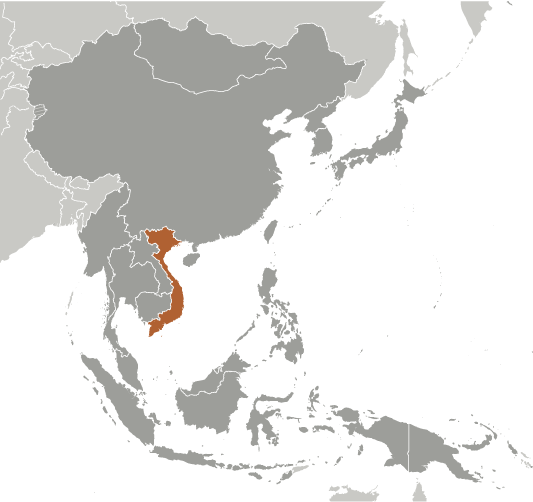
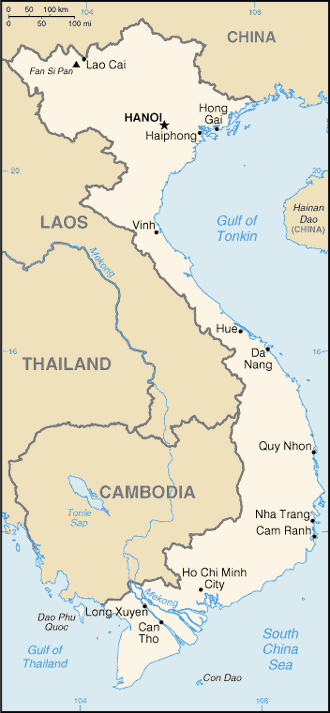
| Click map for larger view |
| Click flag for Country Report |



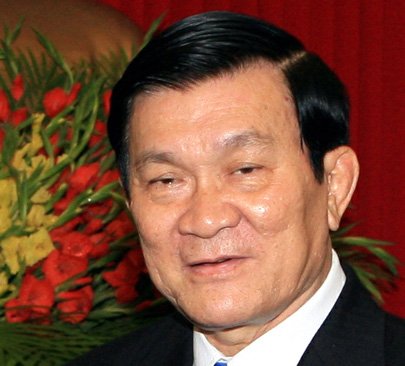
Truong Tan Sang
President since 25 July 2011
President since 25 July 2011
Nguyen Thi Doan
Vice President since 25 July 2007
Vice President since 25 July 2007
| TRAFFICKING IN PERSONS |
None reported.


Hoang Trung Hai, Nguyen Thien Nhan, *Vu Van Ninh and *Nguyen Xuan Phuc
Deputy Prime Minister since 2 August 2007 and *3 August 2011 respectively
Deputy Prime Minister since 2 August 2007 and *3 August 2011 respectively