Republic of Guinea is located in the west of the African Continent, with a population of 10,884,958, making it the 76th largest
national population. Its capital and largest city is Conakry with a total population of 1,931,184. The country encompasses
245,857 square kilometers making it the 78th largest country in total area. It shares boundaries with Mali, Cote d’Ivoire,
Liberia, Sierra Leone, the North Atlantic Ocean, Guinea Bissau and Senegal.
President Alpha Conde is recognized as the Chief of State and achieved that status through popular vote and holds that position
for five years. These were the first democratic elections following the 3 December 2009 military coup led by Moussa Camara
(serving as the President of the National Council For Democracy and Development following the 23 December 2009 death of
President Lansana Conte) who was forced to flee the country for medical treatment due to a botched assassination attempt by
his aide-de-camp. Prime Minister Mohamed Said Fofana is recognized as the Head of Government and achieved that status
through appointment by the President. Presidential elections were held on 27 June 2010 with a runoff presently slated for 24
August 2010. Its form of government is a republic and they celebrate the creation of their constitution on 7 May 2010.
The languages commonly or officially spoken are French however each ethnic group (Peuhl, Malinke, Soussou, and a variety
of smaller ethnic groups) has its own language. It counts among its major religions Muslim, Christian and indigenous beliefs.
As sources of mass communication it has 9 AM, 1 FM, 3 Short Wave and 6 Television stations.
Major geographical features are Mont Nimba, its highest point at 1,752 meters and North Atlantic Ocean, its lowest point at 0
meters. Its principal waterways are the Niger River and the Milo River, which measures 1,200 kilometers.
Major industries providing for the bulk of their Gross Domestic Product (GDP) are bauxite, gold, diamonds, alumina refining,
light manufacturing and agricultural processing industries. Its official currency is Guinea Franc.
Here’s something you may not know about Guinea. The Guinea Hogs originate from the Guinea coast.
national population. Its capital and largest city is Conakry with a total population of 1,931,184. The country encompasses
245,857 square kilometers making it the 78th largest country in total area. It shares boundaries with Mali, Cote d’Ivoire,
Liberia, Sierra Leone, the North Atlantic Ocean, Guinea Bissau and Senegal.
President Alpha Conde is recognized as the Chief of State and achieved that status through popular vote and holds that position
for five years. These were the first democratic elections following the 3 December 2009 military coup led by Moussa Camara
(serving as the President of the National Council For Democracy and Development following the 23 December 2009 death of
President Lansana Conte) who was forced to flee the country for medical treatment due to a botched assassination attempt by
his aide-de-camp. Prime Minister Mohamed Said Fofana is recognized as the Head of Government and achieved that status
through appointment by the President. Presidential elections were held on 27 June 2010 with a runoff presently slated for 24
August 2010. Its form of government is a republic and they celebrate the creation of their constitution on 7 May 2010.
The languages commonly or officially spoken are French however each ethnic group (Peuhl, Malinke, Soussou, and a variety
of smaller ethnic groups) has its own language. It counts among its major religions Muslim, Christian and indigenous beliefs.
As sources of mass communication it has 9 AM, 1 FM, 3 Short Wave and 6 Television stations.
Major geographical features are Mont Nimba, its highest point at 1,752 meters and North Atlantic Ocean, its lowest point at 0
meters. Its principal waterways are the Niger River and the Milo River, which measures 1,200 kilometers.
Major industries providing for the bulk of their Gross Domestic Product (GDP) are bauxite, gold, diamonds, alumina refining,
light manufacturing and agricultural processing industries. Its official currency is Guinea Franc.
Here’s something you may not know about Guinea. The Guinea Hogs originate from the Guinea coast.
| Doundoun made in Siguri |
| Guinea Hog |
| Ferry crossing the Niger River |
| Guinea kids |
| Hikers close to Labe |
| Huts in Conakry |
| Roasted Guinea pig |
| Tree in the Milo River |
| Mont Nimba- Guinea's highest point |


| Abi's Home Page |
| Back to |
| NEWSPAPERS Le Lynx Le Journal Guinee L' Observateur |


Read about human rights in Pax
Gaea World Post Report!
Gaea World Post Report!

GUINEA
Updated 09 November 2012
Updated 09 November 2012


| Adult Prevalence Rate: People Living with HIV/AIDS: HIV/AIDS Deaths: |
1.3% (2009 est.)
79,000
4,700
79,000
4,700


| Conakry- Guinea's capital and largest city on the Atlantic Ocean, its lowest point |

| Fouta Djallon- the source of the Niger River near Tembakonda on Guinea's border with Sierra Leone |

| Fouta from Coyah |

| Guardian of the Sosa Bala, a 13th Century royal instrument in Niagassola- on Guinea's border with Mali |

| Gueckadou- on Guinea's border with Liberia |
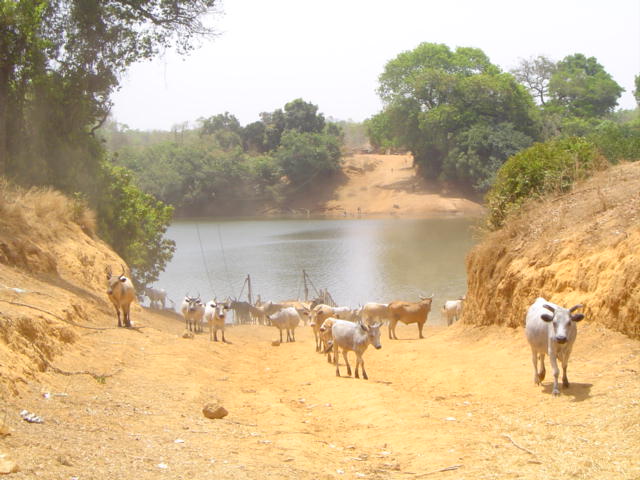
| Ferry crossing on the Kogon River on Guinea's border with Guinea-Bissau |
| Guinean child drawing water from a well at Lac Faguibine |

| Koundara- Guinea's northernmost point on the border with Senegal |
| Mani singers in traditional dress |

| Miners on the Mongo River on Guinea's border with Sierra Leone |

| Refugees crossing from Cote d'Ivoire into Guinea |


| East of Boola- Guinea's easternmost point on the border with Cote d'Ivoire |

| Labe- Guinea's second largest city |

| Nzerekore Region- Guinea's southernmost point on the border with Liberia |

| Port of Kamsar on the Rio Nunez Delta- Guinea's westernmost point on the border with Guinea-Bissau |