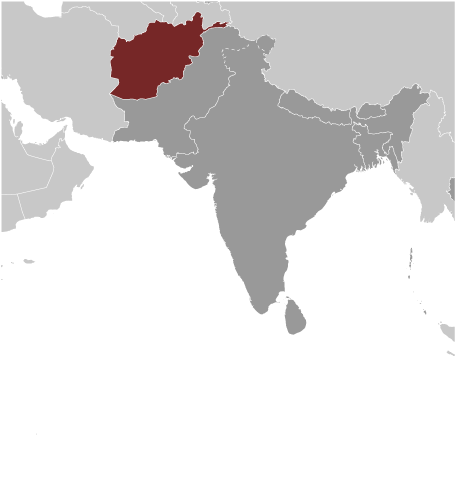

| AFGHANISTAN Islamic Republic of Afghanistan Jomhuri-ye Eslami-ye Afghanestan Joined United Nations: 19 November 1946 Human Rights as assured by their constitution Click here Updated 27 February 2013 |

| CAPITAL |
| POPULATION |
| CHIEF OF STATE |
| SELECTION PROCESS |
Kabul
30,419,928 (July 2012 est.)
The president and two vice presidents are elected by direct vote for
a five-year term (eligible for a second term); if no candidate receives
50% or more of the vote in the first round of voting, the two
candidates with the most votes will participate in a second round; a
president can only be elected for two terms; election last held 20
August 2009
NOTE- remained unresolved during a lengthy period of vote
counting and fraud investigation. A run-off vote between incumbent
President Hamid Karzai and his main rival Abdullah Abdullah was
announced for November 7, 2009. On November 1, however,
Abdullah announced that he would no longer be participating in the
run-off because his demands for changes in the electoral commission
had not been met, and a "transparent election is not possible." A day
later, on November 2, 2009, officials of the election commission
cancelled the run-off and declared Hamid Karzai as President of
Afghanistan for another 5 year term.
Next scheduled election: 2014
a five-year term (eligible for a second term); if no candidate receives
50% or more of the vote in the first round of voting, the two
candidates with the most votes will participate in a second round; a
president can only be elected for two terms; election last held 20
August 2009
NOTE- remained unresolved during a lengthy period of vote
counting and fraud investigation. A run-off vote between incumbent
President Hamid Karzai and his main rival Abdullah Abdullah was
announced for November 7, 2009. On November 1, however,
Abdullah announced that he would no longer be participating in the
run-off because his demands for changes in the electoral commission
had not been met, and a "transparent election is not possible." A day
later, on November 2, 2009, officials of the election commission
cancelled the run-off and declared Hamid Karzai as President of
Afghanistan for another 5 year term.
Next scheduled election: 2014
HEAD OF GOVERNMENT
According to the Afghani Constitution, the President is both the
Chief of State and Head of Government
Chief of State and Head of Government
| DECLARATION OF HUMAN RIGHTS |
| ETHNIC GROUPS |
Pashtun 42%, Tajik 27%, Hazara 9%, Uzbek 9%, Aimak 4%, Turkmen 3%, Baloch 2%, other 4%
| RELIGIONS |
Sunni Muslim 80%, Shi'a Muslim 19%, other 1%
| GOVERNMENT STRUCTURE |
Islamic republic with 34 provinces (velayat, singular - velayat); Legal system is based on mixed civil and Shari'a law; has not
accepted compulsory ICJ jurisdiction
Executive: The president and two vice presidents are elected by direct vote for a five-year term (eligible for a second term); if no
candidate receives 50% or more of the vote in the first round of voting, the two candidates with the most votes will participate in a
second round; a president can only be elected for two terms; election last held 20 August 2009 (next to be held in August 2014)
Legislative: Bicameral National Assembly consists of the Wolesi Jirga or House of People (no more than 250 seats), directly
elected for five-year terms, and the Meshrano Jirga or House of Elders (102 seats, one-third elected from provincial councils for
four-year terms, one-third elected from local district councils for three-year terms, and one-third nominated by the president for
five-year terms)
note: on rare occasions the government may convene a Loya Jirga (Grand Council) on issues of independence, national sovereignty,
and territorial integrity; it can amend the provisions of the constitution and prosecute the president; it is made up of members of the
National Assembly and chairpersons of the provincial and district councils
elections: last held 18 September 2010 (next election expected in 2015)
Judicial: Constitution establishes a nine-member Stera Mahkama or Supreme Court (its nine justices are appointed for 10-year
terms by the president with approval of the Wolesi Jirga) and subordinate High Courts and Appeals Courts; there is also a minister
of justice; a separate Afghan Independent Human Rights Commission established by the Bonn Agreement is charged with
investigating human rights abuses and war crimes
accepted compulsory ICJ jurisdiction
Executive: The president and two vice presidents are elected by direct vote for a five-year term (eligible for a second term); if no
candidate receives 50% or more of the vote in the first round of voting, the two candidates with the most votes will participate in a
second round; a president can only be elected for two terms; election last held 20 August 2009 (next to be held in August 2014)
Legislative: Bicameral National Assembly consists of the Wolesi Jirga or House of People (no more than 250 seats), directly
elected for five-year terms, and the Meshrano Jirga or House of Elders (102 seats, one-third elected from provincial councils for
four-year terms, one-third elected from local district councils for three-year terms, and one-third nominated by the president for
five-year terms)
note: on rare occasions the government may convene a Loya Jirga (Grand Council) on issues of independence, national sovereignty,
and territorial integrity; it can amend the provisions of the constitution and prosecute the president; it is made up of members of the
National Assembly and chairpersons of the provincial and district councils
elections: last held 18 September 2010 (next election expected in 2015)
Judicial: Constitution establishes a nine-member Stera Mahkama or Supreme Court (its nine justices are appointed for 10-year
terms by the president with approval of the Wolesi Jirga) and subordinate High Courts and Appeals Courts; there is also a minister
of justice; a separate Afghan Independent Human Rights Commission established by the Bonn Agreement is charged with
investigating human rights abuses and war crimes
| LANGUAGES |
Afghan Persian or Dari (official) 50%, Pashto (official) 35%, Turkic languages (primarily Uzbek and Turkmen) 11%, 30 minor
languages (primarily Balochi and Pashai) 4%, much bilingualism
languages (primarily Balochi and Pashai) 4%, much bilingualism
| BRIEF HISTORY |
Excavation of prehistoric sites by Louis Dupree, the University of Pennsylvania, the Smithsonian Institute and others suggests that
early humans were living in what is now Afghanistan at least 50,000 years ago, and that farming communities in Afghanistan were
among the earliest in the world. Afghanistan's known pre-Islamic past began with Aryan invasions around 2000 BCE and continued
with Persian, Median, Greek, Mauryan, Bactrian, and other phases in its history. Following the defeat of the Persian Achaemenids
in 329 BCE, Alexander the Great entered the territory of modern Afghanistan to capture Bactria, the area around the present-day
Balkh. After the defeat of Seleucus' invasion by Chandragupta, the Maurya Empire of India obtained the provinces of Southern
Afghanistan, including the Kabul Valley and modern Kandahar. Mauryan rule lasted roughly 100-120 years. It was most notable for
the introduction of Buddhism under Emperor Ashoka. Provincial governor under the Mauryas. Invasions by the Indo Greeks,
Scythians, Kushans, Parthians, White Huns, and Göktürks followed in succeeding centuries. Buddhas of Bamyan were the largest
Buddha statues in the world, dating back to the first century CE. Buddhas of Bamyan were the largest Buddha statues in the world,
dating back to the first century CE. During the Kushan rule, Afghanistan became the center of culture and learning. The Sassanians
and other Persian powers ruled most of Afghanistan before the coming of Muslim armies. The Shahis ruled eastern Afghanistan from
the mid-7th century until Turkic invasions in the 10th century CE. In 642 CE, Arabs invaded the entire region and introduced Islam.
Afghanistan--like all others conquered by the Arabs--had local rulers including the empire of Tang China, which had extended its
influence all the way to Kabul. The Khorasani Persian-Arabs controlled the western and northern areas until they were conquered
by the Ghaznavid Empire in 998. The Arab forces did not conquer all of Afghanistan. The southern and eastern parts of Afghanistan
became part of the Kingdom of Gandhara, ruled first by the Buddhist Shahi, from the 6th century to about 970, and then by the
Hindu Shahi which lasted through the 10th century in the area now known as Afghanistan, when it too was conquered by the
Muslim Ghaznavid Empire. Mahmud of Ghazni (998-1030) consolidated the conquests of his predecessors and turned Ghazna
(Ghazni) into a great cultural center as well as a base for frequent forays into India. The Ghaznavid dynasty was defeated in 1146 by
the Ghurids (Ghor), the Ghaznavid Khans continued to live in Ghazni as the 'Nasher' until the early 20th century, but they did not
regain their once vast power until about 500 years later when the Ghilzai Pashtuns's defeated the Safavid Persians in Kandahar.
Various princes and Seljuk rulers attempted to rule parts of the country until the Shah Muhammad II of the Khwarezmid Empire
conquered all of Persia in 1205. By 1219, the empire had fallen to the Mongols. Led by Genghis Khan, the invasion resulted in
massive slaughter of the population, destruction of many cities, including Herat, Ghazni, and Balkh, and the despoliation of fertile
agricultural areas. Following Genghis Khan's death in 1227, a succession of petty chiefs and princes struggled for supremacy until
late in the 14th century, when one of his descendants, Timur Lang, incorporated what is today Afghanistan into his own vast Asian
empire. Babur, a descendant of Timur and the founder of Moghul Empire at the beginning of the 16th century, made Kabul the
capital. Afghanistan was divided in many parts in the 16th, 17th and early 18th century. North were the Uzbeks, west was Safavid's
rule and east was the Mughal's and local Pashtun rule. In 1709, the Afghans (Pashstuns) decided to rise against the Persian
Safavids. The Persians were defeated very badly and the Afghans held Isfahan (Iran) from 1719-1729. Nadir Shah of Persia
pushed back the Afghans in the 1729 Battle of Damghan. In 1738, Nadir Shah conquered Kandahar, in the same year he occupied
Ghazni, Kabul and Lahore. After his death in 1747, the Durrani Pashtuns became the principal Afghan rulers. Ahmed Shah Durrani,
the founder of the Durrani Empire, established his rule in 1747 at Kandahar. Ahmad Shah, a Pashtun from the Abdali clan, was
elected King in a loya jirga after the assassination of Nadir Shah in the same year. Throughout his reign, Ahmad Shah consolidated
chieftains, petty principalities, and fragmented provinces into one country. His rule extended from Mashad in the west to Kashmir
and Delhi in the east, and from the Amu Darya (Oxus) River in the north to the Arabian Sea in the south. With the exception of a
9-month period in 1929, all of Afghanistan's rulers until the 1978 Marxist coup were from Durrani's Pashtun tribal confederation,
and all were members of that tribe's Mohammedzai clan after 1818. Dost Mohammed Khan gained control in Kabul. Collision
between the expanding British and Russian Empires significantly influenced Afghanistan during the 19th century in what was termed
"The Great Game." British concern over Russian advances in Central Asia and growing influence in Persia culminated in two
Anglo-Afghan wars and "The Siege of Herat" 1837-1838, in which Persians trying to retake Afghanistan and throw out the British
and Russians sent armies into the country waging wars with the British mostly around and in the city of Herat. The first (1839-1842)
resulted in the destruction of a British army; it is remembered as an example of the ferocity of Afghan resistance to foreign rule. The
second Anglo-Afghan war (1878-1880) was sparked by Amir Shir Ali's refusal to accept a British mission in Kabul. This conflict
brought Amir Abdur Rahman to the Afghan throne. During his reign (1880-1901), the British and Russians officially established the
boundaries of what would become modern Afghanistan. The British retained effective control over Kabul's foreign affairs.
Afghanistan remained neutral during World War I, despite German encouragement of anti-British feelings and Afghan rebellion
along the borders of British India. The Afghan king's policy of neutrality was not universally popular within the country, however.
Habibullah, Abdur Rahman's son and successor, was assassinated in 1919, possibly by family members opposed to British
influence. His third son, Amanullah, regained control of Afghanistan's foreign policy after launching the Third Anglo-Afghan war with
an attack on India in the same year. During the ensuing conflict, the war-weary British relinquished their control over Afghan foreign
affairs by signing the Treaty of Rawalpindi in August 1919. In commemoration of this event, Afghans celebrate August 19 as their
Independence Day.King Amanullah (1919-1929) moved to end his country's traditional isolation in the years following the Third
Anglo-Afghan war. He established diplomatic relations with most major countries and, following a 1927 tour of Europe and Turkey.
Mohammad Zahir Shah, Nadir Khan's 19-year-old son, succeeded to the throne and reigned from 1933 to 1973. Amid charges of
corruption and malfeasance against the royal family and poor economic conditions created by the severe 1971-72 drought, former
Prime Minister Mohammad Sardar Daoud Khan seized power in a military coup on July 17, 1973 while Zahir Shah was receiving
treatment for eye problems and therapy for lumbago in Italy. As disillusionment set in, on April 27, 1978, the PDPA initiated a
bloody coup, which resulted in the overthrow and murder of Daoud and most of his family. On December 25, 1979, the Soviet
army entered Kabul. This was the starting point of the Soviet occupation of Afghanistan and the Soviet war in Afghanistan, which
ended only in 1989 with a full withdrawal of Soviet troops under the Geneva Accords reached in 1988 between Afghanistan and
Pakistan. For over nine years, the Soviet Army conducted military operations against the Afghan mujahedin rebels. The American
CIA, Pakistan, and Saudi Arabia assisted in the financing of the resistance because of their anti-communist stance, and, in the case
of Saudi Arabia, because of their Islamist inclinations. Among the foreign participants in the war was Osama bin Laden, whose
Maktab al-Khidamat (MAK) (Office of Order) organization trained a small number of mujahideen and provided some arms and
funds to fight the Soviets. Bin Laden played only a limited part in this conflict and, in 1988, he broke away from the MAK with
some of its more militant members to form Al-Qaida, in order to expand the anti-Soviet resistance effort into a worldwide Islamic
fundamentalist movement. After the collapse of the Soviet Union, the Najibullah government was overthrown on April 18, 1992
when Abdul Rashid Dostum mutinied, and allied himself with Ahmed Shah Massoud, to take control of Kabul and declare the
Islamic State of Afghanistan. When the victorious mujahideen entered Kabul to assume control over the city and the central
government, internecine fighting began between the various militias, which had coexisted only uneasily during the Soviet occupation.
With the demise of their common enemy, the militias' ethnic, clan, religious, and personality differences surfaced, and civil war
continued. An interim Islamic Jihad Council was put in place, first led by Sibghatullah Mojadeddi for two months, then by
Burhanuddin Rabbani. Fighting among rival factions intensified. In reaction to the anarchy and warlordism prevalent in the country,
and the lack of Pashtun representation in the Kabul government, the Taliban, a movement of religious scholars and former
mujahideen, emerged from the southern province of Kandahar. In response to the Taliban support of Al Qaeda, the terrorist group
that perpetrated the September 11, 2001 attacks, the Taliban's refusal to assist the U.S. in prosecuting Al Qaeda, and the Taliban's
ruthless attack on women's rights (e.g., women were not allowed to see male doctors, but women were not allowed to attend
school, leaving women without medical care), the United States and its coalition allies launched an invasion of Afghanistan to oust
the Taliban government. Sponsored by the UN, Afghan factions met in Bonn, Germany and chose a 30 member interim authority
led by Hamid Karzai, a Pashtun from Kandahar. After governing for 6 months, former King Zahir Shah convened a Loya Jirga,
which elected Karzai as president and gave him authority to govern for two more years. Then, on October 9, 2004, Karzai was
elected as president of Afghanistan in the country's first ever presidential election. The Afghan nation was able to build democratic
structures over the years, and some progress was made in key areas such as governance, economy, health, education, transport,
and agriculture. NATO is training the Afghan armed forces as well its national police. ISAF and Afghan troops led many offensives
against the Taliban but failed to fully defeat them. By 2009, a Taliban-led shadow government began to form in many parts of the
country complete with their own version of mediation court. In October 2008 U.S. Defense Secretary Gates had asserted that a
political settlement with the Taliban was the endgame for the Afghanistan war. On 26 January 2010, at a major conference in
London which brought together some 70 countries and organizations, Afghan President Hamid Karzai said he intends to reach out
to the Taliban leadership (including Mullah Omar, Sirajuddin Haqqani and Gulbuddin Hekmatyar). Supported by NATO, Karzai
called on the group's leadership to take part in a loya jirga meeting to initiate peace talks. These steps have resulted in an
intensification of bombings, assassinations and ambushes. In March 2010, the Karzai government held preliminary talks with
Hezb-i-Islami, who presented a plan which included the withdrawal of all foreign troops by the end of 2010. The Taliban declined
to participate. In June 2010 the Afghan Peace Jirga 2010 took place. After the May 2011 death of Osama bin Laden in Pakistan,
many prominent Afghan figures began being assassinated. On October 16, 2011, "Operation Knife Edge" was launched by NATO
and Afghan forces against the Haqqani network in south-eastern Afghanistan. In November 2011, NATO forces killed 24 Pakistani
Army soldiers around the border region with Pakistan. ISAF forces, lead by the United States military project leaving all but a
residual training force by the end 2014.
Source: Wikipedia: History of Afghanistan
early humans were living in what is now Afghanistan at least 50,000 years ago, and that farming communities in Afghanistan were
among the earliest in the world. Afghanistan's known pre-Islamic past began with Aryan invasions around 2000 BCE and continued
with Persian, Median, Greek, Mauryan, Bactrian, and other phases in its history. Following the defeat of the Persian Achaemenids
in 329 BCE, Alexander the Great entered the territory of modern Afghanistan to capture Bactria, the area around the present-day
Balkh. After the defeat of Seleucus' invasion by Chandragupta, the Maurya Empire of India obtained the provinces of Southern
Afghanistan, including the Kabul Valley and modern Kandahar. Mauryan rule lasted roughly 100-120 years. It was most notable for
the introduction of Buddhism under Emperor Ashoka. Provincial governor under the Mauryas. Invasions by the Indo Greeks,
Scythians, Kushans, Parthians, White Huns, and Göktürks followed in succeeding centuries. Buddhas of Bamyan were the largest
Buddha statues in the world, dating back to the first century CE. Buddhas of Bamyan were the largest Buddha statues in the world,
dating back to the first century CE. During the Kushan rule, Afghanistan became the center of culture and learning. The Sassanians
and other Persian powers ruled most of Afghanistan before the coming of Muslim armies. The Shahis ruled eastern Afghanistan from
the mid-7th century until Turkic invasions in the 10th century CE. In 642 CE, Arabs invaded the entire region and introduced Islam.
Afghanistan--like all others conquered by the Arabs--had local rulers including the empire of Tang China, which had extended its
influence all the way to Kabul. The Khorasani Persian-Arabs controlled the western and northern areas until they were conquered
by the Ghaznavid Empire in 998. The Arab forces did not conquer all of Afghanistan. The southern and eastern parts of Afghanistan
became part of the Kingdom of Gandhara, ruled first by the Buddhist Shahi, from the 6th century to about 970, and then by the
Hindu Shahi which lasted through the 10th century in the area now known as Afghanistan, when it too was conquered by the
Muslim Ghaznavid Empire. Mahmud of Ghazni (998-1030) consolidated the conquests of his predecessors and turned Ghazna
(Ghazni) into a great cultural center as well as a base for frequent forays into India. The Ghaznavid dynasty was defeated in 1146 by
the Ghurids (Ghor), the Ghaznavid Khans continued to live in Ghazni as the 'Nasher' until the early 20th century, but they did not
regain their once vast power until about 500 years later when the Ghilzai Pashtuns's defeated the Safavid Persians in Kandahar.
Various princes and Seljuk rulers attempted to rule parts of the country until the Shah Muhammad II of the Khwarezmid Empire
conquered all of Persia in 1205. By 1219, the empire had fallen to the Mongols. Led by Genghis Khan, the invasion resulted in
massive slaughter of the population, destruction of many cities, including Herat, Ghazni, and Balkh, and the despoliation of fertile
agricultural areas. Following Genghis Khan's death in 1227, a succession of petty chiefs and princes struggled for supremacy until
late in the 14th century, when one of his descendants, Timur Lang, incorporated what is today Afghanistan into his own vast Asian
empire. Babur, a descendant of Timur and the founder of Moghul Empire at the beginning of the 16th century, made Kabul the
capital. Afghanistan was divided in many parts in the 16th, 17th and early 18th century. North were the Uzbeks, west was Safavid's
rule and east was the Mughal's and local Pashtun rule. In 1709, the Afghans (Pashstuns) decided to rise against the Persian
Safavids. The Persians were defeated very badly and the Afghans held Isfahan (Iran) from 1719-1729. Nadir Shah of Persia
pushed back the Afghans in the 1729 Battle of Damghan. In 1738, Nadir Shah conquered Kandahar, in the same year he occupied
Ghazni, Kabul and Lahore. After his death in 1747, the Durrani Pashtuns became the principal Afghan rulers. Ahmed Shah Durrani,
the founder of the Durrani Empire, established his rule in 1747 at Kandahar. Ahmad Shah, a Pashtun from the Abdali clan, was
elected King in a loya jirga after the assassination of Nadir Shah in the same year. Throughout his reign, Ahmad Shah consolidated
chieftains, petty principalities, and fragmented provinces into one country. His rule extended from Mashad in the west to Kashmir
and Delhi in the east, and from the Amu Darya (Oxus) River in the north to the Arabian Sea in the south. With the exception of a
9-month period in 1929, all of Afghanistan's rulers until the 1978 Marxist coup were from Durrani's Pashtun tribal confederation,
and all were members of that tribe's Mohammedzai clan after 1818. Dost Mohammed Khan gained control in Kabul. Collision
between the expanding British and Russian Empires significantly influenced Afghanistan during the 19th century in what was termed
"The Great Game." British concern over Russian advances in Central Asia and growing influence in Persia culminated in two
Anglo-Afghan wars and "The Siege of Herat" 1837-1838, in which Persians trying to retake Afghanistan and throw out the British
and Russians sent armies into the country waging wars with the British mostly around and in the city of Herat. The first (1839-1842)
resulted in the destruction of a British army; it is remembered as an example of the ferocity of Afghan resistance to foreign rule. The
second Anglo-Afghan war (1878-1880) was sparked by Amir Shir Ali's refusal to accept a British mission in Kabul. This conflict
brought Amir Abdur Rahman to the Afghan throne. During his reign (1880-1901), the British and Russians officially established the
boundaries of what would become modern Afghanistan. The British retained effective control over Kabul's foreign affairs.
Afghanistan remained neutral during World War I, despite German encouragement of anti-British feelings and Afghan rebellion
along the borders of British India. The Afghan king's policy of neutrality was not universally popular within the country, however.
Habibullah, Abdur Rahman's son and successor, was assassinated in 1919, possibly by family members opposed to British
influence. His third son, Amanullah, regained control of Afghanistan's foreign policy after launching the Third Anglo-Afghan war with
an attack on India in the same year. During the ensuing conflict, the war-weary British relinquished their control over Afghan foreign
affairs by signing the Treaty of Rawalpindi in August 1919. In commemoration of this event, Afghans celebrate August 19 as their
Independence Day.King Amanullah (1919-1929) moved to end his country's traditional isolation in the years following the Third
Anglo-Afghan war. He established diplomatic relations with most major countries and, following a 1927 tour of Europe and Turkey.
Mohammad Zahir Shah, Nadir Khan's 19-year-old son, succeeded to the throne and reigned from 1933 to 1973. Amid charges of
corruption and malfeasance against the royal family and poor economic conditions created by the severe 1971-72 drought, former
Prime Minister Mohammad Sardar Daoud Khan seized power in a military coup on July 17, 1973 while Zahir Shah was receiving
treatment for eye problems and therapy for lumbago in Italy. As disillusionment set in, on April 27, 1978, the PDPA initiated a
bloody coup, which resulted in the overthrow and murder of Daoud and most of his family. On December 25, 1979, the Soviet
army entered Kabul. This was the starting point of the Soviet occupation of Afghanistan and the Soviet war in Afghanistan, which
ended only in 1989 with a full withdrawal of Soviet troops under the Geneva Accords reached in 1988 between Afghanistan and
Pakistan. For over nine years, the Soviet Army conducted military operations against the Afghan mujahedin rebels. The American
CIA, Pakistan, and Saudi Arabia assisted in the financing of the resistance because of their anti-communist stance, and, in the case
of Saudi Arabia, because of their Islamist inclinations. Among the foreign participants in the war was Osama bin Laden, whose
Maktab al-Khidamat (MAK) (Office of Order) organization trained a small number of mujahideen and provided some arms and
funds to fight the Soviets. Bin Laden played only a limited part in this conflict and, in 1988, he broke away from the MAK with
some of its more militant members to form Al-Qaida, in order to expand the anti-Soviet resistance effort into a worldwide Islamic
fundamentalist movement. After the collapse of the Soviet Union, the Najibullah government was overthrown on April 18, 1992
when Abdul Rashid Dostum mutinied, and allied himself with Ahmed Shah Massoud, to take control of Kabul and declare the
Islamic State of Afghanistan. When the victorious mujahideen entered Kabul to assume control over the city and the central
government, internecine fighting began between the various militias, which had coexisted only uneasily during the Soviet occupation.
With the demise of their common enemy, the militias' ethnic, clan, religious, and personality differences surfaced, and civil war
continued. An interim Islamic Jihad Council was put in place, first led by Sibghatullah Mojadeddi for two months, then by
Burhanuddin Rabbani. Fighting among rival factions intensified. In reaction to the anarchy and warlordism prevalent in the country,
and the lack of Pashtun representation in the Kabul government, the Taliban, a movement of religious scholars and former
mujahideen, emerged from the southern province of Kandahar. In response to the Taliban support of Al Qaeda, the terrorist group
that perpetrated the September 11, 2001 attacks, the Taliban's refusal to assist the U.S. in prosecuting Al Qaeda, and the Taliban's
ruthless attack on women's rights (e.g., women were not allowed to see male doctors, but women were not allowed to attend
school, leaving women without medical care), the United States and its coalition allies launched an invasion of Afghanistan to oust
the Taliban government. Sponsored by the UN, Afghan factions met in Bonn, Germany and chose a 30 member interim authority
led by Hamid Karzai, a Pashtun from Kandahar. After governing for 6 months, former King Zahir Shah convened a Loya Jirga,
which elected Karzai as president and gave him authority to govern for two more years. Then, on October 9, 2004, Karzai was
elected as president of Afghanistan in the country's first ever presidential election. The Afghan nation was able to build democratic
structures over the years, and some progress was made in key areas such as governance, economy, health, education, transport,
and agriculture. NATO is training the Afghan armed forces as well its national police. ISAF and Afghan troops led many offensives
against the Taliban but failed to fully defeat them. By 2009, a Taliban-led shadow government began to form in many parts of the
country complete with their own version of mediation court. In October 2008 U.S. Defense Secretary Gates had asserted that a
political settlement with the Taliban was the endgame for the Afghanistan war. On 26 January 2010, at a major conference in
London which brought together some 70 countries and organizations, Afghan President Hamid Karzai said he intends to reach out
to the Taliban leadership (including Mullah Omar, Sirajuddin Haqqani and Gulbuddin Hekmatyar). Supported by NATO, Karzai
called on the group's leadership to take part in a loya jirga meeting to initiate peace talks. These steps have resulted in an
intensification of bombings, assassinations and ambushes. In March 2010, the Karzai government held preliminary talks with
Hezb-i-Islami, who presented a plan which included the withdrawal of all foreign troops by the end of 2010. The Taliban declined
to participate. In June 2010 the Afghan Peace Jirga 2010 took place. After the May 2011 death of Osama bin Laden in Pakistan,
many prominent Afghan figures began being assassinated. On October 16, 2011, "Operation Knife Edge" was launched by NATO
and Afghan forces against the Haqqani network in south-eastern Afghanistan. In November 2011, NATO forces killed 24 Pakistani
Army soldiers around the border region with Pakistan. ISAF forces, lead by the United States military project leaving all but a
residual training force by the end 2014.
Source: Wikipedia: History of Afghanistan
| ECONOMIC OVERVIEW |
Afghanistan's economy is recovering from decades of conflict. The economy has improved significantly since the fall of the Taliban
regime in 2001 largely because of the infusion of international assistance, the recovery of the agricultural sector, and service sector
growth. Despite the progress of the past few years, Afghanistan is extremely poor, landlocked, and highly dependent on foreign aid.
Much of the population continues to suffer from shortages of housing, clean water, electricity, medical care, and jobs. Criminality,
insecurity, weak governance, lack of infrastructure, and the Afghan Government's difficulty in extending rule of law to all parts of the
country pose challenges to future economic growth. Afghanistan's living standards are among the lowest in the world. The
international community remains committed to Afghanistan's development, pledging over $67 billion at nine donors' conferences
between 2003-10. In July 2012, the donors at the Tokyo conference pledged an additional $16 billion in civilian aid through 2016.
Despite this help, the Government of Afghanistan will need to overcome a number of challenges, including low revenue collection,
anemic job creation, high levels of corruption, weak government capacity, and poor public infrastructure.
Source: CIA World Factbook (select Afghanistan)
regime in 2001 largely because of the infusion of international assistance, the recovery of the agricultural sector, and service sector
growth. Despite the progress of the past few years, Afghanistan is extremely poor, landlocked, and highly dependent on foreign aid.
Much of the population continues to suffer from shortages of housing, clean water, electricity, medical care, and jobs. Criminality,
insecurity, weak governance, lack of infrastructure, and the Afghan Government's difficulty in extending rule of law to all parts of the
country pose challenges to future economic growth. Afghanistan's living standards are among the lowest in the world. The
international community remains committed to Afghanistan's development, pledging over $67 billion at nine donors' conferences
between 2003-10. In July 2012, the donors at the Tokyo conference pledged an additional $16 billion in civilian aid through 2016.
Despite this help, the Government of Afghanistan will need to overcome a number of challenges, including low revenue collection,
anemic job creation, high levels of corruption, weak government capacity, and poor public infrastructure.
Source: CIA World Factbook (select Afghanistan)
| POLITICAL CLIMATE |
The 2009 presidential election was characterized by lack of security, low voter turnout and widespread ballot stuffing, intimidation,
and other electoral fraud. The vote, along with elections for 420 provincial council seats, took place on August 20, 2009, but
remained unresolved during a lengthy period of vote counting and fraud investigation.Two months later, under heavy U.S. and ally
pressure, a second round run-off vote between incumbent President Hamid Karzai and his main rival Abdullah Abdullah was
announced for November 7, 2009. On November 1, however, Abdullah announced that he would no longer be participating in the
run-off because his demands for changes in the electoral commission had not been met, and a "transparent election is not possible."
A day later, on November 2, 2009, officials of the election commission cancelled the run-off and declared Hamid Karzai as
President of Afghanistan for another 5 year term.
The current president Hamid Karzai was declared the first ever democratically elected head of state in Afghanistan in 2004, winning
a second five-year term in 2009. The National Assembly is Afghanistan's national legislature. It is a bicameral body, composed of
the House of the People and the House of Elders. The first legislature was elected in 2005 and the current one in 2010. Members of
the Supreme Court were appointed by the president to form the judiciary. Together, this new system is to provide a new set of
checks and balances that was unheard of in the country.
The Supreme Court of Afghanistan is currently led by Chief Justice Faisal Ahmad Shinwari. Dominated by fundamentalist religious
figures, it has tried to ban a candidate in the 2004 presidential election for questioning polygamy laws, and limited the rights of
women, as well as overstepped its constitutional authority by issuing rulings on subjects not yet brought before the court. Though
many believed that Karzai would make reforming the Supreme Court a priority of his administration.
Source: Wikipedia: Politics of Afghanistan
and other electoral fraud. The vote, along with elections for 420 provincial council seats, took place on August 20, 2009, but
remained unresolved during a lengthy period of vote counting and fraud investigation.Two months later, under heavy U.S. and ally
pressure, a second round run-off vote between incumbent President Hamid Karzai and his main rival Abdullah Abdullah was
announced for November 7, 2009. On November 1, however, Abdullah announced that he would no longer be participating in the
run-off because his demands for changes in the electoral commission had not been met, and a "transparent election is not possible."
A day later, on November 2, 2009, officials of the election commission cancelled the run-off and declared Hamid Karzai as
President of Afghanistan for another 5 year term.
The current president Hamid Karzai was declared the first ever democratically elected head of state in Afghanistan in 2004, winning
a second five-year term in 2009. The National Assembly is Afghanistan's national legislature. It is a bicameral body, composed of
the House of the People and the House of Elders. The first legislature was elected in 2005 and the current one in 2010. Members of
the Supreme Court were appointed by the president to form the judiciary. Together, this new system is to provide a new set of
checks and balances that was unheard of in the country.
The Supreme Court of Afghanistan is currently led by Chief Justice Faisal Ahmad Shinwari. Dominated by fundamentalist religious
figures, it has tried to ban a candidate in the 2004 presidential election for questioning polygamy laws, and limited the rights of
women, as well as overstepped its constitutional authority by issuing rulings on subjects not yet brought before the court. Though
many believed that Karzai would make reforming the Supreme Court a priority of his administration.
Source: Wikipedia: Politics of Afghanistan
| INTERNATIONAL DISPUTES |
Afghan, Coalition, and Pakistan military meet periodically to clarify the alignment of the boundary on the ground and on maps;
Afghan and Iranian commissioners have discussed boundary monument densification and resurvey; Iran protests Afghanistan's
restricting flow of dammed Helmand River tributaries during drought; Pakistan has sent troops across and built fences along some
remote tribal areas of its treaty-defined Durand Line border with Afghanistan which serve as bases for foreign terrorists and other
illegal activities; Russia remains concerned about the smuggling of poppy derivatives from Afghanistan through Central Asian
countries
Afghan and Iranian commissioners have discussed boundary monument densification and resurvey; Iran protests Afghanistan's
restricting flow of dammed Helmand River tributaries during drought; Pakistan has sent troops across and built fences along some
remote tribal areas of its treaty-defined Durand Line border with Afghanistan which serve as bases for foreign terrorists and other
illegal activities; Russia remains concerned about the smuggling of poppy derivatives from Afghanistan through Central Asian
countries


| REFUGEES AND INTERNALLY DISPLACED PERSONS (IDPS) |
Refugees (country of origin): 2,972 (Pakistan) (2011)
IDPs: 481,877 (mostly Pashtuns and Kuchis displaced in the south and west due to drought and instability) (2012)
IDPs: 481,877 (mostly Pashtuns and Kuchis displaced in the south and west due to drought and instability) (2012)
| ILLICIT DRUGS |
World's largest producer of opium; poppy cultivation decreased 22% to 157,000 hectares in 2008 but remains at a historically
high level; less favorable growing conditions in 2008 reduced potential opium production to 5,500 metric tons, down 31 percent
from 2007; if the entire opium crop were processed, 648 metric tons of pure heroin potentially could be produced; the Taliban
and other antigovernment groups participate in and profit from the opiate trade, which is a key source of revenue for the Taliban
inside Afghanistan; widespread corruption and instability impede counterdrug efforts; most of the heroin consumed in Europe and
Eurasia is derived from Afghan opium; vulnerable to drug money laundering through informal financial networks; regional source
of hashish (2008)
high level; less favorable growing conditions in 2008 reduced potential opium production to 5,500 metric tons, down 31 percent
from 2007; if the entire opium crop were processed, 648 metric tons of pure heroin potentially could be produced; the Taliban
and other antigovernment groups participate in and profit from the opiate trade, which is a key source of revenue for the Taliban
inside Afghanistan; widespread corruption and instability impede counterdrug efforts; most of the heroin consumed in Europe and
Eurasia is derived from Afghan opium; vulnerable to drug money laundering through informal financial networks; regional source
of hashish (2008)
| HUMAN RIGHTS STATEMENTS, ANALYSIS AND CRITIQUES |
2011 Human Rights Report: Afghanistan
Bureau of Democracy, Human Rights, and Labor
2011 Country Reports on Human Rights Practices
May 24, 2012
Afghanistan is an Islamic republic with a strong, directly elected presidency, a bicameral legislative branch, and a judicial branch.
Widespread fraud and irregularities marred the September 2010 parliamentary elections, with observers concerned that the transparency
of the electoral process would be undermined by President Hamid Karzai’s 2010 appointment of a special tribunal, not envisioned in the
constitution, to adjudicate the disputed election results. In 2009 citizens voted in their second presidential election. The constitutionally
mandated Independent Elections Commission (IEC) declared Karzai president for a second term, after his challenger withdrew from a
run-off election. Allegations of fraud also marred those elections. Civilian authorities generally maintained control over the security
forces, although there were instances in which security forces acted independently.
The most significant human rights problems were: a) the continued dispute over President Karzai’s appointed tribunal, which was not
settled until August, when the president recognized that the sole authority to adjudicate election results lay with the IEC; b) widespread
violence, including armed insurgent groups’ killings of persons affiliated with the government and indiscriminate attacks on civilians, and
credible reports of torture and abuse of detainees by security forces; c) pervasive corruption; and d) endemic violence and societal
discrimination against women and girls, despite considerable improvements in women’s health and maternal mortality.
Other human rights problems included extrajudicial killings by security forces-- for example, the Afghan National Police (ANP) in
Kandahar was implicated in several cases of torture and extrajudicial killings; poor prison conditions; ineffective government
investigations of abuses and torture by local security forces; arbitrary arrest and detention; prolonged pretrial detention; judicial
corruption and ineffectiveness; violations of privacy rights; restrictions on freedom of speech and of the press; some limits on freedom
of assembly; restrictions on freedom of religion; limits on freedom of movement; abuse of children, including sexual abuse;
discrimination and abuses against ethnic minorities; trafficking in persons; societal discrimination based on race, religion, gender, and
sexual orientation; abuse of worker rights; compulsory and bonded labor; and child labor, including forced child labor.
Widespread official impunity for those who committed human rights abuses was a serious problem. The government was either
unwilling or unable to prosecute abuses by officials consistently and effectively.
The Taliban and other insurgents continued to kill record numbers of civilians, using improvised explosive devices, car bombs, and
suicide attacks. The Taliban increasingly used children as suicide bombers. Antigovernment elements also threatened, robbed, and
attacked villagers, foreigners, civil servants, and medical and nongovernmental organization (NGO) workers.
Click here to read more »
Bureau of Democracy, Human Rights, and Labor
2011 Country Reports on Human Rights Practices
May 24, 2012
Afghanistan is an Islamic republic with a strong, directly elected presidency, a bicameral legislative branch, and a judicial branch.
Widespread fraud and irregularities marred the September 2010 parliamentary elections, with observers concerned that the transparency
of the electoral process would be undermined by President Hamid Karzai’s 2010 appointment of a special tribunal, not envisioned in the
constitution, to adjudicate the disputed election results. In 2009 citizens voted in their second presidential election. The constitutionally
mandated Independent Elections Commission (IEC) declared Karzai president for a second term, after his challenger withdrew from a
run-off election. Allegations of fraud also marred those elections. Civilian authorities generally maintained control over the security
forces, although there were instances in which security forces acted independently.
The most significant human rights problems were: a) the continued dispute over President Karzai’s appointed tribunal, which was not
settled until August, when the president recognized that the sole authority to adjudicate election results lay with the IEC; b) widespread
violence, including armed insurgent groups’ killings of persons affiliated with the government and indiscriminate attacks on civilians, and
credible reports of torture and abuse of detainees by security forces; c) pervasive corruption; and d) endemic violence and societal
discrimination against women and girls, despite considerable improvements in women’s health and maternal mortality.
Other human rights problems included extrajudicial killings by security forces-- for example, the Afghan National Police (ANP) in
Kandahar was implicated in several cases of torture and extrajudicial killings; poor prison conditions; ineffective government
investigations of abuses and torture by local security forces; arbitrary arrest and detention; prolonged pretrial detention; judicial
corruption and ineffectiveness; violations of privacy rights; restrictions on freedom of speech and of the press; some limits on freedom
of assembly; restrictions on freedom of religion; limits on freedom of movement; abuse of children, including sexual abuse;
discrimination and abuses against ethnic minorities; trafficking in persons; societal discrimination based on race, religion, gender, and
sexual orientation; abuse of worker rights; compulsory and bonded labor; and child labor, including forced child labor.
Widespread official impunity for those who committed human rights abuses was a serious problem. The government was either
unwilling or unable to prosecute abuses by officials consistently and effectively.
The Taliban and other insurgents continued to kill record numbers of civilians, using improvised explosive devices, car bombs, and
suicide attacks. The Taliban increasingly used children as suicide bombers. Antigovernment elements also threatened, robbed, and
attacked villagers, foreigners, civil servants, and medical and nongovernmental organization (NGO) workers.
Click here to read more »
4 February 2011
COMMITTEE ON THE RIGHTS OF THE CHILD
Fifty sixth session
CONSIDERATION OF REPORTS SUBMITTED BY STATES PARTIES UNDER ARTICLE 44 OF THE CONVENTION
Concluding Observations of the Committee on the Rights of the Child: AFGHANISTAN
A. Introduction
2. The Committee welcomes the submission of the combined second to fourth periodic reports of Afghanistan and the written
replies to its list of issues (E/C.12/AFG/Q/2-4).The Committee appreciates the frank and constructive dialogue with the delegation of the
State party, which included representatives from various ministries with expertise on the subjects covered by the Covenant.
3. The Committee notes with appreciation the contribution of the Afghanistan Independent Human Rights Commission to the
reporting process.
B. Positive aspects
3. The Committee notes with appreciation the adoption of:
a) Law on the Rights and Privileges of People with Disability and Martyrs’ Family in 2010;
b) Law on the Elimination of Violence against Women in 2009;
c) Law of Juvenile Rehabilitation Centers in 2009
d) Education Law in 2008;
e) Law on Counter Abduction and Human Trafficking in July 2008;
f) Labor Law in 2007;
C. Factors and difficulties impeding the implementation of the Convention
6. The Committee notes the continuing effects of over three decades of armed conflict in the State party that impede the
implementation of the rights enshrined in the Convention and delayed the submission of the State party’s report.
D. Main areas of concern and recommendations
1. General measures of implementation (arts. 4, 42 and 44, paragraph 6 of the Convention)
Legislation
7. The Committee notes with concern that in spite of recent legislative developments in the field of child rights, the State party does
not consider the Convention as a legally binding instrument in the internal order and has therefore not incorporated it systematically into
domestic legal system in order to make it applicable. The Committee is also concerned that child rights continue to be negatively affected
by the application of different sources of law, namely codified, customary and Sharia laws and that legislation contradictory to the
Convention remains in force. The Committee is further concerned about the low implementation of legislation enacted in the field of
child rights due mainly to weak enforcement, limited level of awareness of the legal norms promulgated, widespread corruption and the
application by courts of provisions of customary or Sharia law which infringe the principles and rights contained in the Convention.
8. The Committee urges the State party to ensure applicability of the Convention in domestic legal order and ensure that all its
principles and provisions can be applied in courts and in administrative proceedings and apply to all children living on the territory of the
State party. The Committee also urges the State party to ensure that existing domestic framework, including customary or Sharia laws is
brought into compliance with the Convention. To this aim, the Committee recommends that the State Party consider enacting a
comprehensive Child Act which would supersede all legislation that is not in conformity with the Convention and provide children with
appropriate means of redress.
Click here to read more »
COMMITTEE ON THE RIGHTS OF THE CHILD
Fifty sixth session
CONSIDERATION OF REPORTS SUBMITTED BY STATES PARTIES UNDER ARTICLE 44 OF THE CONVENTION
Concluding Observations of the Committee on the Rights of the Child: AFGHANISTAN
A. Introduction
2. The Committee welcomes the submission of the combined second to fourth periodic reports of Afghanistan and the written
replies to its list of issues (E/C.12/AFG/Q/2-4).The Committee appreciates the frank and constructive dialogue with the delegation of the
State party, which included representatives from various ministries with expertise on the subjects covered by the Covenant.
3. The Committee notes with appreciation the contribution of the Afghanistan Independent Human Rights Commission to the
reporting process.
B. Positive aspects
3. The Committee notes with appreciation the adoption of:
a) Law on the Rights and Privileges of People with Disability and Martyrs’ Family in 2010;
b) Law on the Elimination of Violence against Women in 2009;
c) Law of Juvenile Rehabilitation Centers in 2009
d) Education Law in 2008;
e) Law on Counter Abduction and Human Trafficking in July 2008;
f) Labor Law in 2007;
C. Factors and difficulties impeding the implementation of the Convention
6. The Committee notes the continuing effects of over three decades of armed conflict in the State party that impede the
implementation of the rights enshrined in the Convention and delayed the submission of the State party’s report.
D. Main areas of concern and recommendations
1. General measures of implementation (arts. 4, 42 and 44, paragraph 6 of the Convention)
Legislation
7. The Committee notes with concern that in spite of recent legislative developments in the field of child rights, the State party does
not consider the Convention as a legally binding instrument in the internal order and has therefore not incorporated it systematically into
domestic legal system in order to make it applicable. The Committee is also concerned that child rights continue to be negatively affected
by the application of different sources of law, namely codified, customary and Sharia laws and that legislation contradictory to the
Convention remains in force. The Committee is further concerned about the low implementation of legislation enacted in the field of
child rights due mainly to weak enforcement, limited level of awareness of the legal norms promulgated, widespread corruption and the
application by courts of provisions of customary or Sharia law which infringe the principles and rights contained in the Convention.
8. The Committee urges the State party to ensure applicability of the Convention in domestic legal order and ensure that all its
principles and provisions can be applied in courts and in administrative proceedings and apply to all children living on the territory of the
State party. The Committee also urges the State party to ensure that existing domestic framework, including customary or Sharia laws is
brought into compliance with the Convention. To this aim, the Committee recommends that the State Party consider enacting a
comprehensive Child Act which would supersede all legislation that is not in conformity with the Convention and provide children with
appropriate means of redress.
Click here to read more »
Karzai’s Endorsement of “Code of Conduct” a Setback for Women’s Rights in Afghanistan
Mar 7 2012 - 12:47pm
Afghanistan president Hamid Karzai’s decision to endorse a document enforcing a “code of conduct” that limits women’s freedoms is a
grave setback for women in Afghanistan. This decision, which comes a day before International Women’s Day on March 8, represents
a serious threat to the advancements women have achieved in the country since the fall of the Taliban. Freedom House condemns this
egregious affront to women’s rights and calls on Karzai to adhere to previous pledges and respect the constitution, which grants women
equal status to men. The code of conduct strictly adheres to Sharia Law and would give men the right to beat women, require women to
be accompanied by a male guardian when traveling, and under certain circumstances promote the segregation of men and women.
President Karzai issued his endorsement upon the insistence of clerics from the influential Ulema Council.
Afghanistan is rated “Not Free” in the Freedom in the World 2011. The predominantly Muslim state has been plagued with election
fraud, corruption, and rampant instability. During the Taliban’s reign, women were prohibited from attending school, leaving home
without a male escort, and forced to wear burqas. Since 2001, the country has seen vast improvements for women’s rights. Women
were granted equal rights under the constitution, given the chance pursue education, and allocated 68 seats in the lower house of the
General Assembly.
Click here to read more »
Mar 7 2012 - 12:47pm
Afghanistan president Hamid Karzai’s decision to endorse a document enforcing a “code of conduct” that limits women’s freedoms is a
grave setback for women in Afghanistan. This decision, which comes a day before International Women’s Day on March 8, represents
a serious threat to the advancements women have achieved in the country since the fall of the Taliban. Freedom House condemns this
egregious affront to women’s rights and calls on Karzai to adhere to previous pledges and respect the constitution, which grants women
equal status to men. The code of conduct strictly adheres to Sharia Law and would give men the right to beat women, require women to
be accompanied by a male guardian when traveling, and under certain circumstances promote the segregation of men and women.
President Karzai issued his endorsement upon the insistence of clerics from the influential Ulema Council.
Afghanistan is rated “Not Free” in the Freedom in the World 2011. The predominantly Muslim state has been plagued with election
fraud, corruption, and rampant instability. During the Taliban’s reign, women were prohibited from attending school, leaving home
without a male escort, and forced to wear burqas. Since 2001, the country has seen vast improvements for women’s rights. Women
were granted equal rights under the constitution, given the chance pursue education, and allocated 68 seats in the lower house of the
General Assembly.
Click here to read more »
10 December 2012
Afghanistan: Another women’s affairs official murdered
The assassination of a female government official in eastern Afghanistan highlights the urgent need to provide better protection for
women’s human rights defenders, Amnesty International said.
Nadia Sidiqi, the acting Director of the Ministry of Women's Affairs department in the eastern province of Laghman, was killed by
unidentified gunmen while on her way to work in Laghman this morning. Her predecessor, Hanifa Safi, had been killed in a bomb attack
in July 2012. No one has claimed responsibility for either incident.
“This latest killing shows the desperate need for the authorities to provide better protection for women who are courageously fighting for
their rights in Afghanistan,” said Horia Mosadiq, Amnesty International’s Afghanistan Researcher, who is currently in Kabul visiting
women human rights defenders from across Afghanistan.
“This is far from an isolated act of violence. The fact that Nadia Sidiqi’s predecessor was also killed just a few months ago makes the
failure of security forces to provide her, and other such women human rights defenders, with adequate protection all the more
outrageous.
“Impunity for violence against women is endemic in Afghanistan, where perpetrators of human rights abuses are rarely held to account.
We urge the government to launch an immediate, independent investigation into Nadia’s killing and increase the level of protection
provided to representatives of the Ministry of Women’s Affairs
“The government must also uniformly enforce the law on Elimination of Violence against Women. The law criminalises forced marriage,
rape, beatings, and other acts of violence against women. It was enacted in August 2009, but is still only sporadically enforced.”
Click here to read more »
Afghanistan: Another women’s affairs official murdered
The assassination of a female government official in eastern Afghanistan highlights the urgent need to provide better protection for
women’s human rights defenders, Amnesty International said.
Nadia Sidiqi, the acting Director of the Ministry of Women's Affairs department in the eastern province of Laghman, was killed by
unidentified gunmen while on her way to work in Laghman this morning. Her predecessor, Hanifa Safi, had been killed in a bomb attack
in July 2012. No one has claimed responsibility for either incident.
“This latest killing shows the desperate need for the authorities to provide better protection for women who are courageously fighting for
their rights in Afghanistan,” said Horia Mosadiq, Amnesty International’s Afghanistan Researcher, who is currently in Kabul visiting
women human rights defenders from across Afghanistan.
“This is far from an isolated act of violence. The fact that Nadia Sidiqi’s predecessor was also killed just a few months ago makes the
failure of security forces to provide her, and other such women human rights defenders, with adequate protection all the more
outrageous.
“Impunity for violence against women is endemic in Afghanistan, where perpetrators of human rights abuses are rarely held to account.
We urge the government to launch an immediate, independent investigation into Nadia’s killing and increase the level of protection
provided to representatives of the Ministry of Women’s Affairs
“The government must also uniformly enforce the law on Elimination of Violence against Women. The law criminalises forced marriage,
rape, beatings, and other acts of violence against women. It was enacted in August 2009, but is still only sporadically enforced.”
Click here to read more »
Afghanistan: Don’t Prosecute Sexually Assaulted Children
Urgently Reform Response to Sexual Abuse of Boys
February 10, 2013
(Kabul) – The Afghan government should take urgent steps to ensure that rape and sexual abuse of children leads to prosecution of the
abusers – not of victims, Human Rights Watch said today. In Afghanistan’s western Herat province, in an October 2012 case that only
recently came to light, a court convicted a 13-year-old boy on moral crimes charges, and sentenced him to one year in juvenile detention
after he was accused of having sex with two adult men in a public park.
Afghan law prohibits “pederasty,” commonly understood to mean sex between a man and a boy, and makes it a crime punishable by 5 to
15 years in prison. “Moral crimes” charges, which under Afghan law include not only pederasty but also all sexual relations between
people who are not married to each other, have frequently been used to punish the victim of a criminal offense.
“When a man has sex with a 13-year-old child, the child is a victim of rape, not a criminal offender,” said Brad Adams, Asia director.
“The Afghan government should never have victimized this boy a second time, but instead should have released him immediately with
urgent protection and assistance.”
A prosecutor involved in the case told Human Rights Watch that the boy was prosecuted because he said he had consented to engaging
in sexual relations with several adult men. The decision in the case is under appeal. The authorities also arrested the men and charged
them with moral crimes, but the outcome of their case is unknown.
There is no age of consent for sex under Afghan law. Children under age 19 convicted of crimes are entitled to reduced sentences under
the 2005 Juvenile Code. United Nations bodies responsible for protecting the rights of children have said that countries should have an
age of consent sufficiently high to protect children.
In spite of Afghanistan’s strict prohibitions on sex outside of marriage, the United Nations and other organizations have documented
numerous instances of sexual abuse of boys through a practice known as “bacha bazi.” The phrase, which translates as “boy play,”
refers to boys who work as dancers, performing at parties attended by men, and typically living under the protection of a military
commander or other patron. Afghan culture typically prohibits women or girls from dancing for a male audience. While their role as
entertainers can be innocent, in many instances these boys are also the victims of sexual assault and abuse.
Click here to read more »
Urgently Reform Response to Sexual Abuse of Boys
February 10, 2013
(Kabul) – The Afghan government should take urgent steps to ensure that rape and sexual abuse of children leads to prosecution of the
abusers – not of victims, Human Rights Watch said today. In Afghanistan’s western Herat province, in an October 2012 case that only
recently came to light, a court convicted a 13-year-old boy on moral crimes charges, and sentenced him to one year in juvenile detention
after he was accused of having sex with two adult men in a public park.
Afghan law prohibits “pederasty,” commonly understood to mean sex between a man and a boy, and makes it a crime punishable by 5 to
15 years in prison. “Moral crimes” charges, which under Afghan law include not only pederasty but also all sexual relations between
people who are not married to each other, have frequently been used to punish the victim of a criminal offense.
“When a man has sex with a 13-year-old child, the child is a victim of rape, not a criminal offender,” said Brad Adams, Asia director.
“The Afghan government should never have victimized this boy a second time, but instead should have released him immediately with
urgent protection and assistance.”
A prosecutor involved in the case told Human Rights Watch that the boy was prosecuted because he said he had consented to engaging
in sexual relations with several adult men. The decision in the case is under appeal. The authorities also arrested the men and charged
them with moral crimes, but the outcome of their case is unknown.
There is no age of consent for sex under Afghan law. Children under age 19 convicted of crimes are entitled to reduced sentences under
the 2005 Juvenile Code. United Nations bodies responsible for protecting the rights of children have said that countries should have an
age of consent sufficiently high to protect children.
In spite of Afghanistan’s strict prohibitions on sex outside of marriage, the United Nations and other organizations have documented
numerous instances of sexual abuse of boys through a practice known as “bacha bazi.” The phrase, which translates as “boy play,”
refers to boys who work as dancers, performing at parties attended by men, and typically living under the protection of a military
commander or other patron. Afghan culture typically prohibits women or girls from dancing for a male audience. While their role as
entertainers can be innocent, in many instances these boys are also the victims of sexual assault and abuse.
Click here to read more »
President Karzai: Afghan Gov’t Fully Respective of Human Rights
Publish Date: Jul 31, 2012
President Hamid Karzai received for a meeting Dr. Peter Maurer, President of the International Committee of the Red Cross (ICRC),
who is on a visit of Afghanistan.
In the meeting where Mr. Reto STOCKER, ICRC’s head of Kabul delegation was also present, Dr. Peter said the ICRC began to stand
by and assist the people of Afghanistan since very long that dates back to the time of Jihad.
Dr. Peter stressed that over the past ten years, many non-government organizations were in and out of the country, but the ICRC had
maintained its presence and activity and continued to assist Afghans.
He informed the President of the ICRC Headquarters’ decision to reopen its hospital in Kandahar, but asked the Afghan government to
provide working safety for the hospital to run back properly.
President Karzai thanked the ICRC for all its assistance over these past many years and said the Afghan people would never forget the
vital work the Committee has been carrying out.
The President said the government would do everything it can to provide the safety required for the hospital in Kandahar to operate.
President Karzai stressed that the government of Afghanistan was strongly bound by the human rights standards and has always
instructed security agencies to uphold and respect the human rights of its citizens.
Click here to read more »
Publish Date: Jul 31, 2012
President Hamid Karzai received for a meeting Dr. Peter Maurer, President of the International Committee of the Red Cross (ICRC),
who is on a visit of Afghanistan.
In the meeting where Mr. Reto STOCKER, ICRC’s head of Kabul delegation was also present, Dr. Peter said the ICRC began to stand
by and assist the people of Afghanistan since very long that dates back to the time of Jihad.
Dr. Peter stressed that over the past ten years, many non-government organizations were in and out of the country, but the ICRC had
maintained its presence and activity and continued to assist Afghans.
He informed the President of the ICRC Headquarters’ decision to reopen its hospital in Kandahar, but asked the Afghan government to
provide working safety for the hospital to run back properly.
President Karzai thanked the ICRC for all its assistance over these past many years and said the Afghan people would never forget the
vital work the Committee has been carrying out.
The President said the government would do everything it can to provide the safety required for the hospital in Kandahar to operate.
President Karzai stressed that the government of Afghanistan was strongly bound by the human rights standards and has always
instructed security agencies to uphold and respect the human rights of its citizens.
Click here to read more »
The AIHRC expresses its serious concern about the frequency and persistence of violence against women and summary
execution carried out in the province of Ghor
AIHRC
February 20, 2013
Kabul
Summary execution and extrajudicial punishment by irresponsible individuals and groups is gross violation of human rights’ norms and
standards. Unfortunately, in some parts of the country including Ghor province summary or arbitrary enforcement of penalties,
especially towards women has repeatedly been witnessed. The recent example of such punishment was the incident of “whipping” in
which a woman and a man was whipped by irresponsible individuals and groups regardless of the provisions our country’s official laws.
The AIHRC while expressing its severe concern about the frequency and persistence of such arbitrary acts in the country once again
calls on responsible authorities to seriously pursue the case and identify the perpetrators of such actions and bring them to justice.
Click here to read more »
execution carried out in the province of Ghor
AIHRC
February 20, 2013
Kabul
Summary execution and extrajudicial punishment by irresponsible individuals and groups is gross violation of human rights’ norms and
standards. Unfortunately, in some parts of the country including Ghor province summary or arbitrary enforcement of penalties,
especially towards women has repeatedly been witnessed. The recent example of such punishment was the incident of “whipping” in
which a woman and a man was whipped by irresponsible individuals and groups regardless of the provisions our country’s official laws.
The AIHRC while expressing its severe concern about the frequency and persistence of such arbitrary acts in the country once again
calls on responsible authorities to seriously pursue the case and identify the perpetrators of such actions and bring them to justice.
Click here to read more »
RAWA.org
17.01.2013
Paris Conference: We Will Neither Forgive nor Forget!
Our people do not want the US bases, or a single government composed of Jehadi, Talib and Gulbuddini murderers, and their
Parchami and Khalqi cowards
What insulting painful games are not played with our suffering nation. This time, it is the performance of the agonizing drama of the
Paris Conference, with the endorsement and support of the US, which has gathered the enemies from the Northern Alliance, Taliban,
Gulbuddin’s party, Al-Qaeda, the United Front, the Afghan High Peace Council, the National Coalition, the Truth and Justice Party, and
others, to bring ‘peace’ for our people.
Basically, it is not painful why these gangs of professional killers, with their mouths filled with blood, are sitting around a table and
talking about ‘peace’; nor is it the fact that suppose these treacherous murderers reach an ‘agreement’ for creating a joint government,
and butcher our people, together with a comfort they never had before; the actual issue is that the propaganda machine of the US
occupiers and its allies have all created such hue and cry through their ‘experts’, ‘analysts’, and pet bondservants like Zarif Nazar from
Radio Azadi (RFE/RL Dari), Dr. Akbar Wardak, Dr. Ahmad Mahjoor, Wahid Muzhda, and others, who call the Paris Conference an
‘event’ and talk about it with such enthusiasm as if the people of Afghanistan have only this choice, and if they want peace they have to
submit themselves to these murderers, for they are the undoubted ‘leaders’ of Afghanistan, a group of whom is in power, the other is
the ‘respected armed opposition’, another is the ‘respected unarmed opposition’ of the Northern Alliance, and with their conciliation
there will be peace and stability in Afghanistan!
But they have stupidly misperceived our people to be as senseless as they are traitorous and corrupt.
Our people very well know these people who swore by the Quran and broke their vows, who are the worst traitors who brought tribal,
religious and lingual conflicts, were the first importers of the Osama bin Laden virus and their Arab brokers. They also don’t believe that
they will last long without biting each other’s heads off, and that too at the cost of our people’s sufferings. For as much as they have
been beefed up with the embezzlement of billions of dollars, their desire for peace and ending their crimes has diminished. These gangs
have committed the most heinous treacheries and crimes and are worried about the future when they might be tried in field courts and
hung by our people. This is why they pass impunity laws for themselves, with a shamelessness never seen before. They are ready to
accept any indignity for remaining in power, and are not even inclined to divide it because they find it without taste if they don’t have a
monopoly in power, fearing they would be beaten by this or that rival. Although their fag end is mainly in the hands of the US, but they
are one of those loose people, who are not content with one customer, and are busy courting the cruel Iran, Pakistan, Saudi Arabia,
Turkey and other countries.
The relationship between these traitors, who have earned mythical fortunes by servitude to foreign governments, smuggling of drugs and
ancient artifacts, and looting of public wealth, is mainly based on ripping each other apart, not getting along, especially until our people’s
clamorous uprisings has not sent tremors down them. Before they could be punished by our people, a considerable number of these
people, who belong to different mafia groups, have been killed by their ‘brothers’ over disputes related to splitting spoils and privileges.
The US wants relative stability in Afghanistan for its economic, political and strategic aims, so it is planning to tie up all its lackeys from
the likes of Jehadi and Talib to Khalqi and Parchami, and its espionage agents in the form of technocrats (ministers, ambassadors,
spokespersons, advisors, deputies…) in one stall. But this ‘peace’ has no value in the eyes of our people. The division of power between
these traitorous beasts will make them more vicious. Actual peace can only be attained only by the implementation of justice (prosecution
and punishment of tge murderers of the last three decades). Lakhdar Brahimi claimed ‘we have sacrificed justice for peace in Berlin’. We
see that claims of peace without justice is no more than a lie, and our people have burnt in the quarrel between the US and its creations
the Taliban, and the indescribable tyranny by the Jehadi-Gulbuddini puppet regime, spy technocrats, and Karzai and his family.
Click here to read more>>
17.01.2013
Paris Conference: We Will Neither Forgive nor Forget!
Our people do not want the US bases, or a single government composed of Jehadi, Talib and Gulbuddini murderers, and their
Parchami and Khalqi cowards
What insulting painful games are not played with our suffering nation. This time, it is the performance of the agonizing drama of the
Paris Conference, with the endorsement and support of the US, which has gathered the enemies from the Northern Alliance, Taliban,
Gulbuddin’s party, Al-Qaeda, the United Front, the Afghan High Peace Council, the National Coalition, the Truth and Justice Party, and
others, to bring ‘peace’ for our people.
Basically, it is not painful why these gangs of professional killers, with their mouths filled with blood, are sitting around a table and
talking about ‘peace’; nor is it the fact that suppose these treacherous murderers reach an ‘agreement’ for creating a joint government,
and butcher our people, together with a comfort they never had before; the actual issue is that the propaganda machine of the US
occupiers and its allies have all created such hue and cry through their ‘experts’, ‘analysts’, and pet bondservants like Zarif Nazar from
Radio Azadi (RFE/RL Dari), Dr. Akbar Wardak, Dr. Ahmad Mahjoor, Wahid Muzhda, and others, who call the Paris Conference an
‘event’ and talk about it with such enthusiasm as if the people of Afghanistan have only this choice, and if they want peace they have to
submit themselves to these murderers, for they are the undoubted ‘leaders’ of Afghanistan, a group of whom is in power, the other is
the ‘respected armed opposition’, another is the ‘respected unarmed opposition’ of the Northern Alliance, and with their conciliation
there will be peace and stability in Afghanistan!
But they have stupidly misperceived our people to be as senseless as they are traitorous and corrupt.
Our people very well know these people who swore by the Quran and broke their vows, who are the worst traitors who brought tribal,
religious and lingual conflicts, were the first importers of the Osama bin Laden virus and their Arab brokers. They also don’t believe that
they will last long without biting each other’s heads off, and that too at the cost of our people’s sufferings. For as much as they have
been beefed up with the embezzlement of billions of dollars, their desire for peace and ending their crimes has diminished. These gangs
have committed the most heinous treacheries and crimes and are worried about the future when they might be tried in field courts and
hung by our people. This is why they pass impunity laws for themselves, with a shamelessness never seen before. They are ready to
accept any indignity for remaining in power, and are not even inclined to divide it because they find it without taste if they don’t have a
monopoly in power, fearing they would be beaten by this or that rival. Although their fag end is mainly in the hands of the US, but they
are one of those loose people, who are not content with one customer, and are busy courting the cruel Iran, Pakistan, Saudi Arabia,
Turkey and other countries.
The relationship between these traitors, who have earned mythical fortunes by servitude to foreign governments, smuggling of drugs and
ancient artifacts, and looting of public wealth, is mainly based on ripping each other apart, not getting along, especially until our people’s
clamorous uprisings has not sent tremors down them. Before they could be punished by our people, a considerable number of these
people, who belong to different mafia groups, have been killed by their ‘brothers’ over disputes related to splitting spoils and privileges.
The US wants relative stability in Afghanistan for its economic, political and strategic aims, so it is planning to tie up all its lackeys from
the likes of Jehadi and Talib to Khalqi and Parchami, and its espionage agents in the form of technocrats (ministers, ambassadors,
spokespersons, advisors, deputies…) in one stall. But this ‘peace’ has no value in the eyes of our people. The division of power between
these traitorous beasts will make them more vicious. Actual peace can only be attained only by the implementation of justice (prosecution
and punishment of tge murderers of the last three decades). Lakhdar Brahimi claimed ‘we have sacrificed justice for peace in Berlin’. We
see that claims of peace without justice is no more than a lie, and our people have burnt in the quarrel between the US and its creations
the Taliban, and the indescribable tyranny by the Jehadi-Gulbuddini puppet regime, spy technocrats, and Karzai and his family.
Click here to read more>>
| Click map for larger view |
| Click flag for Country Report |



Hamid Karzai
President of the Islamic Republic
since 7 December 2004
President of the Islamic Republic
since 7 December 2004
| TRAFFICKING IN PERSONS |
None reported.
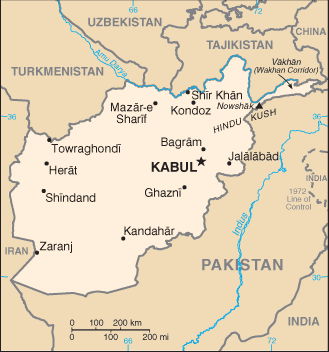
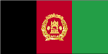

Mohammad Qasim Fahim Khan
First Vice President of the Islamic Republic
since 19 November 2009
First Vice President of the Islamic Republic
since 19 November 2009
Abdul Karim Khalili
Second Vice President of the Islamic Republic
since 7 December 2004
Second Vice President of the Islamic Republic
since 7 December 2004