
| INDIA Republic of India Bharatiya Ganarajya Joined United Nations: 30 October 1945 Human Rights as assured by their constitution Click here Updated 24 November 2012 |

| CAPITAL |
| POPULATION |
| CHIEF OF STATE |
| SELECTION PROCESS |
New Delhi
1,205,073,612 (July 2012 est.)
Manmohan Singh
Prime Minister since 22 May 2004
Prime Minister since 22 May 2004
President elected by an electoral college consisting of elected
members of both houses of Parliament and the legislatures of the
states for a five-year term (no term limits); election last held 19 July
2012; Vice President elected by both houses of Parliament for a
five-year term; election last held 12 August 2007
Next scheduled election: July 2017
members of both houses of Parliament and the legislatures of the
states for a five-year term (no term limits); election last held 19 July
2012; Vice President elected by both houses of Parliament for a
five-year term; election last held 12 August 2007
Next scheduled election: July 2017
HEAD OF GOVERNMENT
SELECTION PROCESS
Prime Minister chosen by parliamentary members of the
majority party following legislative elections; election last held
May 2009
Next scheduled election: May 2014
majority party following legislative elections; election last held
May 2009
Next scheduled election: May 2014
| DECLARATION OF HUMAN RIGHTS |
| ETHNIC GROUPS |
Indo-Aryan 72%, Dravidian 25%, Mongoloid and other 3% (2000)
| RELIGIONS |
Hindu 80.5%, Muslim 13.4%, Christian 2.3%, Sikh 1.9%, other 1.8%, unspecified 0.1% (2001 census)
| GOVERNMENT STRUCTURE |
Federal republic with 28 states and 7 union territories; Legal system is based on English common law; judicial review of legislative
acts; accepts compulsory ICJ jurisdiction with reservations; separate personal law codes apply to Muslims, Christians, and Hindus
Executive: President elected by an electoral college consisting of elected members of both houses of Parliament and the legislatures
of the states for a five-year term (no term limits); president elected by an electoral college consisting of elected members of both
houses of Parliament and the legislatures of the states for a five-year term (no term limits); election last held 19 July 2012 (next to be
held in July 2017); vice president elected by both houses of Parliament for a five-year term; election last held in August 2007 (next
to be held in August 2012); prime minister chosen by parliamentary members of the majority party following legislative elections;
election last held April - May 2009 (next to be held no later than May 2014)
Legislative: bicameral Parliament or Sansad consists of the Council of States or Rajya Sabha (a body consisting of 245 seats up to
12 of which are appointed by the president, the remainder are chosen by the elected members of the state and territorial assemblies;
members serve six-year terms) and the People's Assembly or Lok Sabha (545 seats; 543 members elected by popular vote, 2
appointed by the president; members serve five-year terms)
People's Assembly - last held in five phases on 16, 22-23, 30 April and 7, 13 May 2009 (next must be held by May 2014)
Judicial: Supreme Court (one chief justice and 25 associate justices are appointed by the president and remain in office until they
reach the age of 65 or are removed for "proved misbehavior")
acts; accepts compulsory ICJ jurisdiction with reservations; separate personal law codes apply to Muslims, Christians, and Hindus
Executive: President elected by an electoral college consisting of elected members of both houses of Parliament and the legislatures
of the states for a five-year term (no term limits); president elected by an electoral college consisting of elected members of both
houses of Parliament and the legislatures of the states for a five-year term (no term limits); election last held 19 July 2012 (next to be
held in July 2017); vice president elected by both houses of Parliament for a five-year term; election last held in August 2007 (next
to be held in August 2012); prime minister chosen by parliamentary members of the majority party following legislative elections;
election last held April - May 2009 (next to be held no later than May 2014)
Legislative: bicameral Parliament or Sansad consists of the Council of States or Rajya Sabha (a body consisting of 245 seats up to
12 of which are appointed by the president, the remainder are chosen by the elected members of the state and territorial assemblies;
members serve six-year terms) and the People's Assembly or Lok Sabha (545 seats; 543 members elected by popular vote, 2
appointed by the president; members serve five-year terms)
People's Assembly - last held in five phases on 16, 22-23, 30 April and 7, 13 May 2009 (next must be held by May 2014)
Judicial: Supreme Court (one chief justice and 25 associate justices are appointed by the president and remain in office until they
reach the age of 65 or are removed for "proved misbehavior")
| LANGUAGES |
Hindi 41%, Bengali 8.1%, Telugu 7.2%, Marathi 7%, Tamil 5.9%, Urdu 5%, Gujarati 4.5%, Kannada 3.7%, Malayalam 3.2%,
Oriya 3.2%, Punjabi 2.8%, Assamese 1.3%, Maithili 1.2%, other 5.9%
Oriya 3.2%, Punjabi 2.8%, Assamese 1.3%, Maithili 1.2%, other 5.9%
| BRIEF HISTORY |
Isolated remains of Homo erectus in Hathnora in the Narmada Valley in Central India indicate that India might have been inhabited
since at least the Middle Pleistocene era, somewhere between 200,000 to 500,000 years ago. The Mesolithic period in the Indian
subcontinent covered a timespan of around 25,000 years, starting around 30,000 years ago. Modern humans seem to have settled
the subcontinent towards the end of the last Ice Age, or approximately 12,000 years ago. The first confirmed permanent settlements
appeared 9,000 years ago in the Rock Shelters of Bhimbetka in modern Madhya Pradesh. Early Neolithic culture in South Asia is
represented by the Mehrgarh findings (7000 BC onwards) in present day Balochistan, Pakistan. Traces of a Neolithic culture have
been found submerged in the Gulf of Khambat, radiocarbon dated to 7500 BC. Late Neolithic cultures sprang up in the Indus
Valley region between 6000 and 2000 BC and in southern India between 2800 and 1200 BC. The Bronze Age on the Indian
subcontinent began around 3300 BC with the beginning of the Indus Valley Civilization. Inhabitants of the ancient Indus river valley,
the Harappans, developed new techniques in metallurgy and produced copper, bronze, lead and tin. The Indus Valley Civilization
which flourished from about 2600 BC to 1900 BC, and included urban centers such as Harappa and Mohenjo-daro (in Pakistan),
marked the beginning of the urban civilization on the subcontinent. The Vedic culture is the Indo-Aryan culture associated with the
Vedas, which are some of the oldest extant texts, orally composed in Vedic Sanskrit. It lasted from about 1500 BC to 500 BC. In
the later Vedic Age, a number of small kingdoms or city states had covered the subcontinent, many mentioned during Vedic
literature as far back as 1000 BC. By 600 BC, sixteen monarchies and 'republics' known as the Mahajanapadas — Kasi, Kosala,
Anga, Magadha, Vajji (or Vriji), Malla, Chedi, Vatsa (or Vamsa), Kuru, Panchala, Machcha (or Matsya), Surasena, Assaka,
Avanti, Gandhara, Kamboja — stretched across the Indo-Gangetic plains from modern-day Afghanistan to south pole. Much of the
northwestern Indian Subcontinent (present day Eastern Afghanistan and Pakistan west of the Indus) came under the rule of the
Persian Achaemenid Empire in c. 520 BC during the reign of Darius the Great, and remained so for two centuries thereafter. In 334
BC, Alexander the Great conquered Asia Minor and the Achaemenid Empire, reaching the north-west frontiers of the Indian
subcontinent; there, he defeated King Puru in the Battle of the Hydaspes (near modern-day Jhelum, Pakistan) and conquered much
of the Punjab. However, Alexander's troops refused to go beyond the Hyphases (Beas) River near modern day Jalandhar, Punjab.
Amongst the sixteen Mahajanapadas, the kingdom of Magadha rose to prominence under a number of dynasties. According to
tradition, the Haryanka dynasty founded the Magadha Empire in 684 BC whose capital was Rajagriha, later Pataliputra, near the
present day Patna. This dynasty was succeeded by the Shishunaga dynasty which, in turn, was overthrown by the Nanda dynasty in
424 BC. The Nandas were followed by the Maurya dynasty. The middle period was a time of notable cultural development. The
Satavahanas, also known as the Andhras, were a dynasty which ruled in Southern and Central India starting from around 230 BC.
The north-western hybrid cultures of the subcontinent included the Indo-Greeks, the Indo-Scythians, the Indo-Parthians, and the
Indo-Sassinids. Roman trade with India started around 1 AD following the reign of Augustus and his conquest of Egypt, theretofore
India's biggest trade partner in the West. In the 4th and 5th centuries, the Gupta Dynasty unified northern India. During this period,
known as India's Golden Age, Hindu culture, science and political administration reached new heights. The classical age in India
began with the resurgence of the north during Harsha's conquests around the 7th century, and ended with the fall of the Vijayanagar
Empire in the South, due to pressure from the invaders to the north in the 13th century. This period produced some of India's finest
art, considered the epitome of classical development, and the development of the main spiritual and philosophical systems which
continued to be in Hinduism, Buddhism and Jainism. After the Arab-Turkic invasion of India's ancient northern neighbour Persia,
expanding forces in that area were keen to invade India, which was the richest classical civilization, with the only known diamond
mines in the world. After resistance for a few centuries by various north Indian kingdoms, short lived Islamic empires invaded and
spread across the northern subcontinent over a period of a few centuries. In the 12th and 13th centuries, Arabs, Turks and Afghans
invaded parts of northern India and established the Delhi Sultanate at the beginning of the 13th century, from former Rajput
holdings. The Delhi Sultanate is the only Sultanate to stake a claim to possessing one of the few female rulers in India, Razia Sultan
(1236-1240). Informed about civil war in India, a Turco-Mongol conqueror Timur began a trek starting in 1398 to invade the
reigning Sultan Nasir-u Din Mehmud of the Tughlaq Dynasty in the north Indian city of Delhi. In 1526, Babur, a Timurid (Turco-
Persian) descendant of Timur, swept across the Khyber Pass and established the Mughal Empire, which lasted for over 200 years.
The Mughal Dynasty ruled most of the Indian subcontinent by 1600; it went into a slow decline after 1707 and was finally defeated
during the 1857 war of independence also called the Indian rebellion of 1857. Vasco da Gama's discovery of a new sea route to
India in 1498 paved the way for European commerce with India.[24] The Portuguese soon set up trading-posts in Goa, Daman,
Diu and Bombay. The next to arrive were the Dutch, the British—who set up a trading-post in the west-coast port of Surat[25] in
1619—and the French. Although the continental European powers were to control various regions of southern and western India
during the ensuing century, they would eventually lose all their Indian dominions to the British, with the exception of the French
outposts of Pondicherry and Chandernagore, the Dutch port of Travancore, and the Portuguese colonies of Goa, Daman, and Diu.
The British East India Company had been given permission by the Mughal emperor Jahangir in 1617 to trade in India. Gradually
their increasing influence led the de-jure Mughal emperor Farrukh Siyar to grant them dastaks or permits for duty free trade in
Bengal in 1717. The Nawab of Bengal Siraj Ud Daulah, the de facto ruler of the Bengal province, opposed British attempts to use
these permits. This led to the Battle of Plassey in 1757, in which the East India Company army, led by Robert Clive, defeated the
Nawab. This was the first political foothold that the British acquired in India. By the 1850s, the East India Company controlled most
of the Indian sub-continent, which included present-day Pakistan and Bangladesh. The first major movement against British rule
resulted in the Indian Rebellion of 1857, also known as the "Indian Mutiny" or "Sepoy Mutiny" or the "First War of Independence".
Along with the desire for independence, tensions between Hindus and Muslims had also been developing over the years. The
Muslims had always been a minority, and the prospect of an exclusively Hindu government made them wary of independence; they
were as inclined to mistrust Hindu rule as they were to resist the Raj. In 1915, Mohandas Karamchand Gandhi came onto the
scene, calling for unity between the two groups in an astonishing display of leadership that would eventually lead the country to
independence. The profound impact Gandhi had on India and his ability to gain independence through a totally non-violent mass
movement made him one of the most remarkable leaders the world has ever known. He led by example, wearing homespun clothes
to weaken the British textile industry and orchestrating a march to the sea, where demonstrators proceeded to make their own salt
in protest against the British monopoly. Indians gave him the name Mahatma, or Great Soul. The British promised that they would
leave India by 1947. India gained independence in 1947, after being partitioned into the Republic of India and Pakistan. Following
the division, rioting broke out between Sikhs, Hindus and Muslims in several parts of India, including Punjab, Bengal and Delhi,
leaving some 500,000 dead. Also, this period saw one of the largest mass migrations ever recorded in modern history, with a total
of 12 million Hindus, Sikhs and Muslims moving between the newly created nations of India and Pakistan. On 26 January 1950,
India became a republic and a new constitution came into effect under which India was established as a secular and a democratic
state.In the years since independence India has made huge progress and coped with great problems, and has developed its industry
and its agriculture, and has maintained a system of government which makes it the largest democracy in the world. The nation faces
religious violence, casteism, naxalism, terrorism and regional separatist insurgencies, especially in Jammu and Kashmir and
northeastern India. India has unresolved territorial disputes with the People's Republic of China, which, in 1962, escalated into the
Sino-Indian War, and with Pakistan, which resulted in wars in 1947, 1965, 1971 and 1999. India is a nuclear-weapon state; having
conducted its first nuclear test in 1974, followed by another five tests in 1998. From the 1950s to the 1980s, India followed
socialist-inspired policies. The economy was shackled by extensive regulation, protectionism and public ownership, leading to
pervasive corruption and slow economic growth. Beginning in 1991, significant economic reforms have transformed India into the
third largest and one of the fastest-growing economies in the world. Today, India is a major world power with a prominent voice in
global affairs and is seeking a permanent seat in the United Nations Security Council. Many economists, military analysts and think
tanks expect India to become a superpower in the near future.
Source: Wikipedia: History of India
since at least the Middle Pleistocene era, somewhere between 200,000 to 500,000 years ago. The Mesolithic period in the Indian
subcontinent covered a timespan of around 25,000 years, starting around 30,000 years ago. Modern humans seem to have settled
the subcontinent towards the end of the last Ice Age, or approximately 12,000 years ago. The first confirmed permanent settlements
appeared 9,000 years ago in the Rock Shelters of Bhimbetka in modern Madhya Pradesh. Early Neolithic culture in South Asia is
represented by the Mehrgarh findings (7000 BC onwards) in present day Balochistan, Pakistan. Traces of a Neolithic culture have
been found submerged in the Gulf of Khambat, radiocarbon dated to 7500 BC. Late Neolithic cultures sprang up in the Indus
Valley region between 6000 and 2000 BC and in southern India between 2800 and 1200 BC. The Bronze Age on the Indian
subcontinent began around 3300 BC with the beginning of the Indus Valley Civilization. Inhabitants of the ancient Indus river valley,
the Harappans, developed new techniques in metallurgy and produced copper, bronze, lead and tin. The Indus Valley Civilization
which flourished from about 2600 BC to 1900 BC, and included urban centers such as Harappa and Mohenjo-daro (in Pakistan),
marked the beginning of the urban civilization on the subcontinent. The Vedic culture is the Indo-Aryan culture associated with the
Vedas, which are some of the oldest extant texts, orally composed in Vedic Sanskrit. It lasted from about 1500 BC to 500 BC. In
the later Vedic Age, a number of small kingdoms or city states had covered the subcontinent, many mentioned during Vedic
literature as far back as 1000 BC. By 600 BC, sixteen monarchies and 'republics' known as the Mahajanapadas — Kasi, Kosala,
Anga, Magadha, Vajji (or Vriji), Malla, Chedi, Vatsa (or Vamsa), Kuru, Panchala, Machcha (or Matsya), Surasena, Assaka,
Avanti, Gandhara, Kamboja — stretched across the Indo-Gangetic plains from modern-day Afghanistan to south pole. Much of the
northwestern Indian Subcontinent (present day Eastern Afghanistan and Pakistan west of the Indus) came under the rule of the
Persian Achaemenid Empire in c. 520 BC during the reign of Darius the Great, and remained so for two centuries thereafter. In 334
BC, Alexander the Great conquered Asia Minor and the Achaemenid Empire, reaching the north-west frontiers of the Indian
subcontinent; there, he defeated King Puru in the Battle of the Hydaspes (near modern-day Jhelum, Pakistan) and conquered much
of the Punjab. However, Alexander's troops refused to go beyond the Hyphases (Beas) River near modern day Jalandhar, Punjab.
Amongst the sixteen Mahajanapadas, the kingdom of Magadha rose to prominence under a number of dynasties. According to
tradition, the Haryanka dynasty founded the Magadha Empire in 684 BC whose capital was Rajagriha, later Pataliputra, near the
present day Patna. This dynasty was succeeded by the Shishunaga dynasty which, in turn, was overthrown by the Nanda dynasty in
424 BC. The Nandas were followed by the Maurya dynasty. The middle period was a time of notable cultural development. The
Satavahanas, also known as the Andhras, were a dynasty which ruled in Southern and Central India starting from around 230 BC.
The north-western hybrid cultures of the subcontinent included the Indo-Greeks, the Indo-Scythians, the Indo-Parthians, and the
Indo-Sassinids. Roman trade with India started around 1 AD following the reign of Augustus and his conquest of Egypt, theretofore
India's biggest trade partner in the West. In the 4th and 5th centuries, the Gupta Dynasty unified northern India. During this period,
known as India's Golden Age, Hindu culture, science and political administration reached new heights. The classical age in India
began with the resurgence of the north during Harsha's conquests around the 7th century, and ended with the fall of the Vijayanagar
Empire in the South, due to pressure from the invaders to the north in the 13th century. This period produced some of India's finest
art, considered the epitome of classical development, and the development of the main spiritual and philosophical systems which
continued to be in Hinduism, Buddhism and Jainism. After the Arab-Turkic invasion of India's ancient northern neighbour Persia,
expanding forces in that area were keen to invade India, which was the richest classical civilization, with the only known diamond
mines in the world. After resistance for a few centuries by various north Indian kingdoms, short lived Islamic empires invaded and
spread across the northern subcontinent over a period of a few centuries. In the 12th and 13th centuries, Arabs, Turks and Afghans
invaded parts of northern India and established the Delhi Sultanate at the beginning of the 13th century, from former Rajput
holdings. The Delhi Sultanate is the only Sultanate to stake a claim to possessing one of the few female rulers in India, Razia Sultan
(1236-1240). Informed about civil war in India, a Turco-Mongol conqueror Timur began a trek starting in 1398 to invade the
reigning Sultan Nasir-u Din Mehmud of the Tughlaq Dynasty in the north Indian city of Delhi. In 1526, Babur, a Timurid (Turco-
Persian) descendant of Timur, swept across the Khyber Pass and established the Mughal Empire, which lasted for over 200 years.
The Mughal Dynasty ruled most of the Indian subcontinent by 1600; it went into a slow decline after 1707 and was finally defeated
during the 1857 war of independence also called the Indian rebellion of 1857. Vasco da Gama's discovery of a new sea route to
India in 1498 paved the way for European commerce with India.[24] The Portuguese soon set up trading-posts in Goa, Daman,
Diu and Bombay. The next to arrive were the Dutch, the British—who set up a trading-post in the west-coast port of Surat[25] in
1619—and the French. Although the continental European powers were to control various regions of southern and western India
during the ensuing century, they would eventually lose all their Indian dominions to the British, with the exception of the French
outposts of Pondicherry and Chandernagore, the Dutch port of Travancore, and the Portuguese colonies of Goa, Daman, and Diu.
The British East India Company had been given permission by the Mughal emperor Jahangir in 1617 to trade in India. Gradually
their increasing influence led the de-jure Mughal emperor Farrukh Siyar to grant them dastaks or permits for duty free trade in
Bengal in 1717. The Nawab of Bengal Siraj Ud Daulah, the de facto ruler of the Bengal province, opposed British attempts to use
these permits. This led to the Battle of Plassey in 1757, in which the East India Company army, led by Robert Clive, defeated the
Nawab. This was the first political foothold that the British acquired in India. By the 1850s, the East India Company controlled most
of the Indian sub-continent, which included present-day Pakistan and Bangladesh. The first major movement against British rule
resulted in the Indian Rebellion of 1857, also known as the "Indian Mutiny" or "Sepoy Mutiny" or the "First War of Independence".
Along with the desire for independence, tensions between Hindus and Muslims had also been developing over the years. The
Muslims had always been a minority, and the prospect of an exclusively Hindu government made them wary of independence; they
were as inclined to mistrust Hindu rule as they were to resist the Raj. In 1915, Mohandas Karamchand Gandhi came onto the
scene, calling for unity between the two groups in an astonishing display of leadership that would eventually lead the country to
independence. The profound impact Gandhi had on India and his ability to gain independence through a totally non-violent mass
movement made him one of the most remarkable leaders the world has ever known. He led by example, wearing homespun clothes
to weaken the British textile industry and orchestrating a march to the sea, where demonstrators proceeded to make their own salt
in protest against the British monopoly. Indians gave him the name Mahatma, or Great Soul. The British promised that they would
leave India by 1947. India gained independence in 1947, after being partitioned into the Republic of India and Pakistan. Following
the division, rioting broke out between Sikhs, Hindus and Muslims in several parts of India, including Punjab, Bengal and Delhi,
leaving some 500,000 dead. Also, this period saw one of the largest mass migrations ever recorded in modern history, with a total
of 12 million Hindus, Sikhs and Muslims moving between the newly created nations of India and Pakistan. On 26 January 1950,
India became a republic and a new constitution came into effect under which India was established as a secular and a democratic
state.In the years since independence India has made huge progress and coped with great problems, and has developed its industry
and its agriculture, and has maintained a system of government which makes it the largest democracy in the world. The nation faces
religious violence, casteism, naxalism, terrorism and regional separatist insurgencies, especially in Jammu and Kashmir and
northeastern India. India has unresolved territorial disputes with the People's Republic of China, which, in 1962, escalated into the
Sino-Indian War, and with Pakistan, which resulted in wars in 1947, 1965, 1971 and 1999. India is a nuclear-weapon state; having
conducted its first nuclear test in 1974, followed by another five tests in 1998. From the 1950s to the 1980s, India followed
socialist-inspired policies. The economy was shackled by extensive regulation, protectionism and public ownership, leading to
pervasive corruption and slow economic growth. Beginning in 1991, significant economic reforms have transformed India into the
third largest and one of the fastest-growing economies in the world. Today, India is a major world power with a prominent voice in
global affairs and is seeking a permanent seat in the United Nations Security Council. Many economists, military analysts and think
tanks expect India to become a superpower in the near future.
Source: Wikipedia: History of India
| ECONOMIC OVERVIEW |
India is developing into an open-market economy, yet traces of its past autarkic policies remain. Economic liberalization, including
industrial deregulation, privatization of state-owned enterprises, and reduced controls on foreign trade and investment, began in the
early 1990s and has served to accelerate the country's growth, which has averaged more than 7% per year since 1997. India's
diverse economy encompasses traditional village farming, modern agriculture, handicrafts, a wide range of modern industries, and a
multitude of services. Slightly more than half of the work force is in agriculture, but services are the major source of economic
growth, accounting for more than half of India's output, with only one-third of its labor force. India has capitalized on its large
educated English-speaking population to become a major exporter of information technology services and software workers. In
2010, the Indian economy rebounded robustly from the global financial crisis - in large part because of strong domestic demand -
and growth exceeded 8% year-on-year in real terms. However, India's economic growth in 2011 slowed because of persistently
high inflation and interest rates and little progress on economic reforms. High international crude prices have exacerbated the
government's fuel subsidy expenditures contributing to a higher fiscal deficit, and a worsening current account deficit. Little economic
reform took place in 2011 largely due to corruption scandals that have slowed legislative work. India's medium-term growth
outlook is positive due to a young population and corresponding low dependency ratio, healthy savings and investment rates, and
increasing integration into the global economy. India has many long-term challenges that it has not yet fully addressed, including
widespread poverty, inadequate physical and social infrastructure, limited non-agricultural employment opportunities, scarce access
to quality basic and higher education, and accommodating rural-to-urban migration.
Source: CIA World Factbook (select India)
industrial deregulation, privatization of state-owned enterprises, and reduced controls on foreign trade and investment, began in the
early 1990s and has served to accelerate the country's growth, which has averaged more than 7% per year since 1997. India's
diverse economy encompasses traditional village farming, modern agriculture, handicrafts, a wide range of modern industries, and a
multitude of services. Slightly more than half of the work force is in agriculture, but services are the major source of economic
growth, accounting for more than half of India's output, with only one-third of its labor force. India has capitalized on its large
educated English-speaking population to become a major exporter of information technology services and software workers. In
2010, the Indian economy rebounded robustly from the global financial crisis - in large part because of strong domestic demand -
and growth exceeded 8% year-on-year in real terms. However, India's economic growth in 2011 slowed because of persistently
high inflation and interest rates and little progress on economic reforms. High international crude prices have exacerbated the
government's fuel subsidy expenditures contributing to a higher fiscal deficit, and a worsening current account deficit. Little economic
reform took place in 2011 largely due to corruption scandals that have slowed legislative work. India's medium-term growth
outlook is positive due to a young population and corresponding low dependency ratio, healthy savings and investment rates, and
increasing integration into the global economy. India has many long-term challenges that it has not yet fully addressed, including
widespread poverty, inadequate physical and social infrastructure, limited non-agricultural employment opportunities, scarce access
to quality basic and higher education, and accommodating rural-to-urban migration.
Source: CIA World Factbook (select India)
| POLITICAL CLIMATE |
According to its constitution, India is a "sovereign socialist secular democratic republic." India is the largest state by population with
a democratically-elected government. Like the United States, India has a federal form of government, however, the central
government in India has greater power in relation to its states, and its central government is patterned after the British parliamentary
system. Regarding the former, "the Centre", the national government, can and has dismissed state governments if no majority party
or coalition is able to form a government or under specific Constitutional clauses, and can impose direct federal rule known as
President's rule. Locally, the Panchayati Raj system has several administrative functions.
For most of the years since independence, the federal government has been led by the Indian National Congress (INC), Politics in
the states have been dominated by several national parties including the INC, the Bharatiya Janata Party (BJP), the Communist
Party of India (Marxist) (CPI(M)) and various regional parties. From 1950 to 1990, barring two brief periods, the INC enjoyed a
parliamentary majority. The INC was out of power between 1977 and 1980, when the Janata Party won the election owing to
public discontent with the corruption of the then Prime Minister Indira Gandhi. In 1989, a Janata Dal-led National Front coalition in
alliance with the Left Front coalition won the elections but managed to stay in power for only two years. As the 1991 elections gave
no political party a majority, the INC formed a minority government under Prime Minister P.V. Narasimha Rao and was able to
complete its five-year term. The years 1996–1998 were a period of turmoil in the federal government with several short-lived
alliances holding sway. The BJP formed a government briefly in 1996, followed by the United Front coalition that excluded both the
BJP and the INC. In 1998, the BJP formed the National Democratic Alliance (NDA) with several other parties and became the
first non-Congress government to complete a full five-year term.In the 2004 Indian elections, the INC won the largest number of
Lok Sabha seats and formed a government with a coalition called the United Progressive Alliance (UPA), supported by various
parties. In the 2009 Lok Sabha Elections, it won again with a surprising majority, the INC itself winning more than 200 seats.
At the federal level, India is the most populous democracy in the world. While many neighboring countries witness frequent coups,
Indian democracy has been suspended only once. Nevertheless, Indian politics is often described as chaotic. More than a fifth of
parliament members face criminal charges.
Source: Wikipedia: Politics of India
a democratically-elected government. Like the United States, India has a federal form of government, however, the central
government in India has greater power in relation to its states, and its central government is patterned after the British parliamentary
system. Regarding the former, "the Centre", the national government, can and has dismissed state governments if no majority party
or coalition is able to form a government or under specific Constitutional clauses, and can impose direct federal rule known as
President's rule. Locally, the Panchayati Raj system has several administrative functions.
For most of the years since independence, the federal government has been led by the Indian National Congress (INC), Politics in
the states have been dominated by several national parties including the INC, the Bharatiya Janata Party (BJP), the Communist
Party of India (Marxist) (CPI(M)) and various regional parties. From 1950 to 1990, barring two brief periods, the INC enjoyed a
parliamentary majority. The INC was out of power between 1977 and 1980, when the Janata Party won the election owing to
public discontent with the corruption of the then Prime Minister Indira Gandhi. In 1989, a Janata Dal-led National Front coalition in
alliance with the Left Front coalition won the elections but managed to stay in power for only two years. As the 1991 elections gave
no political party a majority, the INC formed a minority government under Prime Minister P.V. Narasimha Rao and was able to
complete its five-year term. The years 1996–1998 were a period of turmoil in the federal government with several short-lived
alliances holding sway. The BJP formed a government briefly in 1996, followed by the United Front coalition that excluded both the
BJP and the INC. In 1998, the BJP formed the National Democratic Alliance (NDA) with several other parties and became the
first non-Congress government to complete a full five-year term.In the 2004 Indian elections, the INC won the largest number of
Lok Sabha seats and formed a government with a coalition called the United Progressive Alliance (UPA), supported by various
parties. In the 2009 Lok Sabha Elections, it won again with a surprising majority, the INC itself winning more than 200 seats.
At the federal level, India is the most populous democracy in the world. While many neighboring countries witness frequent coups,
Indian democracy has been suspended only once. Nevertheless, Indian politics is often described as chaotic. More than a fifth of
parliament members face criminal charges.
Source: Wikipedia: Politics of India
| INTERNATIONAL DISPUTES |
Since China and India launched a security and foreign policy dialogue in 2005, consolidated discussions related to the dispute over
most of their rugged, militarized boundary, regional nuclear proliferation, Indian claims that China transferred missiles to Pakistan,
and other matters continue; Kashmir remains the site of the world's largest and most militarized territorial dispute with portions under
the de facto administration of China (Aksai Chin), India (Jammu and Kashmir), and Pakistan (Azad Kashmir and Northern Areas);
India and Pakistan resumed bilateral dialogue in February 2011 after a two-year hiatus, have maintained the 2003 cease-fire in
Kashmir, and continue to have disputes over water sharing of the Indus River and its tributaries; UN Military Observer Group in
India and Pakistan has maintained a small group of peacekeepers since 1949; India does not recognize Pakistan's ceding historic
Kashmir lands to China in 1964; to defuse tensions and prepare for discussions on a maritime boundary, India and Pakistan seek
technical resolution of the disputed boundary in Sir Creek estuary at the mouth of the Rann of Kutch in the Arabian Sea; Pakistani
maps continue to show its Junagadh claim in Indian Gujarat State; Prime Minister Singh's September 2011 visit to Bangladesh
resulted in the signing of a Protocol to the 1974 Land Boundary Agreement between India and Bangladesh, which had called for the
settlement of longstanding boundary disputes over undemarcated areas and the exchange of territorial enclaves, but which had never
been implemented; Bangladesh referred its maritime boundary claims with Burma and India to the International Tribunal on the Law
of the Sea; Joint Border Committee with Nepal continues to examine contested boundary sections, including the 400 square
kilometer dispute over the source of the Kalapani River; India maintains a strict border regime to keep out Maoist insurgents and
control illegal cross-border activities from Nepal
most of their rugged, militarized boundary, regional nuclear proliferation, Indian claims that China transferred missiles to Pakistan,
and other matters continue; Kashmir remains the site of the world's largest and most militarized territorial dispute with portions under
the de facto administration of China (Aksai Chin), India (Jammu and Kashmir), and Pakistan (Azad Kashmir and Northern Areas);
India and Pakistan resumed bilateral dialogue in February 2011 after a two-year hiatus, have maintained the 2003 cease-fire in
Kashmir, and continue to have disputes over water sharing of the Indus River and its tributaries; UN Military Observer Group in
India and Pakistan has maintained a small group of peacekeepers since 1949; India does not recognize Pakistan's ceding historic
Kashmir lands to China in 1964; to defuse tensions and prepare for discussions on a maritime boundary, India and Pakistan seek
technical resolution of the disputed boundary in Sir Creek estuary at the mouth of the Rann of Kutch in the Arabian Sea; Pakistani
maps continue to show its Junagadh claim in Indian Gujarat State; Prime Minister Singh's September 2011 visit to Bangladesh
resulted in the signing of a Protocol to the 1974 Land Boundary Agreement between India and Bangladesh, which had called for the
settlement of longstanding boundary disputes over undemarcated areas and the exchange of territorial enclaves, but which had never
been implemented; Bangladesh referred its maritime boundary claims with Burma and India to the International Tribunal on the Law
of the Sea; Joint Border Committee with Nepal continues to examine contested boundary sections, including the 400 square
kilometer dispute over the source of the Kalapani River; India maintains a strict border regime to keep out Maoist insurgents and
control illegal cross-border activities from Nepal


| REFUGEES AND INTERNALLY DISPLACED PERSONS (IDPS) |
Refugees (country of origin): 100,003 (Tibet/China); 69,998 (Sri Lanka); 9,094 (Afghanistan)
IDPs: at least 506,000 (about half are Kashmiri Pandits from Jammu and Kashmir) (2012)
IDPs: at least 506,000 (about half are Kashmiri Pandits from Jammu and Kashmir) (2012)
| ILLICIT DRUGS |
World's largest producer of licit opium for the pharmaceutical trade, but an undetermined quantity of opium is diverted to illicit
international drug markets; transit point for illicit narcotics produced in neighboring countries and throughout Southwest Asia; illicit
producer of methaqualone; vulnerable to narcotics money laundering through the hawala system; licit ketamine and precursor
production
international drug markets; transit point for illicit narcotics produced in neighboring countries and throughout Southwest Asia; illicit
producer of methaqualone; vulnerable to narcotics money laundering through the hawala system; licit ketamine and precursor
production
| HUMAN RIGHTS STATEMENTS, ANALYSIS AND CRITIQUES |
2011 Human Rights Reports: India
Bureau of Democracy, Human Rights, and Labor
2011 Country Reports on Human Rights Practices
May 25, 2012
India is a multiparty, federal, parliamentary democracy with a bicameral parliament. The president, elected by an electoral college, is the
chief of state, and the prime minister is the head of the government. Under the constitution the 28 states and seven union territories have
a high degree of autonomy and have primary responsibility for issues of law and order. President Pratibha Patil was elected in 2007 to a
five-year term, and Manmohan Singh became prime minister for a second term following the Congress Party-led coalition’s victory in
the 2009 general elections, which were considered free and fair, despite scattered instances of violence. Security forces reported to
civilian authorities.
The most significant human rights problems were police and security force abuses, including extrajudicial killings, torture, and rape;
widespread corruption at all levels of government; and separatist, insurgent, and societal violence.
Other human rights problems included disappearances, poor prison conditions that were frequently life threatening, arbitrary arrest and
detention, and lengthy pretrial detention. The judiciary was overburdened, and court backlogs led to lengthy delays or the denial of
justice. Authorities continued to infringe on citizens’ privacy rights. The law in some states restricted religious conversion, and there
were reports of arrests, but no reports of convictions under these laws. There were some limits on freedom of movement. Rape,
domestic violence, dowry-related deaths, honor killings, sexual harassment, and discrimination against women remained serious
problems. Child abuse, child marriage, and child prostitution were problems. Trafficking in persons and caste-based discrimination and
violence continued, as did discrimination against indigenous persons. Discrimination against persons with HIV and discrimination and
violence based on gender identity continued. Forced labor and bonded labor were widespread. Child labor, including forced and bonded
child labor, also was a serious problem.
Widespread impunity at all levels of government remained a serious problem. Investigations into individual cases and legal punishment for
perpetrators occurred, but in many cases a lack of accountability due to weak law enforcement, a lack of trained police, and an
overburdened court system created an atmosphere of impunity.
Separatist insurgents and terrorists in Jammu and Kashmir, the Northeastern States, and the Naxalite belt committed numerous serious
abuses, including killing armed forces personnel, police, government officials, and civilians. Insurgents were responsible for numerous
cases of beheading, kidnapping, torture, rape, and extortion. However, the number of incidents declined considerably in the Northeast
States and Jammu and Kashmir compared with the previous year.
Click here to read more »
Bureau of Democracy, Human Rights, and Labor
2011 Country Reports on Human Rights Practices
May 25, 2012
India is a multiparty, federal, parliamentary democracy with a bicameral parliament. The president, elected by an electoral college, is the
chief of state, and the prime minister is the head of the government. Under the constitution the 28 states and seven union territories have
a high degree of autonomy and have primary responsibility for issues of law and order. President Pratibha Patil was elected in 2007 to a
five-year term, and Manmohan Singh became prime minister for a second term following the Congress Party-led coalition’s victory in
the 2009 general elections, which were considered free and fair, despite scattered instances of violence. Security forces reported to
civilian authorities.
The most significant human rights problems were police and security force abuses, including extrajudicial killings, torture, and rape;
widespread corruption at all levels of government; and separatist, insurgent, and societal violence.
Other human rights problems included disappearances, poor prison conditions that were frequently life threatening, arbitrary arrest and
detention, and lengthy pretrial detention. The judiciary was overburdened, and court backlogs led to lengthy delays or the denial of
justice. Authorities continued to infringe on citizens’ privacy rights. The law in some states restricted religious conversion, and there
were reports of arrests, but no reports of convictions under these laws. There were some limits on freedom of movement. Rape,
domestic violence, dowry-related deaths, honor killings, sexual harassment, and discrimination against women remained serious
problems. Child abuse, child marriage, and child prostitution were problems. Trafficking in persons and caste-based discrimination and
violence continued, as did discrimination against indigenous persons. Discrimination against persons with HIV and discrimination and
violence based on gender identity continued. Forced labor and bonded labor were widespread. Child labor, including forced and bonded
child labor, also was a serious problem.
Widespread impunity at all levels of government remained a serious problem. Investigations into individual cases and legal punishment for
perpetrators occurred, but in many cases a lack of accountability due to weak law enforcement, a lack of trained police, and an
overburdened court system created an atmosphere of impunity.
Separatist insurgents and terrorists in Jammu and Kashmir, the Northeastern States, and the Naxalite belt committed numerous serious
abuses, including killing armed forces personnel, police, government officials, and civilians. Insurgents were responsible for numerous
cases of beheading, kidnapping, torture, rape, and extortion. However, the number of incidents declined considerably in the Northeast
States and Jammu and Kashmir compared with the previous year.
Click here to read more »
22 October 2010
Committee on the Elimination of Discrimination against Women
Forty-seventh session
4 – 22 October 2010
Concluding observations of the Committee on the Elimination of Discrimination against Women
India
Introduction
2. During the State party’s consideration of the combined second and third periodic of India (CEDAW/C/IND/2-3) at its 761st and
762nd meetings, on 18 January 2007 (see CEDAW/C/SR.761 and 762), the Committee on the Elimination of Discrimination against
Women, in paragraph 68 and 69 of its concluding observations, requested the State party to submit in January 2008 a follow-up report
on the impact of the Gujarat massacre on women for the consideration by the Committee later in 2008. At its fortieth session in October
2008, the Committee requested the Secretariat to send a reminder to the State party informing it that its exceptional report was overdue.
In February 2009, the Chairperson, on behalf of the Committee, sent a letter asking for an indication of when its submission could be
expected. The exceptional report was consequently received in July 2009.
3. The Committee expresses its appreciation to the State party for its exceptional report and for the supplementary material. The
Committee however regrets that the exceptional report was long overdue, provided limited and vague information and did not address
adequately all the questions posed by the Committee and that the supplementary material reached the Committee only two days prior to
the dialogue.
Positive aspects
8. The Committee commends the State party for the establishment, in 2002, of the Commission of Inquiry headed by a retired judge of
the Supreme Court and tasked with inquiring into the causes of the riots and the role and conduct of former high ranking government
officials and politicians.
9. The Committee notes the establishment of a Special Cell Committee, headed by the Director-General of Police, which carried out
further investigation in the 2017 cases that had been closed and notes that 15 new cases were registered based on the facts which
emerged during the scrutiny and tendering of evidence of the re-opened cases.
10. The Committee notes the direction of the judiciary concerning the referral to Advocate General of cases where accused have been
acquitted and the decision of the Advocate General to file appeals against all orders of acquittal before the Higher Courts.
INVESTIGATION PROCESS
Principal areas of concern
12. The Committee is concerned about the lack of due diligence demonstrated by the State party in promptly investigating the case of
violence, including sexual violence against women. The Committee notes with regret that the State party paid no notice to the reports of
the National Human Rights Commission and the recommendations pertaining to the investigation, the trial and the relief and rehabilitation
measures needed.
13. The Committee notes with concern that the investigations were flawed from the outset as a result of acts and omissions on the part
of certain police officials through the refusal and/or failure to record first information reports (FIRs) from women victims, the
intimidation of victims and witnesses, the destruction of material evidence, the inadequate recording and investigation of many cases of
violence, including sexual violence. The Committee notes with concern that despite reports and petitions filed victims/witnesses and civil
society groups concerning the complicity of police officials, the State party only appointed a Special Investigation Team (SIT) in 2008
upon order of the Supreme Court. The Committee also notes that the appointment of the SIT was not done with the utmost diligence as
it had to be reconstituted in March 2010.
Click here to read more »
Committee on the Elimination of Discrimination against Women
Forty-seventh session
4 – 22 October 2010
Concluding observations of the Committee on the Elimination of Discrimination against Women
India
Introduction
2. During the State party’s consideration of the combined second and third periodic of India (CEDAW/C/IND/2-3) at its 761st and
762nd meetings, on 18 January 2007 (see CEDAW/C/SR.761 and 762), the Committee on the Elimination of Discrimination against
Women, in paragraph 68 and 69 of its concluding observations, requested the State party to submit in January 2008 a follow-up report
on the impact of the Gujarat massacre on women for the consideration by the Committee later in 2008. At its fortieth session in October
2008, the Committee requested the Secretariat to send a reminder to the State party informing it that its exceptional report was overdue.
In February 2009, the Chairperson, on behalf of the Committee, sent a letter asking for an indication of when its submission could be
expected. The exceptional report was consequently received in July 2009.
3. The Committee expresses its appreciation to the State party for its exceptional report and for the supplementary material. The
Committee however regrets that the exceptional report was long overdue, provided limited and vague information and did not address
adequately all the questions posed by the Committee and that the supplementary material reached the Committee only two days prior to
the dialogue.
Positive aspects
8. The Committee commends the State party for the establishment, in 2002, of the Commission of Inquiry headed by a retired judge of
the Supreme Court and tasked with inquiring into the causes of the riots and the role and conduct of former high ranking government
officials and politicians.
9. The Committee notes the establishment of a Special Cell Committee, headed by the Director-General of Police, which carried out
further investigation in the 2017 cases that had been closed and notes that 15 new cases were registered based on the facts which
emerged during the scrutiny and tendering of evidence of the re-opened cases.
10. The Committee notes the direction of the judiciary concerning the referral to Advocate General of cases where accused have been
acquitted and the decision of the Advocate General to file appeals against all orders of acquittal before the Higher Courts.
INVESTIGATION PROCESS
Principal areas of concern
12. The Committee is concerned about the lack of due diligence demonstrated by the State party in promptly investigating the case of
violence, including sexual violence against women. The Committee notes with regret that the State party paid no notice to the reports of
the National Human Rights Commission and the recommendations pertaining to the investigation, the trial and the relief and rehabilitation
measures needed.
13. The Committee notes with concern that the investigations were flawed from the outset as a result of acts and omissions on the part
of certain police officials through the refusal and/or failure to record first information reports (FIRs) from women victims, the
intimidation of victims and witnesses, the destruction of material evidence, the inadequate recording and investigation of many cases of
violence, including sexual violence. The Committee notes with concern that despite reports and petitions filed victims/witnesses and civil
society groups concerning the complicity of police officials, the State party only appointed a Special Investigation Team (SIT) in 2008
upon order of the Supreme Court. The Committee also notes that the appointment of the SIT was not done with the utmost diligence as
it had to be reconstituted in March 2010.
Click here to read more »
Indian navy files stolen by China-based hackers
Jul 6 2012 - 5:53pm
The Indian Express reported on July 1 that naval computer systems in Visakhapatnam, the headquarters of India’s Eastern Naval
Command, had been targeted by hackers based in China. The Eastern Naval Command plans operations and deployments in the South
China Sea, where Beijing has recently clashed with neighboring countries over its expansive territorial claims (see CMB No. 58).
The naval computers were found to have been infected with a virus that allowed transmission of confidential files and documents to
servers in China. The breach was reportedly made possible by the improper use of USB storage devices on sensitive computers that are
not connected to the internet for security reasons. The virus, which secretly collected specific documents based on certain keywords,
was ferried to the target computers on the small USB drives, which also carried the stolen files back to internet-enabled computers.
The Indian navy has indicted at least six mid-level officers for “procedural lapses” that led to the breach. China has been blamed for
numerous incidents of cyberespionage in recent years, including some with military targets (see CMB No. 50). Moreover, this is not the
first time that highly classified Indian government documents have fallen into the hands of China-based hackers.
In a 2010 investigation into cyberespionage called Shadow in the Clouds, the Infowar Monitor research group discovered that Indian
government documents, including diplomatic correspondence classified as “confidential,” were among the files obtained by apparently
China-based hackers targeting the computers of the Tibetan government in exile.
Click here to read more »
Jul 6 2012 - 5:53pm
The Indian Express reported on July 1 that naval computer systems in Visakhapatnam, the headquarters of India’s Eastern Naval
Command, had been targeted by hackers based in China. The Eastern Naval Command plans operations and deployments in the South
China Sea, where Beijing has recently clashed with neighboring countries over its expansive territorial claims (see CMB No. 58).
The naval computers were found to have been infected with a virus that allowed transmission of confidential files and documents to
servers in China. The breach was reportedly made possible by the improper use of USB storage devices on sensitive computers that are
not connected to the internet for security reasons. The virus, which secretly collected specific documents based on certain keywords,
was ferried to the target computers on the small USB drives, which also carried the stolen files back to internet-enabled computers.
The Indian navy has indicted at least six mid-level officers for “procedural lapses” that led to the breach. China has been blamed for
numerous incidents of cyberespionage in recent years, including some with military targets (see CMB No. 50). Moreover, this is not the
first time that highly classified Indian government documents have fallen into the hands of China-based hackers.
In a 2010 investigation into cyberespionage called Shadow in the Clouds, the Infowar Monitor research group discovered that Indian
government documents, including diplomatic correspondence classified as “confidential,” were among the files obtained by apparently
China-based hackers targeting the computers of the Tibetan government in exile.
Click here to read more »
India: Further information: Authorites execute Ajmal Kasab
21 November 2012
Indian authorities executed Ajmal Kasab, a 25 year old Pakistani national, in Maharashtra, India on 21 November. This is the first
execution in India since 2004.
Ajmal Kasab was hanged in the prison where he was being held in Maharashtra, India. He was sentenced to death in 2010 by a special
court for his involvement in the Mumbai attacks on 26 November 2008, and this sentence was upheld by the Supreme Court in August
this year.
Ajmal Kasab’s petition for mercy was rejected by the Maharashtra Ministry of Home Affairs and the governor of the State of
Maharashtra in September this year. On 23 October the Union Ministry of Home Affairs recommended that the Indian President reject
the petition as well which he reportedly did on 5 November. However, state authorities did not make this public and also kept the date
and time of his execution a secret.
This is the first execution in India since 2004, and marks a turn away from India’s trend towards abolition of the death penalty. Ajmal
Kasab’s petition was considered ‘out of turn’, as 11 mercy petitions from persons on death row were pending before the President
when Ajmal Kasab filed his petition. A decision on Ajmal Kasab’s petition was made in less than 3 months, making it one of the fastest
decisions on mercy petitions in India in recent years.
A recent Amnesty International press release on this can be found here: http://www.amnesty.org/en/formedia/ press-releases/kasab-
execution-represents-indian-death-penalty-backslide-2012-11-21
No further action is required by the UA network. Many thanks to all who sent appeals.
Click here to read more »
21 November 2012
Indian authorities executed Ajmal Kasab, a 25 year old Pakistani national, in Maharashtra, India on 21 November. This is the first
execution in India since 2004.
Ajmal Kasab was hanged in the prison where he was being held in Maharashtra, India. He was sentenced to death in 2010 by a special
court for his involvement in the Mumbai attacks on 26 November 2008, and this sentence was upheld by the Supreme Court in August
this year.
Ajmal Kasab’s petition for mercy was rejected by the Maharashtra Ministry of Home Affairs and the governor of the State of
Maharashtra in September this year. On 23 October the Union Ministry of Home Affairs recommended that the Indian President reject
the petition as well which he reportedly did on 5 November. However, state authorities did not make this public and also kept the date
and time of his execution a secret.
This is the first execution in India since 2004, and marks a turn away from India’s trend towards abolition of the death penalty. Ajmal
Kasab’s petition was considered ‘out of turn’, as 11 mercy petitions from persons on death row were pending before the President
when Ajmal Kasab filed his petition. A decision on Ajmal Kasab’s petition was made in less than 3 months, making it one of the fastest
decisions on mercy petitions in India in recent years.
A recent Amnesty International press release on this can be found here: http://www.amnesty.org/en/formedia/ press-releases/kasab-
execution-represents-indian-death-penalty-backslide-2012-11-21
No further action is required by the UA network. Many thanks to all who sent appeals.
Click here to read more »
India: Drop Sedition Charges Against Cartoonist
Archaic, Abusive Law Should be Repealed
October 12, 2012
ndian authorities in Mumbai should immediately drop politically motivated charges against political cartoonist Aseem Trivedi. The
government should repeal the colonial-era sedition law, which local authorities use to silence peaceful dissent.
Trivedi was arrested in Mumbai on September 8, 2012, after a complaint that his cartoons mocked the Indian constitution and national
emblem. He was charged with sedition under section 124A of the Indian Penal Code, which carries a maximum penalty of life
imprisonment, despite a five-decade-old Supreme Court ruling that sedition requires evidence of incitement to violence.
“Arresting cartoonists for their stinging satire is a hallmark of a dictatorship, not a democracy,” said Meenakshi Ganguly, South Asia
director at Human Rights Watch. “Aseem Trivedi should be immediately released, and the law that put him behind bars promptly
repealed.”
Trivedi’s cartoons have recently focused on political corruption, such as the one portraying the national emblem with blood-thirsty
wolves instead of lions, and with the words “Corruption Triumphs” instead of “Truth Alone Triumphs.” In addition to sedition, he was
also charged under section 2 of the Prevention of Insults to National Honour Act, 1971, dealing with insult to the national flag and the
constitution, and section 66A of the Information Technology Act, which deals with “information that is grossly offensive or has
menacing character.” In December the authorities suspended his website, Cartoons Against Corruption, after a complaint alleging it
showcased inappropriate content.
The national minister for information and broadcasting, Ambika Soni, said that while her government did not promote censorship, it
encourages self-regulation and that every citizen should respect national symbols.
Following public protests in Mumbai, the Maharashtra home minister, R. R. Patil, said the police had no grounds to arrest Trivedi. On
September 10 the Mumbai police announced they no longer require Trivedi’s custody and would not oppose bail, but Trivedi has refused
to apply for bail and has resolved to remain in judicial custody until the sedition charges against him are dropped.
Click here to read more »
Archaic, Abusive Law Should be Repealed
October 12, 2012
ndian authorities in Mumbai should immediately drop politically motivated charges against political cartoonist Aseem Trivedi. The
government should repeal the colonial-era sedition law, which local authorities use to silence peaceful dissent.
Trivedi was arrested in Mumbai on September 8, 2012, after a complaint that his cartoons mocked the Indian constitution and national
emblem. He was charged with sedition under section 124A of the Indian Penal Code, which carries a maximum penalty of life
imprisonment, despite a five-decade-old Supreme Court ruling that sedition requires evidence of incitement to violence.
“Arresting cartoonists for their stinging satire is a hallmark of a dictatorship, not a democracy,” said Meenakshi Ganguly, South Asia
director at Human Rights Watch. “Aseem Trivedi should be immediately released, and the law that put him behind bars promptly
repealed.”
Trivedi’s cartoons have recently focused on political corruption, such as the one portraying the national emblem with blood-thirsty
wolves instead of lions, and with the words “Corruption Triumphs” instead of “Truth Alone Triumphs.” In addition to sedition, he was
also charged under section 2 of the Prevention of Insults to National Honour Act, 1971, dealing with insult to the national flag and the
constitution, and section 66A of the Information Technology Act, which deals with “information that is grossly offensive or has
menacing character.” In December the authorities suspended his website, Cartoons Against Corruption, after a complaint alleging it
showcased inappropriate content.
The national minister for information and broadcasting, Ambika Soni, said that while her government did not promote censorship, it
encourages self-regulation and that every citizen should respect national symbols.
Following public protests in Mumbai, the Maharashtra home minister, R. R. Patil, said the police had no grounds to arrest Trivedi. On
September 10 the Mumbai police announced they no longer require Trivedi’s custody and would not oppose bail, but Trivedi has refused
to apply for bail and has resolved to remain in judicial custody until the sedition charges against him are dropped.
Click here to read more »
PEECH BY THE PRESIDENT OF INDIA, SHRI PRANAB MUKHERJEE AT THE PRESENTATION OF THE INDIRA GANDHI
PRIZE FOR PEACE, DISARMAMENT AND DEVELOPMENT TO H.E. MR. LUIZ INACIO LULA DA SILVA, FORMER
PRESIDENT OF THE FEDERATIVE REPUBLIC OF BRAZIL
Rashtrapati Bhawan, New Delhi: 22-11-2012
Distinguished Ladies and Gentlemen
1. The presentation of the Indira Gandhi Peace Prize for Peace Disarmament and Development for the year 2010 is a key event in the
calendar of global peace, development and disarmament. Today, we recognize and honour a contemporary world leader for his
substantial contribution towards the achievement of these universal aspirations.
2. This prestigious award celebrates the legacy of the Late Shrimati Indira Gandhi as an untiring crusader for global peace, universal
disarmament and a new international economic order. She won the mandate of the Indian people at a time in our recent history when our
country was faced with serious domestic and external challenges. In her characteristic style, she approached these with due urgency,
armed with the principles that Mahatma Gandhi taught and lived by - and the policies of her visionary father, Jawaharlal Nehru.
3. For me personally, this day is a reminder of my own association with one of the most dynamic Prime Ministers of modern India, a tall
leader acclaimed internationally, whose dedication and commitment to the people that she represented was unparalleled.
4. Shrimati Gandhi was very clear that India had to be self reliant and that her first concern always was national interest. In the socio-
economic development of India, Shrimati Indira Gandhi reached out to the poorest and the most deprived. Her call for "Growth with
Social Justice" became a motto for her Government. It drove home the point that growth in India had to go hand in hand with equitable
distribution of its benefits. It made prudent management of resources and revenues a priority - as also the creation of institutions and
programmes for social change such as empowerment of Panchayati Raj institution, strengthening of public distribution system, initiating
of mid-day meal schemes for school children, empowerment of scheduled castes and tribes among others.
5. It was Shrimati Indira Gandhi who steered India's State and business sectors into a co-operative alliance for economic growth.
Improving production was her top priority. She put out a new industrial policy to encourage expansion and also provided finance and tax
relief to encourage investment. Special legislations were passed to discourage strikes and labour unrest. The nationalization of banks not
only helped to increase household savings but it also provided considerable investments in the informal sector, in small and medium
enterprises and agriculture. Thanks to her bold initiatives, the Indian economy today, is more resilient and confident. Two decades of
steady economic reforms have contributed to an improvement in average income and consumption levels in both rural and urban areas.
There is a new-found dynamism in some of the most backward areas - bringing them into the national economic mainstream.
6. Environment and energy were high priority issues on Mrs. Gandhi's agenda. I recall that once she had written to Chief Ministers of all
the States suggesting a drive to plant a tree for every child. She stressed the value of traditional energy-saving technologies - and
welcomed the development of new technologies and their adaptation to India's needs.
7. At the global level, Smt. Indira Gandhi, while meticulous in her attention to detail, had a very clear perspective. She was a firm
believer that only with coexistence could there be any existence at all. I would like to recall her words that are so relevant today. She
said, and I quote, "We regard non-interference and non-intervention as basic laws of international behaviour. Yet different types of
interventions, open or covert, do take place in Asia, in Africa, in Latin America. They are all intolerable and unacceptable. Interference
leads to intervention and one intervention often attracts another. Each situation of conflict has its own origins. Whatever they be,
solutions must be political and peaceful. All States must abide by the principle that force or the threat of force will not be used against
the territorial integrity or political independence of another state. Our plans for a better life for each of our peoples depend on world
peace and the reversal of the arms race".
8. Her theme remained constant - the interrelation of security, development and the environment. She believed that nationalism should not
detach peoples from common humanity. She was convinced of the need to create "a new international order of humanity where power is
tempered with compassion, where knowledge and capability are at the service of all humanity.
Click here to read more »
PRIZE FOR PEACE, DISARMAMENT AND DEVELOPMENT TO H.E. MR. LUIZ INACIO LULA DA SILVA, FORMER
PRESIDENT OF THE FEDERATIVE REPUBLIC OF BRAZIL
Rashtrapati Bhawan, New Delhi: 22-11-2012
Distinguished Ladies and Gentlemen
1. The presentation of the Indira Gandhi Peace Prize for Peace Disarmament and Development for the year 2010 is a key event in the
calendar of global peace, development and disarmament. Today, we recognize and honour a contemporary world leader for his
substantial contribution towards the achievement of these universal aspirations.
2. This prestigious award celebrates the legacy of the Late Shrimati Indira Gandhi as an untiring crusader for global peace, universal
disarmament and a new international economic order. She won the mandate of the Indian people at a time in our recent history when our
country was faced with serious domestic and external challenges. In her characteristic style, she approached these with due urgency,
armed with the principles that Mahatma Gandhi taught and lived by - and the policies of her visionary father, Jawaharlal Nehru.
3. For me personally, this day is a reminder of my own association with one of the most dynamic Prime Ministers of modern India, a tall
leader acclaimed internationally, whose dedication and commitment to the people that she represented was unparalleled.
4. Shrimati Gandhi was very clear that India had to be self reliant and that her first concern always was national interest. In the socio-
economic development of India, Shrimati Indira Gandhi reached out to the poorest and the most deprived. Her call for "Growth with
Social Justice" became a motto for her Government. It drove home the point that growth in India had to go hand in hand with equitable
distribution of its benefits. It made prudent management of resources and revenues a priority - as also the creation of institutions and
programmes for social change such as empowerment of Panchayati Raj institution, strengthening of public distribution system, initiating
of mid-day meal schemes for school children, empowerment of scheduled castes and tribes among others.
5. It was Shrimati Indira Gandhi who steered India's State and business sectors into a co-operative alliance for economic growth.
Improving production was her top priority. She put out a new industrial policy to encourage expansion and also provided finance and tax
relief to encourage investment. Special legislations were passed to discourage strikes and labour unrest. The nationalization of banks not
only helped to increase household savings but it also provided considerable investments in the informal sector, in small and medium
enterprises and agriculture. Thanks to her bold initiatives, the Indian economy today, is more resilient and confident. Two decades of
steady economic reforms have contributed to an improvement in average income and consumption levels in both rural and urban areas.
There is a new-found dynamism in some of the most backward areas - bringing them into the national economic mainstream.
6. Environment and energy were high priority issues on Mrs. Gandhi's agenda. I recall that once she had written to Chief Ministers of all
the States suggesting a drive to plant a tree for every child. She stressed the value of traditional energy-saving technologies - and
welcomed the development of new technologies and their adaptation to India's needs.
7. At the global level, Smt. Indira Gandhi, while meticulous in her attention to detail, had a very clear perspective. She was a firm
believer that only with coexistence could there be any existence at all. I would like to recall her words that are so relevant today. She
said, and I quote, "We regard non-interference and non-intervention as basic laws of international behaviour. Yet different types of
interventions, open or covert, do take place in Asia, in Africa, in Latin America. They are all intolerable and unacceptable. Interference
leads to intervention and one intervention often attracts another. Each situation of conflict has its own origins. Whatever they be,
solutions must be political and peaceful. All States must abide by the principle that force or the threat of force will not be used against
the territorial integrity or political independence of another state. Our plans for a better life for each of our peoples depend on world
peace and the reversal of the arms race".
8. Her theme remained constant - the interrelation of security, development and the environment. She believed that nationalism should not
detach peoples from common humanity. She was convinced of the need to create "a new international order of humanity where power is
tempered with compassion, where knowledge and capability are at the service of all humanity.
Click here to read more »
Police torture results in amputation of four fingers of a man in Uttar Pradesh: NHRC issues notices to the State authorities
New Delhi, November 6th, 2012
The National Human Rights Commission has issued notices to SSP and Superintendent, District Jail, Gorakhpur into the allegations made
in a media report that police torture resulted in amputation of two fingers each in both of Ashutosh Singh's hands and there is a
possibility that his two feet may also require to be amputated because of spread of gangrene.
The Commission has observed that the contents of the press report, if true, raise the serious issue of violation of human rights of the
victim and directed SSP, Gorakhpur to submit report within four weeks in the matter.
Allegedly, Ashutosh Singh, resident of village Kaushali, District Gorkhpur, was arrested by the SHO, Sahjanva Police Station and
severely tortured in police custody. Subsequently, he was sent to the District jail in an injured condition. The jail administration sent him
to the medical college where doctors informed him that he has been suffering from gangrene. After obtaining bail from the court, he got
treatment in SPGI, Lucknow, Safdarjung Hospital and AIIMS, New Delhi. The doctors had to amputate his four fingers to save his life.
The Commission also directed Superintendent, District Jail, Gorakhpur to submit a copy of the admission register showing the health of
the victim at the time of admission and discharge from jail alongwith medical treatment given to him during judicial custody.
The news clipping was forwarded to the Commission by an NGO.
Click here to read more »
New Delhi, November 6th, 2012
The National Human Rights Commission has issued notices to SSP and Superintendent, District Jail, Gorakhpur into the allegations made
in a media report that police torture resulted in amputation of two fingers each in both of Ashutosh Singh's hands and there is a
possibility that his two feet may also require to be amputated because of spread of gangrene.
The Commission has observed that the contents of the press report, if true, raise the serious issue of violation of human rights of the
victim and directed SSP, Gorakhpur to submit report within four weeks in the matter.
Allegedly, Ashutosh Singh, resident of village Kaushali, District Gorkhpur, was arrested by the SHO, Sahjanva Police Station and
severely tortured in police custody. Subsequently, he was sent to the District jail in an injured condition. The jail administration sent him
to the medical college where doctors informed him that he has been suffering from gangrene. After obtaining bail from the court, he got
treatment in SPGI, Lucknow, Safdarjung Hospital and AIIMS, New Delhi. The doctors had to amputate his four fingers to save his life.
The Commission also directed Superintendent, District Jail, Gorakhpur to submit a copy of the admission register showing the health of
the victim at the time of admission and discharge from jail alongwith medical treatment given to him during judicial custody.
The news clipping was forwarded to the Commission by an NGO.
Click here to read more »
Civil society demands Government to - KILL POVERTY NOT THE POOR
NCHRO Delhi
Monday 16th July 2012
New Delhi: An Open Discussion on the theme: KILL POVERTY NOT THE POOR-“STOP KILLING INNOCENT ADIVASIS” was held
yesterday at Indian Social Institute, Lodhi Road,New Delhi, Monday 16th July 2012 by an joint initative of Mission Bhartiyam -National
Confederation of Human Rights Organisation (NCHRO)
Many students, activists and academicians participated in discussion to share the views and to find out a common strategy to prevent
any such incidents in future. Speakers included Swami Agnivesh, Dr John Dayal, Himanshu Kumar, Nandini Sunder,Advocate Mubeen
Akthar, Bimal Bhai, Prof Ashutosh Kumar, Dr. Marianus Kujur and youth activists Anisuzaman.
Denial of justice to adivasis (scheduled tribes) and state violence directed at them continues even today despite official policies and
declarations to the contrary. In 1990, the National Commission on Scheduled Castes and Scheduled Tribes found that the main causes of
‘atrocities’ were land disputes, alienation of tribal land, bonded labour, indebtedness, and non-payment of minimum wages. The adivasis
are handicapped by poverty, illiteracy, economic dependence and ignorance of the law.
Recently the Indian state has intensified its eviction and extermination campaign against the adivasis of central and eastern India under
the rubric of Operation Green Hunt. On the night of 28 June 2012 when the adivasi peasants of Sarkeguda, Kottaguda and Rajpenta
(Bijapur district of south Chhattisgarh) gathered to plan the performance of the traditional festival Beej Pandum (seed festival), they were
surrounded by hundreds of Police and Para-military forces of the Indian state. The armed forces resorted to indiscriminate firing killing
17 adivasis (including 6 minors) cold-blooded and several others were injured seriously. Two other villagers were likewise killed near
Jagargunda village of Sukma district in the same night, and predictably, were shown as casualties of an ‘encounter’ between the Maoists
and the armed forces.
As the testimonies of the eyewitnesses coming through the Media, Fact Finding Reports of different Civil / Democratic Right Teams and
the statements of different social-political forces (including the Congress Party of Chhattisgarh ) now confirm that the killing of the
adivasis was a heinous massacre committed by the Cobra battalion of the CRPF and the Chhattisgarh Police, under the command of top
police officials. Even the Union Tribal Minister Mr. K C Deo has said that ‘17 innocent citizens, who were unarmed, who were wearing
just a dhoti or a baniyan and who did not even have a sickle or a knife’ had been killed by the CRPF.
But still the central Home Minister and the top officials of CRPF are claiming that these adivasis have been killed in a "fierce" gunfight in
the dense jungles of Dantewada on June 27-28 in a joint anti-Maoist operation by the CRPF and state police. This is really a matter of
grave concern for all the justice loving progressive and democratic forces of our country.
Swami Agnivesh emphasized on a common strategy to fight with this problem, he told that people must have to know about truth on
these reasons. He told that political solutions of these problems must come from the side of public. He told to apply tools of awareness
and a nationwide common group to fight for right and to prevent any such incidents.
Himanshu Kumar, a well known activist who are working for adivasis, narrated letters written to him by adivasis and also shared his
experiences and view point. He told that President of India is the main custodian of adivasis and thus it automatically becomes his
responsibility to react and to come forward on such issue. We also should lodge complaints against guilty.
Click here to read more>>
NCHRO Delhi
Monday 16th July 2012
New Delhi: An Open Discussion on the theme: KILL POVERTY NOT THE POOR-“STOP KILLING INNOCENT ADIVASIS” was held
yesterday at Indian Social Institute, Lodhi Road,New Delhi, Monday 16th July 2012 by an joint initative of Mission Bhartiyam -National
Confederation of Human Rights Organisation (NCHRO)
Many students, activists and academicians participated in discussion to share the views and to find out a common strategy to prevent
any such incidents in future. Speakers included Swami Agnivesh, Dr John Dayal, Himanshu Kumar, Nandini Sunder,Advocate Mubeen
Akthar, Bimal Bhai, Prof Ashutosh Kumar, Dr. Marianus Kujur and youth activists Anisuzaman.
Denial of justice to adivasis (scheduled tribes) and state violence directed at them continues even today despite official policies and
declarations to the contrary. In 1990, the National Commission on Scheduled Castes and Scheduled Tribes found that the main causes of
‘atrocities’ were land disputes, alienation of tribal land, bonded labour, indebtedness, and non-payment of minimum wages. The adivasis
are handicapped by poverty, illiteracy, economic dependence and ignorance of the law.
Recently the Indian state has intensified its eviction and extermination campaign against the adivasis of central and eastern India under
the rubric of Operation Green Hunt. On the night of 28 June 2012 when the adivasi peasants of Sarkeguda, Kottaguda and Rajpenta
(Bijapur district of south Chhattisgarh) gathered to plan the performance of the traditional festival Beej Pandum (seed festival), they were
surrounded by hundreds of Police and Para-military forces of the Indian state. The armed forces resorted to indiscriminate firing killing
17 adivasis (including 6 minors) cold-blooded and several others were injured seriously. Two other villagers were likewise killed near
Jagargunda village of Sukma district in the same night, and predictably, were shown as casualties of an ‘encounter’ between the Maoists
and the armed forces.
As the testimonies of the eyewitnesses coming through the Media, Fact Finding Reports of different Civil / Democratic Right Teams and
the statements of different social-political forces (including the Congress Party of Chhattisgarh ) now confirm that the killing of the
adivasis was a heinous massacre committed by the Cobra battalion of the CRPF and the Chhattisgarh Police, under the command of top
police officials. Even the Union Tribal Minister Mr. K C Deo has said that ‘17 innocent citizens, who were unarmed, who were wearing
just a dhoti or a baniyan and who did not even have a sickle or a knife’ had been killed by the CRPF.
But still the central Home Minister and the top officials of CRPF are claiming that these adivasis have been killed in a "fierce" gunfight in
the dense jungles of Dantewada on June 27-28 in a joint anti-Maoist operation by the CRPF and state police. This is really a matter of
grave concern for all the justice loving progressive and democratic forces of our country.
Swami Agnivesh emphasized on a common strategy to fight with this problem, he told that people must have to know about truth on
these reasons. He told that political solutions of these problems must come from the side of public. He told to apply tools of awareness
and a nationwide common group to fight for right and to prevent any such incidents.
Himanshu Kumar, a well known activist who are working for adivasis, narrated letters written to him by adivasis and also shared his
experiences and view point. He told that President of India is the main custodian of adivasis and thus it automatically becomes his
responsibility to react and to come forward on such issue. We also should lodge complaints against guilty.
Click here to read more>>
| Click map for larger view |
| Click flag for Country Report |



Pranab Mukherjee
President since 22 July 2012
President since 22 July 2012
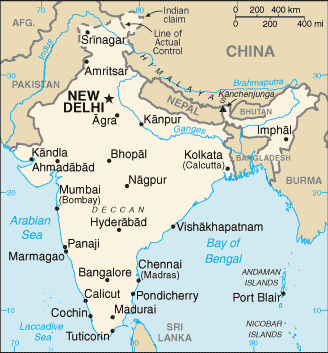


Hamid Ansari
Vice President since 11 August 2007
Vice President since 11 August 2007
| TRAFFICKING IN PERSONS |
Current situation: India is a source, destination, and transit country for men, women, and children trafficked for the purposes of
forced labor and commercial sexual exploitation; internal forced labor may constitute India's largest trafficking problem; men,
women, and children are held in debt bondage and face forced labor working in brick kilns, rice mills, agriculture, and embroidery
factories; women and girls are trafficked within the country for the purposes of commercial sexual exploitation and forced marriage;
children are subjected to forced labor as factory workers, domestic servants, beggars, and agriculture workers, and have been used
as armed combatants by some terrorist and insurgent groups; India is also a destination for women and girls from Nepal and
Bangladesh trafficked for the purpose of commercial sexual exploitation; Indian women are trafficked to the Middle East for
commercial sexual exploitation; men and women from Bangladesh and Nepal are trafficked through India for forced labor and
commercial sexual exploitation in the Middle East
Tier rating: Tier 2 Watch List - India is on the Tier 2 Watch List for a ninth consecutive year for its failure to provide evidence of
increasing efforts to combat human trafficking in 2012; despite the reported extent of the trafficking crisis in India, government
authorities made uneven efforts to prosecute traffickers and protect trafficking victims; government authorities continued to rescue
victims of commercial sexual exploitation and forced child labor and child armed combatants, and began to show progress in law
enforcement against these forms of trafficking; a critical challenge overall is the lack of punishment for traffickers, effectively resulting
in impunity for acts of human trafficking; India has not ratified the 2000 UN TIP Protocol (2012)
forced labor and commercial sexual exploitation; internal forced labor may constitute India's largest trafficking problem; men,
women, and children are held in debt bondage and face forced labor working in brick kilns, rice mills, agriculture, and embroidery
factories; women and girls are trafficked within the country for the purposes of commercial sexual exploitation and forced marriage;
children are subjected to forced labor as factory workers, domestic servants, beggars, and agriculture workers, and have been used
as armed combatants by some terrorist and insurgent groups; India is also a destination for women and girls from Nepal and
Bangladesh trafficked for the purpose of commercial sexual exploitation; Indian women are trafficked to the Middle East for
commercial sexual exploitation; men and women from Bangladesh and Nepal are trafficked through India for forced labor and
commercial sexual exploitation in the Middle East
Tier rating: Tier 2 Watch List - India is on the Tier 2 Watch List for a ninth consecutive year for its failure to provide evidence of
increasing efforts to combat human trafficking in 2012; despite the reported extent of the trafficking crisis in India, government
authorities made uneven efforts to prosecute traffickers and protect trafficking victims; government authorities continued to rescue
victims of commercial sexual exploitation and forced child labor and child armed combatants, and began to show progress in law
enforcement against these forms of trafficking; a critical challenge overall is the lack of punishment for traffickers, effectively resulting
in impunity for acts of human trafficking; India has not ratified the 2000 UN TIP Protocol (2012)