
| INDONESIA Republic of Indonesia Republik Indonesia Joined United Nations: 28 September 1950 Rescinded membership 20 January 1965 Reinstated membership: 28 September 1966 Human Rights as assured by their constitution Click here Updated 27 October 2012 |

| CAPITAL |
| POPULATION |
| CHIEF OF STATE |
| SELECTION PROCESS |
Jakarta
248,645,008 (July 2012 est.)
Susilo Bambang Yudhoyono
President since 20 October 2004
President since 20 October 2004
President and Vice President were elected for five-year terms
(eligible for a second term) by direct vote of the citizenry; last
held 8 July 2009
Next scheduled election: July 2014
(eligible for a second term) by direct vote of the citizenry; last
held 8 July 2009
Next scheduled election: July 2014
HEAD OF GOVERNMENT
Boediono
Vice President since 20 October 2009
Vice President since 20 October 2009
According to the Indonesian Constitution, the president is both
the chief of state and head of government
the chief of state and head of government
| DECLARATION OF HUMAN RIGHTS |
| ETHNIC GROUPS |
Javanese 40.6%, Sundanese 15%, Madurese 3.3%, Minangkabau 2.7%, Betawi 2.4%, Bugis 2.4%, Banten 2%, Banjar 1.7%,
other or unspecified 29.9% (2000 census)
other or unspecified 29.9% (2000 census)
| RELIGIONS |
Muslim 86.1%, Protestant 5.7%, Roman Catholic 3%, Hindu 1.8%, other or unspecified 3.4% (2000 census)
| GOVERNMENT STRUCTURE |
Republic -30 provinces (propinsi-propinsi, singular - propinsi), 2 special regions (daerah-daerah istimewa, singular - daerah istimewa), and
1 special capital city district (daerah khusus ibukota). Legal system is rooted in based on Roman-Dutch law, substantially modified by
indigenous concepts and by new criminal procedures and election codes; has not accepted compulsory ICJ jurisdiction
Executive: President and Vice President were elected for five-year terms (eligible for a second term) by direct vote of the citizenry; last
held 8 July 2009 (next to be held July 2014)
Legislative: House of Representatives or Dewan Perwakilan Rakyat (DPR) (550 seats; members elected to serve five-year
terms); House of Regional Representatives (Dewan Perwakilan Daerah or DPD), constitutionally mandated role includes providing
legislative input to DPR on issues affecting regions; People's Consultative Assembly (Majelis Permusyawaratan Rakyat or MPR)
has role in inaugurating and impeaching president and in amending constitution; consists of popularly-elected members in DPR and
DPD; MPR does not formulate national policy
elections: last held 9 April 2009 (next to be held in 2014)
Judicial: Supreme Court or Mahkamah Agung (justices appointed by the president from a list of candidates approved by the
legislature); a separate Constitutional Court or Mahkamah Konstitusi was invested by the president on 16 August 2003; in March
2004 the Supreme Court assumed administrative and financial responsibility for the lower court system from the Ministry of Justice
and Human Rights; Labor Court under supervision of Supreme Court began functioning in January 2006
1 special capital city district (daerah khusus ibukota). Legal system is rooted in based on Roman-Dutch law, substantially modified by
indigenous concepts and by new criminal procedures and election codes; has not accepted compulsory ICJ jurisdiction
Executive: President and Vice President were elected for five-year terms (eligible for a second term) by direct vote of the citizenry; last
held 8 July 2009 (next to be held July 2014)
Legislative: House of Representatives or Dewan Perwakilan Rakyat (DPR) (550 seats; members elected to serve five-year
terms); House of Regional Representatives (Dewan Perwakilan Daerah or DPD), constitutionally mandated role includes providing
legislative input to DPR on issues affecting regions; People's Consultative Assembly (Majelis Permusyawaratan Rakyat or MPR)
has role in inaugurating and impeaching president and in amending constitution; consists of popularly-elected members in DPR and
DPD; MPR does not formulate national policy
elections: last held 9 April 2009 (next to be held in 2014)
Judicial: Supreme Court or Mahkamah Agung (justices appointed by the president from a list of candidates approved by the
legislature); a separate Constitutional Court or Mahkamah Konstitusi was invested by the president on 16 August 2003; in March
2004 the Supreme Court assumed administrative and financial responsibility for the lower court system from the Ministry of Justice
and Human Rights; Labor Court under supervision of Supreme Court began functioning in January 2006
| LANGUAGES |
Bahasa Indonesia (official, modified form of Malay), English, Dutch, local dialects (the most widely spoken of which is Javanese)
| BRIEF HISTORY |
Geologically the area of modern Indonesia appeared sometime around the Pleistocene period when it was still linked with the Asian
mainland. The archipelago formed during the thaw after the latest ice age. The area's first known humanlike inhabitant some
500,000 years ago was "Java Man" (first classified as Pithecanthropus erectus, then subsequently named a part of the species
Homo erectus). Recent discoveries on the island of Flores were dubbed "Flores Man" (Homo floresiensis), a miniature hominoid
that grew only three feet tall, although whether this is a separate species is in dispute. Nevertheless, Flores Man seems to have
shared some islands with Java Man until only 10,000 years ago, when they became extinct. Indian scholars wrote about the
Dvipantara or Jawa Dwipa Hindu kingdom in Java and Sumatra around 200 BC. The earliest archeological record from the present
era is from the Ujung Kulon National Park, West Java, where an early Hindu archeological relic of a Ganesha statue from the 1st
century AD was found on the summit of Mount Raksa in Panaitan Island. There is also archeological evidence of a kingdom in Tatar
Sunda / Sunda Territory (West Java) dating from the 2nd century, and according to Dr Tony Djubiantono, the head of Bandung
Archeology Agency, Jiwa Temple in Batujaya, Karawang, Java was also built around this time. By the time of the European
Renaissance, the two largest islands in what is now Indonesia, Java and Sumatra had already seen over a millennium of civilization
and two major empires. Mataram was an Indianized kingdom based in Central Java (the area surrounding modern-day Yogyakarta)
between the 8th and 10th centuries. The centre of the kingdom was moved from Central Java to East Java by Mpu Sindok. The
move may have been caused by an eruption of the volcano Mount Merapi, or a power struggle. Srivijaya (-sri meaning glitters or
radiant, -jaya meaning success or excellence) was an ancient Malay kingdom on the island of Sumatra which influenced much of the
Malay Archipelago. Records of its beginning are scarce, and estimates are from the 200s to the 500s. It ceased to exist around the
year 1400. A stronghold of Vajrayana Buddhism, Srivijaya attracted pilgrims and scholars from other parts of Asia. These included
the Chinese monk Yijing, who made several lengthy visits to Sumatra on his way to study at Nalanda in India in 671 and 695. Two
empires would originate in Eastern Java, and would drive Srivijaya and assume its territory: the Singhasari and the Majapahit.
Singhasari was a kingdom located in east Java between 1222 and 1292. The Majapahit Empire would emerge later, and ruled
much of the southern Malay Peninsula, Borneo, Sumatra, and Bali from about 1293 to around 1500. Islam was first established in
Indonesia sometime during the 12th century and, through assimilation, supplanted Hinduism by the end of the 16th century in Java
and Sumatra. Only Bali retained a Hindu majority. In the eastern archipelago, both Christian and Islamic missionaries were active in
the 16th and 17th centuries, and, currently, there are large communities of both religions on these islands. The spread of Islam was
driven by increasing trade links outside of the archipelago; in general, traders and the royalty of major kingdoms were the first to
adopt the new religion. Beginning in the sixteenth century, successive waves of Europeans—the Portuguese, Spanish, Dutch and
British—sought to dominate the spice trade at its sources in India and the 'Spice Islands' (Maluku) of Indonesia. This meant finding
a way to Asia to cut out Muslim merchants who, with their Venetian outlet in the Mediterranean, monopolised spice imports to
Europe. Astronomically priced at the time, spices were highly coveted not only to preserve and make poorly preserved meat
palatable, but also as medicines and magic potions. The arrival of Europeans in South East Asia is often regarded as the watershed
moment in its history. Other scholars consider this view untenable, arguing that European influence during the times of the early
arrivals of the sixteenth and seventeenth centuries was limited in both area and depth. This is in part due to Europe not being the
most advanced or dynamic area of the world in the early fifteenth century. Rather, the major expansionist force of this time was
Islam; in 1453, for example, the Ottoman Turks conquered Constantinople, while Islam continued to spread through Indonesia and
the Philippines. European influence, particularly that of the Dutch, would not have its greatest impact on Indonesia until the
eighteenth and nineteenth centuries. Starting with the first exploratory expeditions sent from newly-conquered Malacca in 1512, the
Portuguese came to Indonesia seeking to dominate the sources of valuable spices and to extend their Roman Catholic missionary
efforts. The Dutch followed the Portuguese aspirations, courage, brutality and strategies but brought better organisation, weapons,
ships, and superior financial backing. Although they failed to gain complete control of the Indonesian spice trade, they had much
more success than the previous Portuguese efforts. Beginning in 1602 with the founding of the Dutch East India Company, the
Dutch took three centuries to establish themselves as rulers of what is now Indonesia, exploiting the fractionalisation of the small
kingdoms that had replaced Majapahit. Unlike the Portuguese, the Dutch established a permanent foothold in Java, from which the
Dutch ultimately established a land-based colonial empire known as the Dutch East Indies into one of the world's richest colonial
possessions. In 1908 the first nationalist movement was formed, Budi Utomo, followed in 1912 by the first nationalist mass
movement, Sarekat Islam. In May 1940, early in World War II, the Netherlands was occupied by Nazi Germany. During World
War II, with the Netherlands under German occupation, Japan began a five-prong campaign in December 1941 towards Java and
the vital fuel supplies of the Dutch East Indies. On 9 August 1945 Sukarno, Hatta, and Radjiman Wediodiningrat were flown to
meet Marshal Terauchi in Vietnam. They were told that Japan intended to announce Indonesian independence on 24 August. After
the Japanese surrender however, Sukarno unilaterally proclaimed Indonesian independence on 17 August. Indonesia's war for
independence lasted from 1945 until December 27, 1949 when, under heavy international pressure, especially from the United
States, which threatened to cut off Marshall Plan funds, the Netherlands acknowledged the independence of Indonesia as a
Federation of autonomous states. From 1959 to 1965, President Sukarno imposed an authoritarian regime under the label of
"Guided Democracy." When the United Nations accepted Malaysia as a nonpermanent member, Sukarno withdrew Indonesia from
the UN and attempted to form the Conference of New Emerging Forces (Conefo) as an alternative. In 1996 Suharto undertook
efforts to pre-empt a challenge to the New Order government. On August 30, 1999, the people of East Timor voted
overwhelmingly for independence in a UN-conducted popular consultation. In 2004, the largest one-day election in the world and
Indonesia's first direct Presidential election was held and was won by Susilo Bambang Yudhoyono, commonly referred by his initials
SBY. On 26 December 2004, early in Yudhoyono's administration, a massive earthquake and tsunami devastated parts of northern
Sumatra, particularly Aceh. On the morning of Saturday, May 27, 2006, the city of Yogyakarta was struck by a severe earthquake.
More than 6,000 people are currently estimated to have died. Yudhoyono was reelected for a second term on 08 July 2009.
Source Wikipedia: History of Indonesia
mainland. The archipelago formed during the thaw after the latest ice age. The area's first known humanlike inhabitant some
500,000 years ago was "Java Man" (first classified as Pithecanthropus erectus, then subsequently named a part of the species
Homo erectus). Recent discoveries on the island of Flores were dubbed "Flores Man" (Homo floresiensis), a miniature hominoid
that grew only three feet tall, although whether this is a separate species is in dispute. Nevertheless, Flores Man seems to have
shared some islands with Java Man until only 10,000 years ago, when they became extinct. Indian scholars wrote about the
Dvipantara or Jawa Dwipa Hindu kingdom in Java and Sumatra around 200 BC. The earliest archeological record from the present
era is from the Ujung Kulon National Park, West Java, where an early Hindu archeological relic of a Ganesha statue from the 1st
century AD was found on the summit of Mount Raksa in Panaitan Island. There is also archeological evidence of a kingdom in Tatar
Sunda / Sunda Territory (West Java) dating from the 2nd century, and according to Dr Tony Djubiantono, the head of Bandung
Archeology Agency, Jiwa Temple in Batujaya, Karawang, Java was also built around this time. By the time of the European
Renaissance, the two largest islands in what is now Indonesia, Java and Sumatra had already seen over a millennium of civilization
and two major empires. Mataram was an Indianized kingdom based in Central Java (the area surrounding modern-day Yogyakarta)
between the 8th and 10th centuries. The centre of the kingdom was moved from Central Java to East Java by Mpu Sindok. The
move may have been caused by an eruption of the volcano Mount Merapi, or a power struggle. Srivijaya (-sri meaning glitters or
radiant, -jaya meaning success or excellence) was an ancient Malay kingdom on the island of Sumatra which influenced much of the
Malay Archipelago. Records of its beginning are scarce, and estimates are from the 200s to the 500s. It ceased to exist around the
year 1400. A stronghold of Vajrayana Buddhism, Srivijaya attracted pilgrims and scholars from other parts of Asia. These included
the Chinese monk Yijing, who made several lengthy visits to Sumatra on his way to study at Nalanda in India in 671 and 695. Two
empires would originate in Eastern Java, and would drive Srivijaya and assume its territory: the Singhasari and the Majapahit.
Singhasari was a kingdom located in east Java between 1222 and 1292. The Majapahit Empire would emerge later, and ruled
much of the southern Malay Peninsula, Borneo, Sumatra, and Bali from about 1293 to around 1500. Islam was first established in
Indonesia sometime during the 12th century and, through assimilation, supplanted Hinduism by the end of the 16th century in Java
and Sumatra. Only Bali retained a Hindu majority. In the eastern archipelago, both Christian and Islamic missionaries were active in
the 16th and 17th centuries, and, currently, there are large communities of both religions on these islands. The spread of Islam was
driven by increasing trade links outside of the archipelago; in general, traders and the royalty of major kingdoms were the first to
adopt the new religion. Beginning in the sixteenth century, successive waves of Europeans—the Portuguese, Spanish, Dutch and
British—sought to dominate the spice trade at its sources in India and the 'Spice Islands' (Maluku) of Indonesia. This meant finding
a way to Asia to cut out Muslim merchants who, with their Venetian outlet in the Mediterranean, monopolised spice imports to
Europe. Astronomically priced at the time, spices were highly coveted not only to preserve and make poorly preserved meat
palatable, but also as medicines and magic potions. The arrival of Europeans in South East Asia is often regarded as the watershed
moment in its history. Other scholars consider this view untenable, arguing that European influence during the times of the early
arrivals of the sixteenth and seventeenth centuries was limited in both area and depth. This is in part due to Europe not being the
most advanced or dynamic area of the world in the early fifteenth century. Rather, the major expansionist force of this time was
Islam; in 1453, for example, the Ottoman Turks conquered Constantinople, while Islam continued to spread through Indonesia and
the Philippines. European influence, particularly that of the Dutch, would not have its greatest impact on Indonesia until the
eighteenth and nineteenth centuries. Starting with the first exploratory expeditions sent from newly-conquered Malacca in 1512, the
Portuguese came to Indonesia seeking to dominate the sources of valuable spices and to extend their Roman Catholic missionary
efforts. The Dutch followed the Portuguese aspirations, courage, brutality and strategies but brought better organisation, weapons,
ships, and superior financial backing. Although they failed to gain complete control of the Indonesian spice trade, they had much
more success than the previous Portuguese efforts. Beginning in 1602 with the founding of the Dutch East India Company, the
Dutch took three centuries to establish themselves as rulers of what is now Indonesia, exploiting the fractionalisation of the small
kingdoms that had replaced Majapahit. Unlike the Portuguese, the Dutch established a permanent foothold in Java, from which the
Dutch ultimately established a land-based colonial empire known as the Dutch East Indies into one of the world's richest colonial
possessions. In 1908 the first nationalist movement was formed, Budi Utomo, followed in 1912 by the first nationalist mass
movement, Sarekat Islam. In May 1940, early in World War II, the Netherlands was occupied by Nazi Germany. During World
War II, with the Netherlands under German occupation, Japan began a five-prong campaign in December 1941 towards Java and
the vital fuel supplies of the Dutch East Indies. On 9 August 1945 Sukarno, Hatta, and Radjiman Wediodiningrat were flown to
meet Marshal Terauchi in Vietnam. They were told that Japan intended to announce Indonesian independence on 24 August. After
the Japanese surrender however, Sukarno unilaterally proclaimed Indonesian independence on 17 August. Indonesia's war for
independence lasted from 1945 until December 27, 1949 when, under heavy international pressure, especially from the United
States, which threatened to cut off Marshall Plan funds, the Netherlands acknowledged the independence of Indonesia as a
Federation of autonomous states. From 1959 to 1965, President Sukarno imposed an authoritarian regime under the label of
"Guided Democracy." When the United Nations accepted Malaysia as a nonpermanent member, Sukarno withdrew Indonesia from
the UN and attempted to form the Conference of New Emerging Forces (Conefo) as an alternative. In 1996 Suharto undertook
efforts to pre-empt a challenge to the New Order government. On August 30, 1999, the people of East Timor voted
overwhelmingly for independence in a UN-conducted popular consultation. In 2004, the largest one-day election in the world and
Indonesia's first direct Presidential election was held and was won by Susilo Bambang Yudhoyono, commonly referred by his initials
SBY. On 26 December 2004, early in Yudhoyono's administration, a massive earthquake and tsunami devastated parts of northern
Sumatra, particularly Aceh. On the morning of Saturday, May 27, 2006, the city of Yogyakarta was struck by a severe earthquake.
More than 6,000 people are currently estimated to have died. Yudhoyono was reelected for a second term on 08 July 2009.
Source Wikipedia: History of Indonesia
| ECONOMIC OVERVIEW |
Indonesia, a vast polyglot nation, grew an estimated 6.1% and 6.4% in 2010 and 2011, respectively. The government made
economic advances under the first administration of President YUDHOYONO (2004-09), introducing significant reforms in the
financial sector, including tax and customs reforms, the use of Treasury bills, and capital market development and supervision.
During the global financial crisis, Indonesia outperformed its regional neighbors and joined China and India as the only G20
members posting growth in 2009. The government has promoted fiscally conservative policies, resulting in a debt-to-GDP ratio of
less than 25%, a small current account surplus, a fiscal deficit below 2%, and historically low rates of inflation. Fitch and Moody's
upgraded Indonesia's credit rating to investment grade in December 2011. Indonesia still struggles with poverty and unemployment,
inadequate infrastructure, corruption, a complex regulatory environment, and unequal resource distribution among regions. The
government in 2012 faces the ongoing challenge of improving Indonesia's insufficient infrastructure to remove impediments to
economic growth, labor unrest over wages, and reducing its fuel subsidy program in the face of rising oil prices.
Source CIA World Factbook (select Indonesia)
economic advances under the first administration of President YUDHOYONO (2004-09), introducing significant reforms in the
financial sector, including tax and customs reforms, the use of Treasury bills, and capital market development and supervision.
During the global financial crisis, Indonesia outperformed its regional neighbors and joined China and India as the only G20
members posting growth in 2009. The government has promoted fiscally conservative policies, resulting in a debt-to-GDP ratio of
less than 25%, a small current account surplus, a fiscal deficit below 2%, and historically low rates of inflation. Fitch and Moody's
upgraded Indonesia's credit rating to investment grade in December 2011. Indonesia still struggles with poverty and unemployment,
inadequate infrastructure, corruption, a complex regulatory environment, and unequal resource distribution among regions. The
government in 2012 faces the ongoing challenge of improving Indonesia's insufficient infrastructure to remove impediments to
economic growth, labor unrest over wages, and reducing its fuel subsidy program in the face of rising oil prices.
Source CIA World Factbook (select Indonesia)
| POLITICAL CLIMATE |
The DPR, which is the premier legislative institution, originally included 462 members elected through a mixed proportional/district
representational system and thirty-eight appointed members of the armed forces (TNI) and police (POLRI). TNI/POLRI
representation in the DPR and MPR ended in 2004. Societal group representation in the MPR was eliminated in 2004 through
further constitutional change.
Having served as rubberstamp bodies in the past, the DPR and MPR have gained considerable power and are increasingly assertive
in oversight of the executive branch. Under constitutional changes in 2004, the MPR became a bicameral legislature, with the
creation of the Dewan Perwakilan Daerah (DPD), in which each province is represented by four members, although its legislative
powers are more limited than those of the DPR. Through his appointed cabinet, the president retains the authority to conduct the
administration of the government.
A general election in June 1999 produced the first freely elected national, provincial, and regional parliaments in over forty years. In
October 1999 the MPR elected a compromise candidate, Abdurrahman Wahid, as the country's fourth president, and Megawati
Sukarnoputri — a daughter of Sukarno, the country's first president — as the vice president. Megawati's PDI-P party had won the
largest share of the vote (34%) in the general election, while Golkar, the dominant party during the Soeharto era, came in second
(22%). Several other, mostly Islamic parties won shares large enough to be seated in the DPR. Further democratic elections took
place in 2004 and 2009.
Source Wikipedia: Politics of Indonesia
representational system and thirty-eight appointed members of the armed forces (TNI) and police (POLRI). TNI/POLRI
representation in the DPR and MPR ended in 2004. Societal group representation in the MPR was eliminated in 2004 through
further constitutional change.
Having served as rubberstamp bodies in the past, the DPR and MPR have gained considerable power and are increasingly assertive
in oversight of the executive branch. Under constitutional changes in 2004, the MPR became a bicameral legislature, with the
creation of the Dewan Perwakilan Daerah (DPD), in which each province is represented by four members, although its legislative
powers are more limited than those of the DPR. Through his appointed cabinet, the president retains the authority to conduct the
administration of the government.
A general election in June 1999 produced the first freely elected national, provincial, and regional parliaments in over forty years. In
October 1999 the MPR elected a compromise candidate, Abdurrahman Wahid, as the country's fourth president, and Megawati
Sukarnoputri — a daughter of Sukarno, the country's first president — as the vice president. Megawati's PDI-P party had won the
largest share of the vote (34%) in the general election, while Golkar, the dominant party during the Soeharto era, came in second
(22%). Several other, mostly Islamic parties won shares large enough to be seated in the DPR. Further democratic elections took
place in 2004 and 2009.
Source Wikipedia: Politics of Indonesia
| INTERNATIONAL DISPUTES |
Indonesia has a stated foreign policy objective of establishing stable fixed land and maritime boundaries with all of its neighbors;
three stretches of land borders with Timor-Leste have yet to be delimited, two of which are in the Oecussi exclave area, and no
maritime or Exclusive Economic Zone (EEZ) boundaries have been established between the countries; many refugees from
Timor-Leste who left in 2003 still reside in Indonesia and refuse repatriation; all borders between Indonesia and Australia have been
agreed upon bilaterally, but a 1997 treaty that would settle the last of their maritime and EEZ boundary has yet to be ratified by
Indonesia's legislature; Indonesian groups challenge Australia's claim to Ashmore Reef; Australia has closed parts of the Ashmore
and Cartier Reserve to Indonesian traditional fishing and placed restrictions on certain catches ; land and maritime negotiations with
Malaysia are ongoing, and disputed areas include the controversial Tanjung Datu and Camar Wulan border area in Borneo and the
maritime boundary in the Ambalat oil block in the Celebes Sea; Indonesia and Singapore continue to work on finalizing their 1973
maritime boundary agreement by defining unresolved areas north of Indonesia's Batam Island; Indonesian secessionists, squatters,
and illegal migrants create repatriation problems for Papua New Guinea; maritime delimitation talks continue with Palau; EEZ
negotiations with Vietnam are ongoing, and the two countries in Fall 2011 agreed to work together to reduce illegal fishing along
their maritime boundary
three stretches of land borders with Timor-Leste have yet to be delimited, two of which are in the Oecussi exclave area, and no
maritime or Exclusive Economic Zone (EEZ) boundaries have been established between the countries; many refugees from
Timor-Leste who left in 2003 still reside in Indonesia and refuse repatriation; all borders between Indonesia and Australia have been
agreed upon bilaterally, but a 1997 treaty that would settle the last of their maritime and EEZ boundary has yet to be ratified by
Indonesia's legislature; Indonesian groups challenge Australia's claim to Ashmore Reef; Australia has closed parts of the Ashmore
and Cartier Reserve to Indonesian traditional fishing and placed restrictions on certain catches ; land and maritime negotiations with
Malaysia are ongoing, and disputed areas include the controversial Tanjung Datu and Camar Wulan border area in Borneo and the
maritime boundary in the Ambalat oil block in the Celebes Sea; Indonesia and Singapore continue to work on finalizing their 1973
maritime boundary agreement by defining unresolved areas north of Indonesia's Batam Island; Indonesian secessionists, squatters,
and illegal migrants create repatriation problems for Papua New Guinea; maritime delimitation talks continue with Palau; EEZ
negotiations with Vietnam are ongoing, and the two countries in Fall 2011 agreed to work together to reduce illegal fishing along
their maritime boundary


| REFUGEES AND INTERNALLY DISPLACED PERSONS (IDP) |
IDPs: 180,000 (government offensives against rebels in Aceh; most IDPs in Aceh, Central Kalimantan, Central Sulawesi Provinces,
and Maluku) (2011)
and Maluku) (2011)
| TRAFFICKING IN PERSONS |
None reported.
| HUMAN RIGHTS STATEMENTS, ANALYSIS AND CRITIQUES |
2011 Human Rights Report: Indonesia
Bureau of Democracy, Human Rights, and Labor
2011 Country Reports on Human Rights Practices
May 25, 2012
Indonesia is a multiparty democracy. In 2009 Susilo Bambang Yudhoyono was reelected president in free and fair elections.
Domestic and international observers judged the 2009 legislative elections free and fair as well. Security forces reported to civilian
authorities.
Major human rights problems included instances of arbitrary and unlawful killings by security forces and others in Papua and West
Papua provinces, societal abuse against certain minority religious groups, and abridgement of the rights of particular religious
minorities to freely practice their religion by regional and local governments. Official corruption, including within the judiciary, was
a major problem, although the Anticorruption Commission (KPK) took some concrete steps to address this.
Other human rights problems included: occasionally harsh prison conditions; some narrow and specific limitations on freedom of
expression; trafficking in persons; child labor; and failure to enforce labor standards and worker rights.
The government attempted to punish officials who committed abuses, but judicial sentencing often was not commensurate with the
severity of offenses, as was true in other types of crimes as well.
Separatist guerillas in Papua killed members of the security forces in several attacks and injured others. Nongovernment actors
engaged in politically related violence, including murder, in Aceh Province.
Click here to read more »
Bureau of Democracy, Human Rights, and Labor
2011 Country Reports on Human Rights Practices
May 25, 2012
Indonesia is a multiparty democracy. In 2009 Susilo Bambang Yudhoyono was reelected president in free and fair elections.
Domestic and international observers judged the 2009 legislative elections free and fair as well. Security forces reported to civilian
authorities.
Major human rights problems included instances of arbitrary and unlawful killings by security forces and others in Papua and West
Papua provinces, societal abuse against certain minority religious groups, and abridgement of the rights of particular religious
minorities to freely practice their religion by regional and local governments. Official corruption, including within the judiciary, was
a major problem, although the Anticorruption Commission (KPK) took some concrete steps to address this.
Other human rights problems included: occasionally harsh prison conditions; some narrow and specific limitations on freedom of
expression; trafficking in persons; child labor; and failure to enforce labor standards and worker rights.
The government attempted to punish officials who committed abuses, but judicial sentencing often was not commensurate with the
severity of offenses, as was true in other types of crimes as well.
Separatist guerillas in Papua killed members of the security forces in several attacks and injured others. Nongovernment actors
engaged in politically related violence, including murder, in Aceh Province.
Click here to read more »
2 July 2008
COMMITTEE AGAINST TORTURE
Fortieth session, Geneva, 28 April-16 May 2008
CONSIDERATION OF REPORTS SUBMITTED BY STATES PARTIES UNDER ARTICLE 19 OF THE CONVENTION
Concluding observations of the Committee against Torture
INDONESIA
A. Introduction
2. The Committee welcomes the second periodic report of Indonesia, which, while generally following the Committee’s guidelines
for reporting, lacks statistical data and practical information on the implementation of the provisions of the Convention and relevant
domestic legislation.
B. Positive aspects
4. The Committee welcomes the continuing effort of the State party to strengthen its institutions and legislation to safeguard
universal human rights protection, including the establishment of the Constitutional Court, the National Law Commission, the
Judiciary Commission, the Ombudsman Commission, the Prosecutorial Commission, the Police Commission and the Eradication of
Corruption Commission, pursuant to articles 2 and 10 of Law No. 4/2004 on Judicial Authority.
C. Subjects of concern and recommendations
Widespread torture and ill-treatment and insufficient safeguards during police detention
10. The Committee is deeply concerned about the numerous, ongoing credible and consistent allegations, corroborated by the
Special Rapporteur on torture in his report (A/HRC/7/3/Add.7) and other sources, of routine and widespread use of torture and ill-
treatment of suspects in police custody, especially to extract confessions or information to be used in criminal proceedings
Furthermore, there are insufficient legal safeguards for detainees, including:
(a) Failure to bring detainees promptly before a judge, thus keeping them in prolonged police custody for up to 61 days;
(b) Absence of systematic registration of all detainees, including juveniles, and failure to keep records of all periods of pretrial
detention;
(c) Restricted access to lawyers and independent doctors and failure to notify detainees of their rights at the time of detention,
including their rights to contact family members (arts. 2, 10 and 11).
As a matter of urgency, the State party should take immediate steps to prevent acts of torture and ill-treatment throughout the
country and to announce a zero-tolerance policy on any ill-treatment or torture by State officials.
As part of this, the State party should implement effective measures promptly to ensure that all detained suspects are afforded, in
practice, all fundamental legal safeguards during their detention. These include, in particular, the right to have access to a lawyer
and an independent medical examination, to notify a relative, and to be informed of their rights at the time of detention, including
about the charges laid against them, as well as to appear before a judge within a time limit in accordance with international
standards. The State party should also ensure that all suspects under criminal investigation are registered, especially children.
Click here to read more »
COMMITTEE AGAINST TORTURE
Fortieth session, Geneva, 28 April-16 May 2008
CONSIDERATION OF REPORTS SUBMITTED BY STATES PARTIES UNDER ARTICLE 19 OF THE CONVENTION
Concluding observations of the Committee against Torture
INDONESIA
A. Introduction
2. The Committee welcomes the second periodic report of Indonesia, which, while generally following the Committee’s guidelines
for reporting, lacks statistical data and practical information on the implementation of the provisions of the Convention and relevant
domestic legislation.
B. Positive aspects
4. The Committee welcomes the continuing effort of the State party to strengthen its institutions and legislation to safeguard
universal human rights protection, including the establishment of the Constitutional Court, the National Law Commission, the
Judiciary Commission, the Ombudsman Commission, the Prosecutorial Commission, the Police Commission and the Eradication of
Corruption Commission, pursuant to articles 2 and 10 of Law No. 4/2004 on Judicial Authority.
C. Subjects of concern and recommendations
Widespread torture and ill-treatment and insufficient safeguards during police detention
10. The Committee is deeply concerned about the numerous, ongoing credible and consistent allegations, corroborated by the
Special Rapporteur on torture in his report (A/HRC/7/3/Add.7) and other sources, of routine and widespread use of torture and ill-
treatment of suspects in police custody, especially to extract confessions or information to be used in criminal proceedings
Furthermore, there are insufficient legal safeguards for detainees, including:
(a) Failure to bring detainees promptly before a judge, thus keeping them in prolonged police custody for up to 61 days;
(b) Absence of systematic registration of all detainees, including juveniles, and failure to keep records of all periods of pretrial
detention;
(c) Restricted access to lawyers and independent doctors and failure to notify detainees of their rights at the time of detention,
including their rights to contact family members (arts. 2, 10 and 11).
As a matter of urgency, the State party should take immediate steps to prevent acts of torture and ill-treatment throughout the
country and to announce a zero-tolerance policy on any ill-treatment or torture by State officials.
As part of this, the State party should implement effective measures promptly to ensure that all detained suspects are afforded, in
practice, all fundamental legal safeguards during their detention. These include, in particular, the right to have access to a lawyer
and an independent medical examination, to notify a relative, and to be informed of their rights at the time of detention, including
about the charges laid against them, as well as to appear before a judge within a time limit in accordance with international
standards. The State party should also ensure that all suspects under criminal investigation are registered, especially children.
Click here to read more »
Indonesian Government Must End Violence Against Journalists, Activists in Papua
Oct 25 2012 - 12:57pm
Freedom House is deeply concerned about the intimidation and violence aimed at journalists and human rights defenders in Papua,
Indonesia, and calls on the Indonesian government to end the culture of impunity that has allowed the violence to escalate.
On October 23, members of the National Committee for West Papua (KNPB) staged a series of pro-independence demonstrations
in cities throughout Papua. At the State University of Papua in Manokwari, Indonesian security forces sought to end the
demonstration with a brutal crackdown that reportedly left several protesters dead and dozens injured. During the confrontation, an
Indonesian journalist photographing the security forces’ actions was severely beaten by five police officers, despite displaying his
press credentials. This incident is the latest in a series of attacks on the press and human rights defenders in Papua, who are
increasingly being targeted for their work.
Indonesia is ranked Partly Free in Freedom House’s Freedom of the Press 2012 survey. As a result of the increasingly hostile
environment in Papua, a number of human rights defenders have relocated after suffering continued harassment and in some cases
receiving death threats. Attacks on journalists and human rights defenders in Papua are rarely investigated or prosecuted. In 2011,
two journalists were killed in Papua, eight were kidnapped, and more than a dozen others were attacked. Freedom House strongly
condemns this intimidation and violence and calls on the Indonesian government to ensure that all journalists and human rights
defenders in Papua receive the rights and protections afforded them under Indonesian law.
Click here to read more »
Oct 25 2012 - 12:57pm
Freedom House is deeply concerned about the intimidation and violence aimed at journalists and human rights defenders in Papua,
Indonesia, and calls on the Indonesian government to end the culture of impunity that has allowed the violence to escalate.
On October 23, members of the National Committee for West Papua (KNPB) staged a series of pro-independence demonstrations
in cities throughout Papua. At the State University of Papua in Manokwari, Indonesian security forces sought to end the
demonstration with a brutal crackdown that reportedly left several protesters dead and dozens injured. During the confrontation, an
Indonesian journalist photographing the security forces’ actions was severely beaten by five police officers, despite displaying his
press credentials. This incident is the latest in a series of attacks on the press and human rights defenders in Papua, who are
increasingly being targeted for their work.
Indonesia is ranked Partly Free in Freedom House’s Freedom of the Press 2012 survey. As a result of the increasingly hostile
environment in Papua, a number of human rights defenders have relocated after suffering continued harassment and in some cases
receiving death threats. Attacks on journalists and human rights defenders in Papua are rarely investigated or prosecuted. In 2011,
two journalists were killed in Papua, eight were kidnapped, and more than a dozen others were attacked. Freedom House strongly
condemns this intimidation and violence and calls on the Indonesian government to ensure that all journalists and human rights
defenders in Papua receive the rights and protections afforded them under Indonesian law.
Click here to read more »
25 October 2012
Indonesia: Excessive use of force by police against demonstrators in Papua
Amnesty International calls on the Indonesian security forces to halt the excessive use of force and firearms when policing
demonstrations in Papua. The organization also urges the authorities to respect the right of Papuans to peaceful assembly and to
freedom of expression of their political opinions.
On 23 October 2012, around 300 people gathered for a pro-independence demonstration organized by the West Papua National
Committee (KNPB) in front of the State University of Papua in Manokwari, West Papua province. Manokwari sub-district police
and military personnel prevented them from proceeding along the road. In response to stones thrown by a few protesters, police
opened fire indiscriminately, firing shots into the air and at the crowd. Some demonstrators alleged that they were beaten by police.
Immediate resort to firearms in response to stone-throwing by a minority of demonstrators amounts to excessive use of force in
violation of international law. Moreover, the reported beating of demonstrators by police amounts to a violation of the absolute
prohibition in international law on torture or other ill-treatment.
At least eleven demonstrators were reportedly injured, four of them suffering gunshot wounds. A journalist, Oktovianus Pogau,
who was covering the demonstration, stated that he was attacked by the police. One of them held him around his throat while
another punched him in the face as he tried to retrieve his press card to show them. At least five police officers also reportedly
suffered injuries.
Indonesia is party to key international treaties, such as the International Covenant on Civil and Political Rights (ICCPR) and the
Convention against Torture and Other Cruel, Inhuman or Degrading Treatment or Punishment (CAT), under which it has explicitly
accepted its obligation to respect and protect human rights, including the right to life and the prohibition on torture and other
illtreatment. These obligations are reflected in the UN Basic Principles on the Use of Force and Firearms by Law Enforcement
Officials. These standards stipulate that the use of force should be exceptional, and no force should be used beyond what is strictly
necessary and proportionate in the circumstances for the achievement of a legitimate law enforcement objective. Firearms may be
used only as a last resort in defence against an imminent threat of death or serious injury, and only when less extreme means are
insufficient.
Law enforcement officials should be equipped with a range of means to allow for a differentiated use of force as well as adequate
self-defensive equipment such as shields, helmets and body armour to decrease the need to use weapons of any kind. The
Principles also state that governments must ensure that arbitrary or abusive use of force by law enforcement officials is punished
as a criminal offence.
Click here to read more »
Indonesia: Excessive use of force by police against demonstrators in Papua
Amnesty International calls on the Indonesian security forces to halt the excessive use of force and firearms when policing
demonstrations in Papua. The organization also urges the authorities to respect the right of Papuans to peaceful assembly and to
freedom of expression of their political opinions.
On 23 October 2012, around 300 people gathered for a pro-independence demonstration organized by the West Papua National
Committee (KNPB) in front of the State University of Papua in Manokwari, West Papua province. Manokwari sub-district police
and military personnel prevented them from proceeding along the road. In response to stones thrown by a few protesters, police
opened fire indiscriminately, firing shots into the air and at the crowd. Some demonstrators alleged that they were beaten by police.
Immediate resort to firearms in response to stone-throwing by a minority of demonstrators amounts to excessive use of force in
violation of international law. Moreover, the reported beating of demonstrators by police amounts to a violation of the absolute
prohibition in international law on torture or other ill-treatment.
At least eleven demonstrators were reportedly injured, four of them suffering gunshot wounds. A journalist, Oktovianus Pogau,
who was covering the demonstration, stated that he was attacked by the police. One of them held him around his throat while
another punched him in the face as he tried to retrieve his press card to show them. At least five police officers also reportedly
suffered injuries.
Indonesia is party to key international treaties, such as the International Covenant on Civil and Political Rights (ICCPR) and the
Convention against Torture and Other Cruel, Inhuman or Degrading Treatment or Punishment (CAT), under which it has explicitly
accepted its obligation to respect and protect human rights, including the right to life and the prohibition on torture and other
illtreatment. These obligations are reflected in the UN Basic Principles on the Use of Force and Firearms by Law Enforcement
Officials. These standards stipulate that the use of force should be exceptional, and no force should be used beyond what is strictly
necessary and proportionate in the circumstances for the achievement of a legitimate law enforcement objective. Firearms may be
used only as a last resort in defence against an imminent threat of death or serious injury, and only when less extreme means are
insufficient.
Law enforcement officials should be equipped with a range of means to allow for a differentiated use of force as well as adequate
self-defensive equipment such as shields, helmets and body armour to decrease the need to use weapons of any kind. The
Principles also state that governments must ensure that arbitrary or abusive use of force by law enforcement officials is punished
as a criminal offence.
Click here to read more »
Indonesia/Australia: Protect ‘Boat Children’
100 Deaths in Sinking Underscore Perils to Migrants
September 10, 2012
(Jakarta) – The Australian and Indonesian governments should urgently take effective measures to protect migrant children at high
risk of abuse while in Indonesia en route to Australia, Human Rights Watch said today.
The sinking on August 29, 2012, of an unseaworthy boat filled with migrant families heading to Australia highlights the need for
better protection for migrant children from outside Indonesia, Human Rights Watch said. Media reports indicate that children were
among the more than 100 fatalities from the incident in Indonesia’s Sunda Strait.
“Far too many children take incredibly risky journeys because they face no good choices,” said Zama Coursen-Neff, children’s
rights director at Human Rights Watch. “They can’t go home because of persecution or war, and they can’t stay put, because
Indonesia doesn’t assist with basic needs or address their legal status.”
A 10-year-old Afghan boy, Omed Jafari, was among those rescued in last week’s boat sinking. He was badly sunburned and
dehydrated, and news reports indicate he lost his father and other relatives in the incident. Mangamed Tamin Satiawan, the head of
the immigration office in Indonesia’s Merak district, said Omed’s case would be expedited “because his case is special. He’s just a
kid.” But his case highlights the need for special attention to all cases involving migrant children, Human Rights Watch said.
Recent Human Rights Watch research in Indonesia found that hundreds of migrant children, especially unaccompanied children,
from Sri Lanka, Afghanistan, Burma, and elsewhere, face detention, mistreatment in custody, no access to education, and little or
no basic assistance in Indonesia. The Indonesian government does not provide them or their families opportunities to obtain legal
status, such as to seek asylum. Many migrants consider traveling to Australia on boats arranged by smugglers a viable option,
despite the dangers.
Unaccompanied migrant children – those who travel without their parents or other caregivers – have to make these decisions
without guidance. Arief B., an ethnic Hazara from Afghanistan, was 15 years old when he traveled to Indonesia alone with the goal
of finding safety in Australia. Arief’s boat went into distress and for three days before he was rescued, he watched many of his
fellow passengers drown.
“Now, I am afraid of the water,” Arief told Human Rights Watch. “For three days and nights, no water and food. We kept climbing
higher and higher as the boat was sinking.”
Click here to read more »
100 Deaths in Sinking Underscore Perils to Migrants
September 10, 2012
(Jakarta) – The Australian and Indonesian governments should urgently take effective measures to protect migrant children at high
risk of abuse while in Indonesia en route to Australia, Human Rights Watch said today.
The sinking on August 29, 2012, of an unseaworthy boat filled with migrant families heading to Australia highlights the need for
better protection for migrant children from outside Indonesia, Human Rights Watch said. Media reports indicate that children were
among the more than 100 fatalities from the incident in Indonesia’s Sunda Strait.
“Far too many children take incredibly risky journeys because they face no good choices,” said Zama Coursen-Neff, children’s
rights director at Human Rights Watch. “They can’t go home because of persecution or war, and they can’t stay put, because
Indonesia doesn’t assist with basic needs or address their legal status.”
A 10-year-old Afghan boy, Omed Jafari, was among those rescued in last week’s boat sinking. He was badly sunburned and
dehydrated, and news reports indicate he lost his father and other relatives in the incident. Mangamed Tamin Satiawan, the head of
the immigration office in Indonesia’s Merak district, said Omed’s case would be expedited “because his case is special. He’s just a
kid.” But his case highlights the need for special attention to all cases involving migrant children, Human Rights Watch said.
Recent Human Rights Watch research in Indonesia found that hundreds of migrant children, especially unaccompanied children,
from Sri Lanka, Afghanistan, Burma, and elsewhere, face detention, mistreatment in custody, no access to education, and little or
no basic assistance in Indonesia. The Indonesian government does not provide them or their families opportunities to obtain legal
status, such as to seek asylum. Many migrants consider traveling to Australia on boats arranged by smugglers a viable option,
despite the dangers.
Unaccompanied migrant children – those who travel without their parents or other caregivers – have to make these decisions
without guidance. Arief B., an ethnic Hazara from Afghanistan, was 15 years old when he traveled to Indonesia alone with the goal
of finding safety in Australia. Arief’s boat went into distress and for three days before he was rescued, he watched many of his
fellow passengers drown.
“Now, I am afraid of the water,” Arief told Human Rights Watch. “For three days and nights, no water and food. We kept climbing
higher and higher as the boat was sinking.”
Click here to read more »
SPEECH BY H.E. DR. SUSILO BAMBANG YUDHOYONO PRESIDENT OF THE REPUBLIC OF INDONESIA
AT THE GENERAL DEBATE OF THE 67TH SESSION OF THE UNITED NATIONS GENERAL ASSEMBLY
NEW YORK, 25 SEPTEMBER 2012
Mr. President,
As a nation that celebrates its diversity of culture and religions, Indonesia calls for mutual respect and understanding among peoples
of different faiths. Despite initiatives undertaken by states at the United Nations and other forums, the defamation of religions
persists. We have seen yet another one of its ugly face in the film "Innocence of Muslims" that is now causing an international
uproar. The Universal Declaration of Human Rights underlines that in exercising their freedom of expression, everyone must
observe morality and public order. Freedom of expression is therefore not absolute.
Hence, I call for an international instrument to effectively prevent incitement to hostility or violence based on religions or beliefs.
This instrument, a product of international consensus, shall serve as a point of reference that the world community must comply
with.
For good measure, we also need to promote a continuing process of dialogue among faiths, civilizations, and cultures. But of
course this dialogue should not remain a dialogue, but should translate into actual cooperation so that communities in which peoples
of different cultures and faiths can come together and care for one another. These communities will become bulwarks for peace
and they will make it difficult if not impossible for any kind of armed conflict to erupt. Yet another thing that we must do is to
master the art of preventive diplomacy. Most disputes are intractable: they simmer for what seems to be an eternity but by
historical reckoning they are not really long drawn-out affairs.
Sooner or later, there comes a confluence of factors and events that provide a window of opportunity for resolving a dispute and
removing conflict from the table of options.
And finally the culture of peace, mutual tolerance and appreciation, and cooperation must be supported by the right kind of
economics. People need to be fed, to be sheltered and to be assured of a future where they have opportunities for a living and a
livelihood. That is the only way that peace can be locked in for the long term—when it brings dividends that give human beings a
robust confidence in the future.
Click here to read more »
AT THE GENERAL DEBATE OF THE 67TH SESSION OF THE UNITED NATIONS GENERAL ASSEMBLY
NEW YORK, 25 SEPTEMBER 2012
Mr. President,
As a nation that celebrates its diversity of culture and religions, Indonesia calls for mutual respect and understanding among peoples
of different faiths. Despite initiatives undertaken by states at the United Nations and other forums, the defamation of religions
persists. We have seen yet another one of its ugly face in the film "Innocence of Muslims" that is now causing an international
uproar. The Universal Declaration of Human Rights underlines that in exercising their freedom of expression, everyone must
observe morality and public order. Freedom of expression is therefore not absolute.
Hence, I call for an international instrument to effectively prevent incitement to hostility or violence based on religions or beliefs.
This instrument, a product of international consensus, shall serve as a point of reference that the world community must comply
with.
For good measure, we also need to promote a continuing process of dialogue among faiths, civilizations, and cultures. But of
course this dialogue should not remain a dialogue, but should translate into actual cooperation so that communities in which peoples
of different cultures and faiths can come together and care for one another. These communities will become bulwarks for peace
and they will make it difficult if not impossible for any kind of armed conflict to erupt. Yet another thing that we must do is to
master the art of preventive diplomacy. Most disputes are intractable: they simmer for what seems to be an eternity but by
historical reckoning they are not really long drawn-out affairs.
Sooner or later, there comes a confluence of factors and events that provide a window of opportunity for resolving a dispute and
removing conflict from the table of options.
And finally the culture of peace, mutual tolerance and appreciation, and cooperation must be supported by the right kind of
economics. People need to be fed, to be sheltered and to be assured of a future where they have opportunities for a living and a
livelihood. That is the only way that peace can be locked in for the long term—when it brings dividends that give human beings a
robust confidence in the future.
Click here to read more »
TRANSLATED FROM INDONESIAN BY GOOGLE TRANSLATE
Mediation: Alternative Dispute Resolution
Wednesday, 24 October 2012 15:05
[Public Relations], Jakarta, Ombudsman of the Republic of Indonesia has several ways to complete a report / complaint that
through clarification, mediation, adjudication to the recommendation. On the day Rabu/24 October 2012, Member Peter Beda Care
Ombudsman is assisted by two assistant mediate between PT.Nindya Works (Limited) with PT.Cemerlang Kontrindo Ocean.
"Mediation is one effective way of resolving disputes" Beda Care Ombudsman Peter explains, "Mediation can be done if both parties
are willing to communicate, the Ombudsman acts as a mediator, also help facilitate communication between the parties to the
dispute".
Not all reports / complaints to the Ombudsman of the Republic of Indonesia settled by the issuance of recommendations. The
process of issuing recommendation is a long process, while if both parties agree to mediation, the problem can be done relatively
quickly with time. Different Care Ombudsman Peter said, "Pre-mediation conducted on Friday, October 19, agreement was
reached on this day, Wednesday, October 24, 2012, would ya .. quite quickly selesaimya".
The difference is mediation with a court ruling has no party wins and the loser. Mediation priority to win-win solution, so both
parties are satisfied with the resulting agreement.
Click here to read more »
Mediation: Alternative Dispute Resolution
Wednesday, 24 October 2012 15:05
[Public Relations], Jakarta, Ombudsman of the Republic of Indonesia has several ways to complete a report / complaint that
through clarification, mediation, adjudication to the recommendation. On the day Rabu/24 October 2012, Member Peter Beda Care
Ombudsman is assisted by two assistant mediate between PT.Nindya Works (Limited) with PT.Cemerlang Kontrindo Ocean.
"Mediation is one effective way of resolving disputes" Beda Care Ombudsman Peter explains, "Mediation can be done if both parties
are willing to communicate, the Ombudsman acts as a mediator, also help facilitate communication between the parties to the
dispute".
Not all reports / complaints to the Ombudsman of the Republic of Indonesia settled by the issuance of recommendations. The
process of issuing recommendation is a long process, while if both parties agree to mediation, the problem can be done relatively
quickly with time. Different Care Ombudsman Peter said, "Pre-mediation conducted on Friday, October 19, agreement was
reached on this day, Wednesday, October 24, 2012, would ya .. quite quickly selesaimya".
The difference is mediation with a court ruling has no party wins and the loser. Mediation priority to win-win solution, so both
parties are satisfied with the resulting agreement.
Click here to read more »
INDONESIA: No mass killings can ever be justified
October 3, 2012
The Asian Human Rights Commission (AHRC) is disturbed with the recent rejection of the Indonesian government to the findings
by the National Human Rights Commission (Komnas HAM) claiming the 1965 massacre constituted a gross human rights violation.
As reported by national media, the Coordinator Political, Legal and Security Affairs Minister Djoko Suyanto insisted that the mass
killing was justified as it was aimed at saving the country from communism. The Minister further claimed that Indonesia "would
not be what it is today if it did not happen".
Previously in July this year, Komnas HAM concluded its four year investigation on the 1965 massacre. It found that gross human
rights violations had been perpetrated by the state during 1965-1966 against individuals allegedly to be communists. Komnas HAM
noted that systematic and widespread killings, torture, enforced disappearances, rape, arbitrary detention as well as other human
rights abuses had taken place during the particular period. Despite these findings, Djoko Suyanto suggested President Susilo
Bambang Yudhoyono not to make an official apology for the abuses.
The AHRC wishes to emphasise that gross human rights violations such as crimes against humanity cannot be justified in any
circumstances. Denial on the occurrence of such abuses is hurtful and disrespectful to the victims and their families who in fact
should be provided with adequate reparation such as acknowledgement of the facts and acceptance of responsibility and other
forms of satisfaction from the state. Under widely accepted international human rights principles, the states have the duty to
investigate any allegation on gross violations of human rights as well as to prosecute and punish those who are responsible for it.
The AHRC is also concerned by the Minister’s statement which has reaffirmed the stigmatisation against communism and those
who share the ideology. Discrimination towards people who are alleged to be ex-supporter of the Indonesian Communist Party
(PKI) is still ongoing to date and an inconsiderate, lack of human rights understanding statement such as one just delivered by the
Minister will only preserve, if not aggravate, it. As a country who claimed itself to be a supporter of freedom of opinion, Indonesia
should treat communism as any other ideology instead of taking it as a threat that those who subscribe to such view can enjoy their
rights without any fear of persecution or discrimination.
Given above, the AHRC is calling the Coordinator Political, Legal and Security Affairs Minister Djoko Suyanto to take back his
statement and apologise to the 1965 massacre victims for his disrespectful comment. In line with the Indonesian Law No. 26 Year
2000 on the Human Rights Court, the AHRC urges the Attorney General Office to take up the findings concluded by Komnas HAM
and to conduct further investigation on the matter at stake. With the recommendation of the Parliament, the President shall issue a
Presidential Decree ordering the establishment of an ad hoc human rights court to try those who are responsible for the massacre.
Click here to read more »
October 3, 2012
The Asian Human Rights Commission (AHRC) is disturbed with the recent rejection of the Indonesian government to the findings
by the National Human Rights Commission (Komnas HAM) claiming the 1965 massacre constituted a gross human rights violation.
As reported by national media, the Coordinator Political, Legal and Security Affairs Minister Djoko Suyanto insisted that the mass
killing was justified as it was aimed at saving the country from communism. The Minister further claimed that Indonesia "would
not be what it is today if it did not happen".
Previously in July this year, Komnas HAM concluded its four year investigation on the 1965 massacre. It found that gross human
rights violations had been perpetrated by the state during 1965-1966 against individuals allegedly to be communists. Komnas HAM
noted that systematic and widespread killings, torture, enforced disappearances, rape, arbitrary detention as well as other human
rights abuses had taken place during the particular period. Despite these findings, Djoko Suyanto suggested President Susilo
Bambang Yudhoyono not to make an official apology for the abuses.
The AHRC wishes to emphasise that gross human rights violations such as crimes against humanity cannot be justified in any
circumstances. Denial on the occurrence of such abuses is hurtful and disrespectful to the victims and their families who in fact
should be provided with adequate reparation such as acknowledgement of the facts and acceptance of responsibility and other
forms of satisfaction from the state. Under widely accepted international human rights principles, the states have the duty to
investigate any allegation on gross violations of human rights as well as to prosecute and punish those who are responsible for it.
The AHRC is also concerned by the Minister’s statement which has reaffirmed the stigmatisation against communism and those
who share the ideology. Discrimination towards people who are alleged to be ex-supporter of the Indonesian Communist Party
(PKI) is still ongoing to date and an inconsiderate, lack of human rights understanding statement such as one just delivered by the
Minister will only preserve, if not aggravate, it. As a country who claimed itself to be a supporter of freedom of opinion, Indonesia
should treat communism as any other ideology instead of taking it as a threat that those who subscribe to such view can enjoy their
rights without any fear of persecution or discrimination.
Given above, the AHRC is calling the Coordinator Political, Legal and Security Affairs Minister Djoko Suyanto to take back his
statement and apologise to the 1965 massacre victims for his disrespectful comment. In line with the Indonesian Law No. 26 Year
2000 on the Human Rights Court, the AHRC urges the Attorney General Office to take up the findings concluded by Komnas HAM
and to conduct further investigation on the matter at stake. With the recommendation of the Parliament, the President shall issue a
Presidential Decree ordering the establishment of an ad hoc human rights court to try those who are responsible for the massacre.
Click here to read more »
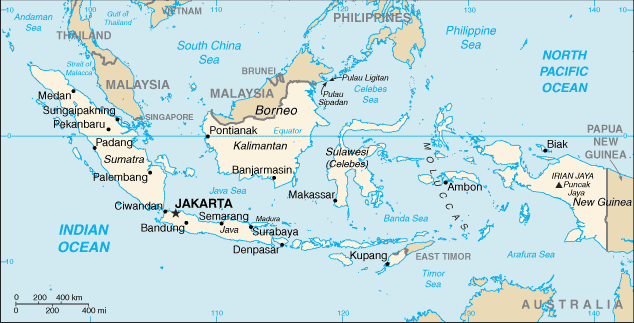
| Click map for larger view |
| Click flag for Country Report |





| ILLICIT DRUGS |
Illicit producer of cannabis largely for domestic use; producer of methamphetamine and ecstasy