



| MARSHALL ISLANDS Republic of Marshall Islands Republic of Marshall Islands Joined United Nations: 17 September 1991 Human Rights as assured by their constitution Click here Updated 27 November 2012 |

| CAPITAL |
| POPULATION |
| CHIEF OF STATE |
| SELECTION PROCESS |
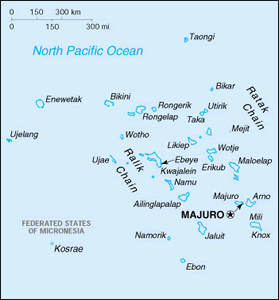
Majuro
68,480 (July 2012 est.)
president elected by Nitijela (legislature) from among its members
for a four-year term; election last held on 3 January 2012
Next scheduled election: 2016
for a four-year term; election last held on 3 January 2012
Next scheduled election: 2016
HEAD OF GOVERNMENT
SELECTION PROCESS
According to the Marshall Islands Constitution, the President is
both the Chief of State and Head of Government
both the Chief of State and Head of Government
| DECLARATION OF HUMAN RIGHTS |
| ETHNIC GROUPS |
Marshallese 92.1%, mixed Marshallese 5.9%, other 2% (2006)
| RELIGIONS |
Protestant 54.8%, Assembly of God 25.8%, Roman Catholic 8.4%, Bukot nan Jesus 2.8%, Mormon 2.1%, other Christian 3.6%, other
1%, none 1.5% (1999 census)
1%, none 1.5% (1999 census)
| GOVERNMENT STRUCTURE |
Constitutional government in free association with the US; the Compact of Free Association entered into force 21 October 1986
and the Amended Compact entered into force in May 2004 with 33 municipalities; Legal system is based on adapted Trust
Territory laws, acts of the legislature, municipal, common, and customary laws
Executive: President elected by Nitijela (legislature) from among its members for a four-year term; election last held on 3 January
2012 (next to be held in 2016)
Legislative: Unicameral legislature or Nitijela (33 seats; members elected by popular vote to serve four-year terms)
elections: last held 21 November 2011 (next to be held by November 2015)
Judicial: Supreme Court; High Court; Traditional Rights Court
and the Amended Compact entered into force in May 2004 with 33 municipalities; Legal system is based on adapted Trust
Territory laws, acts of the legislature, municipal, common, and customary laws
Executive: President elected by Nitijela (legislature) from among its members for a four-year term; election last held on 3 January
2012 (next to be held in 2016)
Legislative: Unicameral legislature or Nitijela (33 seats; members elected by popular vote to serve four-year terms)
elections: last held 21 November 2011 (next to be held by November 2015)
Judicial: Supreme Court; High Court; Traditional Rights Court
| LANGUAGES |
Marshallese (official) 98.2%, other languages 1.8% (1999 census), English (official), widely spoken as a second language
| BRIEF HISTORY |
Little is clearly understood about the prehistory of the Marshall Islands. Researchers agree on little more than that successive waves
of migratory peoples from Southeast Asia spread across the Western Pacific about 3,000 years ago, and that some of them landed
on and remained on these islands. The Spanish explorer Alonso de Salazar landed there in 1529. They were named for English
explorer John Marshall, who visited them in 1799. The Marshall Islands were claimed by Spain in 1874. Following papal mediation
and German compensation of $4.5 million, Spain recognized Germany's claim in 1885, which established a protectorate and set up
trading stations on the islands of Jaluit and Ebon to carry out the flourishing copra (dried coconut meat) trade. Marshallese Iroij
(high chiefs) continued to rule under indirect colonial German administration. At the beginning of World War I, Japan assumed
control of the Marshall Islands. Their headquarters remained at the German center of administration, Jaluit. On January 31, 1944
American forces landed on Kwajalein atoll and U.S. Marines and Army troops later took control of the islands from the Japanese
on February 3, following intense fighting on Kwajalein and Enewetak atolls. In 1947, the United States, as the occupying power,
entered into an agreement with the UN Security Council to administer much of Micronesia, including the Marshall Islands, as the
Trust Territory of the Pacific Islands. From 1946 to 1958 there were 67 nuclear weapon tests on various atolls. A significant radar
installation was constructed on Kwajalein atoll. On May 1, 1979, in recognition of the evolving political status of the Marshall
Islands, the United States recognized the constitution of the Marshall Islands and the establishment of the Government of the
Republic of the Marshall Islands. The constitution incorporates both American and British constitutional concepts. There have been
a number of local and national elections since the Republic of the Marshall Islands was founded, and in general, democracy has
functioned well. The United Democratic Party, running on a reform platform, won the 1999 parliamentary election, taking control of
the presidency and cabinet. The islands signed a Compact of Free Association with the US in 1986 and up to 1999 the islanders
received US $180M for continued American use of Kwajalein atoll, US $250M in compensation for nuclear testing, and $600m in
other payments under the compact. Despite the constitution the government was largely controlled by traditional chiefs. It was not
until 1999 following corruption allegations that the aristocratic government was overthrown, with Imata Kabua replaced by the
'commoner' Kessai Note. He was replaced by Litokwa Tomeing of United Democratic Party or UDP on 7 January 2008 and was
removed as president by no confidence vote on 21 October 2009; legislature elects ZEDKAIA president on 26 October 2009.
Following legislative elections in November 2011 Zedkalia was replaced by Christopher J. Loeak who assume office on 17 January
2012.
Source: Wikipedia: History of Marshall Islands
of migratory peoples from Southeast Asia spread across the Western Pacific about 3,000 years ago, and that some of them landed
on and remained on these islands. The Spanish explorer Alonso de Salazar landed there in 1529. They were named for English
explorer John Marshall, who visited them in 1799. The Marshall Islands were claimed by Spain in 1874. Following papal mediation
and German compensation of $4.5 million, Spain recognized Germany's claim in 1885, which established a protectorate and set up
trading stations on the islands of Jaluit and Ebon to carry out the flourishing copra (dried coconut meat) trade. Marshallese Iroij
(high chiefs) continued to rule under indirect colonial German administration. At the beginning of World War I, Japan assumed
control of the Marshall Islands. Their headquarters remained at the German center of administration, Jaluit. On January 31, 1944
American forces landed on Kwajalein atoll and U.S. Marines and Army troops later took control of the islands from the Japanese
on February 3, following intense fighting on Kwajalein and Enewetak atolls. In 1947, the United States, as the occupying power,
entered into an agreement with the UN Security Council to administer much of Micronesia, including the Marshall Islands, as the
Trust Territory of the Pacific Islands. From 1946 to 1958 there were 67 nuclear weapon tests on various atolls. A significant radar
installation was constructed on Kwajalein atoll. On May 1, 1979, in recognition of the evolving political status of the Marshall
Islands, the United States recognized the constitution of the Marshall Islands and the establishment of the Government of the
Republic of the Marshall Islands. The constitution incorporates both American and British constitutional concepts. There have been
a number of local and national elections since the Republic of the Marshall Islands was founded, and in general, democracy has
functioned well. The United Democratic Party, running on a reform platform, won the 1999 parliamentary election, taking control of
the presidency and cabinet. The islands signed a Compact of Free Association with the US in 1986 and up to 1999 the islanders
received US $180M for continued American use of Kwajalein atoll, US $250M in compensation for nuclear testing, and $600m in
other payments under the compact. Despite the constitution the government was largely controlled by traditional chiefs. It was not
until 1999 following corruption allegations that the aristocratic government was overthrown, with Imata Kabua replaced by the
'commoner' Kessai Note. He was replaced by Litokwa Tomeing of United Democratic Party or UDP on 7 January 2008 and was
removed as president by no confidence vote on 21 October 2009; legislature elects ZEDKAIA president on 26 October 2009.
Following legislative elections in November 2011 Zedkalia was replaced by Christopher J. Loeak who assume office on 17 January
2012.
Source: Wikipedia: History of Marshall Islands
| ECONOMIC OVERVIEW |
US Government assistance is the mainstay of this tiny island economy. The Marshall Islands received more than $1 billion in aid
from the US from 1986-2002. Agricultural production, primarily subsistence, is concentrated on small farms; the most important
commercial crops are coconuts and breadfruit. Small-scale industry is limited to handicrafts, tuna processing, and copra. The tourist
industry, now a small source of foreign exchange employing less than 10% of the labor force, remains the best hope for future
added income. The islands have few natural resources, and imports far exceed exports. Under the terms of the Amended Compact
of Free Association, the US will provide millions of dollars per year to the Marshall Islands (RMI) through 2023, at which time a
Trust Fund made up of US and RMI contributions will begin perpetual annual payouts. Government downsizing, drought, a drop in
construction, the decline in tourism, and less income from the renewal of fishing vessel licenses have held GDP growth to an average
of 1% over the past decade.
Source: CIA World Factbook (select Marshall Islands)
from the US from 1986-2002. Agricultural production, primarily subsistence, is concentrated on small farms; the most important
commercial crops are coconuts and breadfruit. Small-scale industry is limited to handicrafts, tuna processing, and copra. The tourist
industry, now a small source of foreign exchange employing less than 10% of the labor force, remains the best hope for future
added income. The islands have few natural resources, and imports far exceed exports. Under the terms of the Amended Compact
of Free Association, the US will provide millions of dollars per year to the Marshall Islands (RMI) through 2023, at which time a
Trust Fund made up of US and RMI contributions will begin perpetual annual payouts. Government downsizing, drought, a drop in
construction, the decline in tourism, and less income from the renewal of fishing vessel licenses have held GDP growth to an average
of 1% over the past decade.
Source: CIA World Factbook (select Marshall Islands)
| POLITICAL CLIMATE |
Citizens of the Marshall Islands live with a relatively new democratic political system combined with a hierarchical traditional culture.
The first two presidents were chiefs. Kessai Note is a commoner.
There have been a number of local and national elections since the Republic of the Marshall Islands was founded, and in general,
democracy has functioned well. There have been some incidents of human rights concern, however, such as undue government
pressure on the judiciary and the press. The United Democratic Party, running on a reform platform, won the 1999 parliamentary
election, taking control of the presidency and cabinet. The new government has publicly confirmed its commitment to an
independent judiciary.
The territorial claim by the Republic of the Marshall Islands on Wake Atoll leaves a certain amount of ambiguity regarding the actual
or hypothetical role of the US military, responsible under agreement for the defence of Marshallese territory, in the event of any
strategic crisis or hostilities involving Wake. The Atoll was formally annexed by the US in the 19th century and is still administered
by the US Department of the Interior.
Source: Wikipedia: Politics of Marshall Islands
The first two presidents were chiefs. Kessai Note is a commoner.
There have been a number of local and national elections since the Republic of the Marshall Islands was founded, and in general,
democracy has functioned well. There have been some incidents of human rights concern, however, such as undue government
pressure on the judiciary and the press. The United Democratic Party, running on a reform platform, won the 1999 parliamentary
election, taking control of the presidency and cabinet. The new government has publicly confirmed its commitment to an
independent judiciary.
The territorial claim by the Republic of the Marshall Islands on Wake Atoll leaves a certain amount of ambiguity regarding the actual
or hypothetical role of the US military, responsible under agreement for the defence of Marshallese territory, in the event of any
strategic crisis or hostilities involving Wake. The Atoll was formally annexed by the US in the 19th century and is still administered
by the US Department of the Interior.
Source: Wikipedia: Politics of Marshall Islands
| INTERNATIONAL DISPUTES |
Claims US territory of Wake Island


| REFUGEES AND INTERNALLY DISPLACED PERSONS (IDPS) |
None reported.
| ILLICIT DRUGS |
None reported.
| HUMAN RIGHTS STATEMENTS, ANALYSIS AND CRITIQUES |
2011 Human Rights Report: Marshall Islands
Bureau of Democracy, Human Rights, and Labor
2011 Country Reports on Human Rights Practices
May 25, 2012
The Republic of the Marshall Islands is a constitutional republic led by President Jurelang Zedkaia. On November 21, voters elected the
Nitijela (parliament) in generally free and fair multiparty elections. The Nitijela, almost evenly divided between the two dominant political
factions, is scheduled to elect a new president in January 2012. Security forces report to civilian authorities.
The government continued to address human rights challenges including poor prison conditions, government corruption, violence toward
women, child abuse, and lack of worker protections.
The government took steps to prosecute and punish officials who committed abuses, whether in the security services or elsewhere in
the government.
Click here to read more »
Bureau of Democracy, Human Rights, and Labor
2011 Country Reports on Human Rights Practices
May 25, 2012
The Republic of the Marshall Islands is a constitutional republic led by President Jurelang Zedkaia. On November 21, voters elected the
Nitijela (parliament) in generally free and fair multiparty elections. The Nitijela, almost evenly divided between the two dominant political
factions, is scheduled to elect a new president in January 2012. Security forces report to civilian authorities.
The government continued to address human rights challenges including poor prison conditions, government corruption, violence toward
women, child abuse, and lack of worker protections.
The government took steps to prosecute and punish officials who committed abuses, whether in the security services or elsewhere in
the government.
Click here to read more »
Nuclear legacy in the Marshall Islands: “Nomads in their own country” – UN Expert
MAJURO / GENEVA (30 March 2012)
United Nations Special Rapporteur Calin Georgescu warned Friday that the communities affected by nuclear testing over sixty years ago
in the Marshall Islands are “yet to find durable solutions to the dislocation to their indigenous ways of life.” Mr. Georgescu also urged
the country’s government, as well as the United States of America and the international community, to find effective redress to the
affected population.
“They feel like ‘nomads’ in their own country, and many have suffered long-term health effects,” said the UN Special Rapporteur on the
human rights obligations related to environmentally sound management and disposal of hazardous substances and waste, at the end of
the first mission ever to the Republic of the Marshall Islands by an independent expert of the UN Human Rights Council.
“I have listened to the concerns and stories of affected communities from Bikini, Enewetak, Rongelap and Utrik. As a result of the
nuclear testing, all of these communities have suffered dislocation, in one form or another, from their indigenous way of life,” he noted.
“Many have become internally displaced persons who are yet to find durable solutions.”
Mr. Georgescu focused his fact-finding mission on the human rights issues associated with the sixty-seven nuclear tests conducted by
the United States in the islands from 1946 to 1958. During most of that time, the Marshall Islands was a part of the United Nations Trust
Territory of the Pacific Islands administered by the United States.
“Human rights are not meant to be a set of legal principles and rules on paper alone. They are a necessary requirement in an evolving
reality. We must all continuously strive to meet this requirement to live with dignity and respect for ourselves and our future
generations,” the rights expert stressed.
“The affected communities are searching for solutions, but are yet to feel that they have been restored to a position that is any way
equivalent to the life they and their families lived before this dislocation,” said the Special Rapporteur. “Each of the communities from
these four affected atolls has a unique history in relation to the nuclear testing and each needs its own solutions.”
The independent expert drew special attention to the need for strategic and long-term vision to tackle the residual consequences of the
nuclear testing programme; to ensure sustainable progress beyond 2023, when U.S. assistance under the Compact of Free Association is
due to end; and to cope with the growing challenges of climate change in the specific circumstances of the Marshall Islands.
“These are issues of utmost importance, in particular, when we consider the sensitive and fragile environmental conditions prevailing in
the Republic of the Marshall Islands, an atoll nation,” he said. “It is therefore important to create an appropriate framework to ensure
conditions for an efficient and ecological stewardship in the country. UNESCO has declared Bikini Atoll a World Heritage site, and the
other atolls of the Republic could equally share such a status, based on their great natural capital, as well as their extraordinary and
resilient people.”
“The long term survival of the Republic of the Marshall Islands depends on investment in education,” the UN Special Rapporteur
underscored. “This means education should be considered a top priority in order to conserve and use sustainably the cultural heritage of
the country.”
During his four-day mission, Mr. Georgescu met with President Christopher J. Loeak, as well as government representatives, ministers,
senators, high-level officials, experts, academics, civil society, local communities and members of the press.
The UN Special Rapporteur’s final conclusions and recommendations will be submitted as a report to the Human Rights Council in
September 2012. “I shall expect that the follow-up to my report will result in meaningful action,” he said.
Click here to read more »
MAJURO / GENEVA (30 March 2012)
United Nations Special Rapporteur Calin Georgescu warned Friday that the communities affected by nuclear testing over sixty years ago
in the Marshall Islands are “yet to find durable solutions to the dislocation to their indigenous ways of life.” Mr. Georgescu also urged
the country’s government, as well as the United States of America and the international community, to find effective redress to the
affected population.
“They feel like ‘nomads’ in their own country, and many have suffered long-term health effects,” said the UN Special Rapporteur on the
human rights obligations related to environmentally sound management and disposal of hazardous substances and waste, at the end of
the first mission ever to the Republic of the Marshall Islands by an independent expert of the UN Human Rights Council.
“I have listened to the concerns and stories of affected communities from Bikini, Enewetak, Rongelap and Utrik. As a result of the
nuclear testing, all of these communities have suffered dislocation, in one form or another, from their indigenous way of life,” he noted.
“Many have become internally displaced persons who are yet to find durable solutions.”
Mr. Georgescu focused his fact-finding mission on the human rights issues associated with the sixty-seven nuclear tests conducted by
the United States in the islands from 1946 to 1958. During most of that time, the Marshall Islands was a part of the United Nations Trust
Territory of the Pacific Islands administered by the United States.
“Human rights are not meant to be a set of legal principles and rules on paper alone. They are a necessary requirement in an evolving
reality. We must all continuously strive to meet this requirement to live with dignity and respect for ourselves and our future
generations,” the rights expert stressed.
“The affected communities are searching for solutions, but are yet to feel that they have been restored to a position that is any way
equivalent to the life they and their families lived before this dislocation,” said the Special Rapporteur. “Each of the communities from
these four affected atolls has a unique history in relation to the nuclear testing and each needs its own solutions.”
The independent expert drew special attention to the need for strategic and long-term vision to tackle the residual consequences of the
nuclear testing programme; to ensure sustainable progress beyond 2023, when U.S. assistance under the Compact of Free Association is
due to end; and to cope with the growing challenges of climate change in the specific circumstances of the Marshall Islands.
“These are issues of utmost importance, in particular, when we consider the sensitive and fragile environmental conditions prevailing in
the Republic of the Marshall Islands, an atoll nation,” he said. “It is therefore important to create an appropriate framework to ensure
conditions for an efficient and ecological stewardship in the country. UNESCO has declared Bikini Atoll a World Heritage site, and the
other atolls of the Republic could equally share such a status, based on their great natural capital, as well as their extraordinary and
resilient people.”
“The long term survival of the Republic of the Marshall Islands depends on investment in education,” the UN Special Rapporteur
underscored. “This means education should be considered a top priority in order to conserve and use sustainably the cultural heritage of
the country.”
During his four-day mission, Mr. Georgescu met with President Christopher J. Loeak, as well as government representatives, ministers,
senators, high-level officials, experts, academics, civil society, local communities and members of the press.
The UN Special Rapporteur’s final conclusions and recommendations will be submitted as a report to the Human Rights Council in
September 2012. “I shall expect that the follow-up to my report will result in meaningful action,” he said.
Click here to read more »
Freedom In The World 2012 Report
Political Rights Score: 1
Civil Liberties Score: 1
Status: Free
Overview
The Marshall Islands held parliamentary elections in November 2011, in which the Aelon Kein Ad party captured the largest number of
seats. Numerous officials, including a cabinet minister, faced charges stemming from a scheme to defraud the government, and
Kwajalein landowners agreed to lease their land to the United States for $32 million a year through 2066.
An amended compact with new funding and accountability requirements took effect in 2004 and will run through 2023. The deal
authorized the Marshall Islands to receive annual transfers of $57 million from the United States until 2013 and $62 million from 2014 to
2023. In exchange, the United States will have use of the Kwajalein missile-testing site—the primary U.S. testing ground for long-range
nuclear missiles—through 2066. Local populations have expressed concern about the about potential health and environmental hazards
posed by the testing facility; Bikini Atoll remains uninhabitable and Enewetak Atoll is partly contaminated. A $150 million Nuclear Claims
Fund provides compensation for past, present, and future Marshallese victims, though some critics charge that the fund is inadequate.
The U.S. government has rejected additional compensation on the basis that it has already paid $1.5 billion in personal injury and property
damages under the original compact. In May 2011, after years of negotiations, a group of Kwajalein landowners agreed to lease their
land to the United States for a total of $32 million through 2066.
With limited education and employment opportunities, about one-third of the country’s citizens live overseas, mostly in the United States.
The government adopted new austerity measures in its 2011 budget in order to counter the impact of the global economic downturn; the
economy was also damaged by lower returns on investments in its trust fund and a 20-year low in tourism. The government initiated a
large-scale audit of government spending from 2007 to 2011 after law enforcement discovered that more than $500,000 in U.S. grants
to the Ministry of Health had been stolen.
Parliamentary elections held on November 21 saw a high voter turnout, with no reports of fraud or violence. Absentee ballots from
overseas voters were allowed through December 5. Official election results published in early December did not give a clear majority to
either the AKA or UDP. However, the AKA eventually controlled 20 seats after victorious independent candidates joined the party. The
parliament had not selected a new president by year’s end.
The Marshall Islands is an electoral democracy. The president is chosen for a four-year term by the unicameral parliament (Nitijela),
from among its 33 members, who are directly elected to four-year terms. An advisory body, the Council of Chiefs (Iroij), consists of 12
traditional leaders who are consulted on customary law. The two main political parties are the AKA and the UDP.
Corruption is a serious problem. In January 2011, the government launched an extensive probe into a scheme to defraud the Marshall
Islands.
Click here to read more »
Political Rights Score: 1
Civil Liberties Score: 1
Status: Free
Overview
The Marshall Islands held parliamentary elections in November 2011, in which the Aelon Kein Ad party captured the largest number of
seats. Numerous officials, including a cabinet minister, faced charges stemming from a scheme to defraud the government, and
Kwajalein landowners agreed to lease their land to the United States for $32 million a year through 2066.
An amended compact with new funding and accountability requirements took effect in 2004 and will run through 2023. The deal
authorized the Marshall Islands to receive annual transfers of $57 million from the United States until 2013 and $62 million from 2014 to
2023. In exchange, the United States will have use of the Kwajalein missile-testing site—the primary U.S. testing ground for long-range
nuclear missiles—through 2066. Local populations have expressed concern about the about potential health and environmental hazards
posed by the testing facility; Bikini Atoll remains uninhabitable and Enewetak Atoll is partly contaminated. A $150 million Nuclear Claims
Fund provides compensation for past, present, and future Marshallese victims, though some critics charge that the fund is inadequate.
The U.S. government has rejected additional compensation on the basis that it has already paid $1.5 billion in personal injury and property
damages under the original compact. In May 2011, after years of negotiations, a group of Kwajalein landowners agreed to lease their
land to the United States for a total of $32 million through 2066.
With limited education and employment opportunities, about one-third of the country’s citizens live overseas, mostly in the United States.
The government adopted new austerity measures in its 2011 budget in order to counter the impact of the global economic downturn; the
economy was also damaged by lower returns on investments in its trust fund and a 20-year low in tourism. The government initiated a
large-scale audit of government spending from 2007 to 2011 after law enforcement discovered that more than $500,000 in U.S. grants
to the Ministry of Health had been stolen.
Parliamentary elections held on November 21 saw a high voter turnout, with no reports of fraud or violence. Absentee ballots from
overseas voters were allowed through December 5. Official election results published in early December did not give a clear majority to
either the AKA or UDP. However, the AKA eventually controlled 20 seats after victorious independent candidates joined the party. The
parliament had not selected a new president by year’s end.
The Marshall Islands is an electoral democracy. The president is chosen for a four-year term by the unicameral parliament (Nitijela),
from among its 33 members, who are directly elected to four-year terms. An advisory body, the Council of Chiefs (Iroij), consists of 12
traditional leaders who are consulted on customary law. The two main political parties are the AKA and the UDP.
Corruption is a serious problem. In January 2011, the government launched an extensive probe into a scheme to defraud the Marshall
Islands.
Click here to read more »
Suggested recommendations to States considered in the ninth round of the Universal Periodic Review, November 2010
1 September 2010
Recommendations to the government of Marshall Islands
Ratification of international human rights standards
· To ratify the outstanding core international human rights treaties, in particular:
- The International Covenant on Economic, Social and Cultural Rights and its Optional Protocol and the International Covenant on Civil
and Political Rights and its two Optional Protocols;
- The International Convention for the Protection of All Persons from Enforced Disappearance,
making the declarations set out in Articles 31 and 32, and to implement it in national law in accordance with conventional and customary
international law;
- The International Convention against Torture and Other Cruel, Inhuman or Degrading
Treatment or Punishment, and implement it in national law in accordance with conventional and customary international law;
- The Convention on the non-applicability of statutory limitations to war crimes and crimes against humanity, without making prohibited
reservations and to implement it in national law in accordance with conventional and customary international law.
International Criminal Court
· As a state party to the Rome Statute of the International Criminal Court, Marshall Islands should promptly ratify the Agreement on the
Privileges and Immunities of the International Criminal Court, and to implement it in national law.
Click here to read more »
1 September 2010
Recommendations to the government of Marshall Islands
Ratification of international human rights standards
· To ratify the outstanding core international human rights treaties, in particular:
- The International Covenant on Economic, Social and Cultural Rights and its Optional Protocol and the International Covenant on Civil
and Political Rights and its two Optional Protocols;
- The International Convention for the Protection of All Persons from Enforced Disappearance,
making the declarations set out in Articles 31 and 32, and to implement it in national law in accordance with conventional and customary
international law;
- The International Convention against Torture and Other Cruel, Inhuman or Degrading
Treatment or Punishment, and implement it in national law in accordance with conventional and customary international law;
- The Convention on the non-applicability of statutory limitations to war crimes and crimes against humanity, without making prohibited
reservations and to implement it in national law in accordance with conventional and customary international law.
International Criminal Court
· As a state party to the Rome Statute of the International Criminal Court, Marshall Islands should promptly ratify the Agreement on the
Privileges and Immunities of the International Criminal Court, and to implement it in national law.
Click here to read more »
United States Ratification of International Human Rights Treaties
July 24, 2009
Overview
With a new administration and Congress, the United States has an important opportunity to reposition itself as a global leader on human
rights. One means towards that goal is to sign and ratify core human rights treaties. Chief among these are international conventions
relating to children, women, persons with disabilities, torture, enforced disappearance, and the use of anti-personnel landmines and
cluster munitions.
The failure of the US to join with other nations in taking on international human rights legal obligations has undercut its international
leadership on key issues, limiting its influence, its stature, and its credibility in promoting respect for human rights around the world.
Convention on the Rights of the Child Background:
The Convention on the Rights of the Child (CRC) promotes and protects the well-being of all children, and was the first international
treaty to integrate the full range of human rights-civil, political, economic, social and cultural-into a single document. It emphasizes four
key themes: the right of children to survival; to develop to their fullest potential; to protection from abuse, neglect and exploitation; and to
participate in family, cultural and social life.
Key points:
* The Convention on the Rights of the Child is the most widely and rapidly ratified human rights treaty in history. Only the United States
and Somalia, which has no functioning national government, have failed to ratify the treaty.
* The conspicuous absence of the United States among the CRC's states parties undermines the its international leadership role for
children, and consistently raises questions in UN and other international forums regarding the its commitment to children's rights. For
example, for the past seven years, the US (joined by the Marshall Islands in 2002 and 2004) has been in the embarrassing position of
being the only UN member state to vote against the UN General Assembly's resolution on the rights of the child, primarily because of the
resolution's references to the CRC.
Click here to read more »
July 24, 2009
Overview
With a new administration and Congress, the United States has an important opportunity to reposition itself as a global leader on human
rights. One means towards that goal is to sign and ratify core human rights treaties. Chief among these are international conventions
relating to children, women, persons with disabilities, torture, enforced disappearance, and the use of anti-personnel landmines and
cluster munitions.
The failure of the US to join with other nations in taking on international human rights legal obligations has undercut its international
leadership on key issues, limiting its influence, its stature, and its credibility in promoting respect for human rights around the world.
Convention on the Rights of the Child Background:
The Convention on the Rights of the Child (CRC) promotes and protects the well-being of all children, and was the first international
treaty to integrate the full range of human rights-civil, political, economic, social and cultural-into a single document. It emphasizes four
key themes: the right of children to survival; to develop to their fullest potential; to protection from abuse, neglect and exploitation; and to
participate in family, cultural and social life.
Key points:
* The Convention on the Rights of the Child is the most widely and rapidly ratified human rights treaty in history. Only the United States
and Somalia, which has no functioning national government, have failed to ratify the treaty.
* The conspicuous absence of the United States among the CRC's states parties undermines the its international leadership role for
children, and consistently raises questions in UN and other international forums regarding the its commitment to children's rights. For
example, for the past seven years, the US (joined by the Marshall Islands in 2002 and 2004) has been in the embarrassing position of
being the only UN member state to vote against the UN General Assembly's resolution on the rights of the child, primarily because of the
resolution's references to the CRC.
Click here to read more »
H.E. Ms. Amatlain E. Kabua
Ambassador & Permanent Representative of the Republic of the Marshall Islands to the United Nations
General Assembly, 3rd Committee Advancement of Women
New York 16 October 2012
Chair,
As we meet at this 67th session of the UN General Assembly, I take this opportunity to affirm the Republic Marshall Island's support
for, and commitment to, the advancement of women and especially the human rights dimensions of this issue.
The Marshallese society is has a matrilineal system of traditional land tenure as land - perhaps our most important resource - passes from
mother to daughter. In our contemporary - and rapidly globalizing - world, women in the Marshall Islands, and around the globe, have
been afforded new opportunities, but also face many challenges. For women m rural areas, and our outer islands, these challenges tend
to be even greater - yet all women face severe challenges, including high rates of domestic violence, limited access to education, and
lack of professional and business opportunities.
These issues were at the forefront at the Forty-third Pacific Islands Forum this past August, where Forum leaders endorsed the Pacific
Leaders Gender Equality Declaration, and committed to supporting women's political representation, eliminating all barriers preventing
women from participating fully in the economic sphere, and acting to end violence against women The Joint Statement by the Leaders of
the Pacific Islands Forum and the UN Secretary-General released in September 2012 again highlighted measures to address the economic
and political empowerment of women, and gender-based violence, as strong national and regional priorities. The focused and dedicated
efforts, taken together by both the UN system and our regional agencies, will do much in further implementing these commitments.
The Marshall Islands is challenged by limited capacity and resources. Despite this, we are taking steps that support the advancement of
women m our society. Here I must note the successful passage in September 2011 of a national domestic violence law, as well as strong
national efforts to improve full access to quality education as a Millennium Development Goal Ongoing initiatives and aspirations related
to improving the situation of women.
Critical gaps remain, but our political will to overcome them is strong. The Marshall Islands is only one member of the General
Assembly, and the Pacific is only one region - but the shared experiences and positive progress of other nations and regions towards the
advancement of women will go far m transforming the written words of declarations or resolutions into visible realities in our parliament
halls, in our workplaces and in our homes.
Thank you and kommol tata _
Click here to read more »
Ambassador & Permanent Representative of the Republic of the Marshall Islands to the United Nations
General Assembly, 3rd Committee Advancement of Women
New York 16 October 2012
Chair,
As we meet at this 67th session of the UN General Assembly, I take this opportunity to affirm the Republic Marshall Island's support
for, and commitment to, the advancement of women and especially the human rights dimensions of this issue.
The Marshallese society is has a matrilineal system of traditional land tenure as land - perhaps our most important resource - passes from
mother to daughter. In our contemporary - and rapidly globalizing - world, women in the Marshall Islands, and around the globe, have
been afforded new opportunities, but also face many challenges. For women m rural areas, and our outer islands, these challenges tend
to be even greater - yet all women face severe challenges, including high rates of domestic violence, limited access to education, and
lack of professional and business opportunities.
These issues were at the forefront at the Forty-third Pacific Islands Forum this past August, where Forum leaders endorsed the Pacific
Leaders Gender Equality Declaration, and committed to supporting women's political representation, eliminating all barriers preventing
women from participating fully in the economic sphere, and acting to end violence against women The Joint Statement by the Leaders of
the Pacific Islands Forum and the UN Secretary-General released in September 2012 again highlighted measures to address the economic
and political empowerment of women, and gender-based violence, as strong national and regional priorities. The focused and dedicated
efforts, taken together by both the UN system and our regional agencies, will do much in further implementing these commitments.
The Marshall Islands is challenged by limited capacity and resources. Despite this, we are taking steps that support the advancement of
women m our society. Here I must note the successful passage in September 2011 of a national domestic violence law, as well as strong
national efforts to improve full access to quality education as a Millennium Development Goal Ongoing initiatives and aspirations related
to improving the situation of women.
Critical gaps remain, but our political will to overcome them is strong. The Marshall Islands is only one member of the General
Assembly, and the Pacific is only one region - but the shared experiences and positive progress of other nations and regions towards the
advancement of women will go far m transforming the written words of declarations or resolutions into visible realities in our parliament
halls, in our workplaces and in our homes.
Thank you and kommol tata _
Click here to read more »
Marshall Islands President Calls For Government Accountability
Loeak urges officials to operate transparently, professionally
By Giff Johnson
SAIPAN, CNMI (Marianas Variety, Oct. 25, 2012)
The 10th Annual Pacific Public Service Commissioners’ Conference (PSC) kicked off Tuesday in Majuro with Marshall Islands
President Christopher Loeak making a strong pitch for accountability in government services.
Delivering the keynote speech to the conference of PSC chiefs from the region, Loeak said "there is no greater issue more central to
good governance than accountability." Constitutions in most countries outline that PSC’s are to operate independently, professionally and
in accord with the law.
Close to 100 officials from the region are attending the conference this week that wraps up on Thursday.
"It is incumbent on you, as public service commissioners and CEO’s, to provide the vision required for public service management,"
Loeak said.
He told conferees that when he took office in January, he announced the Marshall Islands needed to improve its public service. "When
the national administrative organization does not work properly, development and investment slows down," Loeak said. "Our most
vulnerable people are then penalized and denied opportunities and essential services."
PSC’s everywhere need to be focused on operating in a "transparent, accountable and professional manner," he said, adding the
conference should produce an outcome "for reform that promotes restructuring of the public sector into an effective, affordable and
efficient service."
He also directed advice to government workers, saying they must be willing to serve the public. He called for "creating a real culture of
public service. The reality is that the people are not simply clients, but are citizens — they provide the capital that pays our wages and
expenses."
Speaking after the president, Mishka Tu’ifua, the chairperson of Tonga’s public service agency, said: "We’ll work to make public
service good for Pacific citizens."
Loeak’s government earlier this month appointed experienced government executive Marie Maddison as the new chairperson of the
Marshall Islands Public Service Commission. She is known for her reform philosophy and focus on good governance.
Click here to read more »
Loeak urges officials to operate transparently, professionally
By Giff Johnson
SAIPAN, CNMI (Marianas Variety, Oct. 25, 2012)
The 10th Annual Pacific Public Service Commissioners’ Conference (PSC) kicked off Tuesday in Majuro with Marshall Islands
President Christopher Loeak making a strong pitch for accountability in government services.
Delivering the keynote speech to the conference of PSC chiefs from the region, Loeak said "there is no greater issue more central to
good governance than accountability." Constitutions in most countries outline that PSC’s are to operate independently, professionally and
in accord with the law.
Close to 100 officials from the region are attending the conference this week that wraps up on Thursday.
"It is incumbent on you, as public service commissioners and CEO’s, to provide the vision required for public service management,"
Loeak said.
He told conferees that when he took office in January, he announced the Marshall Islands needed to improve its public service. "When
the national administrative organization does not work properly, development and investment slows down," Loeak said. "Our most
vulnerable people are then penalized and denied opportunities and essential services."
PSC’s everywhere need to be focused on operating in a "transparent, accountable and professional manner," he said, adding the
conference should produce an outcome "for reform that promotes restructuring of the public sector into an effective, affordable and
efficient service."
He also directed advice to government workers, saying they must be willing to serve the public. He called for "creating a real culture of
public service. The reality is that the people are not simply clients, but are citizens — they provide the capital that pays our wages and
expenses."
Speaking after the president, Mishka Tu’ifua, the chairperson of Tonga’s public service agency, said: "We’ll work to make public
service good for Pacific citizens."
Loeak’s government earlier this month appointed experienced government executive Marie Maddison as the new chairperson of the
Marshall Islands Public Service Commission. She is known for her reform philosophy and focus on good governance.
Click here to read more »
UN presses US to increase Marshalls nuclear compensation
(AFP) – Sep 11, 2012
WELLINGTON — The United States needs to provide extra compensation to settle claims by nuclear-affected Marshall islanders and
end a "legacy of distrust", according to a UN report released Tuesday.
The 19-page report prepared by UN Special Rapporteur Calin Georgescu also urged Washington to declassify secret reports on its
nuclear testing programme in the Marshall Islands.
The United States conducted 67 nuclear weapons tests at Bikini and Enewetak atolls from 1946 to 1958.
Georgescu's report, compiled following a fact-finding mission to the Marshall Islands earlier this year, will be presented to the UN
Human Rights Council on Thursday in Geneva.
Marshall Islands Foreign Minister Phillip Muller and survivors of the 1954 Bravo hydrogen bomb test at Bikini Atoll, which spewed
radioactive fallout over many islands, will be appearing at the Human Rights Council.
Georgescu said the report "is neither to apportion blame nor attempt to make a legal pronouncement on the nuclear testing program".
The goal was to stimulate dialogue "between the parties in the spirit of understanding, respect and reconciliation, for the benefit of the
Marshallese people".
The Nuclear Claims Tribunal awarded more than $2 billion in personal injury and land damage claims arising form the nuclear tests, but
stopped paying after a US-provided $150 million compensation fund was exhausted.
Georgescu said the nuclear testing and experiments "have left a legacy of distrust in the hearts and minds of the Marshallese", but there
was an opportunity for reconciliation.
The report noted the dispute between US government scientists and Marshallese officials over the effects of radiation and said "a
precautionary approach that emphasises the likelihood of risk over conclusive proof may prove more prudent and protective of rights."
Georgescu's report also said testimony by nuclear test survivors about the psychological trauma from witnessing the explosions and their
effect recognised a "serious health concern".
"Although these health concerns are of a different nature to cancer, the fear of radiation itself is no less real."
Click here to read more>>
(AFP) – Sep 11, 2012
WELLINGTON — The United States needs to provide extra compensation to settle claims by nuclear-affected Marshall islanders and
end a "legacy of distrust", according to a UN report released Tuesday.
The 19-page report prepared by UN Special Rapporteur Calin Georgescu also urged Washington to declassify secret reports on its
nuclear testing programme in the Marshall Islands.
The United States conducted 67 nuclear weapons tests at Bikini and Enewetak atolls from 1946 to 1958.
Georgescu's report, compiled following a fact-finding mission to the Marshall Islands earlier this year, will be presented to the UN
Human Rights Council on Thursday in Geneva.
Marshall Islands Foreign Minister Phillip Muller and survivors of the 1954 Bravo hydrogen bomb test at Bikini Atoll, which spewed
radioactive fallout over many islands, will be appearing at the Human Rights Council.
Georgescu said the report "is neither to apportion blame nor attempt to make a legal pronouncement on the nuclear testing program".
The goal was to stimulate dialogue "between the parties in the spirit of understanding, respect and reconciliation, for the benefit of the
Marshallese people".
The Nuclear Claims Tribunal awarded more than $2 billion in personal injury and land damage claims arising form the nuclear tests, but
stopped paying after a US-provided $150 million compensation fund was exhausted.
Georgescu said the nuclear testing and experiments "have left a legacy of distrust in the hearts and minds of the Marshallese", but there
was an opportunity for reconciliation.
The report noted the dispute between US government scientists and Marshallese officials over the effects of radiation and said "a
precautionary approach that emphasises the likelihood of risk over conclusive proof may prove more prudent and protective of rights."
Georgescu's report also said testimony by nuclear test survivors about the psychological trauma from witnessing the explosions and their
effect recognised a "serious health concern".
"Although these health concerns are of a different nature to cancer, the fear of radiation itself is no less real."
Click here to read more>>
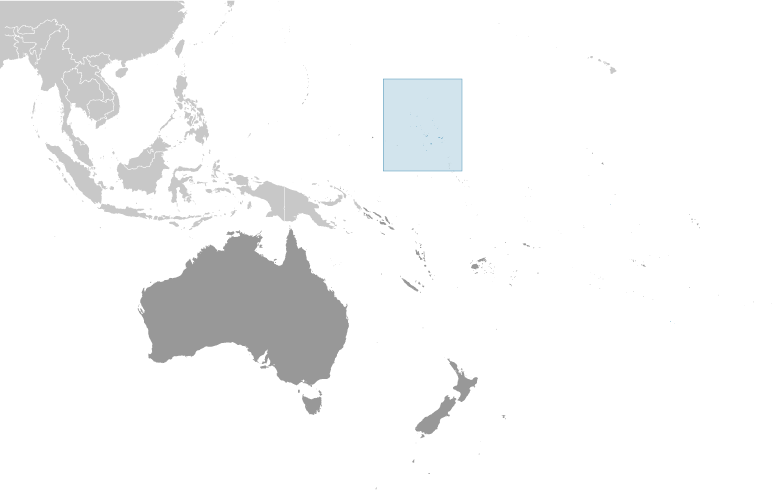
| Click map for larger view |
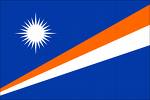
| Click flag for Country Report |



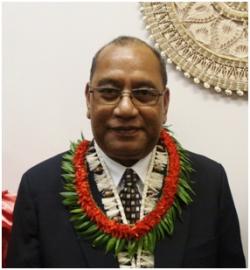
Christopher J. Loeak
President since 17 January 2012
President since 17 January 2012
| TRAFFICKING IN PERSONS |
None reported.
Christopher J. Loeak
President since 17 January 2012
President since 17 January 2012