

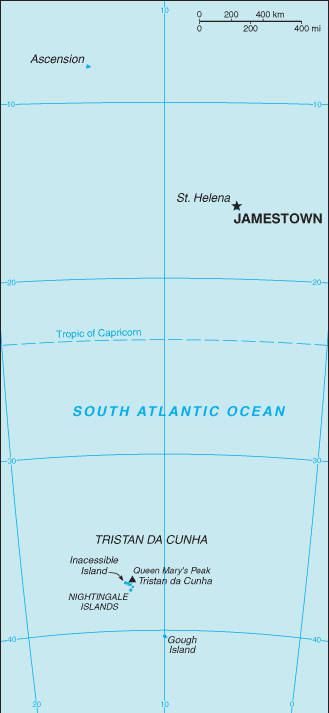
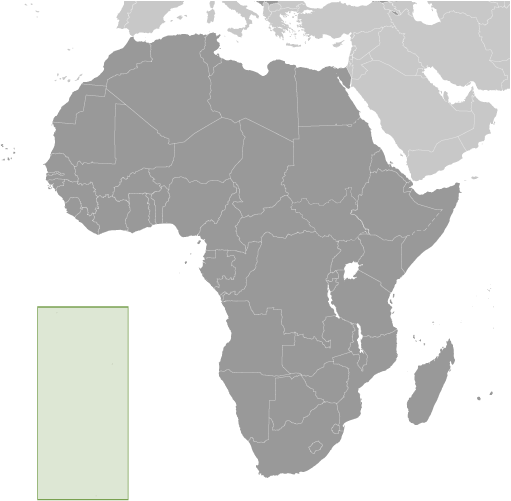
| SAINT HELENA Ascension, Saint Helena, Tristan Da Cunha, Nightingale and Gough Islands (Overseas territory of the United Kingdom) Joined United Nations: 24 October 1945 Human Rights as assured by their constitution Click here Updated 23 December 2012 |

| CAPITAL |
| POPULATION |
| CHIEF OF STATE |
| SELECTION PROCESS |
Jamestown
7,728
note: only Saint Helena, Ascension, and Tristan da Cunha islands are inhabited (July
2012 est.)
note: only Saint Helena, Ascension, and Tristan da Cunha islands are inhabited (July
2012 est.)
Mark Capes
Governor since 29 October 2011
Governor since 29 October 2011
The monarch is hereditary
Next scheduled election: None
Next scheduled election: None
HEAD OF GOVERNMENT
SELECTION PROCESS
Governor is appointed by the monarch; the constitution order
provides for an administrator for Ascension and Tristan da
Cunha appointed by the governor
Next scheduled election: None
provides for an administrator for Ascension and Tristan da
Cunha appointed by the governor
Next scheduled election: None
| DECLARATION OF HUMAN RIGHTS |
| ETHNIC GROUPS |
African descent 50%, white 25%, Chinese 25%
| RELIGIONS |
Anglican (majority), Baptist, Seventh-Day Adventist, Roman Catholic
| GOVERNMENT STRUCTURE |
Overseas territory of the UK with 1 administrative area and 2 dependencies; Legal system is English common law and statutes,
supplemented by local statutes
Executive: The monarch is hereditary; governor is appointed by the monarch; the constitution order provides for an administrator
for Ascension and Tristan da Cunha appointed by the governor
Legislative: Unicameral Legislative Council (17 seats, including a speaker and deputy speaker, 12 elected, and three ex officio
members; members elected by popular vote to serve four-year terms)
note: the Constitution Order provides for separate Island Councils for both Ascension and Tristan da Cunha
elections: last held on 4 November 2009 (next to be held in November 2013)
Judicial: Magistrate's Court; Supreme Court; Court of Appeal
supplemented by local statutes
Executive: The monarch is hereditary; governor is appointed by the monarch; the constitution order provides for an administrator
for Ascension and Tristan da Cunha appointed by the governor
Legislative: Unicameral Legislative Council (17 seats, including a speaker and deputy speaker, 12 elected, and three ex officio
members; members elected by popular vote to serve four-year terms)
note: the Constitution Order provides for separate Island Councils for both Ascension and Tristan da Cunha
elections: last held on 4 November 2009 (next to be held in November 2013)
Judicial: Magistrate's Court; Supreme Court; Court of Appeal
| LANGUAGES |
English
| BRIEF HISTORY |
The island was discovered on May 21, 1502 by the Portuguese navigator João da Nova, on his voyage home from India, and he
named it "Saint Helena". The Portuguese found it uninhabited, with an abundance of trees and fresh water. They imported livestock
(mainly goats), fruit trees and vegetables, built a chapel and one or two houses, and left their sick there to be taken home, if they
recovered, by the next ship, but they formed no permanent settlement. The Portuguese kept the location of the island a secret. They
wanted to keep this strategically-placed watering place to themselves. Its first known permanent resident was Portuguese, Fernão
Lopez who had turned traitor in India and had been mutilated by order of Albuquerque, the Governor of Goa. Fernando Lopes
preferred being marooned to returning to Portugal in his maimed condition, and lived on Saint Helena from 1513. By royal
command Lopez did visit Portugal some time later, but returned to Saint Helena, where he died in 1530. When the island was
discovered, it was covered with unique (indigenous) vegetation, including many tropical trees. The island's interior must have been a
dense tropical forest but the coastal areas were probably quite green as well. The modern landscape is very different, with a lot of
naked rock in the lower areas, and a high interior that is green—but mainly of imported vegetation. The dramatic change in
landscape must be contributed to the introduction of goats and the introduction of new vegetation. In 1584 two Japanese
ambassadors to Rome landed at the island. The first Englishman known to have visited it was Thomas Cavendish, who touched
there in June 1588 during his voyage round the world. Another English seaman, Captain Kendall, visited Saint Helena in 1591, and
in 1593 Sir James Lancaster stopped at the island on his way home from the East. In 1603 Lancaster again visited Saint Helena on
his return from the first voyage equipped by the British East India Company. From about 1600 the island was well known by
captains from Portugal, England, France and the United Provinces. The island was used for collecting food and as a rendez-vous
point but at homebound voyages from Asia only: during outbound voyages the ships sailed hundreds of kilometres west of Saint
Helena. Sometimes ships waited near the island, when their captains were hoping to pirate hostile richly-loaded ships. For example,
the Italian merchant Fransesco Carletti, sailing on board a Portuguese ship, was robbed of his valuable possessions by Dutch (or
more precise, Zeeuws) mariners in 1602 [1 in his autobiography entitled My voyage around the world: The chronicles of a 16th
Century Florentine Merchant and his story is confirmed in Dutch archives]. After about 1610 the Portuguese seem to have given up
calling at the island, which appears to have been occupied by the Dutch in about 1645. The Dutch occupation was temporary and
ceased in 1651, the year before they founded Cape Town. The British East India Company appropriated the island immediately
after the departure of the Dutch, and they were confirmed in possession by a clause in their charter of 1661. The company built a
fort (1658), named "Jamestown" after the Duke of York (later James II), and established a garrison on the island. In 1673 the
Dutch succeeded in obtaining possession, but were ejected after a few months' occupation. Since that date St Helena has been in
the undisturbed possession of Great Britain, though in 1706, two ships anchored off Jamestown were carried off by the French. In
1673 the Dutch had been expelled by the forces of the Crown, but by a new charter granted in December 1673 the East India
Company were declared the true and absolute lords and proprietors of the island. At this time nearly half the inhabitants were negro
slaves. In 1810 the company began the importation of Chinese from their factory at Canton, China. During the company's rule the
island prospered, thousands of homeward-bound vessels anchored in the roadstead every year, staying for considerable periods,
refitting and revictualling. Large sums of money were thus expended in the island, where wealthy merchants and officials had their
residence. The plantations were worked by the slaves, who were subjected to very barbarous laws until 1792, when a new code of
regulations ensured their humane treatment and prohibited the importation of any new slaves. Later it was enacted that all children of
slaves born on or after Christmas Day 1818 should be free, and between 1826 and 1836 all slaves were manumitted. Among the
governors appointed by the company to rule at Saint Helena was one of the Huguenot refugees, Captain Stephen Poirier (1697 -
1707), who attempted unsuccessfully to introduce the cultivation of the grape vine. A later governor (1741-1742) was Robert
Jenkins of "War of Jenkins' Ear" fame. William Dampier visited the island twice, in 1691 and 1701; Halley's Mount commemorates
the visit paid by the astronomer Edmund Halley in 1676 - 1678 - the first of a number of scientific men who pursued their studies on
the island.In 1815 the British government selected Saint Helena as the place of detention of Napoleon Bonaparte. He was brought
to the island in October 1815 and lodged at Longwood, where he died in May 1821. During this period the island was strongly
garrisoned by regular troops, and the governor, Sir Hudson Lowe, was selected by the Crown. In fact, the island was heavily
overpopulated with thousands of soldiers and dozens of VIPs, including some French aristocratic families belonging to Napoleon's
household and many British officers with their families. Much of the island's food had to be imported as fish became scarce. Many
soldiers died on the island as result of poor sanitary conditions. Foreign ships became less welcome. After Napoleon's death the
thousands of temporary visitors were soon withdrawn. The East India Company resumed full control of Saint Helena and life
returned to the pre-1815 standards - apart from the gradual emancipation of the slaves. As a result of an act passed in the British
Parliament in 1833, on April 22, 1834 the rule of the East India Company was discontinued and Saint Helena became a British
Crown colony. As a port of call the island continued to enjoy a fair measure of prosperity until about 1870. For example, around
the 1840s and 1850s the island was an important basis for the suppression of the illegal slave trade. From about 1870 the number
of vessels visiting Jamestown went sharply down, depriving the islanders of their principal means of subsistence. When steamers
began to replace sailing vessels and when the Suez Canal opened (in 1869) fewer ships passed the island, while of those that still
passed, the majority were so well supplied that they found it unnecessary to call. The withdrawal in 1906 of the small garrison,
hitherto maintained by the imperial government, was another cause of depression. Dinuzulu kaCetshwayo, son of the Zulu king
Cetshwayo, was imprisoned at St Helena from 1890 to 1897. During the Second Boer War (1899–1902), the British military,
fearing that Boer prisoners of war might be freed by sympathisers in South Africa, detained around 5,000 POWs on the island. As
a port of call on the long route to the Cape Colonies and India, the Island enjoyed an increased prosperity, until the construction of
the Suez Canal reduced the need for long voyages via the Cape of Good Hope. During World War II, Ascension Island was leased
to the United States, where a large airbase was constructed. After World War II, the prosperity of the Island and its dependencies
decreased. A visit by the Duke of Edinburgh to Ascension, Saint Helena and Tristan da Cunha for a time raised the profile of the
islands. In April 2005 the British Government announced plans to construct an airport on Saint Helena to bolster the Island's
economy, and reduce the dependence on boats to supply the Island. In December 2008, the British Government decided not to go
ahead with the long-promised airport. If and when the airport eventually goes ahead, the Royal Mail ship will cease operations when
flights begin. A census held in February 2008 showed the population (including the RMS) had fallen to 4,255. In the first half of
2008, areas of the cliff above the wharf were stabilised from rock falls with netting at a cost of approximately £3 million. On 14
August, about 200 tons of rock fell from the west side of Jamestown severely damaging the Baptist chapel and surrounding
buildings. Plans are in hand to net the most dangerous sections of the mountains either side of Jamestown over the period to 2015 at
an estimated cost of about £15 million.
Source: Wikipedia: History of Saint Helena
named it "Saint Helena". The Portuguese found it uninhabited, with an abundance of trees and fresh water. They imported livestock
(mainly goats), fruit trees and vegetables, built a chapel and one or two houses, and left their sick there to be taken home, if they
recovered, by the next ship, but they formed no permanent settlement. The Portuguese kept the location of the island a secret. They
wanted to keep this strategically-placed watering place to themselves. Its first known permanent resident was Portuguese, Fernão
Lopez who had turned traitor in India and had been mutilated by order of Albuquerque, the Governor of Goa. Fernando Lopes
preferred being marooned to returning to Portugal in his maimed condition, and lived on Saint Helena from 1513. By royal
command Lopez did visit Portugal some time later, but returned to Saint Helena, where he died in 1530. When the island was
discovered, it was covered with unique (indigenous) vegetation, including many tropical trees. The island's interior must have been a
dense tropical forest but the coastal areas were probably quite green as well. The modern landscape is very different, with a lot of
naked rock in the lower areas, and a high interior that is green—but mainly of imported vegetation. The dramatic change in
landscape must be contributed to the introduction of goats and the introduction of new vegetation. In 1584 two Japanese
ambassadors to Rome landed at the island. The first Englishman known to have visited it was Thomas Cavendish, who touched
there in June 1588 during his voyage round the world. Another English seaman, Captain Kendall, visited Saint Helena in 1591, and
in 1593 Sir James Lancaster stopped at the island on his way home from the East. In 1603 Lancaster again visited Saint Helena on
his return from the first voyage equipped by the British East India Company. From about 1600 the island was well known by
captains from Portugal, England, France and the United Provinces. The island was used for collecting food and as a rendez-vous
point but at homebound voyages from Asia only: during outbound voyages the ships sailed hundreds of kilometres west of Saint
Helena. Sometimes ships waited near the island, when their captains were hoping to pirate hostile richly-loaded ships. For example,
the Italian merchant Fransesco Carletti, sailing on board a Portuguese ship, was robbed of his valuable possessions by Dutch (or
more precise, Zeeuws) mariners in 1602 [1 in his autobiography entitled My voyage around the world: The chronicles of a 16th
Century Florentine Merchant and his story is confirmed in Dutch archives]. After about 1610 the Portuguese seem to have given up
calling at the island, which appears to have been occupied by the Dutch in about 1645. The Dutch occupation was temporary and
ceased in 1651, the year before they founded Cape Town. The British East India Company appropriated the island immediately
after the departure of the Dutch, and they were confirmed in possession by a clause in their charter of 1661. The company built a
fort (1658), named "Jamestown" after the Duke of York (later James II), and established a garrison on the island. In 1673 the
Dutch succeeded in obtaining possession, but were ejected after a few months' occupation. Since that date St Helena has been in
the undisturbed possession of Great Britain, though in 1706, two ships anchored off Jamestown were carried off by the French. In
1673 the Dutch had been expelled by the forces of the Crown, but by a new charter granted in December 1673 the East India
Company were declared the true and absolute lords and proprietors of the island. At this time nearly half the inhabitants were negro
slaves. In 1810 the company began the importation of Chinese from their factory at Canton, China. During the company's rule the
island prospered, thousands of homeward-bound vessels anchored in the roadstead every year, staying for considerable periods,
refitting and revictualling. Large sums of money were thus expended in the island, where wealthy merchants and officials had their
residence. The plantations were worked by the slaves, who were subjected to very barbarous laws until 1792, when a new code of
regulations ensured their humane treatment and prohibited the importation of any new slaves. Later it was enacted that all children of
slaves born on or after Christmas Day 1818 should be free, and between 1826 and 1836 all slaves were manumitted. Among the
governors appointed by the company to rule at Saint Helena was one of the Huguenot refugees, Captain Stephen Poirier (1697 -
1707), who attempted unsuccessfully to introduce the cultivation of the grape vine. A later governor (1741-1742) was Robert
Jenkins of "War of Jenkins' Ear" fame. William Dampier visited the island twice, in 1691 and 1701; Halley's Mount commemorates
the visit paid by the astronomer Edmund Halley in 1676 - 1678 - the first of a number of scientific men who pursued their studies on
the island.In 1815 the British government selected Saint Helena as the place of detention of Napoleon Bonaparte. He was brought
to the island in October 1815 and lodged at Longwood, where he died in May 1821. During this period the island was strongly
garrisoned by regular troops, and the governor, Sir Hudson Lowe, was selected by the Crown. In fact, the island was heavily
overpopulated with thousands of soldiers and dozens of VIPs, including some French aristocratic families belonging to Napoleon's
household and many British officers with their families. Much of the island's food had to be imported as fish became scarce. Many
soldiers died on the island as result of poor sanitary conditions. Foreign ships became less welcome. After Napoleon's death the
thousands of temporary visitors were soon withdrawn. The East India Company resumed full control of Saint Helena and life
returned to the pre-1815 standards - apart from the gradual emancipation of the slaves. As a result of an act passed in the British
Parliament in 1833, on April 22, 1834 the rule of the East India Company was discontinued and Saint Helena became a British
Crown colony. As a port of call the island continued to enjoy a fair measure of prosperity until about 1870. For example, around
the 1840s and 1850s the island was an important basis for the suppression of the illegal slave trade. From about 1870 the number
of vessels visiting Jamestown went sharply down, depriving the islanders of their principal means of subsistence. When steamers
began to replace sailing vessels and when the Suez Canal opened (in 1869) fewer ships passed the island, while of those that still
passed, the majority were so well supplied that they found it unnecessary to call. The withdrawal in 1906 of the small garrison,
hitherto maintained by the imperial government, was another cause of depression. Dinuzulu kaCetshwayo, son of the Zulu king
Cetshwayo, was imprisoned at St Helena from 1890 to 1897. During the Second Boer War (1899–1902), the British military,
fearing that Boer prisoners of war might be freed by sympathisers in South Africa, detained around 5,000 POWs on the island. As
a port of call on the long route to the Cape Colonies and India, the Island enjoyed an increased prosperity, until the construction of
the Suez Canal reduced the need for long voyages via the Cape of Good Hope. During World War II, Ascension Island was leased
to the United States, where a large airbase was constructed. After World War II, the prosperity of the Island and its dependencies
decreased. A visit by the Duke of Edinburgh to Ascension, Saint Helena and Tristan da Cunha for a time raised the profile of the
islands. In April 2005 the British Government announced plans to construct an airport on Saint Helena to bolster the Island's
economy, and reduce the dependence on boats to supply the Island. In December 2008, the British Government decided not to go
ahead with the long-promised airport. If and when the airport eventually goes ahead, the Royal Mail ship will cease operations when
flights begin. A census held in February 2008 showed the population (including the RMS) had fallen to 4,255. In the first half of
2008, areas of the cliff above the wharf were stabilised from rock falls with netting at a cost of approximately £3 million. On 14
August, about 200 tons of rock fell from the west side of Jamestown severely damaging the Baptist chapel and surrounding
buildings. Plans are in hand to net the most dangerous sections of the mountains either side of Jamestown over the period to 2015 at
an estimated cost of about £15 million.
Source: Wikipedia: History of Saint Helena
| ECONOMIC OVERVIEW |
The economy depends largely on financial assistance from the UK, which amounted to about $27 million in FY06/07 or more than
twice the level of annual budgetary revenues. The local population earns income from fishing, raising livestock, and sales of
handicrafts. Because there are few jobs, 25% of the work force has left to seek employment on Ascension Island, on the Falklands,
and in the UK.
Source: CIA World Factbook (select Saint Helena)
twice the level of annual budgetary revenues. The local population earns income from fishing, raising livestock, and sales of
handicrafts. Because there are few jobs, 25% of the work force has left to seek employment on Ascension Island, on the Falklands,
and in the UK.
Source: CIA World Factbook (select Saint Helena)
| POLITICAL CLIMATE |
Politics of Saint Helena takes place in a framework of limited self-government as a dependent territory of the United Kingdom,
whereby the Governor is the head of government. Saint Helena, an island in the southern Atlantic Ocean, is a part of the British
overseas territory of Saint Helena, Ascension and Tristan da Cunha.
It has had its present constitution since 1 September 2009. Executive power is exercised by the Governor and the Executive
Council. Legislative power is vested in both the Governor and the Legislative Council. The judiciary is independent of the executive
and the legislature. Military defence is the responsibility of the United Kingdom.
Saint Helena had until 2009 two dependencies: Ascension Island and Tristan da Cunha. These territories have their own political
structures with Administrators under the Governor of Saint Helena. They are now equal parts of Saint Helena, Ascension and
Tristan da Cunha along with St Helena itself.
The Executive Council consists of the Governor, three ex officio officers (one, the Attorney General, having no vote), and five
elected members of the Legislative Council. The monarch is the reigning monarch of the United Kingdom and is hereditary; the
Governor is appointed by the monarch on the advice of the British government. The Chief Secretary is the main advisor to the
Governor on the island and runs the administrative side of the government, which is based at The Castle in the capital, Jamestown.
The Legislative Council has 15 members, 12 members elected for a four year term by popular vote and 3 members ex officio. This
arrangement gives the governing of Saint Helena an aspect of representative democracy.
Source: Wikipedia: Politics of Saint Helena
whereby the Governor is the head of government. Saint Helena, an island in the southern Atlantic Ocean, is a part of the British
overseas territory of Saint Helena, Ascension and Tristan da Cunha.
It has had its present constitution since 1 September 2009. Executive power is exercised by the Governor and the Executive
Council. Legislative power is vested in both the Governor and the Legislative Council. The judiciary is independent of the executive
and the legislature. Military defence is the responsibility of the United Kingdom.
Saint Helena had until 2009 two dependencies: Ascension Island and Tristan da Cunha. These territories have their own political
structures with Administrators under the Governor of Saint Helena. They are now equal parts of Saint Helena, Ascension and
Tristan da Cunha along with St Helena itself.
The Executive Council consists of the Governor, three ex officio officers (one, the Attorney General, having no vote), and five
elected members of the Legislative Council. The monarch is the reigning monarch of the United Kingdom and is hereditary; the
Governor is appointed by the monarch on the advice of the British government. The Chief Secretary is the main advisor to the
Governor on the island and runs the administrative side of the government, which is based at The Castle in the capital, Jamestown.
The Legislative Council has 15 members, 12 members elected for a four year term by popular vote and 3 members ex officio. This
arrangement gives the governing of Saint Helena an aspect of representative democracy.
Source: Wikipedia: Politics of Saint Helena
| INTERNATIONAL DISPUTES |
None reported.


| REFUGEES AND INTERNALLY DISPLACED PERSONS (IDPS) |
None reported.
| ILLICIT DRUGS |
None reported.
| HUMAN RIGHTS STATEMENTS, ANALYSIS AND CRITIQUES |
09-22-10
INSTRUCTIONS FOR THE 2012 DIVERSITY IMMIGRANT VISA PROGRAM (DV-2012)
The congressionally mandated Diversity Immigrant Visa Program is administered on an annual basis by the Department of State and
conducted under the terms of Section 203(c) of the Immigration and Nationality Act (INA). Section 131 of the Immigration Act of 1990
(Pub. L. 101-649) amended INA 203 and provides for a class of immigrants known as “diversity immigrants.” Section 203(c) of the
INA provides a maximum of 55,000 Diversity Visas (DVs) each fiscal year to be made available to persons from countries with low
rates of immigration to the United States. For fiscal year 2012, 50,000 DVs will be available.
Natives of the following European countries are not eligible for this year’s diversity program: Great Britain (United Kingdom) and Poland.
Great Britain (United Kingdom) includes the following dependent areas: Anguilla, Bermuda, British Virgin Islands, Cayman Islands,
Falkland Islands, Gibraltar, Montserrat, Pitcairn, St. Helena, and Turks and Caicos Islands. Note that for purposes of the diversity
program only, Northern Ireland is treated separately; Northern Ireland does qualify and is listed among the qualifying areas.
Click here to read more »
INSTRUCTIONS FOR THE 2012 DIVERSITY IMMIGRANT VISA PROGRAM (DV-2012)
The congressionally mandated Diversity Immigrant Visa Program is administered on an annual basis by the Department of State and
conducted under the terms of Section 203(c) of the Immigration and Nationality Act (INA). Section 131 of the Immigration Act of 1990
(Pub. L. 101-649) amended INA 203 and provides for a class of immigrants known as “diversity immigrants.” Section 203(c) of the
INA provides a maximum of 55,000 Diversity Visas (DVs) each fiscal year to be made available to persons from countries with low
rates of immigration to the United States. For fiscal year 2012, 50,000 DVs will be available.
Natives of the following European countries are not eligible for this year’s diversity program: Great Britain (United Kingdom) and Poland.
Great Britain (United Kingdom) includes the following dependent areas: Anguilla, Bermuda, British Virgin Islands, Cayman Islands,
Falkland Islands, Gibraltar, Montserrat, Pitcairn, St. Helena, and Turks and Caicos Islands. Note that for purposes of the diversity
program only, Northern Ireland is treated separately; Northern Ireland does qualify and is listed among the qualifying areas.
Click here to read more »
02 September 2010
UNITED KINGDOM OVERSEAS TERRITORIES AND CROWN DEPENDENCIES
SUMMARY REPORTS
ST HELENA AND its DEPENDENCIES
(Ascension and Tristan da Cunha)
PART I: ST HELENA
CHAPTER I: GENERAL MEASURES OF IMPLEMENTATION
1. There are no specific human rights institutions or committees in St Helena. However by virtue of The Queen and The Attorney
General (ex parte Philip Lake) {Case No SC M 2/01} The Human Rights Act 1998 applies in St Helena. Work is to be undertaken to
enact a local Human Rights Act in the near future.
2. The Convention was ratified by the United Kingdom with a number of reservations in respect of itself and the dependent
territories. When submitting our initial report in 1998 the view was taken that it would be premature to withdraw these reservations made
by the United Kingdom in respect of St Helena. We are not aware of any change in circumstances that would warrant the withdrawal of
these reservations.
3. Protection of children and young persons is specifically provided for under The Children and Young Persons Ordinance (CAP
83) which defines a child as a person under the age of sixteen years and a young person as a person who is between sixteen and
eighteen years of age and The Child Care Ordinance (CAP 82) which defines a child as a person who has not attained eighteen years of
age.
4. It is believed that the above measures substantially bring St Helena into conformity with the principles and provisions of the
Convention but no further Ordinances have been enacted specifically to meet the provisions of the Convention since the last report.
5. As stated above the Human Rights Act 1998 provisions apply in St Helena and therefore such remedies as are available under that
Act are available to children. No monitoring of the implementation of the Convention is undertaken as such. No separate dedicated
national human rights institution exists on St Helena.
6. The multi-agency Child Protection Working Group (CPWG) posted a CRC charter in schools. Promotion has taken place through
child protection presentations to classes of children and a limited adult audience. The Social Work Division’s (SWD) endeavour is to use
the media services, presentations, opportunities during public meetings and leaflet publication to make the principles and provisions of the
convention widely known. New Horizons (NH) is in the process of setting up Youth Forums where staff will discuss matters such as
the Rights of the child with the youth of St. Helena. It will also hold quarterly parental meetings where they can discuss issues on Child
rights. One of the aims of the organisation is to work closely with the media to get information across to both adults and children.
Click here to read more »
UNITED KINGDOM OVERSEAS TERRITORIES AND CROWN DEPENDENCIES
SUMMARY REPORTS
ST HELENA AND its DEPENDENCIES
(Ascension and Tristan da Cunha)
PART I: ST HELENA
CHAPTER I: GENERAL MEASURES OF IMPLEMENTATION
1. There are no specific human rights institutions or committees in St Helena. However by virtue of The Queen and The Attorney
General (ex parte Philip Lake) {Case No SC M 2/01} The Human Rights Act 1998 applies in St Helena. Work is to be undertaken to
enact a local Human Rights Act in the near future.
2. The Convention was ratified by the United Kingdom with a number of reservations in respect of itself and the dependent
territories. When submitting our initial report in 1998 the view was taken that it would be premature to withdraw these reservations made
by the United Kingdom in respect of St Helena. We are not aware of any change in circumstances that would warrant the withdrawal of
these reservations.
3. Protection of children and young persons is specifically provided for under The Children and Young Persons Ordinance (CAP
83) which defines a child as a person under the age of sixteen years and a young person as a person who is between sixteen and
eighteen years of age and The Child Care Ordinance (CAP 82) which defines a child as a person who has not attained eighteen years of
age.
4. It is believed that the above measures substantially bring St Helena into conformity with the principles and provisions of the
Convention but no further Ordinances have been enacted specifically to meet the provisions of the Convention since the last report.
5. As stated above the Human Rights Act 1998 provisions apply in St Helena and therefore such remedies as are available under that
Act are available to children. No monitoring of the implementation of the Convention is undertaken as such. No separate dedicated
national human rights institution exists on St Helena.
6. The multi-agency Child Protection Working Group (CPWG) posted a CRC charter in schools. Promotion has taken place through
child protection presentations to classes of children and a limited adult audience. The Social Work Division’s (SWD) endeavour is to use
the media services, presentations, opportunities during public meetings and leaflet publication to make the principles and provisions of the
convention widely known. New Horizons (NH) is in the process of setting up Youth Forums where staff will discuss matters such as
the Rights of the child with the youth of St. Helena. It will also hold quarterly parental meetings where they can discuss issues on Child
rights. One of the aims of the organisation is to work closely with the media to get information across to both adults and children.
Click here to read more »
No Reports from Freedom House mentioning Saint Helena after exhaustive search of their database. Please forward any
information you may have regarding Freedom House efforts on behalf of Saint Helena to the Pax Gaea World Report editor at
the link below
Contact the editor »
information you may have regarding Freedom House efforts on behalf of Saint Helena to the Pax Gaea World Report editor at
the link below
Contact the editor »
No Reports from Amnesty International mentioning Saint Helena after exhaustive search of their database. Please forward
any information you may have regarding Amnesty International efforts on behalf of Saint Helena to the Pax Gaea World
Report editor at the link below
Contact the editor »
any information you may have regarding Amnesty International efforts on behalf of Saint Helena to the Pax Gaea World
Report editor at the link below
Contact the editor »
No Reports from Human Rights Watch mentioning Saint Helena after exhaustive search of their database. Please forward any
information you may have regarding Human Rights Watch efforts on behalf of Saint Helena to the Pax Gaea World Report
editor at the link below
Contact the editor »
information you may have regarding Human Rights Watch efforts on behalf of Saint Helena to the Pax Gaea World Report
editor at the link below
Contact the editor »
Saints say No to violence at home
Posted on 22 November, 2012 by Simon Pipe
Growing numbers of people on St Helena are seeking help after being attacked in their homes.
And on the last weekend of November 2012, men and women on the island were asked to wear white ribbons to show their opposition
to domestic violence.
A coffee morning and a vigil were organised to help spell out the message to abusers – and let victims know they need not suffer in
silence.
Police reported seven incidents of domestic violence over a three-month period from late August 2012, and six people were arrested –
including one women. Some were refused bail.
A new push to reduce violence in the home began when the international White Ribbon Day was marked on St Helena for the first time.
St Helena Police adopted a policy on dealing with reported cases the same day, on 25 November 2011.
Christine Coleman, of the social services department, said: “From that, people are being made more aware, and now I feel people are not
afraid to come forward and speak up when they feel they are being treated by their partner in a way that they feel is unfair or violent.
“By wearing the white ribbon, you are saying you won’t take part in violence yourself, but also you won’t condone it in your friends.
“It is about raising awareness, especially for males to be aware: a pledge where you are giving that support, acknowledging the fact that
violence against women needs to be reduced.
“We have had more referrals coming in regarding domestic violence.”
Catherine Turner, the islands human rights co-ordinator, said: “Violence against women is not just domestic and it doesn’t have to be
physical. It can be anything from name-calling right through to rape.
“It can be trying to persuade you to do something you don’t want to do, calling you names in public, not allowing you to go out – that
happens a lot, in teenage relationships particularly, and if it starts there it becomes slamming violence later in life.
“It happens, but we don’t see it in the street: it happens in the home.
“A lot of women have told us it’s all right for their husband to force them to have sex. Well it’s not: that is rape.”
She said that in the UK, men had helped to get the message across that beating wives and girlfriends was not manly behaviour.
Christine said victims who reported incidents to social workers would be given support and advised that they could complain to the
police, who had a procedure in place for dealing with abuse.”
Leaflets, advice and books are available in the human rights office, next to Marlene Yon’s shop in Main Street, Jamestown.
Click here to read more »
Posted on 22 November, 2012 by Simon Pipe
Growing numbers of people on St Helena are seeking help after being attacked in their homes.
And on the last weekend of November 2012, men and women on the island were asked to wear white ribbons to show their opposition
to domestic violence.
A coffee morning and a vigil were organised to help spell out the message to abusers – and let victims know they need not suffer in
silence.
Police reported seven incidents of domestic violence over a three-month period from late August 2012, and six people were arrested –
including one women. Some were refused bail.
A new push to reduce violence in the home began when the international White Ribbon Day was marked on St Helena for the first time.
St Helena Police adopted a policy on dealing with reported cases the same day, on 25 November 2011.
Christine Coleman, of the social services department, said: “From that, people are being made more aware, and now I feel people are not
afraid to come forward and speak up when they feel they are being treated by their partner in a way that they feel is unfair or violent.
“By wearing the white ribbon, you are saying you won’t take part in violence yourself, but also you won’t condone it in your friends.
“It is about raising awareness, especially for males to be aware: a pledge where you are giving that support, acknowledging the fact that
violence against women needs to be reduced.
“We have had more referrals coming in regarding domestic violence.”
Catherine Turner, the islands human rights co-ordinator, said: “Violence against women is not just domestic and it doesn’t have to be
physical. It can be anything from name-calling right through to rape.
“It can be trying to persuade you to do something you don’t want to do, calling you names in public, not allowing you to go out – that
happens a lot, in teenage relationships particularly, and if it starts there it becomes slamming violence later in life.
“It happens, but we don’t see it in the street: it happens in the home.
“A lot of women have told us it’s all right for their husband to force them to have sex. Well it’s not: that is rape.”
She said that in the UK, men had helped to get the message across that beating wives and girlfriends was not manly behaviour.
Christine said victims who reported incidents to social workers would be given support and advised that they could complain to the
police, who had a procedure in place for dealing with abuse.”
Leaflets, advice and books are available in the human rights office, next to Marlene Yon’s shop in Main Street, Jamestown.
Click here to read more »
NEW COMMUNITY DEVELOPMENT ORGANISATION AND GRANT SCHEME FOR ST HELENA
20 November 2012
A new Community Development Organisation (CDO) has been created following recent agreement from Executive Council. The new
body will provide support to Civil Society Organisations through training provision and small Grants.
The Community Grant Scheme is now open for applications and Civil Society, community and voluntary organisations are invited to
apply for projects that deliver opportunities, support and help to the people of St Helena.
Any group that has a constitution, a bank account, is not for profit and aims to bring benefits to residents of St Helena, can apply to the
grants scheme. You do not need to have charitable status to apply.
In your application, you can ask for funding for:
• Start-up costs
• Special projects
• Equipment
• Salaries
• Running or capital costs.
Grants will normally be given up to the sum of £500, although larger amounts will be considered in exceptional cases. We would
encourage organisations to think creatively and go beyond what they have always done!
We will also be looking for ‘match-funding’ of up to 50% of the total project cost, but this can be through volunteer time or other ‘in
kind’ support, not necessarily money.
Services for which funding cannot be provided are listed in the guidance notes which accompany the application form. Details for how
to obtain application forms and related documents can be found towards the end of this release.
If you are successful in receiving a grant, then towards the end of that grant period, you will need to complete and return to us the
appropriate monitoring and evaluation forms (which can be found in the Related Forms section).
Successful applications to the Community Grant Scheme and their impact on the community will also be published in the local media.
For more information on making an application, contact Liz Johnson or drop in at the Human Rights Office between 10am and 2pm on
Thursdays 22 or 29 November and 6 December - to collect forms or talk through ideas.
Click here to read more »
20 November 2012
A new Community Development Organisation (CDO) has been created following recent agreement from Executive Council. The new
body will provide support to Civil Society Organisations through training provision and small Grants.
The Community Grant Scheme is now open for applications and Civil Society, community and voluntary organisations are invited to
apply for projects that deliver opportunities, support and help to the people of St Helena.
Any group that has a constitution, a bank account, is not for profit and aims to bring benefits to residents of St Helena, can apply to the
grants scheme. You do not need to have charitable status to apply.
In your application, you can ask for funding for:
• Start-up costs
• Special projects
• Equipment
• Salaries
• Running or capital costs.
Grants will normally be given up to the sum of £500, although larger amounts will be considered in exceptional cases. We would
encourage organisations to think creatively and go beyond what they have always done!
We will also be looking for ‘match-funding’ of up to 50% of the total project cost, but this can be through volunteer time or other ‘in
kind’ support, not necessarily money.
Services for which funding cannot be provided are listed in the guidance notes which accompany the application form. Details for how
to obtain application forms and related documents can be found towards the end of this release.
If you are successful in receiving a grant, then towards the end of that grant period, you will need to complete and return to us the
appropriate monitoring and evaluation forms (which can be found in the Related Forms section).
Successful applications to the Community Grant Scheme and their impact on the community will also be published in the local media.
For more information on making an application, contact Liz Johnson or drop in at the Human Rights Office between 10am and 2pm on
Thursdays 22 or 29 November and 6 December - to collect forms or talk through ideas.
Click here to read more »
Transparency at The Castle becomes a human rights issue
Posted on 6 September, 2012 by Simon Pipe
The battle against secrecy within St Helena Government has been taken up by the island’s human rights co-ordinator.
And emails have been sent to all of the island’s councillors asking whether they support transparency in the way they carry out their
duties on behalf of the public.
The St Helena Freedom of Information Campaign has cast doubt on SHG’s insistence that it acts “in the spirit” of UK laws on open
government.
Catherine Turner has intervened after concerns that the government’s refusal to disclose information was not in keeping with the
Universal Declaration on Human Rights.
She has been asked by the island’s human rights capacity building committee to see if the constitution of St Helena offers ways to bring
freedom of information – known as FoI – to the island.
One concern is understood to be that the island’s Attorney General, Ken Baddon, is already overburdened with demands for new
legislation.
Catherine said: ”First of all we are going to examine the existing constitution to look for means of obtaining FoI more speedily.
“Our main thrust will be to demonstrate it is possible to have the legislation, and to allow for the fact that the Attorney General has a
massive legislative programme in front of him already, and FoI may not be seen as urgent as legislation on the environment or economic
development or discrimination.”
She said her involvement was not about confrontation with St Helena Government. “Human rights is about bringing people together and
increasing understanding,” she said.
Faryma Bahrami, the island’s new assistant public solicitor – who has researched international law – will help look for ways to make
freedom of information legislation achievable.
Senior officials have repeatedly stated that St Helena Government acts “in the spirit” of the UK legislation.
But a series of requests by the St Helena Freedom of Information Campaign has cast doubt on this claim.
The campaigners have been pushing for details of council meetings to be published, as a first step towards fully open government. This
would not require a new law and it is felt that there is no credible reason for withholding information that is freely published elsewhere.
But requests to see agendas for meetings – a basic requirement of Freedom of Information laws in the UK - have been sidestepped.
In the coming week, the campaigners expect to produce firm evidence of SHG acting against the ”spirit” of the UK laws on
transparency in government.
SHG’s conduct is in direct conflict with the urgings of the UK government in its recent White Paper on overseas territories. It said:
“Those territories which choose to remain British should abide by the same basic standards of good government as the UK.”
Click here to read more>>
Posted on 6 September, 2012 by Simon Pipe
The battle against secrecy within St Helena Government has been taken up by the island’s human rights co-ordinator.
And emails have been sent to all of the island’s councillors asking whether they support transparency in the way they carry out their
duties on behalf of the public.
The St Helena Freedom of Information Campaign has cast doubt on SHG’s insistence that it acts “in the spirit” of UK laws on open
government.
Catherine Turner has intervened after concerns that the government’s refusal to disclose information was not in keeping with the
Universal Declaration on Human Rights.
She has been asked by the island’s human rights capacity building committee to see if the constitution of St Helena offers ways to bring
freedom of information – known as FoI – to the island.
One concern is understood to be that the island’s Attorney General, Ken Baddon, is already overburdened with demands for new
legislation.
Catherine said: ”First of all we are going to examine the existing constitution to look for means of obtaining FoI more speedily.
“Our main thrust will be to demonstrate it is possible to have the legislation, and to allow for the fact that the Attorney General has a
massive legislative programme in front of him already, and FoI may not be seen as urgent as legislation on the environment or economic
development or discrimination.”
She said her involvement was not about confrontation with St Helena Government. “Human rights is about bringing people together and
increasing understanding,” she said.
Faryma Bahrami, the island’s new assistant public solicitor – who has researched international law – will help look for ways to make
freedom of information legislation achievable.
Senior officials have repeatedly stated that St Helena Government acts “in the spirit” of the UK legislation.
But a series of requests by the St Helena Freedom of Information Campaign has cast doubt on this claim.
The campaigners have been pushing for details of council meetings to be published, as a first step towards fully open government. This
would not require a new law and it is felt that there is no credible reason for withholding information that is freely published elsewhere.
But requests to see agendas for meetings – a basic requirement of Freedom of Information laws in the UK - have been sidestepped.
In the coming week, the campaigners expect to produce firm evidence of SHG acting against the ”spirit” of the UK laws on
transparency in government.
SHG’s conduct is in direct conflict with the urgings of the UK government in its recent White Paper on overseas territories. It said:
“Those territories which choose to remain British should abide by the same basic standards of good government as the UK.”
Click here to read more>>
| Click map for larger view |
| Click flag for Country Report |



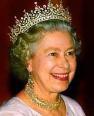
Elizabeth II of the United Kingdom
Queen since 6 February 1952
Queen since 6 February 1952
| TRAFFICKING IN PERSONS |
None reported.


Colin Wells
Administrator of Ascension Island
since 27 October 2011
Administrator of Ascension Island
since 27 October 2011

Sean Burns
Administrator of Tristan da Cunha Island
since 15 September 2010
Administrator of Tristan da Cunha Island
since 15 September 2010